- Product Description Description
- Table of Contents TOC
- List of Table & Figure LOT
- Get Free Sample PDF Sample PDF
Market Size, 2025
$3.70 BnMarket Estimate, 2026
$3.82 BnMarket Forecast, 2034
$4.89 BnCAGR, 2026–2034
3.14%Executive Summary: Europe Food Intolerance Product Market
- Market Scope: Detailed evaluation of the European food intolerance market encompassing product types (lactose-free foods, gluten-free foods, diabetic foods, and other special milk preparations) and key country-level markets (UK, Germany, France, Italy, Spain, and Rest of Europe).
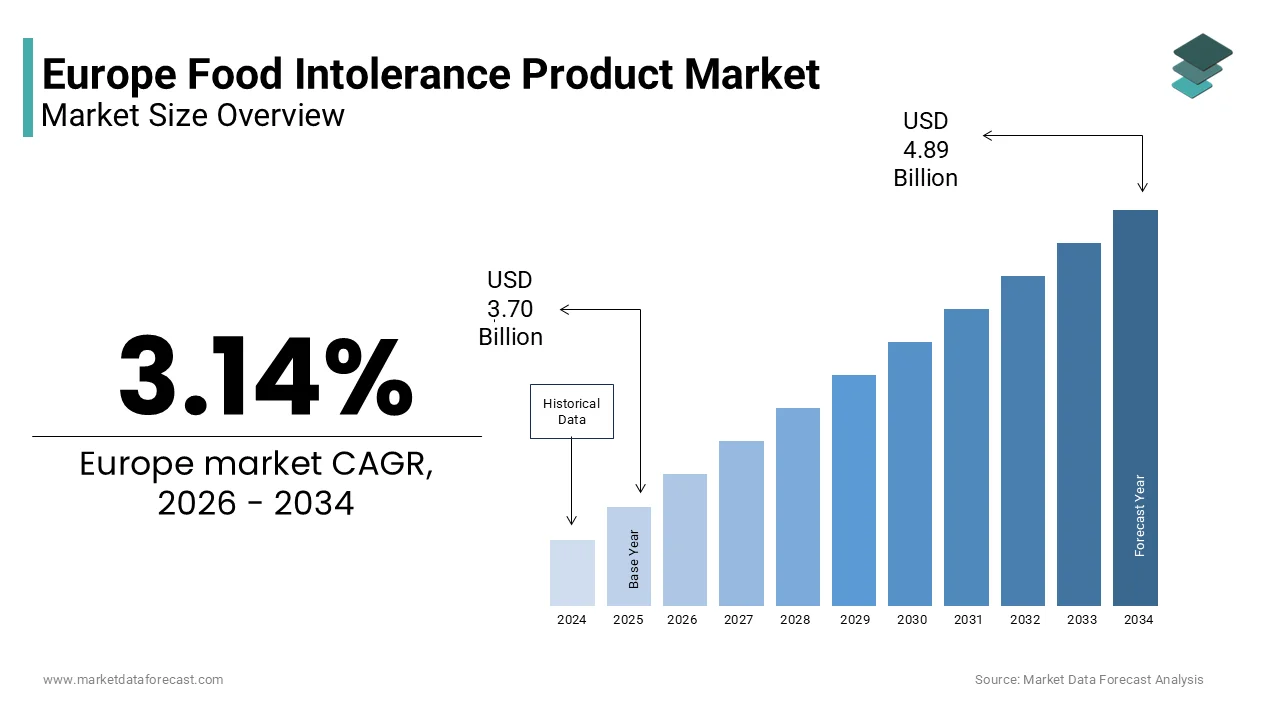
- Market Valuation: Valued at USD 3.70 billion in 2025, estimated at USD 3.82 billion in 2026, and projected to reach USD 4.89 billion by 2034, registering a compound annual growth rate (CAGR) of 3.14%.
- Primary Growth Drivers: Rising prevalence of celiac disease, Crohn's disease, and food intolerances, growing consumer health awareness, and additional wellness claims associated with specialty foods such as digestion and cholesterol control.
Key Market Segment Metrics (2026–2034)
| Category | Leading Segment Focus | Fastest-Growing / Key Structural Trends |
|---|---|---|
| By Type | Gluten-Free & Lactose-Free Foods (anchor market demand due to rising clinical diagnoses of celiac disease and lactose sensitivities across Europe) | Diabetic Foods & Special Milk Preparations (expanding through specialized bakery, confectionery, and dairy-free alternatives) |
| By Region | Western Europe (Germany, UK, France, Italy, and Spain represent the core revenue generators backed by robust health infrastructure) | Ingredient Formulation Innovations (new product lines offering better taste, texture, and functional health benefits are accelerating consumer adoption) |
Major Market Players & Market Structure
Market Structure: Concentrated and competitive market featuring major multinational food corporations driving expansion through strategic acquisitions, portfolio diversification, and plant-based/allergen-free brand integrations.
Key Companies: Amy’s Kitchen, General Mills, Inc., Danone SA, Hain Celestial Group Inc., and Conagra Brands Inc.
Europe Food Intolerance Product Market Size
The Europe food intolerance product market size was valued at USD 3.70 billion in 2025 and is expected to reach USD 4.89 billion by 2034 from USD 3.82 billion in 2026. The market is projected to grow at a CAGR of 3.14%.
Food intolerance is a food-borne adverse reaction that does not involve the immune system. Lactose, sugars and gluten are few common ingredients that cause food intolerance worldwide. The onset of symptoms is generally slower and may be delayed for several hours after eating the offending food. Multiple food or food group intolerance is common and it is difficult to diagnose whether food intolerance is due to a chronic disease or a particular food ingredient. Gluten-free and lactose-free diabetic foods are recommended to overcome food intolerance. Celiac patients consume mostly gluten-free foods because they cannot digest the gluten found in wheat, barley, and other similar grains. Lactose intolerant people prefer lactose-free foods because they lack the enzyme necessary for the digestion of milk sugar.
Market Drivers and Restraints:
The market for food intolerance products has witnessed huge development in the last few years in Europe, owing to the rising prevalence of celiac disease, Crohn's disease and the increasing consumer awareness related to health. According to Celiac UK, celiac disease affects at least 1 in 100 people in the UK and Europe; however, only about 24% of people are diagnosed. In contrast, the high price of gluten-free products and low awareness of food intolerance impede the growth of the market for food intolerance products.
Market Segmentation
The market for Europe Food Intolerance Product can be segmented by Type and region. Depending on the type, the market is segmented into lactose-free foods, gluten-free foods, diabetic foods, and other special milk preparations. These are further divided as diabetic food in diabetic confectionery and diabetic bakery products and diabetic spread; gluten-free foods in gluten-free prepared foods, gluten-free pastries, gluten-free baby foods, gluten-free baked goods, and lactose-free foods in lactose-free baby food, lactose-free ice creams, and lactose-free dairy products.
Impact of COVID-19 on Europe Food Intolerance Product Market
The Covid-19 pandemic has a great influence on all end-user verticals, especially the food and beverages. The global lockdown has resulted in a shutdown of manufacturing plants and disruption in supply chain, affecting the associated industries like food intolerance products. The sales have fallen in both global and local markets during the first half of 2020. However, with the increasing cases of celiac disorder and gluten-free condition around the world, the market for food intolerance products is touted to expand in the coming years.
Regional Analysis
The Europe Food Intolerance Product market has been divided based on the geography to have deeper understanding, which is spread across the nations of Spain, Italy, France, Germany, United Kingdom and other nations. Europe is supposed to expand in the foreseen years. Significant and notable developments in ingredient formulations should also give new impetus to gluten-free products in the area. Besides, the additional health claims associated with gluten-free products, such as cholesterol control and digestion control, have generated increased consumer interest, which has ultimately resulted in increased sales in the European Union.
Leading Company
General Mills had the largest share of the Europe Food Intolerance Product market based on sales and revenue in 2019.
Key Players
The Europe Food Intolerance Product Market is concentrated with well-established players. Key players in the Europe Food Intolerance Product Market include Amy’s Kitchen, General Mills, Inc., Danone SA, Hain Celestial Group Inc, and Conagra Brands Inc.
Recent Developments
- In February 2015, Mondelez International announced the acquisition of Enjoy Life Foods. The biggest concern for loyal small businesses is allergen safety.
- In October 2019, Nestlé Health Science (NHSc) declared about its investment in Before Brands, a renowned company in allergy prevention. With its significant minority stake, NHSc has acquired exclusive license rights for Before Brands products outside of the United States and also has the option to purchase any remaining shares in Before Brands in the future.
- WhiteWave Foods' acquisition of SO Delicious Dairy Free for $ 195 million is a smart move for the company and enables it to establish its leadership position in plant-based foods. Furthermore, it is strongly present in alternatives to non-dairy milk, mainly thanks to its Silk and Alpro brands.
- In July 2017, Otsuka Pharmaceutical Co., Ltd. announced that it has signed a definitive agreement to acquire all the issued and outstanding shares of Daiya Foods Inc.
- In February 2016, Abbott Laboratories launched Curate snack bars, a new brand of gluten-free bars based on ingredients not derived from bioengineering.