- Product Description Description
- Table of Contents TOC
- List of Table & Figure LOT
- Get Free Sample PDF Sample PDF
Market Size, 2025
$14.45 BnMarket Estimate, 2026
$15.28 BnMarket Forecast, 2034
$23.86 BnCAGR, 2026–2034
5.73%Europe Food Waste Management Market Size
The Europe food waste management market size was valued at USD 14.45 billion in 2025. The European market is estimated to be worth USD 23.86 billion by 2034 from USD 15.28 billion in 2026, growing at a CAGR of 5.73% from 2026 to 2034.
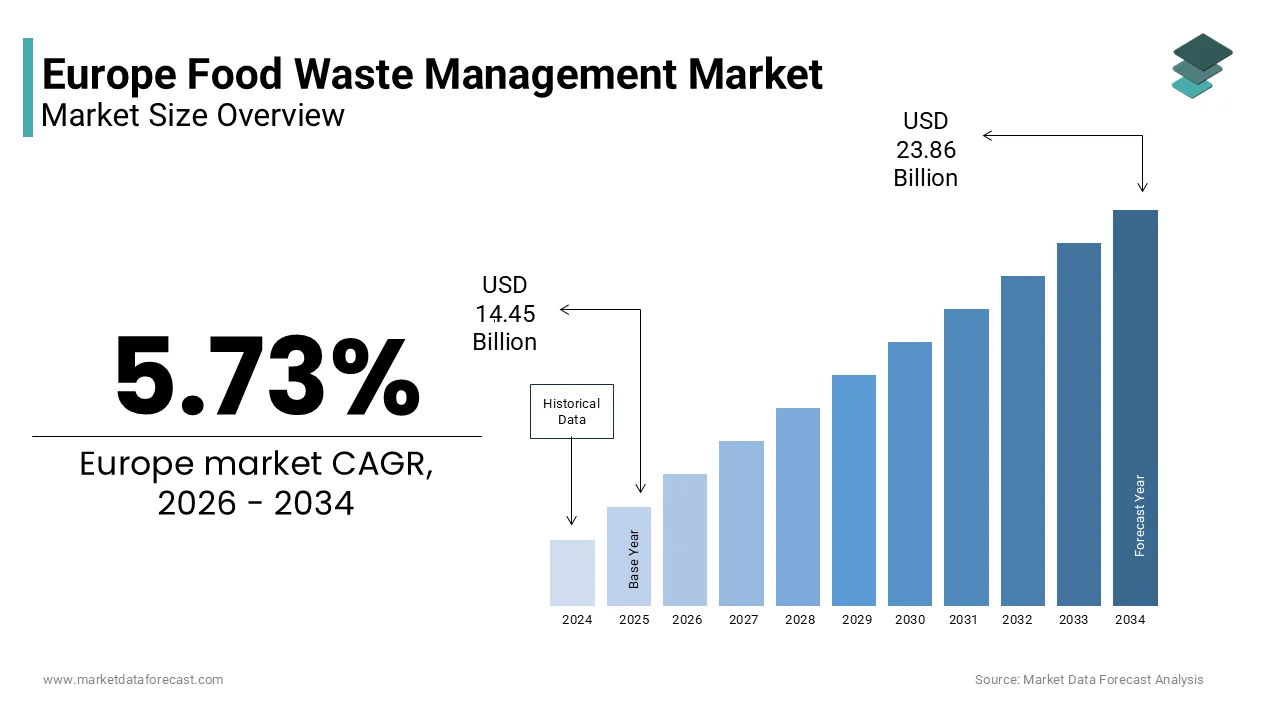
Food waste is primarily made up of animal oils, fats, and by-products that become marketable products, especially grease, meat, and protein-rich fats, among others. These products have applications in the making of biofuels, soap, pet food, cosmetics, toothpaste, leather, lubricants, pharmaceuticals, etc. Food waste is expected to increase at an alarming rate, which will cause several challenges for the food industry during the forecast period, resulting in the growth of the Europe Food Waste Management Market. Furthermore, unwanted food spills at weddings, parties, restaurants, and hotels also support the need for proper food waste management. All these factors are bolstering the growth of the Europe Food Waste Management Market during the forecast period.
The use of food waste as a renewable energy source is an essential factor stimulating the market for Europe Food Waste Management systems. Food waste is one of the causes of methane that is used as a renewable energy source to power the various treatment plants. The trend shows that most of the food waste generated from food waste is recycled to produce organic fertilizers or animal feed, driving the growth of the Europe Food Waste Management market. The growing demand for improved technologies, such as gasification for waste treatment, is expected to create new opportunities in the next seven years. The gasification process converts organic materials such as biomass or combinations of inorganic and organic surpluses into a combustible gas called synthesis gas. On the other hand, the appearance of new technologies for the elimination of residues, followed by the need to generate another energy source, constitute opportunities in the world market for the Europe Food Waste Management.
REPORT COVERAGE
| REPORT METRIC | DETAILS |
| Market Size Available | 2025 to 2034 |
| Base Year | 2025 |
| Forecast Period | 2026 to 2034 |
| CAGR | 5.73% |
| Segments Covered | By Type, Process, Application, Source, Method, and Region |
| Various Analyses Covered | Global, Regional, & Country Level Analysis; Segment-Level Analysis; DROC, PESTLE Analysis; Porter’s Five Forces Analysis; Competitive Landscape; Analyst Overview of Investment Opportunities |
| Regions Covered | UK, France, Spain, Germany, Italy, Russia, Sweden, Denmark, Switzerland, Netherlands, Turkey, and the Czech Republic |
| Market Leaders Profiled | Advanced Disposal Services, Inc, Republic Services, Inc, Waste Management, Inc, Waste Connections Inc, Stericycle, Inc, Clean Harbors, Inc, FCC Environment Ltd, Veolia Environnement SA, CT Environmental Group Ltd, Recology Inc |
REGIONAL ANALYSIS
Europe Food Waste Management Market has been classified on the basis of geography to understand the market clearly. The Europe Food Waste Management Market has been divided into the United Kingdom, Germany, France, Italy, Spain, and the rest of Europe.
Europe is the leading market for food waste management solutions. One of the main factors behind its growth is the increase in government initiatives to reduce food waste. Furthermore, significant investments in advanced disposable techniques to generate useful products such as fertilizers and biogas have also strengthened its position in the world market. In the European region, waste management legislation has forced retail sectors, service providers, and food manufacturers to develop the elimination and recycling of food waste without affecting the environment. Some of the most notable trends in food waste management have occurred in European countries, including the United Kingdom, Denmark, Hungary, and the Netherlands. Sweden has been praised globally for being a leader in food waste management, with its recent efforts to import waste from other countries to turn it into biogas. This led Europe to position itself geographically in the food waste management market, with 40% of the overall revenue in 2018.
KEY MARKET PLAYERS
Key players in Europe Food Waste Management Market Are Advanced Disposal Services, Inc, Republic Services, Inc, Waste Management, Inc, Waste Connections Inc, Stericycle, Inc, Clean Harbors, Inc, FCC Environment Ltd, Veolia Environnement SA, CT Environmental Group Ltd, Recology Inc.
RECENT HAPPENINGS IN THE MARKET
- In January 2017, Waste Connections, Inc. acquired Groot Industries, Inc., a private Illinois-based stable waste management company with annual sales of $ 200 million. This acquisition enabled Waste Connections to serve approximately 300,000 customers in Illinois with a network of two recycling facilities, six transfer stations, and six collection operations.
- In January 2016, Florida Waste Management Inc., a subsidiary of Waste Management Inc., acquired Southern Waste Systems LLC, a waste management company dedicated to the collection, recycling, and treatment of residential, municipal, industrial, and commercial products in Davie, Florida Commercial assets acquired include the collection, transfer, recycling and treatment of industrial, commercial and residential solid waste.
- Harsco Corporation HSC recently announced the signing of a final agreement with Stericycle, Inc. SRCL for the purchase of its Stericycle Environmental Solutions business. In particular, the $ 462.5 million agreement is subject to customary regulatory approvals and closing conditions.
- The amount of FW is expected to increase over the next 25 years due to economic and demographic growth, mainly in Asian countries. It has been reported that the annual amount of urban waste in Asian countries could increase from 278 to 416 million tons between 2005 and 2026.
MARKET SEGMENTATION
This Research Report on European Food Waste Management Market is segmented and sub segmented into following categories.
By Waste Type
- Cereals
- Dairy Products
- Fruits & Vegetables
- Meat
- Fish & Sea Food
- Processed Food
By Process
- Aerobic Digestion
- Anaerobic Digestion
- Combustion/Incineration
- Others
By Application
- Animal Feed
- Fertilizers
- Biofuel
- Power Generation
By Source
- Primary Food Producers
- Food Manufacturers
- Food Distributors & Suppliers
- Food Service Providers
- Municipalities & Households
By Method
- Prevention
- Recovery
- Recycling
- Others
By Region
- United Kingdom
- Germany
- France
- Italy
- Spain
- and the rest of Europe.