Europe Forklift Market Size, Share, Trends & Growth Forecast Report, Segmented By Power Source (Electric, ICE), Load Capacity, End Use, And Country (UK, France, Spain, Germany, Italy, Russia, Sweden, Denmark, Switzerland, Netherlands, Turkey, Czech Republic & Rest Of Europe) - Industry Analysis From (2026 To 2034)
Market Size, 2025
$25.40 BnMarket Estimate, 2026
$28.55 BnMarket Forecast, 2034
$72.84 BnCAGR, 2026–2034
12.42%Europe Forklift Market Report Summary
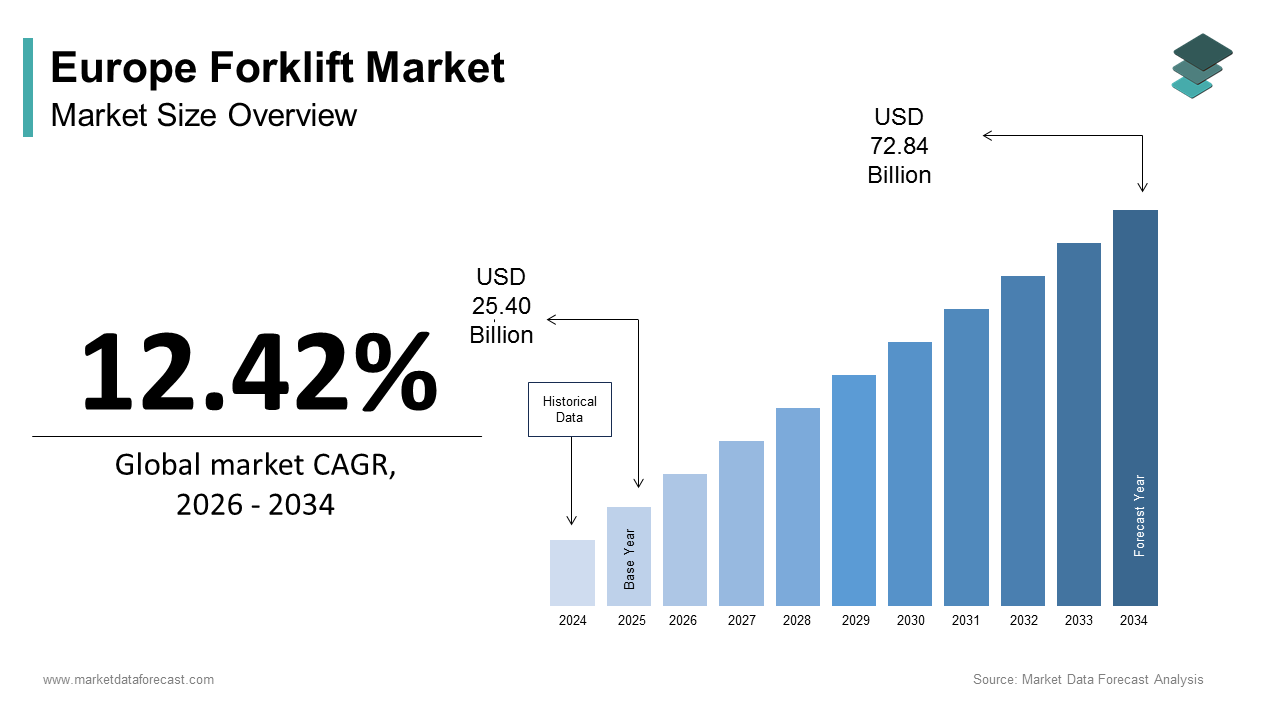
The Europe forklift market was valued at USD 25.40 billion in 2025 and is projected to reach USD 72.84 billion by 2034, growing from USD 28.55 billion in 2026 at a CAGR of 12.42% during the forecast period. Market growth is driven by the rapid expansion of logistics and warehousing activities, increasing adoption of electric material handling equipment, and strong demand from e-commerce and industrial sectors. Stringent emission regulations, rising labor costs, and the push toward warehouse automation are accelerating the shift toward advanced, energy-efficient forklift solutions across Europe. Continued investment in smart logistics infrastructure and sustainable material handling technologies is further strengthening market expansion.
Key Market Trends
- Rising adoption of electric forklifts is driven by emission regulations and lower operating costs.
- Strong demand from the logistics and warehousing sectors due to e-commerce growth
- Increasing use of forklifts with lower load capacities for indoor and automated operations
- Integration of telematics, automation, and safety features in modern forklift fleets
- Growing focus on sustainable and energy-efficient material handling solutions
Segmental Insights
Based on power source, the electric forklifts segment dominated the Europe forklift market in 2025, supported by regulatory pressure, energy efficiency, and suitability for indoor logistics environments.
Based on load capacity, the below 5 tons segment held a significant market share in 2025, driven by widespread use in warehouses, distribution centers, and manufacturing facilities.s
Based on end use, the logistics segment led the market in 2025 by capturing 38.6% of the total market share, reflecting the rapid expansion of warehousing and distribution networks
Regional Insights
- Germany led the Europe forklift market in 2025 by accounting for 26.7% of the total market share, supported by a strong manufacturing base and advanced logistics infrastructure.The
- United Kingdom ranked as the second-largest market with a 17.5% share in 2025, driven by e-commerce growth and warehouse automation.
- France remains a major market due to aggressive climate legislation and public investment in sustainable logistics solutions.s
- Italy is witnessing steady growth supported by a vast network of small and medium-sized enterprises in furniture, textiles, and machinery manufacturing.The
- Netherlands is expected to expand strongly from 2026 to 2034, driven by its role as Europe’s premier logistics gateway through the Port of Rotterdam and Schiphol Airport.
Competitive Landscape
The Europe forklift market is moderately competitive, with leading manufacturers focusing on electrification, automation, and digital fleet management solutions. Companies are expanding electric forklift portfolios, investing in autonomous material handling technologies, and strengthening after-sales service networks to enhance customer retention and market presence.
Prominent players in the Europe forklift market include Toyota Material Handling, KION Group, Jungheinrich AG, Mitsubishi Logisnext, Crown Equipment, Hyster-Yale Group, Komatsu, Manitou Group, Doosan Industrial Vehicle, Clark, Hyundai Material Handling, and UniCarriers.
Europe Forklift Market Size
The Europe forklift market size was calculated to be USD 25.40 billion in 2025 and is anticipated to be worth USD 72.84 billion by 2034, growing from USD 28.55 billion in 2026 at a CAGR of 12.42% during the forecast period.
A forklift (also known as a lift truck, jitney, or fork truck) is a small, powered industrial vehicle used to lift, transport, and stack heavy loads over short distances. These machines are increasingly defined by electrification, intelligence, and connectivity rather than mere lifting capacity. According to sources, infrastructure development for storage and distribution is expanding across the European Union as businesses prioritize e-commerce capabilities and more resilient supply chains, which in turn fuels the need for advanced material handling technology. As per research, a significant portion of occupational accidents in Europe is attributed to physical exertion and the handling of goods, prompting a transition away from manual labor toward mechanized solutions like electric lift trucks to minimize worker strain. The market is further shaped by stringent EU directives on emissions, occupational safety, and machinery design, which mandate features such as pedestrian detection systems, regenerative braking, and operator presence sensing. Unlike commodity markets, the European forklift sector prioritizes total cost of ownership, energy efficiency, and integration with warehouse management software, which makes it a technology-intensive domain embedded within the continent’s industrial modernization agenda.
MARKET DRIVERS
Expansion of E-Commerce Fulfillment Infrastructure Across Urban Logistics Hubs
The exponential growth of online retail has triggered a continent-wide warehouse construction boom, which necessitates high-density, flexible material-handling solutions, and thereby fuels the growth of the Europe forklift market. European e-commerce is experiencing exponential growth, driving massive increases in small-item imports from outside the EU, which is forcing logistics operators to adopt highly automated sorting and high-density vertical storage systems to manage volume and compliance. Due to the persistent, structural scarcity of space and high demand, major logistics developers are expanding their footprint near key German transport corridors, focusing on modernized, sustainable facilities for e-fulfillment. These facilities operate twenty-four hours with minimal lighting and narrow racking configurations, demanding electric forklifts equipped with LED guidance lasers and low noise profiles. Similarly, major European postal services are heavily investing in urban micro-fulfillment hubs and electric equipment, including lithium-powered handling tools, to support same-day delivery demand while meeting strict environmental standards in residential areas. The shift from bulk pallet movement to piece-level picking has elevated demand for ergonomic order pickers with intuitive controls, reducing operator fatigue during repetitive tasks. This structural transformation of retail logistics ensures sustained forklift adoption beyond cyclical inventory fluctuations.
Stringent EU Regulations Phasing Out Internal Combustion Engines in Indoor Environments
Environmental and occupational health mandates have effectively eliminated diesel and LPG forklifts from enclosed industrial spaces across the region, which accelerates the transition to zero-emission electric models and the expansion of the Europe forklift market. Regulations regarding indoor air quality set specific limits for carbon monoxide, which can be difficult to maintain when internal combustion engines operate in confined or poorly ventilated areas. Guidelines in certain regions restrict the use of internal combustion forklifts in specialized environments, such as food processing, pharmaceutical, and cold storage facilities, to prevent contamination from exhaust fumes. There is a noticeable shift toward adopting battery electric units equipped with fast-charging technology for warehouse operations. Workplace safety regulations are increasingly requiring automated safety features, such as speed reduction near pedestrians, which are more readily integrated into electric drive-by-wire systems. These regulatory imperatives transform electrification from an option into a legal necessity, reinforcing long-term demand for advanced electric forklift platforms.
MARKET RESTRAINTS
Persistent Shortage of Skilled Forklift Operators Across Key Industrial Sectors
Operational constraints due to a chronic deficit of certified operators, particularly in high-turnover sectors like logistics and food distribution, are impeding the growth of the Europe forklift market, despite technological advancements. The logistics sector is experiencing a significant gap in filling specialized material handling positions across the European region, with training timelines for new personnel taking over a month. Staffing shortages in these roles are impacting operational efficiency, with a notable portion of warehouses working below capacity due to a lack of available forklift operators. The widespread adoption of automated solutions is constrained by high implementation costs, particularly for smaller industry players, which represent a significant segment of the logistics landscape. Inconsistent certification standards across different countries create challenges for operator mobility within cross-border supply chains. Labour shortages will constrain equipment utilization and delay ROI until advanced remote supervision and digital credentialing technologies are fully implemented.
High Upfront Cost and Limited Financing Access for Advanced Electric and Automated Models
The capital intensity of next-generation forklifts, particularly lithium-powered or AGV-integrated units, poses a significant barrier to cost-sensitive businesses and to the expansion of the European forklift market. This is despite their lower lifetime operating expenses. Small and medium enterprises in specific regions are encountering challenges in accessing financing for green equipment, often due to strict collateral requirements and a need for greater awareness regarding available sustainability loan programs. The initial purchase price for modern lithium-powered material handling equipment is significantly higher than traditional lead-acid options, which can discourage companies with limited capital expenditures. In regions where bank lending remains cautious, some logistics firms continue to utilize older diesel fleets because leasing or financing options for newer, more advanced models are not widely available. Despite dedicated funding programs aimed at supporting the adoption of clean industrial equipment, the pace of uptake for these technologies remains inconsistent across different markets. The transition to smart forklifts will stay skewed toward large companies unless scalable, usage-based, or battery-as-a-service models are adopted, leaving behind a long tail of older equipment.
MARKET OPPORTUNITIES
Integration of Forklift Fleets into Smart Warehouse Digital Twins
The rise of industrial Internet of Things (IoT) and cloud-based warehouse management systems is transforming forklifts from standalone machines into connected data nodes within holistic logistics ecosystems, which is predicted to propel the growth of the Europe forklift market. Many recently constructed warehouse facilities in Europe are incorporating real-time location systems to facilitate dynamic task allocation based on equipment proximity and battery status. IoT platforms are increasingly used to track forklifts, enabling predictive maintenance that reduces unplanned downtime. Warehouse technologies are being applied to optimize energy consumption through the management of charging schedules during off-peak hours. Crucially, this connectivity supports workforce augmentation; supervisors receive alerts when operators deviate from safe routes or exceed speed limits, enhancing compliance without constant oversight. The transformation of warehouses into intelligent, interconnected systems turns forklifts into key agents of operational agility.
Growth of Cold Chain Logistics Driven by Pharmaceutical and Perishable Food Demand
The expansion of temperature-controlled supply chains paves the way for a specialized growth vector for forklifts engineered to operate reliably in sub zero environments, which is anticipated to boost the expansion of the Europe forklift market. The establishment of new mRNA vaccine distribution centers across Europe has led to an increased requirement for material handling equipment capable of operating in low-temperature environments to ensure product integrity. Growth in the chilled food e-commerce sector has created greater demand for warehouse machinery designed to function in cold storage conditions, such as forklifts with specialized hydraulic and electronic systems. Material handling equipment manufacturers are addressing this demand by producing specialized, cold-store-compatible models that feature enhanced durability against freezing temperatures, including protected electrical systems and corrosion-resistant components. Automated, large-scale cold storage facilities are employing fleets of refrigerated vehicles for continuous operation, necessitating equipment that can withstand sustained, extreme cold without hydraulic failures. Increasing regulatory pressure and biopharma growth make this specialized, high-margin niche an attractive, recession-resistant investment with long-term contract stability.
MARKET CHALLENGES
Fragmented Charging Infrastructure and Battery Standardization Gaps
The rapid adoption of lithium-powered forklifts has exposed critical inconsistencies in charging protocols, battery management systems, and grid integration across European facilities, which inhibit the growth of the Europe forklift market. Warehouses utilizing diverse equipment fleets frequently manage incompatible charging infrastructures, leading to inefficient space utilization and logistical challenges. A lack of universal charging connectors contributes to reduced utilization of lithium-powered fleets during busy periods. Furthermore, the absence of standardized battery health reporting presents obstacles for reusing and recycling, with only a small portion of industrial lithium batteries currently being repurposed. Efforts like the EU Battery Passport aim to improve transparency, yet they currently trail behind the rapid progress in vehicle-sector traceability. The lack of standardized charging infrastructure and data formats forces fleet operators into redundant investments and suboptimal asset utilization, which diminishes the potential gains of electric vehicle adoption.
Cybersecurity Vulnerabilities in Connected and Autonomous Forklift Systems
The evolution of forklifts into connected IoT devices creates new attack vectors that threaten both operational continuity and workplace safety, and thereby constrains the expansion of the Europe forklift market. A significant portion of the analyzed material handling machinery shows deficiencies in essential security measures, including encrypted updates and secure boot capabilities, which increases vulnerability to remote exploitation and data theft. Threat actors have demonstrated the ability to exploit weaknesses in connected forklift components to gain unauthorized access to corporate warehouse networks, leading to substantial production disruptions. Upcoming regulatory shifts necessitate cyber risk evaluations for connected equipment, yet a segment of the existing fleet cannot be easily upgraded. Autonomous forklifts pose additional risks; spoofed sensor data could cause collisions in high-traffic aisles. Material handling's digital transformation risks outweigh productivity gains until manufacturers embed security by design and operators adopt zero-trust architectures.
REPORT COVERAGE
| REPORT METRIC | DETAILS |
| Market Size Available | 2025 to 2034 |
| Base Year | 2025 |
| Forecast Period | 2026 to 2034 |
| CAGR | 12.42% |
| Segments Covered | By Power Source, Load Capacity, End Use, And Region |
| Various Analyses Covered | Global, Regional & Country Level Analysis; Segment-Level Analysis; DROC, PESTLE Analysis; Porter’s Five Forces Analysis; Competitive Landscape; Analyst Overview of Investment Opportunities |
| Regions Covered | UK, France, Spain, Germany, Italy, Russia, Sweden, Denmark, Switzerland, Netherlands, Turkey, and the Czech Republic |
| Market Leaders Profiled | Toyota Material Handling Europe, KION Group, Jungheinrich AG, Mitsubishi Logisnext Europe, Crown Equipment Europe, Hyster-Yale Group, Komatsu Europe, Manitou Group, Doosan Industrial Vehicle Europe, Clark Europe, Hyundai Material Handling Europe, UniCarriers Europe |
SEGMENTAL ANALYSIS
By Power Source Insights
The electric forklifts segment led the Europe forklift market by accounting for a substantial share in 2025. The leading position of the electric forklift segment is driven by stringent environmental regulations, indoor air quality mandates, and total cost of ownership advantages. A further push for this segment is the EU’s progressive phaseout of internal combustion engines in enclosed industrial environments. Regulations establish maximum permissible levels for carbon monoxide, which can be exceeded by diesel-powered equipment in environments with limited air circulation. Industry standards and safety regulations restrict or forbid the use of internal combustion equipment in specialized environments, such as food or pharmaceutical facilities, encouraging a shift toward electric alternatives. Electric models tend to require fewer service interventions compared to internal combustion alternatives, which can be attributed to fewer moving parts and the use of regenerative braking. The rise of lithium-ion technology further enhances appeal, eliminating battery room infrastructure and enabling opportunity charging during breaks. The addition of millions of square meters of EV-ready warehouse space across the EU has firmly entrenched this segment's leadership.
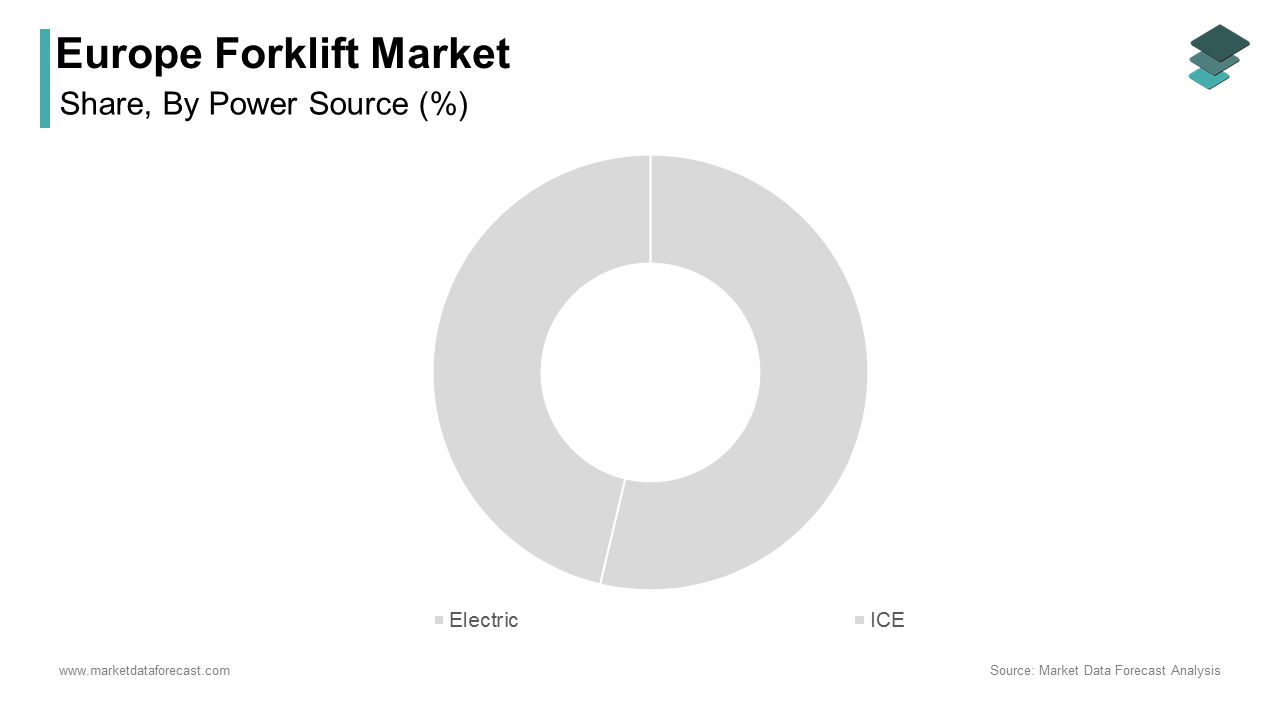
The electric forklift segment remains the fastest growing with a projected CAGR of 8.9% from 2026 to 2034 due to the convergence of decarbonization policy, e-commerce logistics density, and advances in battery intelligence. Regulatory frameworks in Europe now mandate increased transparency regarding direct operational emissions, driving major logistics providers to accelerate the transition toward fully electrified warehouse equipment. Regional safety and environmental mandates are influencing the logistics sector to adopt electric material handling equipment, particularly in temperature-controlled environments, to eliminate exhaust fumes. Technological improvements in battery management systems and energy storage capacity are extending the operational life of warehouse equipment, resulting in more durable and long-lasting power units. The industry is experiencing a shift in battery performance, with newer units delivering higher charge-discharge cycles, which enhances operational efficiency in distribution centers. Furthermore, EU funding mechanisms like the Innovation Fund subsidize a portion of electric fleet conversions for SMEs. These synergies ensure electric forklifts will not only dominate but also deepen their penetration across all industrial subsectors.
By Load Capacity Insights
The below 5 tons segment dominated the Europe forklift market by capturing a significant share in 2025. The supremacy of the below 5 tons segment is attributed to the prevalence of light to medium material handling tasks in warehousing, retail, and manufacturing. This segment also dominates because most European logistics operations prioritize maneuverability and aisle efficiency over heavy lifting. Warehouse construction in certain regions increasingly favors configurations with narrower aisles, which impacts the types of material handling equipment required. The rise of online retail fulfillment contributes to a greater demand for specialized, compact lifting machinery designed for high-density storage environments. Automated fulfillment centers are incorporating specialized equipment to manage precision picking within tightly configured racking systems. Manufacturing environments, particularly those with constrained space, often utilize specific electric equipment for efficient, just-in-time material transport. Changes in regulatory classifications have influenced the preference for lighter equipment by impacting certification processes. The fragmentation of supply chains into localized hubs has caused demand for agile, low-capacity units to surpass that of traditional heavy-duty transportation.
The 5–15 ton segment is anticipated to witness the fastest CAGR of 7.2% during the forecast period, owing to the expansion of heavy industrial logistics and cross-dock operations handling dense cargo. Unlike light-duty applications, this segment serves sectors where palletized loads exceed standard weights, such as building materials, machinery, and bulk food packaging. Increased construction activity in key European markets is driving higher demand for heavy-duty electric forklifts designed to handle steel and concrete materials. Major port terminals are integrating high-capacity lithium-powered equipment to manage container transport between vessels and rail lines, facilitating a reduction in diesel reliance without sacrificing efficiency. Specialized, explosion-proof heavy forklifts are being utilized within the chemical industry to safely manage hazardous materials in high-risk zones. Crucially, advancements in electric drivetrains now enable high-capacity performance without emissions. Mid-to-heavy electric forklifts balance agility with power, meeting the demand for increased load densities in consolidated industrial spaces.
By End Use Insights
The logistics segment held the majority share of 38.6% of the Europe forklift market in 2025. The prominence of the logistics segment is credited to the structural expansion of distribution networks supporting e-commerce, omnichannel retail, and cross-border trade. The volume of parcels handled within the European region has experienced growth, leading to a greater demand for efficient, high-capacity material handling systems in logistics centers. Continuous, around-the-clock operations at fulfillment centers require industrial handling equipment that offers high reliability and fast charging capabilities. Regional policy initiatives aimed at sustainability are accelerating the adoption of electric vehicles in the logistics sector. Logistics operators are increasingly transitioning toward zero-emission fleets to meet specific, target-based reductions in emissions per parcel. National regulations are further intensifying the push for logistics providers to adopt electric handling equipment in urban environments. Rapid expansion of large, automated logistics facilities ensures the sector remains Europe’s primary driver of forklift demand.
The retail & e-commerce segment is likely to experience the fastest CAGR of 9.4% from 2026 to 2034. The rapid expansion of the retail & e-commerce segment is propelled by the rise of micro-fulfillment centers, hyperlocal delivery, and store-based inventory automation. Unlike traditional logistics, this segment demands ultra-compact, quiet, and highly maneuverable forklifts suitable for backroom operations in urban retail spaces. European retail locations are increasing the adoption of automated stock replenishment systems to optimize inventory management. Electric pallet jacks, including autonomous models, are being deployed to handle inventory movement within, and sometimes during, operational hours. Retailers are utilizing technology to facilitate overnight shelf restocking, with implementations expanding across various European regions. The shift toward faster fulfillment models is driving retailers to adapt store backrooms to function as micro-fulfillment or distribution hubs. Increased in-store handling activity is creating demand for ergonomic equipment and intuitive, automated, or semi-automated picking solutions. The blending of physical and digital retail is making forklifts indispensable for in-store logistics, driving, in turn, unprecedented growth in this once-underserved niche.
REGIONAL ANALYSIS
Germany Forklift Market Analysis
Germany outperformed other countries in the Europe forklift market by accounting for a 26.7% share in 2025. The dominance of the German market is attributed to its world-class manufacturing base, automotive logistics networks, and strict occupational safety standards. The country’s factories and warehouses operate under the German Occupational Safety and Health Act, which mandates zero-emission equipment in enclosed spaces, accelerating the shift to electric forklifts. Major players like KION Group and Jungheinrich are headquartered here, driving innovation in AGV integration and predictive maintenance. The government’s Industrie 4.0 initiative further supports smart fleet deployment. Germany sets the benchmark for advanced material handling across the continent. This is driven by its dense industrial clusters in Bavaria and Baden-Württemberg, as well as a culture of engineering precision.
United Kingdom Forklift Market Analysis
The UK was the next prominent country in the Europe forklift market by capturing a share of 17.5% share in 2025. The growth of the UK market is fuelled by its dense network of urban fulfillment centers and early adoption of automation in retail logistics. High levels of consumer online purchasing are driving logistical shifts in urban areas. Compact electric material handling equipment is seeing increased utilization within city-center storage facilities, while automated fulfillment centers incorporate specialized reach trucks to operate in tandem with robotic systems. The UK’s departure from the EU has intensified focus on domestic supply chain resilience, prompting investments in regional distribution hubs across the Midlands and Yorkshire. Moreover, the Health and Safety Executive enforces rigorous operator certification, driving demand for ergonomic models with intuitive controls. Facing spatial constraints and soaring labor expenses, the UK has shifted its focus from raw volume to operational excellence, establishing itself as a premier proving ground for AI-driven forklift automation.
France Forklift Market Analysis
France continues to be a major player in the European forklift market due to aggressive climate legislation and public investment in sustainable logistics. Regulatory requirements for urban logistics are accelerating the transition to zero-emission material handling, driving increased adoption of electric equipment. Electric forklifts are increasingly adopted for material handling tasks to reduce greenhouse gas emissions. A significant portion of electric material handling equipment is deployed within the food distribution and retail sectors. Public funding initiatives are supporting the development of green logistics infrastructure, including necessary charging stations for industrial electric vehicles. The shift to cleaner, quieter indoor material handling is reducing reliance on fossil fuel-powered alternatives. Infrastructure improvements, particularly in warehousing and logistics, are focused on expanding the availability of electric charging solutions. Major retailers like Carrefour and Auchan have converted their regional hubs to fully electric fleets, often co-located with solar canopies to power operations. Additionally, France’s strong agricultural sector drives demand for 3–5 ton forklifts in wine and dairy cooperatives handling heavy barrels and crates. This blend of regulatory pressure and sectoral diversity makes France a dynamic and rapidly evolving market.
Italy Forklift Market Analysis
Italy witnessed a steady growth in the Europe forklift market owing to a vast network of small and medium enterprises in furniture, textile,s and machinery that rely on flexible material handling. The country’s export-oriented economy, particularly in fashion and automotive components, requires efficient loading docks and container handling, driving demand for 5–8 ton counterbalance trucks in ports like Genoa and Trieste. However, financing constraints limit access to advanced models. Recent EU Recovery Fund disbursements are changing this. As digitization spreads, Italy’s fragmented but resilient industrial base offers steady long-term demand.
Netherlands Forklift Market Analysis
The Netherlands is anticipated to expand in the Europe forklift market from 2026 to 2034 due to its role as Europe’s premier logistics gateway through the Port of Rotterdam and Schiphol Airport. A significant portion of sea-container traffic within the European Union is processed through Dutch terminals, which drives the demand for specialized, heavy-duty intermodal handling equipment. The industry is shifting toward cleaner energy solutions for port operations due to updated, stringent requirements for newly acquired machinery. This regulatory environment is accelerating the integration of electric and hydrogen-powered container handlers to replace traditional equipment. Beyond ports, the Netherlands hosts Europe’s densest concentration of automated distribution centers. The government’s National Logistics Vision promotes smart and clean freight, offering tax incentives for electric fleet conversion. The Netherlands showcases how high-density logistics drive advanced, automated forklift technology, supported by superior connectivity, forward-thinking regulations, and an innovative culture.
COMPETITION OVERVIEW
Competition in the Europe forklift market is defined by a convergence of technological sophistication, regulatory compliance, and service excellence rather than price alone. European buyers prioritize total cost of ownership, energy efficiency, and integration with warehouse management systems, making software and connectivity as critical as mechanical reliability. The market features a triad of integrated manufacturers—KION, Toyota, and Jungheinrich—that dominate through proprietary technology service density and brand trust, while niche players compete on specialization, such as cold chain or explosion-proof applications. Regulatory pressures, including the EU Machinery Regulation and carbon disclosure rules, raise entry barriers favoring incumbents with compliance expertise. Labor shortages further intensify demand for ergonomic andsemi-autonomouss solutions that reduce operator dependency. With e-commerce logistics driving infrastructure modernization and sustainability mandates, accelerating electrification, the competitive landscape rewards innovation, agility, and deep customer collaboration over volume scale.
KEY MARKET PLAYERS
A few major players of the Europe forklift market include
- Toyota Material Handling
- KION Group
- Jungheinrich AG
- Mitsubishi Logisnext
- Crown Equipment
- Hyster-Yale Group
- Komatsu
- Manitou Group
- Doosan Industrial Vehicle
- Clark
- Hyundai Material Handling
- UniCarriers
Top Strategies Used by the Key Market Participants
Key players in the Europe forklift market prioritize electrification through lithium-ion and hydrogen powertrains to comply with indoor emission bans and corporate sustainability targets. They invest in digital fleet management platforms that enable predictive maintenance, energy optimization, and operator safety monitoring via real-time data analytics. Companies expand service networks with remote diagnostics and certified technician training to enhance uptime and customer retention. Strategic partnerships with warehouse developers and e-commerce operators ensure early integration of forklift specifications into new facility designs. Additionally, firms actively participate in EU standardization bodies to shape safety, cybersecurity, and battery recycling regulations that favor technologically advanced and sustainable equipment.
Leading Players in the Market
- KION Group is a cornerstone of the Europe forklift market through its portfolio of brands, including Linde and STILL, which deliver advanced electric and automated material handling solutions across industrial and logistics sectors. The company leverages its German engineering heritage to integrate lithium-ion technology, smart fleet management software, and autonomous navigation into its equipment. In recent years, KION has expanded its IoT platform to connect over fifty thousand forklifts across Europe, enabling predictive maintenance and energy optimization. It also established a dedicated battery innovation center in Aschaffenburg to develop second-life applications for industrial batteries in alignment with EU circular economy goals. Globally, KION exports itsEurope-validatedd safety and efficiency standards to emerging markets, setting benchmarks for intelligent intralogistics worldwide.
- Toyota Material Handling maintains a strong presence in the Europe forklift market by offering reliable electric counterbalance and warehouse trucks tailored to regional regulatory and operational demands. The company emphasizes total cost of ownership through innovations like its System of Active Stability and opportunity charging lithium systems that reduce downtime. Recently, Toyota enhanced its European service network with remote diagnostics capabilities, allowing technicians to resolve issues before site visits. It also launched cold store-specific models rated for minus thirty degrees Celsius to serve pharmaceutical and food logistics clients. Toyota aligns its European forklift production with performance and sustainability mandates through combined global manufacturing and local R&D in Sweden and France.
- Jungheinrich plays a pivotal role in the Europe forklift market by pioneering automation and digitalization in warehouse operations with a focus on narrow aisle and high bay storage solutions. The company’s ETV and ERC series reach trucks dominate dense logistics environments where space efficiency is critical. Jungheinrich has invested heavily in its Hamburg-based automation division, developing AGV-integrated forklifts that operate collaboratively with human workers under dynamic task allocation. It also introduced a cloud-based fleet management system that optimizes charging schedules based on electricity tariffs and workload forecasts. Jungheinrich boosts operational efficiency and supports Europe’s green and digital transition through intelligent, end-to-end material handling solutions.
MARKET SEGMENTATION
This research report on the Europe forklift market has been segmented and sub-segmented based on power source, load capacity, end use, and region.
By Power Source
- Electric
- ICE
By Load Capacity
- 5-15 Ton
- Below 5 Ton
- Above 16 Ton
By End Use
- Industrial
- Retail & E-Commerce
- Logistics
- Food & Beverage
- Chemical
- Others
By Region
- UK
- France
- Spain
- Germany
- Italy
- Russia
- Sweden
- Denmark
- Switzerland
- Netherlands
- Turkey
- Czech Republic
- Rest of Europe
Frequently Asked Questions
1. What factors are driving the growth of the Europe forklift market?
Key growth drivers include the expansion of e-commerce and logistics, growth in warehousing activities, industrial automation, rising manufacturing output, and increasing demand for efficient material handling equipment.
2. What are the main types of forklifts used in Europe?
Major types include electric forklifts, internal combustion engine (ICE) forklifts, reach trucks, pallet trucks, rough terrain forklifts, and very narrow aisle (VNA) forklifts.
3. Why is demand for electric forklifts increasing in Europe?
Electric forklifts are gaining popularity due to strict emission regulations, lower operating costs, reduced noise levels, and advancements in lithium-ion battery technology.
4. Which industries are the largest users of forklifts in Europe?
Key end-user industries include logistics and warehousing, manufacturing, retail and e-commerce, food and beverage, automotive, construction, and ports and terminals.
5. What role does automation play in the Europe forklift market?
Automation is driving demand for automated guided vehicles (AGVs) and autonomous mobile robots (AMRs), enhancing productivity and safety in warehouses and distribution centers.
6. What challenges does the Europe forklift market face?
Major challenges include high initial investment costs, operator safety concerns, fluctuating raw material prices, and shortages of skilled forklift operators.
7. How do safety regulations impact the Europe forklift market?
Strict European safety standards and workplace regulations encourage the adoption of advanced safety features such as collision detection, stability control, and operator assistance systems.
8. What is the impact of e-commerce growth on forklift demand in Europe?
Rapid growth of e-commerce has increased the need for efficient warehousing and order fulfillment, boosting demand for forklifts and warehouse handling equipment.
9. How does sustainability influence forklift adoption in Europe?
Sustainability goals are accelerating the shift toward electric and energy-efficient forklifts, along with recyclable materials and environmentally friendly manufacturing practices.
10. What technological trends are shaping the Europe forklift market?
Key trends include lithium-ion batteries, telematics, fleet management software, predictive maintenance, and integration with warehouse management systems.
11. How competitive is the Europe forklift market?
The market is highly competitive, with global and regional manufacturers focusing on innovation, product differentiation, and after-sales services.
12. What is the future outlook for the Europe forklift market?
The market is expected to grow steadily, driven by automation, electrification, logistics expansion, and continued investments in smart warehouses and industrial infrastructure across Europe.
Related Reports
Access the study in MULTIPLE FORMATS
Purchase options starting from
$ 2000
Didn’t find what you’re looking for?
TALK TO OUR ANALYST TEAM
Need something within your budget?
NO WORRIES! WE GOT YOU COVERED!
Call us on: +1 888 702 9696 (U.S Toll Free)
Write to us: sales@marketdataforecast.com