- Product Description Description
- Table of Contents TOC
- List of Table & Figure LOT
- Get Free Sample PDF Sample PDF
Market Size, 2025
$626.00 MnMarket Estimate, 2026
$647.35 MnMarket Forecast, 2034
$846.52 MnCAGR, 2026–2034
3.41%Europe Formic Acid Market Report Summary
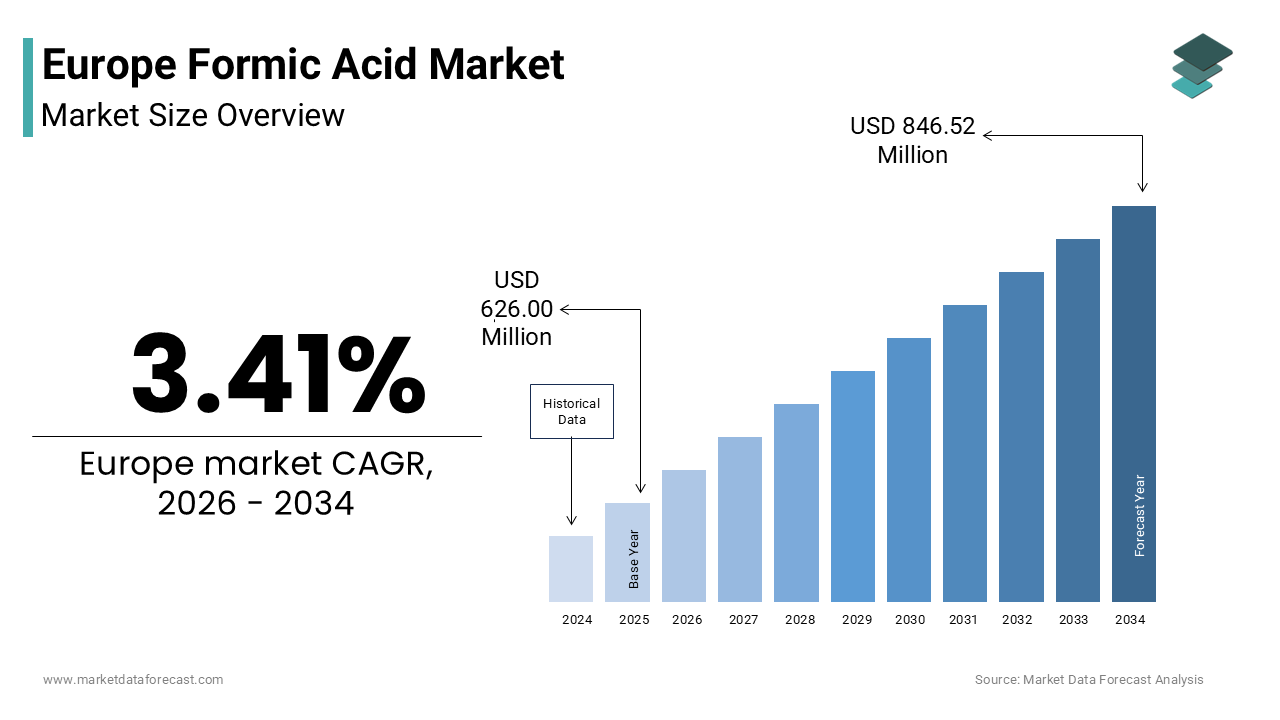
The Europe formic acid market was valued at USD 626.00 million in 2025, is estimated to reach USD 647.35 million in 2026, and is projected to reach USD 846.52 million by 2034, growing at a CAGR of 3.41% during the forecast period from 2026 to 2034. The growth of the Europe formic acid market is driven by its critical role in agriculture, particularly in silage preservation and livestock feed safety, along with increasing applications across leather tanning, rubber processing, and pharmaceuticals. The rising demand for organic acids as alternatives to antibiotics in animal feed, coupled with stringent EU regulations on food safety, is further supporting market expansion. Moreover, the emergence of formic acid as a potential hydrogen carrier and its integration into decarbonization strategies is creating new growth avenues across Europe.
Key Market Trends
- Rising demand for formic acid in animal feed and silage preservation, driven by strict regulations on feed safety and increasing livestock population.
- Growing adoption of formic acid as a Liquid Organic Hydrogen Carrier (LOHC) supporting the development of the hydrogen economy.
- Increasing focus on sustainable production methods, including carbon capture and utilization (CCU) for formic acid synthesis.
- Expansion of applications in pharmaceutical and high-purity chemical processes, driven by growth in drug manufacturing.
- Rising interest in formic acid-based fuel cells for portable and backup power applications.
Segmental Insights
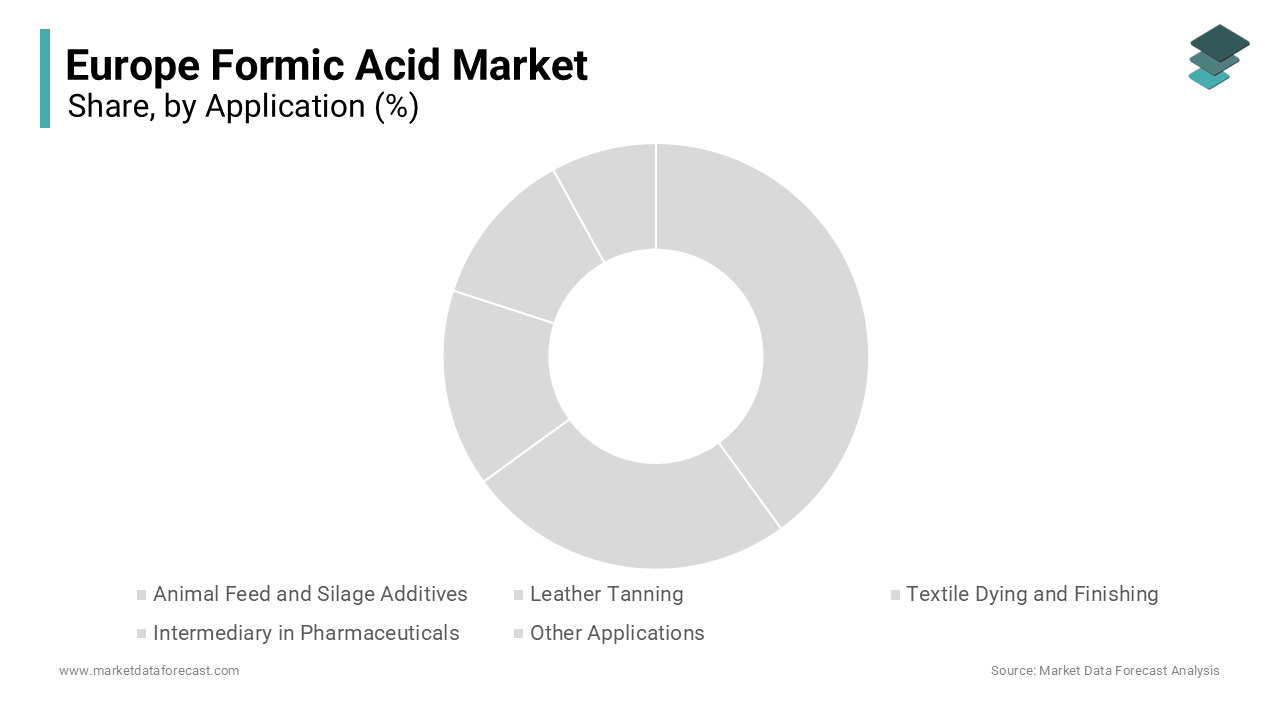
- Based on application, the animal feed and silage additives segment was the largest and held a significant share of the Europe formic acid market in 2025. The dominance of this segment is attributed to the widespread use of formic acid as a preservative that prevents bacterial growth and nutrient loss in livestock feed, ensuring food safety and productivity.
- The pharmaceutical intermediates segment is expected to witness the fastest growth during the forecast period. The growth of this segment is driven by increasing demand for high-purity formic acid in drug synthesis, protein purification, and advanced pharmaceutical manufacturing processes.
Regional Insights
The Europe formic acid market is witnessing steady growth across major economies, supported by strong agricultural demand, industrial applications, and emerging energy-related use cases.
- Germany was the largest contributor, accounting for 28.3% of the European formic acid market share in 2025, driven by its strong chemical industry, large livestock sector, and advancements in hydrogen-related technologies.
- France holds a significant position in the market, supported by its extensive agricultural activities and well-established leather tanning industry.
- Italy is emerging as a key market due to its dominant leather and textile industries, which rely heavily on formic acid for processing and finishing applications.
- Spain is witnessing growth driven by its large livestock farming sector and increasing adoption of renewable energy initiatives involving formic acid.
- The Netherlands plays a crucial role as a logistics hub and innovation center, supported by advanced agricultural practices and a growing focus on sustainable chemical production.
Competitive Landscape
The Europe formic acid market is characterized by strong competition among global chemical manufacturers and regional players focusing on sustainability, innovation, and high-purity product offerings. Leading companies are investing in carbon capture technologies, bio-based production methods, and hydrogen carrier applications to align with European environmental regulations and future energy trends. Strategic collaborations with the agriculture, pharmaceutical, and energy sectors are further strengthening market positioning. Prominent players in the Europe formic acid market include BASF SE, Eastman Chemical Company, LUXI Group, PETRONAS, POLIOLI SpA, CK Chemicals, Qingdao Hisea Chem Co., Ltd., Mitsubishi Gas Chemical Company, Perstorp Holding AB, GNFC, Chongqing Chuandong Chemical Group, and Feicheng Acid Chemicals Co., Ltd.
Europe Formic Acid Market Size
The Europe formic acid market size was valued at USD 626.00 million in 2025 and is anticipated to reach USD 647.35 million in 2026 from USD 846.52 million by 2034, growing at a CAGR of 3.41% during the forecast period from 2026 to 2034.
The Formic acid is the simplest carboxylic acid, a versatile chemical agent utilized extensively as a preservative, antibacterial agent, and hydrogen carrier across the continent. This colorless liquid with a pungent odor serves as a critical input for the agriculture, leather tanning, rubber, and emerging energy sectors, distinguished by its dual role as an industrial commodity and a potential pillar of the future hydrogen economy. The region operates under a unique paradigm where traditional agricultural demand intersects with groundbreaking decarbonization initiatives, particularly the Liquid Organic Hydrogen Carrier (LOHC) technology. The shift from fossil-based production methods to carbon-capture-derived synthesis, transforming the chemical from a byproduct into a strategic energy vector will drive the Europe formic acid market. Furthermore, the leather industry, concentrated in Italy and Spain, relies on formic acid for pH regulation during the tanning process, adhering to strict EU regulations on chemical residues.
MARKET DRIVERS
Critical Role in Silage Preservation and Livestock Feed Safety
The indispensable function as a preservative in the production of silage and compound animal feed, ensuring food security and livestock health across the continent is elevating the growth of Europe formic acid market. Formic acid acts as a powerful antibacterial and antifungal agent that inhibits the growth of Clostridia bacteria and molds, thereby preventing nutrient loss and mycotoxin formation in fermented fodder. In 2024, the European Union maintained a livestock population of over 76 million cattle and 144 million pigs, creating a massive and consistent demand for high-quality preserved feed to sustain meat and dairy production according to Eurostat agricultural data. The stringent regulations imposed by the European Food Safety Authority regarding mycotoxin levels in animal feed have compelled farmers to adopt formic acid-based additives as a standard practice, with over 80% of silage in Northern Europe now treated with organic acids. Furthermore, the ban on antibiotic growth promoters in the EU has elevated the importance of organic acids as natural alternatives to maintain gut health in poultry and swine. This structural reliance on formic acid for maintaining the integrity of the European food supply chain ensures a robust and inelastic demand baseline that sustains market volume regardless of broader economic fluctuations.
Emergence as a Premier Liquid Organic Hydrogen Carrier
The rapid emergence of formic acid as a leading Liquid Organic Hydrogen Carrier (LOHC), positioning it as a cornerstone of the European hydrogen economy and decarbonization strategy is another factor propelling the growth of Europe formic acid market. Unlike gaseous hydrogen, which requires expensive high-pressure storage and cryogenic transport, formic acid can store hydrogen at ambient temperature and pressure by offering a safe and logistically feasible solution for distributing green energy. According to the Fuel Cells and Hydrogen Joint Undertaking, the potential market for hydrogen storage via formic acid in Europe could reach 2 million tons of hydrogen equivalent by 2030 if current scaling trajectories are maintained. Major industrial clusters in Germany and the Netherlands are already integrating formic acid dehydrogenation units to supply fuel cells for heavy-duty transport and stationary power generation. As per the International Energy Agency, the efficiency of converting electricity to formic acid and back to hydrogen has improved to over 60%, making it commercially competitive with other storage mediums. This paradigm shift from viewing formic acid merely as a chemical intermediate to recognizing it as a vital energy vector creates a entirely new demand stream, attracting capital from the energy sector and driving innovation in catalytic processes that promise to exponentially expand market size in the coming decade.
MARKET RESTRAINTS
Volatility in Feedstock Prices and Energy Costs
The extreme volatility in the prices of key feedstocks and the high energy intensity associated with its production processes is restraining the growth of Europe formic acid market. Traditional manufacturing routes rely on methyl formate hydrolysis or are a byproduct of acetic acid production, both of which are sensitive to fluctuations in methanol, carbon monoxide, and natural gas prices. In 2024, industrial natural gas prices in Europe remained 40% higher than pre-crisis levels, significantly inflating the operational expenditures for producers who require substantial heat for distillation and purification, according to Eurostat energy data. The cost of methanol, a primary precursor, experienced swings of up to 30% within a single year due to global supply chain disruptions and geopolitical tensions, making cost forecasting nearly impossible for formic acid manufacturers. The financial instability discourages long-term investment in capacity expansion and complicates pricing strategies for downstream customers in the price-sensitive agriculture sector. Furthermore, the transition to green production methods using electrolysis introduces additional exposure to electricity price volatility, which remains elevated in many European grids. The inability to stabilize input costs creates a precarious operating environment where producers struggle to pass on price increases to farmers and industrial users, thereby dampening market momentum and limiting the competitiveness of European formic acid against imports from regions with lower energy costs.
Stringent Regulatory Compliance and Environmental Scrutiny
The increasing complex web of environmental regulations and safety standards governed by the REACH framework, which imposes rigorous compliance burdens on manufacturers and users is additionally hindering the growth of Europe formic acid market. Formic acid is classified as a corrosive substance and skin irritant, requiring strict handling protocols, specialized storage infrastructure, and comprehensive employee training, all of which add to the operational overhead. In 2025, the European Chemicals Agency updated the exposure limits for formic acid in workplace environments, mandating advanced ventilation systems and monitoring equipment that small and medium-sized enterprises often find prohibitively expensive to implement according to official ECHA announcements. The transportation of formic acid is also subject to stringent ADR regulations for hazardous goods, increasing logistics costs and limiting the flexibility of supply chains for last-mile delivery to rural farms. As per the European Transport Safety Council, the administrative burden associated with complying with evolving hazard communication standards has increased by 20% over the last three years, diverting resources from innovation to compliance administration. Furthermore, the push for zero-emission industrial zones in major cities restricts the operation of certain production facilities or delivery vehicles, creating logistical bottlenecks. The constant evolution of regulatory requirements regarding emissions, waste disposal, and worker safety creates a moving target for compliance, slowing down the approval of new production sites and hindering the rapid scale-up needed to meet emerging demands in the energy sector.
MARKET OPPORTUNITIES
Expansion of Carbon Capture and Utilization Technologies
The large-scale adoption of Carbon Capture and Utilization (CCU) technologies, which enable the sustainable production of formic acid by hydrogenating captured carbon dioxide is solely to amplify the growth of Europe formic acid market. This approach aligns perfectly with the European Green Deal's objective of creating a circular carbon economy, turning a greenhouse gas liability into a valuable chemical asset. In 2025, the European Union allocated 500 million euros through the Innovation Fund specifically for CCU projects that produce fuels and chemicals, with formic acid synthesis being a primary beneficiary due to its technical maturity. According to the Joint Research Centre of the European Commission, the theoretical potential for producing formic acid from industrial CO2 sources in Europe exceeds 1 million metric tons annually, utilizing emissions from steel mills, cement plants, and power stations. Companies are increasingly partnering with carbon capture startups to integrate electrolyzers and catalytic reactors directly at emission sources, reducing transport costs and carbon footprints. As per the Nova-Institute, bio-based and CO2-derived formic acid commands a premium price in the market, appealing to corporate buyers seeking to lower their Scope 3 emissions and achieve sustainability certifications. This technological pathway not only secures a domestic supply of formic acid independent of fossil feedstocks but also creates a new revenue stream for heavy industries looking to monetize their carbon emissions.
Adoption in Direct Formic Acid Fuel Cells for Portable Power
The growing adoption of Direct Formic Acid Fuel Cells (DFAFCs) is driven by the demand for safe, high-energy-density power sources for portable electronics and backup power system is to escalate the growth of Europe formic acid market. Unlike hydrogen fuel cells that require complex high-pressure storage, DFAFCs utilize liquid formic acid directly, offering a simpler, safer, and more compact solution ideal for consumer devices, drones, and remote sensors. The technology is particularly attractive for the logistics sector, where handheld scanners and warehouse robots require quick recharge cycles without the downtime associated with battery swapping. As per the European Association for Storage of Energy, the efficiency of DFAFC systems has improved to over 50%, making them commercially viable for niche applications where weight and safety are crucial. Furthermore, the military and emergency services sectors in Europe are exploring formic acid fuel cells for field operations due to the stability and non-flammability of the fuel compared to methanol or gasoline. This diversification into the energy storage and conversion market opens a high-value avenue for formic acid producers, moving beyond traditional low-margin industrial applications into the sophisticated realm of advanced power generation technologies.
MARKET CHALLENGES
Competition from Alternative Preservatives and Acids
The intense competition from alternative preservatives and organic acids, such as propionic acid, lactic acid, and synthetic silage additives, which offer varying cost and performance benefits is one of the challenges for the growth of Europe formic acid market. In the agriculture sector, farmers often switch between different acid blends based on price fluctuations and specific crop conditions, creating a volatile demand environment for formic acid suppliers. Additionally, the rise of biological silage inoculants, which use bacteria rather than acids to preserve fodder, poses a long-term threat as these solutions are perceived as more natural and environmentally friendly by organic farmers. As per the European Organic Agriculture Movement, the adoption of non-chemical preservatives in organic farming has grown by eroding the market share of conventional acid treatments in this premium segment. In the leather industry, the search for chrome-free and acid-free tanning methods to meet stricter environmental standards further threatens traditional formic acid usage. The availability of diverse alternatives forces formic acid producers to constantly justify their product's superiority through technical support and pricing strategies by making it difficult to maintain stable market share and pricing power in a highly fragmented and price-sensitive landscape.
Technical Barriers in Hydrogen Release Efficiency
The efficiency and catalyst stability of hydrogen release from formic acid, which hinders the widespread commercialization of formic acid as a hydrogen carrier is also significantly to decline the growth of Europe formic acid market. While the concept of using formic acid for hydrogen storage is promising, the dehydrogenation process currently requires precious metal catalysts, such as palladium or platinum, which are expensive and susceptible to poisoning by impurities, limiting the economic viability of large-scale operations. In 2025, research indicated that the turnover frequency of existing catalysts for formic acid dehydrogenation still falls short of the targets set for automotive applications, with durability issues arising after repeated cycling, according to the Max Planck Institute for Chemical Energy Conversion. The presence of carbon monoxide as a byproduct during decomposition can also poison fuel cell membranes, necessitating complex purification steps that add cost and complexity to the system. As per the European Research Council, bridging the gap between laboratory-scale success and industrial-scale reliability remains a significant hurdle, with few commercial systems currently capable of operating continuously for thousands of hours without performance degradation. Furthermore, the lack of standardized infrastructure for formic acid refueling and the absence of unified safety codes for LOHC handling create uncertainty for investors and end-users.
REPORT COVERAGE
| REPORT METRIC | DETAILS |
| Market Size Available | 2025 to 2034 |
| Base Year | 2025 |
| Forecast Period | 2026 to 2034 |
| CAGR | 3.41% |
| Segments Covered | By Application and Region. |
| Various Analyses Covered | Global, Regional & Country Level Analysis, Segment-Level Analysis, DROC, PESTLE Analysis, Porter’s Five Forces Analysis, Competitive Landscape, Analyst Overview of Investment Opportunities |
| Country Covered | UK, France, Spain, Germany, Italy, Russia, Sweden, Denmark, Switzerland, the Netherlands, Turkey, the Czech Republic, and the Rest of Europe. |
| Market Leaders Profiled | BASF SE, Eastman Chemical Company, LUXI Group, Petroliam Nasional Berhad (PETRONAS), POLIOLI SpA, CK Chemicals, and Qingdao Hisea Chem Co., Ltd., along with other prominent companies such as Mitsubishi Gas Chemical Company, Perstorp Holding AB, Gujarat Narmada Valley Fertilizers & Chemicals Ltd., Chongqing Chuandong Chemical Group Co. Ltd., and Feicheng Acid Chemicals Co., Ltd. |
SEGMENTAL ANALYSIS
By Application Insights
The animal feed and silage additives segment was accounted in holding 54.3% of the Europe formic acid market share in 2025 by ensuring food security and livestock health across the continent's intensive farming sectors. The widespread adoption of formic acid as a primary preservative for silage, where it effectively lowers pH levels to inhibit the growth of Clostridia bacteria and molds, thereby preventing nutrient loss and mycotoxin formation in fermented fodder. In 2024, over 85% of dairy farms in Northern Europe utilized formic acid-based additives for grass silage preservation, driven by strict European Union regulations on feed safety and the ban on antibiotic growth promoters according to data from the Federation of European Compound Feed Manufacturers. The massive scale of the European livestock industry, which maintains a population of over 76 million cattle and 144 million pigs, creating a consistent and inelastic demand for high-quality preserved feed to sustain meat and milk production. As per Eurostat agricultural statistics, the volume of compound feed produced in the EU exceeded 150 million metric tons in 2025, with formic acid serving as a key ingredient in piglet starter feeds to maintain gut health without relying on pharmaceuticals. The inability of alternative organic acids to match the cost-effectiveness and rapid pH reduction capabilities of formic acid in wet silage conditions cements its position as the indispensable standard for European agriculture.
The intermediary in pharmaceuticals segment is likely to grow at an anticipated CAGR of 9.3% from 2026 to 2034. The growth of the segment is driven by the resurgence of the European pharmaceutical manufacturing sector and the increasing complexity of drug synthesis processes that require high-purity formic acid as a reagent and solvent. The booming biopharmaceutical industry, where formic acid is essential for the purification of proteins and peptides via high-performance liquid chromatography (HPLC), a step in the development of monoclonal antibodies and novel therapeutics. The shift toward continuous manufacturing processes in drug production, which relies heavily on formic acid for efficient reactions and precise pH control during active pharmaceutical ingredient (API) synthesis is escalating the growth of segment. As per the Innovative Medicines Initiative, the number of new drug candidates utilizing formic acid-dependent synthetic pathways has increased by 20% annually by reflecting its growing importance in modern medicinal chemistry. Furthermore, the stringent quality standards imposed by the European Medicines Agency necessitate the use of certified high-purity reagents by creating a high-margin niche that attracts specialized producers.
REGIONAL ANALYSIS
Germany Formic Acid Market Analysis
Germany was the top performer in the Europe formic acid market by holding 28.3% of share in 2025 with its massive chemical, automotive, and agricultural sectors. In 2024, German chemical plants produced over 110,000 metric tons of formic acid, supplying diverse domestic industries ranging from leather processing in Bavaria to large-scale animal farming in Lower Saxony, according to the German Chemical Industry Association. The country's robust agricultural sector, with over 12 million cattle, creates immense demand for silage additives, while its leading pharmaceutical industry drives consumption of high-purity grades for drug synthesis. Furthermore, Germany is at the forefront of the hydrogen economy, piloting several projects that utilize formic acid as a Liquid Organic Hydrogen Carrier for fuel cell applications. As per the Federal Ministry for Economic Affairs and Climate Action, investments in green hydrogen infrastructure involving formic acid pathways exceeded 200 million euros in 2025. The synergy between established industrial capacity, technological leadership in CCU, and strong agricultural demand solidifies Germany's role as the central engine of the European formic acid market.
France Formic Acid Market Analysis
France formic acid market was ranked second by holding 18.4% of share in 2025 with its powerful agricultural base and renowned leather tanning industry. The extensive livestock sector, particularly in regions like Brittany and Normandy, where formic acid is extensively used for preserving corn and grass silage to ensure winter feed quality for dairy and beef cattle. In 2025, French farmers applied over 45,000 metric tons of formic acid-based preservatives, representing a 10% increase from previous years due to stricter mycotoxin regulations according to the French Ministry of Agriculture. France hosts a prestigious leather industry centered in regions like Limoges and Romans-sur-Isere, which relies on formic acid for pH regulation during the tanning of high-end hides for luxury fashion brands. The "Made in France" label in luxury goods drives demand for premium tanning chemicals that meet strict environmental standards. Additionally, the country's growing focus on green chemistry has spurred pilot projects for producing bio-based formic acid from agricultural waste. As per INSEE data, the agro-food and leather sectors combined account for over 60% of national formic acid consumption.
Italy Formic Acid Market Analysis
Italy formic acid market growth is likely to witness a fastest CAGR in coming years with its world-leading leather tanning and textile dyeing industries which are concentrated in specialized industrial districts. The high demand for high-purity formic acid used in the finishing processes of luxury leather goods, footwear, and high-fashion textiles, where precision and quality are paramount. In 2024, the tanning district of Santa Croce sull'Arno alone consumed over 25,000 metric tons of formic acid, driven by the need to process millions of square meters of leather for global luxury brands according to the Italian Tanners Association. The country's textile sector, particularly in Prato and Como, also utilizes significant volumes for dye fixation and neutralization in wool and silk processing. Furthermore, Italy's strong pharmaceutical and cosmetic industries contribute to the demand for specialized grades of formic acid used in synthesis and formulation. The "Made in Italy" brand's global reputation ensures a steady flow of exports, sustaining upstream chemical consumption.
Spain Formic Acid Market Analysis
Spain formic acid market growth is propelling with its intensive livestock farming sector and emerging renewable energy initiatives. The Spanish market is heavily influenced by the pig and poultry industries, which are among the largest in Europe, generating substantial demand for formic acid as a feed additive to improve gut health and preserve feed quality. The country's arid climate also necessitates effective silage preservation techniques to maximize the nutritional value of limited forage resources. Additionally, Spain is emerging as a leader in solar energy, with several pilot projects exploring the use of formic acid as a hydrogen storage medium powered by photovoltaic electricity, aligning with the national hydrogen roadmap.
Netherlands Formic Acid Market Analysis
The Netherlands formic acid market growth is driven by the logistical gateway and a pioneer in high-tech, sustainable agriculture. The Dutch market is characterized by an extremely dense livestock population relative to its size by creating intense demand for efficient feed preservatives and acidifiers to manage manure quality and animal health. The global leader in greenhouse horticulture, where formic acid is increasingly used as a disinfectant and pH regulator in hydroponic systems. Furthermore, the Port of Rotterdam serves as an entry point for imported formic acid and a hub for distributing it across Northwest Europe by enhancing the country's strategic relevance. The Dutch government's commitment to circular agriculture has spurred research into using formic acid derived from local biomass waste streams. As per the Dutch Ministry of Economic Affairs, the adoption of precision feeding systems utilizing formic acid has increased by 12%, optimizing usage efficiency. The combination of agricultural intensity, logistical superiority, and sustainability leadership positions the Netherlands as a vital and innovative node in the European formic acid value chain.
COMPETITIVE LANDSCAPE
The competition in the Europe formic acid market is characterized by intense rivalry among established multinational chemical giants and specialized regional producers who vie for dominance through technological innovation and sustainability credentials. Major players leverage their integrated production sites to offer cost effective and reliable supplies while striving to decarbonize their operations amidst high energy prices and carbon compliance burdens. The market landscape features a shift from pure volume competition to differentiation based on carbon footprint and green certification as customers increasingly demand sustainable chemicals for agriculture and industry. Competitive pressure drives continuous investment in carbon capture utilization technologies and bio based feedstocks to future proof operations against regulatory changes and fossil fuel dependency. Pricing strategies remain complex due to volatility in natural gas and methanol costs forcing firms to balance margin protection with market share retention in price sensitive sectors like animal feed. Strategic alliances with downstream users in the pharmaceutical and energy sectors are common tactics to secure long term off take agreements for high purity and green formic acid. The threat of substitution from alternative acids or biological preservatives requires incumbent companies to constantly demonstrate superior efficacy and value. Maintaining regulatory compliance and proving lifecycle sustainability becomes paramount as customers prioritize ethical sourcing and environmental impact in their procurement decisions within this sophisticated marketplace.
KEY MARKET PLAYERS
Some of the companies that are playing a dominating role in the Europe Formic Acid Market include
- BASF SE
- Eastman Chemical Company
- LUXI Group
- Petroliam Nasional Berhad (PETRONAS)
- POLIOLI SpA
- CK Chemicals
- Qingdao Hisea Chem Co., Ltd.
Top Players in the Europe Formic Acid Market
BASF SE
BASF SE stands as a global chemical leader with a significant footprint in the Europe formic acid market through its integrated production networks. The company supplies high purity formic acid essential for agriculture, leather tanning, and emerging energy applications worldwide. Recent actions to strengthen its market position include the expansion of its carbon capture utilization facilities in Germany to produce sustainable formic acid from industrial emissions. BASF actively collaborates with energy partners to develop Liquid Organic Hydrogen Carrier technologies that utilize formic acid for safe hydrogen storage. The corporation invests heavily in research to optimize catalytic processes ensuring cost efficiency and environmental compliance. By leveraging its verbund system BASF minimizes waste and energy consumption while securing raw material supplies. These strategic initiatives reinforce its commitment to sustainability and innovation solidifying its role as a key enabler of the circular economy and green hydrogen transition across Europe and global markets.
OXEA GmbH
OXEA GmbH operates as a leading specialty chemical producer with a dominant presence in the Europe formic acid sector known for its high quality oxo chemistry products. The company contributes globally by providing reliable supplies of formic acid for diverse industrial applications ranging from animal feed preservation to pharmaceutical synthesis. Recent efforts to bolster its market presence involve the modernization of its production plants in Germany to increase capacity and improve energy efficiency. OXEA has launched new grades of ultra pure formic acid specifically designed for the growing biopharmaceutical and electronics sectors. The firm actively pursues sustainability certifications to meet stringent European environmental regulations and customer demands for green chemicals. Furthermore, OXEA engages in long term supply agreements with major agricultural cooperatives to ensure stable distribution channels. These forward looking strategies demonstrate its dedication to operational excellence and product innovation positioning the company as a preferred partner for industries requiring consistent and high-performance chemical solutions.
Perstorp Holding AB
Perstorp Holding AB serves as a specialized chemical company headquartered in Sweden with a strong reputation in the Europe formic acid market for its sustainable production methods. The company plays a vital role globally by supplying formic acid derivatives and pure forms for animal nutrition and industrial processes. Recent strategic actions include the integration of bio-based feedstocks into its manufacturing processes to reduce carbon footprints and align with EU Green Deal objectives. Perstorp collaborates closely with research institutions to develop novel applications for formic acid in renewable energy storage and decarbonization projects. The firm has strengthened its logistics network to ensure timely delivery across Northern and Central Europe. By prioritizing circular economy principles and investing in green technology Perstorp enhances its competitive edge.
Top Strategies Used by Key Market Participants
Key players in the Europe formic acid market predominantly employ sustainability driven strategies to develop carbon neutral and bio-based production methods that comply with strict environmental regulations. Companies frequently pursue vertical integration to secure access to critical raw materials like carbon monoxide and methanol ensuring supply chain stability and cost control. Strategic partnerships with energy firms and research institutions enable co development of Liquid Organic Hydrogen Carrier technologies for the emerging hydrogen economy. Expansion of production facilities in key industrial hubs allows firms to reduce logistics costs and improve service delivery speeds to local customers. Innovation leadership acts as a core differentiator with corporations investing heavily in carbon capture utilization and advanced catalysis to create green formic acid. Mergers and acquisitions are utilized to consolidate market positions and acquire specialized technologies or niche application expertise rapidly. Digital transformation of manufacturing processes enhances operational efficiency and quality control while reducing waste.
MARKET SEGMENTATION
This research report on the Europe formic acid market has been segmented and sub-segmented based on the following categories.
By Application
- Animal Feed and Silage Additives
- Leather Tanning
- Textile Dying and Finishing
- Intermediary in Pharmaceuticals
- Other Applications
By Country
- UK
- France
- Spain
- Germany
- Italy
- Russia
- Sweden
- Denmark
- Switzerland
- Netherlands
- Turkey
- Czech Republic
- Rest of Europe