- Product Description Description
- Table of Contents TOC
- List of Table & Figure LOT
- Get Free Sample PDF Sample PDF
Market Size, 2025
$15.30 BnMarket Estimate, 2026
$16.44 BnMarket Forecast, 2034
$29.15 BnCAGR, 2026–2034
7.42%Executive Summary: Europe Fox Nuts Market
- Market Scope: Comprehensive European fox nuts (makhana) market analysis covering product types, application sectors, distribution channels, regional leadership shares, and clean-label dietary trends.
- Market Valuation: Valued at USD 15.30 billion (2025), estimated at USD 16.44 billion (2026), and projected to attain USD 29.15 billion by 2034, registering a solid CAGR of 7.42% (2026–2034).
- Primary Growth Drivers: Surging demand for gluten-free, low-glycemic, and high-fiber snack options, expanding preferences for plant-based functional foods, clean-label compliance, ethnic food exploration, and minimally processed alternatives. Enhanced product accessibility across Europe is further supported by the rapid growth of specialty grocery networks, premium health-food retailers, and digital e-commerce platforms.
Key Market Segment Metrics (2026–2034)
| Category | Leading Segment (2025 Position) | Fastest-Growing Segment |
|---|---|---|
| By Product Type | Processed / flavored fox nuts (held the leading market share in 2025) | Raw fox nuts (projected to register the highest CAGR at 14.3% from 2026 to 2034) |
| By Application Sector | Human consumption and direct snacking (dominated the application segment in 2025) | Industrial and ingredient applications (forecast to expand at a rapid 19.1% CAGR) |
| By Distribution Channel | Supermarkets and hypermarkets (accounted for 42.8% of the European market in 2025) | Online sales and digital retail platforms (projected to record the fastest CAGR at 21.4% through 2034) |
| By Country / Region | Germany (led the European market with a 24.8% share in 2025, closely followed by the United Kingdom at 19.6%) | High-growth Western European health-conscious consumer markets |
Major Market Players & Market Structure
Market Structure: Moderately fragmented European and international marketplace where competition centers heavily on continuous flavor innovation, functional product fortification, sustainable eco-friendly packaging, Ayurvedic wellness positioning, direct agricultural sourcing, and robust e-commerce expansion.
Key Companies: Shaktisudha Makhana, K.K. Products, Maruti Makhana, Manju Makhana, Sattviko, Edible Desires Pvt Ltd, Indulge Foods Private Limited, MoonLite Foods Inc, Mahaveer Udhyog, and Bar Italia Srl.
Europe Fox Nuts Market Size
The size of the Europe fox nuts market was calculated to be USD 15.30 billion in 2025 and is anticipated to be worth USD 29.15 billion by 2034, from USD 16.44 billion in 2026, growing at a CAGR of 7.42% during the forecast period.
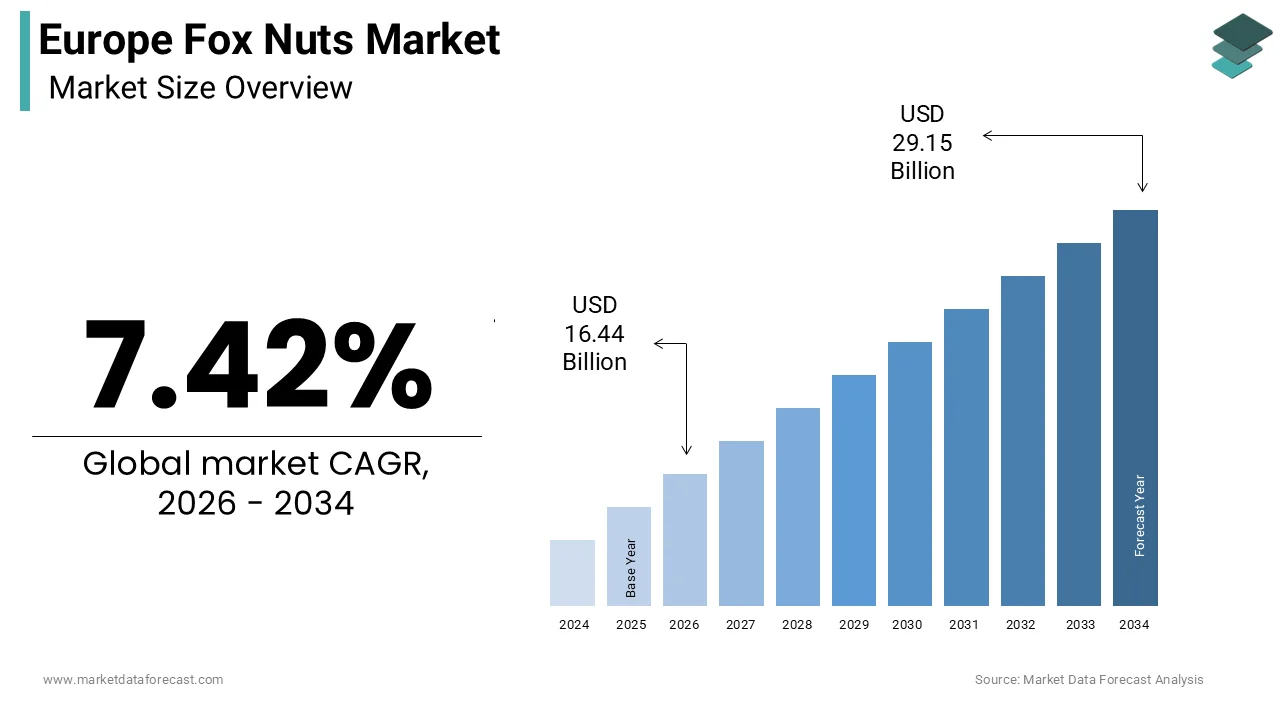
Fox nuts, scientifically derived from the aquatic plant Euryale ferox and commonly known as makhana or lotus seeds, are emerging as a niche yet promising functional food within Europe’s evolving health and wellness landscape. Traditionally consumed across South Asia for their nutritional and Ayurvedic properties, fox nuts are now gaining visibility in European markets as a gluten-free, low glycemic, and high fiber snack alternative. In Europe, they are primarily distributed through ethnic grocery stores, premium health food retailers, and e-commerce platforms, targeting health-conscious consumers seeking plant-based, minimally processed options. The European fox nuts market, while still in its early adoption phase, is positioned at the intersection of ethnic culinary heritage and contemporary functional nutrition trends.
MARKET DRIVERS
Rising Consumer Preference for Plant-Based Functional Snacks
Consumers are increasingly prioritizing snacks that deliver measurable physiological benefits, and this creates fertile ground for nutrient-dense alternatives, which drives the growth of the Europe fox nuts market. According to the European Commission, a portion of adults in the EU expressed willingness to pay a premium for snacks labeled as functional or enriched with natural health-promoting compounds. Fox nuts contain protein and dietary fiber, alongside significant levels of magnesium and potassium, nutrients linked to cardiovascular and metabolic health. This convergence of nutritional awareness, clean label expectations, and demand for satiating yet low-calorie options positions fox nuts as a compelling addition to Europe’s functional snack portfolio, particularly among urban, health-literate demographics.
Expansion of Ethnic and Specialty Grocery Retail Channels
The proliferation of ethnic and specialty food retail networks has significantly enhanced the accessibility of traditionally non-European ingredients, which in turn propels the expansion of the Europe fox nuts market. Major retailers have expanded their ethnic aisles to include premium dried snacks, with fox nuts appearing alongside other Ayurvedic and wellness-oriented products. Apart from these, online platforms reported a rise in consumer searches for lotus seeds and makhana in recent years. This retail diversification not only reduces dependency on traditional importers but also enables direct consumer education through packaging and digital content. E-commerce penetration for specialty foods is exceeding in markets. This channel evolution is instrumental in transitioning fox nuts from an ethnic novelty to a recognized functional snack within mainstream European consumption patterns.
MARKET RESTRAINTS
Limited Consumer Awareness and Misidentification of Product Attributes
Low consumer recognition and frequent misclassification a significant barriers to the growth of the Europe fox nuts market. This lack of clarity impedes effective marketing and limits trial willingness, especially when competing against established functional ingredients like chia or flaxseeds. Moreover, the absence of authorized health claims for Euryale ferox under Regulation EC restricts promotional messaging. The product risks remaining confined to niche markets rather than achieving broader adoption without targeted education and regulatory validation.
Supply Chain Volatility and Import Dependency
Dependency on imports and supply chain volatility further hampers the expansion of the Europe fox market. This heavy import dependency introduces significant supply chain vulnerabilities, including logistical delays, currency fluctuations, and geopolitical trade barriers. Furthermore, the European Union’s stringent pesticide residue regulations under Regulation EC have resulted in multiple shipment rejections. Fox nuts cannot be viably grown in European climates due to their requirement for stagnant freshwater wetlands, eliminating local production as a risk mitigation strategy, unlike domestically cultivable crops. This structural import reliance constrains scalability and price stability, which poses a persistent operational challenge for market participants.
MARKET OPPORTUNITIES
Growing Integration into Clean Label and Plant-Based Product Formulations
Food manufacturers are actively reformulating products to align with clean label and plant-based mandates, which creates new opportunities for the growth of the Europe fox nuts market. Fox nuts, with their neutral flavor, crunchy texture, and natural gluten-free status, are increasingly incorporated into granola bars, protein clusters, and savory snack mixes by brands such as Rude Health in the UK and Alnatura in Germany. Apart from these, the European Food Safety Authority issued a positive scientific opinion on the safety of Euryale ferox as a novel food ingredient in 2022, which clears regulatory pathways for broader application. Startups like Makhana Co in Berlin are already leveraging this opportunity by developing ready-to-eat nut snacks fortified with European-grown herbs.
Expansion of Ayurveda and Traditional Wellness Practices in European Health Ecosystems
The institutionalization of Ayurvedic principles within the region’s complementary and alternative medicine landscape is fuelling demand for authentic botanicals, and this provides fresh prospects for the Europe fox nuts market. Fox nuts, long revered in Ayurveda for their cooling properties and role in balancing pitta dosha, are increasingly recommended by practitioners as part of dietary protocols for stress management and metabolic balance. The growing acceptance is amplified by the European Medicines Agency’s acknowledgment of traditional herbal registrations, which, while not directly covering fox nuts, have normalized the use of South Asian botanicals in regulated wellness contexts. Retail partnerships between Ayurvedic institutes and organic stores have facilitated direct consumer access to certified makhana products. Moreover, the European Union’s Horizon Europe research program allocated funds to studies on traditional plant-based interventions for chronic lifestyle diseases, which indirectly validates the scientific exploration of ingredients like fox nuts. This convergence of cultural legitimacy, clinical endorsement, and retail integration positions fox nuts as more than a snack. It is becoming a symbol of holistic wellness within Europe’s evolving health paradigm.
MARKET CHALLENGES
Inconsistent Product Standardization and Quality Grading
The absence of uniform quality standards affects consumer trust, complicates large-scale commercial adoption, and challenges the growth of the Europe fox nuts market. Fox nuts lack harmonized grading criteria for size, puffing consistency, moisture content, or foreign matter limits within the European Union, unlike regulated commodities such as almonds or walnuts. The inconsistency leads to spoilage, texture degradation, and microbial risks, particularly in humid European storage environments. Furthermore, the lack of standardized terminology where makhana, fox nuts, and lotus seeds are used interchangeably despite botanical distinctions creates confusion among both retailers and consumers. The European Committee for Standardization has not yet initiated a technical specification for Euryale ferox products, leaving quality control to individual importers. This regulatory vacuum discourages mainstream food manufacturers from incorporating fox nuts into branded products, as they cannot guarantee consistent sensory or safety profiles.
Regulatory Ambiguity Under Novel Food and Health Claim Frameworks
Fox nuts occupy a precarious regulatory position in Europe due to incomplete classification under the EU’s Novel Food Regulation and restrictive health claim policies, which further hampers the expansion of the Europe fox nuts market. Euryale ferox was not widely consumed in the EU before May 199,7, which triggered novel food status, and it has not undergone a full safety assessment by the European Food Safety Authority for all intended uses. The limitation stifles innovation and restricts market diversification. Moreover, Regulation EC No prohibits any health-related marketing unless supported by an approved claim, and no such claim exists for fox nuts despite their documented nutrient profile. In addition, ingredients like oats benefit from authorized claims linking beta-glucans to cholesterol reduction, giving them a decisive marketing edge. The regulatory inertia not only dampens investment but also perpetuates consumer skepticism, as the absence of official endorsement is often misinterpreted as a lack of efficacy. The market potential for fox nuts in Europe will remain constrained by legal uncertainty and promotional limitations until they receive comprehensive regulatory clarity.
REPORT COVERAGE
| REPORT METRIC | DETAILS |
| Market Size Available | 2025 to 2034 |
| Base Year | 2025 |
| Forecast Period | 2026 to 2034 |
| CAGR | 7.42% |
| Segments Covered | By Type, Application, Distribution Channel, and Region. |
| Various Analyses Covered | Global, Regional, & Country Level Analysis; Segment-Level Analysis; DROC, PESTLE Analysis; Porter’s Five Forces Analysis; Competitive Landscape; Analyst Overview of Investment Opportunities |
| Regions Covered | North America, Europe, APAC, Latin America, Middle East & Africa |
| Market Leaders Profiled | Shaktisudha Makhana, K.K. Products, Maruti Makhana, Manju Makhana, Sattviko, Edible Desires Pvt Ltd, Indulge Foods Private Limited, MoonLite Foods Inc, Mahaveer Udhyog, and Bar Italia Srl. |
SEGMENTAL ANALYSIS
By Type Insights
In 2025, the processed fox nuts segment was the top performer in the Europe fox nuts market and held a substantial share in 2025. Factors like strong consumer preference for ready-to-eat, flavored, and value-added formats that align with convenience-driven snacking habits across urban European demographics have largely contributed to the growth of the processed fox nuts segment in the regional market. Raw fox nuts, while nutritionally intact, face limited appeal due to their unseasoned taste and requirement for home preparation, which conflicts with fast-paced lifestyles prevalent in Western Europe. European consumers increasingly seek snacks that combine health benefits with immediate consumption readiness. According to studies, a portion of adults in the EU prefer pre-portioned and ready-to-eat healthy snacks over raw or unprocessed alternatives. Processed fox nuts, often roasted, spiced, or lightly salted, fit seamlessly into this paradigm, which offers a crunchy, low-calorie option without requiring culinary effort. Furthermore, processed variants allow for flavor innovation, such as turmeric, black pepper, or sea salt rosemary, that resonates with Europe’s growing interest in global culinary influences. Retailers and manufacturers prioritize processed fox nuts due to higher margins and stronger shelf appeal. Processed fox nuts are frequently positioned in high-visibility, better-for-you snack aisles, often alongside quinoa puffs and lentil crisps, benefiting from strategic planogram placement.
The raw fox nuts segment is predicted to witness the highest CAGR of 14.3% from 2026 to 2034. The rapid expansion of the raw fox nuts segment is fueled by rising demand from artisanal food producers, Ayurvedic practitioners, and clean label enthusiasts who prioritize ingredient purity and minimal intervention. In addition, a growing cohort of European consumers is rejecting ultra-processed foods in favor of whole, single-ingredient products. Apart from these, raw fox nuts appeal to vegan and paleo diet adherents who avoid oils, salts, and additives commonly found in processed versions. Furthermore, raw fox nuts are gaining traction among nutritionists, chefs, and wellness centers that require unadulterated ingredients for custom formulations. In addition, certified Ayurvedic clinics prescribe raw makhana for detox and digestive protocols. This professional endorsement enhances credibility and drives bulk purchases from wellness institutions. Moreover, the rise of DIY wellness kits, such as home Ayurvedic cleanse boxes sold by startups in Berlin and Amsterdam, relies on raw fox nuts as a core component.
By Application Insights
The human consumption segment captured the dominant share of the Europe fox nuts market in 2025. The growth of the human consumption segment is due to its exclusive role as a food and wellness product rather than an industrial raw material. Industrial applications, such as use in cosmetics or bio-based packaging, remain negligible due to limited extraction infrastructure and a lack of cost-effective processing technologies for Euryale ferox derivatives in Europe. Fox nuts are culturally and scientifically recognized solely as a dietary item, with no established industrial utility in the European context. Consumer perception further reinforces this boundary. Unlike soy or flax, which have dual food and industrial streams, fox nuts lack the oil content or fiber strength required for scalable non-food applications. Consequently, all commercial activity remains anchored in human consumption, particularly in health food, ethnic cuisine, and functional snack categories.
The industrial application segment is estimated to register the fastest CAGR of 19.1% from 2026 to 2034, owing to exploratory research into sustainable biomaterials and cosmetic actives. Researchers are investigating fox nuts as a potential source of resistant starch for eco-friendly packaging. According to sources, Euryale ferox starch exhibits high amylose content and thermal stability, making it suitable for biodegradable film production. This research is still only on a lab scale. However, it has already attracted funding from the EU’s Horizon Europe Circular Bio-Based Europe Joint Undertaking, which allocated funds to projects exploring underutilized aquatic plants. If scaled, such applications could open a new industrial stream. The scientific validation provides a foundation for future industrial adoption, even though commercial viability remains distant. Also, preliminary studies suggest fox nut extracts may possess antioxidant and anti-inflammatory properties relevant to skincare. Though not yet commercialized, European natural cosmetic brands are monitoring such findings. Industrial use will remain experimental until safety and efficacy data are submitted, but the growth trajectory is rooted in genuine scientific interest.
By Distribution Channel Insights
The supermarkets and hypermarkets segment led the Europe fox nuts market and accounted for 42.8% share in 2025. The dominance of the supermarkets and hypermarkets segment is propelled by their extensive reach, established health food sections, and consumer trust in mainstream availability. Major European supermarket chains have systematically expanded their ethnic and wellness offerings, creating dedicated space for products like fox nuts. Retailers have partnered with importers to offer private-label fox nut variants, which reduces price barriers. Apart from these, supermarkets benefit from high footfall and impulse purchase dynamics. This integration transforms fox nuts from an exotic import into an accessible everyday item. European shoppers place higher confidence in products sold through established retail channels due to perceived safety and quality assurance. Supermarkets enforce strict supplier compliance with EU food safety regulations, including traceability and allergen labeling, which mitigates perceived risks associated with unfamiliar ingredients. This trust is especially critical for botanicals like fox nuts, where contamination concerns exist. Furthermore, promotional support, like in-store demos and loyalty discounts, accelerates trial. Such institutional backing cements supermarkets as the primary gateway for market penetration.
The online sales segment is anticipated to witness the fastest CAGR of 21.4% from 2026 to 2034. The swift expansion of the online sales segment is driven by digital convenience, targeted marketing, and niche audience reach. E-commerce platforms enable hyper-targeted advertising to specific consumer cohorts interested in Ayurveda, plant-based diets, or functional nutrition. Platforms use algorithmic recommendations, such as customers who bought ashwagandha also bought makhana, to drive cross-sales. Social media integration further amplifies discovery. This digital ecosystem allows small brands to bypass traditional retail gatekeepers and build direct relationships with engaged consumers. Online channels facilitate recurring purchase models and access to premium or imported variants unavailable locally. Some companies curate monthly deliveries that include limited-edition fox nut flavors, fostering brand loyalty. Besides, EU-wide e-commerce regulations ensure seamless cross-border shipping by allowing consumers to access UK or Dutch specialty brands. This borderless accessibility, combined with personalized logistics, positions online sales as the highest growth vector for fox nuts in Europe.
REGIONAL ANALYSIS
Germany Market Analysis
Germany outperformed other regions in the Europe fox nuts market by accounting for 24.8% in 2025. The dominance of Germany is due to its position as the continent’s most advanced hub for health foods, organic retail, and Ayurvedic integration. The country’s robust regulatory framework, high disposable income, and dense network of health-conscious consumers create an ideal environment for niche botanicals. Fox nuts are widely available in chains like dm Drogerie and Alnatura, often positioned alongside superfoods like goji berries and hemp seeds. Apart from these, Germany hosts numerous certified Ayurvedic clinics, which actively recommend makhana for dietary balance. The presence of food tech startups in Berlin further accelerates product innovation through flavored and fortified variants. This convergence of retail infrastructure, wellness culture, and entrepreneurial activity solidifies Germany’s leadership in the regional market.
United Kingdom Market Analysis
The United Kingdom followed closely in the Europe fox nuts market by occupying a 19.6% share in 2025. Its large South Asian diaspora, progressive health food retail landscape, and strong e-commerce adoption are fuelling the growth of the United Kingdom. According to sources, a large number of people of South Asian origin reside in the UK by creating a foundational demand base for traditional ingredients like makhana. Major retailers have expanded their World Foods and Free From sections to include fox nuts. The UK’s departure from the EU has also spurred import diversification, with direct sourcing from Indian cooperatives improving supply consistency. Online platforms have capitalized on digital wellness trends. Furthermore, the UK’s regulatory body, the Food Standards Agency, has streamlined novel food notifications, which enables faster market entry for compliant suppliers. These factors combine to make the UK a dynamic and responsive market for fox nuts.
France Market Analysis
France experienced moderate growth in the Europe fox nuts market due to its growing interest in plant-based nutrition and gourmet functional foods. Unlike other markets focused on wellness or ethnicity, France emphasizes culinary sophistication, with fox nuts appearing in high-end health boutiques and chef-driven product lines. According to studies, sales of premium botanical snacks in Paris and Lyon grew, with fox nuts featured in brands. Apart from these, France’s strong organic certification system supports clean label positioning. This unique blend of gastronomic culture and health awareness sustains France’s strong market presence.
Italy Market Analysis
Italy saw steady expansion in the Europe fox nuts market and was propelled by rising veganism, interest in alternative grains, and integration into Mediterranean wellness adaptations. Fox nuts are increasingly used in gluten-free bakeries and health cafes in cities like Milan and Rome, often blended into energy bars or used as a rice substitute in risotto-style dishes. As per research, imports of specialty seeds from Asia rose, with fox nuts among the key growing categories. Apart from these, Italy’s strong herbal medicine tradition, recognized under national law, creates openness to Ayurvedic ingredients. A portion of herbal pharmacies in Tuscany and Emilia Romagna stock makhana for dietary protocols. This cultural receptivity to botanical wellness, combined with culinary experimentation, supports Italy’s steady market growth.
Netherlands Market Analysis
The Netherlands is anticipated to grow in the Europe fox nuts market during the forecast period by standing out for its progressive food innovation ecosystem, high e-commerce penetration, and prowess in sustainable snacking. According to sources, a share of Dutch households made at least one online health food purchase, with fox nuts featured on platforms. The Netherlands is also home to several food tech incubators. The Dutch Nutrition Center’s dietary guidelines emphasized diversification of plant proteins, indirectly boosting interest in underutilized seeds. Furthermore, the country’s port of Rotterdam serves as a key entry point for Asian botanicals, reducing logistics costs and ensuring fresher inventory. This alignment with circular economy values and digital convenience cements the Netherlands as a high-potential growth market in Northern Europe.
COMPETITION OVERVIEW
The Europe fox nuts market features a moderately fragmented competitive landscape characterized by a mix of specialized startups, regional organic brands, and international importers. While no single entity dominates the market, competition is intensifying as consumer awareness grows and retail channels expand. New entrants differentiate themselves through flavor innovation, sustainable packaging, and Ayurvedic positioning, while established players leverage existing distribution networks and brand loyalty. The absence of standardized quality norms allows for varied product quality, which creates both opportunity and risk. Price competition remains limited due to the premium positioning of most offerings, yet private label development by major retailers could pressure margins in the future. Regulatory compliance, particularly around novel food status and health claims, acts as a barrier to entry for smaller players. Overall, the market is evolving from a niche ethnic product to a recognized functional snack with increasing emphasis on transparency, authenticity, and wellness integration, driving strategic differentiation among participants.
KEY MARKET PLAYERS
A few of the dominating players in the Europe fox nuts market include
- Shaktisudha Makhana
- K.K. Products
- Maruti Makhana
- Manju Makhana
- Sattviko
- Edible Desires Pvt Ltd
- Indulge Foods Private Limited
- MoonLite Foods Inc
- Mahaveer Udhyog
- Bar Italia Srl
Top Strategies Used by the Key Market Participants
Key players in the Europe fox nuts market employ several strategic approaches to enhance their competitive position. Product diversification through flavored and fortified variants caters to evolving consumer taste preferences and functional health demands. Strategic partnerships with Ayurvedic institutions and wellness practitioners lend scientific and cultural credibility to marketing efforts. Investment in sustainable and compostable packaging aligns with EU environmental regulations and appeals to eco-conscious shoppers. Direct sourcing from certified farms in India ensures quality control and supply chain transparency. Digital engagement via social media influencers and targeted e-commerce campaigns drives discovery among younger demographics. Retail collaborations with major supermarket chains and specialty stores expand physical shelf presence. Participation in health food expos and wellness festivals builds brand visibility. Compliance with EU novel food and labeling regulations mitigates legal risks and accelerates market entry. These strategies collectively strengthen brand trust and market penetration across diverse European consumer segments.
MARKET SEGMENTATION
This research report on the Europe fox nuts market has been segmented and sub-segmented based on the following categories.
By Type
- Raw
- Processed
By Application
- Human Consumption
- Industrial
By Distribution Channel
- Supermarkets
- Specialty Stores
- Online Sales Channel
- Others
By Region
- UK
- France
- Spain
- Germany
- Italy
- Russia
- Sweden
- Denmark
- Switzerland
- Netherlands
- Turkey
- Czech Republic
- Rest of Europe