- Product Description Description
- Table of Contents TOC
- List of Table & Figure LOT
- Get Free Sample PDF Sample PDF
Market Size, 2025
$54.29 BnMarket Estimate, 2026
$57.37 BnMarket Forecast, 2034
$89.19 BnCAGR, 2026–2034
5.67%Executive Summary: Europe Fruit and Vegetable Juice Market
- Market Scope: Regional Europe fruit and vegetable juice market analysis covering flavor categories, distribution channels, country-level dynamics, functional nutrition trends, and circular economy adoption metrics.
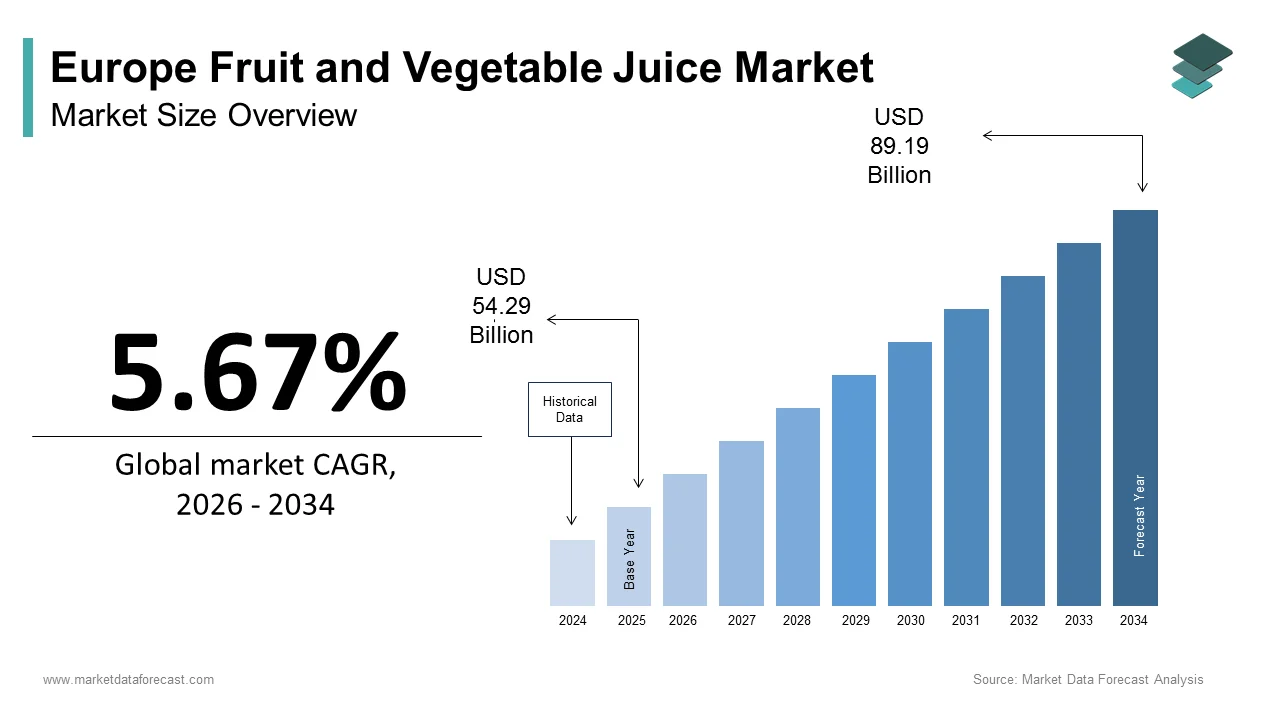
- Market Valuation: Valued at USD 54.29 billion in 2025, estimated at USD 57.37 billion in 2026, and projected to reach USD 89.19 billion by 2034, registering a CAGR of 5.67% from 2026 to 2034.
- Primary Growth Drivers: Rising health consciousness increasing demand for functional and low-sugar blends, alongside stable volume channels created by school and institutional procurement programs.
Key Market Segment Metrics (2026–2034)
| Category | Leading Segment (Position) | Fastest-Growing / Key Growth Segment |
|---|---|---|
| By Flavor & Channel | Fruit juice (dominated by flavor in 2025) & Supermarkets (captured majority distribution share in 2025) | Vegetable juice (fastest-growing segment at 9.6% CAGR) & On-trade channel (fastest-growing channel at 11.4% CAGR) |
| By Technology & Innovation | Traditional pasteurization and standard regional bottling lines | Cold-pressed and high-pressure processing (HPP) technologies, upcycled fruit/vegetable byproducts, and waste valorization |
| By Country / Regional Dynamics | Germany (led regionally with a 22.3% market share, followed by the United Kingdom) | Institutional procurement programs and clean-label circular economy initiatives across European hubs |
Major Market Players & Market Structure
Market Structure: Highly competitive European beverage sector characterized by EU sugar reduction compliance, cold-pressed premium innovations, upcycled ingredient integration, and sustainable agricultural sourcing partnerships.
Key Companies: Del Monte Foods, PepsiCo, Welch’s, Nestlé, Ocean Spray Cranberries, Dr. Pepper Snapple Group Inc., Citrus World, The Coca-Cola Company, and Döhler Group.
 Download Free Sample Report
Europe Fruit and Vegetable Juice Market Size
The size of the European fruit and vegetable juice market was calculated to be USD 54.29 billion in 2025 and is anticipated to be worth USD 89.19 billion by 2034, from USD 57.37 billion in 2026, growing at a CAGR of 5.67% during the forecast period.
The fruit and vegetable juice are beverages derived from the extraction or reconstitution of fruits and vegetables, including 100% pure juices, nectars, juice blends, and functional formulations enriched with vitamins or botanicals. Unlike sugary soft drinks, these products are increasingly positioned as health-oriented alternatives aligned with EU nutritional guidelines and consumer wellness trends. The market operates under stringent regulatory frameworks, including Regulation (EU) No 1169/2011 on food information to consumers and Directive 2001/112/EC, which defines juice categories and permitted additives. According to Eurostat, over 8.2 billion liters of fruit and vegetable juices were consumed in the European Union in 2025, with per capita intake averaging 18.4 liters annually. The European Food Safety Authority recognizes that 100% fruit juice contributes to daily fruit intake when consumed in moderation, though it cautions against excessive sugar consumption. National dietary guidelines in countries like Germany and Sweden now recommend vegetable juice blends for their lower glycemic impact.
MARKET DRIVERS
Rising Health Consciousness Drives Demand for Functional and Low Sugar Blends
The increasing prioritizing of beverages that support specific health outcomes, such as immune function, digestion, and cardiovascular wellness, for fortified and vegetable-based juice blends is propelling the growth of Europe fruit and vegetable juice market. According to the European Commission’s Special Eurobarometer on Food Safety, 72% of EU citizens actively seek products with added health benefits, with vitamin C and antioxidants ranking as top priorities. This has led to the proliferation of functional juices containing ingredients like ginger, turmeric, and beetroot for anti-inflammatory and endurance properties. In Germany, the Federal Ministry of Food and Agriculture reports that vegetable juice sales grew by 19% annually between 2022 and 2025, outpacing traditional fruit juices. Retailers like Edeka and Carrefour now dedicate “wellness beverage” aisles featuring cold-pressed blends with no added sugar and clear front-of-pack nutrition labeling. The European Food Safety Authority’s qualified health claims for polyphenols in berry juices further legitimize marketing efforts. This shift transforms juice from a simple refreshment into a targeted wellness tool, expanding its relevance beyond breakfast tables to fitness and preventive health routines.
School and Institutional Procurement Programs Create Stable Volume Channels
The public sector initiatives mandate the inclusion of 100% fruit and vegetable juices in school meal programs and institutional catering, generating predictable uptake for producers. The school and institutional procurement programs create stable volume channels, which are propelling the growth of Europe fruit and vegetable juice market. According to the European Commission’s School Fruit and Vegetables Scheme, over 12 million children in 25 member states receive fresh produce or juice weekly, with 380 million liters of juice procured annually under this program alone. Countries like Finland and Sweden prioritize locally sourced apple and berry juices during harvest seasons, supporting regional farmers while meeting nutritional standards. In France, the National Nutrition and Health Program requires all school canteens to offer unsweetened juice options, creating consistent demand for compliant suppliers. Similarly, hospitals and corporate cafeterias under the EU Platform for Action on Diet and Physical Activity increasingly replace sugary drinks with vegetable blends. This institutional anchoring provides price stability and volume certainty that buffers producers against retail volatility and encourages investment in processing infrastructure for small and medium growers.
MARKET RESTRAINTS
EU Sugar Reduction Initiatives Constrain Traditional Juice Formulations
The European Union’s aggressive public health strategy to reduce free sugar consumption directly challenges conventional fruit juice products, due to their naturally high fructose content, which is hampering the growth of Europe fruit and vegetable juice market. According to the World Health Organization’s European Office, 13 member states have implemented or proposed taxes on sugary beverages, with several, including Portugal and the UK, explicitly including fruit juice in their definitions. The European Commission’s Farm to Fork Strategy sets a target of reducing added and free sugars in processed foods by 10% by 2025, pressuring brands to reformulate. Consequently, major retailers like Tesco and Aldi now restrict shelf space for juices exceeding 5 grams of sugar per 100 milliliters. The European Food Safety Authority’s 2023 scientific opinion reaffirmed that while 100% juice counts toward fruit intake, its liquid form lacks fiber and can contribute to excess calorie consumption. These regulatory and retail headwinds force producers to either dilute with water or add non-nutritive sweeteners, which conflict with clean label trends or shift toward inherently low sugar vegetable bases, fundamentally altering product portfolios.
Seasonal and Climatic Volatility Disrupts Raw Material Supply and Pricing
Europe’s fruit and vegetable juice industry faces acute vulnerability to weather-related crop failures that destabilize supply chains and inflate input costs. According to the European Environment Agency, extreme weather events, including late frosts, droughts, and hailstorms, have increased by 28% since 2020, directly impacting key juice crops. In 2024, Poland lost 35% of its apple harvest, where the EU’s largest loss due to unseasonal frosts, causing concentrate prices to surge by 42%, as reported by the International Fruit Juice Association. Similarly, Spain’s orange production declined by 22% in 2025 due to prolonged drought, forcing reliance on costly Brazilian imports. Unlike global commodities, juice producers cannot easily hedge against such localized disruptions due to varietal specificity and quality requirements. Small and medium processors lack the scale to secure long-term contracts, leaving them exposed to spot market volatility. This climatic fragility undermines cost predictability and complicates compliance with fixed price institutional tenders, threatening the economic viability of regional juice businesses.
MARKET OPPORTUNITIES
Expansion of Cold-Pressed and High-Pressure Processing Technologies Enables Premium Innovation
The adoption of non-thermal processing methods like high-pressure processing and cold pressing to deliver superior nutritional quality and extended shelf life without preservatives is likely to create new opportunities for the growth of Europe's fruit and vegetable juice market. According to the European Institute of Innovation and Technology, HPP capacity in the EU grew by 34% between 2022 and 2025, enabling brands to retain heat-sensitive vitamins and enzymes that traditional pasteurization destroys. Companies like Suja in Germany and Innocent in the UK leverage HPP to offer refrigerated vegetable blends with a 30-day shelf life and clean labels free from additives. The European Food Safety Authority acknowledges that HPP effectively inactivates pathogens while preserving bioactive compounds, supporting premium health claims. As consumer demand for “raw” and minimally processed foods intensifies, HPP and cold press technologies unlock new premium segments that transcend traditional juice categories.
Integration of Upcycled Fruit and Vegetable Byproducts Aligns with Circular Economy Goals
The utilization of surplus or imperfect produce and processing residues, such as pomace skins and pulp, creates sustainable value streams that align with EU circular economy mandates. The integration of upcycled fruit and vegetable byproducts aligns with circular economy goals, which is eventually to set up new opportunities for the growth of Europe's fruit and vegetable juice market. According to the European Circular Economy Stakeholder Platform, over 42 juice producers across the Netherlands, Belgium, and Italy now incorporate upcycled ingredients into their formulations, diverting an estimated 180000 metric tons of agricultural waste annually from landfills. Brands like Rubies in the Rubble in the UK and Peel Pioneers in the Netherlands transform discarded citrus peels and apple pomace into fiber-rich juices with enhanced texture and polyphenol content. The European Commission’s Horizon Europe program has allocated 28 million euros to projects developing valorization techniques for juice byproducts, recognizing their potential to reduce environmental impact and improve resource efficiency. Consumers respond positively, where a YouGov Europe survey found that 68% of shoppers prefer brands using upcycled ingredients. This synergy between waste reduction and nutritional enhancement positions upcycled juice as a credible pillar of Europe’s sustainable food future.
MARKET CHALLENGES
Fragmented National Labeling Regulations Increase Compliance Complexity
Despite EU harmonization efforts, significant disparities in national interpretation of juice labeling rules create operational burdens for pan-European brands. While Directive 2001/112/EC defines “fruit juice” as 100% extracted liquid, countries differ on permissible reconstitution methods and naming conventions for blends. According to the European Commission’s Internal Market Scoreboard, Germany requires an explicit declaration of concentrate usage even in 100% juice, while France permits “pure juice” labeling for reconstituted products. Italy mandates regional origin disclosure for certain fruits, whereas Spain does not. These inconsistencies force manufacturers to maintain multiple label versions, increasing packaging costs by 15 to 20%, as reported by FoodDrinkEurope. The European Court of Justice ruled in 2024 that such divergences violate the principle of free movement, yet full alignment remains distant. Until a unified EU juice labeling regulation emerges, producers will face redundant compliance overhead that stifles innovation and inflates consumer prices.
Consumer Confusion Over Nutritional Value Undermines Category Trust
The persistent ambiguity among European consumers regarding the health implications of fruit juice compared to whole fruit erodes category credibility and drives substitution toward water or plant-based alternatives. The consumer confusion over nutritional value undermines category trust, and also slows the growth of Europe fruit and vegetable juice market. According to the European Food Information Council, only 38% of EU citizens correctly identify that 100% fruit juice lacks dietary fiber and has similar sugar content to soda. This knowledge gap fuels negative perceptions amplified by media headlines linking juice to childhood obesity. In response, schools in Denmark and the Netherlands have removed juice from meal programs entirely, replacing it with whole fruit or water. The European Society for Paediatric Gastroenterology recommends limiting juice to 120 milliliters per day for children, a guideline rarely communicated at the point of sale. Without coordinated public education campaigns and clearer front-of-pack labeling distinguishing juice from whole fruit, the category risks long-term decline as health-conscious consumers opt for perceived safer alternatives, regardless of actual nutritional science.
REPORT COVERAGE
| REPORT METRIC | DETAILS |
| Market Size Available | 2025 to 2034 |
| Base Year | 2025 |
| Forecast Period | 2026 to 2034 |
| CAGR | 5.67% |
| Segments Covered | By Flavour, Type, Concentration, Distribution Channel, And Region |
| Various Analyses Covered | Global, Regional & Country Level Analysis; Segment-Level Analysis; DROC, PESTLE Analysis; Porter’s Five Forces Analysis; Competitive Landscape; Analyst Overview of Investment Opportunities |
| Regions Covered | UK, France, Spain, Germany, Italy, Russia, Sweden, Denmark, Switzerland, Netherlands, Turkey, and the Czech Republic |
| Market Leaders Profiled | Del Monte Foods, Del Monte Foods Corporation, Pepsi Co, Welch’s, Nestle, Ocean Spray Cranberries, Dr. Pepper Snapple Group Inc., and Citrus World |
SEGMENTAL ANALYSIS
By Flavour Insights
The fruit juice segment was the largest by holding a significant share of the Europe fruit and vegetable juice market in 2024, owing to the deep-rooted cultural traditions, widespread availability, and consumer familiarity with flavors like orange, apple, and grape. According to Eurostat, per capita consumption of fruit juice in the EU averages 14.3 liters annually, with countries like Germany and the UK exceeding 18 liters per person. The European Food Safety Authority recognizes 100% fruit juice as a contributor to daily fruit intake with its legitimacy in dietary guidelines. National school programs further entrench demand, where the EU’s School Fruit Scheme distributed a million litres of fruit juice in 2025, primarily apple and orange varieties. Retailers allocate prime shelf space to fruit juices due to high turnover and brand loyalty, with private label offerings from Edeka, Carrefour, and Tesco ensuring affordability. While health concerns around sugar persist, the emotional appeal of familiar flavors and breakfast rituals sustains fruit juice as the default choice for millions of European households.
The vegetable juice segment is likely to expand at the fastest CAGR of 9.6% throughout the forecast period. National health authorities across Europe increasingly recommend vegetable juice as a practical way to meet daily vegetable consumption targets for children and elderly populations with chewing difficulties. According to the European Commission’s Joint Research Centre, only 14% of EU adults meet the recommended five servings of vegetables per day, creating a nutritional gap that juice can partially address. Sweden’s National Food Agency explicitly endorses unsweetened beetroot and carrot blends as part of balanced diets, while Germany’s DGE includes vegetable juice in its official food pyramid. School meal programs in Finland and the Netherlands now feature low-sodium tomato and mixed vegetable juices as standard offerings. This institutional endorsement legitimizes vegetable juice as a health tool rather than a niche product, driving trial and habitual consumption among demographics previously unreached by traditional produce marketing. Brands leverage the naturally low glycemic index and high nitrate content of vegetable juices to target specific wellness outcomes. According to the European Functional Food Association, over 620 new vegetable juice SKUs were launched in 2025, featuring claims related to immunity, digestion, and heart health. Companies like Innocent and Biotta use cold-pressed methods to preserve heat-sensitive nutrients, commanding 30 to 40% price premiums.
By Type Insights
The ambient fruit and vegetable juice segment held a dominant share of the Europe fruit and vegetable juice market in 2024, due to its extended shelf life, logistical simplicity, and affordability in mainstream retail channels. Pasteurized and aseptically packaged in cartons or PET bottles, ambient juice requires no refrigeration until opening, reducing transport and storage costs significantly. According to the European Federation of Bottled Waters and Juices, ambient format juice sales in supermarkets and hypermarkets across Southern and Eastern Europe are growing, where chilled infrastructure is limited. Brands like Tropicana and private labels from Aldi and Lidl rely on ambient formats to achieve pan-European distribution without cold chain dependencies. The format also dominates institutional procurement for schools and hospitals due to ease of storage and bulk handling. While perceived as less fresh than chilled alternatives, ambient juice remains the backbone of mass market accessibility, particularly in price-sensitive regions.
The chilled juice segment is expected to witness the fastest CAGR of 8.9% throughout the forecast period, owing to the premiumization and cold chain expansion. Investments in refrigerated logistics and in-store chillers have dramatically expanded the reach of chilled juice beyond urban centers. Retailers like Edeka and Tesco upgraded over 12000 stores with energy-efficient juice chillers in 2024 alone, increasing visibility and impulse purchases. This infrastructure growth allows premium brands like Eckes Granini and Copella to scale beyond niche markets while maintaining product integrity. European consumers increasingly associate chilled juice with freshness, authenticity, and superior nutritional value compared to shelf-stable alternatives. According to the European Food Information Council, many shoppers believe chilled juice contains fewer additives and more vitamins, with a perception reinforced by clear labeling and glass bottle packaging. The rise of “raw” and “living” juice trends further amplifies demand, with social media influencers promoting chilled green juices as detox staples.
By Concentration Insights
The 100% juice segment was the largest by accounting for 52.3% of the Europe fruit and vegetable juice market share in 2024 from explicit recognition under EU Directive 2001/112/EC, as a legitimate fruit serving and strong consumer trust in its purity. Unlike nectars or juice drinks, 100% juice contains no added sugars, water, or preservatives by aligning with clean label demands. According to the European Commission, 100% juice is included in national dietary guidelines in 22 member states as a valid contributor to daily fruit intake when consumed in moderation. Institutional buyers prioritize it for school and hospital programs, where the EU School Fruit Scheme procured 210 million liters of 100% juice in 2025. Brands like Eckes Granini and Tropicana invest heavily in origin storytelling, highlighting Italian oranges or Polish apples to reinforce authenticity.
The 100% vegetable juice segment is expected to grow at the fastest CAGR of 10.2% throughout the forecast period. As member states implement measures to reduce free sugar consumption, 100% vegetable juices gain a strategic advantage due to inherently low fructose levels. According to the World Health Organization’s European Office, vegetable juices like tomato and carrot contain less than 3 grams of sugar per 100 milliliters compared to 9 to 10 grams in fruit variants. Countries like Portugal and the UK that tax sugary beverages explicitly exempt 100% vegetable juices by creating a regulatory safe harbor. Retailers respond by expanding shelf space; Carrefour’s “Low Sugar” section in France that features 100% beetroot and celery blends with prominent front-of-pack labeling. Consumers increasingly reject nectars and juice drinks containing added water sweeteners or flavorings, driving demand for pure 100% vegetable formulations. Brands like Biotta and Rabenhorst use glass bottles and minimal ingredient lists to signal purity, appealing to conscious shoppers.
By Distribution Channel Insights
The supermarkets and hypermarkets segment was the largest by capturing a dominant share of the Europe fruit and vegetable juice market in 2024, serving as the main conduit for both branded and private label products across all price tiers. According to Eurostat, 82% of European households shop for groceries weekly at large format retailers, where juice is a staple category. These channels offer extensive shelf space, temperature-controlled sections for chilled variants, and promotional end caps that drive volume. Private label programs from Edeka, Carrefour, and Tesco ensure competitive pricing while national brands leverage seasonal campaigns, such as winter vitamin C boosts or summer hydration, to maintain visibility. The scale and frequency of supermarket purchases make them indispensable for mass market penetration for ambient and family size formats that require bulk handling and consistent replenishment.
The on-trade channel segment is likely to grow at the fastest CAGR of 11.4% throughout the forecast period. Restaurants, juice bars, and wellness cafes are elevating fruit and vegetable juice from commodity to culinary experience through house-made cold-pressed blends and functional pairings. According to the European Restaurant Association, 64% of upscale urban venues in London, Berlin, and Barcelona added dedicated juice menus in 2025 featuring ingredients like turmeric, ginger, and spirulina. These establishments position juice as a non-alcoholic alternative to cocktails or a pre-meal digestive aid, often priced at 6 to 9 euros per serving. Chains like Joe & The Juice operate 120 outlets across Europe, offering customized green and red shots with protein or collagen boosts. This gastronomic framing transforms juice into a lifestyle choice rather than a grocery item, attracting health-conscious millennials and Gen Z consumers willing to pay premium prices for perceived quality and exclusivity. Companies are increasingly incorporating premium juices into workplace wellness initiatives to boost employee health and retention. Google’s Dublin office orders 800 juice shots weekly from local supplier Press Brothers for its staff cafe, while consulting firms in Frankfurt partner with organic brands for team meeting refreshments. This institutional B2B demand creates recurring high-margin revenue streams insulated from retail price competition. As hybrid work stabilizes, offices seek ways to entice staff back with premium amenities, making on-trade juice a strategic tool in corporate culture, elevating it from refreshment to retention asset.
REGIONAL ANALYSIS
Germany Fruit and Vegetable Juice Market Analysis
Germany was the top performer of the Europe fruit and vegetable juice market by holding 22.3% of the market share in 2024, owing to the strong health consciousness, high purchasing power, and advanced retail infrastructure. Germans consume over 18 liters per capita annually, with demand split between traditional apple juice and emerging vegetable blends, as per recent studies. The country’s dense network of discounters (Aldi, Lidl), supermarkets (Edeka, Rewe), and organic stores (Alnatura) ensures broad accessibility across price segments. Eckes Granini, headquartered in Niederdollendorf, dominates with brands like Hohes C and Rio Delle Antiche, while private labels capture value segments. The Federal Ministry of Food promotes juice as part of balanced diets, yet cautions against excess sugar, driving reformulation toward lower sugar and vegetable mixes.
United Kingdom Fruit and Vegetable Juice Market Analysis
The United Kingdom fruit and vegetable juice market growth is likely to be driven by the regulatory influence and premium functional growth. The Soft Drinks Industry Levy, implemented in 2018, explicitly exempted 100% juice but pressured nectars to reformulate, accelerating the shift toward pure and vegetable variants. According to the Office for National Statistics, per capita consumption stands at 16.2 liters, with strong demand for cold-pressed green juices in urban centers. Brands like Innocent lead in functional innovation with immunity and gut health blends, while private labels from Tesco and Sainsbury’s ensure mass market access. The National Health Service promotes vegetable juice for children and elderly populations, creating institutional demand.
France Fruit and Vegetable Juice Market Analysis
France fruit and vegetable juice market is growing steadily with its unique balance of culinary heritage and health-driven evolution. Traditional apple and grape juices remain popular in rural areas while urban consumers embrace vegetable blends and cold-pressed formats. According to FranceAgriMer, per capita intake reached 15.4 liters in 2025 with strong regional preferences. Normandy favors cider-style apple juice while Provence leans toward citrus. Carrefour and Auchan lead private label development with organic and low sugar variants prominently featured. The National Nutrition and Health Program includes 100% juice in school meals yet restricts added sugar in children’s products, driving clean label adoption. French consumers value origin and terroir, and brands highlight regional fruit sources like Corsican clementines or Alsatian apples.
Italy Fruit and Vegetable Juice Market Analysis
Italy fruit and vegetable juice market growth is likely to grow with the seasonal consumption patterns and integration into the Mediterranean diet. Italians prefer freshly squeezed orange and blood orange juice during the winter months, with consumption peaking at 20 liters per capita in citrus-producing regions like Sicily and Calabria, as per ISTAT. Industrial juice competes with home juicing yet gains ground through convenience and fortified variants. Conad and Coop lead retail distribution with strong private label programs emphasizing local sourcing. The Ministry of Health promotes tomato and vegetable juices as part of heart-healthy eating, aligning with national dietary identity. Export of Italian citrus concentrate also supports domestic processing capacity.
Netherlands Fruit and Vegetable Juice Market Analysis
The Netherlands' fruit and vegetable juice market growth is likely to grow with the juice imports, and is a leader in health-oriented consumption. Dutch consumers exhibit high openness to vegetable blends and functional formulations, with per capita intake of 17.1 liters, according to Statistics Netherlands. Albert Heijn and Jumbo drive innovation with extensive organic and low sugar selections while supporting local apple and berry juice producers. Public health campaigns promote juice as a fruit serving, yet emphasize portion control. The Dutch Nutrition Centre provides clear guidance distinguishing juice from whole fruit, fostering informed consumption. This combination of logistical advantage and nutritional literacy positions the Netherlands as a progressive and influential market in the European juice landscape.
COMPETITION OVERVIEW
Competition in the Europe fruit and vegetable juice market is defined by a three-tier structure: mass market leaders, premium functional brands, and organic specialists. Global players like Eckes Granini compete on scale, distribution efficiency, and private label partnerships serving mainstream supermarkets with affordable ambient and chilled options. Premium innovators such as Innocent focus on cold-pressed functional formulations and experiential branding targeting urban wellness consumers through on-trade and specialty retail. Meanwhile, organic purists like Biotta occupy a niche centered on biodynamic integrity and therapeutic positioning distributed via health food stores and pharmacies. Success hinges on balancing affordability with authenticity while navigating the tension between public health messaging and consumer taste preferences in an increasingly scrutinized beverage category.
KEY MARKET PLAYERS
A few major players of the Europe fruit and vegetable juice market include
- Del Monte Foods
- Del Monte Foods Corporation
- Pepsi Co
- Welch’s
- Nestle
- Ocean Spray Cranberries
- Dr. Pepper Snapple Group Inc
- Citrus World
Top Strategies Used by the Key Market Participants
Key players in the Europe fruit and vegetable juice market prioritize clean label formulations with no added sugars or artificial ingredients to align with consumer demand for transparency. They invest in cold-pressed and high-pressure processing technologies to preserve nutrients and extend shelf life without preservatives. Companies develop functional juice blends targeting specific health benefits such as immunity, digestion, and heart health to capture premium segments. Strategic partnerships with pharmacies, schools, and corporate wellness programs create stable off-take channels beyond retail.
Leading Players in the Europe Fruit and Vegetable Juice Market
- Eckes Granini Group GmbH is a Germany-based global leader in fruit and vegetable juices with deep roots in the European market through its iconic brands Hohes C and Rio Delle Antiche. The company operates 12 production facilities across Europe, producing over 2 billion liters annually with a strong focus on 100% juices, nectars, and functional blends. Eckes Granini leverages its integrated supply chain from orchard to bottle to ensure consistent quality and traceability. It launched a new line of cold-pressed vegetable juices under the Hohes C Vital range, featuring beetroot, carrot, and ginger formulations targeted at health-conscious urban consumers. These initiatives reinforce its position as a trusted innovator in Europe’s evolving juice landscape.
- Innocent Drinks Ltd is a UK-headquartered pioneer in premium cold-pressed fruit and vegetable juices known for its ethical branding and functional formulations. Acquired by Coca-Cola yet operating with strategic autonomy, Innocent maintains its European innovation hub in London, developing recipes that blend taste with wellness benefits. The company sources fruits and vegetables from certified sustainable farms across Europe and uses high-pressure processing to retain nutrients without preservatives. It introduced a new range of immunity-boosting shots featuring acerola cherry, turmeric, and echinacea, aligned with post pandemic health trends. Innocent also expanded its carbon-neutral delivery fleet to 100% across the UK and Benelux regions, reinforcing its environmental commitments.
- Biotta AG is a Swiss-based specialist in organic vegetable and fruit juices with a heritage in biodynamic farming and holistic nutrition. The company produces over 100 million liters annually from its facility in Tägerwilen using Demeter-certified ingredients and glass bottle packaging to preserve purity. Biotta’s portfolio emphasizes vegetable-dominant blends such as beetroot, spinach, and celery, marketed for detoxification and digestive health. It launched a new line of functional juices enriched with plant based protein and prebiotic fibers targeting fitness and gut health segments. The firm also partnered with Swiss and German pharmacies to distribute its products through health professional channels, enhancing credibility. Biotta’s unwavering commitment to organic integrity and therapeutic positioning has made it a benchmark for clean-label vegetable juice across Central and Alpine Europe.
MARKET SEGMENTATION
This research report on the Europe fruit and vegetable juice market has been segmented and sub-segmented based on flavour, type, concentration, distribution channel & region.
By Flavour
- Fruit
- Mango
- Apple
- Guava
- Pomegranate
- Grape
- Orange
- Lemon
- Pineapple
- Others
- Vegetable
- Carrot
- Beetroot
- Tomato
- Pumpkin
- Others
By Type
- Ambient
- Chilled
- Frozen
- Others
By Concentration
- 100% juice
- 25-99% juice
- 4 <25% juice
- Flavored
- Others
By Distribution Channel
- Convenience stores
- Supermarkets or hypermarkets
- Independent retailers
- On-trade
By Region
- UK
- France
- Spain
- Germany
- Italy
- Russia
- Sweden
- Denmark
- Switzerland
- Netherlands
- Turkey
- Czech Republic
- Rest of Europe