- Product Description Description
- Table of Contents TOC
- List of Table & Figure LOT
- Get Free Sample PDF Sample PDF
Market Size, 2025
$5.61 BnMarket Estimate, 2026
$6.05 BnMarket Forecast, 2034
$11.09 BnCAGR, 2026–2034
7.87%Europe Fruit & Vegetable Seeds Market Size, Growth, Trends & Forecast (2026–2034)
The Europe fruit & vegetable seeds market size was valued at USD 5.61 billion in 2025, is anticipated to reach USD 6.05 billion in 2026, and is projected to scale up to USD 11.09 billion by the end of 2034, registering a compound annual growth rate (CAGR) of 7.87% during the forecast period from 2026 to 2034. Driven by EU regulatory mandates for organic farming under the Farm to Fork Strategy, increasing demand for certified organic seeds, and a surge in protected indoor/greenhouse cultivation, the regional market continues to expand steadily.
Key Executive Metrics (At-a-Glance)
- 2025 Base Valuation: USD 5.61 Billion
- 2026 Current Valuation: USD 6.05 Billion
- 2034 Forecast Valuation: USD 11.09 Billion
- Compound Annual Growth Rate (CAGR): 7.87% (2026–2034)
- Leading Country Market: France (holding a major share backed by extensive germplasm collections and seed-breeding infrastructure)
- Covered Country Markets: United Kingdom, France, Spain, Germany, Italy, Russia, Sweden, Denmark, Switzerland, Netherlands, and Rest of Europe
Core Market Drivers
- Organic Farming Mandates: Implementation of EU Regulation 2018/848 and the Farm to Fork Strategy targeting 25% organic agricultural land by 2030, spurring massive demand for certified organic seeds.
- Niche Variety Adoption: Consumer preference for local, regional, and heirloom produce driving the registration and cultivation of diverse open-pollinated seed varieties.
Primary Market Restraints & Challenges
- Regulatory Barriers: Strict EU seed marketing laws (Directive 2002/55/EC) imposing complex Distinctness, Uniformity, and Stability (DUS) testing requirements that limit traditional variety registration.
- Supply Chain Vulnerabilities: Overreliance on extra-EU seed imports and offshore multiplication hubs leaving the continental food system exposed to geopolitical and climatic trade shocks.
Europe Fruit & Vegetable Seeds Market Segmentation Breakdown
| Segment Category | Largest / Dominant Segment | Fastest-Growing / Alternative Segments |
|---|---|---|
| By Trait | Conventional Crop Seeds | Genetically Modified (GM) / Gene-Edited Lines (CAGR of 3.1%) |
| By Type | Solanaceae (28.3% share) | Leafy Vegetable Seeds (CAGR of 9.6%) |
| By Form | Inorganic (Conventional Hybrid) Seeds | Organic Seeds (CAGR of 12.3%) |
| By Farm Type | Outdoor Farms | Indoor / Controlled Environment Agriculture (CAGR of 18.7%) |
| By Country | France | Spain, Germany & Netherlands |
Major Industry Players Profiled
Key enterprises shaping the European fruit and vegetable seeds market include Bayer CropScience AG, Syngenta AG, BASF SE, Rijk Zwaan Zaadteelt en Zaadhandel BV, Monsanto Company, Groupe Limagrain, Sakata Seed Corporation, Takii & Co Ltd., Advanta Limited, Mahyco, Mahindra Agri, and Western Bio Vegetable Seeds Ltd.
Europe Fruit & Vegetable Seeds Market Size
The Europe fruit & vegetable seeds market size was valued at USD 5.61 billion in 2025 and is anticipated to reach USD 6.05 billion in 2026 to reach USD 11.09 billion by 2034, growing at a CAGR of 7.87% during the forecast period from 2026 to 2034.
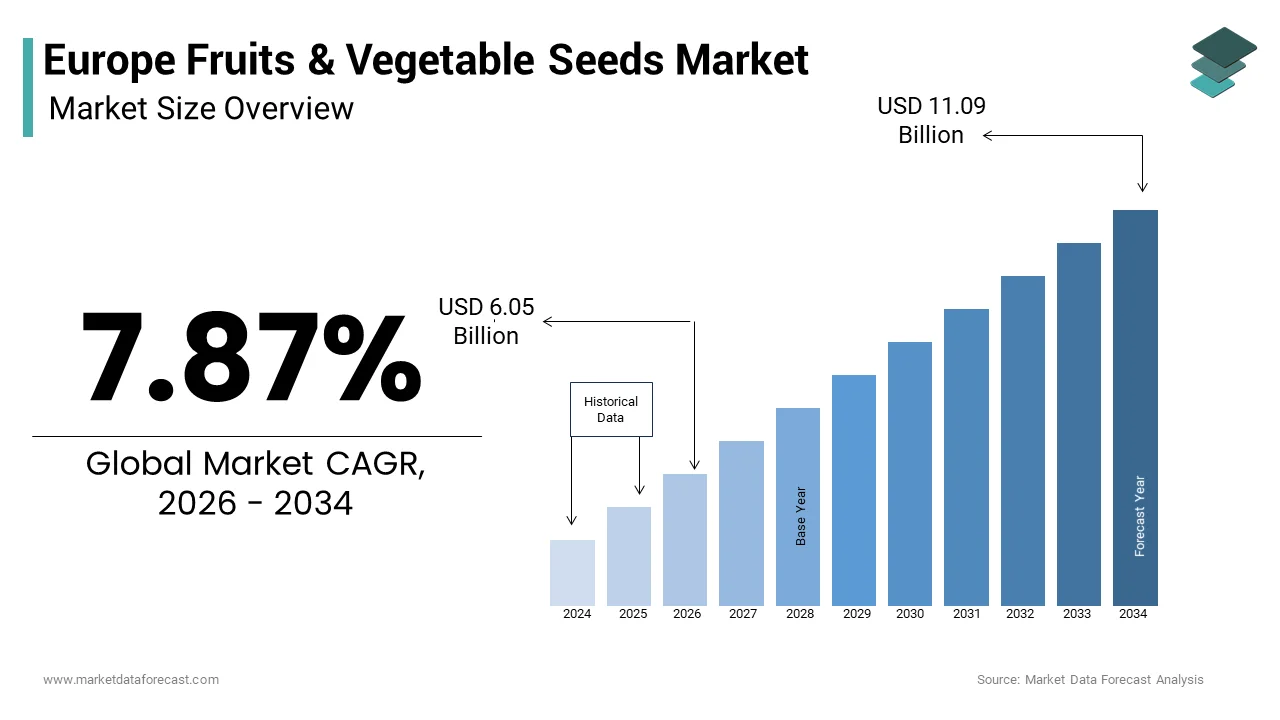
The Fruit And Vegetable Seeds are used for cultivating edible horticultural crops, including tomato, peppers, cucumbers, leafy greens, berries, and stone fruits across commercial ffarmssmarket ggardenseand home growing settings. These seeds range from conventional open-pollinated varieties to hybrid and increasingly biotechnologically enhanced lines developed for yield resilience and climate adaptation. According to Eurostat, over 1.8 million hectares of land in the EU were dedicated to fruit and vegetable cultivation in 2023, reflecting a sustained agricultural focus. As per the European Commission’s Farm to Fork Strategy, 25 % of EU agricultural land is targeted for organic farming by 2030, driving demand for certified organic seeds. Additionally, the European Food Safety Authority maintains a positive list of approved vegetable species for seed registration, ensuring varietal purity and traceability.
MARKET DRIVERS
Expansion of Organic Farming Under EU Policy Mandates Drives Seed Demand
The expansion of organic farming under EU policy mandates is propelling the growth of the Europe fruit and vegetable seeds market. This expansion directly increases reliance on organic seeds, which EU Regulation 2018/848 mandates must be used whenever commercially available. However, supply remains constrained. This gap has spurred investment by seed companies in organic breeding programs. In Germany, FFranceeand the Netherlands n, a national organic seed database now lists over 1,200 certified organic vegetable varieties, up from 650 in 2020. Public funding under Horizon Europe has also supported projects like Organic Seed Innovation to develop disease-resistant organic tomato and carrot lines.
Consumer Preference for Local and Diverse Produce Fuels Niche Variety Adoption
The growing consumer preference for local and diverse products is prompting the growth of the Europe fruit and vegetable seeds market. European consumers are increasingly seeking locally grown seasonal and heirloom fruits and vegetables, which is driving demand for specialized and non-mainstream seed varieties. This shift has revitalized interest in open-pollinated and landrace seeds that offer distinct flavors, colors, and textures absent in commercial hybrids. Seed savers networks and small-scale breeders in Italy, Spain, and Greece have responded by registering over 200 traditional vegetable varieties in the EU Common Catalogue since 2021 as per the European Commission’s Community Plant Variety Office. Supermarkets like Eataly and specialty retailers now feature produce grown from these niche seeds, creating market pull.
MARKET RESTRAINTS
Stringent EU Seed Marketing Regulations Limit Variety Registration and Access
The European Union’s seed marketing framework imposes significant barriers to the registration and commercialization of new or traditional fruit and vegetable varieties. The stringent EU seed marketing regulations are impeding the growth of the Europe fruit and vegetable seeds market. Under Directive 2002/55/EC and Regulation EU 2017/625, only seeds of varieties listed in the EU Common Catalogue may be legally sold, requiring extensive Distinctness, Uniformity, and Stability testing. This burden disproportionately affects small seed enterprises and farmer breeders who lack resources for bureaucratic compliance. As per a 2023 study by the International Panel of Experts on Sustainable Food Systems, traditional vegetable landraces in Southern Europe remain unregistered due to these requirements.
Dependence on Extra EU Seed Imports Creates Supply Chain Vulnerability
The imports for key crops, creating strategic supply risks, are additionally inhibiting the growth of Europe’s fruit and vegetable seeds market. The hybrid vegetable seed volume in 2023 was primarily from the United States, Netherlands-based multinationals’ offshore facility, and Israel. This dependency became evident during the 2022 Suez Canal disruptions, which delayed seed shipments and forced last-minute substitutions in Italian and Spanish nurseries. Consequently, geopolitical trade or climatic shocks can rapidly cascade into planting delays, reduced varietal choice, and yield instability across European farms with vulnerability in the continental food system.
MARKET OPPORTUNITIES
Development of Climate Resilient Varieties Through Advanced Breeding Techniques
The increasing breeding programs that are leveraging genomic selection and high-throughput phenotyping to address Europe’s climate adaptation needs are a major opportunity for the growth of Europe’s fruit and vegetable seeds market. EU vegetable growing areas face high or very high water stress in the summer months. In response, public research institutions like Wageningen University and INRAE have developed drought-tolerant lettuce and heat-stable pepper lines using marker-assisted selection without genetic modification. Additionally, the European Innovation Partnership for Agricultural Productivity and Sustainability supports on-farm participatory trials where farmers co-select promising lines.
Growth of Vertical and Controlled Environment Agriculture Opens New Seed Segments
The rapid expansion of vertical farms, greenhouses, and other controlled environment agriculture systems across Europe is creating demand for specialized seed varieties optimized for artificial lighting, hydroponics, and dense planting. The growth of vertical and controlled environment agriculture is expected s substantially leverage the growth of the Europe fruit and vegetable seeds market. These systems require compact disease-resistant and fast cycling cultivars that differ significantly from field varieties. For instance, leafy greens bred for vertical farms exhibit reduced internode length, higher nutrient density, and resistance to tip burn under LED spectra. Seed companies like Rijk Zwaan and Enza Zaden have launched dedicated CEA seed portfolios with traits validated in indoor settings.
MARKET CHALLENGES
Loss of Agricultural Biodiversity Threatens Long-Term Crop Resilience
The ongoing erosion of agrobiodiversity, which undermines the genetic foundation needed for future breeding, is likely to pose new challenges to the growth of the Europe Fruit and Vegetable Seeds Market. Over 90 % of historic vegetable varieties in Europe have been lost since the early 20th century, with fewer than 10 commercial hybrids dominating major crops like tomatoes and carrots. This genetic homogenization increases vulnerability to emerging pathogens, where the 2021 outbreak of Fusarium wilt TR4 in greenhouse cucumbers. While the EU hosts over 50 national gene banks, these collections remain underutilized in breeding due to a lack of phenotypic data and legal barriers to access.
Rising Input Costs and Labor Shortages Reduce Farmer Investment in Premium Seeds
The mounting economic pressures that constrain their ability to adopt high-quality or innovative seed varieties will additionally degrade the growth of the Europe Fruit and Vegetable Seeds Market. The lower cost of saved seeds rather than investing in premium hybrids with disease resistance or yield advantages. As per a 2024 survey by the German Farmers Association, some small-scale vegetable producers reduced seed expenditure by switching to cheaper or uncertified sources. This trend is exacerbated by volatile market prices for fresh produce, which compress margins.
REPORT COVERAGE
| REPORT METRIC | DETAILS |
| Market Size Available | 2025 to 2034 |
| Base Year | 2025 |
| Forecast Period | 2026 to 2034 |
| CAGR | 7.87% |
| Segments Covered | By Trait, Type, Form, and Farm Type Components |
| Various Analyses Covered | Global, Regional & Country Level Analysis, Segment-Level Analysis, DROC, PESTLE Analysis, Porter’s Five Forces Analysis, Competitive Landscape, Analyst Overview on Investment Opportunities |
| Regions Covered | UK, France, Spain, Germany, Italy, Russia, Sweden |
| Market Leaders Profiled | Bayer CropScience AG, Syngenta AG, Advanta Limited, Monsanto Company, Groupe Limagrain, Sakata Seed Corporation, Takii & Co Ltd., Mahyco, Mahindra Agri, Western Bio Vegetable Seeds Ltd. |
SEGMENTAL ANALYSIS
By Trait Insights
The conventional crop seeds segment was the largest and held a significant share of the European and Vegetable Seeds Market in 2025. As per the European Commission, no GM fruit or vegetable variety has received authorization for commercial planting in the EU since the regulatory framework was established in 2001. Consequently, seed companies focus exclusively on conventional breeding techniques, including hybridization m,, marker-assisted selection, and mutagenesis to develop improved varieties. The European Food Safety Authority maintains a zero-tolerance stance on GM contamination in conventional seed lots with thresholds set below 0.1 % for adventitious presence. National seed certification bodies in Germany, France, and the Netherlands enforce rigorous testing protocols to ensure compliance. This regulatory and societal consensus ensures that conventional seeds remain the sole viable option for European growers across all horticultural sectors.

The GM segment is projected to grow at a CAGR of 3.1% throughout the forecast period, owing to the research activity and potential regulatory reconsideration for specific applications. According to the European Network of GMO Laboratories, over 40 experimental permits for GM tomato and potato were issued in 2023 under Directive 2001/18/EC. The European Commission’s 2023 proposal on new genomic techniques seeks to relax regulations for certain gene-edited crops that could mimic natural mutations, potentially creating a pathway for non-transgenic edited seeds. Additionally, global seed multinationals maintain GM research pipelines in EU-affiliated labs to prepare for possible future market openings.
By Type Insights
The Solanaceae seeds segment was the largest and held 28.3% of the Europe fruit And Vegetable Seeds Market share in 202, with the high consumer demand, intensive cultivation systems, and year-round production in protected environments. Southern European countries like Spain, Italy, and the Netherlands specialize in greenhouse tomato and pepper production, supplying fresh markets across the continent. According to the European Vegetable Oil and Proteinmeal Industry Federation, commercial tomato varieties in Europe are F1 hybrids bred for disease resistance, yield uniformity, and shelf life. The Dutch seed industry alone registers more than 200 new tomato varieties annually with the Community Plant Variety Office. Additionally, the rise of snacking tomatoes and specialty peppers has spurred demand for diverse seed lines.
The Leafy vegetable seeds segment is projected to expand at a CAGR of 9.6% from 2025 to 2033, owing to surging demand for salads,, aby ggreensss and microgreens in retail food service and vertical farming. Seed companies have responded with specialized varieties featuring slow bolting, crisp texture, and enhanced nutrient density. A 2024 study by Wageningen University demonstrated that indoor optimized lettuce lines yielded more biomass under LED lighting than standard field types. Furthermore, the EU’s School Fruit and Vegetable Scheme now includes diverse leafy greens, increasing institutional demand.
By Form Insights
The inorganic seeds segment was the largest by capturing a dominant share of the Europe fruit And Vegetable Seeds Market in 2024. Most commercial vegetable production in the EU in high-output regions like the Netherlands, Spain, and Italy relies on hybrid inorganic seeds optimized for yield, disease resistance, and mechanized harvesting. Seed certification protocols under EU Directive 2002/55/EC do not differentiate between organic and inorganic seed production for registration purposes, allowing conventional seeds to be used even in organic systems when organic alternatives are unavailable. Additionally, organic seeds benefit from decades of breeding investment, resulting in superior uniformity and performance. These agronomic and systemic factors ensure inorganic seeds remain the backbone of European horticulture.
The organic seeds segment is esteemed to grow with a CAGR of 12.3% throughout the forecast period, which is directly tied to the EU’s binding target of 25 % organic agricultural land by 2030, which mandates the use of organic seeds whenever available. According to FiBL Europe, the number of certified organic vegetable seed varieties listed in EU national databases increased from 650 in 2020 to over 1,300 in 2023. Additionally, organic seed enterprises like Bingenheimer and Sativa have scaled production through cooperative breeding networks across France and Switzerland.
By Farm Insights
The outdoor farms segment accounted in holding a significant share of the Europe Fruit and Vegetable Seeds Market in 2024 due to the vast scale of field production for crops like potatoes, carrots, cabbage, and field tomatoes. According to Eurostat, open field vegetable cultivation occurred in the EU in 2023 primarily in Eastern and Southern Europe, where land and labor costs favor extensive systems. Countries like Poland, Romaniaand Spain rely on outdoor farming for bulk vegetable supply to processing and fresh markets. These systems prioritize high-yielding stress-tolerant seed varieties adapted to seasonal climates and mechanized sowing. Although protected cultivation is growing, outdoor farming remains economically dominant for staple vegetables, ensuring continued high volume demand for field-adapted seeds across the continent.
The indoor farms segment is expected to register a CAGR of 18.7% in next coming years with the proliferation of vertical farms, greenhouses, and controlled environment agriculture facilities in urban and peri-urban areas. These systems require specialized seeds bred for artificial lighting, high-density planting, and rapid-cycling trtraitsbsent from additional yields. Seed developers like Rijk Zwaan and Bejo have launched dedicated indoor seed portfolios with validated performance under LED spectra. The European Commission’s AgriTech Strategy now includes indoor farming in innovation funding, further accelerating adoption.
COUNTRY ANALYSIS
France Fruit And Vegetable Seeds Market Analysis
The French fruit and vegetable seeds market was the largest by holding a 23rd share in 2024, with its strong public breeding programs and commitment to organic seed development. The French National Institute for Agricultural Research maintains one of Europe’s largest vegetable germplasm collections with over 15,000 accessions used in breeding for disease resistance and climate adaptation. France is also a leader in field vegetable production,n particularly carrots,s, and endive, with over 200,000 hectares under cultivation. The country hosts major seed companies like Vilmorin Mikado and Clause, which supply both European and global markets. Regulatory support through the French Seed and Plant Interprofessional Organization ensures rigorous varietal testing and certification. These institutional agronomic and policy strengths sustain France’s role as a diversified and resilient seed market.
Germany Fruit And Vegetable Seeds Market Analysis
Germany's fruit and vegetable seeds market growth is likely to grow with high demand for quality seeds, organic innovation, and strong small-scale farming. The country is home to leading organic seed enterprises like Bingenheimer and Dreschflegel, which supply certified organic seeds to over 20,000 organic farms. Public research at institutions like the Julius Kühn Institute focuses on breeding for pest resistance without chemical inputs. Additionally, German consumers’ preference for regional and seasonal produce supports diverse seed demand beyond commercial hybrids. These cultural, sc scientific, and policy factors position Germany as a leader in sustainable and biodiverse seed systems.
Spain Fruit And Vegetable Seeds Market Analysis
Spain's fruit and vegetable seeds market growth is likely to grow with its role as the continent’s winter vegetable garden and intensive protected cultivation. This system demands high-performance hybrid seeds with resistance to soil-borne pathogens and heat stress. Spanish seed companies like Semillas Fitó and Syngenta’s local division develop varieties specifically for Mediterranean conditions. The country also leads in seed production with over 15,000 hectares dedicated to seed multiplication.
Italy Fruit And Vegetable Seeds Market Analysis
Italy's Fruit and Vegetable Seeds market growth is likely to grow with its rich agrobiodiversity and strong demand for traditional and specialty varieties. The country cultivates over 500 local vegetable landraces, including San Marzano tomatoes and Chioggia beets m many of which are now registered in the EU Common Catalogue. Italy is also a major producer of processing tomatoes with over 8 million tons harvested annually, requiring specific seed traits for mechanical harvesting and solids content.
COMPETITIVE LANDSCAPE
The Europe Fruit and Vegetable Seeds Market features a dynamic mix of multinational agrochemical firms, specialized vegetable seed companies, and public research institutions competing on genetic innovation, agronomic performance, and sustainability credentials. Unlike ctthemoditycrophthee vvegetableector is highly fragmented by crop type, region, and farming systems, creating opportunities for niche players. Competition centers on developing varieties that meet specific needs such as greenhouse adaptation, organic certification, or urban farming suitability. Regulatory constraints on genetic modification limit technological pathways favoring conventional and new genomic techniques that comply with EU law. Large companies leverage global R and D networks and digital tools while smaller breeders differentiate through heritage varieties and farmer collaboration. Price is less decisive than trait reliability, seed purity, and technical support.
KEY MARKET PLAYERS
A few of the market players in the European fruit & vegetable seeds market include
- include Bayer CropScience AG
- Syngenta AG
- BASF SE (through BASF Agricultural Solutions)
- Advanta Limited
- Rijk Zwaan Zaadteelt en Zaadhandel BV
- Monsanto Company
- Groupe Limagrain
- Sakata Seed Corporation
- Takii & Co Ltd.
- Mahyco
- Mahindra Agri
- Western Bio Vegetable Seeds Ltd.
Top Players In The Market
- Bayer AG is a global leader in agricultural innovation with a significant presence in the Europe fruit And Vegetable Seeds Market through its extensive portfolio of hybrid vegetable seeds under brands like Seminis and De Ruiter. The company supplies seeds for tomatoes, peppers, cucumbers, and leafy greens tailored to European growing conditions and market demands. Bayer invests heavily in research and development at its European breeding stations in France and Germany, focusing on disease resistance, yield ststabilitydaptation. Recently, the company expanded its digital breeding platform using artificial intelligence to accelerate the development of resilient vegetable varieties. It also launched a sustainability initiative to support organic seed development in alignment with EtTheFarm to Fobjective,,tive reinforcing its commitment to European agroecological transitions.
- BASF SE contributes to the Europe Fruit and Vegetable Seeds Market through its vegetable seeds business, formerly part of Bayer and now integrated under its agricultural solutions segment. The company offers a diverse range of conventional hybrid seeds for key crops, including brassicaeafy grgreensand solanaceous vegetables. BASF emphasizes trait development for biotic and abiotic stress tolerance using advanced non-GM breeding techniques. In recent years, it has strengthened its European footprint by enhancing collaboration with local growers and research institutions in Spain, Italy, and the Netherlands. The company also introduced a digital seed selection tool that helps farmers choose optimal varieties based on soil type, climate, and market requirements. These efforts position BASF as a responsive and science-driven partner in n Europe’s evolving horticultural landscape.
- Rijk Zwaan is a Netherlands-based family-owned seed company and a major independent player in the Europe Fruit and Vegetable Seeds Market. Specializing exclusively in vegetable seeds, the company offers over 1,200 varieties across 25 crop types with a strong focus on tomatoes, cucumbers, lettuce, and peppers. Rijk Zwaan operates breeding programs in 15 countries and maintains trial stations across Europe to validate performance under local conditions. The company has recently intensified its work on indoor farming, optimized seeds, and organic varieties in response to EU policy shifts. It also launched a sustainability program that includes seed traceability, carbon footprint reduction, and support for smallholder growers.
Top Strategies Used by the Key Market Participants
Key players in the Europe Fruit and Vegetable Seeds Market prioritize investment in advanced non-GM breeding technologies such as marker-assisted selection and genomic prediction to develop climate-resilient disease-resistant varieties. They expand organic seed portfolios in response to the EU’s 25 % organic land target by 2030 and collaborate with national organic farming associations. Companies establish regional trial networks across Southern and Northern Europe to validate seed performance under diverse agroclimatic conditions. Strategic partnerships with vertical farming operators and greenhouse cooperatives drive the development of indoor optimized seed lines. Digital tools, including seed selection apps and traceability platforms, enhance grower support and supply chain transparency. Additionally, firms engage in germplasm conservation and participatory breeding with local farmers to preserve agrobiodiversity and co-develop regionally adapted varietiesaligning with both market demands and sustainability mandates.
MARKET SEGMENTATION
This research report on the European fruit & vegetable seeds market has been segmented and sub-segmented into the following regions.
By Trait
- GM
- Conventional crop seeds
By Type
- Cucurbit
- Brassica
- Leafy
- Solanaceae
- Root bulb
- Other seeds
By Form
- Organic
- Inorganic
By Farm Type
- Indoor
- Outdoor farms
By Country
- United Kingdom
- France
- Spain
- Germany
- Italy
- Russia
- Sweden
- Denmark
- Switzerland
- Netherlands
- Rest of Europe