- Product Description Description
- Table of Contents TOC
- List of Table & Figure LOT
- Get Free Sample PDF Sample PDF
Market Size, 2025
$1.65 BnMarket Estimate, 2026
$1.74 BnMarket Forecast, 2034
$2.60 BnCAGR, 2026–2034
5.16%Executive Summary: Europe Fumed Silica Market
- Market Scope: Comprehensive European fumed silica market analysis covering product types, application segments, regional leadership frameworks, and advanced material trends across industrial sectors.
- Market Valuation: Valued at USD 1.65 billion (2025), estimated at USD 1.74 billion (2026), and projected to reach USD 2.60 billion by 2034, expanding at a steady CAGR of 5.16% (2026–2034).
- Primary Growth Drivers: Increasing demand for silicone rubber in automotive and healthcare, growing adoption in high-performance paints and coatings, the European Green Deal’s sustainable manufacturing focus, and over €30 billion in advanced materials and nanotechnology investments.
Key Market Segment Metrics (2026–2034)
| Category | Leading Segment Position | Fastest-Growing Segment |
|---|---|---|
| By Type | Hydrophilic fumed silica segment (held the largest share at 61.6% in 2025) | Hydrophobic fumed silica segment (expected to register the fastest CAGR of 9.1%) |
| By Application | Silicone rubber segment (accounted for the largest share at 35.5% in 2025) | Personal care segment (projected to grow at the fastest CAGR of 10.4%) |
| By Region / Country | Germany (led the market with a 26.8% share in 2025, followed by France) | Expanding European advanced manufacturing hubs |
Major Market Players & Market Structure
Market Structure: Highly competitive European specialty chemicals landscape characterized by eco-friendly product innovations, strict compliance with REACH directives, and strategic expansion into pharmaceuticals and green building materials.
Key Companies: Reade International Corp., Tokuyama Corporation, Lawrence Industries, Hubei Xingfa Chemicals Group Co., Ltd., Flexicon Corporation, Orisil Ltd., Wacker Chemie AG, Evonik Industries AG, Cabot Corporation, and Kemitura A/S.
Europe Fumed Silica Market Size
The Europe fumed silica market size was valued at USD 1.65 billion in 2025 and is expected to reach USD 2.60 billion by 2034 from USD 1.74 billion in 2026, growing at a CAGR of 5.16% from 2026 to 2034.
Fumed silica is a versatile nanomaterial produced through the hydrolysis of silicon compounds and is widely utilized across various industries due to its unique properties such as thickening, anti-settling, and reinforcing capabilities. In Europe, the fumed silica market is driven by its extensive applications in silicone rubber, plastics, paints, coatings, and pharmaceuticals. According to the European Chemical Industry Council, the demand for fumed silica in Europe grew by 7% in 2022, supported by advancements in material science and increasing adoption in high-performance applications. The European Commission's Green Deal initiative emphasizes sustainable manufacturing practices, further boosting demand for eco-friendly fumed silica solutions. Additionally, according to Eurostat, investments in advanced materials and nanotechnology exceeded €30 billion in 2022, creating a favorable environment for market growth.
MARKET DRIVERS
Increasing Demand for Silicone Rubber in Europe
The rising demand for silicone rubber is a major driver for the European fumed silica market. According to the European Rubber Manufacturers Association, silicone rubber production in Europe grew by 10% in 2022, driven by its widespread use in automotive, construction, and healthcare applications. Fumed silica plays a critical role as a reinforcing agent, enhancing the mechanical properties and thermal stability of silicone rubber. The European Commission reports that over 60% of silicone rubber formulations incorporate fumed silica, reflecting its indispensable role in achieving high performance. The versatility and reliability of fumed silica ensure its sustained dominance in the silicone rubber sector, particularly for applications requiring compliance with stringent performance standards.
Growing Adoption in Paints and Coatings
The growing adoption of fumed silica in paints and coatings is further fuelling the growth of the European market. According to the European Paints and Coatings Association, the demand for high-performance additives in architectural and industrial coatings grew by 8% in 2022, driven by increasing consumer awareness of durability and aesthetic quality. Fumed silica is extensively used as a rheology modifier and anti-settling agent, ensuring uniform dispersion and enhanced shelf life of coatings. The European Commission's Horizon Europe program emphasizes innovation in sustainable materials, further boosting demand for eco-friendly fumed silica solutions. This trend positions fumed silica as a cornerstone of growth in the paints and coatings industry.
MARKET RESTRAINTS
High Production Costs
High production costs associated with fumed silica is a significant restraint for the European market. According to the European Federation of Chemical Industries, the cost of producing fumed silica is approximately 30-40% higher than traditional fillers and additives, limiting its affordability for small and medium-sized enterprises (SMEs). The European Chemical Industry Council notes that over 60% of manufacturers cite affordability as a primary barrier to integrating fumed silica into their formulations, particularly in low-margin industries. Additionally, fluctuations in raw material prices, particularly silicon tetrachloride, exacerbate this issue. According to the European Metals Association, the cost of silicon tetrachloride surged by 25% in 2022 due to supply chain disruptions, impacting profit margins. These financial barriers not only hinder market growth but also constrain investments in scaling production capacities and expanding product portfolios.
Stringent Regulatory Standards
Stringent regulatory standards governing the use of nanomaterials is also restraining the growth of the European fumed silica market. According to the European Chemicals Agency, fumed silica must comply with strict safety and environmental regulations under the REACH Directive, which mandates rigorous testing and documentation to ensure compliance. The European Commission reports that over 40% of fumed silica projects face delays due to these stringent requirements, impacting time-to-market. Additionally, the European Federation of Chemical Industries highlights that compliance costs for fumed silica producers have risen by 20% over the past three years, limiting affordability for SMEs. These regulatory hurdles not only hinder market growth but also deter new entrants, constraining overall expansion.
MARKET OPPORTUNITIES
Advancements in Sustainable Manufacturing Practices
Advancements in sustainable manufacturing practices is a lucrative opportunity for the European fumed silica market. According to the European Commission's Green Deal initiative, over 30% of European industries are transitioning to eco-friendly materials, driving demand for bio-based and recyclable fumed silica solutions. Additionally, the European Technology Platform for Sustainable Chemistry highlights the increasing use of fumed silica in green building materials and renewable energy applications, further amplifying demand. This opportunity positions fumed silica as a critical enabler of Europe's sustainability goals, aligning with the region's commitment to reducing carbon footprints.
Expansion into Emerging Applications
The growing focus on emerging applications such as pharmaceuticals and personal care is another promising opportunity for the European fumed silica market. According to the European Pharmaceutical Manufacturers Association, the demand for fumed silica in drug formulations and excipients grew by 12% in 2022, driven by its ability to enhance flowability and stability. Similarly, the European Cosmetics Association reports a 15% annual increase in its use in skincare and haircare products, where it acts as a thickening and stabilizing agent. Additionally, the European Commission's Circular Economy Action Plan supports the development of sustainable beauty and healthcare solutions, amplifying the need for advanced materials like fumed silica. This opportunity underscores the immense potential for market expansion in these high-growth sectors.
MARKET CHALLENGES
Supply Chain Disruptions
Supply chain disruptions is a significant challenge to the European fumed silica market, exacerbated by logistical bottlenecks and geopolitical tensions. According to the European Maritime Safety Agency, shipping delays increased by 25% in 2022, affecting the timely delivery of raw materials and finished products. The Russia-Ukraine conflict has further disrupted the supply of key raw materials such as silicon tetrachloride, which accounts for nearly 70% of fumed silica production expenses. The European Chemical Industry Council reports that imports of certain raw materials declined by 40% in 2022, leading to shortages and price spikes. These disruptions not only elevate operational costs but also hinder production schedules, impacting market stability. According to Eurostat, over 30% of manufacturers experienced production halts in 2022 due to supply chain challenges, underscoring the severity of this issue.
Limited Awareness Among Small-Scale Manufacturers
Limited awareness among small-scale manufacturers regarding the benefits of fumed silica is also challenging the growth of the European market. According to the European Federation of Chemical Industries, less than 40% of small and medium-sized enterprises (SMEs) in Europe utilize fumed silica in their formulations, creating a significant knowledge gap. According to the European Commission, over 50% of SMEs struggle to adopt advanced materials due to insufficient training and education. This lack of awareness not only slows the adoption of fumed silica but also limits innovation and technological advancement. Addressing this challenge requires coordinated efforts between governments, educational institutions, and industry stakeholders to develop comprehensive awareness initiatives.
REPORT COVERAGE
| REPORT METRIC | DETAILS |
| Market Size Available | 2025 to 2034 |
| Base Year | 2025 |
| Forecast Period | 2026 to 2034 |
| CAGR | 5.16% |
| Segments Covered | By Type, Application, and Region |
| Various Analyses Covered | Global, Regional, & Country Level Analysis; Segment-Level Analysis; DROC; PESTLE Analysis; Porter’s Five Forces Analysis; Competitive Landscape; Analyst Overview of Investment Opportunities |
| Regions Covered | UK, France, Spain, Germany, Italy, Russia, Sweden, Denmark, Switzerland, Netherlands, Turkey, Czech Republic, Rest of Europe |
| Market Leaders Profiled | Reade International Corp., Tokuyama Corporation, Lawrence Industries, Hubei Xingfa Chemicals Group Co., Ltd., Flexicon Corporation, Orisil Ltd., Wacker Chemie AG, Evonik Industries AG, Cabot Corporation, Kemitura A/S, and others. |
SEGMENTAL ANALYSIS
By Type Insights
The hydrophilic fumed silica segment dominated the market by holding 61.6% of the European market share in 2025. The widespread use of hydrophilic fumed silica as a thickening agent, anti-settling additive, and reinforcing filler in industries such as paints, coatings, and adhesives is majorly driving the expansion of the segment in the European market. The European Commission reports that over 70% of hydrophilic fumed silica consumed in Europe is utilized in industrial applications, reflecting its widespread adoption. The versatility and performance of hydrophilic fumed silica ensure its sustained dominance in the market, particularly for applications requiring compliance with stringent performance standards.
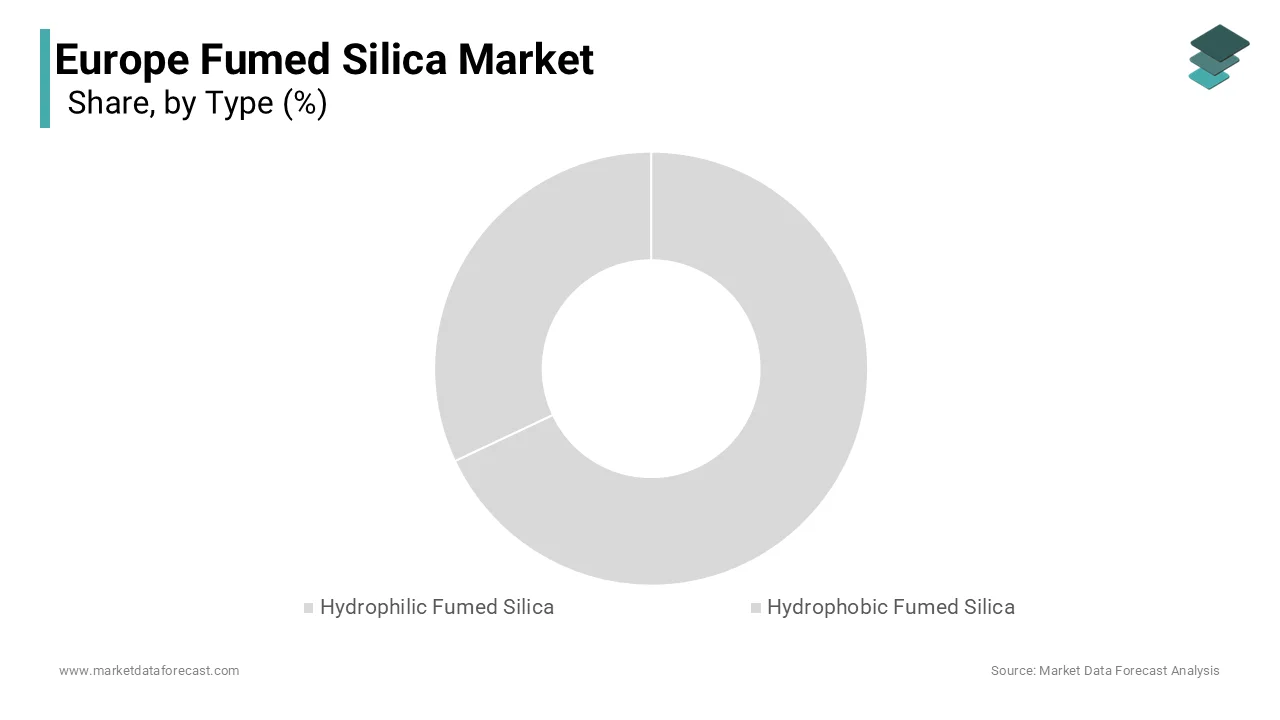
The hydrophobic fumed silica segment is anticipated to register a promising CAGR of 9.1% over the forecast period due to its increasing adoption in high-performance applications such as silicone rubber, pharmaceuticals, and personal care products, where it provides superior moisture resistance and flowability. Additionally, the European Commission's Horizon Europe program supports the development of sustainable materials, amplifying the need for hydrophobic fumed silica. This trend positions hydrophobic fumed silica as a key driver of innovation in the European market.
By Application Insights
The silicone rubber segment occupied 35.5% of the European market share in 2025. The leading position of silicone rubber segment in the European market is attributed to its extensive use of fumed silica as a reinforcing agent, enhancing the mechanical properties and thermal stability of silicone rubber. The European Commission reports that over 60% of silicone rubber formulations incorporate fumed silica, reflecting its widespread adoption. The versatility and reliability of fumed silica ensure its sustained dominance in the silicone rubber sector.
The personal care segment is estimated to exhibit a CAGR of 10.4% over the forecast period owing to the increasing demand for eco-friendly and clean-label ingredients in skincare and haircare formulations. Fumed silica is extensively used as a thickening and stabilizing agent in cosmetics, ensuring compliance with stringent safety regulations. Additionally, the European Commission's Circular Economy Action Plan supports the development of sustainable beauty solutions, amplifying the need for advanced materials like fumed silica. This trend positions personal care as a key driver of innovation in the European market.
REGIONAL ANALYSIS
Germany had the major share of 26.8% of the European fumed silica market in 2025. The prominence of Germany in the European market is attributed to the country's robust chemical and automotive industries, which account for over 40% of total fumed silica consumption in Europe. The German Federal Ministry for Economic Affairs and Climate Action reports that over 60% of domestic fumed silica production is utilized in silicone rubber and coatings, reflecting the region's leadership in adopting advanced manufacturing technologies. Additionally, Germany's strategic investments in sustainable materials create a favorable environment for market growth, aligning with the European Green Deal initiative.
France accounted for a significant share of the European market in 2025 and is estimated to witness a prominent CAGR over the forecast period. The strong presence of France in the cosmetics and coatings sectors drives fumed silica adoption in France. According to the French Ministry of Agriculture, the growing use of fumed silica in clean-label formulations, while the French Cosmetics Association reports a 15% annual increase in its use in skincare and haircare products. Furthermore, France's focus on sustainability boosts the use of eco-friendly fumed silica
KEY MARKET PLAYERS
The major key players in Europe Fumed Silica market are Reade International Corp., Tokuyama Corporation, Lawrence Industries, Hubei Xingfa Chemicals Group Co., Ltd., Flexicon Corporation, Orisil Ltd., Wacker Chemie AG, Evonik Industries AG, Cabot Corporation, Kemitura A/S, and others.
MARKET SEGMENTATION
This research report on the Europe fumed silica market is segmented and sub-segmented into the following categories.
By Type
- Hydrophilic Fumed Silica
- Hydrophobic Fumed Silica
By Application
- Silicone Rubber
- Plastics and Composites (Unsaturated Polyester Resin)
- Food and Beverages
- Paints and Coatings (Including Inks)
- Adhesives and Sealants
- Other Applications (Pharmaceutical, Personal Care, and Chemicals and Fertilizers)
By Country
- UK
- France
- Spain
- Germany
- Italy
- Russia
- Sweden
- Denmark
- Switzerland
- Netherlands
- Turkey
- Czech Republic
- Rest of Europe