Europe Furfural Market Size, Share, Trends & Growth Forecast Report By Raw Material, By Application, and By Country (Germany, France, Italy, Netherlands, Spain, United Kingdom, Sweden & Rest of Europe) – Industry Analysis and Forecast, 2026 to 2034
Market Size, 2025
$123.21 KilotonsMarket Estimate, 2026
$126.62 KilotonsMarket Forecast, 2034
$157.56 KilotonsCAGR, 2026–2034
2.77%Europe Furfural Market Summary
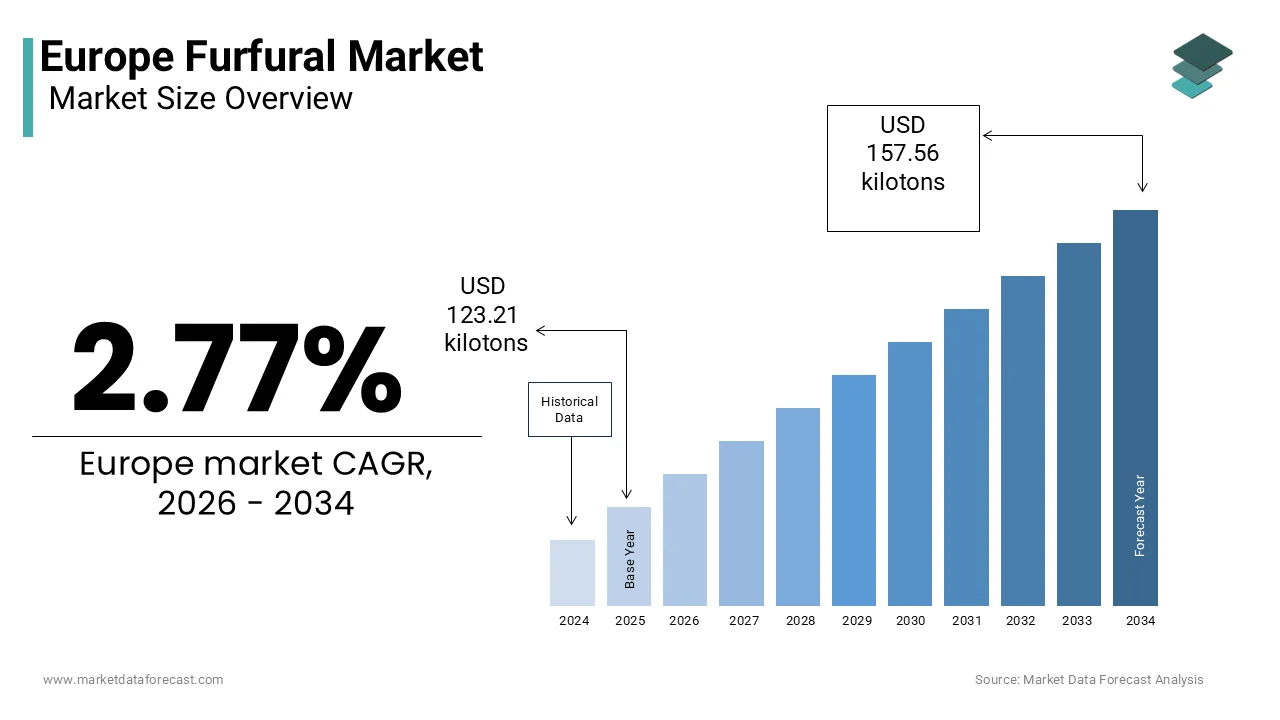
The Europe furfural market, valued at 123.21 kilotons in 2025, is projected to reach 157.56 kilotons by 2034, growing at a CAGR of 2.77% driven by bio-based foundry resins, green solvent substitution, and circular biorefinery integration.
Key Market Highlights
- 2025 Market Size: 123.21 kilotons
- 2026 Market Size: 126.62 kilotons
- 2034 Forecast: 157.56 kilotons
- CAGR (2026–2034): 2.77%
- Base Year: 2025
- Forecast Period: 2026–2034
Quick Growth Drivers
- Rising adoption of furfuryl alcohol–based foundry resins under EU emission regulations
- Shift toward bio-based solvents in pharmaceuticals and fine chemicals
- Regulatory pressure under REACH, Green Deal, and Zero Pollution Action Plan
- Stable demand from automotive and metal casting industries
- Increasing policy support for non-food biomass valorization
Principal Restraints
- Classification of furfural as an SVHC under REACH, increasing compliance burden
- Tight occupational exposure limits raising production and handling costs
- Fragmented and seasonal agricultural residue supply chains
- Limited flexibility for expansion into consumer-facing applications
High-Value Opportunities
- Integration of furfural into next-generation, multi-output biorefineries
- EU funding under Horizon Europe and Circular Bio-Based Europe JU
- Development of furfural-to-sustainable aviation fuel (SAF) pathways
- Cascading biomass use models improving carbon and material efficiency
- Increased utilization of residues such as corncobs and bagasse
Key Market Challenges
- Technological stagnation in batch-based furfural production systems
- High capital costs and long payback periods for continuous processing upgrades
- Competitive pressure from alternative bio-based platform chemicals
- Price volatility and uncertain long-term offtake commitments
Fastest-Growing Segments
- Sugarcane Bagasse–Based Feedstock – driven by integrated biorefinery models
- Solvent Applications – pharma, agrochemical, and fine chemical substitution
- SAF Precursors – emerging high-growth, policy-backed application
Regional Leadership & Dynamics
- Germany (24.4%) – largest market, anchored by foundry industry and bioeconomy policy
- France – access to overseas biomass and strong public bioeconomy funding
- Italy – agricultural residues and green chemistry clusters
- Netherlands – solvent recovery infrastructure and circular logistics hub
- Spain – growing residue valorization and rural bioeconomy initiatives
What Wins Commercially
- Secure access to pentosan-rich agricultural residues
- Compliance with REACH, CLP, and Industrial Emissions Directive
- Integration with downstream foundry and solvent recovery systems
- Participation in EU-funded bioeconomy consortia
- Ability to supply high-purity, application-specific grades
Top Strategic Ask for Executives
Invest in integrated biorefineries, process intensification, and high-value derivative pathways to defend relevance amid regulatory pressure and rising competition from alternative bio-based platform chemicals.
Leading Players
Some of the companies that are playing a dominating role in the Europe furfural market include
AVA Biochem, Silvateam S.p.A., Penn A Kem Europe, Ameco Clean Energy, Anhui BBCA Biochemical, Shandong Fuhua Tongda Chemical, Zhejiang Furfural Chemical, Renewable Chemicals Group (RCG), Furfural Chemicals Ltd., and others.
Europe Furfural Market Size
The Europe furfural market was valued at 123.21 kilotons in 2025, is estimated to reach 126.62 kilotons in 2026, and is projected to reach 157.56 kilotons by 2034, growing at a CAGR of 2.77% from 2026 to 2034.
Furfural is a renewable heterocyclic aldehyde produced through the acid-catalysed dehydration of pentose sugars found in lignocellulosic biomass such as corncobs, oat hulls, and sugarcane bagasse. In the European context, furfural functions as a foundational platform chemical for synthesizing furfuryl alcohol, tetrahydrofuran, and other high-value derivatives used in foundry resins, pharmaceutical intermediates, and green solvents. The market operates within a stringent regulatory ecosystem shaped by the EU’s Green Deal, Circular Economy Action Plan, and REACH legislation. According to the European Commission’s Joint Research Centre, the European Union continues to rely heavily on biomass for food, feed, energy, and materials, with significant flows documented in 2023. As per the European Environment Agency, many agriculture-dependent habitats in the EU remain in poor conservation status, which highlights challenges in fully utilizing agricultural residues for sustainable chemical production. According to the Renewable Energy Directive II, the European Union has set a binding target that 32% of its energy consumption must come from renewable sources by 2030, which is a goal that indirectly supports biorefinery development. Unlike commodity-driven markets, the European furfural sector is defined by its intersection with sustainability mandates, supply chain fragmentation, and technological constraints.
MARKET DRIVERS
Expansion of Bio-Based Foundry Resins Drives Furfural Demand
The European foundry industry’s shift toward furfuryl alcohol-based binders represents a primary demand catalyst for furfural, which is one of the major factors propelling the European furfural market growth. These binders, essential for producing high-integrity molds in metal casting, offer superior thermal stability and lower emissions compared to phenolic or urea-formaldehyde alternatives. According to the European Casting Association, the EU produced millions of metric tons of castings in 2024, with ferrous alloys constituting the majority of output, each requiring robust resin systems. Germany, Italy, and Poland lead this transition, which is driven by compliance with the Industrial Emissions Directive, which limits volatile organic compound emissions. As per the German Foundry Association, a growing share of German foundries now use furan resins compared to 2019. The European Commission’s Circular Economy Action Plan further incentivizes bio-based binders, aligning with broader decarbonization goals. According to the European Automobile Manufacturers Association, vehicle production in 2024 remained strong, sustaining downstream demand for precision cast components across automotive and aerospace sectors.
Rising Utilization of Furfural in Sustainable Solvent Applications
Furfural’s adoption as a green solvent in pharmaceutical and agrochemical purification processes is gaining momentum due to its biodegradability, selectivity, and regulatory acceptability, which is further boosting the expansion of the European furfural market. Unlike petroleum-derived solvents such as toluene, furfural exhibits lower ecotoxicity and is derived from non-food biomass, and is aligning with EU chemical safety priorities. According to the European Chemicals Agency, over a thousand substances are under REACH reauthorization review, prompting industries to seek safer alternatives. As per the European Pharmaceutical Group, a significant share of active pharmaceutical ingredient manufacturers in Western Europe integrated bio-based solvents between 2021 and 2024, with furfural playing a key role in antibiotic and vitamin isolation. The EU’s Green Deal Chemistry Strategy explicitly endorses platform chemicals from agricultural residues, while the Zero Pollution Action Plan targets a reduction in hazardous chemical use by 2030. According to the European Solvents Industry Group, registrations for furfural-based solvent blends increased year-on-year in 2023, particularly in France and the Netherlands,s where solvent recovery infrastructure is mature. This regulatory and performance-driven shift positions furfural as a strategic enabler of sustainable chemistry in Europe.
MARKET RESTRAINTS
Stringent Regulatory Classification Under REACH Limits Market Flexibility
Furfural’s designation as a Substance of Very High Concern under the EU’s REACH regulation significantly constrains its market potential. Listed since 2010 for its classification as a Category 2 carcinogen and reproductive toxicant, furfural triggers extensive communication, labeling, and exposure control obligations. According to the European Commission’s REACH implementation report, many small and medium enterprises avoid handling SVHC-listed substances due to high compliance costs. Downstream users must submit detailed exposure scenarios, which is increasing administrative burden andetersng adoption in consumer-facing applications. As per the European Trade Union Institute, occupational exposure limits were tightened in 2022, necessitating costly engineering controls in production facilities. Although industrial uses like resin manufacturing remain authorized, the stigma and legal complexity discourage innovation in new applications such as food additives or cosmetics. This regulatory friction reduces market elasticity and impedes cross-sectoral diffusion, despite furfural’s renewable origin and functional versatility.
Inconsistent and Fragmented Agricultural Residue Supply Chains
The economic viability of furfural production in Europe is hampered by the spatial dispersion and seasonal variability of lignocellulosic feedstock, which further hampers the growth of the European furfural market. Unlike regions with centralized agro-processing, the EU’s agricultural system is highly decentralized across 27 member states, each with differing residue management practices. According to the Joint Research Centre of the European Commission, only a portion of cereal straw and corncob residues are economically recoverable due to competition with soil health practices and livestock use. In 2023, Germany harvested millions of hectares of corn but collected a limited share of corncobs for industrial use, as per the Federal Ministry of Food and Agriculture. Similarly, France’s sugar beet pulp faces logistical bottlenecks in reaching biorefineries. As per the Biomass Research Network Europe, transport costs account for a large share of total feedstock expenses when facilities are located far from source fields. The absence of standardized pricing, long-term contracts, or coordinated collection networks undermines supply security, inflates production costs, and discourages investment in new furfural capacity.
MARKET OPPORTUNITIES
Integration into Next-Generation Biorefineries Presents Strategic Growth Avenues
The integration of furfural production into advanced multi-output biorefineries offers a transformative opportunity for the European furfural market. Unlike standalone plants, integrated facilities co-produce furfural alongside lignin, cellulose nanofibers, and biofuels from the same biomass input, maximizing value extraction. According to the Bio-Based Industries Joint Undertaking, several demonstration-scale biorefineries incorporating furfural platforms received significant funding under Horizon Europe. As per industry reports, pilot plants in Scandinavia have shown higher carbon efficiency compared to sequential processing. The European Commission’s Innovation Fund has designated furfural valorization as a priority for carbon capture and utilization projects, projecting potential displacement of carbon emissions by 2030. The updated EU Bioeconomy Strategy promotes cascading biomass use, where furfural extraction precedes energy recovery, further enhancing material efficiency. According to the European Parliament, billions of euros have been allocated to the Circular Bio-Based Europe Joint Undertaking through 2027, positioning integrated furfural production for accelerated deployment, particularly in Scandinavia and the Baltics.
Emergence of Furfural-Derived Sustainable Aviation Fuel Pathways
Furfural’s conversion into sustainable aviation fuel precursors represents a high-impact growth corridor for the European furfural market. Through catalytic upgrading, furfural can yield alkanes suitable for jet fuel blending, a pathway certified under ASTM standards by the European Union Aviation Safety Agency. Under the ReFuelEU Aviation initiative, airlines must blend sustainable aviation fuel starting in 2025, with targets rising toward 2050. According to the European Commission, meeting the 2030 interim target will require large volumes of bio-based feedstock annually. In 2024, TotalEnergies and Avantium launched a feasibility study at the Grandpuits biorefinery in France to scale furfural-to-kerosene conversion, targeting significant lifecycle emissions reductions compared to fossil jet fuel. As per the International Air Transport Association’s European branch, EU Emissions Trading System compliance costs for airlines are expected to rise in 2025, intensifying demand for drop-in biofuels. Given furfural’s molecular structure, which enables high-yield production of branched alkanes with excellent cold-flow properties, it stands among the most promising non-lipid feedstocks for next-generation sustainable aviation fuel in a policy-driven market.
MARKET CHALLENGES
Technological Maturity in Continuous Furfural Production Systems
Despite its long industrial history, furfural production in Europe remains technologically stagnant, relying on outdated batch or semi-continuous reactors that deliver suboptimal yields and high energy consumption, which is a notable challenge to the growth of the European furfural market. Modern continuous processes such as reactive distillation or solid-acid catalysis can increase yields, yet commercial adoption is minimal. According to the European Federation of Chemical Engineering, only a few fully continuous European plants operate in the EU as of 2025. A techno-economic analysis by the Technical University of Denmark estimated that retrofitting a standard facility would require significant investment, with long payback periods without subsidies. Catalyst deactivation due to humin formation during aqueous-phase synthesis causes frequent shutdowns, undermining process reliability. Moreover, the European Institute of Innovation and Technology reported that only a small share of Horizon Europe-funded bio-based chemical projects between 2020 and 2024 focused on furfural process intensification. This systemic underinvestment in core production technology elevates costs and hinders alignment with the EU’s Industrial Decarbonisation Roadmap, which mandates emissions reductions by 2030.
Price Volatility of Alternative Bio-Based Platform Chemicals Undermines Investment Certainty
Furfural faces intensifying competitive pressure from substitute bio-based platform chemicals such as levulinic acid and 5-hydroxymethylfurfural, whose erratic pricing disrupts market stability and deters long-term investment, which is further challenging the European furfural market expansion. Levulinic acid, derived from cellulose, competes directly in solvent and resin markets, with EU spot prices fluctuating widely in recent years, according to the European Biomass Industry Association. This volatility Europeanfrom inconsistent policy support and production setbacks, including plant closures. Simultaneously, 5-HMF positioned for polyethylene furanoate production has attracted hundreds of millions of euros in venture funding since 2021, as per the European Circular Bioeconomy Fund, diverting capital from furfural infrastructure. A survey by the European Chemical Site Promotion Platform revealed that many specialty chemical formulators maintain dual sourcing strategies for furanic compounds, reducing volume commitments to any single supplier. Additionally, the EU’s Carbon Border Adjustment Mechanism alters the landed cost of imported alternatives, particularly from Brazil and China, where production costs are lower. Without stable pricing or differentiated performance advantages, furfural risks marginalization in emerging bio-based value chains despite its established industrial presence.
REPORT COVERAGE
| REPORT METRIC | DETAILS |
| Market Size Available | 2025 to 2034 |
| Base Year | 2025 |
| Forecast Period | 2026 to 2034 |
| Segments Covered | By Raw Material, Application, and Region. |
| Various Analyses Covered | Global, Regional, and Country-Level Analysis, Segment-Level Analysis, Drivers, Restraints, Opportunities, Challenges; PESTLE Analysis; Porter’s Five Forces Analysis, Competitive Landscape, Analyst Overview of Investment Opportunities |
| Countries Covered | UK, France, Spain, Germany, Italy, Russia, Sweden, Denmark, Switzerland, Netherlands, Turkey, Czech Republic, Rest of Europe |
| Market Leaders Profiled | Ameco Clean Energy Co., Ltd., Anhui BBCA Biochemical Co., Ltd., Balaji Furfural & ChemicainnovativeGino Chemical Co., Ltd., Furfural Chemicals Ltd., GUANGDONG NANNING FURFURAL CO., LTD., Hebei Chemical Co., Ltd., Jiangsu Jinhai Technology Co., Ltd., Linxens International Holding S.A., Renewable Chemicals Group (RCG), Santa Cruz Biotechnology, Inc., Shaanxi Jiateng Chemical Co., Ltd., Shandong Fuhua Tongda Chemical Co., Ltd., Tianjin Jinhai Technology Co., Ltd., Valerolactones, LLC, Zhejiang Furfural Chemical Co., Ltd., A.R. Chemtech Pvt. Ltd., Koch Industries (via specialty chemical subsidiaries), T.T.C. Chemical Corporation, Mega Chem Industries |
SEGMENTAL ANALYSIS
By Raw Material Insights
The corncobs segment led the market by holding 41.4% of the European market share in 2025. The leading position of the corncobs segment in this regional market is driven by their high pentosan content, which enables efficient furfural yields during acid hydrolysis. According to the European Commission’s Joint Research Centre, the EU harvested large volumes of grain maize in 2024, generating significant amounts of corncobs as a byproduct. Germany, France, and Romania are the primary contributors, with Germany producing extensive corn harvests, as reported by the Federal Ministry of Food and Agriculture. The widespread adoption of combine harvesters in these countries ensures consistent corncob availability post-harvest, unlike manual harvesting systems that leave residues in fields. Additionally, the Common Agricultural Policy incentivizes residue valorization through rural development funds, indirectly supporting furfural feedstock collection. Corncobs also benefit from lower moisture content compared to alternatives like bagasse, reducing drying costs and improving process economics. As per the Biomass Research Network Europe, corncob-based furfural facilities achieve higher energy efficiency than those using rice or cotton hulls due to favorable lignin-to-hemicellulose ratios.
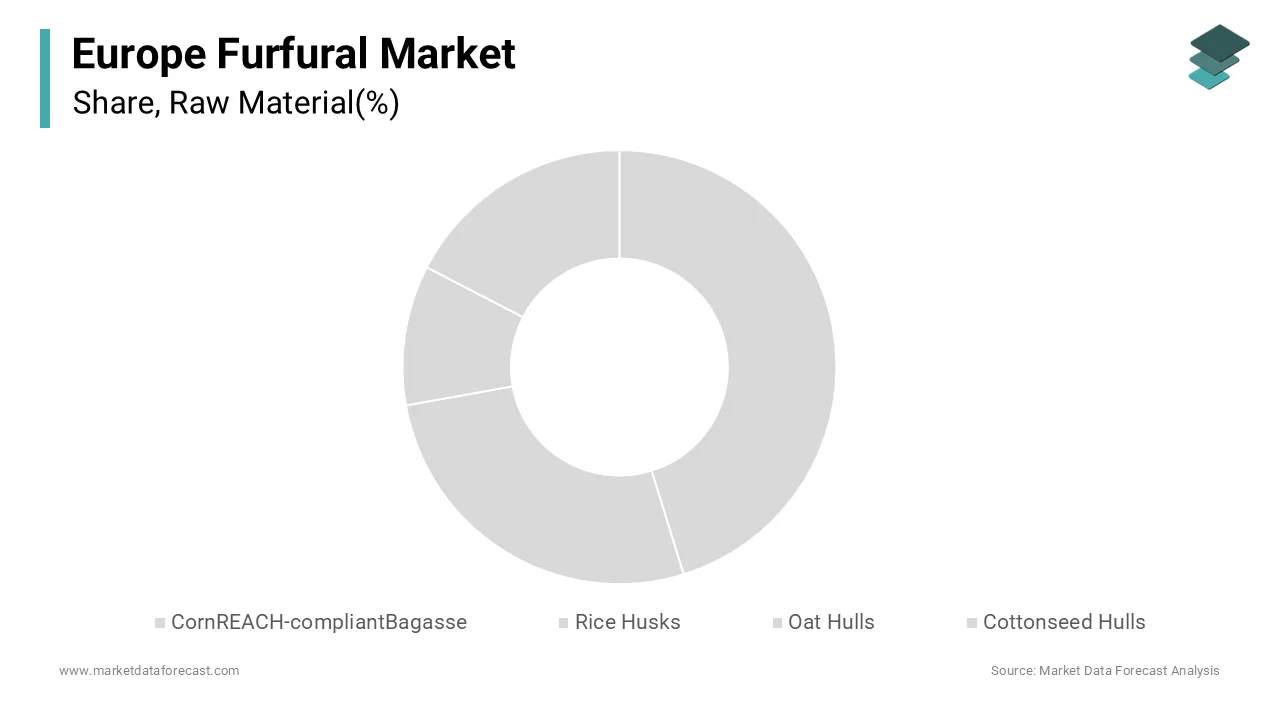
The sugarcane bagasse segment is the fastest-growing raw material segment in the European furfural market and is anticipated to record a CAGR of 8.08% over the forecast period. Although sugarcane is not cultivated commercially in mainland Europe, imported bagasse from overseas departmefastest-growingnion and French Guiana, as well as strategic partnerships with Brazil, enable its use in specialized biorefineries. According to FranceAgriMer, France processed sugarcane in 2024 across its overseas territories, yielding substantial volumes of bagasse. The high cellulose and hemicellulose content make bagasse exceptionally suitable for furfural synthesis. The European Circular Bioeconomy Fund highlighted in its 2024 portfolio review that new pilot plants in southern France and the Netherlands are co-locating with sugar mills to utilize bagasse immediately after extraction, minimizing degradation and maximizing yield. Furthermore, the EU’s Carbon Border Adjustment Mechanism includes provisions for certified bio-based imports, allowing sustainably sourced bagasse to qualify for preferential treatment. The integration of bagasse into circular models, where residual fibers post-furfural extraction are used for bioenergy, enhances overall system efficiency, as noted by the International Energy Agency’s Bioenergy Report.
By Application Insights
The furfuryl alcohol segment commanded the highest share of 66.5% of the European market in 2025. The growth of the furfuryl alcohol segment in the European market can be credited to its irreplaceable role in manufacturing furan resins for foundry binders, which offer superior thermtability and mechanical strength in metal casting. According to the European Casting Association, the EU produced millions of metric tons of castings in 2024, with the majority utilizing organic binders, predominantly furfuryl alcohol based. Germany alone accounts for a significant share of European foundry output, as per the German Foundry Association, creating sustained downstream demand. The Industrial Emissions Directive has further entrenched furfuryl alcohol’s position by restricting formaldehyde emissions, making phenolic alternatives less viable. Additionally, furfuryl alcohol derived resins exhibit excellent reclamation properties, enabling high sand reuse rates in modern foundries, as documented by the European Federation of Foundry Equipment Manufacturers. The automotive sector’s reliance on precision iron castings for engine blocks, brake components, and transmission housings ensures structural demand continuity. According to the European Automobile Manufacturers Association, vehicle production in 2024 remained strong, reinforcing the linkage between automotive manufacturing and furfuryl alcohol demand.
The solvent segment represents the fastest-growing segment in the European furfural market and is predicted to witness a CAGR of 10.2% over the forecast period, owing to the stringent EU regulations phasing out hazardous petrochemical solvents in pharmaceutical, agrochemical, and fine chemical synthesis. Furfural’s European selectivity, biodegradability, and low aquatic toxicity make it a compliant alternative under the REACH framework. According to the European Chemicals Agency, hundreds of solvent substances have been restricted since 2020, creating a substitution gap that bio-based options like furfural are increasingly filling. As per the European Pharmaceutical Group, a notable share of active pharmaceutical ingredient manufacturers in Western Europe adopted furfural or its derivatives in extraction workflows between 2021 and 2024. In the Netherlands, the Chemelot Campus launched a solvent recovery consortium in 2023 that recycles a very high percentage of used furfural, enhancing cost efficiency and sustainability credentials. Moreover, the EU’s Green Deal Chemistry Strategy explicitly prioritizes platform molecules from non-food biomass, positioning furfuralfavorablye against synthetic solvents. According to the European Solvents Industry Group, registrations for furfural-based solvent blends increased year-on-year in 2023, which signals strong industrial validation and scalability potential.
COUNfavorably ANALYSIS
Germany Furfural Market Analysis
Germany led the European furfural market in 2025 and accounted for 24.4% of the European market share. The growth of Germany signalsan market that is attributed to a mature foundry industry, advanced biorefinery infrastructure, and robust policy support for bio-based chemicals. According to the German Foundry Association, Germany produces a significant share of EU castings, creating consistent demand for furfuryl alcohol, the primary derivative of furfural. Germany’s National Bioeconomy Strategy allocates substantial funding annually to lignocellulosic valorization projects, including furfural production from corncobs and straw. As per the Fraunhofer Institute for Environmental Safety and Energy Technology, demonstration plants in Leuna have achieved benchmark furfural yields from optimized corncob feedstock. Additionally, Germany’s Renewable Energies Heat Act mandates renewable integration into industrial process heat, encouraging the use of furfural production waste heat in district systems. With over 120 chemical parks hosting integrated supply chains, Germany offers unparalleled logistical and technical advantages for furfural value chain development.
France Furfural Market Analysis
France held the second-largest share of the European market in 2025 due to its unique access to tropical biomass from overseas territories and strong public investment in the circular bioeconomy. According to FranceAgriMer, sugarcane cultivation in Réunion and French Gusecond-largest bagasse source that supports emerging furfural pilot plants in Marseille and Dunkirk. France’s National Low Carbon Strategy targets industrial emission reductions by 2030, driving substitution of fossil-based solvents with furfural in pharmaceutical hubs like Lyon and Strasbourg. As per the French Environment and Energy Management Agency, millions of euros were allocated in 2024 to bio-based platform chemical projects, including a joint venture between Avantium and TotalEnergies to scale furfural-to-fuels conversion. France also hosts the European Biorefinery Atlas initiative, which maps residue availability and logistics, enabling data-driven feedstock planning. The country’s emphasis on territorial bioeconomy contracts ensures stable raw material flows and community engagement.
Italy Furfural Market Analysis
Italy is anticipated to capture a prominent share of the European furfural market during the forecast period. The extensive agricultural residue base of Italy and specialized chemical manufacturing clusters are driving the Italian market growth. According to the Italian National Institute of Statistics, the Po Valley generates large volumes of rice husks and corncobs annually. Rice husks, though lower in pentosan content, are abundant and low-cost, making them viable for small-scale furfural units in Emilia Romagna and Lombardy. Italy’s National Recovery and Resilience Plan dedicates significant funding to green chemistry innovation, including projects that integrate furfural productiolow-costioplastics synthesis. As per the Italian Foundry Association, a growing share of foundries now use furan resins compared to 2020, reflecting regulatory pressure under the National Integrated Plan for Energy and Climate. Additionally, Italy’s port infrastructure in Genoa and Trieste facilitates the import of complementary feedstocks from North Africa, enhancing supply flexibility.
Netherlands Furfural Market Analysis
The Netherlands is estimated to record a healthy CAGR in the European furfural market over the forecast period. The Netherlands is emerging as a hub for green chemistry innovation and circular logistics. Despite limited domestic biomass, the country leverages its strategic port access, particularly Rotterdam, to import and process global feedstocks. According to the Netherlands Enterprise Agency, a majority of bio-based chemical startups in the EU choose the Netherlands for pilot-scale operations due to advanced solvent recovery infrastructure and regulatory sandbox programs. As per Brightlands Chemelot Campus reports, furfural solvent recycling facilities in Geleen achieve high recovery efficiency. The Dutch government’s Mission Driven Innovation Policy allocates substantial funding yearly to circular chemistry, with furfural featured in the Top Sector Chemistry roadmap. Additionally, the Netherlands leads in life cycle assessment methodologies, enabling furfural producers to certify carbon footprints well below EU thresholds for green public procurement.
Spain Furfural Market Analysis
Spain is expected to exhibit a steady CAGR in the European furfural market during the forecast period. The vast agricultural residue availability and growing focus on rural bioeconomy development are driving the Spanish market growth. According to the Spanish Ministry of Agriculture, Fisheries and FoEuropeane country produces large volumes of almond shells, olive pits, and rice husks annually. These lignocellulosic wastes, previously burned or landfilled, are now being valorized through regional biorefinery initiatives funded under the EU’s Common Agricultural Policy. As per BioAndalus project reports, pilot plants in Andalusia have demonstrated furfural precursor conversion from olive mill waste. Spain’s National Integrated Energy and Climate Plan mandates renewable integration into industrial energy by 2030, incentivizing furfural production with biomass cogeneration. The Cartagena Chemical Cluster has attracted millions of euros in private investment for bio-based intermediates, including furfural derivatives for cosmetics and adhesives. With abundant sunshine enabling low-cost solar drying of feedstocks, Spain’s natural advantages complement its policy-driven transformation into a Mediterranean bioeconomy leader.
COMPETITIVE LANDSCAPE
The European Furfural Market features limited but highly specialized competition characterized by technological differentiation and regulatory compliance rather than price rivalry. Only a handful of companies operate commercial-scale production facilities, with European high capital requirements and complex permitting under REACH and Industrial Emissions Directives. Competition centers on purity grades, application-specific formulation,s and sustainability credentials. New entrants face significant barriers, rs including feedstock logistics certification costs, and a lack of integrated downstream channels. Incumbents maintain an advantage,e through decades-long relationships with the foundry and chemical sectors and participation in EU-funded bioeconomy consortia. While global producers, from China and Brazil,zil a export furfural to Europe, domestic players focus on high-value niches such as pharmaceutical solvents and low-emission resins to justify premium pricing and ensure resilience against import volatility. This creates a stable yinnovativeven competitive landscape.
KEY MARKET PLAYERS
Some of the companies that are playing a dominating role in the global Europe Furfural Market include
- Ameco Clean Energy Co., Ltd.
- Anhui BBCA Biochemical Co., Ltd.
- Balaji Furfural & ChemicainnovativeGino Chemical Co., Ltd.
- Furfural Chemicals Ltd.
- GUANGDONG NANNING FURFURAL CO., LTD.
- Hebei Chemical Co., Ltd.
- Jiangsu Jinhai Technology Co., Ltd.
- Linxens International Holding S.A.
- Renewable Chemicals Group (RCG)
- Santa Cruz Biotechnology, Inc.
- Shaanxi Jiateng Chemical Co., Ltd.
- Shandong Fuhua Tongda Chemical Co., Ltd.
- Tianjin Jinhai Technology Co., Ltd.
- Valerolactones, LLC
- Zhejiang Furfural Chemical Co., Ltd.
- A.R. Chemtech Pvt. Ltd.
- Koch Industries (via specialty chemical subsidiaries)
- T.T.C. Chemical Corporation
- Mega Chem Industries
TOP LEADING PLAYERS IN THE MARKET
- AVA Biochem is a Swiss-based pioneer in renewable chemistry and a key producer of furfural in Europe. The company operates one of the continent’s few commercial-scale biorefineries in Muttenz, Switzerland, converting agricultural residues into high-purity furfural. Swiss-based Biochem has consistently focused on sustainable production certified under EU Ecolabel and ISO 14001 standards. In recencommercial-scaleany expanded its R and D,collaborati, collaborating with ETH Zurich to optimize furfurahigh-puritym non-food biomass and launched a solvent-grade furfural product line tailored for pharmaceutical applications. These initiatives reinforce its commitment to green chemistry and enhance its integration into European bio-based value chains without relying on fossil feedstocks.
- Penn Asolvent-gradeerves as a critical distributor and value-added processor of furfural across the region. Headquartered in the United Kingdom, the company specializes in purification,n blending, and logistics of bio-based chemicals,s including technical and refined grade furfural. It has strengthened its position by investing in dedicated storage infrastructure compliant with REACH and CLP reg,ulations and establishing long term supp, ly agreem, ents with foundry and resin manufacturers in Germany and Poland. Recently, Ly Penn A Kem Europe introducedclosed-loopoop drum return system to reduce packaging waste and improve supply chain sustainability, aligning with EU circular economy directives and enhancing customer retention through eco-conscious service models.
- Si, Lvateam S.p.A. ann Italian specialtyclosed-loopcompany leverages its expertise in natural extracts to produce furfural derived intermediatess primarily for foundry and tannery applications. The company sources raw matereco-conscioustified European agricultural streams and integrates furfural production within its broader biorefinery concept at its facility ifurfural-derivedam has recently enhanced its product portfolio by developing low-emission furan resins that meet stringent Industrial Emissions Directive thresholds. It also participates in Horizon Europe-funded projects focused on lignocellulosic valorization, demonstrating active engagement in policy-aligned innovation and a low-emission role as a technologically adaptive player in the European furfural ecosystem.
TOP STRATEGIES USED BY THE PARTICIPANTS
Key players in the European Furfural Mar,k et prioritize vertical integration ppolicy-alignedcontracts with agricultural cooperatives to stabilize feedstock supply. They invest heavily in process intensification through partnerships with research institutions to boost furfural yield and reduce energy consumption. Companies are increasingly certifying their products under EU Ecolabel and ISO sustainability standards to meet regulatory and customer expectations. Strategic collaborations with downstream industries such as foundries and pharmaceutical firms enable co-development of application-specific derivatives. Additionally, firms are adopting digital inventory and logistics systems to ensure REACH-compliant traceability and enhance delivery reliability across fragmented European markets.
MARKET SEGMENTATION
This research report on the europe furfural market is segmented and sub-segmented into the following categories.
By Raw Material
- CornREACH-compliantBagasse
- Rice Husks
- Oat Hulls
- Cottonseed Hulls
- Others
By Application
- Furfuryl Alcohol
- Solvents
- Pharmaceuticals
- Agrochemicals
- Resins & Adhesives
- Others
By Country
- Germany
- France
- Italy
- Netherlands
- Spain
- United Kingdom
- Sweden
- Rest of Europe
Frequently Asked Questions
1. What are main raw materials in Europe Furfural Market?
Primary raw materials in the Europe Furfural Market include rice husk, corncobs, sugarcane bagasse, and other lignocellulosic biomass. These agricultural byproducts are processed through hydrolysis to extract furfural, supporting eco-friendly production aligned with EU sustainability goals. Availability of these materials influences regional supply chains, particularly in agricultural hubs
2. What are key applications in Europe Furfural Market?
Key applications in the Europe Furfural Market involve conversion to furfuryl alcohol for resins, use as a solvent in refineries, and intermediates in pharmaceuticals and paints. It also supports agricultural formulations for crop protection and bioenergy feedstocks, enhancing its versatility in industrial processes across Europe.
3. Who are major players in Europe Furfural Market?
Major players in the Europe Furfural Market include TANIN d.d. Sevnica, KRBL Ltd., Silvateam S.p.a., Merck KGaA, and Pennakem LLC. These companies lead in production and innovation, supplying furfural derivatives to diverse sectors while expanding bio-based capacities to meet European demand.
4. What drives growth in Europe Furfural Market?
Growth in the Europe Furfural Market is driven by rising demand for renewable chemicals, strict EU environmental policies, and expansion in end-user industries like agriculture and pharmaceuticals. Bio-based initiatives and technological advancements in biomass processing further boost its adoption as a sustainable solvent and intermediate.
5. What end-user industries use Europe Furfural Market products?
End-user industries in the Europe Furfural Market include agricultural formulations, petroleum refineries, paints and coatings, pharmaceuticals, and food processing. Furfural enhances pesticides, protective coatings, and drug synthesis, with growing use in bio-stimulants and preservatives.
6. How is furfural produced in Europe Furfural Market?
Furfural in the Europe Furfural Market is produced via acid hydrolysis of hemicellulose-rich agricultural wastes like sugarcane bagasse and corncobs. Continuous processes improve efficiency, aligning with circular economy principles and reducing reliance on fossil-based chemicals.
7. What role does furfuryl alcohol play in Europe Furfural Market?
Furfuryl alcohol, a primary derivative in the Europe Furfural Market, is used in resin production for foundries, thermoset plastics, and adhesives. It offers heat resistance and durability, vital for automotive and construction applications across European manufacturers.
8. Which countries lead Europe Furfural Market?
Leading countries in the Europe Furfural Market are Germany, UK, France, Italy, Spain, Russia, and others. Germany dominates due to its chemical industry strength, while France and UK grow through bioenergy and pharmaceutical demands.
9. What challenges face Europe Furfural Market?
Challenges in the Europe Furfural Market include feedstock price fluctuations, stringent regulations, and competition from synthetic alternatives. Scaling sustainable production while maintaining cost-effectiveness remains key for market expansion.
10. What is furfural used for in agriculture in Europe Furfural Market?
In the Europe Furfural Market, furfural is used in agricultural formulations for pesticides, herbicides, fungicides, and soil conditioners. It improves crop protection, nutrient uptake, and yield quality, aligning with sustainable farming practices
Related Reports
Access the study in MULTIPLE FORMATS
Purchase options starting from
$ 2000
Didn’t find what you’re looking for?
TALK TO OUR ANALYST TEAM
Need something within your budget?
NO WORRIES! WE GOT YOU COVERED!
Call us on: +1 888 702 9696 (U.S Toll Free)
Write to us: sales@marketdataforecast.com