- Product Description Description
- Table of Contents TOC
- List of Table & Figure LOT
- Get Free Sample PDF Sample PDF
Market Size, 2025
$0.58 BnMarket Estimate, 2026
$0.60 BnMarket Forecast, 2034
$0.78 BnCAGR, 2026–2034
3.34%Europe Garlic Seeds Market Size, Share, Trends & Forecast (2026–2034)
- Market Scope: Comprehensive regional assessment of the European garlic seeds market, evaluating applications (Farmland, Greenhouse), types (White Garlic, Red Garlic), country-level performance (Spain, Italy, France, Turkey, Netherlands), and competitive breeding dynamics.
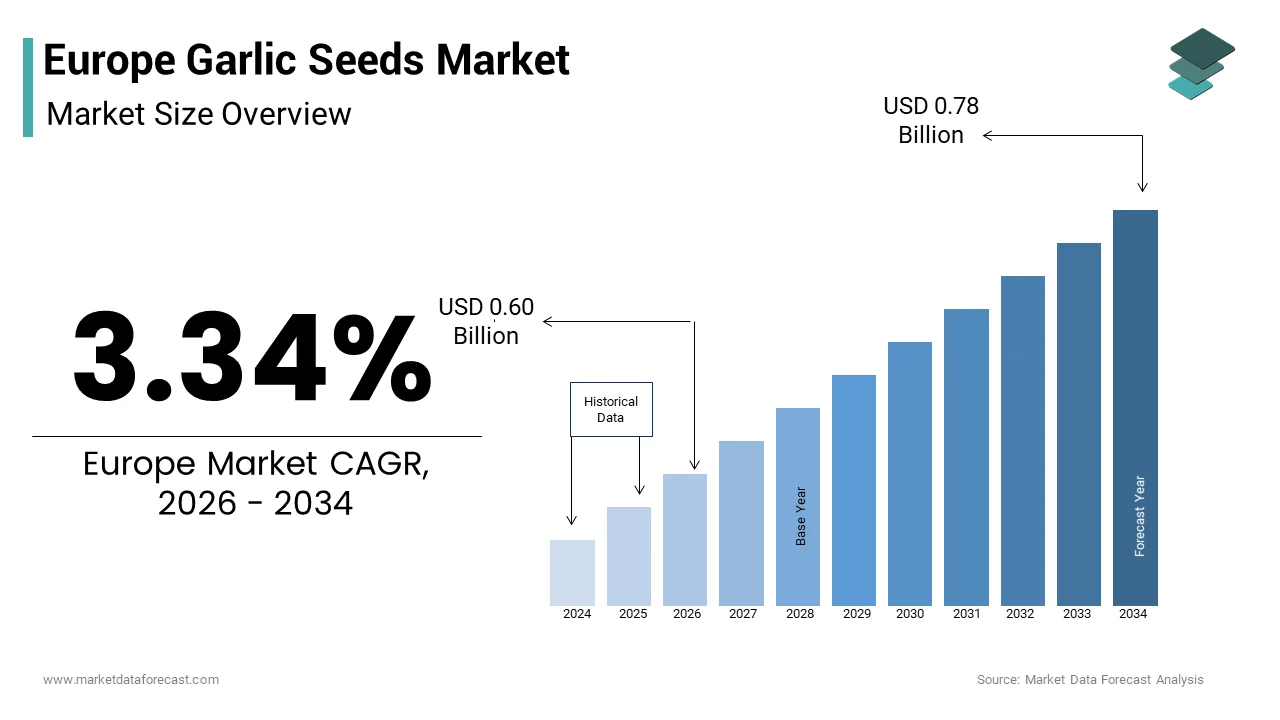
- Market Valuation: Valued at USD 0.58 billion in 2025, estimated at USD 0.60 billion in 2026, and projected to reach USD 0.78 billion by 2034, growing at a compound annual growth rate (CAGR) of 3.34% during the forecast period from 2026 to 2034.
- Primary Growth Drivers: Growing emphasis on disease-resistant garlic varieties through sexual reproduction to bypass pathogen accumulation in conventional cloves, and integration into EU agroecological and organic farming frameworks.
Europe Garlic Seeds Market Segment Metrics (2026–2034)
| Category | Leading Segment / Baseline Position | Fastest-Growing Segment |
|---|---|---|
| By Application | Farmland (dominant due to extensive traditional open-field production across Southern and Eastern Europe) | Greenhouse (projected at a robust 14.2% CAGR from 2025 to 2033, driven by controlled-environment seed propagation needs) |
| By Type | White Garlic (historical market leader embedded in major Mediterranean culinary and commercial operations) | Red Garlic (growing at an 11.8% CAGR, propelled by consumer preference for specialty produce and enhanced antioxidant profiles) |
| By Country | Spain (top performer, capturing a 28.4% share in 2024 as Europe's leading garlic producer and true-seed research hub) | Netherlands & France (anchoring seed tech advancement, logistics, and protected geographical indication standards) |
Major Industry Players & Market Structure
Market Structure: Highly specialized and pre-commercial market driven by scientific capability, public-private research partnerships, and stringent EU regulatory frameworks rather than volume pricing alone.
Key Companies: Bejo, Vilmorin Mikado (Limagrain Group), Seminis (Bayer Crop Science), Syngenta, Enza Zaden, Rijk Zwaan, Sakata, VoloAgri, Takii, East-West Seed, and regional agricultural institutes.
Europe Garlic Seeds Market Size
The European garlic seeds market size was valued at USD 0.58 billion in 2025 and is anticipated to reach USD 0.60 billion in 2026 to reach USD 0.78 billion by 2034, growing at a CAGR of 3.34% from 2026 to 2034.
Current Introduction of the Europe Garlic Seeds Market
Garlic seed refers to individual cloves or large bulbil propagules set aside from healthy bulbs for planting, rather than true botanical seeds, used for vegetative propagation to grow new garlic bulbs. Unlike vegetative propagation, which dominates commercial garlic farming, true garlic seeds enable genetic recombination essential for developing disease-resistant and climate-resilient varieties. This market remains niche but is gaining scientific and policy attention due to mounting pressures on agricultural sustainability and biodiversity. According to sources, the overall area used for agricultural production in the EU has remained broadly stable in recent years, with varied cropping patterns across different member states. As per research, the high prevalence of soil-borne pathogens in allium crops has driven increased scientific research into developing disease-resistant garlic varieties through diverse breeding strategies, including sexual propagation techniques. Furthermore, there is a growing recognition within the EU agricultural community of the agronomic potential of diverse garlic genetic resources, including seed-propagated lines, prompting ongoing discussions and research related to their conservation and potential future registration pathways. True garlic seeds are becoming essential for sustainable crop enhancement and developing robust seed systems, aligning with Europe's Farm to Fork Strategy, even as clove-based planting remains prevalent for its predictable yields.
MARKET DRIVERS
Growing Emphasis on Disease-Resistant Garlic Varieties Through Sexual Reproduction
The urgent need to combat soil-borne pathogens such as Fusarium oxysporum and Sclerotium cepivorum is driving the growth of the Europe garlic seeds market. This enables genetic diversity unattainable through clonal propagation. Continuous clove replanting in garlic production often leads to the accumulation of pathogens, a significant challenge for sustainable agriculture. Breeders are utilizing true seeds from controlled pollination to introduce resistance genes from wild Allium relatives, a key strategy for enhancing pathogen tolerance in new garlic lines. European breeding programs are actively working on developing garlic varieties with resistance to white rot, a major soil-borne disease. Additionally, certified, disease-screened planting material is subject to stringent EU phytosanitary certification requirements, a measure that helps prevent the cross-border spread of plant diseases and enhances research collaboration involving healthy stock. This shift from vegetative to sexual propagation represents a strategic pivot toward biologically sustainable garlic production systems essential for long-term crop viability in pathogen-prone regions.
Integration of Garlic into EU Agroecological and Organic Farming Frameworks
The European Union’s aggressive push toward agroecology and organic farming is creating renewed demand for genetically diverse planting materials, which propels the expansion of the Europe garlic seeds market. This includes true garlic seeds. The EU has an established policy goal to substantially expand the area of land under organic management within its borders by 2030, which involves a commitment to farming practices that do not use synthetic pesticides. The area of organic farmland across the EU has consistently increased, exceeding a significant number of hectares in 2023. However, organic garlic producers in Spain and Italy report chronic replant failure due to soil pathogen buildup when using conventional cloves. Research institutions in Europe are exploring innovative garlic propagation methods to improve disease resilience in organic farming systems compared to traditional approaches. Furthermore, European Union research initiatives, such as the Horizon Europe program, are providing substantial financial support to projects focused on innovative breeding and propagation methods for crops traditionally grown vegetatively. This policy and research alignment positions true garlic seeds not as a commercial commodity but as a foundational input for Europe’s transition to resilient low-input horticultural systems.
MARKET RESTRAINTS
Limited Commercial Viability Due to Low Seed Germination and Yield Instability
The inherent biological challenge of low germination rates and inconsistent agronomic performance in seed propagated lines restrains the growth of the Europe garlic seeds market. Garlic grown from true seed tends to have a highly variable rate of emergence compared to traditional clove planting methods. The initial generation of plants grown from seed commonly results in smaller bulbs and a longer time until harvest than those grown clonally. This unpredictability discourages commercial growers who operate on narrow profit margins and require harvest uniformity for mechanized processing. Only a limited number of specialized companies offer certified garlic seed for sale. A lack of consistent, standardized guidelines for planting practices adds complexity and variability to expected yields. Mainstream cultivation of true garlic seeds will only become viable once breeding programs successfully stabilize their performance metrics through consistent recurrent selection.
Regulatory and Certification Gaps for True Garlic Seeds in EU Seed Legislation
Structural constraints, resulting from the incomplete alignment of EU seed legislation with the biological realities of sexually propagated garlic, constrain the expansion of the European garlic seed market. Current regulations under Directive 2002 55 EC were designed for conventional seed crops and do not account for the unique reproductive biology of garlic, which requires vernalization and manual pollination. A limited number of member states have established official protocols for garlic seed certification. This regulatory fragmentation impedes commercial distribution and deters investment in seed production infrastructure. Furthermore, the EU Common Catalogue historically excluded seed-propagated garlic varieties due to a lack of Distinctness, Uniformity, and Stability data, a barrier only partially addressed by the 2023 regulatory update. Standardized germination testing methods for garlic seeds are still in development, which results in inconsistencies in quality labeling. Europe's diverse agricultural landscape prevents the legal and commercial expansion of true garlic seeds without the implementation of unified standards for certification, phytosanitary controls, and variety registration.
MARKET OPPORTUNITIES
Expansion of Public Plant Breeding Programs Focused on Climate-Resilient Garlic
The revitalization of public sector plant breeding initiatives targeting climate-adaptive garlic varieties through true seed propagation provides new opportunities for the growth of the Europe garlic seeds market. Traditional areas where garlic has long been grown are experiencing changes in their local climates, which are impacting where the crop can thrive. European researchers are working together to develop new types of garlic that can better withstand dry conditions. Efforts are focused on creating garlic varieties grown from seeds that can tolerate heat stress. Gene banks are expanding their collections of different wild and cultivated garlic types to help find traits that improve resilience to these changing conditions. The European Commission’s Farm Sustainability Toolkit now explicitly recommends seed-propagated planting materials for crops facing climate vulnerability. This convergence of public research policy support and climate urgency is transforming true garlic seeds from a scientific curiosity into a strategic asset for Europe’s future horticultural security.
Rising Demand for Locally Adapted and Traceable Seed Systems Under the EU Seed Marketing Reform
The ongoing reform of the EU seed marketing framework offers a potential opportunity for the European garlic seed market. This is due to provisions supporting decentralized and farmer-led seed systems. A proposal for a new regulation introduces simplified registration options for "locally adapted populations," which allows smaller seed enterprises to commercialize region-specific garlic seed lines using a streamlined testing process. Numerous agroecological seed networks across Europe are exploring garlic seed production as part of wider efforts toward biodiversity conservation. Several regional authorities have initiated pilot programs focused on distributing certified, seed-propagated garlic to organic cooperatives. Guidance on seed traceability requires digital documentation for batches, creating a market differentiation for transparent seed sources. True garlic seeds can deliver unique flavor profiles and genetic authenticity, meeting the rising demand from consumers and chefs for terroir-specific produce with documented provenance and supporting Europe's push for culinary biodiversity and food sovereignty.
MARKET CHALLENGES
Lack of Specialized Infrastructure for Garlic Seed Production and Processing
The absence of dedicated facilities for garlic seed production, cleaning, and storage across the region challenges the growth of the Europe garlic seeds market. Unlike grain or vegetable seeds, garlic seeds are small, mucilaginous, and highly susceptible to desiccation, requiring specialized post-harvest handling. Seed processing facilities lack adequate infrastructure for managing specific seed types, such as Allium seeds, particularly regarding humidity control during drying. Most existing infrastructure is optimized for clove or bulb handling, not true seed lots, leading to high post-harvest losses. Inadequate drying processes can significantly reduce the potential for seeds to remain viable over time, thereby hindering effective storage and widespread distribution. Furthermore, pollination for seed set requires insect-proof cages and manual emasculation, a labor-intensive process not supported by current horticultural machinery. The cost associated with adapting existing equipment for pilot production presents a substantial financial obstacle for smaller seed businesses. Coordinated public investment in shared seed production hubs or modular processing units is essential for scaling up true garlic seed systems beyond small research plots into commercial networks.
Limited Farmer and Agronomic Knowledge on Seed-Propagated Garlic Cultivation
A pervasive knowledge gap among European growers represents a fundamental barrier to the adoption of true garlic seeds. This inhibits the expansion of the Europe garlic seed market. For generations, garlic has been exclusively cultivated from cloves, and agronomic curricula at agricultural universities rarely cover sexual propagation techniques. Many agricultural advisors lack the specific expertise required to guide on the nuances of garlic cultivation, such as appropriate seed sowing depth, vernalization requirements, and transplanting protocols. A majority of initial attempts by farmers to propagate garlic using true seed face challenges, often failing due to insufficient knowledge regarding correct planting timing or the essential cold treatment process needed for healthy plant development. Moreover, the delayed bulb formation in first-year seedlings is often misinterpreted as crop failure, leading to premature abandonment. Initiatives are emerging within the agricultural sector to address this knowledge gap, with pilot training modules being introduced in various regions to improve understanding and practical skills related to garlic seed literacy. The shift from traditional clove-based systems to modern seed-based methods will stay slow and uneven throughout Europe until this knowledge is consistently spread via farmer field schools and digital advisory tools.
REPORT COVERAGE
| REPORT METRIC | DETAILS |
| Market Size Available | 2025 to 2034 |
| Base Year | 2025 |
| Forecast Period | 2026 to 2034 |
| CAGR | 3.34% |
| Segments Covered | By Application, Type, and By Country |
| Various Analyses Covered | Global, Regional & Country Level Analysis, Segment-Level Analysis, DROC, PESTLE Analysis, Porter’s Five Forces Analysis, Competitive Landscape, Analyst Overview on Investment Opportunities |
| Regions Covered | UK, France, Spain, Germany, Italy, Russia, Sweden, Denmark, Switzerland, Netherlands, Turkey, the Czech Republic, and the Rest of Europe |
| Market Leaders Profiled | Monsanto, Syngenta, Limagrain, Bayer Crop Science, Bejo, Enza Zaden, Rijk Zwaan, Sakata, VoloAgri, Takii, East-West Seed, Nongwoobio, Yuan Longping High-tech Agriculture, Denghai Seeds, Jing Yan YiNong, Huasheng Seed, Horticulture Seeds, Beijing Zhongshu, Jiangsu Seed, Asia Seed, Gansu Dunhuang, Dongya Seed. |
SEGMENTAL ANALYSIS
By Application Insights
The farmland segment held the majority share of the Europe garlic seeds market in 2025. The dominance of the farmland segment is driven by the traditional large-scale nature of garlic cultivation across Southern and Eastern Europe, where open field production remains the primary method. Countries such as Spain, Italy, and France dedicate tens of thousands of hectares annually to garlic farming, primarily using clove propagation,n but with growing experimental use of true seeds in breeding plots integrated within farmland systems. Farmland across the EU is being utilized for garlic cultivation, with a significant portion concentrated in Spain. The European Commission’s Common Agricultural Policy provides direct payments for crop diversification, which incentivizes farmers to trial seed-propagated lines within existing rotations. Furthermore, the majority of trials for garlic varieties that show resistance to Fusarium are being performed on commercial farmland settings rather than in more contained, controlled environments. The scalability, soil adaptability, and compatibility with mechanized planting make farmland the natural and economically viable base for both current clove-based systems and future seed-based innovations in European garlic production.

The greenhouse segment is expected to exhibit a noteworthy CAGR of 14.2% from 2025 to 2033 due to the need for controlled environments to overcome the biological limitations of true garlic seed propagation. Greenhouses enable precise regulation of temperature, photoperiod, and humidity, critical for successful flowering, seed, et and seedling development. Garlic seed production in Northern Europe tends to occur under protective cultivation conditions, which may be linked to regional climatic conditions that impact the natural growth cycle of the plant. Producers often utilize specific greenhouse structures and netting techniques to manage plant isolation and maintain consistent genetic characteristics. Collaborative projects are establishing facilities dedicated to early-stage plant development, which has shown a positive impact on the successful establishment of the crop compared to direct planting methods. Climate unpredictability necessitates reliable seed sources. Consequently, scaling up greenhouse operations is essential for European garlic seed production and fostering innovation in the sector.
By Type Insights
The white garlic segment led the Europe garlic seeds market by holding a significant share in 2024. The leading position of the white garlic segment is attributed to its historical cultivation preference across major producing regions such as Spain, France, and Italy, where varieties are deeply embedded in culinary and agricultural traditions. White garlic is favored for its strong pungency, long storage life, and adaptability to Mediterranean climates. Certified garlic planting material distributed in Western Europe frequently belongs to white subtypes, reflecting market demand from processors and retailers. Furthermore, the European Cooperative for Seedborne Disease Management prioritizes white garlic lines in its resistance breeding programs because of their economic significance. Numerous white garlic accessions are maintained in genetic reservoirs for potential trait improvement efforts. The dominance is further reinforced by consumer perception. European households commonly associate authentic garlic flavor with white varieties. This cultural, agronomic, and commercial entrenchment ensures white garlic remains the cornerstone of both clove and emerging seed-based systems.
The red garlic segment is predicted to witness the highest CAGR of 11.8% over the forecast period, owing to rising consumer interest in specialty and colored produce with enhanced phytochemical profiles. Red garlic varieties such as ‘Rouge de Lautrec’, protected under EU geographical indication, and ‘Red Toch’ contain significantly higher levels of anthocyanins and allicin,n which are linked to antioxidant and cardiovascular benefits. Scientific findings indicate that organosulfur compounds in red garlic may have greater bioavailability compared to those in white types, which could support the development of related health claims. Sales of red garlic in organic markets have experienced growth, influenced by premium pricing and endorsements within dining establishments that focus on regional ingredients. Additionally, breeding programs at the Leibniz Institute have successfully developed the first seed-propagated red garlic lines with stable clove pigmentation, previously a major barrier due to trait instability. The introduction of numerous new red garlic products in gourmet food retail suggests this segment is shifting from a specialized regional item toward a more established, commercially valuable crop, driven by both culinary preferences and nutritional understanding.
COUNTRY ANALYSIS
Spain Garlic Seeds Market Analysis
Spain outperformed other countries in the Europe garlic seeds market by accounting for a 28.4% share in 2024 due to its position as the continent’s leading garlic producer and exporter. The country grows a significant amount of garlic annually. Cultivation occurs in major agricultural areas. Specific types of garlic are widely used in the market. The country's garlic is a primary supplier to the regional fresh garlic market. While traditional clove propagation dominates national practice, Spain has become a focal point for true seed research through the Institute for Sustainable Agriculture in Córdoba, Ba. Bach leads the EU-funded project testing seed-propagated lines under semi-arid conditions. The Spanish National Seed Certification Service has also developed specific protocols for garlic seed lot validation in alignment with EU phytosanitary standards. Spain serves as Europe's leading epicenter for garlic seed production and innovation, leveraging strong export networks, ideal agroclimatic suitability, and significant public investment in research.
Italy Garlic Seeds Market Analysis
Italy was the next biggest player in the Europe garlic seeds market by holding a 21.6% share in 2024. The growth of the Italian market is driven by its deep-rooted garlic cultivation heritage and premium product valorization. The country is home to renowned varieties such as ‘Aglio Rosso di Nubia’ and ‘Aglio Bianco Piacentino’, both protected under EU quality schemes. Italy’s strength lies in integrating garlic into high-value food chains; Parmigiano Reggiano producers and balsamic vinegar makers often specify regional garlic types for flavor synergy. European and Italian agricultural policies encourage the use of sustainable practices, such as organic farming and the use of non-chemical plant protection methods, within a broader framework of biodiversity conservation and climate change adaptation. There is a general trend within the Italian agricultural sector to pursue innovation in organic farming and explore alternative, sustainable cultivation strategies for crop protection and yield improvement. This fusion of tradition, innovation,n and policy support positions Italy as qa uality-driven leader in the European garlic seeds market.
France Garlic Seeds Market Analysis
France experienced steady growth in the Europe garlic seeds market, with its emphasis on geographical indication and agroecological transition. The country is famed for ‘Ail Blanc de Lomagne’ and ‘Ail Rose de Lautrec’, both awarded Protected Geographical Indication status by the European Commission. Garlic cultivation areas are substantial across various regions. A significant amount of this cultivated land is dedicated to organic farming practices, representing a leading share compared to other European regions. Producers are exploring innovative farming techniques to maintain soil health. New methods, such as using true seed for propagation, are being trialed to address challenges associated with continuous single-crop farming. France also hosts the European Garlic Research Platform at INRAE Toulouse, which coordinates multi-country trials on seed viability and disease resistance. The French Seed and Plant Interprofessional Group has developed the first national standard for garlic seed certification, including germination and purity thresholds. France is a leader in Europe for the development of sustainable and terroir-based garlic seeds, due to its robust policy support, renowned culinary heritage, and strong scientific infrastructure.
Turkey Garlic Seeds Market Analysis
Turkey expanded moderately in the Europe garlic seeds market because of its strategic role as a bridge between European and Near Eastern garlic genetics. Turkey engages in significant garlic export trade with the EU bloc, despite not being a member. Certain regions are known for their distinctive, high-allicin white garlic, and have initiated efforts to improve seed production. Research institutions in the country maintain diverse collections of native garlic genetic material, some of which show useful resistance traits. The country's participation in international research collaborations has facilitated the sharing of technology related to seed handling processes like drying and storage. Furthermore, Turkish seed companies are increasingly certified under the EU phytosanitary protocol, enabling the legal export of true garlic seeds. This unique combination of genetic diversity, production scale, nd regulatory alignment positions Turkey as an indispensable external partner in Europe’s garlic seed resilience strategy.
Netherlands Garlic Seeds Market Analysis
The Netherlands is likely to grow in the Europe garlic seeds market from 2025 to 2033, owing to its command in seed technology and distribution infrastructure. The country's garlic cultivation area is relatively small in scope. Also, the nation hosts prominent seed companies and research institutions focused on Allium species. A significant portion of certified vegetable seed exports from Europe originates from this country, including specialized crops such as garlic. Moreover, a major university operates a research center for Allium genetics. Advanced techniques for garlic seed germination have been developed through specific treatment protocols, demonstrating a high degree of success in research settings. Dutch seed companies have launched pilot garlic seed lines for organic farms in Germany and Belgium. Besides, the Netherlands’ port of Rotterdam and cold chain logistics enable rapid seed distribution across the continent. The Netherlands extends its influence far beyond its actual farming area by serving as a central hub for science and logistics, which ensures high-quality seeds and new ideas are available across Europe.
COMPETITIVE LANDSCAPE
Competition in the Europe garlic seeds market is highly specialized and driven by scientific capability rather than volume. The market features a mix of dedicated vegetable seed companies, public research institutions, and an emerging organic seed network, all focused on overcoming the biological and regulatory hurdles of true garlic seed propagation. Unlike commodity seed markets, price is not a primary differentiator; instead, competition revolves around germination reliability, disease resistance, trait stability, and compliance with EU seed legislation. Established players like Bejo and Vilmorin leverage decades of Allium breeding experience while global firms such as Seminis contribute genomic tools and trial validation networks. The absence of large-scale commercial demand limits aggressive marketing but fosters deep collaboration through EU-funded projects. Innovation is concentrated in seed treatment protocols, vernalization methods, and genetic preservation of regional varieties. As the market remains in a pre-commercial phase, competition is less about market capture and more about establishing technical leadership and regulatory readiness for future scale-up.
KEY MARKET PLAYERS
Some of the market players dominate the Europe garlic seeds market.
- Monsanto
- Syngenta
- Vilmorin Mikado
- Limagrain
- Bayer Crop Science
- Bejo
- Enza Zaden
- Rijk Zwaan
- Sakata
- VoloAgri
- Takii
- East-West Seed
- Nongwoobio
- Yuan Longping High-tech Agriculture
- Denghai Seeds
- Jing Yan YiNong
- Huasheng Seed
- Horticulture Seeds
- Beijing Zhongshu
- Jiangsu Seed
- Asia Seed
- Gansu Dunhuang
- Dongya Seed
Top Players In The Market
- Bejo Zaden B V is a Netherlands-based global vegetable seed company with a specialized focus on Allium crops, including garlic. The company contributes to the global market by developing disease-resistant and climate-resilient garlic seed lines through advanced breeding programs at its research facility in Warmenhuizen. In Europe, Bejo supplies true garlic seeds to organic seed networks and research institutions under strict phytosanitary certification. These initiatives position Bejo as a science-driven enabler of sustainable garlic cultivation both in Europe and in export markets across North Africa and the Middle East.
- Vilmorin Mikado, a subsidiary of the Limagrain Group, is a European seed innovator with deep expertise in specialty vegetable genetics, including garlic. Headquartered in F, the company leverages its national germplasm collections to develop regionally adapted garlic seed lines that align with EU organic and geographical indication standards. Gl Vilmorin supports garlic breeding programs in Mediterranean and South American countries through technical collaboration and seed distribution. The company also enhanced its seed cleaning and cold storage infrastructure in Lyon to meet EU viability requirements. These actions reinforce its role as a bridge between traditional agro biodiversity and modern seed science.
- Seminis, a Bayer Company, participates in the Europe garlic seeds market through its global vegetable seed portfolio and advanced genomic research capabilities. Although garlic represents a niche segment within its Allium divi,sion Seminis assisted selection platforms to accelerate trait development in sexually propagated garlic lines. The company collaborates with European research consortia, including the EU-funded GarlicResilience pprojecprojectidate drought and white rot resistance traits in seed-grown populations. It also integrated garlic seed data into its digital agronomy platform, allowing European partners to track performance metrics. These efforts extend Seminis’s influence beyond commercial scale into foundational crop improvement for long-term food system resilience.
Top Strategies Used By The Key Market Participants
Key players in the Europe garlic seeds market focus on developing disease-resistant and climate-adaptive varieties through public-private research collaborations with national agricultural institutes. They invest in specialized post-harvest infrastructure, including humidity-controlled drying and cold storage, to maintain seed viability under EU phytosanitary standards. Companies pursue geographical indication alignment by breeding region-specific traits that meet EU quality scheme requirements for premium garlic types. They also prioritize organic certification pathways to access growing demand from agroecological farming networks. Additionally, leverage digital agronomy tools to collect field performance data and refine seed selection for future generations, enhancing both scientific credibility and farmer trust across diverse European growing conditions.
MARKET SEGMENTATION
This research report on the European garlic seeds market is segmented and sub-segmented into the following categories.
By Applications
- Farmland
- Greenhouse
- Others
By Type
- White Garlic
- Red Garlic
- Other
By Country
- UK
- France
- Spain
- Germany
- Italy
- Russia
- Sweden
- Denmark
- Switzerland
- Netherlands
- Turkey
- Czech Republic
- Rest of Europe