- Product Description Description
- Table of Contents TOC
- List of Table & Figure LOT
- Get Free Sample PDF Sample PDF
Market Size, 2025
$255.69 MnMarket Estimate, 2026
$264.55 MnMarket Forecast, 2034
$343.23 MnCAGR, 2026–2034
3.45%Europe Garment Market Size, Growth, Trends & Forecast (2026–2034)
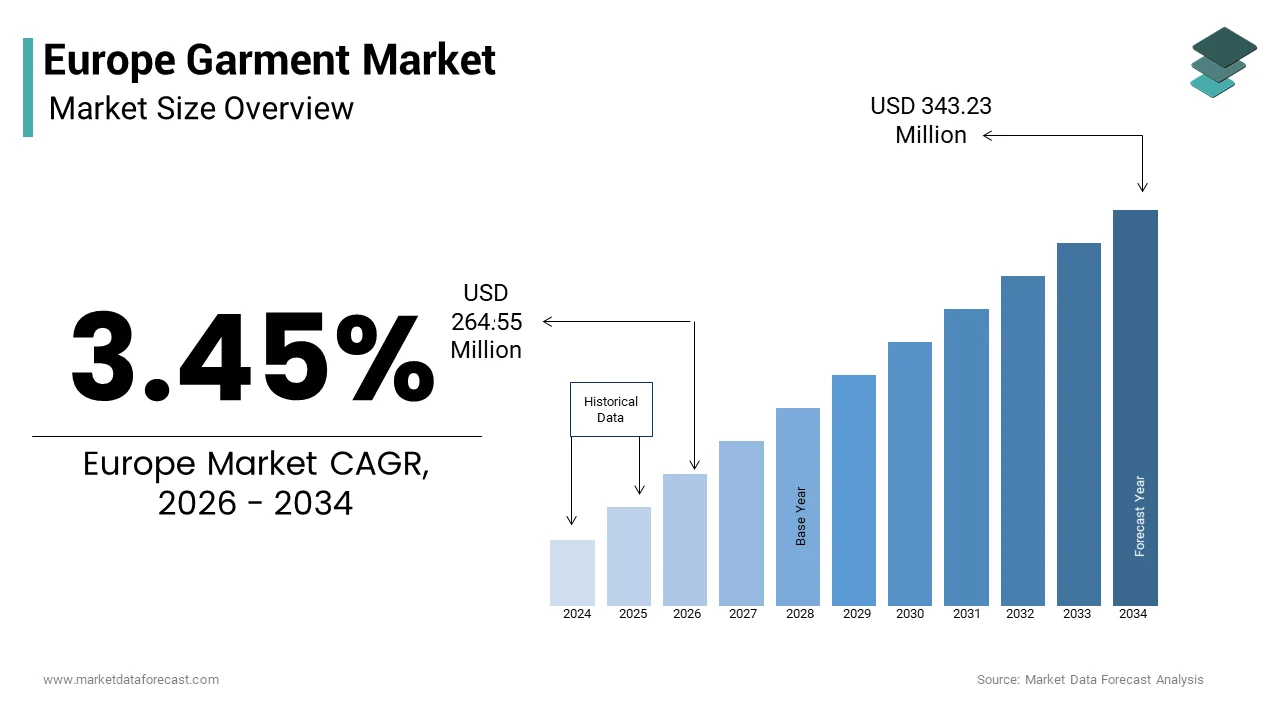
The Europe garment market size was valued at USD 255.69 million in 2025, is anticipated to reach USD 264.55 million in 2026, and is projected to scale up to USD 343.23 million by 2034, registering a compound annual growth rate (CAGR) of 3.45% during the forecast period from 2026 to 2034. Driven by increasing consumer demand for sustainable and circular fashion, the strategic resurgence of nearshoring to boost supply chain resilience, and the implementation of digital product passports, the European apparel sector continues to evolve dynamically.
Key Executive Metrics (At-a-Glance)
- 2025 Base Valuation: USD 255.69 Million
- 2026 Current Valuation: USD 264.55 Million
- 2034 Forecast Valuation: USD 343.23 Million
- Compound Annual Growth Rate (CAGR): 3.45% (2026–2034)
- Dominant Material Segment: Cotton Segment (46.4% share in 2025)
- Fastest-Growing Material Segment: Silk Segment (projected at 8.8% CAGR)
- Dominant Product Segment: Women's Segment (53.8% share in 2025)
- Fastest-Growing Product Segment: Kids' Segment (projected at 7.7% CAGR)
- Dominant Country Market: Germany (23.5% share in 2025) followed by the United Kingdom and France
Core Market Drivers
- Sustainable & Circular Fashion: Shoppers scrutinizing supply chains and driving demand for eco-friendly materials and second-hand retail.
- Nearshoring Resurgence: Relocating production facilities closer to European consumption hubs to ensure agility and shorter lead times.
- Transparency Frameworks: EU mandates and Digital Product Passports promoting clear tracking of material composition and lifecycle data.
Primary Market Restraints & Challenges
- Regulatory Compliance Costs: Substantial financial and administrative burdens imposed on small enterprises by EU sustainability mandates.
- Cost Volatility: Unpredictable fluctuations in raw material pricing and industrial energy costs squeezing manufacturer profit margins.
- Ultra-Fast Fashion Competition: Aggressive low-cost pricing models distorting consumer expectations and encouraging disposable consumption.
Europe Garment Market Segmentation Highlights
| Segment Category | Largest Market Segment | Fastest-Growing Market Segment |
|---|---|---|
| By Material Type | Cotton Segment (46.4% share in 2025) | Silk Segment (8.8% CAGR) |
| By Product | Women's Segment (53.8% share) | Kids' Segment (7.7% CAGR) |
| By Country | Germany (23.5% share in 2025) | Italy, Spain, and the United Kingdom |
Major Industry Players Profiled
Key enterprises dominating the European garment market include Inditex Group, Hennes and Mauritz AB (H&M), LVMH Moet Hennessy Louis Vuitton, Toray Industries, Inc., Arvind Limited, Grasim Industries Limited, PVH Corp., and Dior.
Europe Garment Market Size
The Europe garment market size was valued at USD 255.69 million in 2025 and is anticipated to reach USD 264.55 million in 2026 to reach USD 343.23 million by 2034, growing at a CAGR of 3.45% during the forecast period from 2026 to 2034.
Introduction to the Europe Garment Market
Garments serve as a cornerstone of cultural expression and economic activity. This sector ranges from high fashion houses in Paris and Milan to mass-market retailers and specialized workwear producers. The industry operates within a complex framework defined by the European Union strategy for sustainable and circular textiles, which mandates higher durability and recyclability standards. Europe hosts a large number of textile and clothing enterprises, which is employing a significant workforce directly, as per Eurostat. The region boasts a rich heritage of craftsmanship, with Italy and France accounting for a notable portion of global luxury apparel exports. Consumer behavior is increasingly shaped by digital integration, with online sales channels capturing a growing share of total revenue. As per the European Commission, the average European consumer purchases textiles annually, reflecting the deep embeddedness of clothing in daily life. The market faces intense pressure to transition from linear consumption models to circular economies and is driven by legislative proposals on eco design and extended producer responsibility. Demographic shifts, including an aging population and increasing urbanization, further influence demand patterns for specific garment types. The interplay between traditional artisanal skills and modern automated production technologies defines the current operational landscape, positioning Europe as a hub for both innovation and heritage preservation in the global apparel value chain.
MARKET DRIVERS
Rising Consumer Demand for Sustainable and Circular Fashion
The escalating consumer preference for sustainable and circular fashion is one of the major factors propelling the Europe garment market growth. Shoppers are increasingly scrutinizing supply chains, demanding transparency regarding labor practices and environmental footprints before making purchases. As per the European Consumer Organisation, sustainability has become a key factor for a majority of European consumers when buying clothes. This shift forces brands to adopt eco-friendly materials like organic cotton, recycled polyester, and innovative bio-based fibers. Retailers are responding by launching take-back schemes and repair services to extend garment lifecycles, aligning with the EU circular economy action plan. As per the Ellen MacArthur Foundation, the market for second-hand and refurbished clothing in Europe is expected to expand significantly by 2030, driven by conscious consumerism. Major brands are investing heavily in traceability technologies such as blockchain to verify claims and build trust. The demand for durability over disposability is altering product design philosophies, leading to higher quality standards and reduced collection frequencies.
Resurgence of Nearshoring to Enhance Supply Chain Resilience
The strategic shift toward nearshoring production facilities is further boosting the expansion of the Europe garment market. Following global supply chain disruptions caused by geopolitical tensions and pandemics, brands are relocating production closer to end markets to ensure agility and reduce lead times. As per the European Clothing Industry Association, investment in textile manufacturing within Eastern and Southern Europe has increased in recent years. Countries like Portugal, Romania, and Turkey are benefiting from this trend due to their skilled workforce and proximity to major Western European consumption hubs. This relocation reduces dependency on distant Asian suppliers, allowing for faster response to changing fashion trends and lower carbon emissions associated with logistics. The European Union supports this movement through funding programs aimed at modernizing local factories with automation and digital tools. As per the World Bank, nearshoring can reduce shipping times considerably compared to transcontinental sourcing. Brands are leveraging this proximity to implement on-demand manufacturing models, minimizing inventory waste and enhancing customization capabilities.
MARKET RESTRAINTS
Stringent Regulatory Compliance Costs Burdening Small Enterprises
The imposition of rigorous environmental and social regulations is a significant restraint on the Europe garment market, particularly for small and medium-sized enterprises. The European Union Strategy for Sustainable and Circular Textiles introduces mandatory requirements for eco-design, digital product passports, and extended producer responsibility, demanding substantial financial and administrative resources. As per the European Small Business Alliance, compliance costs for these new regulations could increase operational expenses significantly for smaller manufacturers who lack economies of scale. These firms often struggle to invest in necessary tracking systems, sustainable material sourcing, and recycling infrastructure required to meet legal standards. The complexity of navigating varying national implementations of EU directives further exacerbates the burden, creating barriers to market entry and expansion. As per the Federation of the European Apparel and Textile Industries, a notable portion of small clothing businesses fear being forced out of the market due to regulatory pressures. The need for detailed supply chain mapping and third-party verification adds layers of bureaucracy that slow down product launches.
Volatility in Raw Material Prices and Energy Costs
The persistent volatility in raw material prices and energy costs is another key restraint on the profitability and stability of the Europe garment market. Fluctuations in the costs of cotton, synthetic fibers, and dyes, driven by climate change impacts on agriculture and geopolitical instability, create unpredictable production expenses. As per the International Cotton Advisory Committee, cotton prices have experienced significant swings in recent years, severely impacting margin planning for European manufacturers. Additionally, the energy crisis in Europe has caused electricity and gas prices to rise sharply, which are critical for textile spinning, weaving, and dyeing processes. As per Eurostat, industrial energy prices in the EU have increased considerably compared to pre-crisis levels, forcing many factories to reduce output or halt operations temporarily. These cost pressures are difficult to pass entirely to consumers in a highly competitive retail environment, squeezing profit margins across the value chain. Smaller players without long-term hedging contracts are particularly vulnerable to these shocks. The uncertainty surrounding future energy availability and pricing discourages long-term capital investment in modernization and expansion.
MARKET OPPORTUNTIES
Expansion of Digital Product Passports for Transparency
The implementation of Digital Product Passports offers a promising opportunity for the Europe garment market by enabling unprecedented levels of transparency and consumer engagement. These digital identifiers will provide detailed information about a garment's lifecycle, including material composition, origin, repair instructions, and recycling options, accessible via QR codes or NFC tags. As per the European Commission, the rollout of Digital Product Passports is expected to cover all textile products by 2030, creating a standardized framework for sustainability data. This initiative allows brands to differentiate themselves by proving authenticity and ethical sourcing, appealing to the growing segment of conscious consumers. Retailers can leverage this data to optimize reverse logistics for recycling and resale, fostering a robust circular economy. As per pilot projects, products with transparent digital profiles have shown higher engagement rates from customers. The technology also facilitates compliance with upcoming regulations, reducing the administrative burden through automated data collection.
Growth of On-Demand and Customized Manufacturing Models
The adoption of on-demand and customized manufacturing models presents a lucrative opportunity for the Europe garment market to reduce waste and enhance customer satisfaction. Advanced technologies such as 3D knitting, automated cutting, and AI-driven design allow producers to create garments only after an order is placed, eliminating overproduction and inventory obsolescence. As per the European Technology Platform for the Future of Clothing, on-demand production can reduce textile waste while shortening lead times. This model appeals to modern consumers seeking unique, personalized items that reflect their individual style. Brands utilizing these methods can respond rapidly to trending styles without the risk of unsold stock, improving overall financial efficiency. As per early adopters, return rates for customized garments are significantly lower than standard off-the-rack items due to better fit and personal relevance. The shift supports the nearshoring trend by making local production economically viable even for smaller batches.
MARKET CHALLENGES
Complexity of Managing Global Supply Chain Traceability
The intricate challenge of establishing full supply chain traceability poses a significant hurdle for the Europe garment market as it strives for transparency and compliance. Garment supply chains are notoriously fragmented, involving multiple tiers of suppliers across different countries, each with varying levels of digital maturity and regulatory adherence. As per the Global Fashion Agenda, mapping the entire supply chain down to the raw material level remains elusive for a majority of major brands due to data silos and lack of cooperation from upstream providers. The requirement to verify labor conditions, environmental impacts, and material origins at every stage demands sophisticated tracking systems and extensive auditing resources. Many suppliers in developing nations lack the infrastructure to provide reliable digital data, creating gaps in the information flow. As per industry audits, discrepancies in reported versus actual practices are common, leading to reputational risks and potential legal liabilities. The cost and complexity of implementing end-to-end traceability solutions deter widespread adoption, particularly among mid-sized companies.
Intense Competition from Ultra-Fast Fashion Retailers
The aggressive expansion of ultra-fast fashion retailers is another major challenge for the Europe garment market by distorting price expectations and accelerating consumption cycles. These competitors leverage highly optimized global supply chains and data-driven design to offer trendy apparel at extremely low prices, putting immense pressure on traditional brands to match costs. As per the European Parliament, ultra-fast fashion giants can introduce thousands of new styles weekly, flooding the market with inexpensive items that encourage disposable consumption habits. This model undermines efforts to promote durability and sustainability, as consumers prioritize immediate affordability over long-term value. Traditional European manufacturers struggle to compete on price without compromising on labor standards and environmental protections, which are legally mandated in the EU. As per market analysis, the market share of ultra-fast fashion in Europe has grown significantly in recent years, eroding the customer base of established players. The race to the bottom on pricing squeezes margins for compliant companies, forcing difficult choices between profitability and ethical practices.
REPORT COVERAGE
| REPORT METRIC | DETAILS |
| Market Size Available | 2025 to 2034 |
| Base Year | 2025 |
| Forecast Period | 2026 to 2034 |
| CAGR | 3.45% |
| Segments Covered | By Material, Product, Country |
| Various Analyses Covered | Global, Regional & Country Level Analysis, Segment-Level Analysis, DROC, PESTLE Analysis, Porter’s Five Forces Analysis, Competitive Landscape, Analyst Overview on Investment Opportunities |
| Regions Covered | UK, France, Spain, Germany, Italy, Russia, Sweden, Denmark, Switzerland, Netherlands, Turkey, the Czech Republic, and the Rest of Europe |
| Market Leaders Profiled | Toray Industries, Inc., Arvind Limited, Grasim Industries Limited, Youngor, Pvh Corp, Tabb Textile Company Inc., Ruby Mills, Alok Industries Ltd, Dior, Kpr Mill Limited, Hyosung Tnc, Texhong Textile Group Limited, Apparel Production, The Tjx Companies, Inc, And Vardhman Textiles Limited. |
SEGMENTAL ANALYSIS
By Material Insights
The cotton segment led the market by holding 46.4% of the regional market share in 2025. The supremacy of cotton segment in the European market can be credited to the fiber's unparalleled versatility, breathability, and comfort, making it the preferred choice for everything from basic t-shirts to high-end formal wear across all demographics. The deep cultural acceptance of cotton as a natural and skin-friendly material ensures its continued prevalence despite the rise of synthetic alternatives. The enduring dominance of cotton segment is further driven by the strong consumer preference for natural fibers that offer superior comfort and breathability in diverse European climates. Europeans increasingly prioritize health and wellness, leading to a rejection of synthetic materials that can cause skin irritation or trap heat. As per the International Cotton Advisory Committee, cotton remains a major component of fiber consumption in the European Union, reflecting its status as the default choice for daily apparel. As per Eurostat, household expenditure on cotton-based garments continues to be higher than other material categories, underscoring its essential role in wardrobes. Furthermore, the perception of cotton as a hypoallergenic material drives its adoption in baby clothing and sensitive skin categories. The widespread availability of organic cotton options further strengthens this position, allowing consumers to align their comfort preferences with sustainability goals.
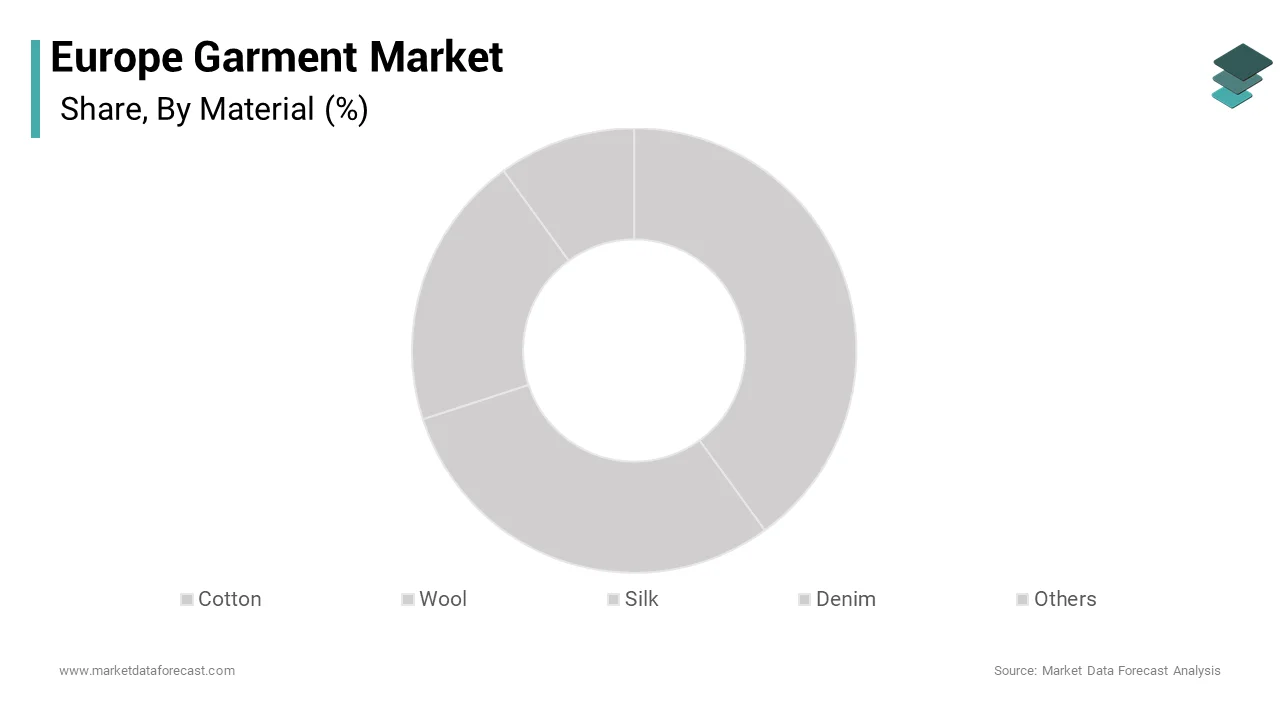
However, the silk segment is projected to register the highest CAGR of 8.8% over the forecast period in the Europe garment market due to the resurgence of luxury consumption, the growing appreciation for sustainable natural proteins, and the increasing use of silk in high-performance wellness apparel. The robust recovery and growth of the luxury sector in Europe are acting as a powerful catalyst for the silk market, as silk remains the quintessential symbol of opulence and refinement. Post-pandemic economic recovery has led to a surge in discretionary spending, with consumers eager to invest in high-quality, timeless pieces that convey status and elegance. As per Bain and Company, the European personal luxury goods market has grown significantly, with silk scarves, blouses, and lingerie being key contributors. The tradition of gifting premium silk items during holidays and special occasions continues to drive seasonal sales across major markets like France and Italy. As per luxury conglomerates, silk-based product lines have shown notable revenue increases, outpacing other material categories. The association of silk with heritage brands and artisanal craftsmanship resonates strongly with European consumers who value provenance and quality.
By Product Insights
The women's segment dominated the market by capturing 53.8% of the regional market share in 2025 due to the vast diversity of styles, the frequency of fashion cycles targeting female consumers, and the broader range of occasions requiring specific attire. The women's segment leads the market due to the incredibly dynamic nature of female fashion, which features rapid trend cycles and an extensive array of style categories ranging from casual wear to formal evening gowns. Women's apparel is characterized by a higher frequency of collection launches, with retailers introducing new styles weekly to capture fleeting trends and seasonal shifts. As per the European Fashion Council, female consumers in Europe purchase significantly more clothing annually compared to their male counterparts, driven by the desire for variety and self-expression. As per retail analytics firms, women's departments occupy a majority of floor space in major department stores, reflecting the sheer volume of SKUs available. The influence of social media and fashion influencers disproportionately targets female audiences, accelerating trend adoption and driving impulse purchases.
On the other hand, the kids' segment is anticipated to witness the fastest CAGR of 7.7% over the forecast period owing to the rising parental disposable income, the "mini-me" fashion trend, and an increasing focus on high-quality, durable, and safe clothing for children. The increase in parental disposable income across Europe is driving a shift toward premium and branded clothing for children, which is further fuelling the rapid growth of the kids' segment. Parents are increasingly willing to spend more on high-quality garments that offer better durability, comfort, and safety standards for their offspring. As per Eurostat, household spending on children's clothing in Western Europe has risen, reflecting a trend toward premiumization. As per market research, the average price point for kids' clothing has increased as parents prioritize organic materials and ethical production methods. The willingness to pay for certified safe dyes and reinforced stitching ensures that children's clothes withstand rough play and frequent washing. This shift in consumer behavior is encouraging brands to expand their kids' lines with luxury and designer collaborations. The focus on quality and brand reputation is transforming the kids' segment into a high-value market with robust growth potential.
COUNTRY LEVEL ANALYSIS
Germany Garment Market Analysis
Germany dominated the garment market in Europe in 2025 with 23.5% of the regional market share. The dominance of Germany in the European market is attributed to its massive population, strong economic fundamentals, and a retail landscape that balances value-oriented discounters with a growing appetite for sustainable premium brands. The German consumer is discerning, prioritizing quality, functionality, and durability over fleeting trends, which shapes a market resistant to ultra-fast fashion waste. As per the German Fashion Institute, the domestic textile and clothing market has generated significant revenue, driven by steady demand for work wear, outdoor apparel, and everyday basics. The rise of eco-consciousness is pronounced here, with German shoppers leading Europe in the adoption of certified organic cotton and fair-trades labelled garments. Major retail chains headquartered in Germany exert strong influence on regional supply chains and digital commerce trends. The government's strict enforcement of supply chain due diligence laws forces brands to maintain high transparency standards. Urban centers like Berlin and Munich serve as hubs for emerging designers and sustainable fashion startups, fostering innovation.
United Kingdom Garment Market Analysis
The United Kingdom held a key position in the Europe garment market in 2025 due to its vibrant fashion culture, strong heritage brands, and status as a global trendsetter. London remains one of the "Big Four" fashion capitals, influencing styles worldwide and driving domestic demand for both high-end luxury and street wear. The UK market is highly diversified, encompassing everything from historic bespoke tailoring to aggressive high-street fast fashion retailers. As per the British Fashion Council, the fashion industry contributes substantially to the UK economy. Post-Brexit trade adjustments have led to a reshuffling of supply chains, with some brands increasing local sourcing to avoid tariffs. The British consumer is highly digitally engaged, with online penetration rates for clothing among the highest in Europe. As per retail analysts, the second-hand and vintage clothing market in the UK has been growing steadily as younger generations embrace circular fashion. The presence of major global headquarters for retailers ensures a robust distribution network. The market is defined by agility and responsiveness to trends, with a strong emphasis on individuality and self-expression.
France Garment Market Analysis
France is anticipated to command for a substantial share of the European market over the forecast period owing to its undisputed leadership in the global luxury garment sector and its deep-rooted culture of elegance and craftsmanship. The country is home to the world's most prestigious fashion houses, which drive a significant portion of high-value apparel sales domestically and globally. The French market is bifurcated between the exclusive luxury segment centered in Paris and a strong mid-market sector that values style and quality. As per the French Federation of Haute Couture and Fashion, the luxury ready-to-wear segment in France has seen notable revenue growth, fueled by strong tourist spending and resilient domestic demand. French consumers are known for their "chic" aesthetic, preferring timeless pieces and capsule wardrobes over fast fashion disposables. The government actively supports the industry through initiatives promoting "Made in France" labeling to protect local artisans and jobs. As per INSEE, expenditure on clothing per capita in France is among the highest in Europe, reflecting the cultural importance of appearance. Paris Fashion Week continues to set the tone for global trends, ensuring France remains at the forefront of the industry.
Italy Garment Market Analysis
Italy is predicted to showcase a prominent CAGR in the Europe garment market over the forecast period owing to its exceptional textile manufacturing capabilities, design excellence, and concentration of small to medium-sized artisanal enterprises. The country serves as the production backbone for many global luxury brands, with regions like Tuscany and Lombardy specializing in high-quality fabrics and finished garments. The Italian domestic market reflects this heritage, with consumers displaying a keen eye for fabric quality, fit, and design details. As per the National Chamber of Italian Fashion, the Italian fashion system has generated substantial turnover, with a significant portion retained within the domestic retail sector. Italians tend to invest in fewer, higher-quality items that last longer, aligning with the principles of slow fashion. The "Made in Italy" label carries immense weight, driving both local pride and export success. As per ISTAT, spending on premium apparel remains resilient among the Italian middle and upper classes. The market is characterized by a dense network of independent boutiques and specialized stores that offer personalized service. Recent initiatives to digitize supply chains and promote circular economy practices are modernizing the sector while preserving its artisanal soul.
Spain Garment Market Analysis
Spain is estimated to secure a notable share of the European garment market over the forecast period. Spain is uniquely positioned as the headquarters for some of the world's most influential fast-fashion giants, which profoundly shapes its domestic retail landscape. The presence of Inditex and other major retailers creates a highly competitive environment with rapid stock turnover and affordable pricing, making fashion accessible to a broad demographic. Spanish consumers are highly fashion-forward, embracing new trends quickly and frequently updating their wardrobes. As per the Spanish Textile and Clothing Business Association, the domestic market value has reached significant levels, driven by strong internal consumption and a thriving tourism sector. The climate in Spain dictates a specific demand for lightweight, breathable fabrics and resort wear, influencing seasonal collection strategies. The country has also become a hub for sustainable fashion innovation, with many brands investing in recycling technologies and eco-friendly materials to meet EU regulations. As per retail reports, Spain has one of the highest per capita clothing consumption rates in Europe, fueled by the culture of socializing and outdoor living. The market status is dynamic and volume-driven, balancing the speed of fast fashion with an emerging commitment to sustainability.
COMPETITIVE LANDSCAPE
The competition in the Europe garment market is intense and multifaceted, characterized by the coexistence of global fast fashion giants, luxury conglomerates, and agile local brands. Major players compete fiercely on speed to market, price competitiveness, and increasingly on sustainability credentials to attract conscious consumers. The rise of ultra-fast fashion entrants has pressured established retailers to accelerate their design-to-shelf cycles while maintaining ethical standards. Luxury houses differentiate themselves through exclusivity, heritage storytelling, and superior craftsmanship, creating a distinct competitive sphere insulated from price wars. Digital capabilities have become a primary battleground, with companies vying for dominance in e-commerce through personalized marketing and seamless logistics. The regulatory environment regarding environmental compliance adds another layer of complexity, forcing all participants to invest in green technologies and transparent supply chains. Smaller niche brands challenge incumbents by offering unique designs and strong ethical narratives that resonate with specific demographics. This dynamic landscape drives continuous innovation in business models, product offerings, and operational efficiencies as firms strive to secure loyalty and market share in a saturated and rapidly evolving region.
KEY MARKET PLAYERS
A few of the market players that are in the Europe garment market are
- Toray Industries, Inc.
- Arvind Limited
- Inditex Group
- Hennes and Mauritz AB
- LVMH Moet Hennessy Louis Vuitton
- Grasim Industries Limited
- Youngor
- Pvh Corp
- Tabb Textile Company Inc.
- Ruby Mills
- Alok Industries Ltd
- Dior
- Kpr Mill Limited
- Hyosung Tnc
- Texhong Textile Group Limited
- Apparel Production
- The Tjx Companies, Inc
- Vardhman Textiles Limited.
Top Players In The Market
- Inditex Group stands as a global powerhouse headquartered in Spain, fundamentally shaping the Europe garment market through its agile fast fashion model and diverse brand portfolio including Zara. The company contributes significantly to the global industry by pioneering rapid supply chain responses that translate runway trends into store inventory within weeks. Inditex recently strengthened its market position by investing heavily in integrated online and offline retail experiences, allowing customers to seamlessly browse and return items across channels. The firm has also committed to ambitious sustainability goals, aiming for all collections to use sustainable fabrics by 2025. Their strategic focus on automation and logistics optimization ensures efficient distribution across European hubs. By leveraging data analytics to predict consumer preferences, Inditex minimizes waste and maximizes relevance. These continuous innovations in operational efficiency and digital integration solidify their leadership status while setting new standards for speed and responsiveness in the global apparel sector.
- Hennes and Mauritz AB, commonly known as H&M, is a Swedish multinational that plays a pivotal role in the Europe garment market by offering fashionable and affordable clothing to a mass audience. The company influences the global market through its extensive network of stores and strong emphasis on circular fashion initiatives. H&M recently intensified its efforts to become climate positive by launching garment collecting programs in thousands of locations and increasing the share of recycled materials in its products. The retailer has partnered with innovative startups to develop new recycling technologies for textile waste. Their strategy involves expanding premium segments like COS and Arket to cater to discerning consumers seeking higher quality. H&M also utilizes artificial intelligence to optimize inventory management and reduce overproduction. By championing transparency in supply chains and promoting rental services, the company reinforces its commitment to sustainability. These proactive measures enhance brand loyalty and ensure resilience against evolving regulatory landscapes in Europe.
- LVMH Moet Hennessy Louis Vuitton dominates the luxury segment of the Europe garment market with an unparalleled portfolio of heritage brands including Louis Vuitton, Dior, and Givenchy. The conglomerate drives global luxury trends by combining traditional craftsmanship with contemporary design innovation. LVMH recently strengthened its position by acquiring niche artisanal workshops to secure exclusive skills and materials for its fashion houses. The group has invested significantly in digital platforms to offer immersive online shopping experiences that reflect the exclusivity of their physical boutiques. Their commitment to sustainability is evident in the Life 360 program, which focuses on environmental protection and creative circularity. LVMH also expands its reach through strategic flagship store openings in key European cities, enhancing brand visibility. By maintaining strict control over distribution and pricing, the company preserves brand equity and desirability. These strategic moves ensure LVMH remains the benchmark for luxury excellence, driving growth through high value addition and cultural influence worldwide.
Top Strategies Used By Key Market Participants
Key players in the Europe garment market primarily employ digital transformation strategies to integrate online and offline channels for a seamless customer experience. Companies invest heavily in data analytics to predict trends and optimize inventory levels, reducing waste and improving responsiveness. Sustainability initiatives are central to corporate planning, with firms adopting circular economy models through recycling programs and eco-friendly material sourcing. Nearshoring production facilities is another critical strategy used to shorten supply chains and increase agility in response to market changes. Brands also focus on diversification by launching premium sub-labels or acquiring niche designers to capture different consumer segments. Strategic partnerships with technology firms enable the adoption of augmented reality for virtual try-ons and blockchain for supply chain transparency. These multifaceted approaches allow market participants to navigate regulatory pressures, meet evolving consumer demands, and maintain competitive advantages in a dynamic regional landscape.
MARKET SEGMENTATION
This research report on the Europe garment market is segmented and sub-segmented into the following categories.
By Material Type
- Cotton
- Wool
- Silk
- Denim
- Others
By Product
- Women
- Men
- Kids
By Country
- UK
- France
- Spain
- Germany
- Italy
- Russia
- Sweden
- Denmark
- Switzerland
- Netherlands
- Turkey
- Czech Republic