- Product Description Description
- Table of Contents TOC
- List of Table & Figure LOT
- Get Free Sample PDF Sample PDF
Market Size, 2025
$655 MnMarket Estimate, 2026
$685 MnMarket Forecast, 2034
$986 MnCAGR, 2026–2034
4.65%Executive Summary: Europe Gas Separation Membrane Market
- Market Scope: European gas separation technology market analysis covering membrane types, application verticals, regional leadership frameworks, and adoption metrics.
- Market Valuation: Valued at USD 655.14 million (2025), estimated at USD 685.60 million (2026), and projected to reach USD 986.24 million by 2034, growing at a robust CAGR of 4.65% (2026–2034).
- Primary Growth Drivers: High regional renewable output (Europe's biogas output exceeding 22 billion cubic meters in 2023, with over 60% of new facilities integrating membrane units for methane enrichment) and stringent industrial standards. Key operational metrics include raw biogas containing 50–70% methane upgraded to >95% purity via membranes, the EU commissioning 232 new biogas plants in 2023 (bringing totals to over 20,500 facilities), and membrane-based CO₂ separation demonstrating CO₂/nitrogen selectivity ratios exceeding 40.
Key Market Segment Metrics (2026–2034)
| Category | Leading Segment (2025 Position) | Fastest-Growing Segment |
|---|---|---|
| By Membrane Type | Polymeric membranes (dominated with 48.2% market share in 2025, supported by >12,000 small-to-mid-scale digesters in Germany and France) | Inorganic membranes (projected to expand at a 15.3% CAGR from 2026 to 2034, with modules showing <5% degradation over 3,000 hours) |
| By Application | Natural gas treatment (held a significant application share) | Hydrogen recovery (forecast to grow at a 14.1% CAGR; membrane systems capture up to 95% of lost hydrogen, with a BASF pilot achieving 98% recovery efficiency) |
| By Region | Germany (led Europe with 25.4% market share in 2025, hosting over 9,500 biogas plants where >70% use membrane systems), followed by France with 18.2% | — |
Major Market Players & Market Structure
Market Structure: Highly competitive European gas separation membrane landscape featuring 9 prominent market leaders competing on high selectivity ratios, methane enrichment efficiency, durability, and advanced industrial application rollouts.
Key Companies: Air Liquide, Evonik Industries AG, Fujifilm Manufacturing Europe B.V., Linde plc, Honeywell International, Parker-Hannifin Corporation, DIC Corporation, UBE Industries Ltd., and Air Products and Chemicals, Inc.
 Download Free Sample Report
Europe Gas Separation Membrane Market Size
The Europe gas separation membrane market size was valued at USD 655.14 million in 2025 and is projected to reach USD 986.24 million by 2034 from USD 685.60 million in 2026, growing at a CAGR of 4.65%.
Gas separation membranes are engineered materials designed to selectively separate gaseous components, such as carbon dioxide, nitrogen, oxygen, and hydrogen, through differences in permeability and solubility. Their deployment is increasingly aligned with the European Green Deal and net zero mandates, which prioritise low-energy, low-emission separation technologies over conventional methods. Additionally, the International Energy Agency reported that Europe’s biogas output surpassed 22 billion cubic meters in 2023, with over 60% of new facilities integrating membrane units for methane enrichment. This combination of regulatory pressure, renewable energy expansion, and industrial decarbonization is reshaping the technical and commercial landscape of the European gas separation membrane market.
MARKET DRIVERS
WHAT ARE THE KEY TRENDS AND GROWTH DRIVERS SHAPING THE EUROPE GAS SEPARATION MEMBRANE MARKET?
Escalating Demand for Biogas Upgrading Drives Membrane Adoption
The renewable energy roadmap has made biogas, with its clean energy transition, is majorly propelling the growth othe f the European gas separation membrane market. Gas separation membranes are central to upgrading raw biogas, typically 50 to 70% methane, into grid-quality biomethane (>95% methane). According to the European Biogas Association, 232 new biogas plants were commissioned across the EU in 2023, expanding the total to over 20500 facilities. This growth is propelled by the Renewable Energy Directive II, which requires 38% of transport energy to come from renewables by 2030. Membrane systems offer significant advantages over amine scrubbing or pressure swing adsorption, including minimal chemical usage, modular scalability, and reduced operational complexity,, that attributes for decentralised agricultural digesters. The technology’s compatibility with variable feedstock inputs and compact design makes it especially suitable for rural and small-scale operations, with its adoption trajectory across Central and Southern Europe.
Industrial Decarbonization Imperatives Amplify Demand for Carbon Capture Solutions
Europe’s net zero 2050 target is accelerating he deployment of carbon capture across heavy-emitting sectors is additionally bolstering the growth of the European gas separation membrane market. Gas separation membranes provide a solvent-free alternative for post-combustion CO₂ capture in cement, steel, and chemical plants, where industries are responsible for 18% of the EU’s total emissions. These membranes selectively extract CO₂ from flue gas with lower energy penalties than liquid absorption methods. The emerging North Sea CO₂ transport corridor, led by the Northern Lights consortium, demands consistent CO₂ purity levels that membrane systems can deliver, with laboratory tests showing CO₂ nitrogen selectivity ratios exceeding 40.
MARKET RESTRAINTS
WHAT FACTORS ARE LIMITING THE GROWTH OF THE EUROPE GAS SEPARATION MEMBRANE MARKET?
Technological Limitations in Achieving High Selectivity and Permeability Simultaneously Restrict Performance
The technological limitations in achieving high selectivity and permeability simultaneously are hindering the growth of the European gas separation membrane market. Commercial polymeric membranes typically achieve CO₂ nitrogen selectivity between 20 and 35, whereas grid injection or fuel cell feed standards often require ratios above 50. Although ceramic and metal organic framework membranes show promise, their brittleness and high manufacturing costs hinder scalability. Real-world operational challenges further degrade performance. These limitations compel operators to adopt hybrid or fallback technologies by slowing membrane penetration in precision-driven industrial environments.
High Capital Expenditure and Limited Economies of Scale Inhibit Widespread Commercialisation
The membrane systems face significant economic barriers in Europe’s mid-tier industrial segment, which is restraining the growth of the European gas separation membrane market. The European Industrial Gases Association noted in 2025 that installed costs for biogas membrane units range from 800 to 1200 euros per kilowatt, 25 to 40% higher than pressure swing adsorption alternatives. This premium stems from limited local manufacturing capacity, where fewer than 15 EU companies can produce advanced composite membranes with consistent quality. The reliance on imported speciality polymers from North America and Asia inflates procurement costs and introduces supply chain vulnerabilities. Operational expenses, including pre-filtration, membrane replacement, and monitoring that further reduce the total cost advantage.
MARKET OPPORTUNITIES
WHAT NEW OPPORTUNITIES ARE EMERGING IN THE EUROPE GAS SEPARATION MEMBRANE MARKET?
Integration with Emerging Hydrogen Infrastructure Presents Strategic Growth Avenues
Europe’s Hydrogen Strategy targets 40 gigawatts of electrolyser capacity by 2030, which is creating robust demand for gas purification technologies. The integration with emerging hydrogen infrastructure presents strategic growth avenues is setting up new opportunities for the growth of the European gas separation membrane market. Membranes are critical for both green hydrogen (purifying product gas) and blue hydrogen (recovering H₂ from reformer off gases and capturing CO₂). Furthermore, the European Network of Transmission System Operators for Gas outlined in its 2025 Ten-Year Plan that 15% of natural gas pipelines will be repurposed for hydrogen transport by 2030. This infrastructure shift establishes a high-value niche for membrane integrators across Western and Central Europe.
Expansion of Circular Economy Frameworks Fuels Demand for Gas Recovery in Waste Processing
Europe’s circular economy action plan is driving gas recovery from municipal and industrial waste streams, where methane and hydrogen represent untapped energy resources, which can additionally leverage the growth of Europe's gas separation membrane market. EU landfills produced over 9 billion cubic meters of landfill gas, with only 62% captured, with a major recovery gap. Membrane systems offer decentralised, low-maintenance solution for upgrading this gas, particularly in regions lacking centralised biogas networks. Similarly, wastewater treatment plants, which emit an estimated 3.5 million tonnes of methane annually, according to Eurostat.
MARKET CHALLENGES
WHAT ARE THE MAIN CHALLENGES FACING THE EUROPE GAS SEPARATION MEMBRANE MARKET?
Feed Gas Contamination and Membrane Degradation Under Real Operating Conditions Pose Operational Hurdles
The performance degradation due to complex feed compositions containing hydrogen sulfide, siloxanes, moisture, and volatile organics is inhibiting the growth of the European gas separation membrane market. These contaminants cause swelling, fouling, and irreversible chemical changes in polymeric layers. In heavy industry, flue gases from cement kilns or steel furnaces carry particulates and acidic gases that accelerate physical wear, especially at elevated temperatures where polymer stability declines. Until anti-fouling coatings or intrinsically stable inorganic membranes become cost-competitive, these operational instabilities will impede deployment in Europe’s heterogeneous industrial gas environments.
Fragmented Regulatory Approvals and Lack of Standardised Performance Certification Delay Market Entry
Europe lacks a harmonised certification framework for gas separation membrane performance by creating uncertainty for manufacturers and project developers, which also impedes the growth of the European gas separation membrane market. Unlike regulated equipment such as compressors or heat exchangers, membranes are not covered by unified EU directives for separation efficiency or longevity. This absence of common benchmarks forces end-users to conduct redundant pilot trials. In Germany, for instance, biomethane injection mandates require ISO 14687 compliance for gas quality but do not recognise specific membrane technologies by leading to inconsistent procurement practices. The European Chemicals Agency has also not yet evaluated novel membrane materials under REACH, leaving environmental safety assessments incomplete.
REPORT COVERAGE
| REPORT METRIC | DETAILS |
| Market Size Available | 2025 to 2034 |
| Base Year | 2025 |
| Forecast Period | 2026 to 2034 |
| CAGR | 4.65% |
| Segments Covered | By Membrane Type, Application, and Region |
| Various Analyses Covered | Global, Regional, & Country Level Analysis; Segment-Level Analysis; DROC, PESTLE Analysis; Porter’s Five Forces Analysis; Competitive Landscape; Analyst Overview of Investment Opportunities |
| Regions Covered | UK, France, Spain, Germany, Italy, Russia, Sweden, Denmark, Switzerland, Netherlands, Turkey, and the Czech Republic |
| Market Leaders Profiled | Air Liquide, Evonik Industries AG, Fujifilm Manufacturing Europe B.V., Linde plc, Honeywell International, Parker-Hannifin Corporation, DIC Corporation, UBE Industries Ltd., and Air Products and Chemicals, Inc. |
SEGMENTAL ANALYSIS
By Membrane Type Insights
The polymeric membranes segment accounted in holding 48.2% of the European gas separation membrane market share in 2025, with its cost efficiency, established manufacturing infrastructure, and versatility across biogas, nitrogen generation, and natural gas applications. Polymers such as cellulose acetate, polyimide, and polysulfone offer a favourable balance of selectivity and processability, enabling mass production at scale. The widespread adoption of polymeric membranes in agricultural biogas plants across Germany and France, where over 12,000 small to mid-scale digesters rely low-cost membrane modules for biomethane upgrading. The maturity of polymer supply chains within the EU is also elevating the growth of the segment.
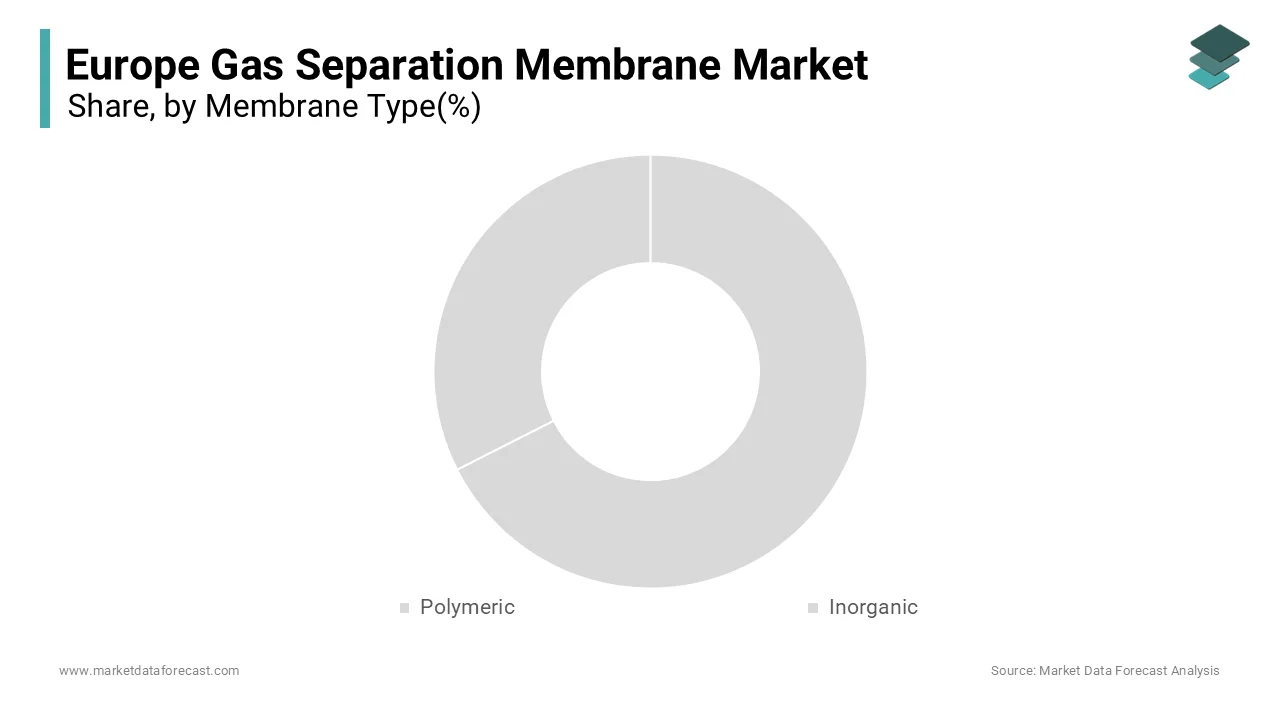
The inorganic membranes segment is growing at a fast CAGR of 15.3% from 2026 to 2034. The deployment of ceramic membranes in hydrogen purification for fuel cell systems is elevating the growth of the segment. The European Union’s Innovation Fund supports blue hydrogen and carbon capture initiatives. In 2023, the fund allocated 1.2 billion euros to projects utilising inorganic membranes for CO₂ separation from syngas streams with their superior long-term stability and resistance to acid gases. As per the German Aerospace Centre, inorganic membrane modules demonstrated less than 5% performance degradation over 3000 hours of continuous operation in refinery off-gas tests. These technical advantages position inorganic membranes as the technology of choice for Europe’s decarbonization vanguard.
By Application Insights
The natural gas treatment segment held a significant share of the European gas separation membrane market in 2025, with the continent’s reliance on imported natural gas and stringent pipeline specifications that mandate CO₂ and water vapour removal to prevent corrosion and ensure calorific consistency. The expansion of LNG import terminals across Northwest Europe is escalating the growth of the segment. The European Network of Transmission System Operators for Gas reported in 2025 that Europe added 12 new LNG regasification capacities since 2022, with facilities in the Netherlands, Germany, and France integrating membrane skids for rapid CO₂ stripping. The retrofitting of ageing North Sea gas fields is additionally to further scalate the growth of the segment.
The hydrogen recovery segment is anticipated to witness the fastest CAGR of 14.1% throughout the forecast period. The integration of membrane separation in refineries and ammonia plants to recover hydrogen from purge and off gases is solely surging the growth of the segment. Membrane systems can capture up to 95% of this lost hydrogen, as demonstrated in a 2023 pilot at BASF’s Ludwigshafen site, which achieved 98% recovery efficiency using composite polyimide membranes.
REGIONAL ANALYSIS
Germany Market Analysis
Germany was the largest contributor to the European gas separation membrane market by capturing 25.4% of the share in 2025, with its advanced industrial base, robust biogas sector, and in the hydrogen transition. The country hosts over 9500 biogas plants, with the highest in Europe, pe with more than 70% utilising membrane systems for biomethane upgrading. Germany’s Energiewende policy mandates that renewable gases supply 10% of total heat and power by 2030, which is accelerating membrane deployment in rural energy cooperatives. Additionally, the nation is home to major chemical clusters in Ludwigshafen and Marl, where refineries and ammonia producers are retrofitting hydrogen recovery units to comply with the EU Emissions Trading System.
France Market Analysis
The French gas separation membrane market was positioned second by holding 18.2% in 2025, with its extensive waste management infrastructure nuclear-powered hydrogen ambitions. Regulatory mandates under the Anti Waste Law require 75% gas capture from landfills by 2027, which is driving membrane retrofits nationwide. The country’s centralised industrial policy and strong public investment in circular economy technologies are evidenced by 1.1 billion euros in green gas subsidies in 2023, which will create a stable environment for membrane adoption across municipal and energy sectors.
Italy Market Analysis
Italy's gas separation membrane market growth is likely to have a significant CAGR from 2026 to 2034, with its dense network of agricultural biogas facilities and natural gas dependency. Over 60% of these plants use membrane systems to produce biomethane for injection into Snam’s gas grid, which now carries renewable gas in 12 regional networks. Italy’s 2023 Decree on Renewable Gases mandates that 12% of natural gas consumption must derive from biomethane by 2030, which is spurring investment in modular membrane skids suited small-scale digesters. Additionally, the country’s limited domestic fossil reserves make imported LNG treatment essential, with terminals in Livorno and Trieste deploying membrane units for CO₂ removal.
United Kingdom Market Analysis
The United Kingdom gas separation membrane market growth is likely to grow with the offshore natural gas processing and emerging hydrogen initiatives. Operators, such as BP and Shell, have installed compact polymeric membrane systems on platforms like Buzzard and Elgin to avoid costly pipeline corrosion and ensure gas marketability. Onshore is the UK’s Ten Point Plan for a Green Industrial Revolution targets 10 gigawatts low-carbon hydrogen by 2030, with projects like the HyNet cluster in Northwest England incorporating membrane purification for industrial hydrogen distribution.
COMPETITIVE LANDSCAPE
HOW ARE LEADING COMPANIES SHAPING THE EUROPE GAS SEPARATION MEMBRANE MARKET?
Competition in the European gas separation membrane market is characterised by a blend of global material science leaders and specialised engineering integrators. The market features high technical barriers to entry due to stringent performance and certification requirements across diverse applications, including biogas upgrading, natural gas pprocessingg and hydrogen recovery. Established players leverage decades of polymer expertise and strong relationships with industrial gas and energy clients to maintain technological leadership. At the same time,me regional firms compete with customisationion, rapid deployment, and lifecycle cosopoptimisationticularly in decentralised waste-to-energy projects. Innovation in membrane materials, such as high temperature ceramics and anti-fouling coatings, is a key battleground. Regulatory alignment and participation in EU-funded decarbonization initiatives further differentiate market participants. The competitive intensity is expected to rise as hydrogen and carbon capture applications scale across Western and Central Europe.
KEY MARKET PLAYERS
Some of the notable key players in the European gas separation membrane market are
- Air Liquide
- Evonik Industries AG
- Fujifilm Manufacturing Europe B.V.
- Linde plc
- Honeywell International
- Parker-Hannifin Corporation
- DIC Corporation
- UBE Industries Ltd.
- Air Products and Chemicals, Inc.
TOP STRATEGIES USED BY THE KEY MARKET PLAYERS
Key players in the European gas separation membrane market focus on strategic collaborations with industrial and municipal partners to co-develop application-specific solutions. They invest heavily in research and development to enhance membrane selectivity and long-term durability under real-world conditions. Companies frequently expand their regional service and pilot testing infrastructure to accelerate customer validation and deployment. Many pursue vertical integration by offering full engineering, desidesignbu, and maintenance packages around membrane skids. Additionally, they actively participateEU-fundednded decarbonization and circular economy programs to align their technologies with policy-driven market opportunities and secure early mover advantage in emerging segments such as hydrogen and landfill gas recovery.
TOP PLAYERS IN THE MARKET
- Air Liquide is a global leader in gas technologies and services with a strong footprint in the European gas separation membrane market. The company integrates advanced membrane systems into its industrial gas purification and hydrogen recovery solutions. In recent years, Air Liquide has intensified its focus on carbon capture and renewable gas upgrading by deploying proprietary polymeric membrane modules at biogas and refinery sites across France, Germany, and the Netherlands. The company also collaborates with research institutions to develophigh-fluxx membranes tailored for European decarbonization mandates.
- Evonik Industries is a key innovator in speciality material,s includinhigh-performancece polymers for gas separation membranes. Its SEPURAN® family of membrane products is widely used across Europe for nitrogen generation, hydrogen recover,y and biogas upgrading. Evonik has strengthened its position through continuous R&D investments at its facility in Schörbli,ng Aust,ria and partnerships with engineering firmscustomisemize membrane solutions for industrial clients. Recently, the company expanded its pilot testing capabilities for CO₂ separation membranes in collaboration with European carbon capture initiatives.
- Mitsubishi Chemical Group supplies advanced polymeric and composite membranes to the European gas separation market through its performance products division. The company’s offerings are deployed in natural gas treatment and hydrogen purification applications across the continent. To enhance its European presence, Mitsubishi Chemical has formed strategic alliances with local engineering integrators and increased technical support staffing in regional hubs such as Düsseldorf and Milan.
MARKET SEGMENTATION
This research report on the European gas separation membrane market has been segmented and sub-segmented based on categories.
By Membrane Type
- Polymeric
- Inorganic
By Application
- Nitrogen Production
- Natural Gas Treatment
- Hydrogen Recovery
- Vapour Recovery
- Others
By Country
- UK
- France
- Spain
- Germany
- Italy
- Russia
- Sweden
- Denmark
- Switzerland
- Netherlands
- Turkey
- Czech Republic
- Rest of Europe