- Product Description Description
- Table of Contents TOC
- List of Table & Figure LOT
- Get Free Sample PDF Sample PDF
Market Size, 2025
$0.78 BnMarket Estimate, 2026
$0.82 BnMarket Forecast, 2034
$1.23 BnCAGR, 2026–2034
5.63%Europe Gift Boxes Market Size, Growth, Trends & Forecast (2026–2034)
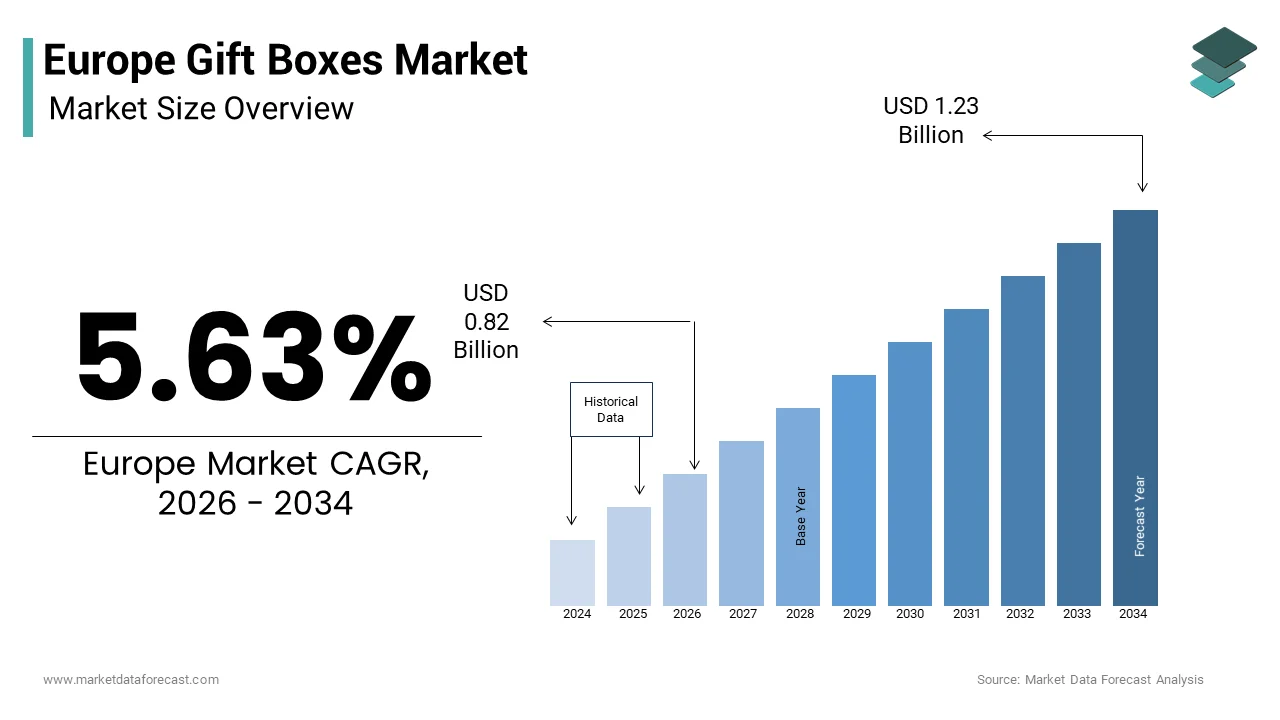
The Europe gift boxes market size was valued at USD 0.78 billion in 2025, is anticipated to reach USD 0.82 billion in 2026, and is projected to scale up to USD 1.23 billion by 2034, registering a compound annual growth rate (CAGR) of 5.63% during the forecast period from 2026 to 2034. Driven by the rising demand for premium unboxing experiences in e-commerce, entrenched cultural traditions governing seasonal gifting, and the integration of smart and sustainable packaging solutions, the regional gift boxes sector continues to record steady expansion.
Key Executive Metrics (At-a-Glance)
- 2025 Base Valuation: USD 0.78 Billion
- 2026 Current Valuation: USD 0.82 Billion
- 2034 Forecast Valuation: USD 1.23 Billion
- Compound Annual Growth Rate (CAGR): 5.63% (2026–2034)
- Dominant Raw Material Segment: Paper Segment (66.5% share in 2025)
- Dominant Product Segment: Telescopic Gift Box Segment (54.5% share in 2025)
- Fastest-Growing Product Segment: Slide Sleeve Gift Box Segment (projected at 9.1% CAGR)
- Dominant End-Use Segment: Food & Beverages Segment (41.9% share in 2025)
- Fastest-Growing End-Use Segment: Cosmetics and Personal Care Products Segment (projected at 10.4% CAGR)
- Dominant Country Market: Germany (24.4% share in 2025) followed by the United Kingdom and France
Core Market Drivers
- E-Commerce Experience: Escalating consumer expectations for premium, memorable unboxing moments when receiving online retail orders.
- Cultural Traditions: Deeply embedded social traditions during festive periods like Christmas, Easter, and Valentine's Day requiring specialized packaging.
- Technological Innovation: Incorporation of digital tools like NFC chips and QR codes to drive brand engagement and provenance tracking.
Primary Market Restraints & Challenges
- Environmental Regulations: Strict EU policies penalizing non-recyclable components and single-use plastics, requiring rapid redesigns.
- Input Cost Volatility: Fluctuations in paperboard, virgin fiber pulp, and industrial energy prices impacting manufacturer margins.
- Multi-Material Complexity: Difficulties in recycling composite luxury boxes due to non-separable elements like metallic foils and plastic windows.
Europe Gift Boxes Market Segmentation Highlights
| Segment Category | Largest Market Segment | Fastest-Growing Market Segment |
|---|---|---|
| By Raw Material | Paper Segment (66.5% share in 2025) | Paper and Mono-Material Alternatives |
| By Product | Telescopic Gift Box Segment (54.5% share) | Slide Sleeve Segment (9.1% CAGR) |
| By End Use | Food & Beverages Segment (41.9% share) | Cosmetics and Personal Care (10.4% CAGR) |
| By Country | Germany (24.4% share in 2025) | United Kingdom, France, and Italy |
Major Industry Players Profiled
Key enterprises dominating the European gift boxes market include Smurfit Kappa Group, Mondi Group, DS Smith Plc, International Paper, WestRock Company, Huhtamaki Oyj, Oji Holdings Corporation, and Graphic Packaging International.
Europe Gift Boxes Market Size
The Europe gift boxes market size was valued at 0.78 billion in 2025 and is anticipated to reach USD 0.82 billion in 2026 to reach USD 1.23 billion by 2034, growing at a CAGR of 5.63% during the forecast period from 2026 to 2034.
Introduction to the Europe Gift Boxes Market
Gift boxes are specialized packaging solutions intended to enhance the presentation and protection of gifted items across the continent. This sector includes rigid boxes, folding cartons, luxury hampers, and custom-shaped containers used for occasions ranging from corporate events to personal celebrations. The industry operates within a cultural landscape where gifting is deeply embedded in social traditions, particularly during festive seasons like Christmas and Easter. As per Eurostat, household final consumption expenditure on cultural and recreational goods in the European Union has reached significant levels in recent years, which is indicating a robust underlying demand for products that require premium presentation. The region hosts a large number of small and medium enterprises in the printing and packaging sector, many of which specialize in bespoke gift solutions. According to the European Commission, the average European consumer spends considerably on gifts annually, creating a consistent need for high quality packaging that reflects the value of the contents. The shift toward e commerce has further transformed the market, which needs durable boxes capable of withstanding logistics chains while maintaining aesthetic appeal upon delivery. Manufacturers are increasingly integrating sustainable materials and smart features to align with stringent EU environmental directives and evolving consumer expectations for eco-friendly yet luxurious unboxing experiences.
MARKET DRIVERS
Escalating Demand for Premium Unboxing Experiences in E Commerce
The surging expectation for premium unboxing experiences due to the exponential growth of online retail is majorly driving the growth of the Europe gift boxes market. Consumers increasingly view the packaging of an online order as an integral part of the product value, especially when items are purchased as gifts for others. As per the European E commerce Association, online retail sales in Europe have accounted for a significant portion of total retail turnover, with many purchases involving gifts. Brands are investing heavily in customized rigid boxes, magnetic closure lids, and interior finishes that create a memorable moment upon opening, fostering brand loyalty and social media sharing. As per logistics providers, returns due to damaged goods have decreased when premium protective gift boxes were utilized, highlighting their functional necessity alongside aesthetic appeal. The rise of direct to consumer luxury brands has intensified this trend, as these companies rely solely on packaging to convey exclusivity without a physical store presence. Social media platforms amplify this effect, with millions of unboxing videos generating free marketing for brands that prioritize box design.
Deep Rooted Cultural Traditions Driving Seasonal Gifting Volumes
The profound influence of entrenched cultural and religious traditions across Europe is further contributing to the expansion of the Europe gift boxes market. Events such as Christmas, Easter, Valentine’s Day, and Mother’s Day dictate specific peaks in gifting activity, requiring vast quantities of themed packaging ranging from advent calendars to chocolate hampers. As per the European Retail Round Table, seasonal sales periods account for a notable share of annual retail revenue in major European markets, directly correlating to packaging procurement cycles. In countries like Germany and France, the tradition of giving high quality confectionery and cosmetics in elaborate boxes remains a staple of social interaction. As per national statistics offices, households in Southern Europe spend more on gift packaging during holiday seasons compared to non festive months. The corporate sector also contributes significantly, with businesses distributing branded gift boxes to clients and employees during year end celebrations. This cyclical yet predictable pattern allows manufacturers to plan production efficiently while innovating with seasonal designs.
MARKET RESTRAINTS
Stringent Environmental Regulations on Packaging Materials
The implementation of rigorous environmental legislation regarding packaging waste and material composition is impeding the growth of the Europe gift boxes market. The European Union Packaging and Packaging Waste Regulation mandates strict limits on single use plastics, heavy metals, and non-recyclable components, which is forcing manufacturers to overhaul existing product lines. As per the European Environment Agency, the new regulations require all packaging to be reusable or recyclable by 2030, posing immediate challenges for producers of traditional laminated or foil stamped gift boxes. Compliance necessitates substantial investment in research and development to source alternative materials that meet both aesthetic standards and legal requirements. As per the European Paper Packaging Alliance, a portion of existing gift box designs may become obsolete due to inability to meet new recyclability criteria without costly redesigns. Small and medium sized enterprises face disproportionate burdens as they lack the capital to rapidly transition to compliant supply chains. The ban on certain colored inks and adhesives further complicates production, limiting design flexibility and increasing costs.
Volatility in Raw Material Prices and Supply Chain Disruptions
The persistent volatility in raw material prices and ongoing supply chain disruptions is also hampering the Europe gift boxes market expansion. The industry relies heavily on paperboard, cardboard, and specialty papers, the costs of which fluctuate due to energy prices, pulp availability, and geopolitical tensions. As per the Confederation of European Paper Industries, the price of virgin fiber pulp in Europe has increased in recent years, squeezing margins for packaging manufacturers. Energy intensive production processes for converting and printing further exacerbate cost pressures amid the regional energy crisis. Supply chain bottlenecks have led to extended lead times, with some manufacturers facing delays for critical inputs like adhesives and decorative foils. As per logistics analysts, freight costs for importing specialty materials from outside Europe remain higher than pre pandemic levels. These financial instabilities force companies to hold larger inventories, tying up capital and increasing storage costs. The unpredictability of input costs makes long term pricing contracts difficult, eroding customer trust and hindering strategic planning.
MARKET OPPORTUNITIES
Integration of Smart Packaging Technologies for Engagement
The adoption of smart packaging technologies offers a promising opportunity for the Europe gift boxes market by enhancing consumer engagement and providing valuable data insights. Manufacturers are increasingly embedding Near Field Communication chips, Quick Response codes, and Augmented Reality markers into gift boxes to create interactive unboxing experiences. As per the European Smart Packaging Forum, the market for intelligent packaging in Europe is projected to grow steadily, driven by demand for authenticity verification and digital content access. Brands can use these features to tell stories, offer discounts, or verify the provenance of luxury goods, adding significant value beyond physical containment. As per pilot projects, gift boxes with interactive elements have shown higher rates of social media sharing compared to static packaging. This technology also facilitates supply chain transparency, allowing recipients to trace the journey of their gift from origin to delivery. The ability to update digital content post purchase extends the lifecycle of the packaging interaction, fostering deeper brand connections.
Expansion of Personalized and On Demand Customization Services
The growing consumer desire for personalized and unique gifting solutions presents a lucrative opportunity for the Europe gift boxes market to shift toward on demand manufacturing models. Advances in digital printing technology now allow for cost effective short runs and complete customization of text, images, and designs on individual boxes without prohibitive setup costs. As per the European Digital Print Association, sales of digitally printed packaging in Europe have grown significantly, fueled by the trend for bespoke gifts. Consumers are willing to pay a premium for boxes featuring names, photos, or custom messages, transforming standard packaging into a cherished part of the gift itself. As per e commerce platforms, personalized gift options have shown higher conversion rates than standard items. Small businesses and artisans can now access high quality custom packaging previously reserved for large corporations. The flexibility to produce small batches rapidly allows brands to test new designs and respond to micro trends instantly.
MARKET CHALLENGES
Complexity of Recycling Multi Material Composite Structures
The technical difficulty associated with recycling multi material composite structures used in luxury gift boxes poses a significant challenge to the Europe gift boxes market. High end packaging often combines paperboard with plastic windows, metallic foils, magnetic closures, and fabric linings to achieve a premium look, rendering these items difficult or impossible to separate for recycling. As per the Joint Research Centre of the European Commission, composite packaging accounts for a notable portion of municipal waste, with low recovery rates due to processing complexities. Current recycling infrastructure in many European regions lacks the capability to efficiently delaminate these mixed materials, leading to entire boxes being sent to landfills or incineration. As per waste management authorities, contamination rates in paper recycling streams increase due to non-separable gift box components. Developing mono material alternatives that mimic the aesthetic and functional properties of composites remains costly and technologically demanding.
Intense Price Competition from Low Cost Imports
The influx of low cost imported gift boxes from non-European manufacturers creates intense price competition, which is also challenging the expansion of the Europe gift boxes market. Countries in Asia often benefit from lower labor costs and less stringent environmental regulations, allowing them to export finished boxes at prices below the production cost of European firms. As per the European Packaging Machinery Manufacturers Association, imports of paper packaging products into the EU have increased in volume, exerting downward pressure on local pricing. European manufacturers struggle to compete on price while adhering to strict labor laws, safety standards, and environmental compliance costs. As per trade unions, thousands of jobs in the European packaging sector have been lost due to relocation of production or closure of uncompetitive facilities. The race to the bottom on pricing discourages investment in innovation and sustainable technologies, as margins become too thin to support research and development.
REPORT COVERAGE
| REPORT METRIC | DETAILS |
| Market Size Available | 2025 to 2034 |
| Base Year | 2025 |
| Forecast Period | 2026 to 2034 |
| CAGR | 5.63% |
| Segments Covered | By Raw Material, Product, End-use, Country |
| Various Analyses Covered | Global, Regional & Country Level Analysis, Segment-Level Analysis, DROC, PESTLE Analysis, Porter’s Five Forces Analysis, Competitive Landscape, Analyst Overview on Investment Opportunities |
| Regions Covered | UK, France, Spain, Germany, Italy, Russia, Sweden, Denmark, Switzerland, Netherlands, Turkey, the Czech Republic, and the Rest of Europe |
| Market Leaders Profiled | Mondi Group, Smurfit Kappa Group, DS Smith Plc, International Paper, WestRock Company, Asia Pulp & Paper, Huhtamaki Oyj, Oji Holdings Corporation, Graphic Packaging International, Seaman Paper Company |
SEGMENTAL ANALYSIS
By Raw Material Insights
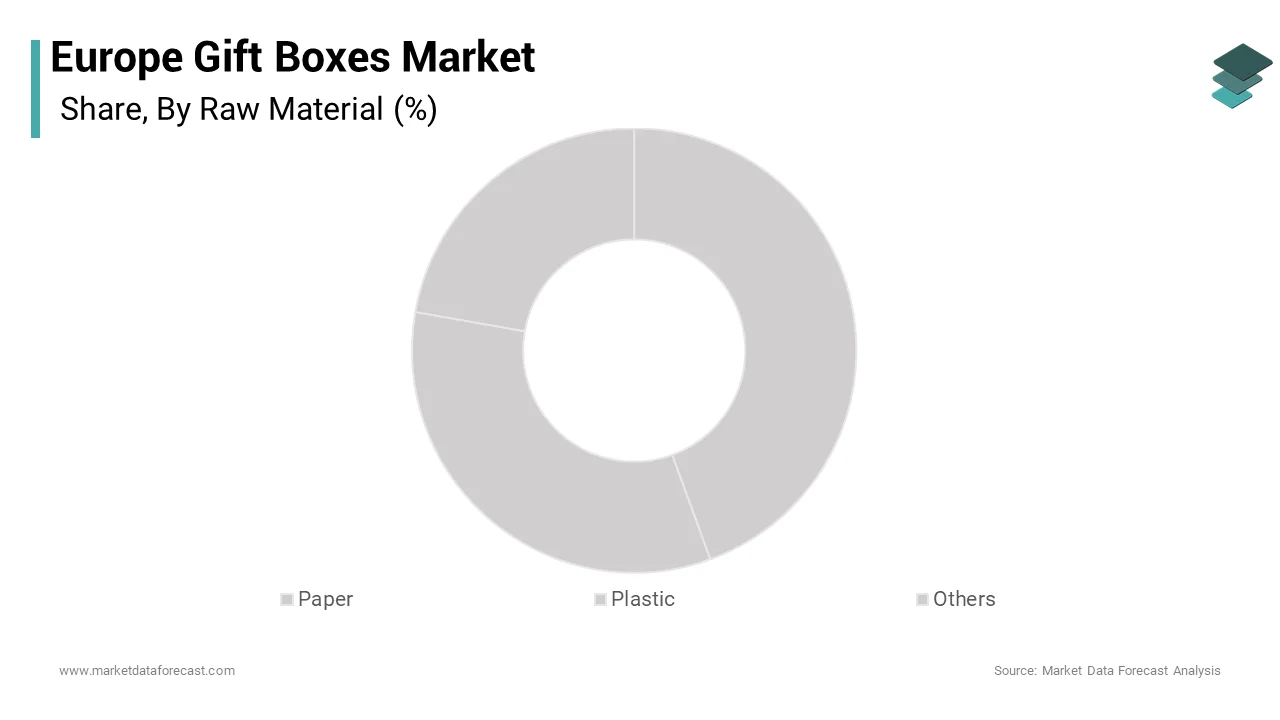
The paper segment led the market by holding the highest share of 66.5% of the regional market in 2025. The dominance of paper segment in the European market is driven by the deep cultural preference for sustainable packaging in Europe and the inherent versatility of paperboard which allows for high quality printing and structural innovation. The regulatory environment heavily favors fiber based solutions over plastic alternatives, cementing paper as the default choice for manufacturers and brands alike. The robust regulatory framework across the European Union that actively discourages single use plastics and promotes recyclable materials is further boosting the expansion of the paper segment in the European market. As per the European Commission, member states are required to ensure all packaging on the market is reusable or recyclable by 2030, a goal that paper naturally meets due to its established recycling infrastructure. As per Eurostat, recycling rates for paper and cardboard in Europe remain significantly higher than other packaging materials, incentivizing brands to switch to paper to avoid extended producer responsibility fees. Manufacturers are rapidly phasing out laminated plastics in favor of coated paperboards that offer similar barrier properties without compromising recyclability. The availability of certified sustainable fibers from responsibly managed forests further aligns with corporate sustainability goals.
By Product Insights
The telescopic gift box segment accounted for 54.5% of the European market share in 2025. This dominance is attributed to the classic two piece design consisting of a base and a separate lid, which offers unparalleled ease of assembly, superior protection, and a timeless aesthetic associated with premium gifting. The widespread adoption of telescopic boxes is further driven by their exceptional versatility in accommodating various product shapes and sizes while offering significant operational efficiencies for retailers and packers. The simple two piece construction allows for rapid manual or automated assembly, reducing labor costs and packing time compared to more complex folding structures. As per the European Packaging Machinery Manufacturers Association, telescopic boxes account for a majority of automated packing line installations in the food and cosmetics sectors due to their reliability and speed. As per logistics providers, telescopic boxes provide superior stacking strength and product protection during transit, reducing damage rates compared to sleeve styles. The ability to nest empty boxes efficiently also optimizes storage space and reduces transportation costs.
On the other end, the slide sleeve gift box segment is anticipated to witness the fastest CAGR of 9.1% over the forecast period in the European market owing to the rising demand for sleek, modern packaging solutions that offer a unique opening mechanism and excellent potential for graphic storytelling. The growing consumer preference for contemporary, minimalist designs and interactive opening experiences are further propelling the rapid expansion of the slide sleeve segment in the European market. As per the European Design Council, packaging featuring sliding mechanisms has seen a notable increase in design award nominations, reflecting a shift in brand preferences toward innovative structures. This format allows for seamless full wrap printing on the outer sleeve, providing a continuous canvas for branding and artistic expression. As per retail analytics firms, products with slide sleeve packaging attracts more attention on shelves and in online thumbnails due to their distinctive silhouette. The tactile sensation of sliding the cover adds a layer of sensory engagement that enhances the overall unboxing ritual, making it popular for tech gadgets, premium stationery, and boutique cosmetics.
By End Use Insights
The food & Beverages segment led the market by accounting for 41.9% of the European market share in 2025. The growth of the food and beverages segment in the European market can be credited to the deep rooted European tradition of gifting gourmet foods, chocolates, wines, and specialty beverages during holidays and social occasions. The profound cultural emphasis on sharing high quality food and drink as tokens of affection drives the overwhelming dominance of the Food & Beverages segment. In Europe, occasions such as Christmas, Easter, and local festivals are synonymous with the exchange of elaborate hampers, chocolate assortments, and wine sets, all requiring specialized protective and decorative packaging. As per the European Retail Round Table, seasonal food gifting accounts for a significant portion of annual sales in the gourmet sector, creating cyclical demand for gift boxes. Countries like Belgium, Switzerland, and France are renowned for their confectionery industries, where premium packaging is essential to maintain product integrity and convey luxury. As per national tourism boards, edible gifts constitute a large share of souvenir purchases by tourists visiting European cities. The tradition of corporate gifting also heavily favors food and beverage items, with companies distributing branded baskets to clients and employees. This entrenched behavior ensures a consistent requirement for diverse packaging formats ranging from windowed cartons to rigid luxury boxes.
However, the cosmetics and personal care products segment is projected to grow at the fastest CAGR of 10.4% over the forecast period owing to the booming beauty industry, the rise of subscription boxes, and the increasing importance of packaging as a brand differentiator in the luxury beauty sector. The rapid proliferation of beauty subscription services and discovery kits is further contributing to the expansion of the exceptional growth of the cosmetics segment in the gift boxes market. These services rely entirely on curated, visually appealing boxes to deliver monthly samples and full size products to subscribers, creating recurring demand for customized packaging solutions. As per the European Cosmetics Association, the subscription beauty market in Europe has expanded significantly, with millions of active subscribers receiving regular shipments. Each shipment requires a uniquely designed box that reflects brand identity and creates an exciting unboxing experience to retain customers and encourage social media sharing. As per marketing agencies, unboxing videos featuring beauty boxes generate vast viewership annually, acting as powerful free advertising for brands. The need for frequent design updates to keep content fresh and engaging drives continuous orders for short run, high quality printed boxes. Furthermore, the trend of gifting personalized beauty sets during holidays has amplified demand for modular box systems that can accommodate various product combinations. This dynamic business model ensures a steady and accelerating stream of orders for packaging manufacturers.
COUNTRY LEVEL ANALYSIS
Germany Gift Boxes Market Analysis
Germany dominated the gift boxes market in Europe in 2025 by holding 24.4% of the regional market share. The country's position is anchored in its robust manufacturing sector, strong export orientation, and a deeply ingrained culture of structured gifting for both personal and corporate purposes. The German market is characterized by a high demand for precision engineered, durable, and eco friendly packaging solutions that reflect the nation's values of quality and sustainability. As per the German Packaging Institute, domestic consumption of premium packaging has risen, driven by the resurgence of corporate gifting and the enduring popularity of Christmas markets which rely heavily on festive packaging. The strict enforcement of the Packaging Act forces manufacturers to prioritize recyclable materials, making Germany a leader in sustainable gift box innovation. Major automotive and industrial companies utilize high end gift boxes for client relations, adding significant volume to the B2B segment. The presence of numerous mid sized packaging specialists ensures a diverse supply chain capable of meeting customized needs.
United Kingdom Gift Boxes Market Analysis
The United Kingdom captured a prominent share of the Europe gift boxes market in 2025. The growth of the UK in the European market can be credited to its vibrant creative industries, strong luxury retail sector, and influential trends in e commerce gifting. London serves as a global hub for design and branding, setting standards for innovative and aesthetically driven gift packaging that influences the wider European market. The UK market is highly responsive to fashion and lifestyle trends, with a notable surge in demand for personalized and visually appealing gift boxes. As per the British Packaging Federation, the UK has seen growth in online gift sales, necessitating robust and attractive shipping ready gift boxes. The tradition of afternoon tea and gourmet food gifting remains strong, supporting steady demand for specialized food grade packaging. Post Brexit adjustments have encouraged some localization of supply chains, benefiting domestic box manufacturers. The prevalence of independent boutiques and artisanal brands fosters a market for bespoke, small batch packaging solutions.
France Gift Boxes Market Analysis
France is estimated to command for a substantial share of the European market over the forecast period due to its status as the global capital of luxury fashion, cosmetics, and gastronomy to drive demand for high end gift boxes. The French market is synonymous with elegance and sophistication, where packaging is considered an art form integral to the brand experience of world renowned houses. The concentration of luxury conglomerates in Paris creates strong demand for exquisite, custom designed rigid boxes that embody heritage and exclusivity. As per the French Federation of Luxury, the luxury goods sector has reported growth, directly correlating to increased procurement of premium packaging for perfumes, jewelry, and haute couture. French consumers place immense value on presentation, often preferring elaborate and reusable boxes over simple cartons. The strong culinary tradition also supports a robust market for gourmet food hampers and wine gift sets. Government initiatives promoting "Made in France" craftsmanship extend to the packaging industry, encouraging the use of local artisans and high quality materials.
Italy Gift Boxes Market Analysis
Italy is anticipated to exhibit a healthy CAGR in the Europe gift boxes market during the forecast period. Italy is renowned for its exceptional design heritage, artisanal craftsmanship, and dominance in the fashion and food sectors which are major consumers of gift packaging. The Italian market is characterized by a preference for stylish, innovative, and high quality boxes that reflect the country's reputation for "La Bella Figura" or making a good impression. Regions like Lombardy and Veneto host a dense network of packaging converters specializing in luxury finishes and complex structures for fashion brands and gourmet food producers. As per the Italian Packaging Machinery Manufacturers Association, exports of Italian packaged goods have reached record highs, driving domestic demand for export ready gift boxes. The strong tradition of family gatherings and festive celebrations ensures consistent seasonal peaks in packaging consumption. Italian designers often lead global trends in box structure and graphic design, influencing preferences across Europe.
Spain Gift Boxes Market Analysis
Spain is expected to secure a notable share of the Europe gift boxes market over the forecast period owing to its thriving tourism industry, rich culinary traditions, and a culture that places high importance on social gifting and celebrations. The Spanish market is notable for its strong demand for packaging related to food and beverages, particularly wines, oils, and confectionery, which are popular gifts for visitors and locals alike. As per the Spanish Confederation of Business Organizations, the hospitality and tourism sectors have recovered, boosting sales of souvenir gift boxes and regional specialty packs. The warm climate and outdoor lifestyle influence packaging choices, favoring durable and vibrant designs suitable for summer gifts and festivals. The rise of e commerce in Spain has accelerated the need for reliable and attractive shipping boxes. Local manufacturers are increasingly adopting sustainable practices to meet EU regulations and consumer expectations. The market is dynamic and seasonally driven, with significant spikes during Christmas, Easter, and local fiestas. Spain’s strategic location as a gateway to Latin America also positions it as a hub for packaging innovations that cater to broader international tastes.
COMPETITIVE LANDSCAPE
The competition in the Europe gift boxes market is characterized by a fragmented landscape comprising large multinational corporations and numerous specialized regional converters vying for dominance through innovation and service quality. Major players compete intensely on sustainability credentials, leveraging certified fiber sources and recyclable designs to meet regulatory mandates and consumer preferences. The rise of e commerce has intensified the battle for durable yet aesthetically pleasing packaging that survives logistics chains while delivering premium unboxing moments. Customization capabilities have become a critical differentiator, with companies investing in digital printing to offer personalized short runs without compromising speed or cost. Price pressure from low cost imports challenges domestic manufacturers to justify premium pricing through superior design and ethical production standards. Consolidation activities are reshaping the sector as leaders seek scale to invest in advanced automation and research. Niche players survive by focusing on ultra luxury segments or specific artisanal techniques that mass producers cannot replicate. This dynamic environment drives continuous improvement in material science, structural design, and operational efficiency as firms strive to capture loyalty in a saturated and rapidly evolving region.
KEY MARKET PLAYERS
A few of the market players that are dominating the Europe gift boxes market are
- Mondi Group
- Smurfit Kappa Group
- DS Smith Plc
- International Paper
- WestRock Company
- Asia Pulp & Paper
- Huhtamaki Oyj
- Oji Holdings Corporation
- Graphic Packaging International
- Seaman Paper Company
Top Players In the Market
- Smurfit Kappa Group stands as a preeminent force in the Europe gift boxes market, leveraging its vast network of paper based packaging solutions to serve diverse global industries. The company contributes significantly to the global sector by pioneering sustainable fiber based designs that replace plastic alternatives. Smurfit Kappa recently strengthened its market position through the strategic merger with WestRock, creating a global leader capable of offering enhanced innovation and scale. Their commitment to circular economy principles drives the development of fully recyclable luxury gift boxes that meet stringent European environmental standards. The firm invests heavily in digital printing technologies to enable short run customization for seasonal campaigns. By integrating supply chain visibility tools, they ensure timely delivery for peak gifting periods. These initiatives solidify their reputation as a partner of choice for brands seeking eco friendly yet premium packaging solutions across international markets.
- Mondi plc operates as a key player in the Europe gift boxes market, renowned for its integrated approach combining pulp production with advanced converting capabilities. The company impacts the global landscape by delivering innovative barrier papers and rigid box solutions that protect sensitive contents while maintaining aesthetic appeal. Mondi recently expanded its production capacity in Central Europe to address rising demand for sustainable luxury packaging. Their focus on replacing complex multi material structures with mono material paper solutions aligns with evolving regulatory requirements. The firm collaborates closely with cosmetic and confectionery brands to co create bespoke unboxing experiences that drive consumer engagement. Mondi also utilizes lifecycle assessment tools to quantify and reduce the carbon footprint of their gift box portfolios. These proactive measures enhance their competitive edge and reinforce their status as a sustainability leader in the global packaging industry.
- DS Smith Plc holds a prominent position in the Europe gift boxes market, specializing in circular packaging solutions designed for the retail and e commerce sectors. The company contributes globally by championing the transition from single use plastics to renewable fiber based alternatives for gift presentation. DS Smith recently launched new design platforms that utilize artificial intelligence to optimize box structures for material efficiency and protection. Their strategic partnerships with major retailers ensure the deployment of scalable, custom gift box programs that enhance brand visibility. The firm actively promotes its closed loop recycling model, collecting used packaging to manufacture new boxes. Investments in automated manufacturing facilities have improved lead times and consistency for high volume seasonal orders. These efforts demonstrate their dedication to innovation and sustainability, securing their role as a critical supplier for brands navigating the complexities of modern gifting demands worldwide.
Top Strategies Used By Key Market Participants
Key players in the Europe gift boxes market primarily employ sustainability driven innovation strategies to develop fully recyclable and biodegradable packaging solutions that comply with strict regulations. Companies invest heavily in digital printing technologies to offer cost effective short run customization and rapid prototyping for seasonal campaigns. Strategic mergers and acquisitions allow major firms to expand geographic reach and integrate supply chains for greater efficiency. Partnerships with end users such as luxury brands and retailers facilitate co creation of bespoke designs that enhance unboxing experiences. Nearshoring production facilities reduces lead times and carbon emissions associated with logistics while improving responsiveness to market trends. Adoption of circular economy models involves establishing take back schemes to recycle used boxes into new materials. These multifaceted approaches enable participants to differentiate their offerings, meet evolving consumer expectations, and maintain competitive advantages in a dynamic regional landscape.
MARKET SEGMENTATION
This research report on the Europe gift boxes market is segmented and sub-segmented into the following categories.
By Raw Material
- Paper
- Plastic
- Others
By Product
- Slide Sleeve
- Telescopic
By End Use
- Consumer Goods
- Food & Beverages
- Bakery & Confectionery
- Alcoholic Drinks
- Frozen Desserts
- Others
- Electronic Devices
- Cosmetics and Personal Care Products
By Printing Technology:
- Lithography Printed
- Flexography Printed
- Electrophotography Technology Printed
- Dry Toner Printed
- Liquid Toner Printed
- Inkjet Photography Technology Printed
- Other Printed
By Country
- UK
- France
- Spain
- Germany
- Italy
- Russia
- Sweden
- Denmark
- Switzerland
- Netherlands
- Turkey
- Czech Republic