- Product Description Description
- Table of Contents TOC
- List of Table & Figure LOT
- Get Free Sample PDF Sample PDF
Market Size, 2025
$424.78 BnMarket Estimate, 2026
$443.30 BnMarket Forecast, 2034
$623.69 BnCAGR, 2026–2034
4.36%Europe Gift Cards Market Report Summary
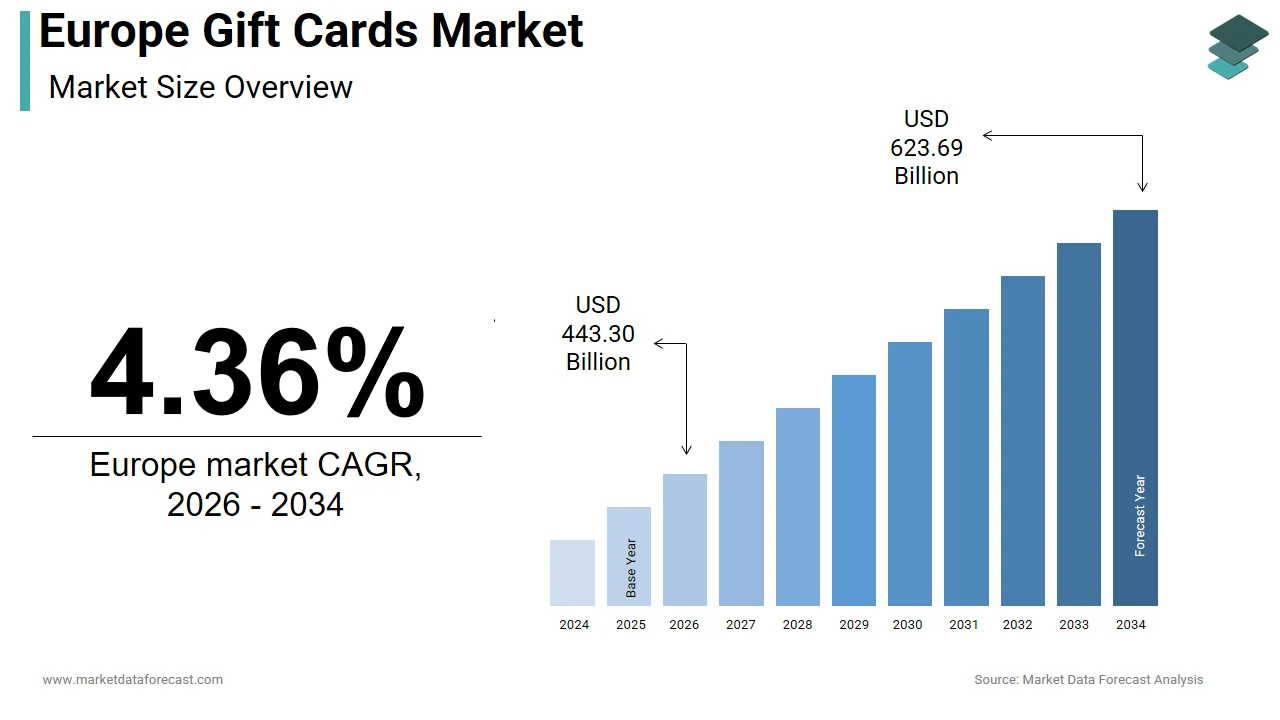
The Europe gift cards market was valued at USD 424.78 billion in 2025, is estimated to reach USD 443.30 billion in 2026, and is projected to reach USD 623.69 billion by 2034, growing at a CAGR of 4.36% from 2026 to 2034. Market growth is driven by strong consumer gifting culture, rising digital payment adoption, and expanding retail and e-commerce ecosystems. Gift cards have become a preferred gifting option across Europe due to convenience, flexibility, and increasing integration with online shopping platforms. The growing popularity of digital wallets, corporate incentives, and promotional campaigns is further strengthening market expansion.
Key Market Trends
- Rising demand for digital and e-gift cards across online platforms.
- Increasing adoption of gift cards for corporate rewards and employee incentives.
- Growing integration of gift cards with mobile wallets and fintech platforms.
- Expansion of premium and experiential closed-loop gift cards.
- Strengthening focus on personalized and customizable gifting solutions.
Segmental Insights
- Based on card type, the closed-loop gift cards segment dominated the market in 2025, driven by strong retailer-specific loyalty programs and brand-focused gifting options.
- Based on card format, the physical gift cards segment remained the largest by capturing 62.5% share in 2025, supported by high demand during festive seasons and in-store purchases.
- Based on end use, the consumer gifting segment led the market in 2025, driven by Europe’s deep-rooted tradition of gift exchange during Christmas, Easter, birthdays, and special occasions.
- Based on distribution channel, the offline or in-store segment dominated the market in 2025, supported by widespread availability across supermarkets, retail outlets, and specialty stores.
Regional Insights
The Europe gift cards market is witnessing steady growth across major economies, supported by strong retail infrastructure, digital payment penetration, and evolving consumer spending patterns.
- The United Kingdom led the regional market in 2025 with 22.7% share, driven by strong e-commerce adoption, corporate gifting programs, and a mature digital payments ecosystem.
- Germany followed with 19.5% share in 2025, supported by high retail penetration and growing adoption of prepaid financial instruments.
- France maintains a significant position, driven by a strong tradition of luxury and experiential gifting and high demand for premium closed-loop cards in fashion, beauty, and gourmet retail sectors.
Competitive Landscape
The Europe gift cards market is characterized by strong competition among payment networks, fintech companies, retail chains, and digital wallet providers. Market players are focusing on expanding digital card offerings, improving omnichannel distribution, and enhancing security and fraud prevention mechanisms. Strategic partnerships with retailers, financial institutions, and e-commerce platforms are shaping competitive dynamics across the region.
Prominent companies operating in the Europe gift cards market include Blackhawk Network Holdings, Inc., Amazon.com, Inc., Apple Inc., InComm Payments, Mastercard Inc., Walmart Inc., Givex Corporation, Fiserv, Inc., Starbucks Corporation, Qwikcilver Solutions Pvt. Ltd., and PayPal Holdings, Inc..
Europe Gift Cards Market Size
The Europe gift cards market was valued at USD 424.78 billion in 2025, is estimated to reach USD 443.30 billion in 2026, and is projected to reach USD 623.69 billion by 2034, growing at a CAGR of 4.36% from 2026 to 2034.
A gift card is a prepaid stored-value card issued by a retailer or bank that can be used to purchase goods and services from the issuer or its affiliated network. The market’s structure is shaped by a complex interplay of consumer gifting culture, retail strategy, and evolving digital payment technologies. Its growth is underpinned by fundamental shifts in European consumer behavior and economic activity. According to Eurostat, household consumption expenditure remains the primary engine of the European Union's economy, representing the largest share of total gross domestic product and underscoring the vital role of retail and services spending. Furthermore, as per the European Central Bank, non-cash transactions in the euro area have seen substantial growth, with electronic payment methods and digital instruments becoming an increasingly significant part of the payment ecosystem.
MARKET DRIVERS
Deeply Embedded Culture of Gifting During Key Holiday Seasons
The continent’s deeply ingrained cultural tradition of gift-giving during major holiday seasons, particularly Christmas and Easter, is a major driver of the Europe gift cards market. In many European countries, it is customary to exchange gifts with family, friends, and colleagues, and the gift card has emerged as the perfect solution to the perennial challenge of selecting a universally appreciated present. It offers the giver the thoughtfulness of a gift while granting the recipient the autonomy to choose exactly what they desire. This cultural norm creates a massive, predictable annual surge in demand. As per a study, a large majority of European households participate in gift-buying, making the holiday season a peak period for consumer spending on others. The gift card’s convenience, security, and wide acceptance make it the default choice for a significant portion of this seasonal spending, providing a stable and substantial revenue base for the market every year.
Strategic Adoption by Retailers as a Customer Acquisition and Loyalty Tool
The strategic deployment of gift cards by retailers as a powerful instrument for customer acquisition, retention, and revenue generation fuels the expansion of the Europe gift card market. For retailers, gift cards represent an interest-free loan from the consumer, as the cash is received upfront while the liability is redeemed later, often with additional spending beyond the card’s value. They are also highly effective at attracting new customers who may not have previously shopped at the store, thereby expanding the brand’s reach. Furthermore, gift cards foster loyalty, as recipients are incentivized to return to the same retailer for future purchases. According to sources, retailers across Europe consistently rank gift cards as one of their top five marketing tools for driving foot traffic and increasing average transaction value, especially during promotional periods, making them an indispensable part of the modern retail playbook.
MARKET RESTRAINTS
Regulatory Complexity and Fragmentation Across Member States
The complex and fragmented regulatory environment that varies significantly from one member state to another poses significant restraint on the European gift cards market. Individual national rules regarding fees, expiration, and escheatment of dormant, unspent balances override the general, broad framework of the EU's Payment Services Directive. For a multinational retailer or a multi-brand gift card provider, this patchwork of national regulations creates a formidable compliance burden. As per research, retailers selling in multiple European markets must navigate a complex, fragmented legal landscape with distinct national regulations for prepaid vouchers and consumer protection. This complexity increases operational costs, hinders the creation of a truly pan-European gift card product, and can lead to consumer confusion, ultimately stifling innovation and market integration.
High Incidence of Fraud and Cybersecurity Vulnerabilities
A persistent and growing threat from fraud and cybersecurity breaches erodes consumer trust and imposes significant financial losses on issuers, which constitutes a serious obstacle to the Europe gift cards market. Digital gift cards, in particular, are vulnerable to sophisticated attacks such as card number guessing, phishing scams, and data breaches where card codes are stolen and resold on the dark web. The anonymous and irreversible nature of most gift card transactions makes them a prime target for criminals. According to a study, Gift card fraud is rising sharply, driven by criminals exploiting gaps in digital security to drain funds, resulting in substantial losses for European consumers. This constant threat forces issuers to invest heavily in advanced security protocols and fraud detection systems, increasing costs and creating a climate of risk that can deter potential new entrants and cautious consumers.
MARKET OPPORTUNITIES
Integration with Mobile Wallets and Contactless Payment Systems
Its seamless integration with the continent’s rapidly expanding mobile wallet and contactless payment infrastructure is a potential growth area for the Europe gift cards market. The proliferation of smartphones and NFC-enabled POS terminals enables seamless, contactless redemption of digital gift cards stored in mobile wallets. This frictionless experience aligns perfectly with the European consumer’s preference for fast, convenient, and secure digital transactions. Contactless and mobile wallet payments have become the preferred method for face-to-face transactions, rapidly displacing physical card insertion in the euro area. Integrating gift cards into popular digital wallets allows issuers to maximize utility and minimize loss risk, while fostering a seamless user experience that boosts redemption and loyalty.
Expansion of Corporate and B2B Gifting Programs
The expansion of corporate and business-to-business gifting programs paves the way for the expansion of the Europe gift cards market. Companies across Europe are increasingly using branded gift cards as a tool for employee rewards, client appreciation, and partner incentives. This B2B channel offers a stable, high-volume, and recurring revenue stream that is less susceptible to seasonal consumer fluctuations. The trend is amplified by the rise of remote and hybrid work, where digital gift cards provide a flexible and personal way to recognize distributed teams. According to sources, Large European companies are increasingly adopting formal employee recognition programs that integrate digital and flexible non-cash rewards, such as gift cards, to enhance workplace engagement. This institutional demand represents a vast, underpenetrated market that can drive sustained growth for specialized B2B gift card platforms.
MARKET CHALLENGES
Low Redemption Rates and the Problem of Breakage
The persistently low redemption rate, a phenomenon known as “breakage,” where a significant portion of the issued value is never spent, is a challenge for the Europe gift cards market. Consumers may lose their cards, forget about them, or find the remaining balance too small to be useful, leading to billions of euros in dormant funds. The practice of benefiting from breakage is now subject to intense ethical examination and regulatory oversight. Consumer advocacy groups argue that unspent balances should be returned to the purchaser or donated to charity after a certain period. Consumer advocacy groups and regulatory bodies in EU member states are moving toward stricter regulations to minimize breakage, focusing on extending expiration dates and facilitating the combining of remaining, small-value balances. This pressure threatens a key financial pillar of the current business model and forces the industry to find new ways to encourage full redemption.
Intense Competition from Alternative Digital Gifting Solutions
Intense competition from a new wave of alternative digital gifting solutions that offer greater flexibility and personalization continues to impede the Europe gift cards market. Peer-to-peer payment apps like Revolut, PayPal, and bank-specific instant transfer services now allow users to send money directly to a friend’s account with a personalized message, effectively replicating the core function of a gift card without its restrictions. These alternatives are often free, instantaneous, and give the recipient complete freedom to spend the money anywhere. Young European consumers increasingly prefer sending funds directly through banking apps as gifts, favouring instant digital solutions over traditional, physical gift cards. This shift poses a direct threat to the market’s relevance, forcing traditional gift card providers to innovate and add unique value propositions to remain competitive in the digital age.
REPORT COVERAGE
| REPORT METRIC | DETAILS |
| Market Size Available | 2025 to 2034 |
| Base Year | 2025 |
| Forecast Period | 2026 to 2034 |
| Segments Covered | By Card Type, Card Format, Distribution Channel, End-use, Redemption Category, and Country. |
| Various Analyses Covered | Global, Regional, and Country-Level Analysis, Segment-Level Analysis, Drivers, Restraints, Opportunities, Challenges; PESTLE Analysis; Porter’s Five Forces Analysis, Competitive Landscape, Analyst Overview of Investment Opportunities |
| Countries Covered | UK, France, Spain, Germany, Italy, Russia, Sweden, Denmark, Switzerland, Netherlands, Turkey, Czech Republic, and the Rest of Europe. |
| Market Leaders Profiled | Blackhawk Network Holdings, Inc. (BHN), Amazon.com, Inc., Apple Inc., InComm Payments, Mastercard Inc., Walmart Inc., Givex Corporation, Fiserv, Inc., Starbucks Corporation, Qwikcilver Solutions Pvt. Ltd., PayPal Holdings, Inc., and Others. |
SEGMENTAL ANALYSIS
By Card Type Insights
In 2025, the closed-loop gift cards segment held the majority share of the European gift cards market. The segment's strategic value to retailers, coupled with its alignment with consumer gifting preferences, drives its continued supremacy. A closed-loop card, issued by a specific brand or retailer, ensures that the entire value is spent within that merchant’s ecosystem, often leading to additional “spend beyond” where the recipient purchases items exceeding the card’s balance. For consumers, these cards offer peace of mind, as they can be confident the recipient will receive something they like from a trusted brand. A vast majority of major European retailers now provide their own branded gift cards, utilizing them as an essential strategy to boost customer loyalty, generate upfront cash flow, and increase sales volume, particularly during key holiday shopping seasons.
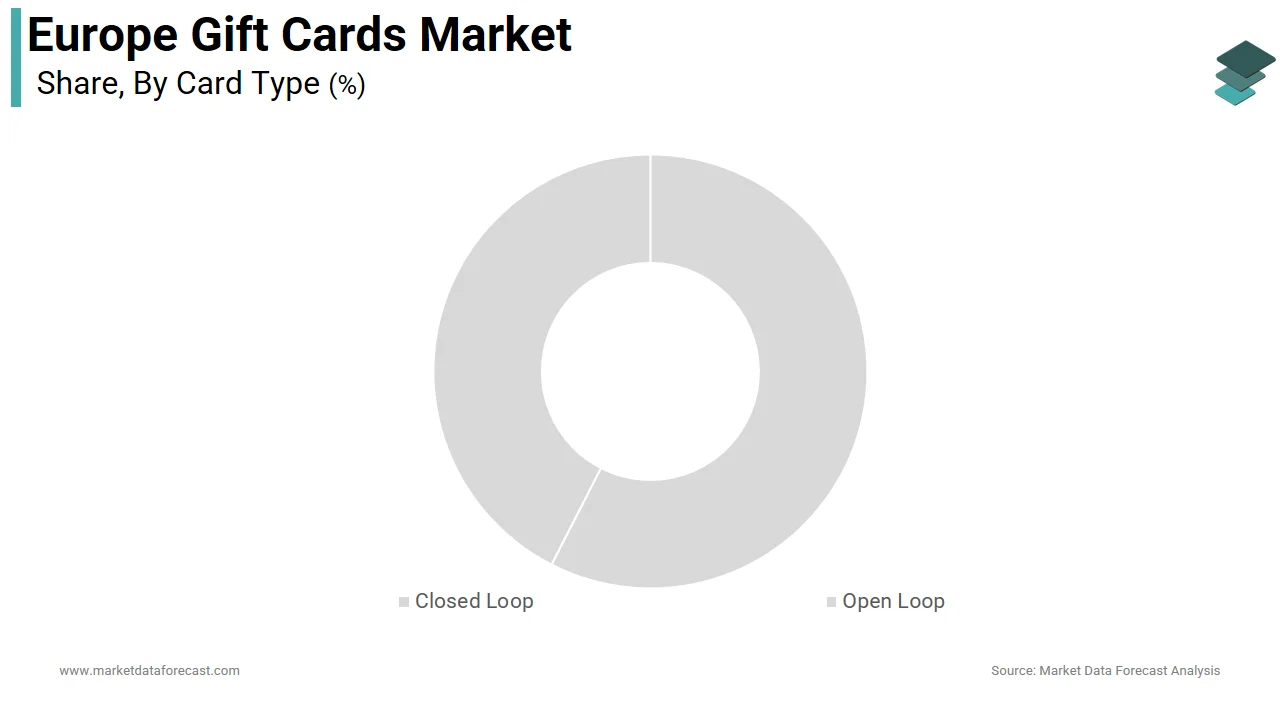
The open-loop gift card segment is anticipated to witness the fastest CAGR of 13.5% from 2026 to 2034 due to the rising demand for maximum flexibility and convenience among consumers. An open-loop card, typically issued by a bank and co-branded with a major payment network like Visa or Mastercard, can be used anywhere the network is accepted, giving the recipient complete freedom of choice. This is particularly appealing for givers who are uncertain of the recipient’s preferences or for corporate rewards programs that aim to be universally appreciated. The integration of flexible, prepaid payment instruments into mobile applications has accelerated their usage in Europe, enabling immediate, touchless transactions. This trend supports the broader regional shift toward frictionless electronic payments and virtual gifting solutions.
By Card Format Insights
The physical gift cards segment remained the largest segment in the European market by capturing a share of 62.5% in 2025. Its prominence is attributed to the enduring cultural and emotional significance of a tangible gift. A physical card can be beautifully designed, wrapped, and presented in person, making it an integral part of the gifting ritual, especially during major holidays like Christmas. The act of handing over a physical object carries a weight and thoughtfulness that a digital message often lacks. European consumers continue to favor physical gift cards for important occasions, as the tangible, unwrapping experience holds more personal value and feels more significant than an easily overlooked digital message. Data indicates that while digital options are growing, the preference for physical, ceremonial gifting remains strong across the region. This preference ensures that physical cards remain the default choice for traditional and high-sentiment gifting scenarios.
The digital gift card format segment is likely to experience the fastest CAGR of 18.2% over the forecast period, owing to the convergence of several powerful trends: the ubiquity of smartphones, the normalization of digital transactions, and the demand for instant gratification. Digital cards can be purchased and delivered via email or messaging apps in seconds, making them ideal for last-minute gifts, remote relationships, and e-commerce integrations. Their seamless compatibility with mobile wallets like Apple Pay and Google Pay further enhances their utility, allowing for easy storage and contactless redemption. According to European digital commerce industry findings, retailers are increasingly adopting digital gift cards as a core promotional tool to engage shoppers and encourage immediate purchases in a competitive online environment. Digital gift card adoption is growing faster than physical alternatives, driven by the need for frictionless consumer incentives.
By End-Use Insights
The consumer gifting segment led the Europe gift cards market by occupying a substantial share in 2025 because of the deep-rooted cultural tradition of gift exchange across the continent, particularly during the Christmas, Easter, and birthday seasons. The gift card has become the quintessential solution to the universal dilemma of selecting a perfect present, offering a balance of thoughtfulness and practicality. It allows the giver to demonstrate care while empowering the recipient with the autonomy to choose exactly what they desire. As per sources, private household consumption on gifts and celebrations forms a significant and recurring component of annual discretionary spending in the EU. This massive, cyclical, and emotionally driven demand from individual consumers forms the unshakeable foundation of the entire gift cards market.
The corporate rewards and incentives segment is on the rise and is expected to be the fastest-growing segment in the market by witnessing a CAGR of 15.8% from 2026 to 2034. This surge is propelled by a fundamental shift in workplace culture and the rise of distributed workforces. Companies across Europe are increasingly leveraging branded gift cards as a flexible, scalable, and tax-efficient tool to recognize employee achievements, reward sales performance, and show appreciation to clients and partners. The trend is amplified by the need to engage remote and hybrid teams, where a digital gift card provides a personal and immediate token of recognition that transcends geographical boundaries. According to research, a significant share of large European corporations now have formal non-cash recognition programs, with gift cards being the most popular instrument due to their ease of administration and universal appeal.
By Distribution Channel Insights
The offline or in-store channels segment dominated the Europe gift cards market by holding a significant share in 2025. The dominance of this segment is credited to the spontaneous and impulse-driven nature of many gift card purchases. Shoppers often decide to buy a gift card at the point of sale, prompted by attractive displays near checkout counters or as an add-on to their primary purchase. For major holidays, physical stores become the primary destination for consumers seeking to buy multiple cards for family and friends, where they can immediately take possession of the product. Major shopping seasons and year-end holidays drive a significant rise in traditional gift card purchases, as the tactile nature of a physical card complements the traditional customs and time-pressured requirements of seasonal gift-giving.
The online channels segment is expected to exhibit a noteworthy CAGR of 20.4% during the forecast period. The swift expansion of the online channels segment is fuelled by the seamless integration of digital gift cards into the e-commerce ecosystem and the demand for convenience. Online platforms allow consumers to purchase and instantly deliver a gift card to anyone with an email address or phone number, making it ideal for last-minute gifts and long-distance relationships. Furthermore, online retailers use digital gift cards as powerful marketing tools, offering them as incentives for newsletter sign-ups, cart abandonment recovery, and post-purchase loyalty rewards. According to a study, the automation and scalability of online gift card distribution have made it an indispensable component of digital marketing strategies, fueling its adoption far beyond simple consumer gifting into sophisticated customer acquisition and retention campaigns.
COUNTRY-LEVEL ANALYSIS
United Kingdom Gift Cards Market Analysis
The United Kingdom outperformed other countries in the European gift cards market by accounting for a 22.7% share in 2025. The supremacy of the UK market is driven by a strong consumer gifting culture, a sophisticated retail sector, and a high level of digital payment adoption. The UK was an early adopter of both closed and open loop systems, and its market is characterized by a high penetration of digital gift cards, particularly for online retail and entertainment. In the United Kingdom, gift cards and digital vouchers are increasingly popular choices for discretionary spending, with a pronounced, accelerating shift toward instant, electronic formats over traditional physical cards, driven by consumer demand for convenience. Research confirms this upward trend, with digital formats now commanding a majority market share. This blend of traditional gifting norms and cutting-edge digital infrastructure makes the UK a key trendsetter and testing ground for new gift card products and services across Europe.
Germany Gift Cards Market Analysis
Germany was the next prominent country in the Europe gift cards market by capturing a 19.5% share in 2025. The expansion of the German market is propelled by its strong preference for cash and a more cautious approach to prepaid financial instruments. However, the market has seen steady growth, driven primarily by the strategic use of closed-loop cards by its powerful retail and automotive sectors. German consumers value the security and budgeting control offered by gift cards, particularly for gifting to younger family members. According to sources, while cash remains king for everyday transactions, the use of gift cards for special occasions like birthdays and Christmas has become a well-established norm. The market is also seeing a gradual increase in corporate gifting programs, as companies adapt to modern employee engagement strategies, making Germany a stable and substantial, if somewhat conservative, cornerstone of the European market.
France Gift Cards Market Analysis
France maintains a significant position in the Europe gift cards market due to a strong tradition of luxury and experiential gifting, which has led to a high demand for premium closed-loop cards from fashion, beauty, and gourmet food retailers. The gift card is seen not just as a monetary substitute but as a curated experience, allowing the recipient to indulge in a brand’s universe. As per a study, the government has also played a role by promoting meal vouchers, a form of closed-loop card, which has normalized the concept of prepaid instruments among the general population. This unique blend of luxury branding and institutional acceptance creates a resilient and high-value market that is highly receptive to innovative and aesthetically pleasing gift card offerings.
Italy Gift Cards Market Analysis
Italy witnessed a steady rise in the European gift cards market owing to its strong familial and social bonds, where gift-giving is a fundamental expression of affection and respect. This cultural context has fostered a robust demand for gift cards, particularly from department stores and popular fashion brands, which are seen as safe and thoughtful presents. According to research, the use of gift cards has grown steadily, especially among younger demographics who appreciate their convenience for online shopping. The market is also seeing a rise in digital formats, as Italians increasingly adopt mobile payment solutions. This combination of traditional gifting values and modern digital adoption ensures that Italy remains a vital and evolving market for gift card issuers.
Spain Gift Cards Market Analysis
Spain is anticipated to expand in the European gift cards market from 2026 to 2034 due to a youthful population, a strong tourism sector, and an increasing comfort with digital financial services. Spanish consumers are highly receptive to digital gift cards, which are popular for online gaming, streaming services, and e-commerce. The country’s large retail chains have also heavily promoted their own closed-loop cards as a convenient gifting solution for major holidays like Christmas and the Three Kings Day. As per sources, the post-pandemic recovery has seen a surge in discretionary spending, with gift cards playing a key role in driving foot traffic to both physical and online stores. This energetic and digitally savvy market makes Spain a crucial frontier for future growth in the European gift cards industry.
COMPETITIVE LANDSCAPE
The competition in the Europe gift cards market is a multi-layered contest between global payment processors, specialized gift card platforms, and individual retailers issuing their own branded cards. At the infrastructure level, large players compete on the scale of their distribution networks, technological robustness, and security capabilities. In the B2B space, the battle is on the sophistication of rewards and incentive platforms that integrate with HR and marketing systems. For retailers, the focus is on creating a compelling in-store and online gifting experience that drives brand loyalty. The market is under intense pressure from alternative digital gifting methods like peer-to-peer bank transfers, forcing all participants to continuously innovate in user experience, security, and value-added services to maintain relevance and capture share in a dynamic and rapidly digitizing landscape.
KEY MARKET PLAYERS
The leading companies operating in the Europe gift cards market include:
- Blackhawk Network Holdings, Inc. (BHN)
- com, Inc.
- Apple Inc.
- InComm Payments
- Mastercard Inc.
- Walmart Inc.
- Givex Corporation
- Fiserv, Inc.
- Starbucks Corporation
- Qwikcilver Solutions Pvt. Ltd.
- PayPal Holdings, Inc.
TOP PLAYERS IN THE MARKET
- Blackhawk Network is a global leader in branded payments and a cornerstone of the European gift cards market, providing a comprehensive platform for both closed and open loop solutions. Its contribution to the global market is defined by its extensive network of partnerships with major retailers, financial institutions, and technology platforms. To strengthen its position in Europe, Blackhawk has recently expanded its digital gifting capabilities by integrating its platform with leading European e-commerce and mobile wallet providers. The company has also launched a suite of sustainability-focused initiatives, including digital-first card options and carbon offset programs for physical card production, aligning with the EU’s environmental priorities and meeting the demands of eco-conscious consumers and corporate clients.
- InComm Payments is a major force in the European gift cards market, renowned for its robust distribution network and innovative prepaid product solutions. Its global impact stems from its ability to deliver scalable and secure gift card programs for a diverse portfolio of international brands across retail, gaming, and entertainment sectors. To fortify its European presence, InComm has heavily invested in its B2B segment, developing tailored corporate rewards and incentive platforms that cater to the continent’s growing demand for employee engagement tools. The company has also enhanced its fraud prevention systems using advanced AI analytics, directly addressing the rising threat of cybercrime and reinforcing trust in its digital and physical gift card offerings across the region.
- Givex is a prominent player in the European gift cards market, specializing in end-to-end loyalty and gift card solutions for the hospitality and retail industries. Its contribution to the global market lies in its integrated technology platform that combines gift card processing with customer relationship management and data analytics. To strengthen its position in Europe, Givex has accelerated its cloud-based platform deployment, enabling merchants to manage their gift card and loyalty programs in real time from a single dashboard. The company has also forged strategic alliances with European point-of-sale system providers, creating seamless integrations that enhance the user experience for both merchants and consumers, thereby driving adoption and retention.
TOP STRATEGIES USED BY THE KEY MARKET PARTICIPANTS
Key players in the Europe gift cards market are executing a strategic framework centered on three core pillars. They are aggressively expanding their digital and mobile wallet integrations to offer seamless, instant delivery and contactless redemption experiences. Simultaneously, they are developing sophisticated B2B platforms tailored for corporate rewards and employee incentives, tapping into a high-growth, recurring revenue stream. Finally, they are investing heavily in advanced security and fraud prevention technologies while promoting sustainability through digital-first options and eco-friendly physical card production, thereby building trust and aligning with evolving European consumer values and regulatory expectations.
MARKET SEGMENTATION
This research report on the Europe gift cards market has been segmented and sub-segmented into the following categories.
By Card Type
- Closed Loop
- Open Loop
By Card Format
- Physical
- Digital
By Distribution Channel
- Online Channels
- Offline / In-store Channels
By End-use
- Consumer Gifting
- Corporate Rewards & Incentives
- Government / Welfare Prepaid
By Redemption Category
- Retail
- Food & Beverage
- Entertainment & Gaming
- Travel & Hospitality
- Others
By Country
- United Kingdom
- France
- Spain
- Germany
- Italy
- Russia
- Sweden
- Denmark
- Switzerland
- Netherlands
- Rest of Europe