- Product Description Description
- Table of Contents TOC
- List of Table & Figure LOT
- Get Free Sample PDF Sample PDF
Market Size, 2025
$146.87 MnMarket Estimate, 2026
$151.09 MnMarket Forecast, 2034
$188.26 MnCAGR, 2026–2034
2.85%Europe Glass Recycling Market Size, Growth, Trends & Forecast (2026–2034)
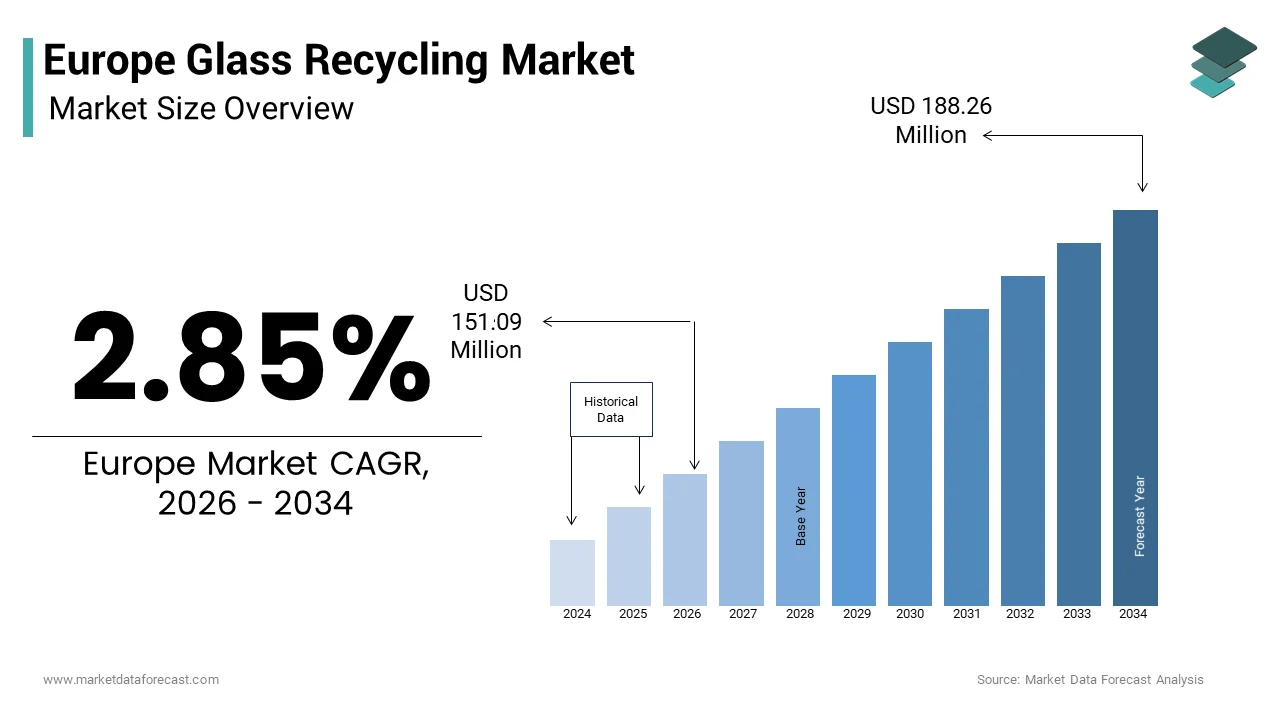
The Europe glass recycling market size was valued at USD 146.87 million in 2025, is anticipated to reach USD 151.09 million in 2026, and is projected to scale up to USD 188.26 million by 2034, registering a compound annual growth rate (CAGR) of 2.85% during the forecast period from 2026 to 2034. Driven by stringent EU legislative frameworks, energy efficiency imperatives, and advanced optical sorting technologies, the European glass recycling sector continues to experience steady expansion.
Key Executive Metrics (At-a-Glance)
- 2025 Base Valuation: USD 146.87 Million
- 2026 Current Valuation: USD 151.09 Million
- 2034 Forecast Valuation: USD 188.26 Million
- Compound Annual Growth Rate (CAGR): 2.85% (2026–2034)
- Dominant Mechanism Segment: Automatic Mechanism Segment (held 66.5% market share in 2025)
- Dominant Type Segment: Glass Bottle and Containers Segment (held 70.7% market share in 2025)
- Fastest-Growing Type Segment: Flat Glass Segment (projected at 10.6% CAGR)
- Dominant Country Markets: Germany (26.1% share in 2025) followed by France, Italy, and the United Kingdom
Core Market Drivers
- Legislative Mandates: Stringent EU packaging and packaging waste directives, landfill bans, and extended producer responsibility schemes.
- Energy Efficiency: Industrial imperatives to lower melting temperatures, reduce greenhouse gas emissions, and offset volatile energy costs.
- Technological Innovation: Advanced optical sorting and AI-driven purification systems improving cullet yield and purity.
Primary Market Restraints & Challenges
- Contamination Issues: Non-glass materials (ceramics, stones, metals) degrading cullet quality and restricting food-grade applicability.
- Logistical Complexities: High transportation costs and heavy, fragile freight dynamics limiting long-distance economic viability.
- Energy Price Volatility: Fluctuating electricity and fuel prices squeezing recycling processing margins.
Europe Glass Recycling Market Segmentation Highlights
| Segment Category | Largest Market Segment | Fastest-Growing Market Segment |
|---|---|---|
| By Mechanism | Automatic Mechanism (66.5% share in 2025) | Sensor-Driven Sorting Solutions |
| By Type | Glass Bottle and Containers (70.7% share) | Flat Glass Segment (10.6% CAGR) |
| By Country | Germany (26.1% share in 2025) | United Kingdom and Spain |
Major Industry Players Profiled
Key enterprises dominating the European glass recycling market include Veolia Environnement SA, Suez SA, Ardagh Group S.A., TOMRA Systems ASA, Stadler Anlagenbau GmbH, BHS-Sonthofen GmbH, Steinert GmbH, and Machinex Technologies Inc.
 Download Free Sample Report
Europe Glass Recycling Market Size
The Europe glass recycling market size was valued at 146.87 million in 2025 and is anticipated to reach USD 151.09 million in 2026 to reach USD 188.26 million by 2034, growing at a CAGR of 2.85% during the forecast period from 2026 to 2034.
Glass recycling constitutes a critical circular economy sector dedicated to the collection, sorting, processing, and remelting of post-consumer and industrial glass waste into cullet for new manufacturing applications. This ecosystem operates as the backbone of the continent's packaging and construction industries, leveraging the unique property of glass to be recycled infinitely without loss of purity or quality. The market is deeply embedded within the legislative framework of the European Union, which mandates high recovery targets to minimize landfill dependency and reduce carbon emissions associated with raw material extraction. According to Eurostat, municipal waste generation in the European Union has shown a gradual decline in recent years, yet packaging waste volumes remain substantial, which is requiring robust recycling infrastructures to manage the flow of materials. Furthermore, the European Environment Agency emphasizes that the use of recycled cullet significantly lowers the melting temperature required in furnaces, which is directly correlating to reduced energy consumption and lower greenhouse gas emissions per ton of produced glass. As per findings from the European Commission, the transition toward a climate-neutral economy by 2050 relies heavily on maximizing the loop closure rates for materials like glass and is making this market a strategic priority for national governments. The sector encompasses a complex network of reverse logistics, advanced optical sorting facilities, and glass manufacturers who integrate recycled content into their production lines, which is creating a symbiotic relationship between waste management and industrial output that defines the modern European sustainability landscape.
MARKET DRIVERS
Stringent Legislative Mandates and Circular Economy Action Plans
The rigorous enforcement of European Union directives and national laws that set binding targets for packaging waste recovery and recycled content usage is primarily driving the expansion of the Europe glass recycling market. The revised Packaging and Packaging Waste Directive establishes ambitious goals requiring member states to achieve specific recycling rates for glass, compelling municipalities and private waste managers to invest heavily in collection infrastructure and sorting technologies. According to the European Commission, recycling targets for packaging waste have been raised, with glass specifically identified as a material where high recovery rates are feasible and economically viable. This regulatory pressure forces producers to adopt extended producer responsibility schemes, making them financially accountable for the end-of-life management of their glass products. As per the European Environment Agency, countries with strict landfill bans and high landfill taxes achieve high recycling rates, demonstrating the efficacy of policy-driven demand. The legal requirement to incorporate recycled content in new glass containers further secures a stable demand stream for processed cullet. As member states transpose these EU directives into national law, recycling becomes a compliance necessity rather than a voluntary choice, driving sustained investment and operational expansion across the continent.
Energy Efficiency Imperatives and Carbon Reduction Goals
The urgent industrial need to reduce energy consumption and carbon footprints in glass manufacturing, where the substitution of virgin raw materials with recycled cullet offers immediate environmental benefits is further boosting the expansion of the Europe glass recycling market. Melting cullet requires less thermal energy than melting silica sand, soda ash, and limestone, which is making it a critical lever for glass producers striving to meet net-zero emissions targets amidst rising energy costs. According to the International Energy Agency, increased cullet usage in furnaces reduces energy consumption and carbon dioxide emissions. In an era of volatile natural gas prices and stringent carbon pricing mechanisms under the EU Emissions Trading System, the economic argument for using recycled glass has become compelling. As per FEVE, the European Container Glass Federation, the industry has integrated high levels of recycled content, with some facilities operating with cullet ratios that maximize efficiency. The correlation between cullet availability and operational cost savings drives glassmakers to secure long-term supply contracts with recyclers, which is fostering a robust market dynamic. This alignment of economic incentives with climate objectives ensures that demand for high-quality recycled glass remains linked to the competitiveness of the European glass industry.
MARKET RESTRAINTS
Contamination Issues and Quality Degradation of Collected Cullet
The persistent challenge of contamination within collected glass streams that impacts the quality of cullet and limits its applicability in high-value manufacturing is a significant restraint to the Europe glass recycling market growth. Non-glass materials such as ceramics, stones, heat-resistant glass, and metal caps can survive the melting process or cause defects in new bottles, which is rendering batches unusable for food-grade applications. According to the European Container Glass Federation, even small percentages of contaminants can disrupt the homogeneity of molten glass, which is leading to production stoppages and increased rejection rates. The reliance on single-stream collection systems in many municipalities often leads to higher contamination levels compared to multi-stream systems and complicating sorting. For instance, a portion of collected glass must be downcycled into construction aggregates or landfilled due to impurity levels, which is representing a loss of valuable material potential. The presence of mixed coloured glass also restricts the ability to produce clear or specific-colored bottles, which is forcing manufacturers to rely more on virgin materials. This quality inconsistency creates a bottleneck where recyclable glass exists, but usable high-purity cullet remains insufficient and hampering the market’s ability to fully close the loop.
Logistical Complexities and High Transportation Costs
The logistical difficulty and high cost associated with transporting heavy and fragile glass waste from collection points to processing facilities and back to manufacturers is further hampering the expansion of the Europe glass recycling market. Glass has a low value-to-weight ratio, which is making long-distance transportation economically unviable and environmentally counterproductive due to carbon emissions from heavy trucks. According to the European Logistics Association, transport costs can account for a substantial portion of the total cost of recycled glass, particularly in regions where collection centers are dispersed and processing plants are centralized. The fragility of glass during transit leads to breakage and dust generation, which is complicating handling and reducing cullet yield. As per the International Transport Forum, optimizing reverse logistics networks for heavy materials like glass requires significant infrastructure investment and coordination that is often lacking in fragmented markets. In rural or less densely populated areas, the distance to the nearest processing facility can be prohibitive, which is leading to lower collection rates or diversion of glass to landfills. The lack of standardized containerization and handling protocols across countries further exacerbates inefficiencies, creating friction in cross-border trade of cullet. These logistical hurdles limit the geographic scope of recycling operations and prevent optimal resource allocation across the continent.
MARKET OPPORTUNITIES
Technological Advancements in Optical Sorting and Purification
The deployment of advanced optical sorting technologies and artificial intelligence-driven purification systems that can dramatically improve the quality and yield of recycled glass cullet is a promising opportunity in the Europe glass recycling market. Modern sensor-based sorting machines equipped with near-infrared spectroscopy, laser detection, and high-speed air jets can identify and remove contaminants, ceramics, and unwanted colors with precision, unlocking new value from previously marginal waste streams. According to the Fraunhofer Institute, next-generation sorting facilities can achieve very high purity levels, which is making the resulting cullet suitable for demanding food and beverage packaging applications. This technological leap allows recyclers to process mixed-color glass streams more effectively, converting them into high-value mono-color fractions that command premium prices. As per the European Recycling Industries Confederation, investments in automated sorting infrastructure can significantly increase recovery rates of usable glass. The integration of machine learning algorithms enables these systems to adapt to varying waste compositions in real time to ensure consistent output quality. By overcoming contamination barriers, these technologies position the market to capture greater value and reduce reliance on virgin raw materials, which is creating a lucrative avenue for innovation and growth.
Expansion of Closed-Loop Systems in Construction and Urban Development
The growing emphasis on sustainable building practices and the circular economy in the construction sector presents a lucrative opportunity for the European glass recycling market. Recycled glass can be processed into glass foam, terrazzo tiles, countertops, and insulation materials that offer aesthetic appeal and superior thermal properties while diverting waste from landfills. According to the European Construction Sector Observatory, demand for green building materials is rising as developers seek to meet environmental certification standards such as LEED and BREEAM. The use of recycled glass in asphalt and concrete mixes also offers enhanced durability and skid resistance. As per the European Commission’s Level(s) framework, incorporating recycled content in construction projects is increasingly rewarded with regulatory incentives and tax breaks, which is driving adoption among contractors and architects. The development of local processing hubs that convert non-bottle glass waste into construction aggregates can solve logistical issues by creating decentralized supply chains tailored to regional projects. This diversification of end-use applications reduces dependence on the packaging industry, opening new revenue streams and enhancing resilience against fluctuations in consumer goods demand.
MARKET CHALLENGES
Volatility in Energy Prices and Processing Costs
The volatility in energy prices that directly impacts the operational costs of collecting, transporting, and processing glass waste into usable cullet is one of the major challenges to the growth of the European glass recycling market. The recycling process involves energy-intensive steps such as crushing, screening, washing, and drying, all of which are sensitive to fluctuations in electricity and fuel costs. According to Eurostat, industrial energy prices in Europe have experienced significant spikes in recent years due to geopolitical tensions and supply chain disruptions, which is squeezing the profit margins of recycling operators. High energy costs can make processing low-value glass streams economically unfeasible, leading to stockpiling of waste or increased tipping fees. As per the European Federation of Waste Management and Environmental Services, many smaller recycling firms face existential threats when energy costs rise sharply, which is potentially leading to market consolidation. The inability to fully pass these increased costs onto downstream manufacturers or municipalities creates financial strain that threatens the stability of the recycling value chain.
Consumer Behavior and Inconsistencies in Collection Participation
The inconsistent consumer behavior and varying levels of participation in glass recycling programs across different European regions that leads to fluctuations in the volume and quality of collected materials is further challenging the expansion of the European glass recycling market. Despite high awareness levels, confusion regarding recyclable glass types, improper disposal habits, and lack of motivation in certain demographics result in significant amounts of glass ending up in residual waste streams. According to the European Consumer Organisation, many households admit to irregular recycling practices or uncertainty about local sorting rules, which is leading to leakage of valuable materials from the circular economy. The effectiveness of collection systems varies widely between deposit return schemes and curbside pickup models, which is creating disparities in recovery rates. As per municipal waste reports, participation rates can drop during holiday seasons or in areas with inadequate bin infrastructure, causing supply shocks for processors. The “free rider” problem, where individuals benefit from recycling systems without contributing, which is further exacerbates the issue. Overcoming these behavioral barriers requires continuous public education campaigns, improved infrastructure accessibility, and incentives, yet changing habits remains a slow process that limits the market’s potential to achieve maximum recovery rates.
REPORT COVERAGE
| REPORT METRIC | DETAILS |
| Market Size Available | 2025 to 2034 |
| Base Year | 2025 |
| Forecast Period | 2026 to 2034 |
| CAGR | 2.85% |
| Segments Covered | By Mechanism, Type, and Countries |
| Various Analyses Covered | Regional & Country Level Analysis, Segment-Level Analysis, DROC, PESTLE Analysis, Porter’s Five Forces Analysis, Competitive Landscape, Analyst Overview on Investment Opportunities |
| Regions Covered | UK, France, Spain, Germany, Italy, Russia, Sweden, Denmark, Switzerland, Netherlands, Turkey, Czech Republic, & Rest of Europe |
| Market Leaders Profiled | Andela Products Inc., Machinex Technologies Inc., Suez SA, Ardagh Group S.A., Veolia Environnement SA, TOMRA Systems ASA, Stadler Anlagenbau GmbH, BHS-Sonthofen GmbH, Steinert GmbH, Sorema S.r.l. (Recycling Division of Previero N. S.r.l.), Binder + Co AG, Untha Shredding Technology GmbH, CM Shredders Corporation |
SEGMENTAL ANALYSIS
By Mechanism Insights
The automatic mechanism segment dominated the market by commanding 66.5% of the European market share in 2025. The dominance of automatic mechanism segment in the European market is driven by the imperative for high purity cullet production and the economic necessity of processing massive volumes with minimal human intervention to meet stringent EU quality standards. The critical requirement of glass manufacturers for ultra-pure cullet free from ceramics, stones, and metals that can only be achieved through sophisticated sensor-based sorting technologies is further contributing to the dominance of automatic mechanism segment in the regional market. Modern automatic systems utilize near-infrared spectroscopy, laser detection, and color cameras to identify and eject contaminants with accuracy that manual or semi-automatic methods cannot match. According to FEVE, the European Container Glass Federation, industry targets for cullet purity are set at very high levels to ensure the structural integrity and safety of food-grade packaging. Manual sorting cannot achieve this precision at the speeds required by modern recycling facilities, which is leading to higher rejection rates and lower value output. Automatic sorters can distinguish between different types of glass and non-glass materials in real time to ensure the final product meets rigorous specifications demanded by furnace operators. As per the European Recycling Industries Confederation, facilities employing fully automatic lines report higher yields of saleable cullet compared to those relying on older technologies. This technological superiority makes automatic mechanisms the indispensable standard for facilities aiming to supply the premium end of the market.
By Type Insights
The glass bottle and containers segment held the dominant position in the Europe glass recycling market by capturing 70.7% of the European market share in 2025. The growth of the glass bottle and containers segment in the European market can be credited to well-established collection infrastructures for beverage packaging and the infinite recyclability of container glass that aligns perfectly with circular economy goals. The dominance of the bottle and container segment is further driven by extensive and mature collection systems specifically designed for beverage packaging, including deposit return schemes and dedicated curbside bins that capture the majority of post-consumer glass. Countries across Europe have implemented highly effective separation-at-source programs where consumers are accustomed to disposing of bottles and jars separately, ensuring a clean and abundant feedstock. According to Reloop, several European nations including Germany, Finland, and Lithuania have achieved very high return rates for beverage containers through mandatory deposit systems, creating a reliable pipeline of recyclable material. The cultural habit of returning bottles is deeply ingrained in many European societies, supported by reverse vending machines located in supermarkets and public spaces. As per Eurostat, packaging waste represents the largest fraction of municipal glass waste, and targeted collection efforts for this stream result in higher recovery rates compared to other glass types. The consistency of supply provided by these organized systems makes bottle recycling the most economically viable segment, which is attracting continuous investment in processing capacity.
On the other hand, the flat glass segment is emerging as the fastest growing type and is expected to record a CAGR of 10.6% over the forecast period in the European market owing to the increasing volumes of end-of-life glass from construction and automotive sectors, coupled with new technologies enabling efficient recovery and reuse. The rapid ascent of the flat glass segment is linked to building renovation and demolition activities across Europe as part of Green Deal initiatives to improve energy efficiency in existing structures. As older buildings are retrofitted with modern glazing, large quantities of outdated flat glass enter the waste stream. According to the European Construction Sector Observatory, renovation rates of commercial and residential buildings are expected to rise significantly, generating millions of tons of construction and demolition waste containing flat glass. Historically, much of this material was landfilled or downcycled due to processing difficulties, but new regulatory pushes are mandating higher recovery rates for construction materials. As per the European Demolition Association, specialized sorting facilities are increasingly equipped to handle flat glass, separating it from frames and sealants effectively. The sheer volume of material becoming available creates a massive new feedstock source that was previously underutilized. As the construction industry embraces circularity, logistics for collecting and processing flat glass are maturing rapidly, driving exceptional growth in this segment.
COUNTRY ANALYSIS
Germany Glass Recycling Market Analysis
Germany dominated the glass recycling market in Europe in 2025 with 26.1% of the regional market share due to its pioneering deposit return system, rigorous waste segregation laws, and advanced processing infrastructure. The nation benefits from a deeply ingrained culture of environmental responsibility where citizens meticulously separate glass by color at thousands of public collection points. According to the German Environment Agency, recycling rates for glass packaging in Germany are consistently very high, setting a benchmark for the rest of the continent. The country hosts some of the world’s most sophisticated sorting facilities that utilize state-of-the-art optical sensors to ensure ultra-pure cullet suitable for direct remanufacturing. The strict Packaging Act imposes significant responsibilities on producers, driving continuous innovation in collection and recycling logistics. As per the Federal Statistical Office, the volume of collected glass per capita in Germany is among the highest globally. The combination of legislative stringency, technological leadership, and public participation secures Germany’s top position in the regional hierarchy.
France Glass Recycling Market Analysis
France held a promising share of the European glass recycling market in 2025 due to comprehensive producer responsibility schemes and a strong national strategy to boost circular economy practices in the glass sector. The French market is distinguished by its extensive network of voluntary drop-off points known as colonnes à verre, which are ubiquitous across urban and rural areas. According to Citeo, France has set ambitious targets to increase recycled glass incorporation in new bottles by 2030, driving significant investment in sorting capacity. The government’s Anti-Waste Law for a Circular Economy introduces bonuses and penalties to encourage eco-design and higher recycling rates. As per the Ministry of Ecological Transition, the tonnage of glass collected annually continues to rise, supported by public awareness campaigns. The presence of major glass manufacturers collaborating with recyclers to develop closed-loop supply chains further strengthens the market.
Italy Glass Recycling Market Analysis
Italy is estimated to showcase a healthy CAGR in the European glass recycling market during the forecast period owing to efficient regional collection systems and a strong tradition of glass manufacturing that prioritizes recycled content. The Italian market benefits from consortia like CoReVe, which coordinate glass packaging collection and recycling across regions, ensuring a unified approach despite administrative fragmentation. According to CoReVe, Italy achieves high recycling rates for glass, supported by effective door-to-door collection schemes in many municipalities. The country’s renowned glass industry, particularly in Veneto, relies heavily on high-quality cullet to maintain product prestige. As per the National Institute of Statistics, demand for recycled glass in Italy is robust, supported by favorable economics and regulatory incentives. Continuous modernization of sorting plants to handle mixed-color glass enhances output quality, maintaining Italy’s strong standing in the European market.
United Kingdom Glass Recycling Market Analysis
The United Kingdom is projected to account for a notable share of the European glass recycling market during the forecast period due to its well-established curbside collection infrastructure and growing momentum toward implementing a nationwide deposit return scheme. The UK market is characterized by high glass packaging consumption and a mature waste management sector. According to WRAP, recycling rates for glass in the UK remain stable, with potential for growth through upcoming policy reforms. Consistent recycling collections mandated by the government aim to standardize practices across local authorities, reducing contamination. As per the Department for Environment, Food and Rural Affairs, investments in optical sorting technology are increasing to improve cullet quality. The strong presence of beverage companies committed to sustainability goals drives demand for recycled content. Despite Brexit-related regulatory complexities, the UK continues to push forward with circularity initiatives.
Spain Glass Recycling Market Analysis
Spain is expected to hold a considerable share of the European glass recycling market over the forecast period owing to the rapid expansion of selective collection networks and aggressive national targets aligned with EU directives. The Spanish market has improved significantly due to Ecoembes, which manages packaging waste and invests in logistics optimization and upgraded sorting facilities. According to Ecoembes, glass collection per inhabitant in Spain has reached record highs, reflecting successful public engagement campaigns. The country’s tourism industry generates substantial glass waste, particularly in coastal regions, prompting localized solutions to manage seasonal peaks. As per the Ministry for Ecological Transition, recycling rates show a clear upward trend as new regulations enforce stricter separation requirements. The domestic glass industry is increasingly integrating recycled content to meet sustainability certifications and reduce energy costs. Expanding collection to rural areas and improving purity through education ensures continued growth, securing Spain’s position as a key market in Southern Europe.
COMPETITIVE LANDSCAPE
The competition within the Europe glass recycling market is characterized by intense rivalry among large multinational waste management corporations specialized regional recyclers and integrated glass manufacturers vying for control of high quality feedstock. Incumbent players leverage their extensive infrastructure networks advanced sorting technologies and established relationships with municipalities to maintain dominance while smaller niche operators differentiate themselves through specialized processing capabilities for difficult glass types. The market is further complicated by varying national regulations regarding waste management and extended producer responsibility which force competitors to adopt localized strategies for compliance and operations. Competitive pressure drives continuous investment in automation and digitalization to lower operational costs and improve yield rates from collected waste. Brands compete fiercely for long term supply contracts with major glass producers who demand consistent quality and volume of cullet for their furnaces. The rise of circular economy mandates has intensified the battle for access to clean glass streams leading to consolidation as larger entities acquire smaller players to gain scale. Trust and reliability have become key differentiators with customers prioritizing providers who demonstrate consistent performance and adherence to environmental standards. This dynamic environment fosters rapid technological advancement but also leads to strategic alliances as companies seek to share risks and resources in a capital intensive sector.
KEY MARKET PLAYERS
A few of the market players that are in the Europe glass recycling market are
- Andela Products Inc.
- Machinex Technologies Inc.
- Suez SA
- Ardagh Group S.A.
- Veolia Environnement SA
- TOMRA Systems ASA
- Stadler Anlagenbau GmbH
- BHS-Sonthofen GmbH
- Steinert GmbH
- Sorema S.r.l. (Recycling Division of Previero N. S.r.l.)
- Binder + Co AG
- Untha Shredding Technology GmbH
- CM Shredders Corporation
Top Players In The Market
- Veolia Environnement SA stands as a global leader in environmental services with a dominant presence in the European glass recycling sector through its extensive network of sorting and processing facilities. The company contributes significantly to the global market by pioneering advanced technologies that transform waste glass into high purity cullet for the manufacturing industry. Its involvement in Europe includes managing complex collection logistics and operating state of the art plants that ensure strict quality standards for recycled materials. Recent actions to strengthen its market position involve substantial investments in optical sorting equipment and artificial intelligence systems to enhance contamination removal efficiency. Veolia has also forged strategic partnerships with major glass manufacturers to secure long term supply contracts for recycled content. By expanding its capacity to process flat glass and ceramics the firm diversifies its feedstock sources. These initiatives reinforce its reputation as an indispensable partner for achieving circular economy goals while driving operational excellence and sustainability throughout the continent.
- Suez SA operates as a premier provider of water and waste management solutions with a strong footprint in the European glass recycling landscape through specialized treatment centers and recovery units. The company plays a pivotal role in the global market by developing innovative processes that maximize the recovery rate of glass from mixed waste streams and construction debris. Its European operations focus on integrating glass recycling into broader urban metabolism strategies to support sustainable city development. Recent actions to strengthen its market position include the acquisition of regional recycling firms to expand its geographic coverage and processing capabilities. Suez has also launched digital platforms to track material flows and optimize collection routes using real time data analytics. The firm actively collaborates with local authorities to improve source separation rates and reduce contamination levels. By investing in research and development for new glass applications such as insulation materials Suez creates additional value chains. These strategic moves demonstrate a clear commitment to innovation and resource efficiency solidifying its status as a key enabler of the circular economy across the region.
- Ardagh Group S.A. functions as a leading global producer of glass and metal packaging with a vertically integrated approach that includes significant in house glass recycling operations across Europe. The company contributes to the global market by setting industry benchmarks for the use of recycled cullet in the production of new bottles and jars. Its involvement in Europe is marked by the operation of dedicated cullet processing centers that supply its own manufacturing plants as well as external customers. Recent actions to strengthen its market position involve the installation of next generation melting furnaces designed to operate with higher percentages of recycled content while reducing energy consumption. Ardagh has also initiated community engagement programs to increase public awareness and participation in glass collection schemes. The firm actively participates in industry consortia to advocate for policies that support closed loop recycling systems. By focusing on lightweighting technologies and sustainable design Ardagh enhances the environmental profile of its products. These efforts highlight its dedication to transforming patient care and consumer goods through advanced recycling technologies and integrated production ecosystems.
Top Strategies Used By The Key Market Participants
Key players in the Europe glass recycling market primarily employ strategies centered on technological innovation and vertical integration to secure competitive advantages. Companies heavily invest in advanced optical sorting systems and artificial intelligence to improve the purity of cullet and remove complex contaminants like ceramics and heat resistant glass. This technical superiority allows them to meet the stringent quality requirements of modern glass manufacturers and command premium prices. Another major strategy involves forming long term partnerships with beverage producers and construction firms to secure stable feedstock supplies and guaranteed off take agreements for recycled materials. Firms actively expand their collection networks through collaborations with municipalities and deposit return scheme operators to increase capture rates. Enhancing logistical efficiency via route optimization software and centralized processing hubs serves as a critical tactic to reduce transportation costs and carbon emissions. Furthermore, participants focus on diversifying their product portfolios to include recycled glass applications in construction and abrasives thereby reducing dependency on the packaging sector alone. These combined approaches enable organizations to navigate regulatory complexities effectively while capturing growth in emerging application areas.
MARKET SEGMENTATION
This research report on the Europe glass recycling market is segmented and sub-segmented into the following categories.
By Machine
- Shredders
- Extruders
- Grinder
- Mixer
- Sorter
- Washer
- Others
By Application
- Flat Glass
- Glass Containers
- Glass Bottle
- Fiber Glass
- Highway Beads
- Abrasives
- Fillers
- Others
By Mechanism
- Semi-Automatic
- Automatic
By Glass
- Glass Bottle & Containers
- Flat Glass
- Fiber Glass
- Others
By Country
- UK
- France
- Spain
- Germany
- Italy
- Russia
- Sweden
- Denmark
- Switzerland
- Netherlands
- Turkey
- Czech Republic
- Rest of Europe