Europe Glycidyl Methacrylate Market Size, Share, Trends, & Growth Forecast Report By Application (Coatings, Adhesives, Electrical Laminate Plastics, Ion Exchange Resins) and Country (UK, France, Spain, Germany, Italy, Russia, Sweden, Denmark, Switzerland, Netherlands, Turkey, Czech Republic and Rest of Europe), Industry Analysis From 2025 to 2033
Europe Glycidyl Methacrylate Market Report Summary
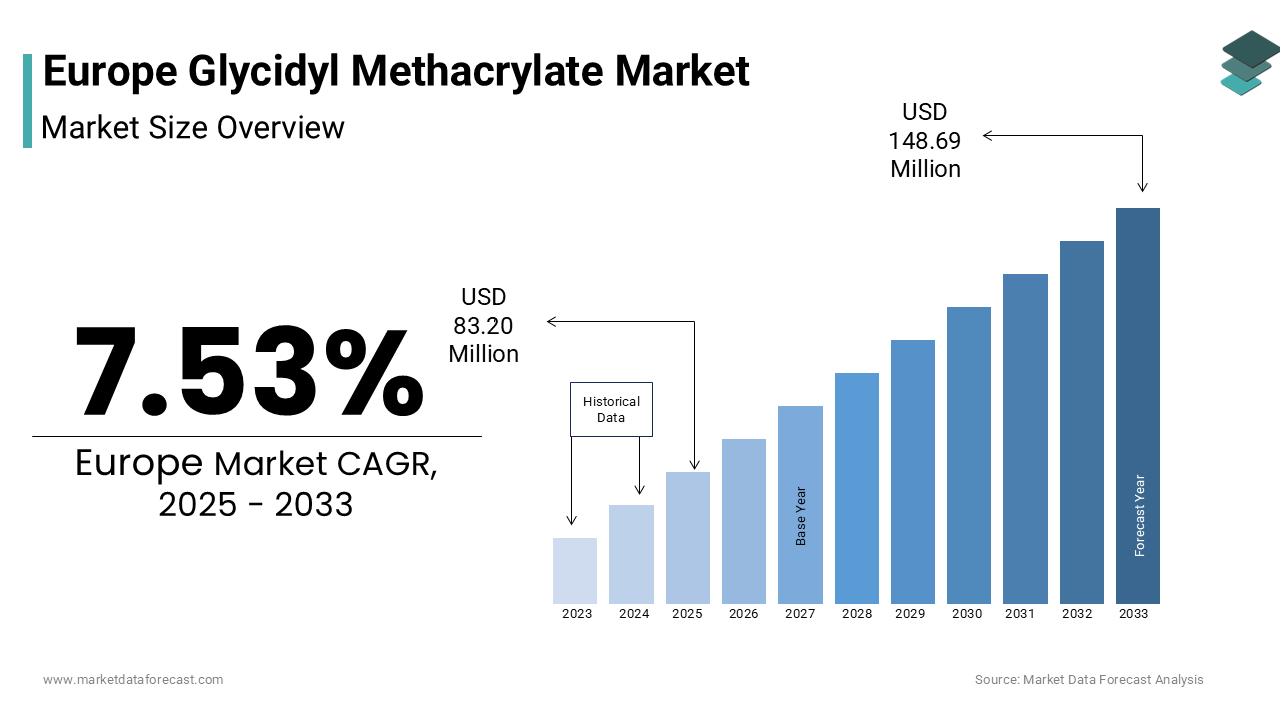
The Europe glycidyl methacrylate market was valued at USD 77.37 million in 2024, is estimated to reach USD 83.20 million in 2025, and is projected to reach USD 148.69 million by 2033, growing at a CAGR of 7.53% during the forecast period from 2025 to 2033. The growth of the Europe glycidyl methacrylate market is driven by rising demand from high-performance coatings, expanding dental and medical device manufacturing, and increasing use in advanced ion exchange resins and specialty polymers. Growing adoption in automotive refinish coatings, electronics protection layers, and water treatment membranes is further supporting market expansion. Moreover, advancements in bio-based monomer development and increasing regulatory emphasis on high-durability, low-VOC materials are reshaping product innovation across Europe’s specialty chemicals ecosystem.
Key Market Trends
- Increasing use of glycidyl methacrylate in dental composites and medical polymers due to superior adhesion and mechanical strength.
- Rising incorporation of high-solids and low-VOC automotive and industrial coatings to meet EU environmental regulations.
- Growing research focuses on bio-based glycidyl methacrylate aligned with the EU Green Deal and circular economy objectives.
- Expanding applications in ion exchange resins and membranes for advanced water purification and resource recovery.
- Strong emphasis on regulatory compliance, closed handling systems, and occupational exposure control under EU REACH.
Segmental Insights
- Based on application, the coatings segment was the largest and held a significant share of the Europe glycidyl methacrylate market in 2024. The dominance of this segment is attributed to its extensive use in automotive clear coats, industrial maintenance coatings, and high-durability architectural finishes requiring enhanced adhesion, chemical resistance, and gloss retention.
- The ion exchange resins segment is expected to register the fastest growth during the forecast period, driven by increasing deployment of advanced water treatment systems and the use of glycidyl methacrylate-functionalized resins in municipal wastewater reuse and battery material recovery applications.
Regional Insights
The Europe glycidyl methacrylate market is witnessing steady growth across major industrial economies, supported by strong specialty chemical manufacturing and strict regulatory frameworks.
- Germany was the largest contributor in 2024, driven by its advanced chemical production base, automotive coatings industry, and widespread use of glycidyl methacrylate in water treatment resins.
- France is emerging as a high-growth market, supported by expanding dental materials manufacturing, water purification upgrades, and aerospace coatings demand.
- The United Kingdom continues to perform steadily, fueled by medical device manufacturing, electronics coatings, and regulatory alignment with EU chemical safety standards.
- Italy and the Netherlands are also gaining traction, supported by automotive refinish coatings, furniture finishes, and advanced water technology deployment.
Competitive Landscape
The Europe glycidyl methacrylate market is characterized by a concentrated competitive structure dominated by large, integrated chemical producers with strong regulatory compliance capabilities. Leading companies focus on high-purity production, closed-loop handling systems, and downstream technical support to serve medical, coatings, and water treatment applications. Strategic investments in sustainable production pathways, bio-based alternatives, and application-specific customization are strengthening competitive positioning. Prominent players in the Europe glycidyl methacrylate market include BASF SE, Evonik Industries AG, Arkema S.A., Wacker Chemie AG, Solvay S.A., Clariant AG, Allnex Group, DSM Coating Resins, Merck KGaA, and Sartomer.
Europe Glycidyl Methacrylate Market Size
The europe glycidyl methacrylate market size was valued at USD 77.37 million in 2024 and is anticipated to reach USD 83.20 million in 2025 from USD 148.69 million by 2033, growing at a CAGR of 7.53% during the forecast period from 2025 to 2033.
The glycidyl methacrylate is a reactive monomer characterized by an epoxy group and a methacrylate functionality by enabling its use as a crosslinking agent and adhesion promoter in high performance polymers, coatings, and specialty resins. In Europe, it serves as an intermediate in the formulation of dental composites, pressure sensitive adhesives, ion exchange membranes, and impact modifiers for engineering plastics. The European market operates under stringent chemical safety regulations, particularly the Registration Evaluation Authorisation and Restriction of Chemicals framework, which governs handling, exposure limits, and environmental release. According to the European Chemicals Agency, glycidyl methacrylate is classified as a substance of very high concern due to its mutagenic properties, which is necessitating strict workplace exposure controls. As per the European Commission’s Industrial Emissions Directive, facilities producing or using more than one ton per year must implement closed transfer systems and real time air monitoring. The European Centre for Ecotoxicology and Toxicology of Chemicals has established an occupational exposure limit of 0.05 parts per million over an 8 hour shift, influencing engineering controls across manufacturing and downstream sectors. These regulatory parameters shape production protocols and application safety, defining the operational landscape for glycidyl methacrylate in Europe’s advanced materials ecosystem.
MARKET DRIVERS
Expansion of Dental and Medical Device Manufacturing in Western Europe
The dental materials sector is a primary consumer of glycidyl methacrylate, which serves as a key monomer in light cured resin composites for fillings, crowns, and orthodontic adhesives. The expansion of dental and medical device manufacturing in Western Europe is escalating the growth of Europe glycidyl methacrylate market. According to the European Federation of Dental Materials Societies, over 90% of commercial dental restorative resins in the EU contain glycidyl methacrylate or its derivatives due to its ability to enhance mechanical strength and bonding durability. Germany alone hosts more than 230 dental material manufacturers, as documented by the German Medical Technology Association, collectively producing over 8,000 metric tons of resin-based products annually. Additionally, the European Medicines Agency requires stringent biocompatibility testing under ISO 10993 for all dental polymers, and glycidyl methacrylate formulations consistently meet these standards when fully polymerized. Innovations in bulk fill composites designed to reduce clinical time that further increase monomer loading per procedure.
Growth in High Performance Coatings for Automotive and Electronics
Glycidyl methacrylate is increasingly incorporated into functional coatings that require chemical resistance adhesion promotion and thermal stability properties essential for automotive clear coats and conformal coatings in electronics. The growth in high performance coatings for automotive and electronics is additionally elevating the growth of Europe glycidyl methacrylate market. The European automotive sector produced 14.3 million passenger vehicles in 2023 as per the European Automobile Manufacturers Association, with each vehicle requiring approximately 8 to 12 kilograms of high solids coatings containing reactive monomers. Regulatory acceptance under the EU’s Biocidal Products Regulation for antimicrobial coating additives, also expands its utility.
MARKET RESTRAINTS
Stringent REACH Classification as a Substance of Very High Concern
Glycidyl methacrylate’s classification as a mutagen category 1B under the European Union’s Registration Evaluation Authorisation and Restriction of Chemicals framework imposes significant operational and compliance burdens. The stringent REACH classification as a substance of very high concern is eventually restraining the growth of Europe glycidyl methacrylate market. According to the European Chemicals Agency, this designation mandates authorization for all industrial uses after sunset dates unless specific exemptions apply, requiring companies to justify continued use through detailed socio-economic analyses. As per the European Occupational Safety and Health Administration, workplaces must implement engineering controls such as closed transfer systems and continuous air monitoring to maintain airborne concentrations below 0.05 parts per million. A 2023 survey by the European Federation of Chemical Distributors found that 74% of downstream formulators incurred capital expenditures exceeding EUR 250,000 to retrofit handling equipment. Additionally, safety data sheets must include explicit risk management measures, increasing administrative complexity for importers and compounders. These constraints discourage small and medium enterprises from using glycidyl methacrylate, narrowing the user base to large corporations with dedicated regulatory affairs teams.
Volatility in Propylene and Methacrylic Acid Feedstock Supply Chains
The glycidyl methacrylate synthesis relies on methacrylic acid and epichlorohydrin, both derived from propylene are a petrochemical feedstock subject to geopolitical and refining disruptions. The volatility in propylene and methacrylic acid feedstock supply chains is also degrading the growth of Europe glycidyl methacrylate market. According to the International Energy Agency, European propylene production declined by 9% between 2021 and 2023 due to the curtailment of steam crackers following natural gas price spikes. The European Petrochemical Association confirmed that methacrylic acid spot prices in the EU fluctuated by over 40% in 2023 alone, directly impacting glycidyl methacrylate production economics. Furthermore, epichlorohydrin supply is concentrated in a few integrated sites in Germany and Belgium, with the European Chlorine Industry Association reporting a 17% reduction in operating rates in 2022 due to chlorine demand imbalances. Producers without backward integration face margin compression, while integrated chemical groups gain disproportionate advantage.
MARKET OPPORTUNITIES
Development of Bio Based Glycidyl Methacrylate from Renewable Feedstocks
Emerging pathways to produce glycidyl methacrylate from bio based methacrylic acid aligned with the EU’s Green Deal objectives is certainly to create new opportunities for the growth of Europe glycidyl methacrylate market. According to the study, pilot projects in the Netherlands and France have successfully synthesized glycidyl methacrylate using methacrylic acid derived from fermented sugars by achieving purity levels exceeding 99.5%. These innovations qualify for support under the EU Innovation Fund, which allocated EUR 180 million in 2023 to bio-monomer scale up initiatives. Companies like Arkema and BASF are actively testing these alternatives in dental and coating applications, with preliminary data indicating equivalent performance. Certification under the EU Ecolabel for industrial chemicals could further accelerate adoption. As public procurement policies increasingly favor renewable carbon content, bio based glycidyl methacrylate may gain premium positioning in sustainability driven segments by offering a long term hedge against fossil feedstock volatility and regulatory carbon pricing.
Integration into Advanced Water Purification and Energy Storage Membranes
Glycidyl methacrylate’s epoxy functionality enables grafting onto polymer backbones to create ion exchange and proton exchange membranes for emerging environmental and energy applications. The integration into advanced water purification and energy storage membranes is also gearing up for the growth of Europe glycidyl methacrylate market. Europe’s push for water reuse is accelerating deployment, where the European Environment Agency reported that 22 EU member states now mandate municipal water recycling for industrial use, driving demand for efficient separation technologies. As the EU ta
MARKET CHALLENGES
Occupational Health and Safety Compliance Costs in Downstream Formulation
The handling of glycidyl methacrylate in formulation facilities incurs substantial compliance costs due to its classification as a sensitizer and mutagen is a great challenge for the growth of Europe glycidyl methacrylate market. According to the European Agency for Safety and Health at Work, employers must implement mandatory health surveillance programs including pre placement and annual lung function tests for exposed workers. A 2023 audit by Germany’s Federal Institute for Occupational Safety and Health found that 61% of adhesive and coating manufacturers using glycidyl methacrylate required full containment glove boxes and local exhaust ventilation systems, with average installation costs of EUR 380 000 per production line. Furthermore, the EU’s Carcinogens and Mutagens Directive mandates substitution assessments every three years, forcing companies to continually evaluate alternatives even when none exist. Training requirements are equally rigorous, where the French Labour Inspectorate reported that 14 hours of annual chemical safety training are compulsory for all personnel handling glycidyl methacrylate. These measures, while protective, disproportionately burden small formulators who lack resources for engineering controls by leading to market consolidation and reduced innovation among niche players. The cumulative effect is a narrowing of the application ecosystem to only the most essential high value uses.
Limited Availability of Verified Safer Alternatives for High Performance Applications
Despite regulatory pressure, viable substitutes for glycidyl methacrylate remain scarce in applications demanding simultaneous adhesion promotion thermal stability and crosslinking density. According to the European Paint and Printing Ink Association, extensive testing of alternatives such as glycidyl acrylate and allyl glycidyl ether revealed inferior performance in automotive clear coats, with 30 to 40% lower gloss retention after accelerated weathering. Even bio-based epoxidized oils lack the reactivity needed for rapid cure systems. This technological lock in forces continued use despite regulatory friction. The European Chemicals Agency’s substitution support portal lists glycidyl methacrylate as “difficult to substitute” in eight out of ten industrial applications. Consequently, end users face a dilemma, incur high compliance costs or compromise product performance. Until next generation monomers with comparable functionality and lower toxicity profiles reach commercial scale, the market will remain dependent on glycidyl methacrylate, exposing participants to persistent regulatory and reputational risks.
REPORT COVERAGE
| REPORT METRIC | DETAILS |
| Market Size Available | 2024 to 2033 |
| Base Year | 2024 |
| Forecast Period | 2025 to 2033 |
| CAGR | 7.53% |
| Segments Covered | By Application and Region. |
| Various Analyses Covered | Global, Regional & Country Level Analysis, Segment-Level Analysis, DROC, PESTLE Analysis, Porter’s Five Forces Analysis, Competitive Landscape, Analyst Overview of Investment Opportunities |
| Regions Covered | United Kingdom, France, Spain, Germany, Italy, Russia, Sweden, Denmark, Switzerland, the Netherlands, Turkey, and the Czech Republic. |
| Market Leaders Profiled | BASF SE, Evonik Industries AG, Arkema S.A., Sartomer, Wacker Chemie AG, Solvay S.A., Clariant AG, Allnex Group, DSM Coating Resins, Merck KGaA |
SEGMENTAL ANALYSIS
By Application Insights
The coatings segment held 38.2% of the Europe glycidyl methacrylate market share in 2024 with the stringent performance requirements in automotive and industrial maintenance applications, where glycidyl methacrylate enhances chemical resistance, gloss retention, and adhesion to metal substrates. According to the European Coatings Journal, over 70% of two component acrylic polyol systems used in automotive refinish coatings in Germany and Italy incorporate glycidyl methacrylate to meet OEM durability standards. The European Automobile Manufacturers Association reported that 14.3 million passenger vehicles were produced in the EU in 2023, each requiring 8 to 12 kilograms of high solids coatings where reactive monomers like glycidyl methacrylate are essential. National regulations in France and the Netherlands mandating VOC content below 300 grams per liter, further favor high solids formulations where glycidyl methacrylate improves film formation without solvents. This emergence of performance mandates and environmental compliance solidifies coatings as the dominant application. Beyond industrial uses, glycidyl methacrylate is increasingly embedded in premium architectural coatings for infrastructure and public buildings requiring long term weatherability. The European Construction Products Regulation mandates CE marking for all durable facade systems, and glycidyl methacrylate formulations consistently achieve the highest durability ratings in accelerated weathering tests per EN ISO 11507. Additionally, the EU’s Green Public Procurement criteria for construction favor low maintenance finishes, indirectly boosting demand for high performance coatings. This institutional and regulatory tailwind ensures sustained growth beyond cyclical automotive demand.
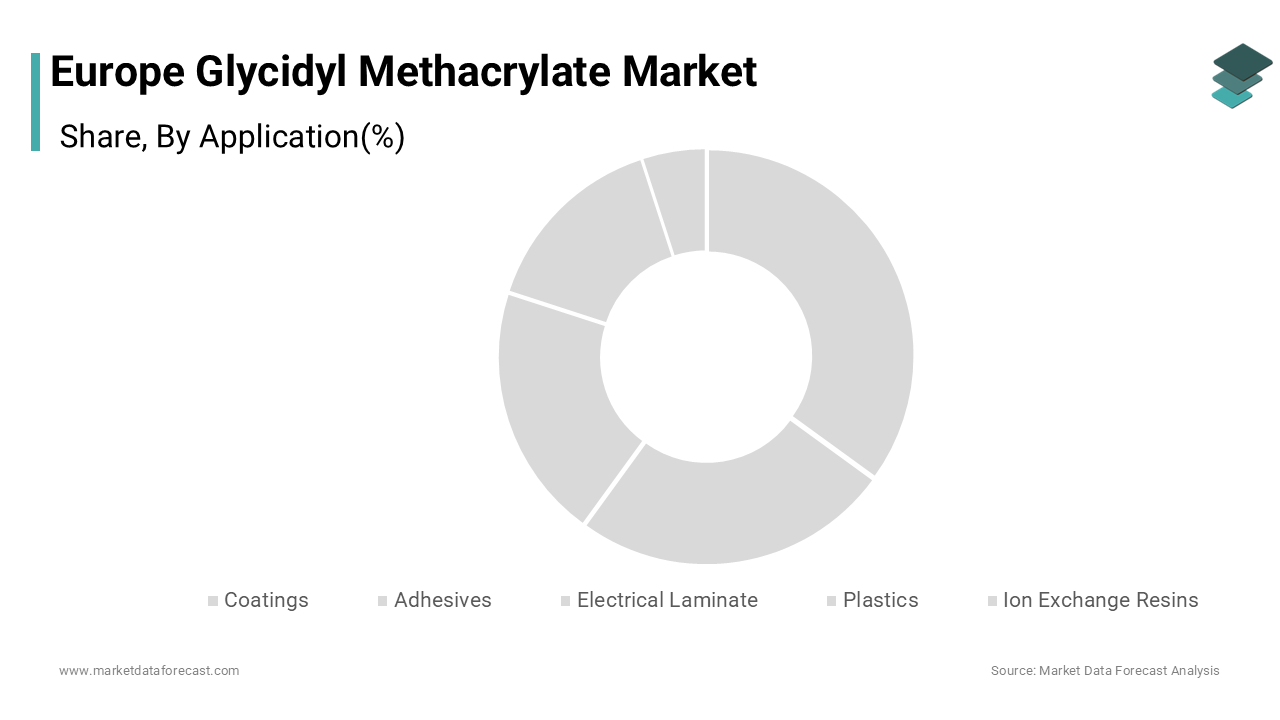
The Ion Exchange Resins segment is projected to expand at a CAGR of 9.4% from 2025 to 2033. Ion exchange resins functionalized with glycidyl methacrylate are advanced water purification systems mandated under the EU’s Urban Wastewater Treatment Directive. According to the European Environment Agency, 22 EU member states now require municipal wastewater to undergo tertiary treatment before discharge or reuse, driving demand for high-capacity anion exchange resins. Beyond conventional softening, glycidyl methacrylate modified membranes and resins are enabling next generation electro dialysis systems for critical raw material recovery from industrial brines. According to the European Institute of Innovation and Technology, pilot projects in Sweden and Spain, now use anion exchange membranes grafted with glycidyl methacrylate to extract lithium and cobalt from battery recycling leachates with recovery rates above 90%. Additionally, the Joint Research Centre validated in 2023 that these resins maintain capacity stability over 1,500 regeneration cycles that 30% more than alternatives reducing operational costs.
REGIONAL ANALYSIS
Germany Glycidyl Methacrylate Market Analysis
Germany was the top performer of the Europe glycidyl methacrylate market by capturing 28.3% of share in 2024 with a production hub and primary consumption center for high performance materials. According to the German Chemical Industry Association, over 12,000 metric tons of specialty monomers including glycidyl methacrylate were consumed in 2023 by downstream formulators. The country hosts major production facilities from BASF and Evonik, which supply integrated value chains from monomer to finished resin. Regulatory stringency also drives demand; the German Technical and Scientific Association for Gas and Water mandates glycidyl methacrylate based ion exchange resins for nitrate removal in 90% of municipal treatment plants.
France Glycidyl Methacrylate Market Analysis
France glycidyl methacrylate market growth is expected to have fastest growth opportunities from 2025 to 2033 with the aerospace, dental, and water treatment sectors. According to the survey, over 400 municipal water plants upgraded to advanced tertiary treatment between 2021 and 2023, which is specifying glycidyl methacrylate functionalized resins for perchlorate and pesticide removal. The country is home to leading dental material firms such as Septodont, which uses glycidyl methacrylate in over 80% of its restorative composites. National occupational safety laws require closed handling systems, encouraging large formulators to invest in compliance infrastructure.
United Kingdom Glycidyl Methacrylate Market Analysis
The United Kingdom glycidyl methacrylate market growth is likely to grow with the advanced medical device manufacturing and electronics coating applications. According to the UK Medical Technology Group, over 220 dental and orthopedic implant companies use glycidyl methacrylate-based polymers in their product lines, benefiting from Medicines and Healthcare products Regulatory Agency approvals under ISO 10993. Despite Brexit, the UK retained alignment with EU REACH for high concern substances by ensuring continued regulatory clarity. This focus on high value life sciences and precision electronics sustains consistent demand even amid macroeconomic volatility.
Netherlands Glycidyl Methacrylate Market Analysis
The Netherlands glycidyl methacrylate market growth is likely to grow with the water technology and chemical logistics. According to the Dutch Water Authorities, all 16 regional water boards now mandate ion exchange polishing for drinking water production, with glycidyl methacrylate based resins specified in over 200 treatment plants nationwide. The Port of Rotterdam serves as Europe’s primary chemical import hub, hosting distribution centers for global suppliers like Mitsubishi Chemical and LG Chem by ensuring rapid delivery across the Rhine corridor. Additionally, the Dutch National Institute for Public Health enforces strict monomer residue limits in medical polymers, driving adoption of high conversion formulations.
Italy Glycidyl Methacrylate Market Analysis
Italy glycidyl methacrylate market growth is likely to grow with the automotive refinish, furniture coatings, and dental manufacturing. According to Federchimica, Italy’s chemical association, over 65% of industrial coating producers in the Veneto and Emilia Romagna regions incorporate glycidyl methacrylate to meet VOC limits under the EU Paints Directive. The country produces 1.2 million passenger vehicles annually as per ANFIA by supporting robust demand for high gloss clear coats. Italy is also Europe’s largest dental chair exporter, and companies like Micerium use glycidyl methacrylate in all their light cured composites.
COMPETITIVE LANDSCAPE
The Europe glycidyl methacrylate market exhibits concentrated competition among a few large integrated chemical producers who dominate due to technical expertise regulatory compliance capabilities and global supply networks. Competition is not price driven but centers on purity consistency safety documentation and application support for medical and electronics end uses where performance tolerances are narrow. Smaller regional suppliers struggle to meet the European Chemicals Agency’s stringent authorization requirements for this substance of very high concern, limiting market entry. Differentiation arises through stewardship programs real time quality control and partnerships with downstream innovators in water purification and advanced dentistry. Substitution remains limited due to glycidyl methacrylate’s unique dual functionality, which is reducing competitive pressure from alternative monomers.
KEY MARKET PLAYERS
Some of the companies that are playing a dominating role in the Europe Glycidyl Methacrylate Market include
- BASF SE
- Evonik Industries AG
- Arkema S.A.
- Sartomer
- Wacker Chemie AG
- Solvay S.A.
- Clariant AG
- Allnex Group
- DSM Coating Resins
- Merck KGaA
Top Players in the Europe Glycidyl Methacrylate Market
BASF SE
BASF SE is a leading global chemical manufacturer with integrated production of glycidyl methacrylate at its Ludwigshafen Germany facility, serving high performance applications across Europe and worldwide. The company supplies ultra pure grades for dental composites, advanced coatings, and ion exchange resins, meeting stringent EU REACH and medical device regulations. BASF has strengthened its position by implementing closed loop monomer recovery systems to minimize worker exposure and reduce waste. In recent years, the company expanded its technical service capabilities to support formulators in developing low emission coating systems compliant with EU Paints Directive limits, which is reinforcing its role as a solutions provider beyond raw material supply in the European glycidyl methacrylate market.
Mitsubishi Chemical Corporation
Mitsubishi Chemical Corporation is a major international producer of glycidyl methacrylate with dedicated European distribution and regulatory support operations headquartered in the Netherlands. The company supplies high purity monomer grades tailored for medical, electronics, and water treatment applications across the EU. Mitsubishi Chemical has reinforced its market presence by achieving full compliance with the European Chemicals Agency’s authorization requirements for substances of very high concern. The firm also launched a stewardship program in 2023 providing downstream users with handling training and exposure monitoring kits by enhancing safety and regulatory alignment throughout the European supply chain for glycidyl methacrylate.
LG Chem Ltd
LG Chem Ltd is a global specialty chemicals producer that supplies glycidyl methacrylate to European customers through its distribution partnership network and Rotterdam logistics hub. The company focuses on high consistency grades for dental resins and membrane functionalization, with products certified under ISO 10993 for biocompatibility. LG Chem has strengthened its European position by investing in real time quality analytics at its Asian production sites to ensure batch to batch uniformity required by EU medical device regulations. The company initiated joint development projects with German and Dutch water technology firms to optimize glycidyl methacrylate based resins for nitrate removal, aligning with EU water reuse mandates and expanding its application footprint in the European glycidyl methacrylate market.
Top Strategies Used by the Key Market Participants
Key players in the Europe glycidyl methacrylate market prioritize regulatory compliance through full REACH authorization and rigorous occupational exposure controls to maintain legal market access. They invest in ultra-high purity production technologies to meet medical and electronics grade specifications demanded by dental and semiconductor sectors. Companies provide extensive downstream technical support including formulation guidance exposure monitoring and safety training to retain high value customers. Strategic partnerships with water treatment and automotive refinish formulators enable co development of compliant end use systems. Additionally, manufacturers implement closed transfer and monomer recovery systems to reduce emissions align with EU Industrial Emissions Directive and enhance sustainability credentials in ESG focused procurement decisions.
MARKET SEGMENTATION
This research report on the europe glycidyl methacrylate market has been segmented and sub–segmented into the following categories.
By Application
- Coatings
- Adhesives
- Electrical Laminate
- Plastics
- Ion Exchange Resins
By Country
- UK
- France
- Spain
- Germany
- Italy
- Russia
- Sweden
- Denmark
- Switzerland
- Netherlands
- Turkey
- Czech Republic
- Rest of Europe
Frequently Asked Questions
What is glycidyl methacrylate (GMA)?
Glycidyl methacrylate is a functional methacrylate monomer containing both epoxy and acrylic groups, widely used in polymer modification and specialty chemical applications.
What is driving the growth of the Europe glycidyl methacrylate market?
Market growth is driven by rising demand from coatings, adhesives, plastics, and composites industries across Europe.
Which industries primarily use glycidyl methacrylate in Europe?
Key end-use industries include coatings, adhesives and sealants, automotive, construction, packaging, and electronics.
How is glycidyl methacrylate used in coatings applications?
In coatings, GMA improves adhesion, chemical resistance, crosslinking ability, and overall durability.
What role does GMA play in polymer modification?
GMA is used as a reactive monomer to introduce epoxy functionality into polymers, enhancing compatibility and performance.
How does the adhesives and sealants sector influence market demand?
Growing demand for high-performance and specialty adhesives significantly boosts GMA consumption in Europe.
What are the key trends in the Europe glycidyl methacrylate market?
Key trends include increased use in high-performance polymers, demand for lightweight materials, and development of low-VOC formulations.
What challenges are faced by the Europe glycidyl methacrylate market?
Major challenges include raw material price volatility, regulatory compliance costs, and handling safety concerns.
Which European countries are major contributors to the market?
Germany, France, the United Kingdom, Italy, and the Netherlands are key contributors due to strong industrial and chemical sectors.
What is the future outlook for the Europe glycidyl methacrylate market?
The market is expected to grow steadily, supported by innovation, expanding industrial applications, and demand for high-performance materials.
Access the study in MULTIPLE FORMATS
Purchase options starting from
$ 2000
Didn’t find what you’re looking for?
TALK TO OUR ANALYST TEAM
Need something within your budget?
NO WORRIES! WE GOT YOU COVERED!
Call us on: +1 888 702 9696 (U.S Toll Free)
Write to us: sales@marketdataforecast.com