- Product Description Description
- Table of Contents TOC
- List of Table & Figure LOT
- Get Free Sample PDF Sample PDF
Market Size, 2025
$1.39 BnMarket Estimate, 2026
$1.62 BnMarket Forecast, 2034
$5.60 BnCAGR, 2026–2034
16.76%Europe GPS Tracker Market Size, Growth, Trends & Forecast (2026–2034)
The Europe GPS tracker market size was calculated at USD 1.39 billion in 2025, is anticipated to reach USD 1.62 billion in 2026, and is projected to reach USD 5.60 billion by 2034, registering a compound annual growth rate (CAGR) of 16.76% during the forecast period from 2026 to 2034. Driven by mandatory commercial transport regulations, aging demographics boosting personal safety tracking, and ongoing digital transformation across municipal infrastructure, the European market continues to grow rapidly despite strict data privacy and compliance hurdles.
Key Executive Metrics (At-a-Glance)
- 2025 Base Valuation: USD 1.39 Billion
- 2026 Current Valuation: USD 1.62 Billion
- 2034 Forecast Valuation: USD 5.60 Billion
- Compound Annual Growth Rate (CAGR): 16.76% (2026–2034)
- Dominant Type Segment: Standalone Trackers (holding a significant share in 2025)
- Fastest-Growing Type Segment: OBD Devices (projected with the fastest CAGR of 12.8% throughout the forecast period)
- Dominant Component Segment: Hardware (holding 58.3% of the market share in 2025)
- Fastest-Growing Component Segment: Services (projected to grow at a CAGR of 14.3% throughout the forecast period)
- Regional Highlights: Germany dominated the market by capturing a 39.2% share in 2025, followed by the United Kingdom with 25.4%.
Core Market Drivers
- Mandatory Commercial Regulations: EU digital tachograph and mobility rules making GNSS-based tracking non-optional for commercial transport fleets.
- Aging Demographics: Increasing demand for personal tracking solutions supporting elderly care and dementia management programs.
- Smart City Integration: Urban mobility frameworks and green logistics mandates accelerating telematics deployment across municipal infrastructure.
Primary Market Restraints & Challenges
- Strict GDPR Compliance: Stringent data privacy laws and legal precedents limiting continuous employee or personal location monitoring.
- Rural Coverage Gaps: Persistent cellular connectivity blackouts in mountainous, cross-border, and rural zones compromising real-time asset tracking.
- Cybersecurity & Fragmentation: Rising location spoofing attacks alongside unaligned country-level type approvals for regulated industries.
Europe GPS Tracker Market Segmentation Breakdown
| Segment Category | Largest Segment in 2025/2026 | Fastest Growing Segment / Growth Rate |
|---|---|---|
| By Type | Standalone Trackers | OBD Devices (12.8% CAGR) |
| By Component | Hardware (58.3% share in 2025) | Services (14.3% CAGR) |
| By Region | Germany (39.2% share in 2025) | United Kingdom, France & Italy (Driven by telematics and safety regulations) |
Major Industry Players Profiled
Key prominent companies operating in the Europe GPS tracker market include Teltonika, Queclink Wireless Solutions, Trackimo, CalAmp, Orbcomm, Ruptela, Meitrack, Concox (Jimi IoT), TomTom Telematics, Verizon Connect, Sierra Wireless, Geotab, and Xirgo Technologies.
Europe GPS Tracker Market Size
The Europe GPS tracker market size was calculated at USD 1.39 billion in 2025 and is anticipated to reach USD 5.60 billion by 2034, from USD 1.62 billion in 2026, growing at a CAGR of 16.76% during the forecast period.
GPS trackers in Europe are specialized electronic devices that utilize global navigation satellite systems to determine and transmit real-time location data for people, vehicles, assets, and wildlife. These devices operate across cellular, satellite, or hybrid connectivity platforms and serve critical functions in logistics, personal safety, fleet management, and regulatory compliance. The European market is distinguished by its advanced digital infrastructure, stringent data privacy laws, and high adoption of telematics in both public and private sectors. According to the European GNSS Agency, over 95% of new commercial vehicles registered in the EU in 2023 were equipped with GNSS-based tracking systems, largely driven by the European Mobility Package and tachograph regulations. Additionally, as per Eurostat, more than 42 million people aged 65 and above reside in the EU, creating a growing demand for personal GPS trackers in elderly care and dementia management programs. The European Commission’s Digital Europe Programme has also allocated significant funding to enhance geospatial data ecosystems, indirectly supporting tracker accuracy and integration. This integration of regulatory mandates, demographic shifts, and digital transformation positions GPS tracking as an essential component of Europe’s smart mobility and safety infrastructure.
MARKET DRIVERS
Mandatory EU Regulations for Commercial Vehicle Tracking Drive Adoption
The European Union’s enforcement of digital tachograph and mobility regulations has made GPS tracking non-optional for commercial fleets is propelling the growth of the Europe GPS tracker market. As per Regulation EU 2021 1228, all new heavy goods vehicles over 3.5 tonnes registered after August 2023 must be equipped with smart tachographs that integrate GNSS to record location at border crossings and during driving breaks. Additionally, the Mobility Package mandates that transport companies digitally log all vehicle movements to prevent social dumping and ensure compliance with driving time rules. National authorities in Germany, France, and the Netherlands conduct routine roadside checks using handheld devices that read tachograph data, which is making non-compliance both legally and financially risky.
Rising Concern for Elderly and Vulnerable Population Safety Fuels Personal Tracker Use
The aging population and growing awareness of cognitive health conditions have significantly increased demand for personal GPS trackers designed for elderly and vulnerable individuals. According to Eurostat, the share of Europeans aged 65 and over reached 21.3% in 2023 and is projected to exceed 30% by 2050. Concurrently, the European Dementia Observatory reported that over 9.2 million people in the EU live with dementia, with wandering behavior occurring in approximately 60% of cases. In response, national health systems are integrating GPS trackers into care protocols. Similarly, Germany’s statutory health insurers now reimburse up to 120 euros annually for approved tracking devices under long-term care plans. As public health policies increasingly emphasize independent living and caregiver support, personal GPS tracking is transitioning from a niche assistive tool to a mainstream welfare technology across the continent.
MARKET RESTRAINTS
Stringent GDPR Compliance Requirements Increase Implementation Complexity
The General Data Protection Regulation imposes strict limitations on the collection, processing, and storage of location data by creating significant legal and technical hurdles for the deployment is restricting the growth of the Europe GPS tracker market. In 2023, the French data authority CNIL fined a logistics company 250000 euros for tracking employee vehicles without clear contractual disclosure, setting a precedent for workforce monitoring cases. Similarly, the German Federal Court of Justice ruled that continuous GPS tracking of company cars constitutes an invasion of privacy unless justified by specific security or operational needs. These legal interpretations compel businesses to implement granular privacy controls such as anonymization time time-limited tracking, and user accessible dashboard features that increase device cost and integration time. Startups and small fleet operators often lack legal resources to navigate this landscape, leading to delayed adoption or reliance on non-compliant low-cost solutions.
Limited Cellular Coverage in Rural and Cross Border Regions Hinders Device Reliability
The persistent gaps in cellular connectivity in mountainous rural and cross-border areas that compromise the real-time functionality of mainstream GPS trackers that rely on GSM or LTE networks are also degrading the growth of the Europe GPS tracker market. According to the European Electronic Communications Authority, 18% of the EU’s landmass still lacks consistent 4G coverage, with countries like Romania, Greece, and parts of Sweden experiencing frequent signal dropouts. This is critical for applications such as livestock tracking in the Carpathians or freight monitoring through the Alps, where location updates may be delayed by hours. Even in Western Europe, the 2023 EU Cross Border Connectivity Report noted that 22 major transport corridors suffer from network handover failures between national operators, causing temporary tracker disconnections. While satellite-enabled trackers offer a solution, they cost three to five times more than cellular models and require separate subscriptions.
MARKET OPPORTUNITIES
Integration of GPS Trackers into Smart City and Urban Mobility Frameworks
European cities are increasingly embedding GPS tracking into broader smart urban ecosystems to enhance traffic management, public safety, and shared mobility services. This is likely to pose new opportunities for the growth of the Europe GPS tracker market. As per the European Commission’s Urban Mobility Framework, over 80 cities, including Barcelona, Copenhagen, and Vienna, have launched integrated mobility platforms that aggregate anonymized GPS data from buses, scooters, and delivery vehicles to optimize traffic flow and reduce congestion. Similarly, the EU-funded HARMONY project deployed GPS-enabled sensors on micro mobility fleets across six cities to study last-mile travel patterns and inform infrastructure planning. These initiatives are supported by the Digital Europe Programme, which allocated 180 million euros in 2023 to urban geospatial data infrastructure.
Expansion of Asset Tracking in Renewable Energy and Circular Economy Sectors
The growth of green infrastructure and circular economy for specialized GPS trackers on high-value mobile assets is also escalating the growth of the Europe GPS tracker market. In the wind energy sector, over 20000 turbine components, including blades and transformers, are transported annually across the EU on specialized trailers requiring real-time condition and location monitoring. Simultaneously, the EU Battery Regulation mandates full traceability of electric vehicle batteries from production to recycling, prompting companies like Northvolt and ACC to install GPS-enabled IoT tags on battery shipments. As per the European Environment Agency, over 24 million end-of-life lithium-ion batteries will enter the recycling stream by 2030.
MARKET CHALLENGES
Intensifying Cybersecurity Threats Targeting Location Data Systems
The attractive targets for cyberattacks that exploit location data for theft, fraud, or espionage a challenging the growth of the Europe GPS tracker market. According to the European Union Agency for Cybersecurity, incidents involving telematics system breaches rose by 47% in 2023, with one major logistics provider in Belgium losing real-time visibility of 300 refrigerated trucks during a ransomware attack. Attackers increasingly use GPS spoofing to manipulate location data, which can redirect high-value shipments or disable geofence alerts. Most consumer and SME grade trackers lack end-to-end encryption or secure boot mechanisms, making them vulnerable to firmware tampering. While the EU Cyber Resilience Act will mandate baseline security for connected devices from 2027, current devices remain exposed.
Fragmented National Approvals for Cross-Border Tracker Deployment
The absence of a unified EU certification framework for GPS trackers used in regulated sectors such as transport and healthcare is also expected to degrade the growth of the Europe GPS tracker market. While CE marking covers general electronics compliance, specific applications require country-level approvals. For instance, Germany’s Federal Motor Transport Authority mandates additional type approval for trackers used in tachograph systems, while France’s ANFR requires radio frequency certification for all trackers operating on national bands. According to the European Logistics Association, a single fleet operating in five EU countries must undergo up to seven separate compliance procedures, adding 8 to 12 weeks to rollout timelines. The European Commission’s 2023 report on digital product harmonization acknowledged this fragmentation as a barrier to scaling IoT solutions.
REPORT COVERAGE
| REPORT METRIC | DETAILS |
| Market Size Available | 2025 to 2034 |
| Base Year | 2025 |
| Forecast Period | 2026 to 2034 |
| CAGR | 16.76% |
| Segments Covered | By Type, Component, and Region |
| Various Analyses Covered | Global, Regional & Country Level Analysis; Segment-Level Analysis; DROC, PESTLE Analysis; Porter’s Five Forces Analysis; Competitive Landscape; Analyst Overview of Investment Opportunities |
| Regions Covered | UK, France, Spain, Germany, Italy, Russia, Sweden, Denmark, Switzerland, Netherlands, Turkey, and the Czech Republic |
| Market Leaders Profiled | Teltonika, Queclink Wireless Solutions, Trackimo, CalAmp, Orbcomm, Ruptela, Meitrack, Concox (Jimi IoT), TomTom Telematics, Verizon Connect, Sierra Wireless, Geotab, Xirgo Technologies |
SEGMENTAL ANALYSIS
By Type Insights
The standalone segment held a significant share of the Europe GPS tracker market in 2025. These self-contained devices are powered by internal batteries and operate independently of vehicle systems, which are widely deployed across logistics, personal safety, asset tracking, and wildlife monitoring due to their flexibility and ease of installation. Their universal applicability across non-vehicle assets is significantly promoting the growth of the segment. In the healthcare sector, the UK’s National Health Service distributed more than 45000 standalone GPS wristbands to dementia patients in 2023 by leveraging their portability and long battery life, which often exceeded 30 days in power-saving mode.
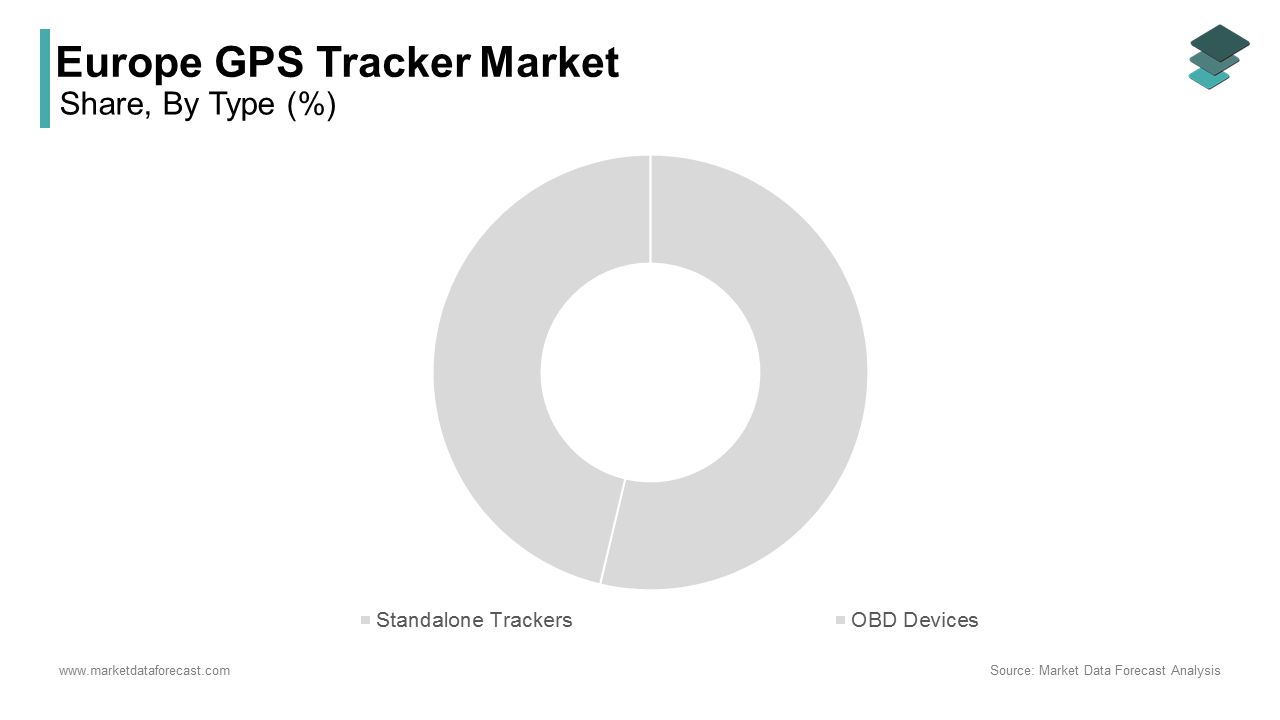
The OBD segment is likely to grow with an expected fastest CAGR of 12.8% throughout the forecast period. As per the European Insurance and Occupational Pensions Authority, over 3.2 million European vehicles were enrolled in UBI programs in 2023, with insurers like Allianz and AXA using OBD trackers to monitor acceleration, braking, and mileage for premium personalization. The EU’s Roadworthiness Directive which encourages real-time vehicle health monitoring. This integration of safety, compliance, and cost efficiency positions OBD devices as the growth engine of the market.
By Component Insights
The hardware segment held 58.3% of the Europe GPS tracker market share in 2025, owing to the scale of regulatory-driven deployments. The European Commission mandates that all new heavy goods vehicles over 3.5 tonnes registered after August 2023 must include GNSS-capable tachographs, directly translating into hardware demand. According to the European Road Safety Observatory, this regulation affects over 500000 new trucks annually, each requiring certified tracking modules. Similarly, national initiatives like Sweden’s “Safe Elderly” program distribute tens of thousands of GPS wristbands each year, all hardware-intensive. Most standalone trackers have a functional lifespan of 3 to 5 years before battery degradation or network sunsetting, such as 2G/3G shutdowns, which necessitate upgrades. This continuous hardware refresh, combined with new regulatory and demographic demands, sustains the segment’s leadership despite rising software value.
The services segment is projected to grow at a CAGR of 14.3% throughout the forecast period. The demand for predictive insights in logistics and fleet management. Companies no longer seek just location data but actionable intelligence, such as route efficiency scores, idling cost analysis, and maintenance alerts. As per a 2025 study by the International Transport Forum, European fleets using advanced analytics services reduced fuel consumption by 15% and CO2 emissions by 12% annually. Providers like Geotab and Webfleet offer tiered subscription models that bundle hardware with real-time dashboards, driving recurring revenue. The rise of managed personal safety services is enhancing the growth of the Europe GPS tracker market. In the UK and Germany, public health agencies contract third parties to operate 24/7 monitoring centers for dementia patients wearing GPS trackers.
REGIONAL ANALYSIS
Germany GPS Tracker Market Analysis
Germany was the top performer of the Europe GPS tracker market by capturing 39.2% of the share in 2025, with its advanced logistics infrastructure, stringent transport regulations, and strong industrial base. The country is home to over 85000 freight carriers that must comply with EU tachograph rules mandating GNSS tracking in all new commercial vehicles. Additionally, Germany’s statutory health insurance funds reimburse GPS trackers for dementia patients under long-term care plans by creating steady demand in the personal safety segment.
United Kingdom GPS Tracker Market Analysis
The United Kingdom GPS tracker market was positioned second by capturing 25.4% of share in 2025, owing to high adoption in personal safety and insurance telematics. The National Health Service’s nationwide rollout of GPS wristbands for dementia patients distributed over 45000 units in 2023. Moreover, London’s congestion and ultra-low emission zones rely on GNSS data for compliance verification, indirectly boosting tracker relevance.
France GPS Tracker Market Analysis
France's GPS tracker market growth is likely to be propelled by its centralized regulatory enforcement and public sector adoption. The French Ministry of Ecological Transition mandates GPS tracking for all freight vehicles over 3.5 tonnes operating in urban logistics zones to monitor emissions and compliance with low-emission zones. Additionally, France’s National Agency for Medicines and Health Products Safety approved GPS trackers as Class I medical devices for cognitive care by enabling reimbursement through social security. The country’s strong data protection stance, enforced by CNIL, which also drives demand for GDPR compliant tracking platforms with local data hosting.
Italy GPS Tracker Market Analysis
Italy's GPS tracker market growth is likely to be driven by the usage-based insurance and agricultural asset tracking. Italy’s insurance regulator, 28% of all new auto policies in 2023 were usage-based, the highest in the EU, with insurers requiring OBD trackers to assess driving behavior. Southern regions like Sicily and Puglia have seen rapid adoption due to EU rural development funds supporting smart farming. Additionally, Italian cities like Milan and Turin enforce strict low-emission zone rules that rely on GNSS data for enforcement. This dual demand from insurance and agriculture ensures Italy’s continued relevance in both consumer and industrial tracking segments.
COMPETITION OVERVIEW
Competition in the Europe GPS tracker market is defined by a mix of specialized telematics providers, global navigation companies, and consumer electronics firms. The market features high regulatory barriers due to GDPR digital tachograph rules and radio equipment directives, which favor established players with compliance expertise. TomTom Webfleet and Trackimo lead through differentiated positioning, fleet compliance, personal safety, and cross-border reliability, respectively. Hardware competition is increasingly secondary to software and service differentiation as customers seek predictive analytics and managed monitoring. Cybersecurity, data sovereignty, and network compatibility are critical purchase criteria.
KEY MARKET PLAYERS
A few major players of the Europe GPS tracker market include
- Teltonika
- Queclink Wireless Solutions
- Trackimo
- CalAmp
- Orbcomm
- Ruptela
- Meitrack
- Concox (Jimi IoT)
- TomTom Telematics
- Verizon Connect
- Sierra Wireless
- Geotab
- Xirgo Technologies
Top Strategies Used by the Key Market Participants
Key players in the Europe GPS tracker market prioritize regulatory alignment by integrating EU mobility and data privacy requirements into hardware and software design. They invest in secure cloud infrastructure with local data residency to ensure GDPR compliance. Companies develop hybrid connectivity solutions using NB IoT and LTE-M to address rural coverage gaps. Strategic partnerships with vehicle manufacturers, insurers, and public agencies enable embedded and service-based deployments. Additionally, they expand analytics capabilities to transform raw location data into actionable insights for sustainability, safety, and operational efficiency.
Leading Players in the Market
TomTom International B.V.
TomTom International B.V. is a Netherlands-based global leader in geolocation technology with deep integration into the Europe GPS tracker market through its fleet management and telematics solutions. The company provides hardware-enabled tracking devices and cloud-based software platforms used by logistics firms, public transport operators, and emergency services across the continent. TomTom leverages its proprietary HD Maps and real-time traffic data to enhance route optimization and compliance reporting. In recent years, the company has strengthened its position by launching GDPR compliant tracking services with EU-based data centers and expanding its partnership network with vehicle manufacturers for embedded telematics. These initiatives reinforce TomTom’s role as a trusted provider of accurate and legally sound location intelligence in one of the world’s most regulated markets.
Webfleet Solutions B.V.
Webfleet Solutions B.V., a subsidiary of Bridgestone, operates as a major telematics provider in Europe, offering integrated GPS tracking hardware, software, and analytics for commercial fleets. The company serves over 55000 business customers across the U.S., enabling real-time vehicle monitoring, driver behavior analysis, and maintenance scheduling. Webfleet actively aligns its platform with European mobility regulations, including digital tachograph integration and CO2 reporting in compliance with the EU Green Deal. Recently, the company enhanced its OBD and standalone tracker portfolio with NB IoT connectivity to support long battery life and rural coverage.
Trackimo LLC
Trackimo LLC maintains a strong foothold in the European GPS tracker market through its focus on personal and asset tracking for consumers and small enterprises. The company offers compact standalone GPS devices with global cellular coverage, real-time geofencing, and emergency alert features widely used for elderly care, pet tracking, and high-value asset monitoring. Trackimo has tailored its European offerings to meet GDPR and CE certification requirements, including localized data handling and multilingual support.
MARKET SEGMENTATION
This research report on the Europe GPS tracker market has been segmented and sub-segmented based on type, component, and region.
By Type
- Standalone Trackers
- OBD Devices
By Component
- Hardware
- Software
- Services
By Region
- UK
- France
- Spain
- Germany
- Italy
- Russia
- Sweden
- Denmark
- Switzerland
- Netherlands
- Turkey
- Czech Republic
- Rest of Europe