- Product Description Description
- Table of Contents TOC
- List of Table & Figure LOT
- Get Free Sample PDF Sample PDF
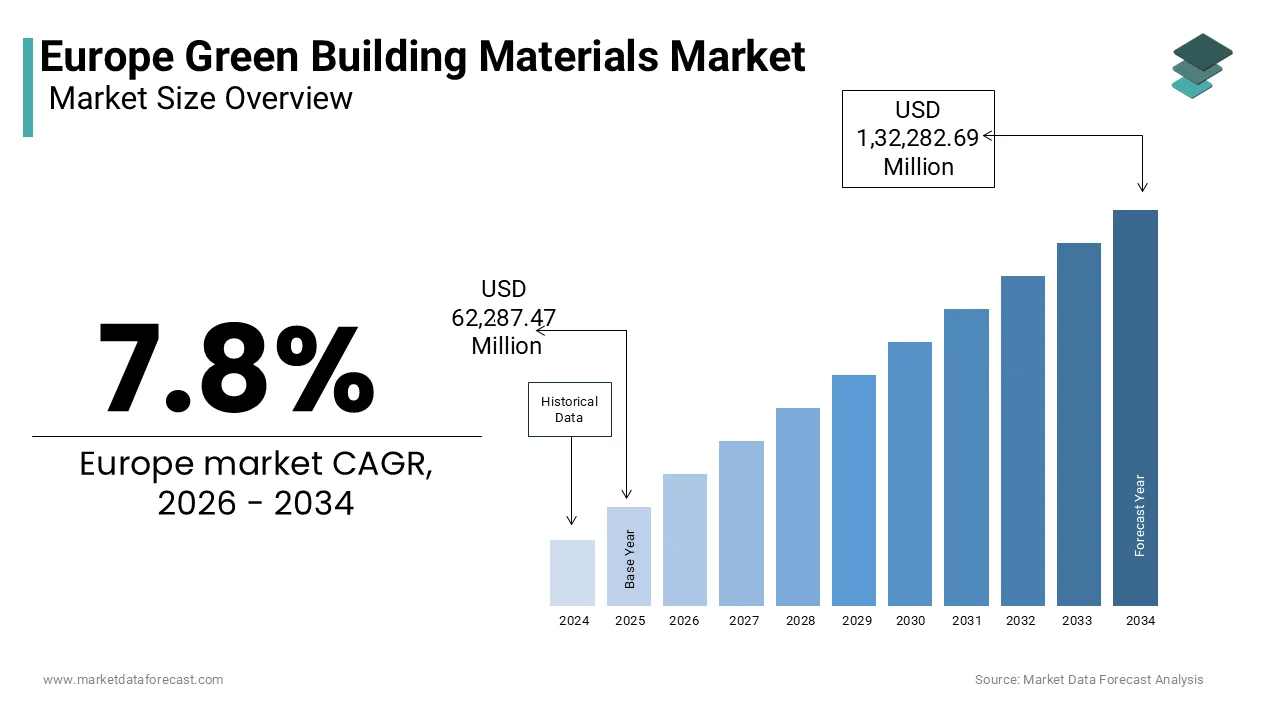
Market Size, 2025
$62,287.47 MnMarket Estimate, 2026
$72,535.89 MnMarket Forecast, 2034
$1,32,282.69 MnCAGR, 2026–2034
7.8%Executive Summary: Europe Green Building Materials Market
- Market Scope: Comprehensive regional green building materials market analysis covering material components, application sectors, country-specific leadership frameworks, and key strategic developments.
- Market Valuation: Valued at USD 62,287.47 million (2025), estimated at USD 72,535.89 million (2026), and projected to reach USD 132,282.69 million by 2034, registering a robust CAGR of 7.8% (2026–2034).
- Primary Growth Drivers: Enforcement of EU climate directives (such as the Energy Performance of Buildings Directive mandating zero-emission status for new buildings by 2030 and CSRD disclosure rules), alongside the Renovation Wave Strategy. Opportunities include low-carbon product decarbonization, circular economy integration, and digital EPD transparency.
Key Market Segment Metrics (2026–2034)
| Category | Leading Segment (2025 Position) | Fastest-Growing Segment |
|---|---|---|
| By Material Type | Cement segment (held 37.4% share in 2025 due to foundational construction demand and clinker substitution) | Bricks segment (predicted to witness the highest CAGR of 10.4% from 2026 to 2034) |
| By Application Sector | Residential application segment (led with 49.5% share in 2025, driven by housing stock energy retrofits) | Industrial segment (expected to register the fastest CAGR of 12.7% due to corporate ESG and logistics accountability) |
| By Region / Country | Germany (dominated regional market with a 21.8% share in 2025 under the Building Energy Act) | European territories prioritizing accelerated net-zero corporate procurement frameworks |
Major Market Players & Market Structure
Market Structure: Highly competitive European sustainable construction materials landscape featuring major chemical, insulation, and cement corporations competing intensely on product decarbonization, recycled binders, and circular manufacturing loops.
Key Companies: BASF SE, Saint-Gobain S.A., Kingspan Group plc, Sika AG, Holcim Ltd., Heidelberg Materials AG, Interface, Inc., Owens Corning, PPG Industries, Inc., DuPont de Nemours, Inc., CEMEX S.A.B. de C.V., Forbo Holding AG, Rockwool International A/S, Armstrong World Industries, Inc., Knauf Gips KG, The Dow Chemical Company, Tata Steel Europe Ltd., CRH plc, Compagnie de Saint-Gobain, and Velux Group.
 Download Free Sample Report
Europe Green Building Materials Market Size
The europe Green Building Materials Market was valued at USD 62,287.47 million in 2025, is estimated to reach USD 72,535.89 million in 2026, and is projected to reach USD 1,32,282.69 million by 2034, growing at a CAGR of 7.8% from 2026 to 2034.
Green building materials are products engineered to minimize environmental impact across their lifecycle from resource extraction and manufacturing to installation, use, and end of life while enhancing energy efficiency, indoor air quality, and occupant well-being. These include insulation from recycled cellulose, low-carbon cement alternatives, sustainably sourced timber, photovoltaic-integrated façades, and bio-based composites. According to the European Environment Agency, the European construction sector accounts for about 40% of total energy consumption and 36% of greenhouse gas emissions, which is making material decarbonization imperative. The Energy Performance of Buildings Directive mandates that all new public buildings be nearly zero-energy from 2021, with all new buildings required to meet this standard by 2030. According to Eurostat, more than 70% of the EU’s building stock was constructed before 1990, which is resulting in poor thermal performance and high operational emissions. According to the United Nations Economic Commission for Europe, Europe’s urban population is projected to reach around 80% by 2050, which is intensifying pressure for sustainable densification. The green building materials are transitioning from niche specifications to a baseline requirement in Europe’s built environment transformation due to the climate policy, circular economy ambitions, and evolving occupant expectations.
MARKET DRIVERS
Stringent EU Climate and Building Regulations as Primary Adoption Catalyst
The comprehensive regulatory architecture of the European Union serves as the foremost driver propelling demand for green building materials and propels the European green building materials market. Central to this is the revised Energy Performance of Buildings Directive, which requires all new buildings to achieve nearly zero energy status by 2030 and mandates deep energy retrofits for the worst-performing existing buildings by 2033. According to the European Commission, the Energy Performance of Buildings framework is expected to impact more than 35 million buildings across the EU. The EU Taxonomy Regulation classifies certain construction activities as environmentally sustainable only if they use materials with verified low embodied carbon, defined as less than 400 kilograms of CO₂ equivalent per square meter of floor area for new non-residential buildings. Furthermore, the Construction Products Regulation is being revised to make environmental performance declarations mandatory for all CE-marked products by 2027. According to France’s Ministry of Ecological Transition, the RE2020 environmental regulation has already increased demand for low-carbon building materials such as wood frame systems and hemp-lime insulation in new residential projects. Germany’s Building Energy Act also limits the carbon intensity of heating systems, which is indirectly boosting demand for high-performance insulation and thermal mass materials. These binding legal frameworks are transforming green materials from optional upgrades into compliance requirements, fundamentally reshaping procurement decisions across both public and private construction.
Corporate Net Zero Commitments and Green Procurement Policies
The corporate sustainability strategies are significantly amplifying demand for green building materials across Europe, which is further boosting the expansion of the European green building materials market. According to the European Corporate Sustainability Reporting Directive, more than 50,000 companies in the EU are now required to disclose environmental impacts, including embodied carbon within their real estate portfolios, which is creating direct pressure to specify low-impact materials. Major developers and occupiers such as Unibail-Rodamco-Westfield and Siemens have committed to achieving net-zero operational and embodied emissions across all assets by 2040 or earlier. This translates into stringent green procurement criteria; for example, IKEA’s People and Planet Positive strategy requires all new stores and distribution centers to achieve BREEAM Outstanding certification, which mandates the use of certified sustainable timber and recycled-content steel. According to the World Green Building Council’s Europe Regional Network, nearly 80% of large European real estate investors now integrate life cycle assessment into their investment decisions. Institutional investors managing more than €30 trillion under the Net Zero Asset Managers initiative also demand climate-aligned construction practices. In the Netherlands, ABN AMRO’s Green Construction Loan offers reduced interest rates for projects using at least 30% circular or bio-based materials. These market-driven forces create premium demand channels that reward innovation and transparency, accelerating the commercial viability of next-generation green building products beyond minimum regulatory compliance.
MARKET RESTRAINTS
Higher Initial Costs and Limited Cost Competitiveness
The elevated upfront cost relative to conventional alternatives that deters price-sensitive developers and public agencies operating under tight budget constraints is further impeding the growth of the European green building materials market. According to the European Commission’s Joint Research Centre, low-carbon construction materials such as recycled aggregate concrete and bio-based insulation typically cost more than conventional alternatives due to higher processing and certification expenses. These materials can carry a notable price premium, which makes adoption challenging for cost-sensitive projects. For mass housing developments where operating margins are often in the single digits, according to the European Federation for Living, such differentials can render green options financially difficult without government support. According to the European Court of Auditors, many public procurement processes across the EU still prioritize the lowest upfront cost rather than lifecycle sustainability metrics, despite existing green public procurement guidelines. Furthermore, as per the European Commission’s Level(s) framework monitoring report, lifecycle costing remains limited across the construction sector, which is restricting full value recognition of long-term energy savings and durability. Until economies of scale and fiscal incentives such as reduced VAT or accelerated depreciation close the cost gap, market penetration of green materials will remain constrained, particularly in Southern and Eastern Europe, where budgets are tighter.
Fragmented Standards and Lack of Harmonized Verification
The absence of unified and enforceable standards for defining and verifying the environmental attributes of green building materials creates confusion and undermines trust among specifiers and regulators is further hindering the growth of the green building materials market in Europe. While Environmental Product Declarations exist under EN 15804, their use is voluntary in most member states, and methodologies vary significantly in system boundaries and allocation rules. According to the European Committee for Standardization, less than half of all construction product categories currently have harmonized Product Category Rules (PCRs) for Environmental Product Declarations (EPDs), which is leading to inconsistent carbon footprint calculations. Additionally, terms such as “bio-based,” “circular,” or “low-carbon” lack formal legal definitions under EU law, which enables misleading or unverified marketing claims. According to a 2025 investigation by the European Consumer Organisation (BEUC), around one-third of green building product labels across five EU countries lacked third-party verification. This fragmentation complicates compliance with emerging regulations like the EU Taxonomy and discourages cross-border trade. According to Construction Products Europe, manufacturers face redundant testing and certification costs averaging about €50,000 per product per country, which is hindering SME participation. Without mandatory harmonized rules for environmental claims and material passports, the market risks greenwashing, reduced investor confidence, and slower innovation diffusion, particularly for novel materials such as mycelium composites or carbon-curing concrete.
MARKET OPPORTUNITIES
Retrofitting the Aging Building Stock as a Massive Growth Vector
The vast and inefficient existing building stock of Europe is a significant opportunity for the European green building materials market. According to Eurostat, around one-third of buildings in the European Union were constructed before 1960 and generally exhibit much lower energy efficiency compared to modern standards. The EU’s Renovation Wave Strategy aims to at least double current renovation rates to around 4% annually and ensure that millions of buildings undergo energy upgrades by 2030. This is translating into large-scale demand for high-performance insulation, low-emissivity glazing, and bio-based interior materials. According to Germany’s development bank KfW, national retrofit programs offer grants covering a substantial share of project costs for those meeting Efficiency House standards, which is boosting demand for advanced insulation solutions such as wood fiber panels. In France, theMaPrimeRénov’ scheme disbursed billions of euros in 2023 to support hundreds of thousands of renovation projects, with eligibility criteria that favor recycled and renewable material use. The revised Energy Performance of Buildings Directive mandates that all renovations affecting more than 25% of a building’s envelope must meet minimum energy performance thresholds, which is a legally compelling material upgrade. As cities such as Amsterdam and Copenhagen phase out fossil fuel-based heating in existing buildings by 2030, the demand for integrated green material solutions is expected to surge across residential and commercial segments.
Circular Economy Integration and Material Passports
The Circular Economy Action Plan of the European Union is unlocking new commercial pathways for green building materials by mandating design for deconstruction and reuse. Starting in 2025, the revised Construction Products Regulation will require digital material passports for all large infrastructure and public buildings, detailing composition, recyclability, and hazardous substance content. According to the European Commission, this initiative could increase the reuse rate of construction materials from the current level of around 5% to more than 25% by 2035. According to Saint-Gobain, its Circular Solutions Hub in France already recovers and reprocesses roughly 1.2 million tonnes of gypsum annually into new plasterboards containing up to 70% recycled content. Similarly, Dutch company StoneCycling transforms construction waste into bio-based bricks used in projects such as the Amsterdam Circular Pavilion. Public procurement is also accelerating adoption. According to the Dutch government, all new government buildings must now incorporate at least 30% reused or recycled materials. According to the Ellen MacArthur Foundation, circular design in the construction sector could generate about €200 billion in annual material savings across Europe by 2030. This systemic shift transforms waste streams into resource reservoirs, creating stable demand for certified secondary raw materials and incentivizing modular, disassemblable product design, which is positioning circular green materials at the core of Europe’s resource-resilient built environment.
MARKET CHALLENGES
Technical Complexity and Skills Gap in Installation
The lack of skilled labor capable of proper installation and integration is one of the potential challenges to the growth of the European green building materials market. Many high-performance products, such as airtight membrane systems, structural insulated panels, or photocatalytic ffaçadess require specialized training and precision execution to deliver promised benefits. According to the European Construction Industry Federation, more than 70% of construction firms across the EU report difficulties in recruiting workers with skills in sustainable building techniques. According to Cedefop’s 2023 assessment, fewer than 20% of EU apprenticeship programs currently include modules on bio-based materials or circular construction principles. According to the Karlsruhe Institute of Technology, around 40% of energy underperformance in retrofitted buildings can be attributed to issues such as incorrect insulation installation or thermal bridging caused by inadequate workmanship. Manufacturers often have to provide on-site training themselves, which is slowing project timelines and increasing costs. According to Eurofound, informal labor still accounts for over 30% of total construction employment in parts of Eastern Europe, which is making standardization and quality control even more difficult. Without urgent investment in upskilling through national green construction academies and mandatory certification for installers, the efficacy and reputation of green materials will remain compromised despite technological advancement.
Supply Chain Volatility and Raw Material Scarcity
The reliability of supply chains for critical raw materials underpinning green building products is emerging as a strategic vulnerability across Europe, which is further challenging the expansion of the European market. According to the European Forest Institute, the EU imports more than 40% of its softwood from outside the bloc, which is exposing supply chains for bio-based materials such as cross-laminated timber to geopolitical and climate-related disruptions. At the same time, demand for industrial by-products like fly ash and slag is declining as a result of coal phase-outs and the growing adoption of electric arc furnaces in steelmaking. According to Eurostat, the availability of fly ash across Western Europe has fallen sharply since 2020, which is forcing cement producers to explore alternative binders. According to the European Raw Materials Alliance, over 90% of the global supply of rare earth elements used in smart glazing and phase change materials originates from China, which is creating concentration risks. Furthermore, competition for biomass feedstocks is intensifying between the construction, energy, and packaging sectors. According to a 2025 assessment by the Joint Research Centre, uncoordinated expansion of bio-based construction could strain land use and biodiversity if not managed under strict sustainability criteria. Until Europe develops diversified, resilient, and circular material supply chains anchored in regional resource loops, green building innovation will remain constrained by input insecurity and price volatility.
REPORT COVERAGE
| REPORT METRIC | DETAILS |
| Market Size Available | 2025 to 2034 |
| Base Year | 2025 |
| Forecast Period | 2026 to 2034 |
| Segments Covered | By Type, Application, and Region. |
| Various Analyses Covered | Global, Regional, and Country-Level Analysis, Segment-Level Analysis, Drivers, Restraints, Opportunities, Challenges; PESTLE Analysis; Porter’s Five Forces Analysis, Competitive Landscape, Analyst Overview of Investment Opportunities |
| Countries Covered | UK, France, Spain, Germany, Italy, Russia, Sweden, Denmark, Switzerland, Netherlands, Turkey, Czech Republic, Rest of Europe |
| Market Leaders Profiled | BASF SE, Saint-Gobain S.A., Kingspan Group plc, Sika AG, Holcim Ltd., Heidelberg Materials AG, Interface, Inc., Owens Corning, PPG Industries, Inc., DuPont de Nemours, Inc., CEMEX S.A.B. de C.V., Forbo Holding AG, Rockwool International A/S, Armstrong World Industries, Inc., Knauf Gips KG, The Dow Chemical Company, Tata Steel Europe Ltd., CRH plc, Compagnie de Saint-Gobain, Velux Group. |
SEGMENTAL ANALYSIS
By Type Insights
The cement segment captured 37.4% of the European green building materials market in 2025. The dominance of the cement segment is driven by the cement’s foundational role in construction and the sector’s aggressive decarbonization push under EU climate mandates. The regulatory pressure to reduce embodied carbon is further boosting the expansion of the cement segment in the European market. The EU Emissions Trading System now covers process emissions from cement production, and the Carbon Border Adjustment Mechanism penalizes high-carbon imports. According to the Global Cement and Concrete Association, European cement plants reduced CO₂ emissions per tonne by about 23% between 1990 and 2022 through measures such as fuel switching and clinker substitution. In response to decarbonization goals, European producers have accelerated the adoption of alternative binders with 50% lower CO₂ footprints using calcined clay and limestone filler. Additionally, public infrastructure procurement increasingly mandates low-carbon concrete; France’s Environmental Regulation 2020 requires life-cycle assessment for all public projects, which is directly boosting demand for eco-cements. According to Eurostat, the EU consumes more than 300 million tonnes of concrete annually, meaning that even small shifts toward greener formulations translate into massive material volumes, which is cementing this segment’s leadership in Europe’s green construction transition.
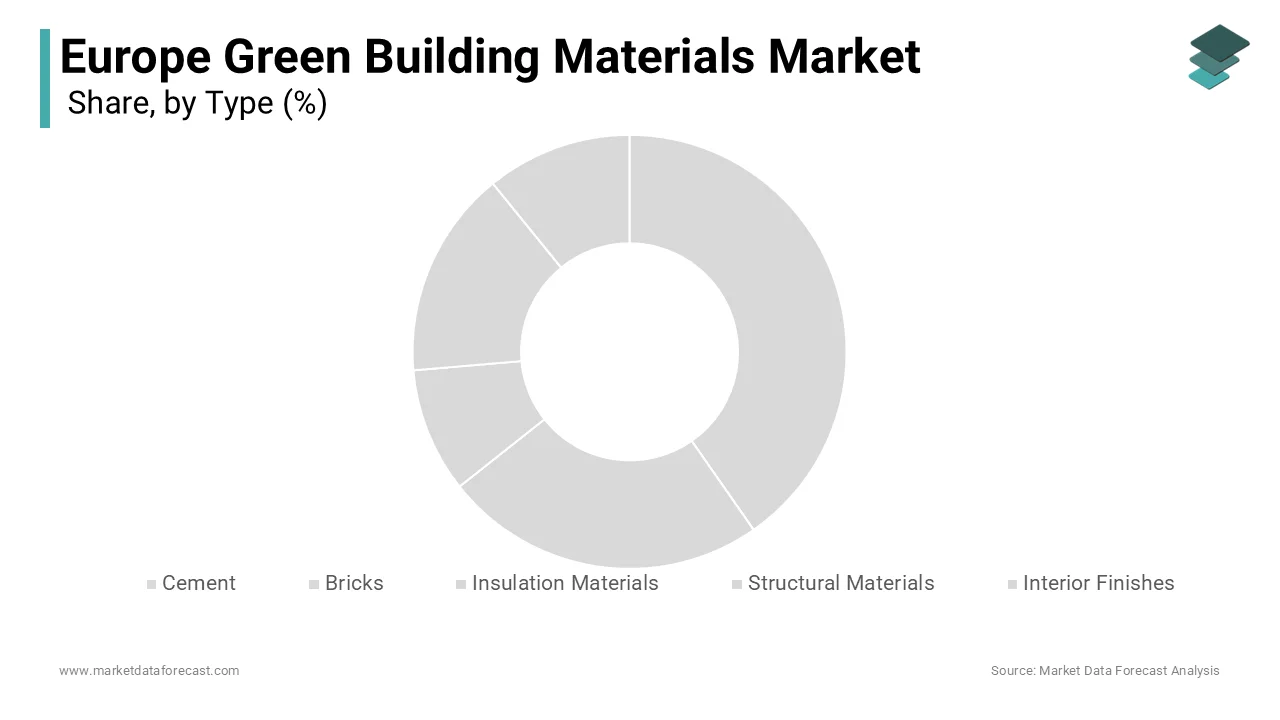
The bricks segment is predicted to witness a CAGR of 10.4% over the forecast period in the European green building materials market, owing to technological innovation and policy alignment favoring durable, low-carbon masonry. According to a 2021 MDPI study, fired clay bricks incorporating up to 30% recycled content from construction waste or industrial by-products such as fly ash can reduce firing energy requirements by around 15%. Denmark’s Building Regulations now grant density bonuses for projects using bricks with Environmental Product Declarations demonstrating low embodied carbon, which is creating direct economic incentives. Moreover, bricks are increasingly specified in deep retrofits due to their thermal mass properties, which stabilize indoor temperatures. As per the Copernicus Climate Change Service, sustained warming trends in Europe since the late 19th century. According to Wienerberger, companies like Wienerberger and Terreal are commercializing bio-based insulation-integrated brick systems that achieve U-values below 0.15 W/m²K. As urban densification and heritage-sensitive renovations rise, the aesthetic durability and circularity of modern green bricks drive exceptional growth for the segment in the European market.
By Application Insights
The residential segment occupied 49.5% of the European green building materials market share in 2025, owing to the scale of housing stock and targeted policy interventions. According to the European Environment Agency, over 70% of buildings in the EU are residential, and around 60% were constructed before 1980 with limited or no insulation, which creates vast potential for energy-efficient retrofits. The EU Renovation Wave specifically prioritizes single- and multi-family homes, aiming to renovate millions of dwellings by 2030. According to Germany’s KfW, the Efficiency House program supported more than 100,000 residential retrofits in 2023, which required the use of certified green insulation and high-efficiency windows. According to a 2025 Eurobarometer survey, 68% of European homeowners consider energy efficiency and material sustainability important when undertaking renovations. According to Eurostat, household electricity prices in the EU rose by about 45% between 2021 and 2023, which is intensifying consumer demand for thermal upgrades. With social housing providers such as France’s Action Logement and the UK’s Homes England mandating Passivhaus or equivalent standards for new builds, the residential segment remains the primary engine of green material adoption across Europe.
The industrial segment is expected to witness a CAGR of 12.7% over the forecast period in the European market, owing to corporate climate accountability and the need for operational decarbonization in logistics and manufacturing facilities. According to the European Commission, under the Corporate Sustainability Reporting Directive (CSRD), more than 10,000 industrial firms in the EU are now required to disclose Scope 3 emissions, including those associated with facility construction and maintenance. As a result, major logistics players such as Amazon and DHL are mandating that all new European warehouses meet at least BREEAM Very Good or LEED Gold certification, which requires the use of low-carbon structural materials and photovoltaic roofing. According to Prologis, its European developments now incorporate around 50% recycled steel and low-embodied-carbon concrete, which is reducing project-related emissions by approximately 35%. The EU Taxonomy further classifies industrial construction as sustainable only when materials have verified environmental performance, which directly influences investor preferences. According to the European Free Trade Association, green industrial park developments in Sweden and the Netherlands experienced a significant increase in tenant demand in 2023, driven by ESG compliance advantages. As industrial real estate becomes a key front for corporate net-zero implementation, demand for advanced green materials in this segment is accelerating rapidly.
COUNTRY LEVEL ANALYSIS
Germany Green Building Materials Market Analysis
Germany dominated the green building materials market in Europe by holding 21.8% of the regional market share in 2025. The dominance of Germany in the European market is attributed to its robust regulatory framework and industrial capacity. Germany’s Building Energy Act mandates progressively stricter carbon limits for new and renovated buildings, which effectively bans fossil fuel heating systems from 2025. According to Germany’s Federal Ministry for Economic Affairs and Climate Action, more than 500,000 residential and commercial retrofits were completed in 2023 under the KfW Efficiency House program, which is driving strong demand for wood fiber insulation, recycled steel, and low-carbon concrete. According to the Umweltbundesamt (German Environment Agency), the construction sector accounts for about 14% of the nation’s total greenhouse gas emissions, which is intensifying pressure for material decarbonization. According to Heidelberg Materials, the company has achieved roughly a 28% reduction in CO₂ emissions per tonne of cement since 2010 through clinker substitution and process efficiency improvements. Additionally, Germany’s Circular Economy Strategy mandates a 70% construction waste recovery rate by 2030, a target already being approached through advanced sorting and recycling infrastructure. With strong public investment and industrial innovation, Germany’s integrated policy–industry framework continues to secure its leading position in sustainable construction materials.
France Green Building Materials Market Analysis
France held the second-largest share of the European market in 2025, and the growth of the French market is primarily attributed to its pioneering regulatory mandates and public procurement leverage. According to France’s Ministry of Ecological Transition, the Environmental Regulation 2020 (RE2020) is the first in Europe to require whole-life carbon assessment for all new buildings, setting maximum thresholds of around 650 kg CO₂ equivalent per square meter for residential projects. This framework has driven a sharp rise in demand for bio-sourced materials such as hemp-lime and cross-laminated timber. Public infrastructure projects, which account for roughly one-third of non-residential construction, must now comply with Green Public Procurement criteria mandating minimum recycled content and Environmental Product Declarations (EPDs). According to the French government, the France Relance recovery plan allocated €6.7 billion to building renovation in 2023, including bonuses for projects using locally sourced green materials. According to Saint-Gobain, over 60% of its French sales now involve certified sustainable products. With Paris hosting the 2025 Olympics and committing to 100% low-carbon venues, France’s combination of regulatory rigor and fiscal support continues to reinforce its strong leadership in sustainable construction.
United Kingdom Green Building Materials Market Analysis
The United Kingdom is a promising market for green building materials in Europe and is expected to hold a notable share of the regional market during the forecast period. According to the UK Department for Levelling Up, Housing and Communities, the Future Homes Standard will prohibit new homes from connecting to the gas grid and require 75–80% lower CO₂ emissions compared to 2013 standards. This policy shift has already driven increased specification of aerogel insulation and low-carbon masonry across 2023 housing starts. According to the UK Green Building Council, its Advancing Net Zero program includes more than 400 signatory firms such as Barratt Developments and Skanska UK, all committed to achieving net-zero whole-life carbon by 2050. Additionally, the British Standards Institution introduced PAS 2080 in 2023, the world’s first specification for carbon management in infrastructure, which mandates green material sourcing. Despite leaving the EU, the UK continues to align with the Level(s) and EPD frameworks, ensuring continuity with European sustainability standards. With strong NGO advocacy and sustained investor pressure, the UK remains a dynamic hub for green building innovation and carbon-conscious construction practices.
Netherlands Green Building Materials Market Analysis
The Netherlands is predicted to showcase a prominent CAGR in the European green building materials market during the forecast period. According to the Dutch Ministry of Infrastructure and Water Management, the national Green Deal Circular Construction mandates that all public buildings must incorporate at least 30% circular materials by 2025, increasing to 50% by 2030. The ministry reports that more than 200 pilot projects demonstrate scalable reuse of concrete, steel, and glass. According to the Netherlands Enterprise Agency, about 95% of construction and demolition waste in the Netherlands is already recycled, with companies such as StoneCycling transforming rubble into bio-based bricks used in municipal housing projects. The BENG standards require all new buildings to meet strict energy and material performance thresholds, which favors the use of low-embodied-carbon products. Major developers such as Heijmans and VolkerWessels maintain digital material passport databases to facilitate component recovery and reuse. With cities such as Amsterdam and Rotterdam enforcing circular procurement clauses for all tenders above €5 million, the Netherlands’ systemic commitment to closed-loop construction continues to reinforce its leadership in sustainable building practices.
Sweden Green Building Materials Market Analysis
Sweden is projected to register a healthy CAGR in the European green building materials market during the forecast period, d owing to its legally binding target of net zero emissions by 2045 and leadership in bio-based construction. According to the Swedish Environmental Protection Agency, the construction sector accounts for about 11% of Sweden’s total greenhouse gas emissions, which is prompting an accelerated shift toward low-carbon materials. Over 40% of new multi-story buildings in the country now use cross-laminated timber frames, a transition made possible by revised fire safety codes introduced in 2022. According to the Swedish Forest Industries Federation, domestic production of engineered wood products increased by roughly 18% in 2023 to meet rising demand. The Swedish Green Building Council’s Miljöbyggnad certification is mandatory for all public projects, which requires a life-cycle assessment and minimum renewable material content. Stockholm’s Royal Seaport development mandates that all buildings use materials with climate declarations showing less than 300 kg CO₂ per square meter. Additionally, Sweden’s carbon tax makes fossil-intensive materials economically uncompetitive. With abundant sustainably managed forests and strong policy alignment, Sweden stands as a leading example of how climate ambition drives green material innovation.
COMPETITIVE LANDSCAPE
Competition in the European green building materials market is intensifying as traditional material producers and specialized green innovators converge under regulatory and market pressures. Incumbents like Saint Gobain and Heidelberg Materials leverage scale and vertical integration to retrofit legacy operations with circular and low-carbon technologyshile agile startups introduce novel bio-based or carbon negative solutions. The competitive landscape is less defined by price and more by compliance readiness, transparency, and lifecycle performance. Certification systems such as BREEAM, LEED, and Level(s) create de facto technical benchmarks that influence procurement decisions across public and private sectors. Companies differentiate through verified environmental data, robust supply chain traceability, and participation in policy-shaping bodies. Barriers to entry remain moderate due to capital intensity and certification costs, yet innovation thrives in niche segments like mycelium insulation or self-healing concrete. Overall, competition drives the rapid standardization of sustainability metrics and accelerates the mainstream adoption of green materials across Europe’s built environment.
KEY MARKET PLAYERS
Some of the companies that are playing a dominating role in the global European green building materials market include
- BASF SE
- Saint-Gobain S.A.
- Kingspan Group plc
- Sika AG
- Holcim Ltd.
- Heidelberg Materials AG
- Interface, Inc.
- Owens Corning
- PPG Industries, Inc.
- DuPont de Nemours, Inc.
- CEMEX S.A.B. de C.V.
- Forbo Holding AG
- Rockwool International A/S
- Armstrong World Industries, Inc.
- Knauf Gips KG
- The Dow Chemical Company
- Tata Steel Europe Ltd.
- CRH plc
- Compagnie de Saint-Gobain
- Velux Group
TOP LEADING PLAYERS IN THE MARKET
- Saint-Gobain is a pivotal force in the European green building materials market, offering a comprehensive portfolio of energy-efficient insulation, glass, and gypsum solutions aligned with circular economy principles. The company actively contributes to global sustainability by advancing low-carbon product innovation, such as its ISOVER recycled content insulation and Placo plasterboards with up to 90 percent secondary raw materials. In 2023 Saint Saint-Gobain launched its Carbon Neutral by 2050 roadmap, accelerating decarbonization across its European manufacturing sites through electrification and biomass energy. It partners with developers on BREEAM LEED-certified projects across France, Germany, and the UK, and supports policy development through the European Construction Products Association. These initiatives reinforce its role as a global sustainability enabler in built environment decarbonization.
- Heidelberg Materials drives the transition to tolow-carbonn construction in Europe through its pioneering range of ECOPact green concretes and andlow-emissionn cements. The company integrates circular principles by utilizing alternative binders like calcined clay and recycled aggregate, significantly reducing embodied carbon. Globally, Heidelberg Materials contributes to climate goals by supplying green concrete for landmark sustainable infrastructure projects from Berlin to Singapore. In 202,3, it commissioned Europe’s first full-scale carbon capture plant at its Brevik facility in Norway and expanded its green concrete availability to over 15 European countries. Collaborations with academic institutions and participation in EU-funded initiatives like CLEANKER underscore its commitment to scalable decarbonization and technological leadership in the global construction materials sector.
- Wienerberger shapes Europe’s sustainable built environment through its range of energy-efficient clay and concrete building products, including Porotherm bricks and Koramic roof tiles with high recycled content. The company champions circularity by recovering construction waste and integrating it into new production cycles across its European plants. On the global stage, Wienerberger advances green building standards through its membership in the World Green Building Council and by exporting low-carbon masonry systems to emerging markets. In 2025, Wierberger launched its Net Zero Roadmap, ap climate-neutral operations by 2039 and introduced a digital material passport for its brick system,,s enabling reuse and traceability. These actions position it as a key innovator in durable low-impact construction solutions worldwide.
TOP STRATEGIES USED BY THE KEY MARKET PARTICIPANTS
Leading companies in the European green building materials market deploy four principal strategies to secure a competitive advantage. First, they invest heavily in product decarbonization by reformulating materials with recycled content, contented in, putsa alternative low-emission binders. Second, Second, adopt digital transparency too,l,s including Environmental Product Declarations and material passports to meet evolving regulatory and procurement demands. They form strategic alliances with developers, architects, and policymakers to co-develop certified sustainable buildings and influence green building cccodethey expand circular production models by integrating construction and demolition waste back into manufacturing loops supported by reverse logistics and sorting infrastructure. These strategies collectively enhance compliance credibility and customer value while future-proofing operations against tightening EU climate regulations.
MARKET SEGMENTATION
This research report on the europe green building materials market is segmented and sub-segmented into the following categories.
By Type
- Cement
- Bricks
- Insulation Materials
- Structural Materials
- Interior Finishes
- Others
By Application
- Residential
- Commercial
- Industrial
- Others
By Country
- Germany
- France
- United Kingdom
- Netherlands
- Sweden
- Rest of Europe