- Product Description Description
- Table of Contents TOC
- List of Table & Figure LOT
- Get Free Sample PDF Sample PDF
Market Size, 2025
$11.10 BnMarket Estimate, 2026
$12.09 BnMarket Forecast, 2034
$23.91 BnCAGR, 2026–2034
8.9%Europe Greenhouse Equipment Market Size, Share, Trends & Forecast (2026–2034)
- Market Scope: In-depth regional evaluation of Europe’s controlled environment agriculture (CEA) equipment sector, analyzing core infrastructure categories (heating, cooling, irrigation, automation), structural frameworks (glass vs. plastic), crop outputs (fruits, vegetables, nursery, ornamentals), and country-specific adoption trends.
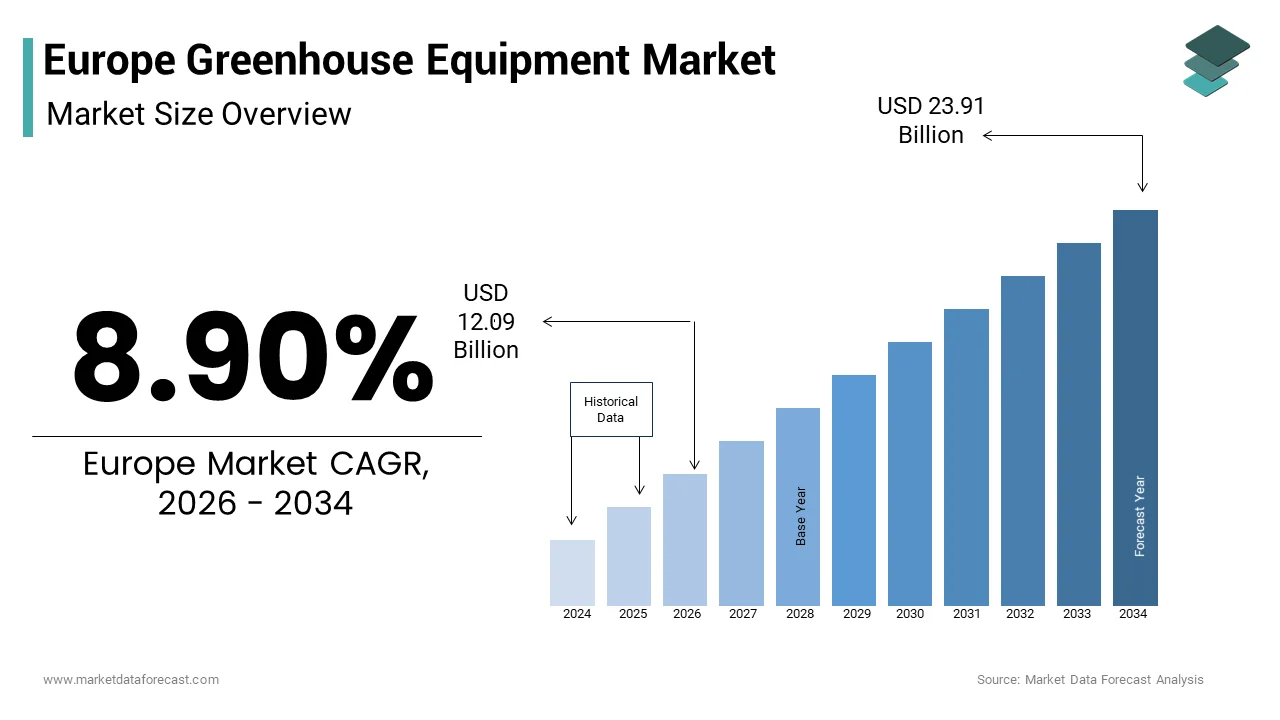
- Market Valuation: Valued at USD 11.10 billion in 2025, estimated at USD 12.09 billion in 2026, and projected to reach USD 23.91 billion by 2034, growing at a compound annual growth rate (CAGR) of 8.9% during the forecast period from 2026 to 2034.
- Primary Growth Drivers: Aggressive EU sustainability policies (Farm to Fork Strategy, decarbonization targets), rising consumer demand for year-round locally sourced fresh produce, and the imperative to mitigate climate volatility and energy price shocks.
Europe Greenhouse Equipment Market Segment Metrics (2026–2034)
| Category | Leading Segment / Baseline Position | Fastest-Growing Segment |
|---|---|---|
| By Equipment | Heating Systems (held 41.4% share in 2025, essential for 6–8 months of annual cold-weather thermal regulation across Northern/Central Europe) | Cooling Systems (projected at a 10.2% CAGR, driven by record summer heatwaves and heat stress prevention in Southern/Central Europe) |
| By Greenhouse Type | Plastic Greenhouses (accounted for 55.8% share, dominating lower-cost structural footprints and extensive high-turnover yield production like in Almería, Spain) | Glass Greenhouses (advancing at an 8.12% CAGR, propelled by high-tech capital investments for advanced year-round production in Northern/Western Europe) |
| By Crop Type | Fruits & Vegetables (commanded the highest share in 2024, anchoring institutional supply chains, retail demands, and high-value export markets) | Nursery Crops (growing at an 8.08% CAGR, fueled by urban greening mandates, municipal biodiversity strategies, and landscaping demand) |
| By Country | The Netherlands (led regionally with 25.5% share in 2024, anchored by world-class yields, automated glass complexes, and public-private innovation hubs) | France, Germany & Italy (registering robust growth trajectories backed by national resilience funding, agritech modernization, and local food sovereignty plans) |
Major Industry Players & Market Structure
Market Structure: Moderately concentrated landscape combining Dutch/German technological leadership in precision digital automation with cost-effective Southern European structural solutions, heavily shaped by EU compliance and sustainability criteria.
Key Companies: Priva BV, Ridder Group, Ceres Greenhouse Solutions, Richel Group SA, Argus Control Systems Ltd, Certhon, Logiqs B.V, Lumigrow, Inc, Agra Tech, Inc, Rough Brothers, Inc, Nexus Corporation, Hort Americas LLC, and Heliospectra AB.
Europe Greenhouse Equipment Market Size
The European greenhouse equipment market was valued at USD 11.10 billion in 2025 and is anticipated to reach USD 12.09 billion in 2026 to reach USD 23.91 billion by 2034, growing at a CAGR of 8.9% during the forecast period from 2026 to 2034.
Greenhouse equipment is a specialized ecosystem of climate control systems, irrigation and fertigation technologies, lighting solutions, structural components, and automation tools designed to optimize plant growth in controlled agricultural environments. These systems enable year-round cultivation of high-value crops such as tomatoes, cucumbers, leafy greens, and berries while mitigating risks associated with unpredictable weather and seasonal limitations. In Europe, greenhouse farming is not merely an agronomic practice but a strategic response to food security, land use efficiency, and environmental sustainability mandates. According to Eurostat, nearly 200,000 hectares of protected cultivation area were under glass or plastic cover across the European Union in 2024, with the Netherlands, Spain, and Italy accounting for a significant share of this footprint. For instance, most modern greenhouses in Europe now operate with advanced automation systems, including climate and irrigation controls, which reflects a strong trend toward digital integration in controlled environment agriculture. Driven by the EU’s Farm to Fork Strategy and national decarbonization targets, the European greenhouse equipment market is rapidly evolving toward energy-efficient closed-loop systems that reduce water consumption and chemical inputs while maximizing yield per square meter.
MARKET DRIVERS
EU Policy Push for Sustainable and Local Food Production
The aggressive policy framework of the European Union, favoring local, resilient, and low-impact food systems, serves as a primary driver for the greenhouse equipment market growth in Europe. The Farm to Fork Strategy explicitly targets a 25% reduction in nutrient loss and a 50% cut in pesticide use by 2030 as goals that controlled environment agriculture is uniquely positioned to achieve. According to the European Commission, a majority of new greenhouse projects funded under the Common Agricultural Policy since 2022 include integrated pest management and precision irrigation components. National schemes further amplify this trend as the Netherlands’ Greenhouse Horticulture Sustainability Program allocated significant funding in 2024 to support energy screen installations and geothermal heating retrofits. Similarly, France’s Plan de Relance provided grants covering a substantial share of capital costs for greenhouses equipped with rainwater harvesting and solar thermal systems. For instance, most tomato and pepper growers in the Netherlands now operate in greenhouses with fully automated climate and nutrient dosing systems. This regulatory and financial tailwind transforms greenhouse equipment from a productivity tool into a compliance enabler, accelerating modernization across the sector.
Rising Consumer Demand for Year-Round Locally Grown Produce.
European consumers are increasingly prioritizing freshness, traceability, and reduced food miles, driving consistent demand for locally grown greenhouse vegetables and herbs, which is further boosting the greenhouse equipment market expansion in Europe. According to a 2024 survey, a majority of shoppers in Germany, Fran,ce, and the Benelux region prefer greenhouse-grown tomatoes over imported field-grown alternatives, which is citing superior taste and lower environmental impact. Retailers have responded by expanding shelf space for locally sourced greenhouse produce. Tesco and Carrefour now label a significant share of their fresh vegetable lines with origin and growing method. This market pull incentivizes farmers to invest in advanced equipment that ensures consistent quality and supply regardless of season. As per the data from the Spanish Ministry of Agriculture, greenhouse vegetable exports from Almería grew notably in 2024 despite global trade headwinds due to premium positioning as EU-grown under controlled conditions.” Moreover, the rise of urban vertical farms in cities like Berlin and Copenhagen further validates consumer willingness to pay for hyperlocal production. This sustained demand signal provides economic justification for capital expenditure on climate screens, energy curtains, and CO2 enrichment systems.
MARKET RESTRAINTS
High Initial Investment and Energy Costs
The substantial capital outlay required for modern greenhouse infrastructure remains a significant restraint to widespread adoption, particularly among small and medium-sized farms in Southern and Eastern Europe. A fully automated glass greenhouse with heating, cooling, and fertigation systems typically costs between 250 and 400 euros per square meter. For a typical five-hectare facility, this translates to upfront investments exceeding 12 million euros. Compounding this burden are steep energy expenses, as natural gas for heating alone has been reported to account for up to 40% of operational costs in Dutch greenhouses. Although subsidies exist, they often cover only 20 to 30% of total costs and require complex application processes. For instance, in Italy, a majority of growers in regions such as Sicily and Puglia cite financing barriers as the main obstacle to upgrading from low-tech plastic tunnels. Without access to affordable capital or stable energy pricing, many producers remain locked in inefficient legacy systems, limiting the market’s expansion potential.
Fragmented Regulatory Standards Across Member States
The absence of harmonized technical and environmental regulations for greenhouse operations across European Union member states creates uncertainty and compliance complexity that hinders equipment standardization and cross-border investment, which further hinders the regional market growth. While the Netherlands mandates real-time monitoring of nutrient discharge and energy use, Spain permits less stringent water recycling protocols, and Poland has minimal requirements for thermal insulation in new greenhouses. Discrepancies in building codes, electrical safety, and water reuse rules can increase equipment customization costs for multinational suppliers. Dutch greenhouse exporters often face lengthy delays resolving regulatory mismatches when establishing operations in other EU countries. Furthermore, the lack of EU-wide certification for energy-efficient greenhouse components delays the adoption of innovations like phase change materials or hybrid solar thermal collectors. This regulatory fragmentation slows technology diffusion and discourages scalable business models in the equipment sector.
MARKET OPPORTUNITIES
Integration of Renewable Energy and Closed Loop Systems
The convergence of greenhouse technology with renewable energy and circular resource models presents a high-value opportunity across Europe for this regional market. Solar photovoltaic integration, geothermal heating, and biomass boilers are increasingly paired with climate control systems to reduce reliance on fossil fuels. In the Netherlands and Denmark, hundreds of greenhouses now operate on near-net-zero energy models using geothermal wells and excess heat from data centers. Similarly, closed-loop irrigation systems that capture, recirculate, and disinfect drainage water are gaining traction under EU water efficiency mandates. According to reports, water use in advanced greenhouses has decreased significantly since 2015, primarily due to the adoption of sensor-based drip fertigation and rainwater harvesting. Companies like Priva and Ridder are responding with integrated platforms that manage energy, water, and climate from a single dashboard. As carbon pricing mechanisms expand under the EU Emissions Trading System, these synergies will transform greenhouses from energy consumers into resource-positive assets, which is creating new revenue streams through carbon credits and grid balancing services.
Expansion of Urban and Vertical Farming Using Greenhouse Derived Technologies
The rapid growth of urban agriculture and vertical farming in European cities is opening a new frontier for the greenhouse equipment market in Europe. While structurally distinct, these controlled environment agriculture systems rely heavily on greenhouse-derived technologies, including LED lighting, climate control algorithms, and nutrient delivery systems. By the end of 2024, more than 200 commercial vertical farms will be operational in EU cities, with a majority sourcing core environmental control hardware from traditional greenhouse suppliers. Cities such as Berlin, Paris, and Stockholm have introduced zoning incentives that mandate integration of food production in new real estate developments, further stimulating demand. A pilot project in Copenhagen demonstrated that retrofitting rooftop greenhouses on public buildings reduced municipal vegetable imports while lowering building cooling loads. Moreover, urban farms increasingly adopt semi-automated greenhouse management software originally designed for rural operations. This cross-pollination allows equipment vendors to diversify beyond traditional horticulture into high-density urban food systems supported by municipal sustainability budgets and circular economy grants.
MARKET CHALLENGES
Vulnerability Climate-Induced Energy Price Volatility
Despite technological advances, European greenhouse operators remain acutely vulnerable to energy price fluctuations driven by climate policy, geopolitical instability, and extreme weather events. During the 2022 energy crisis, natural gas prices in the EU spiked by over 300%, which is forcing many Dutch and Belgian growers to reduce heating or shut down operations in the winter months. According to Eurostat, greenhouse horticulture accounted for around 2% of total EU natural gas consumption in 2023, which makes it disproportionately sensitive to market shocks. Although energy screens and thermal screens can reduce heating demand by up to 30%, complete decoupling from fossil fuels remains elusive for most. Risk assessments have warned that prolonged cold spells combined with high electricity prices could disrupt tomato and cucumber supplies in the coming years. This structural dependency undermines long-term investment security and discourages expansion in energy-intensive regions unless accompanied by robust grid-scale renewable guarantees or state-backed price stabilization mechanisms.
Shortage of Skilled Labor for Advanced System Operation
The increasing sophistication of greenhouse equipment has outpaced the availability of skilled labor capable of operating and maintaining integrated climate, nutrient, and data systems, which is further challenging the expansion of the greenhouse equipment market in Europe. Fewer than 30% of agricultural education programs in Southern Europe include modules on automation or digital horticulture. In Germany and the Netherlands, where technology adoption is highest, labor shortages are acute. Many greenhouse operators report difficulty hiring technicians proficient in PLC controls, sensor calibration, and data analytics. This gap leads to suboptimal system utilization, increased downtime, and overreliance on vendor support contracts. Moreover, the generational shift away from farming means fewer young workers possess both agronomic knowledge and digital literacy. Without targeted upskilling initiatives through EU Skills Partnership or Erasmus programs, the full potential of advanced greenhouse equipment will remain unrealized, which is limiting productivity gains and return on investment across the sector.
REPORT COVERAGE
| REPORT METRIC | DETAILS |
| Market Size Available | 2025 to 2034 |
| Base Year | 2025 |
| Forecast Period | 2026 to 2034 |
| CAGR | 8.9% |
| Segments Covered | By Equipment, Greenhouse, Crop Type, And Region |
| Various Analyses Covered | Global, Regional, andCountry-Levell Analysis; Segment-Level Analysis; DROC; PESTLE Analysis; Porter’s Five Forces Analysis; Competitive Landscape; Analyst Overview of Investment Opportunities |
| Regions Covered | Sudan, Egypt, Kenya, Ethiopia, South Africa, Rest of Africa |
| Market Leaders Profiled | Richel Group SA, Argus Control Systems Ltd, Certhon, Logiqs B.V, Lumigrow, Inc, Agra Tech, Inc, Rough Brothers, Inc, Nexus Corporation, Hort Americas, LLC, Heliospectra AB. |
SEGMENTAL ANALYSIS
By Equipment Insights
The heating systems segment occupied the largest share of 41.4% of the European greenhouse equipment market in 2025, owing to the continent’s temperate to cold climate and the year-round production mandate for high-value crops. In Northern and Central Europe, greenhouse operations require consistent heating for 6 to 8 months annually to maintain optimal growing temperatures. Over 65% of commercial greenhouses in Germany, the Netherlands, and Belgium rely on natural gas-fired boilers, with growing adoption of geothermal and biomass alternatives. Heating accounts for up to 70% of total energy consumption in winter-operated greenhouses, which is making it the single largest operational cost center. Consequently, investment in high-efficiency systems such as condensing boilers, thermal screens, and heat recovery units is prioritized. The Dutch Greenhouse Horticulture Sector recorded a reduction of nearly 30% in specific gas consumption per kilogram of tomato between 2018 and 2024 through integrated heating upgrades. This energy intensity, ty combined with the EU decarbonization pressure, is propelling the domination of the heating systems segment in the European market.
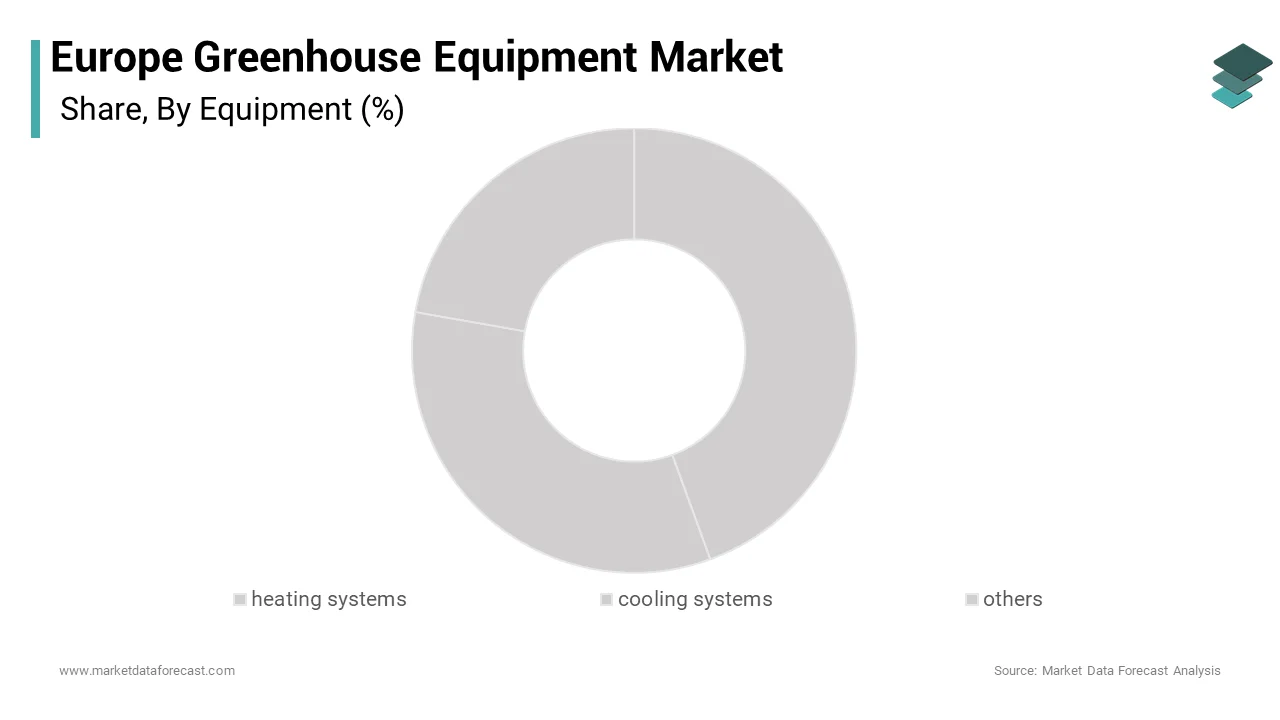
The cooling systems segment is the fastest growing segment in the Europe greenhouse equipment market with a projected CAGR of 10.2% over the forecast period, owing to the rising summer temperatures and increased frequency of heatwaves across Southern and Central Europe that threaten crop viability and yield stability. According to the Copernicus Climate Change Service, the summer of 2024 was the hottest on record in Europe with average temperatures 1.54 degrees Celsius above the 1991–2020 baseline, leading to widespread heat stress in unprotected crops. In response, growers are adopting evaporative cooling pads and fan systems, which include fogging nozzles and retractable shade screens at unprecedented rates. For instance, over half of new greenhouse constructions in Almería since 2023 include active cooling infrastructure compared to just 20% in 2019. Additionally, the EU’s Climate Adaptation Strategy now incentivizes thermal resilience upgrades through CAP eco schemes. As climate volatility intensifies, cooling transitions from a luxury to a necessity and boosts the expansion of the cooling systems segment in the European market.
By Greenhouse Insights
The plastic greenhouses segment dominated the market with 55.8% of the regional market share in 2024, owing to their lower construction cost, st flexibi, and suitability for seasonal or semi-protected cultivation across Southern and Eastern Europe. Polyethylene and polycarbonate sheet structures cost 40 to 60% less than glass equivalents, making them accessible to small and medium-scale growers in countries like Spain, Italy, and Turkey. According to sources, plastic cladding accounts for the majority of new greenhouse construction in the EU, which reflects its economic appeal. These structures are also easier to assemble,, disassemb, le, and reloc, ate, suiting diversified crop rotations and temporary land leases. In Spain’s Almería region alone, over 30,000 hectares of plastic greenhouses produce more than 3 million tons of vegetables annually. While less durable than glass, plastic greenhouses meet the needs of cost-conscious producers focused on high-turnover crops like cucumbers and leafy greens, thereby maintaining their leadership in area coverage and equipment deployment volume.
The glass greenhouses segment is the fastest-growing segment with a CAGR of 8.12% over the forecast period in the European greenhouse equipment market. The rising demand for high-tech year-round production in Northern and Western Europe is majorly propelling the growth of the glass greenhouses segment in the European market. These structures offer superior light transmission, thermal retention, and longevity, which makes them ideal for capital-intensive crops like tomatoes, peppers, and ornamentals. In the Netherlands, recent greenhouse expansions have increasingly adopted advanced glass technologies such as double glazing and anti-reflective coatings. The integration of glass greenhouses with geothermal heating, CO2 enrichment, and robotic harvesting systems further justifies their premium cost in high-value markets. In Germany, a significant share of new glass greenhouses built in 2024 received subsidies under the National Climate Protection Initiative for energy efficiency retrofits. As EU food security policies prioritize local resilient production, glass greenhouses are increasingly viewed as strategic infrastructure,e, not just agricultural facilities.
By Crop Insights
The fruits and vegetables segment commanded the highest share of the European market in 2024. The dominance of the segment is driven by its status as the primary economic output of controlled environment agriculture. Tomatoes, cucumbers, raspberries, rs pep, and strawberries dominate production due to high market value, consistent consumer,, and suitability for vertical and hydroponic systems. According to Eurostat reports that the total fresh vegetable (including melons) harvest was 62.2 million tons in 2024, a 6% increase fr, om 2023, with the Netherlands, Spain, and Italy accounting for the majority of the total volume. The Dutch horticultural sector alone exported billions of euros' worth of greenhouse vegetables in 2024. Retailers’ emphasis on year-round availability and pesticide-free labeling further drives investment in precision irrigation, climate controand integrated pest management. Additionally, the EU’s School Fruit Scheme sources a significant share of its tomatoes and cucumbers from greenhouse growers, ensuring stable institutional demand. This combinationcommercial-scalecale policy support and consumer preference solidifies fruits and vegetables as the anchor crop segment.
The nursery crops segment represents the fastest-growing segment with a CAGR of 8.08% over the forecast period in the European market, owing to the urban greening initiatives, reforestation mandates, and rising demand for ornamental plants in residential and commercial landscaping. According to the European Forest Institute, EU member states committed to planting 3 billion additional trees by 2030 under the EU Biodiversity Strategy, which is creating sustained demand for certified seedlings and saplings. Germany’s Federal Agency for Nature Conservation reported growth in native tree nursery area between 2021 and 2024. Simultaneously, urban sustainability policies in cities like Paris and Copenhagen require new buildings to incorporate green roofs and vertical gardens, driving demand for hardypre-grownn plants. According to the European Nursery Association, hundreds of millions of ornamental shrubs and perennials were produced in EU greenhouses in 2024, with a significant share grown under controlled climate conditions to ensure uniformity and pest resistance. As climate resilience and biodiversity become central to land use planning, nursery crop production is transitioning from seasonal technology-intensive operations and thereby contributing to the growth of the nursery crop segment in the European market.
COUNTRY ANALYSIS
Netherlands Greenhouse Equipment Market Analysis
The Netherlands led the greenhouse equipment market in Europe in 2024 with 25.5% of the regional market share. The Netherlands operates over 5,500 hectares of fully automated glass greenhouses concentrated in the Westland region, producing high-value tomatoes, peppers, and cucumbers with world-leading yields. According to Wageningen University and Research, Dutch greenhouses achieve tomato yields of around 70 kilograms per square meter annually, which is more than double the global average. The sector benefits from deep integration of equipment suppliers such as Ridder and Priva with growers through public-private innovation clusters like Greenhouse Delta. The Dutch government’s Greenhouse 2030 program allocated hundreds of millions of euros in 2024 to support energy-neutral greenhouse retrofits using geothermal and residual heat. Most new greenhouse projects include closed-loop water systems and AI-driven climate control. This fusion of policy research and industry ensures the Netherlands remains the benchmark for technological adoption and efficiency in European protected cultivation.
Spain Greenhouse Equipment Market Analysis
Spain accounted for a substantial share of the European greenhouse equipment market during the forecast period due to the vast expanse of plastic greenhouses in Almería, which is the largest concentration of greenhouse agriculture in Europe. According to the Andalusian Agricultural Agency, this region produces nearly 3 million tons of vegetables annually, supplying a large share of Europe’s winter tomatoes and cucumbers. The low-cost plastic tunnel model has enabled thousands of smallholders to participate in export-oriented farming. However, rising water scarcity and EU sustainability standards are driving modernization,n with many of Almería’s greenhouses adopting drip irrigation and anti-drip plastic films in 2024. National programs like PERTE Agroindustria are now funding upgrades to include climate screens and solar reflective covers. Spain’s strategic location, mild winters, and established export logistics ensure its continued dominance in volume-based greenhouse production despite technological gaps compared to Northern Europe.
Italy Greenhouse Equipment Market Analysis
Italy is predicted to account for a prominent share of the Europe greenhouse equipment market during the forecast period due to the regional diversity and growing investment in Southern horticulture. While traditional open field farming persists, greenhouse adoption is accelerating in P, Puglia and Campania to secure premium fruit and vegetable exports. Italy’s greenhouse area expanded steadily between 2022 a, nd 2024, driven by EU recovery funds targeting agritech modernization. The country is a leading producer of greenhouse strawberries and cherry tomatoes with over 12,000 hectares under cover. Many new greenhouse projects in 2024 included solar shading and rainwater harvesting to combat drought. Additionally, Italy’s strong floriculture sector supports climate-controlled ornamental production. This dual focus on food and flowers, combined with national resilience funding, positions Italy as a dynamic mid-tier market with significant upgrade potential.
Germany Greenhouse Equipment Market Analysis
Germany is expected to exhibit a notable CAGR in the European market during the forecast period due to its emphasis on energy efficiency, circular systems, and urban integration. Germany operates glass greenhouses primarily in North Rhine-Westphalia and Brandenburg, focused on tomatoes, leafy greens, and herbs. Many new greenhouse constructions in 2024 used hybrid heating systems combining biomass boilers with solar thermal collectors. Germany’s National Climate Protection Initiative provided grants for greenhouse decarbonization in 2024. Urban agriculture is also gaining traction. Berlin hosts commercial rooftop greenhouses utilizing greenhouse-derived climate control technology. The Federal Ministry of Food and Agriculture mandates strict nutrient discharge limits, driving the adoption of closed-loop fertigation. This regulatory and environmental rigor makes Germany a leader in sustainable greenhouse design, even as its total area remains modest compared to Southern peers.
France Greenhouse Equipment Market Analysis
France is estimated to showcase a healthy CAGR in the Europe greenhouse equipment market over the forecast period due to the national strategies that concentrate on reducing agricultural imports and enhancing food sovereignty. The France Relance plan allocated funding to support protected horticulture, including grants for energy screens, thermal insulation, and LED interlighting. According to the French Ministry of Agriculture, greenhouse tomato production increased as part of the “Produire en France” initiative. Key production zones in Brit, any Prov,ence, and the Loire Valley are transitioning from basic plastic tunnels to semi-automated structures with climate monitoring. The country also leads in organic greenhouse farming, which is a significant share of its greenhouse vegetables certified organic. With strong political backing and consumer support for local produce, France is emerging as aa high-potential market where policy directly translates into equipment investment.
COMPETITIVE LANDSCAPE
Competition in the Europe greenhouse Equipment Market is characterized by a blend of deep regional specialization and global technological leadership. Dutch and German firms dominate high-end automation and climate control due to decades of horticultural innovation, while Southern European providers focus on cost-effective plastic greenhouse solutions. The market features moderate concentration with established players competing on system reliability, energperformanceenc,e, ,, and digital integration rather than price. New entrants from the building automation and renewable energy sectors are entering through niche applications such as geothermal heating or AI-driven climate prediction, adding cross-industry dynamism. Regulatory alignment with the EU Green Deal and Farm to Fork Strategy has raised technical barriers favoring companies with proven compliance and sustainability credentials. However, agri-mentation in national subsidy programs and crop preferences necessitates localized go-to-market approaches, making agility and partnership networks as critical as product quality in determining competitive advantage.
KEY MARKET PLAYERS
These are the market players that dominate the Europe greenhouse equipment market.
- Richel Group SA
- Argus Control Systems Ltd
- Ridder Group
- Certhon
- Priva BV
- Ceres Greenhouse Solutions
- Logiqs B.V
- Lumigrow, Inc
- Agra Tech, Inc
- Rough Brothers, Inc
- Nexus Corporation
- Hort Americas
- LLC
- Heliospectra AB
Top Players in the Market
- Netherlands-based global leader in climate control and resource management solutions for greenhouse horticulture, with deep integration across Europe. The company provides integrated hardware and software platforms that manage, heheatcooling i, cooling, and cooling in real time. Priva’s systems are widely high-tech high tech glass greenhouses for tomatoes, peppers,, ornamentals where precision environmental control directly impacts yield and quality. I recent years, the company has expanded its digital cloud-based monitoring and predictive analytics that optimize energy consumption based on weather forecasts and energy pricing., In 2024, Pri,va launched a new generation of CO2 dosing controllers compatible with residual heat, ,n networksetworks enhancing its alignment with EU decarbonization goals. These innovations reinforce Priva’s role as a key enabler of sustainable and efficient protected cultivation across the continent.
- Ridder Group is a prominent European developer of automation and drive systems for greenhouse operations headquartered in the Netherlands. The company specializes in climate, scree, ns eer gy, curt,ains, and drive mechanisms that regulate light temperature, with high reliability. Ridder’s products are essential components in modern glass greenhouses across Western and Northern E,uEuopeEuropeEuropepe where energy efficiency is paramount. The company has increasingly focused on integrating its mechanical systems with digital control platforms to support automation 2024, Ride introduced a new line of solar reflective climate screens that reduce cooling loads by up to 30% while maintaining light diffusion. It also partnered with Danish horticultural cooperatives to retrofit legacy greenhouses with energy-saving systems. These actions strengthen Ridder’s position as a critical infrastructure provider in the sustainable greenhouse transition.
- Ceres Greenhouse Solutions contributes significantly to the Europe greenhouse Equipment Market through its energy-efficient greenhouse design and hybrid climate control technologies. Although originally US-based, a US company expanded its European footprint by collaborating with local engineering firms in Germany, France and S,, Spain to deliver net-zero capable structures. Ceres combines passive solar architecture with active systems such as geothermal exchange and hydronic heating tailored to regional climates., In 2024 t,, he company completed a pilot project in southern Sweden featuring a fully insulated greenhouse that runs year-round without fossil fuels. It also launched a modular kit sysystemall-scalell scale grwrs growsporating automated shading and rainwater capture. These initiatives position Ceres as an innovative climate-resilient centralized food pr,,o prductionaligning with EU food security and circular economy objectives.
Top Strategies Used By The Key Market Participants
Key players in the Europe Greenhouse Equipment Market focus on developing integrated digital platforms that unify climate irrigation and energy systems into a single l iinterfaceinterfacee energy efficiency through innovations in thermal, seat,,ry, nd renewable integration to align with EU sustainability mandates. Strategic partnerships with research institutions and horticultural cooperativesco-developmentelopregion-specificspecific solutions. Companies are also expanding service offerings, including remote diagnostics, maintenance, and operational training to enhance customer retention. Addihey tatailorssodular and scalable equipment packages to serve both large commercial growers and emerging urban farming segments across diverse European climatic zones.
MARKET SEGMENTATION
This research report on the Europe greenhouse equipment market is segmented and sub-segmented into the following categories.
By Equipment
- heating systems
- cooling systems
- others
By Greenhouse Type
- glass greenhouse
- horticulture glass
- other greenhouse glass
- plastic greenhouse
- polyethylene
- polycarbonate
- polymethyl methacrylate (PMMA)
By Crop Type
- fruits & vegetables
- flowers & ornamentals
- nursery crops
- other crop types
By Country
- UK
- France
- Spain
- Germany
- Italy
- Russia
- Sweden
- Denmark
- Switzerland
- Netherlands
- Turkey
- Czech Republic
- Rest of Europe