- Product Description Description
- Table of Contents TOC
- List of Table & Figure LOT
- Get Free Sample PDF Sample PDF
Market Size, 2025
$8.37 BnMarket Estimate, 2026
$8.83 BnMarket Forecast, 2034
$13.59 BnCAGR, 2026–2034
5.54%Europe Ground Support Equipment Market Size, Growth, Trends & Forecast (2026–2034)
The Europe ground support equipment market size was calculated at USD 8.37 billion in 2025, is anticipated to reach USD 8.83 billion in 2026, and is projected to reach USD 13.59 billion by 2034, registering a compound annual growth rate (CAGR) of 5.54% during the forecast period from 2026 to 2034. Driven by mandated airport decarbonization under EU climate policies, post-pandemic passenger traffic recovery, and the integration of smart IoT-enabled apron infrastructure, the European market continues to transition steadily toward electric and connected ground operations.
Key Executive Metrics (At-a-Glance)
- 2025 Base Valuation: USD 8.37 Billion
- 2026 Current Valuation: USD 8.83 Billion
- 2034 Forecast Valuation: USD 13.59 Billion
- Compound Annual Growth Rate (CAGR): 5.54% (2026–2034)
- Dominant Type Segment: Tugs & Tractors (holding a 28.3% share in 2025)
- Fastest-Growing Type Segment: De/Anti Icing Vehicles (witnessing the fastest CAGR of 9.6% from 2026 to 2034)
- Dominant Power Source Segment: Non-Electric GSE (holding a leading share of 62.8% in 2025)
- Fastest-Growing Power Source Segment: Electric GSE (projected to experience the fastest CAGR of 18.3% during the forecast period)
- Dominant Ownership Segment: New Sales (holding a 58.5% share in 2025)
- Fastest-Growing Ownership Segment: Rental/Lease (expected to be the fastest-growing segment with a CAGR of 12.7% from 2026 to 2034)
- Regional Highlights: Germany led the market by accounting for a 23.5% share in 2025, followed by the United Kingdom with 16.6%.
Core Market Drivers
- Mandated Decarbonization: Binding EU climate policies and voluntary Airport Carbon Accreditation (ACA) programs driving fleet electrification to achieve net-zero targets.
- Post-Pandemic Traffic Recovery: Resurgent air passenger numbers (nearing pre-pandemic highs) increasing pressure for rapid aircraft turnaround times.
- Smart Airport Integration: Digital transformation and A-CDM system requirements creating demand for connected, data-enabled ground support fleets.
Primary Market Restraints & Challenges
- High Capital Expenditure: Significant initial cost premiums for electric GSE units and charging infrastructure straining thin ground handler margins.
- Fragmented Infrastructure: Lack of harmonized charging standards and grid capacity limitations across diverse European airports.
- Skills & Safety Hurdles: Shortages of technicians trained in high-voltage diagnostics alongside unresolved battery safety and recycling standards.
Europe Ground Support Equipment Market Segmentation Breakdown
| Segment Category | Largest Segment in 2025/2026 | Fastest Growing Segment / Growth Rate |
|---|---|---|
| By Type | Tugs & Tractors (28.3% share in 2025) | De/Anti Icing Vehicles (9.6% CAGR) |
| By Power Source | Non-Electric GSE (62.8% share in 2025) | Electric GSE (18.3% CAGR) |
| By Ownership | New Sales (58.5% share in 2025) | Rental/Lease (12.7% CAGR) |
| By Region | Germany (23.5% share in 2025) | United Kingdom, France & Netherlands (Driven by sustainability mandates) |
Major Industry Players Profiled
Key prominent companies operating in the Europe ground support equipment market include TLD Group, JBT Corporation, Textron GSE, Mallaghan Engineering, Weihai Guangtai, Tronair, Cavotec SA, Aeroservices, ITW GSE, Mulag Fahrzeugwerk, Charlatte Manutention, Aero Specialties, Airport Equipment Ltd, and Goldhofer AG.
 Download Free Sample Report
Europe Ground Support Equipment Market Size
The Europe ground support equipment market size was calculated to be USD 8.37 billion in 2025 and is anticipated to be worth USD 13.59 billion by 2034, from USD 8.83 billion in 2026, growing at a CAGR of 5.54% during the forecast period.
Ground support equipment refers to specialized vehicles and machinery used to service aircraft during ground operations at airports, including pushback tractors, baggage loaders, cargo loaders, aircraft tugs, deicing units, and passenger boarding stairs. These assets ensure safe, efficient, and timely turnaround of aircraft between flights and are indispensable to airport ground handling operations. Europe’s dense network of commercial and cargo airports, serving over 973 million passengers annually as per Eurostat in 2023, generates consistent demand for modern and reliable ground support fleets. Furthermore, the high volume of daily commercial aircraft movements across EU airspace requires synchronized ground logistics. The market is undergoing a structural shift driven by environmental mandates, with the commitment to achieving net zero for carbon emissions from operations within their control by no later than 2050 is a voluntary pledge made by the European airport industry itself, primarily through the trade association ACI EUROPE. This has accelerated the adoption of electric and hybrid ground support equipment to replace diesel-powered units, which historically dominated fleets. The regulatory landscape also emphasizes operational efficiency and emissions reduction, reinforcing the transition toward smarter, cleaner, and connected ground support infrastructure across the continent.
MARKET DRIVERS
Mandated Decarbonization of Airport Ground Operations Under EU Climate Policy
The European Union’s binding climate targets are compelling airports and ground handlers to electrify their fleets to comply with environmental regulations, which drives the growth of the Europe ground support equipment market. According to sources, the popularity of the voluntary Airport Carbon Accreditation (ACA) program, with over 557 airports certified globally, drives the market for carbon management services and low-emission technologies as airports voluntarily commit to net-zero targets and seek accreditation. In addition, the consensus that ground operations contribute significantly to local air quality issues (NOx, particulate matter) and overall airport emissions (around 5%) is driving demand for the electrification of GSE to improve local environmental compliance. Proactive action by key players, coupled with national incentives, creates a robust market in Germany for electric GSE and charging infrastructure, with large airports leading the adoption curve. Similarly, Voluntary commitments from major airlines and airports in the UK, such as British Airways' plans to decarbonize its Heathrow GSE fleet, indicate a strong market trend toward zero-emission solutions driven by corporate sustainability goals and public image. These regulatory deadlines are accelerating procurement of electric baggage tractors, cargo loaders, and pushback tu, gs with manufacturers responding with full electric model lineups. Policy-driven transition ensures sustained demand for modern low-emission ground support equipment across Europe’s several commercial airports.
Recovery and Expansion of Air Passenger Traffic Post-Pandemic
European air travel has rebounded robustly, driving increased aircraft movements and necessitating larger, more efficient ground support fleets, which in turn propels the expansion of the Europe ground support equipment market. As per Eurostat, the number of air passengers in the EU in 2023 was approximately 976.4 million, which was still slightly below the 2019 figure of 1,035.12 million. A resurgence in air traffic has increased the pressure on aircraft turnaround times at major hub airports. This is especially true at high-traffic airports where there is a large volume of daily flights. As per sources, the rise in wide-body aircraft operations necessitates the use of specialized equipment, such as high-capacity cargo loaders and dual-belt baggage systems. Ground handlers have responded by modernizing fleets to reduce turnaround time, critical as airlines face strict slot adherence penalties. For instance, the implementation of electric belt loaders has been shown to significantly reduce baggage unloading times. This operational urgency, combined with fleet aging, creates a compelling replacement and expansion cycle for ground support equipment across the region.
MARKET RESTRAINTS
High Upfront Investment Costs for Electric Ground Support Equipment
The transition to electric ground support equipment is hindered by significant initial capital expenditure, despite long-term operational savings. This hinders the growth of the Europe ground support equipment market. According to sources, the initial cost of electric tugs can be up to 50% higher than traditional diesel units. For ground handling companies, many of which operate on thin margins with limited access to capital, this premium presents a major barrier. Securing green financing for fleet electrification is a challenge for small and medium-sized ground handlers due to strict collateral requirements, as per research. Even large operators face budget constraints. An electric equipment rollout at some airports was delayed because of inflation-related cost overruns. The pace of electrification and market growth will be uneven across Europe's diverse airport ecosystem unless expanded public subsidies or innovative financing models such as equipment-as-a-service are introduced.
Fragmented Infrastructure and Charging Standardization Across Airports
The lack of harmonized charging infrastructure and power supply specifications at European airports complicates the deployment of electric ground support equipment. This impedes the growth of the Europe ground support equipment market. According to research, only a share of EU airports had standardized high-power charging stations for ground vehicles. In practice, this means a ground handler operating across multiple airports must manage different connector types, voltage levels, and access protocols, increasing operational complexity and maintenance costs. Apart from these, older terminals often lack the electrical grid capacity to support multiple high-demand vehicles simultaneously, requiring costly substation upgrades. EU fragmentation in charging standards and grid modernization will delay the adoption and increase the total cost of ownership for electric ground support equipment, unless the Connecting Europe Facility provides uniform standards and funding.
MARKET OPPORTUNITIES
Integration of Smart and Connected Ground Support Equipment with Airport IoT Systems
The digital transformation of European airports is creating demand for intelligent ground support equipment embedded with sensors, telematics, and real-time data exchange capabilities, which provides new opportunities for the growth of the European ground support equipment market. Airports are implementing A-CDM (Airport Collaborative Decision Making) systems, which require ground vehicles to share data like location and fuel status, as per studies. The use of smart, autonomous baggage tractors is being deployed to improve ground operations and reduce congestion by automatically rerouting based on real-time data. Similarly, Heathrow uses connected deicing units that adjust fluid application based on real-time weather feeds, minimizing chemical waste. There is substantial public funding directed towards smart airport initiatives, such as the European Commission's Digital Europe Programme, which allocates significant funds to support the development and adoption of these technologies. Connected ground support equipment is strategically enabling next-generation airport operations by allowing airports to optimize turnaround times, reduce emissions, and improve safety via data-driven coordination.
Growth of Regional and Cargo Airports Driving Demand for Modular and Compact Equipment
The expansion of e-commerce and regional air connectivity is increasing aircraft movements at secondary airports, which require agile and space-efficient ground support solutions, creating fresh prospects for the Europe ground support equipment market. These airports often have limited apron space and lower traffic density, making large conventional equipment impractical. In response, manufacturers have introduced compact electric cargo loaders and narrow-profile baggage conveyors that operate efficiently in constrained environments. Besides, the EU’s Cohesion Policy funds airport modernization in Eastern Europe, where compact modular equipment offers a cost-effective entry point. This shift toward distributed aviation logistics opens a high-growth segment for specialized ground support equipment tailored to smaller-scale operations.
MARKET CHALLENGES
Skilled Workforce Shortage for Operation and Maintenance of Advanced Equipment
The rapid transition to electric and connected ground support equipment has outpaced the availability of technicians trained in high voltage systems, telematics, and software diagnostics, which challenges the growth of the Europe ground support equipment market. As per the survey by the International Air Transport Association (IATA), 37% of ground handling professionals anticipated shortages, and 60% felt they lacked qualified staff. The shift toward electric ground support equipment (e-GSE) for sustainability (part of the broader EU Green Deal objectives) is creating a demand for specialized maintenance and repair skills, particularly for complex components like battery management systems, according to the research. The market is struggling to keep pace with the technical training required for these modern fleets. Moreover, there is a recognized gap in vocational and technical education programs to support the aviation sector's electrification and modernization efforts. This skills deficit increases reliance on OEM service contracts, raising operational costs and reducing fleet availability. Europe’s modernised ground support infrastructure will be hindered by a human capital barrier if there is no coordinated investment in standardised training certification and mutual recognition of qualifications across borders.
Regulatory Uncertainty Around Battery Safety and End-of-Life Management
The deployment of lithium-ion powered ground support equipment raises unresolved questions about aviation safety standards and sustainable battery disposal, which in turn obstructs the expansion of the Europe ground support equipment market. There is no universal certification protocol for high-capacity lithium batteries used in ground vehicles at airports, according to the European Union Aviation Safety Agency (EASA). A thermal runaway incident involving an electric baggage tractor in Scandinavia demonstrated the potential dangers of these batteries and led to operational reviews at other airports. Apart from these, the recycling infrastructure for batteries at airports is insufficient, with a low percentage of airports having take-back agreements in place for battery collection. As per sources, increasing regulatory pressure, such as the EU Battery Regulation, mandates stricter collection and recycling targets for industrial batteries. Operators will remain cautious about fully electrifying their aviation ground support fleets, despite environmental pressures, until clear safety certification pathways and circular economy frameworks are established.
REPORT COVERAGE
| REPORT METRIC | DETAILS |
| Market Size Available | 2025 to 2034 |
| Base Year | 2025 |
| Forecast Period | 2026 to 2034 |
| CAGR | 5.54% |
| Segments Covered | By Type, Power source, Ownership, and Region |
| Various Analyses Covered | Global, Regional & Country Level Analysis; Segment-Level Analysis; DROC, PESTLE Analysis; Porter’s Five Forces Analysis; Competitive Landscape; Analyst Overview of Investment Opportunities |
| Regions Covered | UK, France, Spain, Germany, Italy, Russia, Sweden, Denmark, Switzerland, Netherlands, Turkey, and the Czech Republic |
| Market Leaders Profiled | TLD Group, JBT Corporation, Textron GSE, Mallaghan Engineering, Weihai Guangtai, Tronair, Cavotec SA, Aeroservices, ITW GSE, Mulag Fahrzeugwerk, Charlatte Manutention, Aero Specialties, Airport Equipment Ltd |
SEGMENTAL ANALYSIS
By Type Analysis
The tugs & tractors segment dominated the Europe ground support equipment market by captured a 28.3% share in 2025. The supremacy of the tugs & tractors segment is propelled by its indispensable role in aircraft movement and baggage handling across all airport categories. Aircraft tugs and baggage tractors are essential at every commercial airport, regardless of traffic volume or aircraft size. In addition, even regional airports handling turboprops rely on compact tugs for aircraft positioning. As per sources, many European airports use a large fleet of tugs and tractors for simultaneous turnaround operations. Their versatility, used for moving cargo dollies, ULDs, and catering trucks, makes them the most frequently deployed GSE asset. Unlike specialized units like deicing vehicles, which are seasonally used, tugs operate year-round in all weather conditions, ensuring continuous demand and fleet renewal. Moreover, tugs and tractors endure constant stop-start cycles, heavy loads, and prolonged operation, leading to accelerated mechanical fatigue. The high turnover is compounded by the shift to electric models. The combination of universal utility and rapid depreciation ensures Tugs & Tractors remain the largest segment by volume and replacement demand.
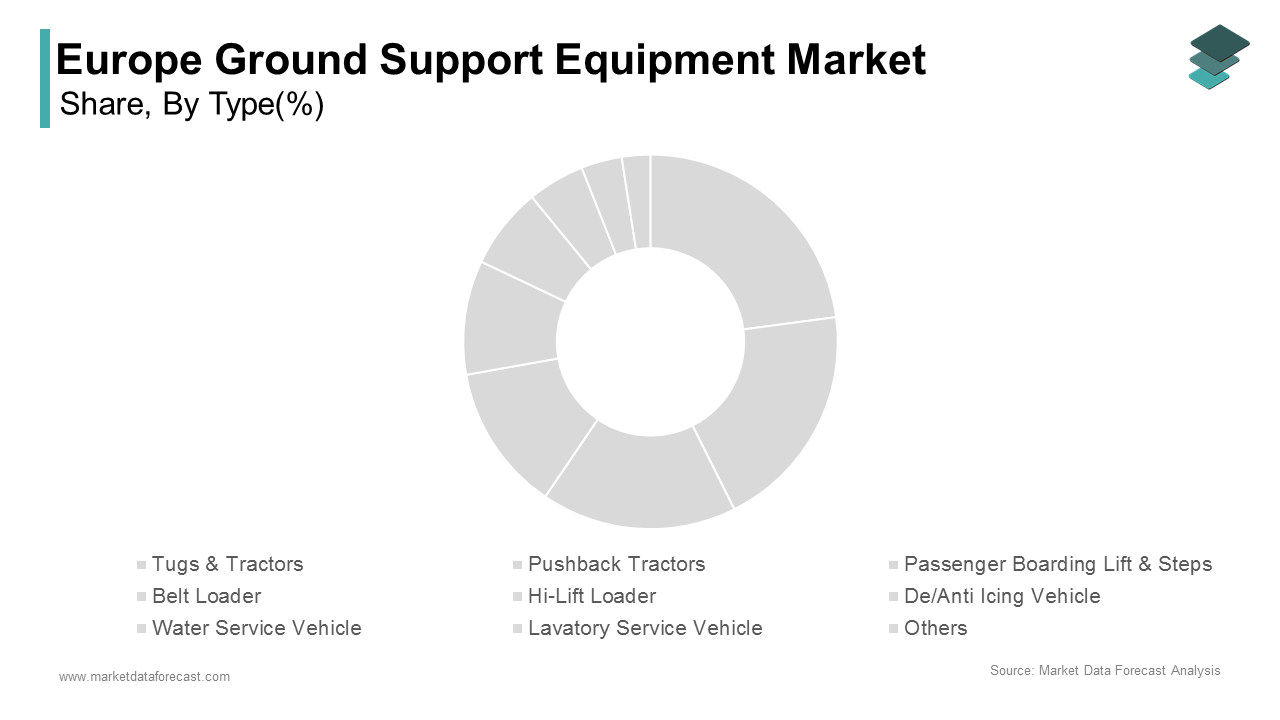
The De/Anti Icing Vehicle segment is anticipated to witness the fastest CAGR of 9.6% from 2026 to 2034 due to climate volatility and regulatory mandates. Unpredictable and severe winter conditions are extending the deicing season beyond traditional months. Modern vehicles with closed-loop glycol recovery, required under the EU Industrial Emissions Directive, reduce environmental impact while improving efficiency. The regulatory and climatic pressure drives investment in high-capacity heated deicing fleets. New deicing vehicles feature real-time fluid metering, heated booms, and glycol reclamation systems to comply with tightening EU environmental standards. The push to eliminate traditional glycol under the EU's Zero Pollution Action Plan is driving increased demand for innovative deicing technology, surpassing that of other Ground Support Equipment (GSE) categories.
By Power Source Analysis
The non-electric GSE segment held the leading share of 62.8% of the Europe ground support equipment market in 2025. The growth of the non-electric GSE segment is propelled by the legacy fleet base and operational inertia in many regional airports. Thousands of diesel-powered tugs, loaders, and tractors remain in service at smaller and regional airports where electrification investments are delayed due to budget constraints. The airports often lack the electrical grid capacity or capital for charging infrastructure, making diesel the only viable option. Ground handling companies operating across multiple airports maintain mixed fleets to ensure compatibility, further prolonging the life of non-electric units despite EU sustainability targets. In addition, diesel equipment offers high torque, cold-weather reliability, and rapid refueling, important advantages in winter operations and remote locations. Apart from these, maintenance is simpler with widely available mechanics and parts. The non-electric ground support equipment (GSE) segment will continue to dominate the market until electric alternatives can match its all-weather performance and service network.
The electric GSE segment is likely to experience the fastest CAGR of 18.3% during the forecast period, owing to regulatory mandates and total cost of ownership improvements. The European Commission’s Green Airport Initiative requires all airports with millions of passengers to operate zero-emission GSE by 2035. These legally binding targets compel ground handlers like Swissport and dnata to place large orders. The regulatory stick, combined with public funding, creates a predictable and accelerating demand curve for electric GSE. Besides, the total cost of ownership for electric GSE has narrowed significantly due to falling lithium-ion battery prices and lower maintenance needs. Electric tugs offer more operating hours between major services compared to those for diesel equivalents. The undeniable economic benefits are prompting even cost-sensitive operators to transition, driving the rapid expansion of the segment.
By Ownership Analysis
The new sales segment led the Europe ground support equipment market by holding a 58.5% share in 2025. The prominence of the new sales segment is attributed to fleet modernization mandates and the transition to electric platforms. EU climate policies and airport-level decarbonization targets necessitate large-scale procurement of new electric GSE. These institutional procurement cycles favor new sales as used electric GSE markets remain nascent, and rental fleets are insufficient to meet volume demands. The regulatory clock is effectively resetting the entire GSE lifecycle toward new asset acquisition. Furthermore, Modern GSE includes collision avoidance systems, real-time diagnostics, and A-CDM connectivity that are unavailable in older units. Airports are increasingly adopting digital apron management systems, a process that presents technical and financial challenges for integrating existing legacy ground support equipment (GSE). Airlines and ground handlers increasingly view GSE not just as machinery but as data nodes in a smart airport ecosystem. This technological leap makes new purchases essential for compliance and efficiency, further entrenching the dominance of the new sales segment.
The rental/lease segment is on the rise and is expected to be the fastest-growing segment in the market by witnessing a CAGR of 12.7% from 2026 to 2034. The swift expansion of the rental/lease segment is fuelled by operational flexibility and capital conservation. Airlines and seasonal charter operators require scalable GSE without long-term capital commitment. Companies increasingly source equipment via short-term leases from specialized providers. During peak summer months, Spanish airports see GSE rental demand surge. This just-in-time model allows operators to match capacity to volatile flight schedules without asset depreciation risk. In addition, rental enables airports and handlers to deploy cutting-edge electric and connected GSE without bearing full acquisition costs. Copenhagen Airport is working to electrify its ground handling fleet, as part of a broader industry push toward sustainability and CO2 neutrality in airport operations. This model transfers technology obsolescence risk to the lessor while ensuring compliance with evolving standards. The European Investment Bank offers green leasing guarantees to encourage such arrangements, particularly in Eastern Europe. As technology cycles shorten and regulations tighten, rental becomes a strategic tool for agile and compliant ground operations.
REGIONAL ANALYSIS
Germany Ground Support Equipment Market Analysis
Germany was the top performer in the Europe ground support equipment market by accounting for a 23.5% share in 2025. The domination of the German market is driven by its status as Europe’s aviation hub with some of the continent’s busiest and most technologically advanced airports. Frankfurt, Munich, and Düsseldorf collectively handled millions of passengers, driving intense ground handling activity. The country’s stringent climate laws mandate rapid GSE electrification. Major ground handlers maintain large modern fleets and invest heavily in smart GSE integration. Apart from these, Germany hosts leading GSE manufacturers that drive innovation and domestic procurement. Germany is establishing itself as Europe's central point for GSE demand and innovation, thanks to its mandatory 2035 zero-emission targets and strong collaboration between public and private sectors.
United Kingdom Ground Support Equipment Market Analysis
The United Kingdom was the second-largest player in the Europe ground support equipment market by capturing a 16.6% share in 2025. The growth of the UK market is fuelled by London’s multi-airport system and strong regulatory push for sustainability. Heathrow Gatwick, Stansted, and Luton together served millions of passengers, creating massive ground support requirements. Ground handling firms operate highly mechanized fleets with advanced telematics to meet tight turnaround slots. Despite Brexit, the UK remains aligned with EU environmental standards and continues to lead in GSE innovation, making it a critical high-value market.
France Ground Support Equipment Market Analysis
France is another major player in the Europe ground support equipment market, with a centralized aviation policy and infrastructure modernization. Paris Charles de Gaulle, Orly, and Lyon Saint Exupéry form a high-traffic corridor that processes millions of passengers. Apart from these, France hosts key GSE players that collaborate with local ground handlers to co-develop solutions. The national focus on reducing airport emissions, targeting a reduction by 2035, creates a stable and predictable demand environment that sustains France’s leadership in both fleet size and technological adoption.
Spain Ground Support Equipment Market Analysis
Spain is growing steadily in the Europe ground support equipment market due to its seasonal tourism peaks and growing cargo operations. Spanish airports handled millions of passengers, with the summer months seeing passenger volumes double, requiring scalable and flexible GSE solutions. Airports deploy large temporary fleets during peak season sourced through rental and lease models. Simultaneously, Zaragoza and Vitoria have emerged as major European cargo hubs for Amazon Air and DHL, driving demand for high-capacity electric cargo loaders. This dual dynamic of seasonal passenger surges and year-round cargo growth makes Spain a unique and rapidly evolving GSE market with strong demand for modular and efficient equipment.
Netherlands Ground Support Equipment Market Analysis
The Netherlands is predicted to expand in the Europe ground support equipment market between 2026 and 2034 due to Amsterdam Schiphol’s role as a global hub and pioneer in sustainable aviation. Schiphol serves millions of passengers and is legally bound to operate electric GSE by 2030. Apart from these, Schiphol’s circular economy policy mandates that all new GSE include recyclable components and end-of-life take-back agreements. The Netherlands is also home to innovative GSE lessors that supply electric fleets across Northern Europe. The Netherlands acts as a testing ground for next-generation ground support equipment due to its strong government backing for sustainable aviation initiatives and its innovative technological culture.
COMPETITION OVERVIEW
The Europe ground support equipment market features intense competition among global technology leaders, specialized European manufacturers, and emerging electric mobility entrants, all vying for dominance in a rapidly transforming aviation landscape. Incumbents leverage decades of aerospace engineering expertise and established service networks while newer players differentiate through battery innovation and digital connectivity. Competition is increasingly defined by compliance with stringent EU environmental regulations, total cost of ownership, and integration with smart airport systems rather than price alone. The market is segmented by airport size, with major hubs driving demand for high-end electric and connected GSE while regional airports favor cost-effective and robust solutions. National climate policies create predictable but uneven demand, with Western Europe leading adoption. Strategic partnerships with ground handling companies and participation in EU-funded sustainability initiatives are critical for securing long-term market relevance in this infrastructure-intensive and regulation-driven sector.
KEY MARKET PLAYERS
A few major players of the Europe ground support equipment market include
- TLD Group
- JBT Corporation
- Textron GSE
- Mallaghan Engineering
- Weihai Guangtai
- Tronair
- Cavotec SA
- Aeroservices
- ITW GSE
- Mulag Fahrzeugwerk
- Charlatte Manutention
- Aero Specialties
- Airport Equipment Ltd
Top Strategies Used by the Key Market Participants
Key players in the Europe ground support equipment market prioritize the development of full electric and hybrid product portfolios to align with EU and national decarbonization mandates for airport operations. They invest in smart GSE technologies, integrating telematics IoT sensors and A-CDM compatibility to enhance operational efficiency and predictive maintenance. Strategic localization through European assembly plants and service centers ensures faster delivery and compliance with regional safety standards. Companies also offer flexible ownership models, including leasing and subscription services to accommodate the budget constraints of ground handlers and low-cost carriers. Additionally, they collaborate with airports, airlines, and regulators to shape charging infrastructure standards and safety protocols, fostering ecosystem readiness for large-scale electrification across the continent.
Leading Players in the Market
TLD Group
TLD Group is a France-based global leader in ground support equipment with deep integration across European airports and a strong export footprint. The company offers a comprehensive portfolio including electric tugs, baggage tractors, cargo loaders, and deicing vehicles serving over 500 airports worldwide. In Europe, TLD supplies major hubs such as Paris Charles de Gaulle, Frankfurt, and Amsterdam Schiphol with fleets compliant with EU emissions and safety standards. Recent actions include establishing a dedicated electric GSE assembly line in Toulouse to meet rising European demand and accelerate delivery timelines for zero-emission equipment under national climate mandates.
JBT Corporation
JBT Corporation is a US-headquartered but Europe-active provider of technologically advanced ground support equipment with major operations in the UK, Germany, and Spain. The company specializes in high-capacity cargo loading systems, belt loaders, and aircraft deicing units widely used by ground handlers like Swissport and Menzies Aviation. JBT leverages its aerospace heritage to integrate smart diagnostics and predictive maintenance into its GSE platforms. Its European service network ensures rapid support across the continent, reinforcing its position as a key enabler of modernized and connected airport ground operations.
Goldhofer AG
Goldhofer AG is a German engineering company renowned for its heavy-duty and specialized ground support vehicles, including aircraft tugs, pushback tractors, and cargo transporters used in both civil and military aviation. The company’s equipment is known for precision, durability, and custom engineering for wide-body and cargo aircraft operations across major European airports. The company also collaborates with German aerospace research institutes to develop autonomous towing prototypes. By combining German engineering excellence with sustainable innovation, Goldhofer strengthens its niche leadership in high-performance ground support solutions for Europe’s most demanding aviation environments.
MARKET SEGMENTATION
This research report on the Europe ground support equipment market has been segmented and sub-segmented based on type, power source, ownership, and region.
By Type
- Tugs & Tractors
- Pushback Tractors
- Passenger Boarding Lift & Steps
- Belt Loader
- Hi-Lift Loader
- De/Anti Icing Vehicle
- Water Service Vehicle
- Lavatory Service Vehicle
- Others
By Power Source
- Non-Electric GSE
- Electric GSE
- Hybrid GSE
- Fuel Cell Vehicle
- Advanced GSE
By Ownership
- New Sales
- Used Sales
- Rental/Lease
By Region
- UK
- France
- Spain
- Germany
- Italy
- Russia
- Sweden
- Denmark
- Switzerland
- Netherlands
- Turkey
- Czech Republic
- Rest of Europe