- Product Description Description
- Table of Contents TOC
- List of Table & Figure LOT
- Get Free Sample PDF Sample PDF
Market Size, 2025
$0.67 BnMarket Estimate, 2026
$0.72 BnMarket Forecast, 2034
$1.36 BnCAGR, 2026–2034
8.18%Europe Guacamole Market Size, Growth, Trends & Forecast (2026–2034)
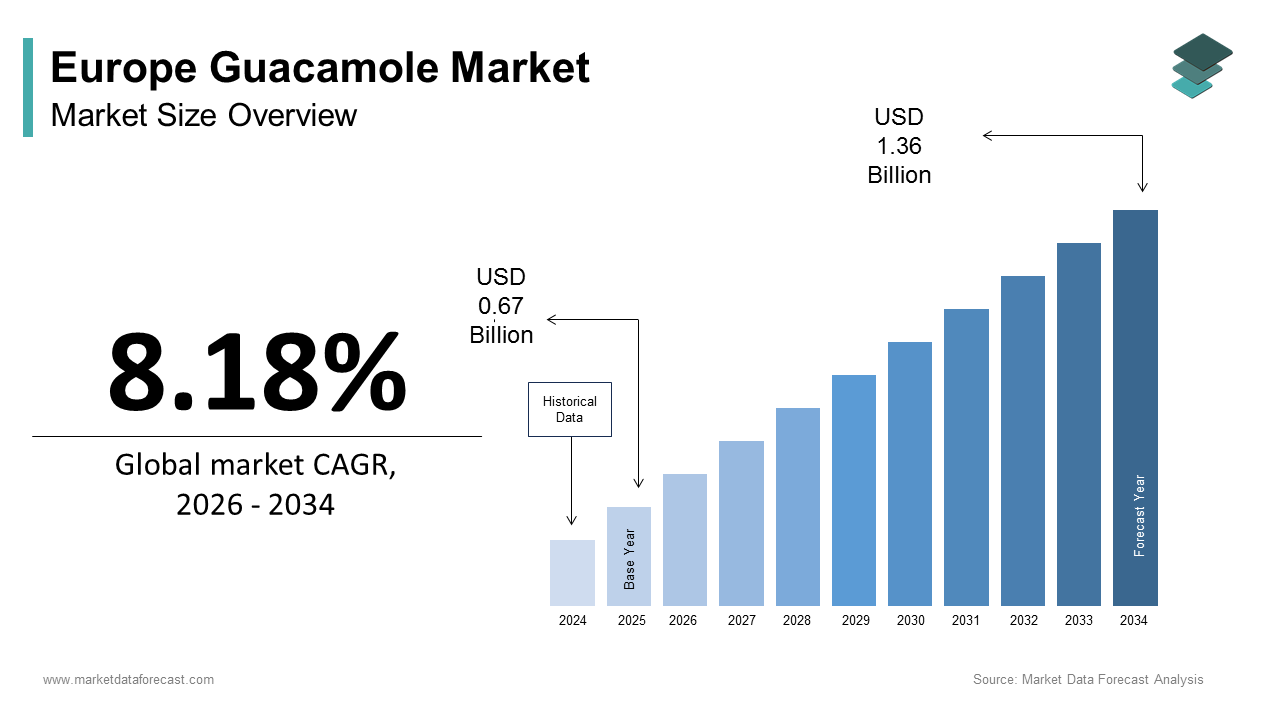
The Europe guacamole market size was calculated to be USD 0.67 billion in 2025, is anticipated to reach USD 0.72 billion in 2026, and is projected to scale up to USD 1.36 billion by 2034, registering a compound annual growth rate (CAGR) of 8.18% during the forecast period from 2026 to 2034. Driven by the rising preference for clean label and plant-based foods, expansion of Mexican and fusion dining in food service channels, and ongoing packaging innovations like HPP and stand-up pouches, the market continues to expand steadily across Europe.
Key Executive Metrics (At-a-Glance)
- 2025 Base Valuation: USD 0.67 Billion
- 2026 Current Valuation: USD 0.72 Billion
- 2034 Forecast Valuation: USD 1.36 Billion
- Compound Annual Growth Rate (CAGR): 8.18% (2026–2034)
- Dominant Form Segment: Ready-to-Make (capturing a 62.4% share in 2025)
- Fastest-Growing Form Segment: Frozen Guacamole (anticipated to witness the fastest CAGR of 18.9% from 2026 to 2034)
- Dominant End-Use Segment: Households (largest segment capturing a 54.7% share in 2025)
- Fastest-Growing End-Use Segment: Food Service Industry (likely to experience the fastest CAGR of 21.3%)
- Dominant Packaging Segment: Plastic Containers (holding a substantial share in 2025)
- Fastest-Growing Packaging Segment: Stand-up Pouches (expected to grow at a CAGR of 24.1%)
- Dominant Region: United Kingdom (top performer accounting for a 24.7% share in 2025)
Core Market Drivers
- Clean Label & Plant-Based Preference: European consumers prioritizing natural, minimally processed, vegan-friendly foods free from synthetic additives.
- Cuisine Expansion: Proliferation of Mexican and global fusion dining normalizing guacamole across restaurants and fast-casual chains.
- Packaging & Technology Innovations: High-pressure processing (HPP) and aseptic packaging enabling extended shelf life and nationwide distribution.
Primary Market Restraints & Challenges
- Supply & Pricing Volatility: Heavy reliance on volatile imports from Mexico, Chile, and Peru subject to climate-related yield fluctuations.
- Regulatory & Shelf-Life Constraints: Strict EU limits on chemical preservatives creating short perishable windows and inventory management challenges.
- Environmental Scrutiny: Water usage, deforestation concerns, and strict upcoming EU traceability regulations governing avocado sourcing.
Europe Guacamole Market Segmentation Breakdown
| Segment Category | Leading Sub-Segment (2025 Base) | Fastest-Growing Sub-Segment (2026–2034) |
|---|---|---|
| By Form | Ready-to-Make (62.4% share in 2025) | Frozen (18.9% CAGR) |
| By End Use | Households (54.7% share in 2025) | Food Service Industry (21.3% CAGR) |
| By Packaging | Plastic Containers (dominant base share) | Stand-Up Pouches (24.1% CAGR) |
| By Region | United Kingdom (24.7% share in 2025) | Netherlands & Germany (expanding via logistics, retail integration, and plant-based demand) |
Major Industry Players Profiled
Key enterprises shaping the competitive European guacamole market include Calavo Growers Inc., Hormel Foods Corporation, Sabra Dipping Company LLC, The Kraft Heinz Company, Fresh Del Monte Produce Inc., Westfalia Fruit Group, Mission Produce Inc., Casa Sanchez Foods, Yucatan Foods L.P., and Avo-King Europe Ltd.
Europe Guacamole Market Size
The Europe guacamole market size was calculated to be USD 0.67 billion in 2025 and is anticipated to be worth USD 1.36 billion by 2034, from USD 0.72 billion in 2026, growing at a CAGR of 8.18% during the forecast period.
Guacamole is a fresh avocado-based dip or spread traditionally composed of mashed avocados, lime juice, onions, tomatoes, cilantro, and chili peppers. In Europe, it has evolved from an ethnic specialty into a mainstream condiment driven by health consciousness, culinary globalization, and the rise of plant-based eating. The European guacamole market covers both retail packaged variants, sold chilled or ambient, and food service applications in restaurants, fast casual chains, and catering. According to research, European avocado imports continue to grow, with increasing amounts directed toward processed goods rather than solely fresh consumption. As per the European Commission’s Directorate General for Agriculture, the Netherlands acts as the primary entry and distribution hub for imported avocados, while Spain serves as both the leading European producer and a critical hub for importing, ripening, and distributing to Southern Europe. Both countries facilitate extensive downstream processing, particularly in ripening and packing for retail. The product’s alignment with clean label trends—often containing no artificial preservatives or additives—resonates with EU consumer preferences, particularly among urban millennials and flexitarians seeking nutrient-dense, plant-derived foods rich in monounsaturated fats and fiber.
MARKET DRIVERS
Rising Consumer Preference for Clean Label and Plant-Based Foods
European consumers are increasingly prioritizing natural and minimally processed foods free from artificial ingredients, a trend that strongly favors traditional guacamole formulations, and fuels the growth of the Europe guacamole market. According to sources, a notable portion of EU shoppers actively avoids products with synthetic additives, driving demand for dips made with recognizable ingredients like avocado, lime, and herbs. Guacamole’s inherent compatibility with plant-based and vegan diets further amplifies its appeal. Besides, a significant portion of European adults are adopting flexitarian diets, which supports the demand for versatile, plant-based, and, according to GFI Europe and the Smart Protein Project, plant-centric condiments. Major retailers like Tesco in the UK and Carrefour in France have expanded their private label guacamole ranges, often highlighting “no added sugar” and “gluten-free” claims. Additionally, the European Commission’s Farm to Fork Strategy promotes whole food consumption, indirectly endorsing avocado-based products as part of a sustainable dietary pattern, reinforcing guacamole’s position in health-oriented grocery baskets.
Expansion of Mexican and Fusion Cuisine in Food Service Channels
The proliferation of Mexican-inspired and global fusion dining across the region has significantly boosted guacamole consumption and the expansion of the Europe guacamole market. This trend has pushed consumption well beyond retail settings. The popularity of Latin American cuisine has risen across the EU, with guacamole becoming a staple, widely featured offering in both independent and chain restaurant settings. Fast casual chains like Tortilla and Wahaca have standardized guacamole as a core menu item, while mainstream burger and salad concepts increasingly offer it as a premium add-on. Germany has experienced a significant increase in new Tex-Mex and Latin American dining options, reflecting a strong consumer preference for these cuisines in the region. This culinary mainstreaming normalizes guacamole as a familiar flavor profile rather than an exotic novelty. Moreover, Major delivery platforms in Western and Northern Europe have reported a surge in orders for dishes containing guacamole, emphasizing its integration into daily urban dietary habits.
MARKET RESTRAINTS
High Volatility in Avocado Supply and Pricing
Supply chain vulnerability remains a key issue for the Europe guacamole market. This market is heavily reliant on volatile imports from Mexico, Chile, and Peru. In 2023, European avocado markets experienced significant price volatility, with acute, short-term price spikes in key ports like Rotterdam driven by a combination of drought-related production challenges in Peru and localized logistical bottlenecks. Because raw avocados represent the overwhelming majority of the raw material cost in guacamole production, volatility in avocado supply and pricing directly dictates the margin stability for manufacturers and the final retail price for consumers. Unlike tomatoes or onions, avocados cannot be easily substituted without compromising authenticity and texture. Furthermore, the fruit’s perishability necessitates air freight during peak demand periods, increasing carbon footprint and costs. The European Commission’s 2023 agricultural outlook noted that climate-related yield variability in major exporting countries is expected to persist, undermining long term supply predictability. This dependency on distant, climate-sensitive origins constrains scalable and affordable guacamole production across the continent.
Stringent Regulations on Additives and Shelf Life Extension
European Union regulations severely limit the use of chemical preservatives in fresh dips hinder the expansion of the Europe guacamole market. This poses a significant challenge for guacamole manufacturers seeking extended shelf life. European regulations strictly limit the use of synthetic antioxidants in pre-prepared guacamole, encouraging manufacturers to adopt natural alternatives and advanced, non-thermal preservation technologies to maintain color and quality. Despite the application of natural preservatives and advanced packaging, refrigerated guacamole has a limited, relatively short, and perishable shelf life, making it prone to oxidation shortly after opening. This short window complicates logistics, increases waste, and restricts distribution to regional markets. Retailers frequently reject deliveries nearing expiry, leading to inventory losses. Research from Wageningen University indicates that a notable portion of fresh guacamole is lost at the retail level because of its limited shelf life, creating significant supply chain challenges. These regulatory and technical constraints hinder national-scale distribution and elevate operational complexity for producers.
MARKET OPPORTUNITIES
Development of Ambient Stable and Single-Serve Formats for Broader Accessibility
Innovations in high pressure processing (HPP) and aseptic packaging are unlocking new distribution channels for the Europe guacamole market. HPP-treated guacamole can achieve up to 60 days of refrigerated shelf life without preservatives, enabling nationwide supermarket distribution. Companies like Del Monte and Michelina’s have launched single-serve cups and squeeze pouches targeting convenience stores, airlines, and school cafeterias. According to the European Snacks Association, the demand for single-portion, portable dips and savory snacks rose throughout Europe in 2023, largely fueled by consumers seeking convenient, on-the-go, and individually packaged options. Additionally, ambient stable guacamole, sterilized via retort technology, is gaining traction in Southern and Eastern Europe, where cold chain infrastructure is limited. The European Commission’s Circular Economy Action Plan supports recyclable mono-material packaging, aligning with new guacamole formats that use PET or aluminum. These innovations democratize access beyond urban centers and expand occasions from party dips to everyday meal enhancers.
Integration into Functional and Fortified Food Trends
Guacamole’s nutrient-dense profile positions it as an ideal base for functional food enhancements aligned with the region’s growing wellness economy, which offers new routes for the Europe guacamole market. Avocados naturally contain heart-healthy monounsaturated fats, potassium, and vitamin E, but brands are now fortifying guacamole with added protein, fiber, or probiotics to target specific health benefits. Nestlé expanded its European plant-based portfolio by introducing high-protein vegetable-based options, focusing on incorporating alternative proteins into savory, refrigerated products. Similarly, Swedish startup NutriBoost introduced a gut health-focused version with live cultures and prebiotic inulin. A large segment of European consumers is actively prioritizing food products that offer functional benefits, particularly those aimed at supporting heart health and digestive well-being. The European Food Safety Authority’s positive opinion on health claims for plant sterols and omega-3 fatty acids further enables science-backed positioning. By evolving from a condiment to a functional food, guacamole can command premium pricing and enter pharmacy and wellness retail channels.
MARKET CHALLENGES
Environmental and Ethical Concerns Surrounding Avocado Sourcing
The environmental footprint of avocado production, particularly water usage and deforestation in key exporting regions, has triggered consumer and regulatory scrutiny in the region, which impedes the growth of the Europe guacamole market. Avocado cultivation for export requires intense irrigation, creating significant local water scarcity and social-ecological conflicts in water-stressed regions like Chile's Petorca province. Media investigations have linked avocado farming in Mexico to illegal deforestation and water diversion, prompting campaigns by NGOs like Oxfam. New European Union regulations legally require companies to provide proof of traceability and guarantee that imported agricultural products are not linked to recent deforestation, with enforcement beginning in late 2025. Retailers such as Aldi and Lidl now require Fairtrade or Rainforest Alliance certification for avocado-based products. Brands failing to verify their ethical sourcing face severe reputational risks and exclusion from major retail channels, particularly in eco-conscious markets like Sweden and Germany.
Seasonal Demand Fluctuations and Limited Culinary Versatility Perception
Guacamole consumption in the region remains heavily skewed toward social occasions such as parties, barbecues, and sporting events, and results in pronounced seasonal demand peaks, which in turn slows down the expansion of the Europe guacamole market. This is despite growing popularity. Seasonal gatherings and summer holidays drive the vast majority of annual guacamole purchases in the United States. This seasonality creates production inefficiencies and inventory management challenges for manufacturers. Moreover, many consumers still perceive guacamole narrowly as a dip rather than a versatile ingredient for sandwiches, sauces, or breakfast bowls. A recent consumer survey across several European nations indicates that most people still primarily consume guacamole as a casual dip or snack rather than integrating it into broader cooking. This limited usage perception restricts per capita consumption compared to staples like hummus or pesto. Overcoming this requires sustained consumer education and recipe innovation by brands and retailers to embed guacamole into daily meal routines year-round.
REPORT COVERAGE
| REPORT METRIC | DETAILS |
| Market Size Available | 2025 to 2034 |
| Base Year | 2025 |
| Forecast Period | 2026 to 2034 |
| CAGR | 8.18% |
| Segments Covered | By Form, End Use, Packaging, And Region |
| Various Analyses Covered | Global, Regional & Country Level Analysis; Segment-Level Analysis; DROC, PESTLE Analysis; Porter’s Five Forces Analysis; Competitive Landscape; Analyst Overview of Investment Opportunities |
| Regions Covered | UK, France, Spain, Germany, Italy, Russia, Sweden, Denmark, Switzerland, Netherlands, Turkey, and the Czech Republic |
| Market Leaders Profiled | Calavo Growers Inc., Hormel Foods Corporation, Sabra Dipping Company LLC, The Kraft Heinz Company, Fresh Del Monte Produce Inc., Westfalia Fruit Group, Mission Produce Inc., Casa Sanchez Foods, Yucatan Foods L.P., Avo-King Europe Ltd. |
SEGMENTAL ANALYSIS
By Form Insights
The ready-to-make segment led the Europe guacamole market by capturing a 62.4% share in 2025. The dominance of the ready-to-make segment is driven by consumer demand for convenience without compromising freshness, particularly among urban professionals and health-conscious households. These products typically come in vacuum-sealed tubs with lime juice and seasonings already incorporated, requiring only stirring before serving. Retailers like Sainsbury’s in the UK and Edeka in Germany have expanded chilled, ready-to-make guacamole sections due to strong sales velocity. Tesco experienced substantial volume growth in its premium, fresh food range, driven by increased consumer demand for higher-quality, convenient products. The European Commission’s Clean Label Initiative further supports this trend by encouraging minimally processed foods with short ingredient lists. Additionally, the application of cold, high-pressure technology allows for significantly extended refrigerated shelf life for fresh products, enabling preservative-free, "clean label" options that align with safety standards and consumer desires for natural, unprocessed food.
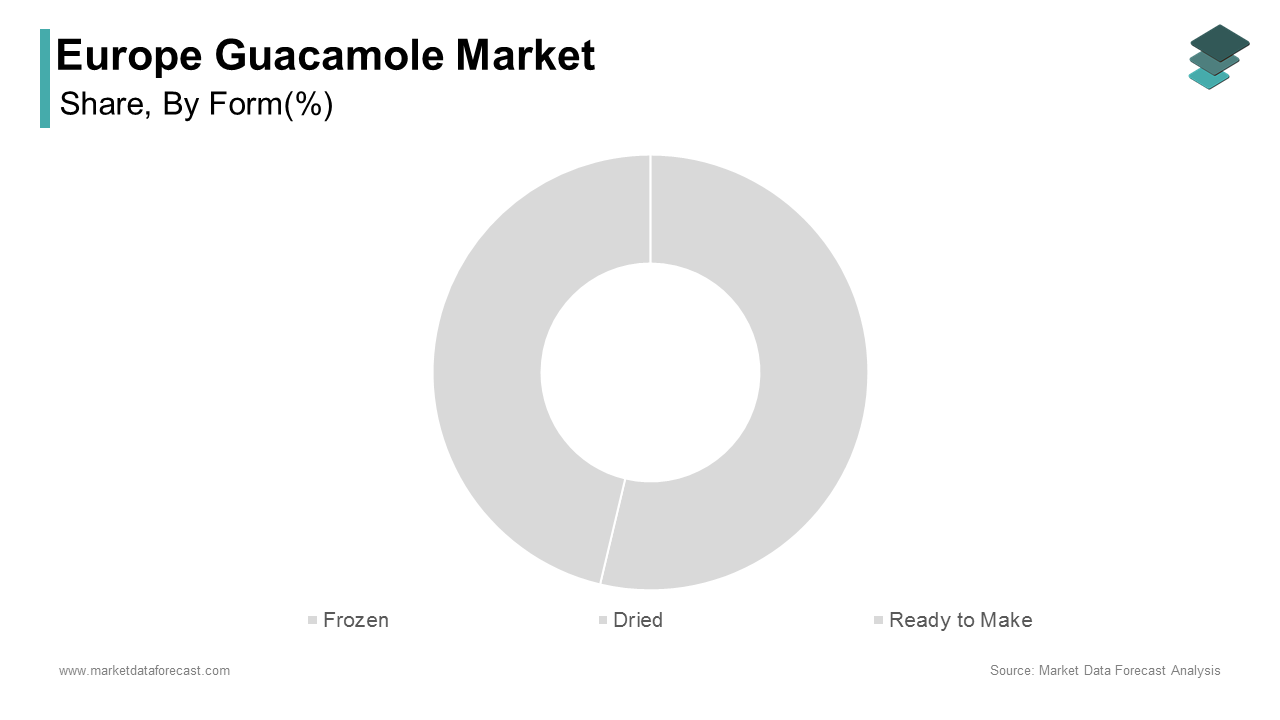
The frozen guacamole segment is anticipated to witness the fastest CAGR of 18.9% between 2026 and 2034 due to its appeal to food service operators seeking cost efficiency, portion control, and extended usability. Frozen blocks or cubes of guacamole can be thawed as needed, reducing waste in high-volume settings such as university cafeterias, airline catering, and fast casual chains. To address environmental concerns and promote local sourcing, this UK-based Mexican restaurant group introduced a sustainable dip made from British-grown pulses as an alternative to traditional avocado-based spreads. Moreover, frozen guacamole retains nutritional integrity better than ambient alternatives, with studies from the University of Reading confirming minimal loss of monounsaturated fats after blast freezing. The EU’s Farm to Fork Strategy encourages reduced food waste, and frozen formats directly support this goal by extending usability beyond the typical perishable window, making them increasingly attractive to both institutional buyers and budget-conscious households.
By End Use Insights
The household segment was the largest in the Europe guacamole market by capturing a 54.7% share in 2025. The supremacy of the household segment is attributed to the product’s integration into everyday home cooking and snacking routines, particularly among millennials and Gen Z consumers who prioritize plant-based, nutrient-dense options. Supermarkets across Western Europe have dedicated chilled dip sections where guacamole competes alongside hummus and tzatziki, often promoted during social occasions like football tournaments or summer barbecues. Household demand for guacamole in Spain has continued to grow, fueled by the widespread availability and increased consumption of locally grown avocados from the Andalusia region. Additionally, private label offerings from retailers like Aldi and Lidl have made guacamole more affordable, with prices dropping since 2021. The perception of guacamole as a “healthy indulgence” further cements its place in weekly grocery baskets across urban and suburban households.
The food service segment is likely to experience the fastest CAGR of 21.3% during the forecast period, owing to the mainstreaming of Mexican and global fusion cuisine in restaurants, pubs, and quick service chains across Europe. Major brands like McDonald’s now offer guacamole as a premium burger topping in Germany and France, while Pret A Manger includes it in vegan wraps across the UK. The rise of delivery and ghost kitchens has amplified demand for consistent, scalable guacamole supplies that maintain quality under reheating or prolonged holding. Deliveroo reported a notable rise in user interest for dishes containing guacamole, highlighting it as a popular, growing choice among customers during this period. Furthermore, corporate wellness programs are incorporating guacamole into office catering menus due to its heart-healthy fat profile. Growing menu diversity and a rebounding restaurant sector are turning food service outlets into essential growth pillars for guacamole brands.
By Packaging Insights
In 2025, the plastic containers dominated the Europe guacamole market by holding a substantial share. The leading position of the plastic containers segment is credited to its optimal balance of functionality, cost, and compatibility with chilled supply chains. Transparent plastic allows visual inspection of product quality, while tamper-evident seals and resealable lids enhance consumer trust and convenience. Crucially, these containers are compatible with high-pressure processing, which extends shelf life without chemical preservatives, a key requirement under EU food regulations. Retailers favor standardized tub sizes for efficient stacking and display. Carrefour’s own-brand guacamole products predominantly rely on small-format, single-use plastic containers in several European markets. Additionally, advances in recyclable mono-material plastics align with new EU legislative requirements. These move from a directive to a binding regulation, necessitating that all packaging placed on the market be designed for reuse or recycling, with further requirements for high-quality, large-scale recycling. This regulatory alignment ensures continued dominance despite environmental scrutiny.
The stand-up pouches segment is on the rise and is expected to be the fastest-growing segment in the market by witnessing a CAGR of 24.1% from 2026 to 2034. The rapid growth of the stand-up pouches segment is propelled by demand for single-serve, portable, and lightweight solutions suited to on-the-go consumption. Squeeze pouches enable mess-free dispensing, appealing to parents, students, and fitness enthusiasts. Brands like Del Monte and Michelina’s have launched 50 to 100-gram guacamole pouches in supermarkets and convenience stores across Germany and the Netherlands. The format uses less material than rigid containers, reducing transport emissions and supporting the EU Green Deal’s carbon reduction targets. Moreover, modern multilayer pouches with oxygen barrier films maintain freshness for several days when refrigerated. In 2023, the French startup Avocad’Oh secured retail distribution for its compostable stand-up pouches made from biobased polymers, signaling innovation toward circularity. This combination of convenience, sustainability, and cost efficiency positions stand-up pouches as the future of premium and functional guacamole formats.
REGIONAL ANALYSIS
United Kingdom Guacamole Market Analysis
The United Kingdom was the top performer in the Europe guacamole market by accounting for a 24.7% share in 2025. The dominance of the UK market is driven by strong multicultural influences, advanced retail infrastructure, and high avocado import volumes. The UK remains a major importer of avocados, with fresh fruit dominating the market, while the demand for ripe, ready-to-eat, and processed avocado products, such as dips, grows rapidly. Major supermarket chains like Tesco and Sainsbury’s offer multiple guacamole variants, including organic and spicy editions, reflecting consumer sophistication. The proliferation of Mexican fast casual chains such as Chilango and Tortilla has normalized guacamole as a mainstream condiment. Additionally, the UK’s departure from the EU has enabled faster approval of novel packaging formats like compostable pouches under UK REACH. Avocado popularity among British adults is exceptionally high, with the country serving as a leading European market for innovation in avocado ripening and ready-to-eat convenience products.
Germany Guacamole Market Analysis
Germany followed closely in the Europe guacamole market by holding a 21.5% share in 2025. The expansion of the German market is fuelled by its health-conscious consumer base and robust organic food sector. Sales of plant-based dips and spreads are seeing strong, sustained growth within the German market, driven by consumer demand for cleaner, plant-derived products. The country’s stringent food safety standards favor high-pressure processed guacamole with no additives, aligning with consumer demand for transparency. Discounters like Aldi and Lidl have played a pivotal role by introducing affordable organic guacamole under private labels, driving mass adoption. Furthermore, Germany’s large Turkish and Latin American communities have accelerated culinary acceptance. A significant, growing portion of German consumers increasingly view guacamole as a healthy, nutrient-dense, plant-based food choice rather than merely an exotic, specialty item. This cultural normalization, combined with retail accessibility, ensures sustained market leadership.
France Guacamole Market Analysis
France occupies a significant position in the Europe guacamole market due to evolving gastronomic openness and urban food trends. Domestic demand for avocados remains robust as they transition from specialty items to dietary staples, with a growing preference for convenient, ready-to-eat processed versions across major urban centers. The rise of healthy fast food concepts such as Exki and Cogito’Z has integrated guacamole into grain bowls and wraps, appealing to young professionals. French consumers increasingly view guacamole as a gourmet ingredient rather than a mere dip, using it in salads and seafood pairings. A rising number of households are incorporating prepared avocado products into their regular grocery shopping, driven by an increasing consumer focus on health-conscious and time-saving food options. Additionally, French retailers emphasize origin labelling, highlighting Peruvian or Spanish avocados, which builds trust and justifies premium pricing. This blend of culinary innovation and transparency sustains France’s strong market presence.
Spain Guacamole Market Analysis
Spain expanded steadily in the Europe guacamole market. It is uniquely positioned as both a major consumer and emerging producer of avocados. Andalusian avocado producers remain the dominant source of continental European supply, allowing local producers to manufacture fresh guacamole with shorter supply chains, despite agricultural challenges affecting total production volumes. Domestic brands like Gran Campo and EcoSano leverage “Made in Spain” messaging to appeal to national pride and sustainability concerns. Guacamole is increasingly featured in tapas bars and summer menus, blending into traditional cuisine. The Spanish market for prepared, chilled guacamole continues to experience rapid growth, outpacing many other dip categories due to rising demand for convenience and ready-to-eat products. Additionally, Spain’s warm climate and tourism sector drive seasonal demand spikes during the summer months. This dual role as producer and consumer creates a resilient and culturally embedded market dynamic unmatched elsewhere in Europe.
Netherlands Guacamole Market Analysis
The Netherlands is predicted to grow in the Europe guacamole market during the forecast period. It is serving as Europe’s primary logistics and distribution gateway for imported avocados. Moreover, the Netherlands continues to solidify its role as Europe’s primary import hub for avocados, with the Port of Rotterdam receiving a massive volume of fruit, most of which is processed and redistributed throughout the continent. Companies like Frosta and Azafran operate state-of-the-art processing plants near Schiphol Airport, enabling rapid distribution across Northern Europe. Dutch consumers, known for early adoption of global food trends, show high openness to plant-based products. Avocado-based products, including guacamole, are experiencing growing demand among consumers, driving increased sales within retail and food service sectors in the Netherlands. The country’s strong cold chain infrastructure and focus on sustainable packaging, such as recyclable mono material tubs, further enhance its competitive edge. As a hub for both processing and innovation, the Netherlands bridges global supply with European demand efficiently.
COMPETITION OVERVIEW
The Europe guacamole market features a mix of specialized ethnic food producers, regional dairy and chilled food companies, and multinational consumer goods firms competing on authenticity, quality, and sustainability. Competition is not primarily price-driven but centers on ingredient transparency, packaging innovation, and supply chain ethics. Private label offerings from retailers like Aldi and Tesco exert moderate pressure, but branded players differentiate through culinary credibility and functional benefits such as organic certification or added protein. Barriers to entry remain moderate due to the need for reliable avocado sourcing, cold chain infrastructure, and compliance with EU food safety regulations. However, the market is not highly consolidated, allowing agile mid-sized players to thrive through niche positioning. As consumer expectations evolve toward both convenience and conscience, competition increasingly hinges on the ability to balance freshness, sustainability, and affordability without compromising on taste or trust.
KEY MARKET PLAYERS
A few major players of the Europe guacamole market include
- Calavo Growers Inc
- Hormel Foods Corporation
- Sabra Dipping Company LLC
- The Kraft Heinz Company
- Fresh Del Monte Produce Inc
- Westfalia Fruit Group
- Mission Produce Inc
- Casa Sanchez Foods
- Yucatan Foods L.P
- Avo-King Europe Ltd
Top Strategies Used by the Key Market Participants
Key players in the Europe guacamole market focus on clean label formulations with minimal ingredients to align with consumer demand for natural products. They invest inhigh-pressuree processing and advanced packaging, such as stand-up pouches and recyclable tubs, to extend shelf life and reduce waste. Companies secure ethically sourced and traceable avocado supply through direct partnerships with growers in Latin America. Strategic expansion into single-serve and functional formats caters to on-the-go and health-oriented consumption trends. Additionally, they leverage private label collaborations with major retailers to achieve broad distribution while maintaining premium quality and sustainability messaging.
Leading Players in the Market
- The Compleat Food Group is a leading European producer of authentic Mexican and Latin American food products, with guacamole as a core offering across retail and food service channels. Headquartered in the UK, the company supplies major supermarket chains and restaurant groups with both chilled and frozen guacamole made from Hass avocados sourced under ethical trade agreements. It also expanded its high-pressure processing capacity at its Midlands facility to extend shelf life without preservatives. These initiatives reinforce its commitment to authenticity, convenience, and environmental responsibility while strengthening its pan-European distribution footprint.
- Froneri has diversified beyond ice cream into premium chilled dips through strategic acquisitions and product innovation, positioning guacamole as a key growth category in its ambient and refrigerated portfolio. Operating across France, Germany, and Italy, Froneri leverages its extensive cold chain logistics to deliver fresh guacamole to thousands of retail points. It also partnered with avocado cooperatives in Peru to secure a traceable supply aligned with deforestation-free commitments. These actions enhance Froneri’s appeal to health-conscious and environmentally aware consumers across Western Europe.
- Azafran is a Netherlands-based specialty foods manufacturer renowned for its authentic ethnic dips, including a market-leading guacamole range distributed across Northern and Central Europe. The company emphasizes clean label formulations using only avocados lime juice, onion, and coriander with no stabilizers or colorants. It also achieved certification under the EU Organic Regulation for its entire guacamole portfolio, enabling access to premium retail segments. Azafran has carved a distinct niche in Europe’s competitive fresh dip market by blending authentic flavors with modern, sustainable packaging.
MARKET SEGMENTATION
This research report on the europe guacamole market has been segmented and sub-segmented based on form, end use, packaging & region.
By Form
- Frozen
- Dried
- Ready to Make
By End Use
- Food Processing Industry
- Food Service Industry
- Households
By Packaging
- Glass Bottles
- Plastic Containers
- Stand Up Pouches
By Region
- UK
- France
- Spain
- Germany
- Italy
- Russia
- Sweden
- Denmark
- Switzerland
- Netherlands
- Turkey
- Czech Republic
- Rest of Europe