- Product Description Description
- Table of Contents TOC
- List of Table & Figure LOT
- Get Free Sample PDF Sample PDF
Europe Guitar Market Report Summary
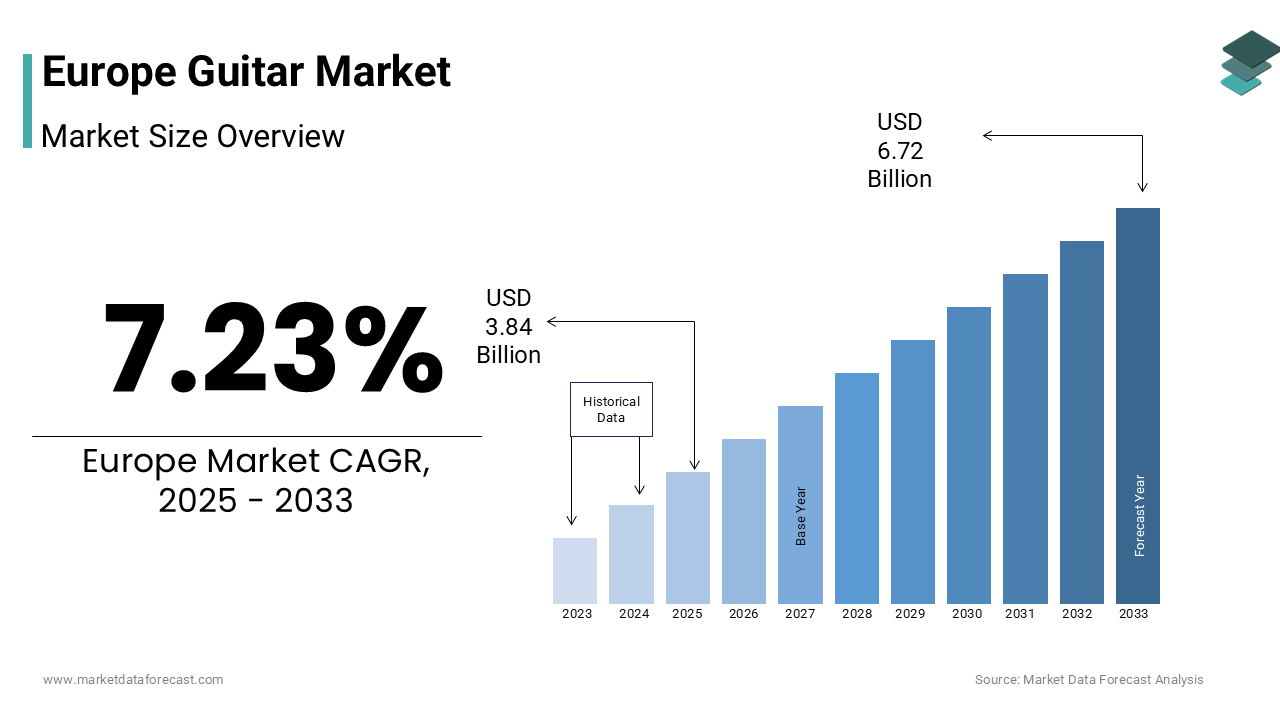
The European guitar market was valued at USD 3.58 billion in 2024, is anticipated to reach USD 3.84 billion in 2025, and is projected to reach USD 6.72 billion by 2033, growing at a CAGR of 7.23% during the forecast period from 2025 to 2033. The growth of the European guitar market is driven by the rising popularity of music as a recreational and professional pursuit, increasing music education programs, and the influence of digital music platforms, encouraging young consumers to take up guitar playing. Furthermore, the increasing adoption of online music learning platforms, along with the growing demand for premium and customized guitars, continues to fuel market expansion across the region.
Key Market Trends
- Rising preference for acoustic guitars among beginners and hobbyists due to affordability and simplicity.
- The growing prominence of electric guitars in live performances and contemporary music genres.
- Increasing adoption of digital and smart guitars integrated with recording and tuning features.
- Expansion of music streaming and social media content creation, driving interest in musical instruments.
- Strong growth in e-commerce-based musical instrument sales across European countries.
Segmental Insights
- Based on product, the acoustic guitars segment dominated the Europe guitar market in 2024, accounting for 62.3% of the market share. The dominance of this segment is attributed to the ease of use for beginners, versatility across music genres, and widespread use in educational and casual playing settings.
- Based on distribution channel, the offline segment held 58.3% of the European guitar market share in 2024. Despite the rise of online platforms, offline channels such as specialty music stores and brand outlets continue to thrive due to consumers’ preference for testing instruments before purchase and personalized in-store guidance.
Regional Insights
The European guitar market shows robust demand across major countries, supported by a strong musical heritage and an active community of musicians and learners.
- Germany led the European guitar market, holding 22.3% of the regional market share in 2024, driven by a thriving music education culture, high consumer purchasing power, and a well-established retail network for musical instruments.
- The United Kingdom follows closely, supported by the presence of major music festivals and a vibrant live performance culture.
- France and Italy are emerging markets with rising demand from young consumers, fueled by growing interest in both classical and contemporary music genres.
- Nordic countries are witnessing increased online purchases and a growing focus on sustainable guitar manufacturing practices.
Competitive Landscape
The European guitar market is moderately consolidated, with key players focusing on product innovation, artist collaborations, and digital integration to enhance their brand presence. Manufacturers are also expanding their distribution networks and introducing eco-friendly models to appeal to environmentally conscious consumers. Prominent companies operating in the Europe guitar market include Fender Musical Instruments Corporation, Gibson Brands Inc., Yamaha Corporation, Ibanez, The ESP Guitar Company, Samick Guitars, and Cordoba Music Group.
 Download Free Sample Report
Europe Guitar Market Size
The Europe guitar market size was valued at USD 3.58 billion in 2024 and is anticipated to reach USD 3.84 billion in 2025 from USD 6.72 billion by 2033, growing at a CAGR of 7.23% during the forecast period from 2025 to 2033.
MARKET DRIVERS
Resurgence of In Person Music Education Fuels Instrument Acquisition
The post pandemic restoration of physical music instruction across European schools and conservatories has significantly revived guitar acquisition among youth and adult beginners. This is one of the major factors levelling up the growth of Europe guitar market. This institutional demand is amplified by adult education centers such as the Volkshochschulen network which enrolled more than 420000 guitar students in 2023 as per Germany’s Federal Institute for Vocational Education and Training.
Growth of Creator Economy Drives Aspirational Guitar Purchases
The expansion of the digital creator economy has transformed the guitar from a purely musical instrument into a content creation tool for social media influencers podcasters and online educators across Europe, which is levelling up the growth of Europe guitar market. Brands have responded by designing instruments with camera ready finishes integrated pickup systems and compact profiles optimized for home studios. The monetization potential of online music content further motivates purchases as creators view guitars as capital equipment rather than discretionary items.
MARKET RESTRAINTS
High Import Tariffs on Non EU Manufactured Guitars Limit Affordability
The European Union imposes a 4.7% customs duty on imported finished musical instruments including guitars manufactured outside the bloc as stipulated in the EU’s Common Customs Tariff schedule. The high import tariffs on non EU manufactured guitars limit affordability, which is declining the growth of Europe guitar market. Consequently, many potential customers delay or forgo purchases opting instead for second hand instruments or digital alternatives. The tariff structure also discourages global brands from establishing direct distribution in smaller EU markets such as Portugal and Greece where sales volumes cannot absorb the cost burden.
Scarcity of Tonewoods Due to Environmental Regulations Constrains Production
The stringent EU regulations on the sourcing of protected timber species such as rosewood ebony and mahogany have created persistent supply chain for European guitar makers reliant on traditional tonewoods is additionally to hamper the growth of Europe guitar market. Although, alternatives like thermally modified ash and composite materials exist they lack the acoustic properties and market prestige of traditional woods deterring adoption among professional musicians.
MARKET OPPORTUNITIES
Integration of Augmented Reality Enhances Retail Guitar Trials
The deployment of augmented reality technology in European music retail is transforming customer engagement by enabling virtual guitar tryouts without physical inventory. This attribute is to escalate new opportunities for the growth of Europe guitar market. Major chains such as Thomann in Germany and Woodbrass in France have implemented AR apps that allow users to visualize scale models of guitars in their environment adjust finishes and hear simulated tones through spatial audio. Crucially AR bridges the experiential gap that historically disadvantaged e commerce in the guitar market where tactile feedback and sound quality are decisive. This funding accelerates pilot projects in countries like Sweden and the Netherlands where hybrid retail models are emerging.
Revival of Regional Craftsmanship Through Geographical Indications
The European Union’s framework for geographical indications is creating new commercial pathways for heritage guitar makers by protecting region specific construction methods and design identities. This factor is additionally to boost the growth of Europe guitar market. Instruments such as the Spanish flamenco guitar from Andalusia and the Selmer style jazz guitar from France are being evaluated for Protected Geographical Indication status which would legally link their origin to unique acoustic and aesthetic traits. This policy driven valorization of craftsmanship represents a high potential opportunity to differentiate European guitars in a globalized market.
MARKET CHALLENGES
Counterfeit Instruments Undermine Brand Trust and Revenue
The proliferation of counterfeit guitars falsely branded as European heritage models is eroding consumer confidence and diverting revenue from legitimate manufacturers. These replicas often mimic iconic designs such as the Torres classical guitar or Höfner violin bass using inferior materials and unregulated labor. The deception extends to online marketplaces where 28 % of listings for premium European brands were found to be fraudulent according to a mystery shopping audit by the European Consumer Organisation.
Fragmented Value Added Tax Structures Increase Cross Border Friction
The absence of a harmonized value added tax regime for musical instruments across European Union member states creates pricing inefficiencies and administrative burdens is limiting the growth of Europe guitar market. This fragmentation complicates pan European e commerce as sellers must register for VAT in each destination country under the distance selling threshold rules. The compliance cost averages 8500 euros annually per cross border market as estimated by the European Guitar Trade Association deterring expansion into neighboring countries.
REPORT COVERAGE
| REPORT METRIC | DETAILS |
| Market Size Available | 2024 to 2033 |
| Base Year | 2024 |
| Forecast Period | 2025 to 2033 |
| Segments Covered | By Product, Distribution Channel, and Region. |
| Various Analyses Covered | Global, Regional, & Country Level Analysis; Segment-Level Analysis, Drivers, Restraints, Opportunities, Challenges, PESTLE Analysis, Porter’s Five Forces Analysis, Competitive Landscape, Analyst Overview of Investment Opportunities |
| Regions Covered | UK, France, Spain, Germany, Italy, Russia, Sweden, Denmark, Switzerland, Netherlands, Turkey, Czech Republic, Rest of Europe |
| Key Market Players | Fender Musical Instruments Corporation, Gibson Brands Inc., Yamaha Corporation, Ibanez, The ESP Guitar Company, Samick Guitars, and Cordoba Music Group. |
SEGMENTAL ANALYSIS
By Product Insights
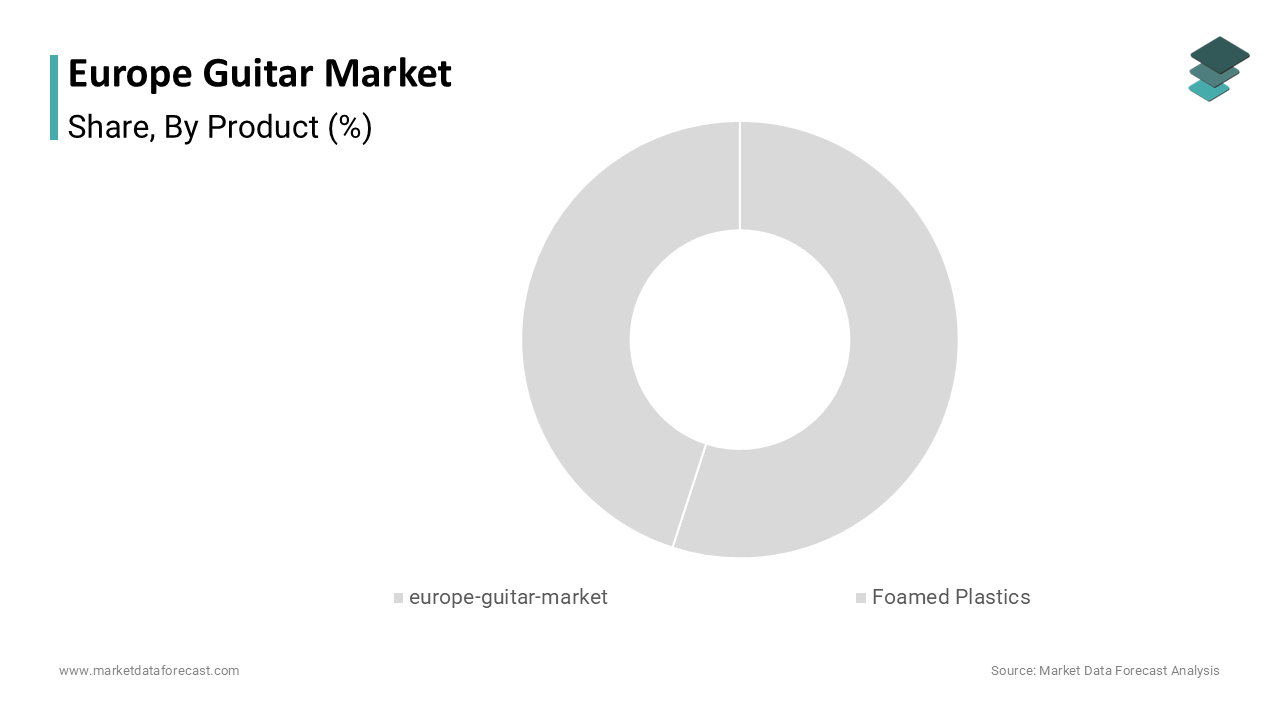
The acoustic guitars segment held 62.3% of the Europe guitar market share in 2024 with their widespread adoption in formal music education community ensembles and beginner instruction due to their simplicity portability and absence of external amplification requirements. European educational systems consistently prioritize acoustic guitars in school music programs owing to cost efficiency and ease of group instruction. Acoustic guitars remain central to Europe’s diverse folk traditions from flamenco in Spain to Celtic ballads in Ireland and chanson in France.
The electric guitars segment is expected to grow with an anticipated CAGR of 6.8 % during the forecast period. The proliferation of affordable home recording setups has transformed electric guitars into essential tools for online musicians. Platforms like BandLab and Splice report a 41 % year on year increase in electric guitar track uploads from European users. Brands such as Fender and Ibanez have responded with compact modeling amps and USB enabled guitars tailored for digital workflows.
By Distribution Channel Insights
The offline distribution segment was the largest and held 58.3% of the Europe guitar market share in 2024. Physical stores remain dominant due to the tactile and auditory nature of instrument selection where sound quality playability and finish require in person evaluation. Consumers purchasing guitars above 500 euros overwhelmingly prefer in store consultations where trained staff demonstrate tonal differences setup adjustments and maintenance protocols. Specialty retailers such as Schleicher in Germany and Casa Del Luthier in Spain employ certified luthiers who perform custom setups enhancing perceived value.
The online distribution segment is lucratively growing with a CAGR of 9.2% from 2025 to 2033. Leading online retailers have overcome historical barriers of sensory evaluation through immersive digital tools. Thomann’s Germany based 360 degree product viewer and integrated audio samples allow users to hear exact tonal output of each model. Online platforms enable European consumers to access specialized guitars unavailable locally such as custom shop models or vintage reissues is also to bolster the growth of segment.
REGIONAL ANALYSIS
Germany Guitar Market Analysis
Germany held 22.3% of the Europe guitar market share in 2024 with a robust ecosystem of music education manufacturing and live performance. Germany is also home to iconic brands such as Höfner and Framus whose heritage models enjoy global prestige. Additionally, the dual vocational training system produces over 1500 certified instrument technicians yearly ensuring high service standards that reinforce consumer trust in physical retail.
United Kingdom Guitar Market Analysis
The United Kingdom guitar market growth is driven by its influential popular music legacy and dynamic creator economy. Iconic brands like Burns and Gordon Smith maintain niche appeal while retailers such as Andertons leverage YouTube tutorials to drive engagement.
Spain Guitar Market Analysis
Spain guitar market growth is likely to grow with its unparalleled legacy in classical and flamenco guitar craftsmanship. The country produces over 60000 handcrafted guitars annually with Granada Córdoba and Madrid serving as epicenters of luthiery as stated by the Spanish Ministry of Culture. Flamenco was inscribed on UNESCO’s Intangible Cultural Heritage list in 2023 reinforcing institutional support for traditional guitar education.
France Guitar Market Analysis
France guitar market growth is likely to be driven by its emphasis on acoustic and chanson traditions. The country is also a leader in eco conscious instrument manufacturing with brands like Altamira using certified sustainable woods and low emission finishes. Paris Lyon and Marseille host over 200 independent music schools that prioritize nylon string guitars for beginners fostering early adoption.
Italy Guitar Market Analysis
Italy guitar market growth is with strength in classical guitar heritage and regional artisanal production. Italy’s Ministry of Cultural Heritage funds apprenticeship programs that trained 210 new luthiers in 2024 preserving centuries old techniques. The integration of artisanal excellence state support and educational integration sustains a high value niche that contributes disproportionately to market prestige and export earnings.
COMPETITIVE LANDSCAPE
The Europe guitar market features intense competition between global brands artisanal luthiers and regional manufacturers each vying for distinct consumer segments. Global players leverage scale brand recognition and digital ecosystems to dominate the mid and entry level tiers while small workshops compete on heritage authenticity and handcrafted quality in the premium segment. Competition is further intensified by the rise of direct to consumer models and cross border e commerce which lower entry barriers for niche brands. Differentiation hinges on tonal quality material provenance educational support and sustainability credentials. Regulatory compliance particularly regarding timber sourcing and emissions also shapes competitive dynamics as companies invest in certification and transparent supply chains.
KEY MARKET PLAYERS
A few of the major companies in the europe guitar market include
- Fender Musical Instruments Corporation
- Gibson Brands Inc.
- Yamaha Corporation
- Ibanez
- The ESP Guitar Company
- Samick Guitars
- Cordoba Music Group.
Top Players in the Europe Guitar Market
Fender Musical Instruments Corporation
Fender Musical Instruments Corporation maintains a strong presence in the Europe guitar market through its iconic electric and acoustic guitar lines that cater to both professional musicians and beginners. The company has deepened its European footprint by expanding localized digital content including multilingual online lessons and artist collaborations. In 2024 Fender launched a dedicated sustainability initiative in partnership with European luthiers to source certified tonewoods and reduce carbon emissions across its distribution network. These efforts reinforce its brand authority while aligning with EU environmental standards and consumer expectations for responsible manufacturing.
Yamaha Corporation
Yamaha Corporation plays a pivotal role in the Europe guitar market by offering a broad portfolio ranging from entry level student models to premium handcrafted instruments. The company leverages its global R and D capabilities to integrate innovative materials such as A.R.E treated wood into its European product lines enhancing tonal quality and durability. Recently Yamaha strengthened its position by establishing a new training academy in Berlin focused on guitar pedagogy for educators. This initiative supports music education systems across the region and builds long term brand loyalty among institutions and learners.
Cordoba Music Group
Cordoba Music Group has emerged as a leading force in the European classical and nylon string guitar segment through its authentic Spanish inspired designs and artisanal craftsmanship. The company collaborates closely with flamenco artists and conservatories across Spain and Southern Europe to ensure cultural fidelity in its instruments. In 2024 Cordoba inaugurated a heritage workshop in Seville dedicated to limited edition models using traditional construction methods. This move reinforces its reputation as a guardian of Iberian guitar tradition while appealing to collectors and professional performers seeking acoustic authenticity.
Top Strategies Used by the Key Market Participants
Key players in the Europe guitar market employ product innovation through sustainable materials and digital integration to meet evolving consumer preferences. They invest in localized music education partnerships to foster early adoption and brand loyalty among students and institutions. Strategic expansion of e commerce capabilities with augmented reality try on features enhances online conversion and reduces return rates. Companies also emphasize heritage storytelling and artisanal craftsmanship to differentiate premium offerings in a competitive landscape.
MARKET SEGMENTATION
This research report on the Europe Guitar Market is segmented and sub-segmented into the following categories.
By Product
- Acoustic
- Electric
By Distribution Channel
- Offline
- Online
By Region
- North America
- Europe
- Asia Pacific
- Latin America
- Middle East and Africa