- Product Description Description
- Table of Contents TOC
- List of Table & Figure LOT
- Get Free Sample PDF Sample PDF
Market Size, 2025
$10.46 BnMarket Estimate, 2026
$11.51 BnMarket Forecast, 2034
$24.74 BnCAGR, 2026–2034
10.04%Europe Gypsum Board Market Size
The Europe gypsum board market size was valued at USD 10.46 billion in 2025 and is projected to reach USD 24.74 billion by 2034 from USD 11.51 billion in 2026, growing at a CAGR of 10.04%.
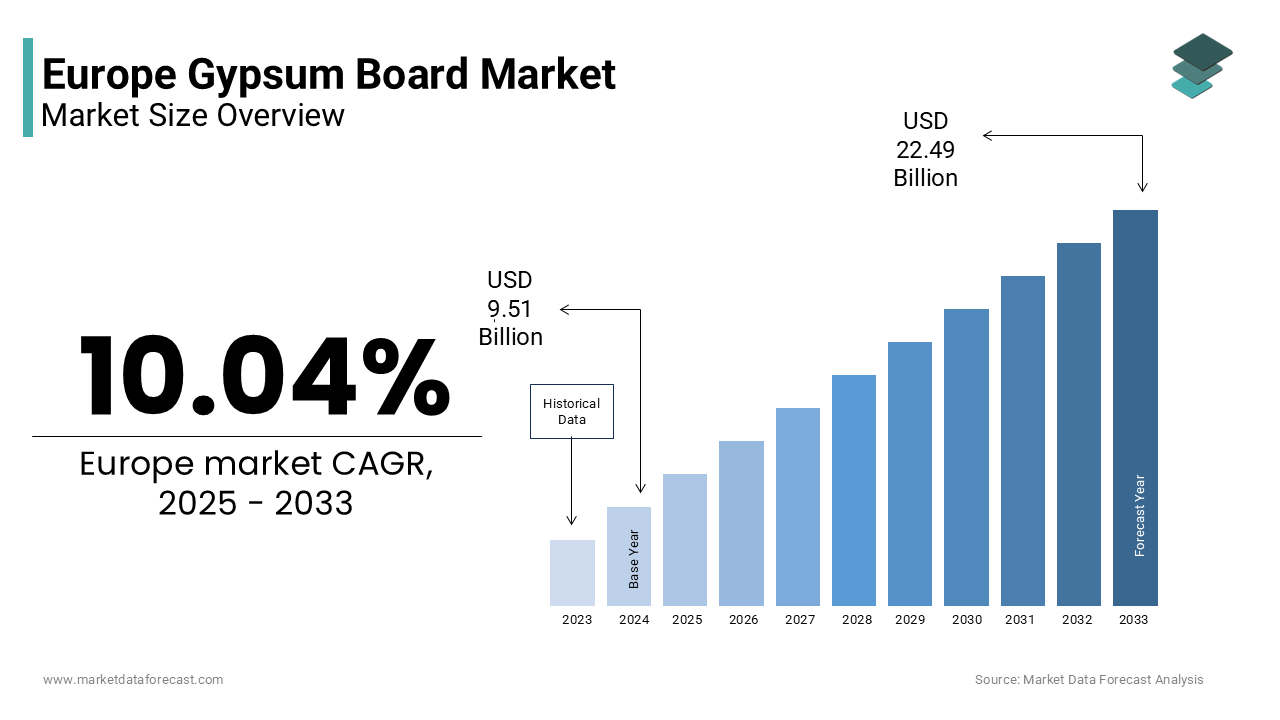
Gypsum board (also known as drywall, plasterboard, or wallboard) is a key building material made from a core of gypsum plaster and water, sandwiched between layers of paper, used extensively for lightweight, fire-resistant interior walls and ceilings in residential, commercial, and industrial construction. These boards are valued for their fire resistance, acoustic insulation and ease of installation, making them a cornerstone of modern drywall systems. Europe’s built environment is undergoing a profound transformation driven by energy efficiency mandates and urban densification. A large portion of existing buildings were built before contemporary energy standards, suggesting a widespread need for upgrades to meet current efficiency targets. Policy aims seek to considerably accelerate energy renovations this decade, impacting millions of buildings. Public and private investment in non-residential construction recently increased, driven by demand in the office, health care, and educational sectors. These structural shifts create a sustained need for interior finishing solutions that align with sustainability codes, fire safety standards, and rapid construction timelines—solidifying gypsum board’s role in Europe’s evolving built landscape.
MARKET DRIVERS
Implementation of the EU Renovation Wave Strategy Accelerates Demand
The European Union’s Renovation Wave Strategy serves as a major driver for the European gypsum board market. This is achieved by mandating deep energy retrofits across millions of existing buildings. The European Commission's Renovation Wave initiative, introduced in 2020, aims to substantially increase the pace of energy-efficient building upgrades across the European Union. This widespread effort seeks a significant increase in the annual renovation rate of buildings to help meet the Union's climate neutrality goals by 2050. A key part of this strategy is the focused effort on improving the least efficient buildings, particularly social housing, to reduce energy consumption and address widespread energy poverty across member nations. Gypsum boards are integral to these retrofits due to their compatibility with insulation systems, vapour barriers and low embodied carbon profiles. A building modernisation funding initiative in one nation has implemented requirements that favour the use of non-combustible interior lining materials, resulting in a preference for gypsum-based products over alternatives. In a second nation, a large-scale renovation support system has shown a pattern where a majority of wall lining projects specify gypsum drywall systems. These policy mechanisms convert regulatory ambition into tangible construction activity. Unlike new builds, which fluctuate with economic cycles, renovation is now a state-funded priority, ensuring consistent demand for interior finishing materials that meet strict thermal, acoustic and fire performance criteria, positioning gypsum boards as a default solution in Europe’s decarbonization roadmap.
Growth in Non-Residential Construction Projects
The expansion of healthcare education and logistics infrastructure across Europe is generating robust demand for gypsum board systems in institutional and commercial settings, which in turn boosts the expansion of the European gypsum board market. There is an observable pattern of increased non-residential construction activity within the European region, notably within the medical and healthcare sectors. The expansion in healthcare infrastructure appears linked to regional health system enhancements and demographic shifts. In primary care developments, material choices for internal divisions show a consistent preference for systems that meet fire safety standards. Within southern and eastern territories, there has been a focus on new educational and research facilities, where material specifications are often driven by acoustic requirements and assembly speed. The construction of new logistics and warehousing space also represents a significant portion of building volume, with modular interior systems being a common feature for internal office spaces. These projects prioritise speed of execution, fire safety, and internal zoning, attributes inherently delivered by modern gypsum board assemblies, making them indispensable in Europe’s institutional construction pipeline.
MARKET RESTRAINTS
Volatility in Raw Material and Energy Constraints Production Economics
Persistent pressure from fluctuating input costs, particularly natural gypsum feedstock and natural gas used in calcination processes, restricts the growth of the European gypsum board market. The primary material for the industry is sourced domestically, subject to evolving regional regulations. Procurement of this raw material is experiencing increased constraints due to environmental and extraction policies. Concurrently, a pattern of elevated operational costs, particularly for energy, has been observed, directly affecting the essential manufacturing step requiring high heat. This rise in energy expenditure constitutes a significant and growing portion of the overall cost of production. More information is available on this topic. These cost pressures squeeze margins, particularly for smaller producers lacking hedging mechanisms, and discourage investment in capacity expansion despite strong end-user demand, which creates a supply constraint that undermines market fluidity.
Stringent Fire and Acoustic Performance Regulations Increase Compliance Burden
Evolving building codes present increasingly complex performance demands, challenging the formulation and certification of gypsum boards, even though they inherently meet many EU safety standards, which constrains the expansion of the European gypsum board market. Fire classification methodologies have shifted, requiring multi-layer assemblies to demonstrate structural integrity under realistic fire condition simulations rather than relying on laboratory testing methods. Public building interior wall systems are now subject to new regulatory requirements, necessitating full-scale fire testing for product validation, which adds to the validation timeline. Acoustic standards show a pattern of tightened requirements for hospitals and schools, requiring higher levels of airborne sound insulation between spaces. Analysis suggests a percentage of existing gypsum board systems may not meet updated acoustic thresholds without supplementary components. These technical shifts force manufacturers to reformulate core additives, adjust board density, type and redesign assembly protocols, increasing R and D costs and slowing time to market. For smaller regional producers lacking testing infrastructure, compliance becomes a significant barrier to public sector tenders, which account for a portion of non-residential demand.
MARKET OPPORTUNITIES
Integration of Recycled Content and Circular Economy Practices
The shift toward circular construction models provides a significant opportunity for the European gypsum board market. This paves the way for manufacturers to differentiate through sustainability leadership. Gypsum is inherently recyclable, and post-consumer waste such as demolition debris can be reprocessed into new boards without performance loss. There has been an increase in the volume of used gypsum materials collected and processed for reuse across the region. One country has established a collaborative agreement that contributes to a high rate of collection for construction and demolition materials containing gypsum. Producers are developing and introducing specific product lines that incorporate a substantial amount of reprocessed content, meeting established criteria for ecological certification. Manufacturers have also initiated programs aimed at recovering used materials from active construction and renovation areas for reprocessing into new products. The European Commission’s Circular Economy Action Plan further incentivises such initiatives by granting green public procurement advantages to products with verified recycled content. This alignment of policy infrastructure and industrial innovation transforms waste into a strategic resource, which opens new revenue streams and reinforces brand credibility in an increasingly eco-conscious market.
Expansion of Prefabricated and Modular Construction Systems
The rapid adoption of off-site construction methods across the region creates a potential growth avenue for specialised gypsum board solutions integrated into factory-built modules, which is expected to drive the growth of the European gypsum board market. An observable shift in construction approaches indicates a greater use of volumetric modular systems in multi-family housing. A pattern of increased utilisation is also apparent for these systems in student accommodation developments across multiple locations. Certain regions are demonstrating leadership in adopting and incorporating these construction techniques. These systems require lightweight yet dimensionally stable interior linings that can withstand transportation and rapid on-site assembly. Gypsum board manufacturers have developed reinforced and moisture-resistant variants specifically for modular envelopes. Collaborations between building material manufacturers and modular construction firms have led to the development of specialised partition systems designed for off-site integration. The pre-installation of interior systems within factory-controlled environments has streamlined the construction process by shifting labour requirements away from the primary building site. Regional policy initiatives are increasingly emphasising the use of standardised interior finishes that combine multiple performance characteristics, such as fire resistance and acoustic insulation. The implementation of specific technical criteria for public housing projects has encouraged the adoption of advanced composite materials to meet rigorous performance benchmarks. The trend toward integrated modular solutions reflects a broader industry shift toward enhancing efficiency through pre-engineered and certified internal components. This trend shifts gypsum boards from a commodity finish to an engineered component within a precision manufacturing workflow. Modular buildings' growing role in European housing, driven by urban and emergency needs, means the requirement for tailored gypsum solutions will soon outpace traditional construction demands.
MARKET CHALLENGES
Fragmentation of Building Codes Across Member States Hinders Standardisation
Significant discrepancies in national building regulations continue to impede pan-European product deployment for gypsum board manufacturers, despite EU harmonisation efforts, which inhibit the growth of the European gypsum board market. Fire resistance duration,, acoustic insulation requirements,, ts vapourapor permeability thresholds vary notably between countries such as Germany,, France and Poland. There continues to be significant variation in how different European Union member states interpret and apply interior wall performance criteria, hindering a truly uniform single market. This forces manufacturers to maintain multiple product certifications and technical dossiers, increasing compliance costs and delaying market entry. For example, a construction product, such as a gypsum board system, approved for use in a hospital in one EU country, like Spain, often faces different or additional national testing and approval processes to meet the specific technical standards, such as those in Germany, before it can be used there. Public procurement tenders often exacerbate fragmentation by inserting country-specific clauses. Reports indicate that a substantial number of cross-border construction bids, particularly those involving interior systems, are often challenged or disqualified due to persistent mismatches in national regulations and technical standards within the European Union. This regulatory patchwork undermines economies of scale, discourages innovation among SMEs, and complicates supply chain planning, which limits the market’s ability to respond cohesively to continent-wide challenges like decarbonization and housing shortages.
Competition from Alternative Low-Carbon Interior Materials
Intense pressure from emerging bio-based and low embodied carbon alternatives that align more closely with net zero construction goals slows down the expansion of the European gypsum board market. Materials such as mycelium panels, hemp lime board, ds, and compressed wofibreber boards are gaining traction in pilot projects funded by EU green building programs. Conventional interior lining materials exhibit a carbon footprint derived from manufacturing and processing methods. Lifecycle assessments have prompted a closer examination of the environmental impact associated with traditional gypsum-based products. Alternative building panels composed of agricultural by-products demonstrate a notably lower level of embodied carbon compared to standard industry options. The shift toward bio-based materials reflects an evolving pattern in material selection aimed at reducing the carbon intensity of interior construction. Comparative analyses indicate that utilising straw-based substrates can alter the environmental profile of interior wall systems. These substitutes do not yet match gypsum in fire safety and soundproofing capabilities, but are strongly supported by current policy initiatives. The EU’s Level(s) framework for sustainable buildings now requires whole life carbon reporting for all public projects, incentivising specifiers to trial novel materials. Though gypsum remains dominant, its long-term position is challenged by this innovation wave, forcing incumbents to accelerate decarbonization of their own production to retain specification preference in an increasingly climate-conscious built environment.
REPORT COVERAGE
| REPORT METRIC | DETAILS |
| Market Size Available | 2025 to 2034 |
| Base Year | 2025 |
| Forecast Period | 2026 to 2034 |
| CAGR | 10.04% |
| Segments Covered | By Product Type, End User Industry, and Region |
| Various Analyses Covered | Global, Regional, & Country Level Analysis; Segment-Level Analysis; DROC, PESTLE Analysis; Porter’s Five Forces Analysis; Competitive Landscape; Analyst Overview of Investment Opportunities |
| Regions Covered | UK, France, Spain, Germany, Italy, Russia, Sweden, Denmark, Switzerland, Netherlands, Turkey, and the Czech Republic |
| Market Leaders Profiled | Saint Gobain, Georgia-Pacific LLC, Knauf, Etex Group, Fermacell, Continental BP, Hengshenglong, Holcim Ltd, National Gypsum Services Company, and Osman Group |
SEGMENTAL ANALYSIS
By Product Type Insights
The wallboard segment dominated the European gypsum board market and accounted for a 62.6% share in 2025. The dominance of the wallboard segment is driven by its foundational role in interior partitioning across all building typologies, residential, commercial and institutional. Unlike ceiling or decorative boards, drywall wallboards are indispensable in virtually every drywall installation, serving as the primary structural and fire-rated surface for vertical enclosures. An additional driver is Europe’s extensive renovation activity mandated under the EU Renovation Wave Strategy, which targets deep energy retrofits of millions of buildings by 2030. Building upgrades require adaptable interior partitions that complement thermal insulation systems. There is an observed increase in the use of interior wall reconfigurations for residential properties across a specific region. The implementation of specific construction materials, such as certified wallboard systems, has become a standard specification for these renovations. Regulatory changes in certain areas necessitate improved sound dampening between separate living spaces within a single building structure. Compliance with new building rules often involves the use of specialised, layered wall systems to meet acoustic performance requirements. These regulatory and functional imperatives ensure wallboards remain the default interior solution across Europe’s built environment. The compatibility of wallboards with off-site and modular construction, a rapidly growing segment in European building practices, also contributes to the growth of this segment. Wallboards are ideal for this application due to their dimensional stability, lightweight nature, and ease of mechanical fixing. Companies like Knauf and Saint-Gobain have developed reinforced edge profiles and moisture-resistant variants specifically for modular envelopes. This shift from traditional stick-built to precision-manufactured interiors cements wallboard’s centrality not just as a material but as an integrated component in modern construction workflows, which sustains its market dominance well into the forecast period.
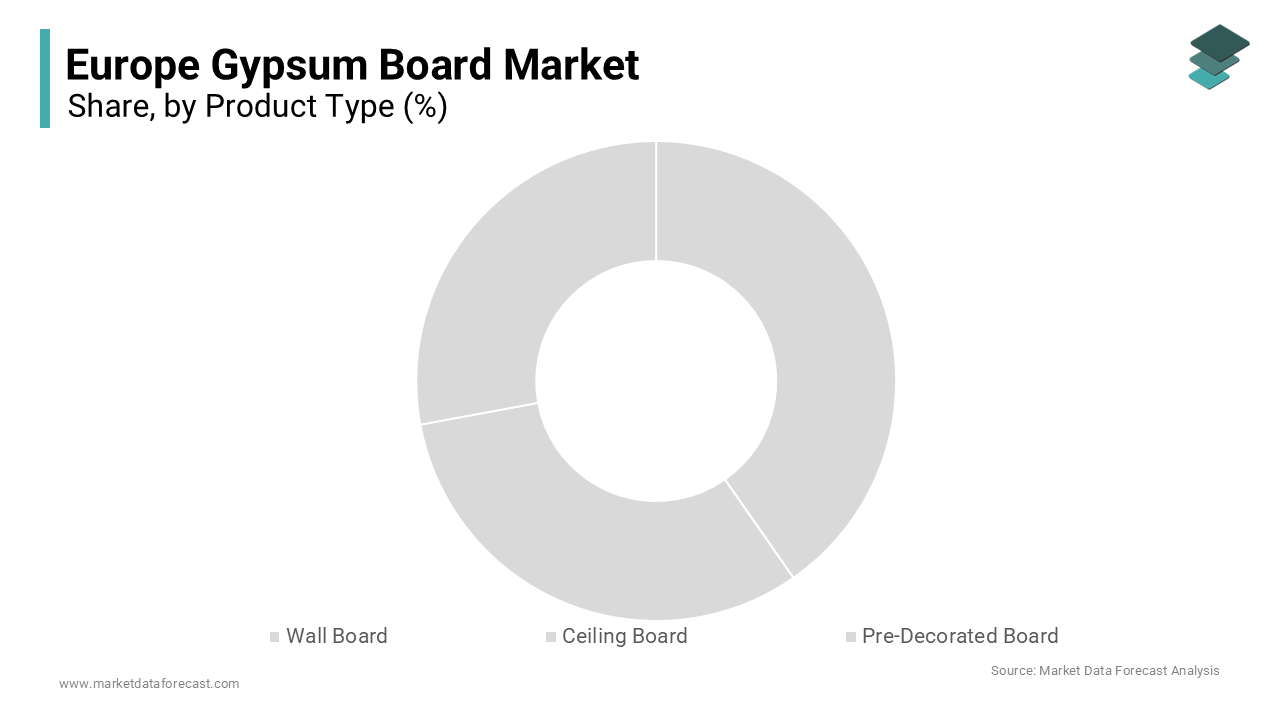
The pre-decorated gypsum board segment is likely to experience the fastest CAGR of 7.2% from 2026 to 2034 due to rising demand for time and labour-efficient finishing solutions in both renovation and new build sectors. Pre-decorated boards arrive at construction sites with factory-applied finishes such as vinyl wallpaper, textured coating, or digital prints, eliminating the need for on-site painting, taping and sanding. In an era of acute skilled labour shortages, this advantage is critical. A significant shortage of skilled labour across various trades is impacting the capacity of the construction sector. Specialised interior finishing roles have become particularly difficult for firms to fill. Small-scale contractors are increasingly adopting integrated building materials to mitigate personnel deficits. The use of pre-finished components is becoming a standard practice to accelerate completion schedules in renovation projects. Operational strategies are shifting toward products that minimise on-site labour requirements and streamline project phases. This efficiency aligns perfectly with public housing programs under pressure to deliver units rapidly. In addition, a complementary driver is the growing emphasis on indoor air quality and low-volatile organic compound interiors. Unlike traditional paint systems, organic compounds (VOCs) for wood-decorated boards use U, UV-cured or water-based laminates that meet stringent EU Ecolabel and EMICODE certifications. Furthermore, aesthetic versatility is expanding adoption beyond cost-driven projects. Designers in Milan and Copenhagen increasingly use digitally printed boards featuring custom patterns or acoustic perforations for boutique hotels and coworking spaces. Manufacturers have launched online configurators allowing architects to upload artwork and receive finished panels in under ten days. This fusion of speed, sustainability, and design freedom positions pre-decorated boards as the innovation frontier in Europe’s interior solutions market.
By End User Industry Insights
The residential segment led the European gypsum board market and captured a share of 48.7% share in 2025. The leading position of the residential segment is attributed to the pervasive use of gypsum boards in interior wall and ceiling systems across single-family homes, apartments, and social housing units. An important accelerator of this segment is the European Union’s sustained push for affordable energy-efficient housing. A consistent, elevated goal for constructing new residential units is evident across national housing programs. Significant financial investment is backing large-scale initiatives designed to increase the overall number of homes in one region. In another area, a program that encouraged extensive property improvements, often including interior surface upgrades, has been extended. These policy levers convert fiscal support into tangible construction demand. A further growth factor is urbanisation and the shift toward high-density living. According to sources, a notable share of Europeans now reside in urban areas, a figure projected to rise through 2030. This concentration fuels demand for multi-story residential buildings where gypsum boards offer fire-rated compartmentalisation, acoustic separation, and rapid installation, key requirements in vertical developments. Furthermore, the renovation of ageing housing stock requires interior drylining to meet modern thermal and safety standards. Gypsum boards are the material of choice for such retrofits due to their compatibility with insulation and minimal structural impact. These demographic, regulatory, and technical forces ensure the residential sector remains the bedrock of gypsum board consumption in Europe.
The institutional segment is on the rise and is expected to be the fastest growing segment in the market by witnessing a CAGR of 6.8% during the forecast period, owing to intensified public investment in education, health care and civic infrastructure. This expansion is propelled by post-pandemic health system reinforcement and demographic pressures on public services. Large-scale financial allocations across numerous European nations are increasingly directed toward the modernisation of healthcare infrastructure and the construction of new medical facilities. The development of primary care centres is incorporating specific building materials designed to meet rigorous national safety standards for fire and moisture resistance. New academic construction projects are prioritising interior design attributes such as acoustic separation and the ability to perform rapid fit-outs. Modern gypsum partition systems are being utilised as a standard solution to address technical requirements for safety, sound insulation, and construction efficiency. Strategic investments in regional infrastructure continue to emphasise the integration of functional interior materials that align with contemporary safety and operational needs. A different driver is the integration of sustainability mandates into public procurement. The EU’s Green Public Procurement criteria now require all new institutional buildings to achieve near-zero energy performance and use low embodied carbon materials. Gypsum boards qualify due to their high recycled content potential and compatibility with circular construction models. Furthermore, institutional projects increasingly demand prefabricated interior systems to minimise disruption in operational environments such as schools and hospitals. Pre-assembled gypsum wall cassettes installed in days rather than weeks are now standard in renovation tenders issued by France’s Ministry of National Education. This convergence of regulatory urgency, operational efficiency, and environmental compliance positions the institutional sector as Europe’s highest growth corridor for advanced gypsum board applications.
REGIONAL ANALYSIS
Germany Gypsum Board Market Analysis
Germany was the top performer in the European gypsum board market and accounted for a 22.6% share in 2025, with its status as the continent’s largest construction economy and a pioneer in energy-efficient building standards. The country’s market status is defined by rigorous implementation of the Energy Saving Ordinance, which mandates interior drylining in nearly all residential retrofits to achieve the required U values. There has been a growing emphasis on energy-efficient renovation in Germany, driven by high energy prices and political pressure to make buildings climate-neutral by 2045, suggesting an increase in modernisation activities. Industrial demand is equally robust, with logistics and automotive facilities expanding in response to nearshoring trends. Moreover, Germany’s dual vocational training system ensures a steady supply of skilled drywall installers, maintaining high installation quality and material utilisation rates. This combination of regulatory depth, industrial activity and workforce readiness sustains Germany’s position as the anchor market for gypsum board consumption in Europe.
France Gypsum Board Market Analysis
France was the next prominent country in the European gypsum board market by capturing a share of 19.8% share in 2025. The growth of the French market is driven by large-scale urban development projects and proactive housing policies. The country’s market status is uniquely shaped by preparations for the 2025 Olympic Games, which triggered massive infrastructure investment. The cost of residential construction has remained elevated after a sharp increase in early 2021. Ongoing market demand is sustaining these elevated construction costs. Significant financial commitments are supporting major urban development projects. A substantial number of new private and public residences are under construction alongside large-scale sporting event facilities. Extensive regional infrastructure expansion is proceeding with the creation of new transit hubs. These new transit facilities require specialised interior building materials designed for both moisture and fire resistance. The Housing First Plan further stimulates private renovation through streamlined permits and subsidies. These coordinated public investments create a multi-year pipeline of gypsum-intensive projects, ensuring France’s continued prominence in the regional market.
United Kingdom Gypsum Board Market Analysis
The United Kingdom witnessed a steady growth in the European gypsum board market due to its post-Brexit housing agenda and institutional renewal programs. The country’s market status is characterised by a dual focus on volume housing and public infrastructure. A significant financial commitment has been observed towards constructing a large volume of new housing units and improving educational and healthcare facilities, a trend that suggests a correlated increase in demand for interior wall materials. The initiation of major private-sector developments, such as the construction of high-rise residential towers in urban centres, exemplifies the considerable scale of current building activities. Recent changes to building regulations have established more stringent fire safety standards for buildings designed for multiple occupants, necessitating the use of enhanced fire-rated internal lining systems in communal areas like corridors and stairwells. An analysis of new residential developments indicates that a large majority of projects now incorporate double-layer fire-rated boards, highlighting a broad shift in material specifications across the industry. This regulatory tightening, combined with ambitious delivery targets, ensures steady and compliant gypsum board consumption across England, Scotland and Wales.
Italy Gypsum Board Market Analysis
Italy expanded gradually in the European gypsum board market owing to its dynamic renovation incentives and Mediterranean construction patterns. The country’s market status was significantly bolstered by the Superbonus 110 per cent tax deduction, which the government extended through mid-2022 to stimulate private investment in energy retrofits. The implementation of a specific policy correlates with a notable increase in renovation applications, where interior drylining appears as a consistent element in submissions. Demand for related materials remains elevated even after program timeline adjustments, as previously approved projects continue towards completion. The existing age of regional buildings indicates a need for broad structural and thermal enhancements to align with current standards. Gypsum board is often employed as a non-structural method to support these necessary building improvements. Urban centres like Milan and Rome are also witnessing a surge in boutique hotel and coworking space conversions, where pre-decorated boards offer rapid aesthetic transformation. This blend of policy legacy, structural need, and adaptive reuse sustains Italy’s robust gypsum board market.
Spain Gypsum Board Market Analysis
Spain is anticipated to grow in the European gypsum board market from 2026 to 2034 due to tourism-linked construction and municipal urban regeneration. The country’s market status benefits from a strong recovery in the hospitality and residential sectors following the pandemic downturn. Approvals for new residential structures have increased to a level not seen in a significant period. This upward trend in construction is associated with an influx of individuals from other countries and a rise in remote workers relocating to the region. Cities in coastal areas are seeing an expansion in accommodation designed for brief occupancy, which creates demand for rapid completion of interior spaces using efficient construction materials. A government program supporting affordable residences has led to significant developments in specific inland and coastal cities, characterised by the use of standardised interior wall systems in large-scale construction projects. Moreover, Spain’s warm climate encourages lightweight construction methods to minimise thermal mass, making gypsum boards preferable to masonry for interior walls. These economic, demographic, and climatic factors converge to position Spain as a high-velocity and growing market within Southern Europe’s gypsum board landscape.
COMPETITIVE LANDSCAPE
Competition in the European gypsum board market is characterised by a consolidated landscape dominated by globally integrated manufacturers who compete on performance innovation and sustainability rather than price alone. Companies such as Saint-Gobain Knauf and Etex leverage decades of regional presence to align product development with stringent EU building codes on fire safety, energy efficiency, and indoor air quality. The market rewards those who offer end-to-end solutions, including technical design, support, installation, training and recycling services rather than standalone products. While entry barriers remain high due to capital intensity and regulatory complexity, ty and established distribution channels, smaller regional producers differentiate through niche formulations or localised service. Competition is further intensified by the shift toward off-site construction, which demands precision-engineered boards compatible with modular systems. In this environment, leadership is sustained not by volume but by the ability to embed gypsum boards into holistic building ecosystems that meet Europe’s decarbonization and urbanisation imperatives.
KEY MARKET PLAYERS
Some of the notable key players in the European gypsum board market are
- Saint Gobain
- Georgia-Pacific LLC
- Knauf
- Etex Group
- Fermacell
- Continental BP
- Hengshenglong
- Holcim Ltd
- National Gypsum Services Company
- Osman Group
Top Players in the Market
- Saint-Gobain is a leading force in the European gypsum board market through its extensive portfolio of plasterboard solutions under brands like Gyproc and Placo. The company integrates sustainability into its core operations by promoting circular construction and using recycled gypsum in board manufacturing. Globally, Saint-Gobain leverages its European innovations in fire-resistant and acoustic boards to set performance benchmarks across North America and Asia. Its R and D centres in France and Germany continuously advance lightweight and low-carbon board technologies, reinforcing its influence as a global standard setter in interior building systems.
- Knauf maintains a strong presence in the European gypsum board market with a vertically integrated production network spanning several countries on the continent. The company emphasises energy efficiency and digitalisation in its manufacturing processes and offers specialised boards for modular construction and high-humidity environments. Knauf has expanded its circular economy initiatives by operating dedicated gypsum recycling plants in Germany, the Netherlands, and Poland, recovering construction waste for new board production. On the global stage, Knauf exports European engineered solutions to emerging markets in the Middle East and Latin America, where regulatory frameworks increasingly mirror EU standards. Its commitment to technical training and installer certification also strengthens long-term product and brand trust across diverse geographies.
- Etex Group contributes significantly to the European gypsum board market through its focus on fibre-reinforced cement and gypsum composite systems under the Promat and ETEX brands. The company targets high-performance applications in institutional and industrial sectors where fire protection and durability are critical. Etex has invested in digital tools that enable architects and contractors to simulate board performance in real-world fire and acoustic scenarios, enhancing specification accuracy. Globally, Etex deploys its European-developed fire-rated systems in data centres, hospitals and transport infrastructure worldwide, aligning international projects with European safety norms. Its sustainability roadmap includes achieving carbon-neutral production at all European plants by 2030, further solidifying its reputation as an innovator in resilient and responsible building materials.
Top Strategies Used by the Key Market Participants
Key players in the European gypsum board market prioritise sustainability by increasing recycled content and establishing closed-loop gypsum collection systems to comply with EU circular economy mandates. They invest in product differentiation through fire-resistant moisture moisture-resistant, acoustic-enhanced boards tailored to specific end-user needs. Strategic joint ventures and acquisitions enable geographic expansion and access to local distribution networks, particularly in Southern and Eastern Europe. Companies also enhance digital engagement by offering BIM-compliant design tools and online configurators that streamline specification and procurement. Furthermore, they strengthen technical support through installer training programs and on-site application guidance to ensure proper installation and long-term performance. These strategies collectively reinforce brand loyalty, regulatory alignment and market responsiveness in a region where building standards and environmental expectations continue to evolve rapidly.
MARKET SEGMENTATION
This research report on the European gypsum board market has been segmented and sub-segmented based on categories.
By Product Type
- Wall Board
- Ceiling Board
- Pre-Decorated Board
By End User Industry
- Residential
- Commercial
- Institutional
- Industrial
By Country
- UK
- France
- Spain
- Germany
- Italy
- Russia
- Sweden
- Denmark
- Switzerland
- Netherlands
- Turkey
- Czech Republic
- Rest of Europe