- Product Description Description
- Table of Contents TOC
- List of Table & Figure LOT
- Get Free Sample PDF Sample PDF
Market Size, 2025
$5.48 BnMarket Estimate, 2026
$5.81 BnMarket Forecast, 2034
$9.32 BnCAGR, 2026–2034
6.09%Executive Summary: Europe Hair Color Market
- Market Scope: European hair color and personal care market analysis covering product types, formulation categories, consumer end-user segments, regional leadership frameworks, and adoption metrics.
- Market Valuation: Valued at USD 5.48 billion (2025), estimated at USD 5.81 billion (2026), and projected to reach USD 9.32 billion by 2034, growing at a robust CAGR of 6.09% (2026–2034).
- Primary Growth Drivers: Personalized beauty and visual identity trends, increasing at-home hair coloring, clean/plant-based formulations, and the integration of AI and augmented reality into personalized shade selection. Key operational trends include concentrated opportunities around ammonia-free and plant-derived dyes, waterless delivery systems, virtual try-on technologies, and AI-powered color matching, balanced against stringent EU cosmetic regulations and rising consumer scrutiny of synthetic ingredients.
Key Market Segment Metrics (2026–2034)
| Category | Leading Segment (2025 Position) | Fastest-Growing Segment |
|---|---|---|
| By Product | Permanent hair color (held the largest product share in 2025) | Temporary hair color (projected to register the fastest 9.2% CAGR from 2026 to 2034) |
| By Formulation / Category | Conventional category (held a significant leading share) | Organic and natural hair color (forecast to expand at a 12.4% CAGR) |
| By End User | Female consumers (dominated the end-user segment) | Male segment (projected to grow at an 11.8% CAGR over the forecast period) |
| By Region | Germany (led the European market with an 18.5% share in 2025, supported by high disposable income, advanced retail infrastructure, and strong personal-care demand) | France (ranked second with a 15.2% share in 2025; identified as a dynamic growth hub driven by established beauty culture, professional salon engagement, and sophisticated shade preferences) |
Major Market Players & Market Structure
Market Structure: Highly competitive European hair color landscape featuring 18 named market leaders competing on ammonia-free formulations, AI/AR shade trials, e-commerce expansion, recyclable packaging, waterless formats, and bio-based dye innovations.
Key Companies: L'Oréal SA, Henkel AG & Co KGaA, Coty Inc., Revlon Inc., Kao Corp., Wella Operations US LLC, Davines S.p.A., Keune Haircosmetics, Korres, Sodalis Group, and Tricobiotos S.p.A.
Europe Hair Colour Market Size
The European hair colour market size was valued at USD 5.48 billion in 2025 and is projected to reach USD 9.32 billion by 2034 from USD 5.81 billion in 2026, growing at a CAGR of 6.09%.
Hair colour refers to a technique that applies a single shade uniformly from roots to tips, covering the entire head. In 2026, consumer attitudes toward personal grooming and visual identity continue to evolve, underpinned by shifting sociocultural norms and digital influenceUrbanisationnn and the proliferation of social media aesthetics have intensified self-presentation norms, particularly among younger demographics in Western and Northern Europe. Regulatory frameworks remain instrumental in shaping ingredient safety and labelling standards by fostering consumer trust while simultaneously pressuring manufacturers to reformulate products. The market is further supported by strong national preferences, with countries like Germany, France, and Italy accounting for a notable share of total regional consumption driven by both mature retail infrastructure and high per capita spending on personal care.
MARKET DRIVERS
Rising Demand for Personalised Beauty and Visual Identity Expression
Consumer desire for individualised appearance and self-expression has emerged as a key factor driving the growth of the European hair colour market. Unlike standardised beauty norms of previous decades, contemporary users increasingly view haicolour as a dynamic tool for identity articulation rather than mere cosmetic maintenance. This shift is especially pronounced among Generation Z and Millennials, who prioritise visual uniqueness and social media presence. Social media platforms amplify this trend. The rise of virtual try-on technologies further lowers the barrier to experimentation. Salon professionals corroborate this trend, noting that a share of colour service requests include custom-blended fashion-forward shades rather than conventional brown or blonde tones. Brands are responding by expanding shade libraries and investing in AI-driven personalisation tools, and thereby converting aesthetic curiosity into sustained product engagement and repeat purchases.
Growing Penetration of At-Home Hair Colouring Solutions
Convenience and cost efficiency have propelled the expansion of the European hair colour market. Consumers are increasingly opting for retail alternatives that offer comparable results at a fraction of the price. The pandemic accelerated this shift with a year-on-year surge in at-home hair dye sales across the region, which has since stabilised. Enhanced product formulations now deliver improved grey coverage and longevity, which narrows the performance gap with salon services. Retailers have capitalised on this demand by dedicating expanded shelf space and in-store digital consultation kiosks to guide selection. Besides, subscription-based colour refresher kits are gaining traction with companies launching recurring delivery models that cater to maintenance cycles. This self-service model aligns with broader European consumer preferences for autonomy and value-driven personal care routines.
MARKET RESTRAINTS
Stringent EU Cosmetic Regulations Limiting Ingredient Flexibility
The European Union’s rigorous regulatory environment for cosmetic products constrains the growth of the European hair colour market. This regulatory stringency forces brands to reformulate products frequently, often compromising colour or vibrancy, longevity, or application ease. Consequently, manufacturers face elevated R and D costs and extended time to market cycles. Smaller brands in particular struggle to absorb these compliance burdens, encompassing regulatory testing and documentatioaccountingnt for a portion of total product development expenses for independent colour lines. These safety measures, while beneficial for the consumer, restrict creative development and limit the spectrum of shade offerings, particularly for vibrant, long-wear fashion colours that require sophisticated chemical formulations. The regulatory gap between the EU and other regions further complicates global product harmonisation strategies for multinational firms.
Heightened Consumer Awareness of Health and Environmental Risks
European consumers are increasingly scrutinising products for potential health and ecological impacts, which leads to demand volatility and scepticism and thereby hinders the expansion of the European colour market. Public concern centres on allergens such as paraphenylenediamine PPD and resorcinol, which are linked to contact dermatitis and endocrine disruption. Moreover, environmental consciousness is reshaping purchasing behaviour, with a portion of French and Scandinavian consumers stating they avoid products containing non-biodegradable synthetic dyes. This has spurred a rapid migration toward certified natural or organic alternatives, yet such products often face efficacy challenges, particularly in greasy coverage. Social media amplifies these concerns with viral content highlighting ingredient risks often outpacing scientific consensus. As a result, brands must invest heavily in transparency initiatives such as full ingredient disclosure and third-party eco certifications, while simultaneously managing expectations around performance trade-offs. This dual pressure complicates product development and pricing strategies across the market.
MARKET OPPORTUNITIES
Expansion of Clean and Plant-Based Colour Innovations
The growing consumer appetite for sustainable,e non-toxic personal care is opening new opportunities for the growth of the European market. Brands are responding with plant-derived dye ammonia-free formulations, and waterless delivery systems that align with clean beauty principles. Henna-based and indigo formulations are experiencing a revival, particularly in Southern Europe, where traditional botanical practices remain culturally resonant. Regulatory tailwinds further support this shift. Startups are leveraging microbial fermentation to produce vibrant dyes with less water and energy compared to conventional synthesis. Retailers are also adapting, with Sephora Europe dedicating entire shelf zones to certified colour brands. This convergence of consumer ethics, technological advancement, and policy support creates a fertile ground for premium clean hcolourolor offerings to capture share from conventional chemical-based products.
Integration of Augmented Reality and AI for Personalised Colour Matching.
Digital transformation is creating new prospects for the expansion of the European hair colour market. This is driven by hyper-personalised virtual experiences. Augmented reality AR and artificial intelligence AI tools now enable consumers to preview thousands of shades in real time under varying lighting conditions, significantly reducing purchase hesitation. Mobile integration is accelerating adoption. Beyoe-commerce, AR kiosks in pharmacies and beauty stores such as Rossmann and Superdrug are bridging offline and online journeys by allowing in-person experimentation without product waste. These technologies not only enhance user confidence but also generate rich data on regional shade preferences, enabling predictive inventory and targeted product development. The deepening of 5G connectivity and smartphone penetration in Eastern and Central Europe is creating a digital opportunity that will expand further geographically.
MARKET CHALLENGES
Persistent Formulation Challenges in Achieving Long-Lasting Vibrant Non-Natural Shades
European manufacturers continue to face significant technical hurdles in developing vibrant non-natural shades, which impede the growth of the European hair colour market. Intense hues such as electric blue, vivid violet, and neon pink rely on large molecule dyes that struggle to penetrate the hair cortex effectively, resulting in rapid fading often within a few washes. Semi-permanent fashion dyes retained less than n share of their original intensity after many standard shampoo cycles under EU water hardness conditions. This performance gap forces consumers to reapply frequently or combine products with conditioning treatments that may contain restricted ingredients. Moreover, achieving colour consistency across diverse hair types, particularly on previously treated grey hair, r ins problematic. The absence of ammonia and peroxide in many clean formulations further limits oxidative development, constraining the palette to pastel or muted tones. The significant expense associated with microencapsulation and polymer-based delivery systems is a barrier to their mass-market implementation. Consequently, brand loyalty in the fashion colour segment remains low.
Fragmented Consumer Preferences Across European Subregions
Deep fragmentation due to cultural, climatic, and aesthetic norms that vary significantly from North to South and East to West creates barriers to standardised product strategies in the European market. Moreover, Southern European markets such as Italy and Spain exhibit a stronger preference for warm espresso tones and rich reds influenced by Mediterranean heritage and sunlight exposure. Eastern Europe presents yet another dynamic where affordability often outweighs brand prestige, with private label capturing a notable market share. Even within countries, subregional differences ex, such as the higher incidence of bocolour experimentation in urban centres compared to rural areas. This heterogeneity complicates European marketing campaigns and inventory planning. A launch that succeeds in France may underperform in the Netherlands due to differing undertone expectations. Furthermore, regulatory interpretations, labelling, and claims can vary by national competent authorities, adding compliance complexity. Brands must therefore delocalize shade development, packaging, and messaging, which inflates operational costs and delays time to market. Such fragmentation limits economies of scale and poses a persistent strategic challenge for both multinational corporations and emerging indie brands seeking regional penetration.
REPORT COVERAGE
| REPORT METRIC | DETAILS |
| Market Size Available | 2025 to 2034 |
| Base Year | 2025 |
| Forecast Period | 2026 to 2034 |
| CAGR | 6.09% |
| Segments Covered | By Product, Category, End User, Distribution Channel, and Region |
| Various Analyses Covered | Global, Regional, & Country Level Analysis; Segment-Level Analysis; DROC, PESTLE Analysis; Porter’s Five Forces Analysis; Competitive Landscape; Analyst Overview of Investment Opportunities |
| Regions Covered | UK, France, Spain, Germany, Italy, Russia, Sweden, Denmark, Switzerland, Netherlands, Turkey, and the Czech Republic |
| Market Leaders Profiled | L'Oréal SA, Henkel AG & Co KGaA, Coty Inc., Revlon Inc., Kao Corp., Wella Operations US LLC, Davines S.p.A., Keune Haircosmetics, Beauty & Business S.p.A., H.S.A. Hair Styling Applications S.p.A., Famasar Srl, ColorDesign Hair, Laboratoire Native, Antica Erboristeria S.p.A., Farmen International Cosmetics Distribution S.p.A. Elcéa, Korres, Sodalis Group, Tricobiotos S.p.A., and others |
SEGMENTAL ANALYSIS
By Product Insights
The permanent hair colour segment held the largest share of the European hair colour market in 2025. The dominance of the permanent hair colour segment is driven by its long-lasting results and superior coverage, which remain vital for the ageing European demographic. Additionally, technological advancements have significantly improved the safety and conditioning properties of permanent dyes. Major brands continue to invest heavily in R and D to enhance colour longevity and minimise scalp irritation, further reinforcing consumer loyalty. Retailers also allocate prime shelf space to permanent variants due to their higher price points and repeat purchase cycles, which creates a self-reinforcing commercial ecosystem that solidifies this segment’s market leadership.
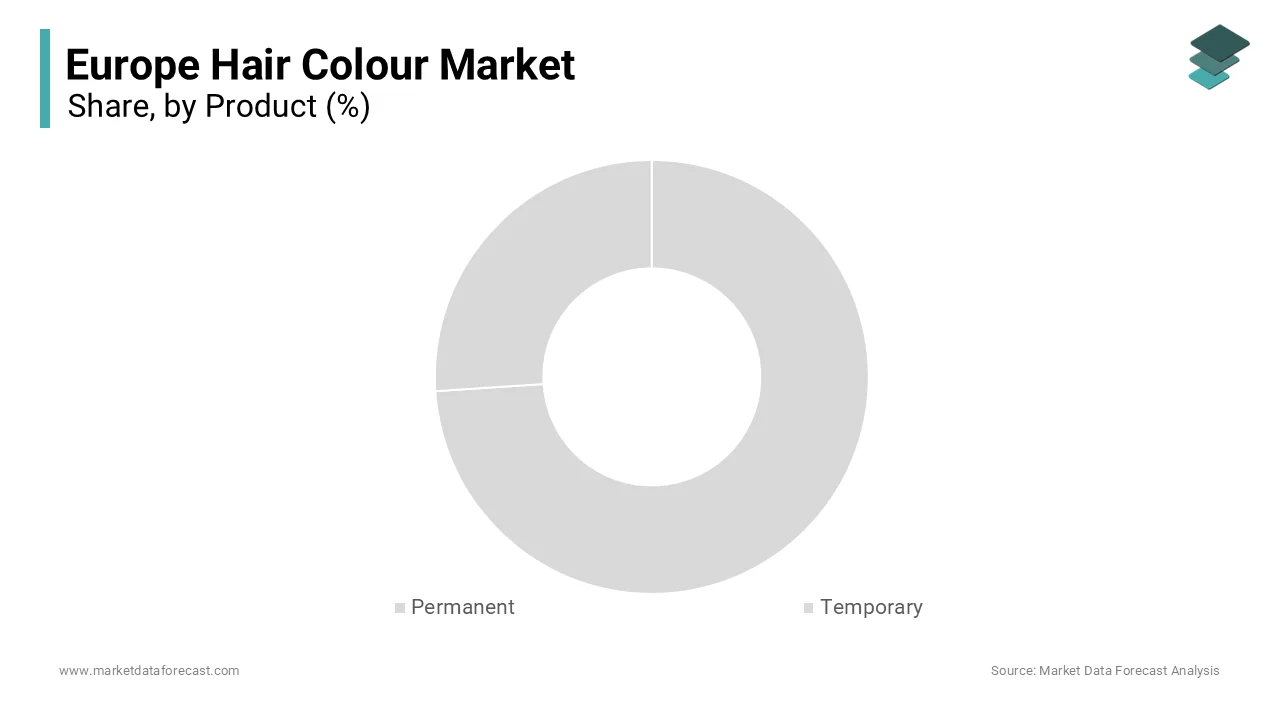
The temporary haicolouror segment is predicted to witness the highest CAGR of 9.2% between 2026 and 2034 due to shifting aesthetics among younger consumers who view hcolourolor as a transient form of self-expression rather than a corrective necessity. The rise of short-form video platforms has intensified visual experimentation. Temporary formats offer zero commitment and minimal chemical exposure, which aligns with clean beauty values while enabling frequent shade rotation. Innovations such as water-resistant spray colour-depositing conditioners, nd biodegradable chalks have expanded usability beyond festivals or costumes. Brands capitalised on this trend with limited edition collections tied to seasonal palettes and influencer collaborations. Furthermore, the absence of PPD and peroxide in most temporary formulas exempts them from stringent EU oxidative dye regulations, which accelerates time to market and encourages niche entrants. This confluence of cultural, regulatory, and product-driven factors underpins the segment’s rapid ascent.
By Category Insights
The conventional segment led the European hair colour market and held a significant share in 2025. The growth of the conventional segment is propelled by performance reliability, extensive shade ranges, and entrenched consumer habits, particularly among middle-aged and older demographics. Conventional oxidative dyes deliver unmatched grey coverage and longevity, critical attributes in a region. Decades of brand trust built by L’Oréal, Henkel, and Procter & Gamble have solidified consumer confidence in established formulations. Retail infrastructure further entrenches this segment. Apart from these, professional salon networks across Europe continue to rely almost exclusively on conventional colour systems due to their predictability and developer compatibility. Despite rising clean beauty sentiment, cost remains a barrier for alternatives. This price differential sustains mass market appeal, especially in price-sensitive Eastern and Southern European markets, where value for money heavily influences purchase decisions.
The organic and natural hair colour segment is estimated to register the fastest CAGR of 12.4% from 2026 to 2,033 owing to the heightened health consciousness and sustainability mandates among European consumers, particularly in Western and Nordic countries. Regulatory alignment with the EU Green Deal further incentivises clean formulations, with Horizon Europe allocating funds for bio-based cosmetic innovation projects. Brands are gaining traction by combining certified organic ingredients with plastic-free packaging. Retailers are responding with dedicated clean beauty aisles. Social media also amplifies trust in nature, with micro influencers showcasing DIY applications and ingredient transparency. Performance challenges remain, but advances in encapsulation and pigmentation stabilisation are quickly narrowing the efficacy gap and enabling faster conversion of new users to loyal customers.
By End User Insights
The female consumers segment dominated tEuropeanope hacolourrlor market and occupied a significant share in 2025. Factors such as deep-rooted cultural norms, grooming expectations, and product design historically tailored to women are fuelling the expansion of the female consumers segment. Hacolourrlor has long been integrated into female beauty rituals. Marketing strategies have reinforced this trend. Apart from these, women are more likely to seek coverage earlier. Retail packaging, shade naming conventions, and in-store displays are optimised for female shoppers, which creates a self-reinforcing commercial environment. Even in the professional salon sector, female clients represent most the the colour service bookings.
The male segment is anticipated to witness the fastest CAGR of 11.8% over the forecast period. The swift growth of the male segment is propelled by evolving masculinity norms, workplace grooming expectations, and digital visibility pressures. The rise of male grooming influencers on platforms like Instagram and YouTube has further destigmatised hair colour, male-focused tutorials generating millions of views across Europe. Brands are responding to masculine-positioned products. Retailers feature men’s hair colour in dedicated grooming sections rather than general beauty aisles, improving accessibility. Moreover, employer wellness programs in countries like Sweden and the Netherlands increasingly include grooming allowances, indirectly supporting malcolourror adoption. This confluence of sociocultural, technological, and commercial shifts is transforming a once-niche behaviour into an aamamainstream malerooming ritual.
REGIONAL ANALYSIS
Germany Market Analysis
Germany outperformed other regions in the European market and accounted for an 18.5% share in 2025. A combination of high disposable income, advanced retail infrastructure, and a pronounced emphasis on personal care within German consumer culture fuels the dominance of colour in the German market. A notable share of German households purchase colour products at least twice annually. The coageing’s ageing population further sustains demand. Germany also hosts major manufacturing and R and D hubs for global players by fostering localised innovation and rapid product iteration. Regulatory compliance is particularly stringent here. The strong presence of drugstore chains such as dm and Rossmann ensures widespread accessibility. Apart from these, Germany’s dominance in sustainability drives demand for eco-friendly formats.
France Market Analysis
France held the second-largest share of the European market at 15.2% in 2025 because its deep-rooted fashion heritage and beauty consciousness make colour an integral component of personal identity. French women, in particular, display high engagement with professional services, with a notable share visiting salons for colour treatments at least quarterly. L’Oréal, headquartered in Clichy, leverages this cultural affinity to drive both mass and premium segment innovation. France also leads in shade sophistication, with consumers favouring nuanced tones like caramel balayage and ash chestnut over basic colours. Regulatory support for clean beauty is robust. E-commerce penetration further amplifies access. Moreover, the integration of colour into wellness rituals, often paired with scalp treatments and hair masks, reflects a holistic grooming philosophy that sustains consistent usage across age groups.
United Kingdom Market Analysis
The United Kingdom is an attractive player in tEuropeanope hacolourrlor market due to a highly diversified consumer base, store-based adoption, and a vibrant salon culture that blends tradition with trend-driven experimentation. British consumers exhibit high openness to bold shades. The UK’s post-Brexit regulatory autonomy has enabled faster approval of novel natural dye ingredients, giving local brands a competitive edge in the organic segment. Boots and Superdrug dominate retail distribution, accounting for a portion of mass market sales and offering in-store convenience on kiosks that boost conversion. Despite economic headwinds, hair colour remains a resilient category. Social media influence is particularly potent here.
Italy Market Analysis
Italy expanded consistently in the European hcolourolor market as Italian consumer preferences are strongly influenced by Mediterranean aestheticfavouringging rich warm tones like espresso brown, auburn, and golden highlights that complement regional skin undertones. Most of Italian hair colour sales consist of permanent demi-permanent formats due to the cultural premium placed long-lastinginnatural-lookinging results. The salon channel remains dominant, contributing a notable share of total colour revenue, which reflects the nation’s artisanal approach to hairdressing. Regional pride also drives local brand loyalty, ty with heritage labels gaining traction in the natural segment. Italy’s urbanisation rate ensures consistent exposure to fashion trends and peer influence. Furthermore, the integration of hair colour into bridal and ceremonial grooming rituals ensures steady seasonal demand peaks. Despite economic constraints in the south, the category demonstrates resilience due to its perceived role in maintaining personal dignity and social presentation.
Spain Market Analysis
Spain is anticipated to grow in Europeanrope hacolourrlor market from 2026 to 2034 due to high sun exposure and a cultural emphasis on vibranhealthy-lookinging h, healthy-looking airhairrhich drives consistent demand fcolourlor refreshing and brassiness correcting products. Spanish consumers show ow strong preference for red and copper tones. The country’s large elderly population sustains robust usage of permanent dyes for grey concealment. Pharmacies play a pivotal distribution role with many of the healthcare units sold through this channel due to consumer trust in pharmacist-guided recommendations. The rise of colour care” hybrids, shampoos and masks pigment-depositing properties, is particularly notable in Spain. Additionally, tourism inflows in coastal regions amplify trend adoption, as visitors bring international colour preferences that local salons quickly assimilate. This blend of climatic, demographic, and cultural dynamics underpins Spain’s stable and distinctive market trajectory.
COMPETITIVE LANDSCAPE
KEY MARKET PLAYERS
Some of the notable key players in the European market are
- L'Oréal SA
- Henkel AG & Co KGaA
- Coty Inc.
- Revlon Inc.
- Kao Corp.
- Wella Operations US LLC
- Davines S.p.A.
- Keune Haircosmetics
- Beauty & Business S.p.A.
- H.S.A. Hair Styling Applications S.p.A.
- Famasar Srl
- ColorDesign Hair
- Laboratoire Native
- Antica Erboristeria S.p.A.
- Farmen International Cosmetics Distribution S.p.A. Elcéa
- Korres
- Sodalis Group
- Tricobiotos S.p.A.
TOP STRATEGIES USED BY THE KEY MARKET PLAYERS
Key players in the European colour market primarily adopt product innovation through clean ammonia-free formulations to align with stringent EU regulations and rising consumer demand for safer products. They heavily invest in digital transformation by deploying AI and augmented reality for virtual shade trials to enhance at-home user confidence. Strategic expansion of e-commerce and omnichannel retail partnerships ensures broader accessibility and seamless customer journeys. Sustainability initiatives such as recyclable packaging, waterless fo, and bio-based dyes are increasingly leveraged to differentiate offerings. Additionally, many companies focus on ocular personalised beauty solutions and localised shade development to address Europe’s diverse aesthetic preferences and fragmented regional demands effectively.
COMPETITION OVERVIEW
The European market features intense competition among multinational corporations and agile niche brands vying for consumer attention amid shifting preferences and regulatory constraints. Established players like L’Oréal, Henk, and Procter & Gamble dominate through extensive distribut, scientific innovation, and brand loya,,lty while clean beauty startups challenge them with transparent formulations and ethical positioning. Competition is further amplified by the convergence of professional and retail segments salon-exclusive technologies enter mass channels. Digital engagement has become a critical battleground with companies investing in virtual-on-ontools and social media-driven content to capture younger demographics. Price sensitivity in Southern and Eastern Europe also pressures premium brands to introduce value-tier lines. Simultaneously, our sustainability compliance allergen-free claims are now baseline expectations rather than differentiators. This dynamic environment demands constant reinvention in formulation marketing and consumer experience to sustain relevance and drive growth across diverse European submarkets.
TOP PLAYERS IN THE MARKET
- L’Oréal maintains a commanding presence in the European colour market through its diversified portfolio spanning mass market Garnier and L’Oréal Paris to professional brands like Matrix and Kérastase. The company leverages deep scientific research in pigment chemistry and scalp health to drive innovation. These initiatives reinforce its commitment to clean beauty while retaining performance excellence. The company’s integrated supply chain and strong retail partnerships further solidify its influence across European consumer and salon channels.
- Henkel is a key player inEuropeanurope hacolourrlor landscape primarily through its Schwarzkopf brand, which bridges professional salons and retail consumers. The company emphasises sustainable formulation and digital engagement to strengthen its regional footprint. It also partnered with leading European beauty retailers to deploy AR-enabled kiosks in stores. Henkel’s investment in biodegradable dye molecules and its collaboration with the Technical University of Berlin on eco-friendly colourants demonstrate its strategic pivot toward environmental responsibility while maintaining colour vibrancy and longevity across its product spectrum.
- Procter & Gamble contributes significantly to the European hair colour market through its Clairol and Herbal Essences,, ds ch ccatersto both conventional and natural colourers. The company has intensified its focus on male grooming and clean formulations in recent years. It also expands its colour-depositing conditioner range under Herbal Essences to include nine new fashion shades targeting Gen Z consumers. Strategic digital campaigns on TikTok and Instagram, coupled wie-commerceroptimisationion have enhanced accessibility and brand relevance across Western and Northern European markets.
MARKET SEGMENTATION
This research report on the European colour market has been segmented and sub-segmented based on categories.
By Product
- Permanent
- Temporary
By Category
- Conventional
- Organic & Natural
By End User
- Male
- Female
By Distribution Channel
- Online
- Offline
By Country
- UK
- France
- Spain
- Germany
- Italy
- Russia
- Sweden
- Denmark
- Switzerland
- Netherlands
- Turkey
- Czech Republic
- Rest of Europe