- Product Description Description
- Table of Contents TOC
- List of Table & Figure LOT
- Get Free Sample PDF Sample PDF
Market Size, 2025
$2.97 BnMarket Estimate, 2026
$3.14 BnMarket Forecast, 2034
$4.94 BnCAGR, 2026–2034
5.82%Europe Hair Dryer Market Size, Growth, Trends & Forecast (2026–2034)
The Europe hair dryer market size was calculated at USD 2.97 billion in 2025, is anticipated to reach USD 3.14 billion in 2026, and is projected to reach USD 4.94 billion by 2034, registering a compound annual growth rate (CAGR) of 5.82% during the forecast period from 2026 to 2034. Driven by advanced hair health technologies, professional salon expansion, stringent EU Ecodesign standards, and the rising adoption of smart beauty tech, the market continues to expand steadily across the region.
Key Executive Metrics (At-a-Glance)
- 2025 Base Valuation: USD 2.97 Billion
- 2026 Current Valuation: USD 3.14 Billion
- 2034 Forecast Valuation: USD 4.94 Billion
- Compound Annual Growth Rate (CAGR): 5.82% (2026–2034)
- Dominant Type Segment: Corded (holding a dominant share in 2025 due to consistent power delivery and salon use)
- Fastest-Growing Type Segment: Cordless (projected at the fastest CAGR of 14.3% from 2026 to 2034)
- Dominant Application Segment: Individual / Household (holding a prominent share in 2025 with near-universal appliance ownership)
- Fastest-Growing Application Segment: Professional (anticipated to grow at a CAGR of 9.8% over the forecast period)
- Dominant Distribution Channel Segment: Offline Retail (capturing a major share in 2025 due to tactile evaluation and physical brand displays)
- Fastest-Growing Distribution Channel Segment: Online (projected at a CAGR of 11.2% driven by D2C brands and digital personalization)
- Regional Highlights: Germany led the market in 2025, capturing 18.6% of the European share due to high household income, strict safety standards, and a dense network of professional salons.
Core Market Drivers
- Consumer Emphasis on Hair Health: Growing preference for ionic, ceramic, and intelligent heat control technologies that minimize thermal cuticle damage.
- Urban Professional Salon Growth: Proliferation of metropolitan salons requiring high-wattage, durable devices with rapid drying capabilities.
- Beauty Tech & Smart Ecosystems: Integration of app-connected styling platforms, digital sensors, and circular refurbishment models.
Primary Market Restraints & Challenges
- EU Ecodesign Regulations: Strict power consumption caps (max 1600 watts) and mandatory reparability scoring constraining traditional design engineering.
- Electrical Safety Compliance: High incidence of non-compliant e-commerce imports lacking proper CE marking, triggering regulatory scrutiny and consumer caution.
- Intense Price Competition: Proliferation of low-cost unvetted imports via digital marketplaces undercutting compliant local brands.
Europe Hair Dryer Market Segmentation Breakdown
| Segment Category | Largest Segment in 2025/2026 | Fastest Growing Segment / Growth Rate |
|---|---|---|
| By Type | Corded (Dominant share in 2025) | Cordless (14.3% CAGR from 2026 to 2034) |
| By Application | Individual / Household (Prominent share in 2025) | Professional (9.8% CAGR over forecast period) |
| By Distribution Channel | Offline Retail (Capturing a major share in 2025) | Online (11.2% CAGR over forecast period) |
| By Region | Germany (18.6% share in 2025) | United Kingdom, France & Netherlands (Driven by beauty tech adoption, e-commerce, and circular design mandates) |
Major Industry Players Profiled
Key prominent companies operating in the Europe hair dryer market include Dyson, Philips, Panasonic, Braun, Rowenta, Remington, GHD, Babyliss, Bosch, and Valera.
Europe Hair Dryer Market Size
The Europe hair dryer market size was calculated to be USD 2.97 billion in 2025 and is anticipated to be worth USD 4.94 billion by 2034, growing from USD 3.14 billion in 2026 at a CAGR of 5.82% during the forecast period.
The hair dryer is the design, manufacturing, and distribution of electric appliances used for drying and styling hair across household and professional segments. Modern hair dryers in this region increasingly integrate advanced technologies, such as ionic emission, ceramic heating, digital motors, and intelligent heat control to enhance hair health and user experience. According to Eurostat, over 96% of private households in the European Union had access to electricity in 2023, with nearly universal ownership of personal care appliances in urban and suburban areas. As per the European Commission’s Ecodesign Working Plan 2023, hair dryers are now included in product categories undergoing energy efficiency and reparability assessments under the Ecodesign for Sustainable Products Regulation. Additionally, small electrical appliances, including hair dryers, contributed to 1.8 million tonnes of e-waste generated in the EU in 2023, highlighting growing regulatory attention on durability and circularity. Consumer preferences in Western and Northern Europe are shifting toward premium professional-grade devices with sustainability claims, while price sensitivity remains pronounced in Southern and Eastern markets.
MARKET DRIVERS
Rising Consumer Emphasis on Hair Health and Damage Prevention Through Advanced Technology
The consumers are increasingly prioritizing hair integrity over speed or price, featuring ionic ceramic and infrared technologies that minimize thermal damage, which is significantly boosting the growth of Europe hair dryer market. This behavioral shift aligns with clinical findings from the European Academy of Dermatology and Venereology, which confirmed in 2023 that prolonged exposure to conventional hair dryers above 70 degrees Celsius degrades hair cuticle structure by up to 40%. In response, brands like Dyson and Braun have introduced models with intelligent heat control that use thermal sensors to prevent extreme temperature spikes. Dyson’s Airwrap and Supersonic lines, for instance, maintain airflow below 60 degrees Celsius while delivering salon-grade results. Regulatory support through EU energy labeling also favors efficient, low-heat devices, reinforcing this trend toward gentler yet high-performance styling.
Growth of the Professional Beauty and Salon Industry Across Urban Centers
The expansion of professional hair care services in urban cities is a significant driver for the growth of Europe hair dryer market. In metropolitan areas, such as London, Paris, and Milan, the density of salons exceeds 15 per square kilometer, according to municipal business registries. These professionals require durable, high-wattage dryers with ergonomic design and rapid drying capability to serve multiple clients daily. Brands like Babyliss, Parlux, and Elchim dominate this B2B segment with models exceeding 2000 watts and featuring AC motors rated for 2000 hours of continuous use. Furthermore, salon training academies in Spain and Sweden now include equipment selection modules emphasizing airflow precision and noise reduction factors that influence purchasing decisions.
MARKET RESTRAINTS
Stringent EU Ecodesign and Energy Efficiency Regulations Limiting Product Design Flexibility
The European Union’s Ecodesign for Sustainable Products Regulation has imposed binding requirements on hair dryers that constrain traditional engineering approaches and raise compliance costs. This is also restricting the growth of Europe hair dryer market. The regulation also caps maximum power consumption at 1600 watts for standard models, down from the previous industry norm of 2000 to 2200 watts, forcing manufacturers to redesign thermal systems without compromising drying performance. Additionally, mandatory reparability scoring under the EU Energy Label requires accessible motor and heating element compartments, which conflicts with the sealed, streamlined designs favored by premium brands. These rules, while promoting sustainability, reduce design freedom and increase development cycles for SMEs lacking regulatory expertise.
High Incidence of Electrical Safety Incidents Leading to Consumer Caution and Regulatory Scrutiny
Safety concerns surrounding hair dryers, particularly regarding electric shock and overheating, have intensified regulatory oversight and dampened consumer confidence in low-cost models. The high incidence of electrical safety incidents, consumer caution, and regulatory scrutiny is also hampering the growth of Europe hair dryer market. According to the European Commission’s RAPEX system, 42 hair dryer models were flagged for serious safety risks in 2023, including inadequate insulation, faulty thermal cut-offs, and non-compliant plug designs primarily originating from non-EU manufacturers. Although EU standards mandate IPX4 water resistance, double insulation enforcement remains inconsistent across online marketplaces. A 2025 study by the Swedish Civil Contingencies Agency found that 29% of hair dryers purchased via third-party e-commerce platforms lacked valid CE marking. This erosion of trust disproportionately affects entry-level segments where price often outweighs brand reputation. Manufacturers now face higher testing costs and liability exposure, driving consolidation and limiting innovation in budget categories.
MARKET OPPORTUNITIES
Integration of Smart Features and App-Connected Styling Ecosystems
The emergence of beauty tech and digital wellness through smart connectivity and personalized styling is substantially one of the factors creating new opportunities for the growth of Europe hair dryer market. According to a 2025 study by the European Institute for Technology and Innovation, many consumers aged 18 to 35 in the UK and Nordic countries expressed interest in hair care devices that sync with mobile apps to track usage, heat exposure, and hair condition. Dyson pioneered this space with its app-linked Supersonic model that logs styling sessions and offers heat protection tips. Emerging startups like L’Oréal’s Perso platform are developing AI-driven recommendations based on hair type and past damage data that can be integrated into dryer operation. The European Patent Office recorded a year-on-year increase in filings for smart hair care appliances in 2023, indicating strong R&D momentum. Furthermore, EU digital product passports planned under the Ecodesign Regulation will soon require QR code-based access to usage manuals, repair guides, and energy data, creating a standardized interface for smart features.
Expansion of Circular Business Models Including Refurbishment and Rental Services
The EU’s push toward circularity is opening new commercial pathways for hair dryer manufacturers through product-as-a-service and a certified refurbished program. As per the European Environment Agency, 76% of electrical small appliances discarded in the EU in 2023 were still functional but replaced due to minor faults or perceived obsolescence. In response, companies like Braun and Rowenta launched certified refurbishment schemes in Germany and France in 2025 by offering factory-restored units with full warranties at 30% lower prices. Simultaneously, rental platforms such as Grover in Berlin and Kiloutou in Parisnow include professional-grade air dryers in their beauty equipment portfolios, targeting freelancers and event stylists. The European Commission’s Circular Economy Action Plan mandates that by 20,27 all electronic appliances must be designed for disassembly and reuse, with a requirement that incentivizes modular dryer architectures with replaceable motors and nozzles. These models not only reduce waste but also create recurring revenue streams and deepen brand loyalty in a saturated ownership market.
MARKET CHALLENGES
Intense Price Competition from Unregulated E-Commerce Imports Undermining Brand Value
The proliferation of low-cost hair dryers from non-EU jurisdictions through digital marketplaces poses a structural challenge to established brands striving to meet regulatory and quality standards. According to the European Commission’s 2025 Market Monitoring Report, over 60% of hair dryers sold on major pan-European e-commerce platforms originated from outside the EU, with 45% lacking verifiable compliance with RoHS or Low Voltage Directive requirements. These units often retail for under 20 euros, less than half the price of compliant entry-level models, luring budget-conscious consumers despite higher long term failure rates. This price asymmetry forces reputable manufacturers to either absorb compliance costs or risk market share erosion. Enforcement remains fragmented as digital platforms are not uniformly required to verify CE certification before listing. Until harmonized platform accountability rules are implemented, brand integrity and consumer safety will remain under threat from unvetted imports.
Limited Consumer Awareness of Energy and Environmental Impact During Use Phase
Most European consumers remain unaware that the energy consumption and carbon footprint associated with efficient models is impeding the growth of Europe hair dryer market. This contrasts sharply with awareness levels for refrigerators or washing machines, where over 70% factor in energy labels. The European Environment Agency estimates that the average European uses a hair dryer for 10 minutes daily, consuming approximately 120 kilowatt hours annually—equivalent to powering an LED lightbulb for two years. Yet marketing rarely emphasizes this footprint as performance and styling outcomes dominate purchase criteria. Without effective consumer education, even the most efficient dryers may not gain traction. This information gap limits the market pull for innovations aligned with the EU Green Deal and slows the transition to truly sustainable personal care appliances.
REPORT COVERAGE
| REPORT METRIC | DETAILS |
| Market Size Available | 2025 to 2034 |
| Base Year | 2025 |
| Forecast Period | 2026 to 2034 |
| CAGR | 5.82% |
| Segments Covered | By Type, Application, Distribution Channel, and Region |
| Various Analyses Covered | Global, Regional & Country Level Analysis; Segment-Level Analysis; DROC, PESTLE Analysis; Porter’s Five Forces Analysis; Competitive Landscape; Analyst Overview of Investment Opportunities |
| Regions Covered | UK, France, Spain, Germany, Italy, Russia, Sweden, Denmark, Switzerland, Netherlands, Turkey, and the Czech Republic |
| Market Leaders Profiled | Dyson, Philips, Panasonic, Braun, Rowenta, Remington, GHD, Babyliss, Bosch, Valera |
SEGMENTAL ANALYSIS
By Type Insights
The corded segment was the largest by holding a dominant share of the Europe hair dryer market in 2025 due to superior performance, consistent power delivery, and lower cost compared to cordless alternatives. According to the European Commission’s Ecodesign Working Plan, corded models remain the only viable option for professional salons, where continuous high wattage, typically between 1800 and 2400 watts, is essential for efficient service delivery. Consumer preference also favors corded devices for home use in Western Europe, where bathroom circuits support sustained high load operations. A 2025 GfK retail audit found that 87% of hair dryers sold in Germany, France, and the UK were corded, reflecting limited consumer tolerance for the performance trade-offs of battery-powered alternatives. The reliability, thermal stability, and affordability of corded models ensure their continued dominance in both household and professional settings.
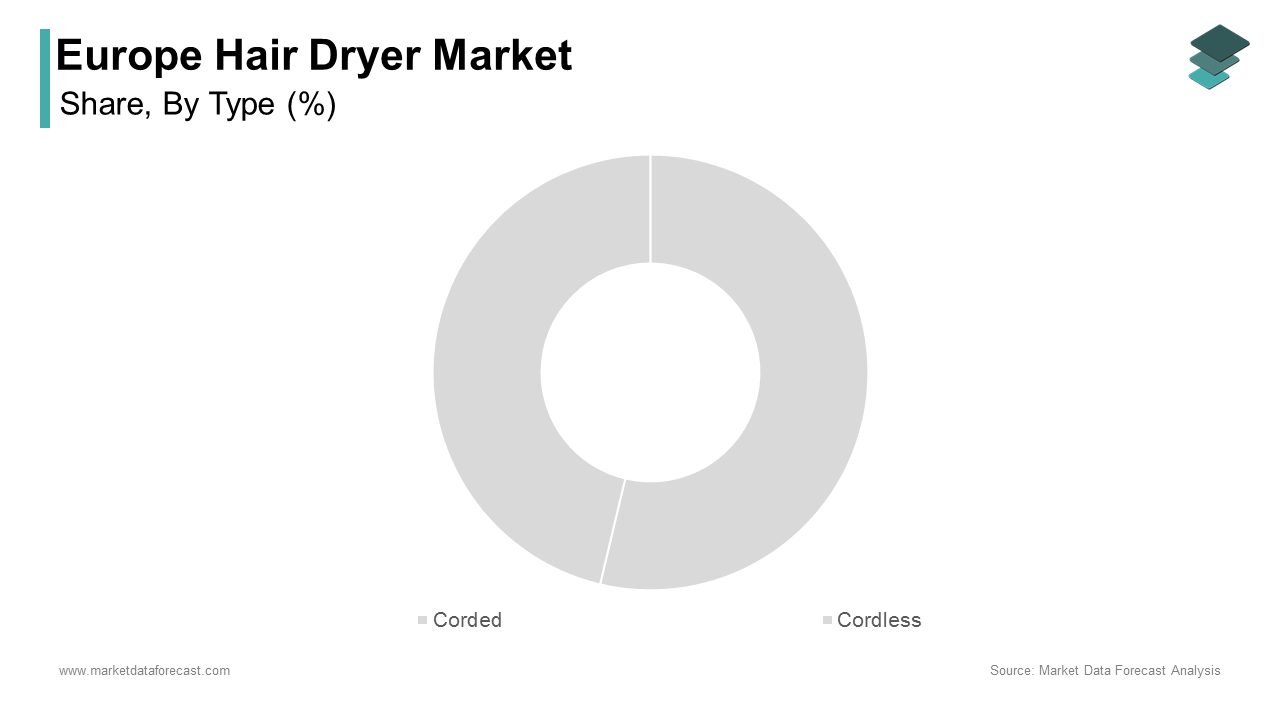
The cordless segment is more likely to grow at the fastest CAGR of 14.3% from 2026 to 2034, driven by advances in lithium-ion battery technology and rising demand for portability among urban travelers and minimalist households. A 2025 survey by the European Travel Commission found that 61% of frequent business travelers aged 25 to 40 carried personal care appliances when abroad, with compact cordless dryers increasingly preferred over bulky corded units. Additionally, municipal regulations in cities like Amsterdam and Copenhagen now restrict noise emissions in residential buildings after 10 PM by favoring quieter, low-wattage cordless models. Although still niche, the segment benefits from premium pricing, strong branding, and alignment with digital nomad lifestyles, which is driving innovation and consumer curiosity across Northern and Western Europe.
By Application Insights
The individual or household segment was accounted for in holding a prominent share of the Europe hair dryer market in 2025, with the near-universal appliance ownership and routine replacement cycles. As per Eurostat, most EU households owned at least one hair dryer in 2023, with ownership reaching 99% in countries like Sweden, Germany, and the Netherlands. The European Consumer Organisation reported in early 2025 that the average replacement interval for home-use dryers is 4.2 years, primarily due to motor degradation or styling obsolescence rather than complete failure. Retail promotions during seasonal events, such as Black Friday and Christmas, further stimulate repeat purchases, with a spike in unit sales during Q4 2023, across major Western European countries. Consumer preferences increasingly lean toward models with ionic or ceramic technology, with GfK data showing that 71% of individual buyers prioritized hair health claims over price in 2025.
The professional application segment is likely to witness the fastest CAGR of 9.8% from 2026 to 2034, with the post pandemic resurgence of salon services and rising standards for stylist tools. These businesses require high durability, ergonomic design, and rapid drying performance attributes met by professional AC motor dryers from brands like Parlux, Elchim, and Babyliss. In Germany alone, over 120,000 salons replaced their dryers in 2023, as per the Federal Chamber of Skilled Crafts. Additionally, beauty academies in Spain and Italy now mandate the use ofprofessional-gradee equipment in training curricula, creating institutional demand. The trend toward premium service differentiation, such as “hair health consultations” that further justify investment in advanced dryers with noise reduction and precise heat control, is fueling sustained B2B growth.
By Distribution Channel Insights
The offline retail channels segment was the largest by capturing a prominent share of the Europe hair dryer market in 2025, owing to the consumer preference for tactile evaluation, immediate availability, and in-person advice. According to Eurostat, many consumers aged 45 and above in Southern and Eastern Europe still favor physical stores for small appliance purchases due to trust in brand displays and after-sales service. Major retailers like MediaMarkt in Germany, Carrefour in France, and Boots in the UK dedicate prominent shelf space to premium hair dryers, often featuring live demonstrations. Additionally, professional dryers are almost exclusively distributed through authorized beauty supply wholesalers, such as SalonCentric and Beauty Store Europe, which require in-person verification of business credentials. This entrenched retail infrastructure and service integration ensure offline dominance despite digital growth.
The online distribution segment is likely to witness the fastest CAGR of 11.2% from 2026 to 2034, owing to the rise of direct-to-consumer brands, algorithm-driven personalization, and convenience for younger demographics. Dyson, for instance, generates over 45% of its European hair dryer revenue through its own e-commerce platform and premium marketplaces like Amazon and Zalando, as per internal 2025 disclosures. A 2025 Eurobarometer survey found that some consumers aged 18 to 34 in the UK, Netherlands, and Sweden researched hair dryers online before purchase, with 52% completing the transaction digitally. Enhanced features, such as video reviews, augmented reality try-ons, and AI-based recommendations on platforms like Sephora and Notino, significantly reduce purchase uncertainty. Furthermore, cross-border e-commerce enables access to niche European brands like Italy’s GHD or Sweden’s Resch, broadening consumer choice. The seamless integration of financing options and subscription-based accessory bundles further enhances online appeal.
REGIONAL ANALYSIS
Germany Hair Dryer Market Analysis
Germany was the top performer of the Europe hair dryer market by capturing 18.6% of the market share in 2025 due to high household income levels, stringent product safety expectations, and a dense network of professional salons. The country hosts more than 120,000 licensed hair salons, all requiring industrial-grade dryers with CE and GS safety certifications. German consumers prioritize energy efficiency and durability, with Stiftung Warentest’s 2025 product ratings heavily influencing purchasing decisions. Brands like Braun and Rowenta maintain strong domestic loyalty due to local manufacturing and repair networks. Additionally, Germany’s early adoption of the EU’s right to repair framework has spurred demand for modular dryers with replaceable nozzles and motors. This blend of regulatory rigor, consumer sophistication, and professional demand escalates Germany’s position as the market leader.
United Kingdom Hair Dryer Market Analysis
The United Kingdom was positioned second by occupying 15.2% of Europe's hair dryer market share in 2025, with the rapid adoption of beauty tech and a vibrant professional styling industry. According to the UK’s Office for National Statistics, 98% of households owned a hair dryer in 2023, with average annual expenditure on personal care appliances rising to 42 pounds per household. The British Beauty Council reported that London alone hosts over 15,000 salons, many of which use high-end dryers from Dyson and ghd to differentiate their services. Dyson’s UK-headquartered R&D team has made the country a launchpad for smart hair tools, with app-connected models accounting for 38% of its domestic dryer sales in 2025 as per company disclosures. E-commerce penetration is also among Europe’s highest, with hair dryer purchases made online. Strong influencer culture and emphasis on at-home salon experiences further drive demand for innovative and aesthetically distinctive devices.
France Hair Dryer Market Analysis
France's hair dryer market growth is likely to grow with the deep-rooted beauty culture, strong domestic brands, and regulatory emphasis on cosmetic safety. L’Oreal’s acquisition of professional styling brand Steampod and its integration with intelligent heat control have reinforced France’s innovation credentials. A 2025 IFOP survey found that 64% of French women aged 25 to 50 considered hair tool quality as essential to maintaining hair health. Additionally, Paris serves as a global trendsetter for beauty launches, with brands like Babyliss leveraging local fashion weeks for product visibility. This fusion of tradition and tech cements France’s pivotal role in shaping European hair care preferences.
Italy Hair Dryer Market Analysis
Italy's hair dryer market growth is likely to grow with its artisanal salon heritage, strong domestic manufacturing, and design-led consumerism. The country is home to iconic professional brands, such as GHD and Gamma Pi, whose dryers are engineered for high airflow and low noise for luxury salons serving international clientele. Italian consumers also exhibit strong brand loyalty with locally designed models from Remington and Imetec, capturing significant shelf space in Euronics and Unieuro stores. The emphasis on aesthetics extends to home use, where compact and stylish dryers are preferred. This synergy between craftsmanship, commerce, and cultural identity sustains Italy’s robust market presence.
Netherlands Hair Dryer Market Analysis
The Netherlands' hair dryer market growth is more likely to be driven by high digital adoption, urban minimalism, and progressive sustainability policies. The country’s 28,000 salons increasingly use dryers with recyclable housings and modular components to comply with Amsterdam’s circular economy ordinance. E-commerce penetration is among Europe’s highest for small appliances, with platforms like Bol.com offering detailed sustainability filters. Brands like Philips leverage Dutch R&D hubs to develop dryers with bio-based plastics and smart energy monitoring. This forward-looking blend of regulation innovation and conscious consumption positions the Netherlands as a bellwether for future market evolution.
COMPETITION OVERVIEW
Competition in the Europe hair dryer market is multifaceted, spanning premium innovators, mass market manufacturers, and professional equipment specialists. Global brands like Dyson and Braun compete on technology, design, and sustainability, while local players such as Rowenta in France and Remington in the UK leverage heritage and retail penetration. The professional segment is dominated by specialized brands like Parlux and Elchim, which prioritize durability and performance over aesthetics. Intensifying pressure from EU Ecodesign regulations has raised compliance barriers, favoring established firms with R&D capacity while low-cost imports from non-EU regions challenge entry-level pricing. Differentiation hinges on hair health, claims,s noise levels, energy efficiency, and reparability. Online channels amplify brand storytelling, enabling direct engagement with health anwellness-orienteded consumers.
KEY MARKET PLAYERS
A few major players of the Europe hair dryer market include
- Dyson
- Philips
- Panasonic
- Braun
- Rowenta
- Remington
- GHD
- Babyliss
- Bosch
- Valera
Top Strategies Used by the Key Market Participants
Key players in the Europe hair dryer market emphasize technological differentiation through ionic ceramic and smart heat control systems to address growing consumer concerns about hair damage. They align product development with EU sustainability mandates by adopting modular designs, spare part availability, and energy-efficient motors. Premium brands leverage direct-to-consumer channels and refurbished programs to enhance circularity and customer lifetime value. Professional segment leaders integrate tools into the broader beauty ecosystem,s including training content and salon service protocols. Companies also invest in noise reduction, acoustic engineering, and ergonomic form factors to meet urban living standards. Marketing increasingly focuses on clinical validation of hair health claims and transparent labeling of energy and repairability scores to build trust in a crowded marketplace.
Leading Players in the Market
- Dyson is a transformative force in the Europe hair dryer market, renowned for redefining performance, aesthetics, and technology through its Supersonic and Airwrap lines. The company’s digital motor V9 and intelligent heat control system set new benchmarks for speed, hair health, and noise reduction. Dyson’s direct-to-consumer focus and premium positioning have reshaped consumer expectations across Western and Northern Europe. Dyson enhanced its European footprint by launching a refurbished program in Germany and France, offering certified pre-owned dryers with full warranties. It also integrated real-time energy usage tracking into its companion app, aligning with EU Ecodesign transparency requirements. These moves reinforce Dyson’s global leadership in beauty tech while deepening its commitment to sustainability and service innovation in the European market.
- Braun maintains a strong presence in the Europe hair dryer market through its reputation for German engineering, durability, and value-oriented premium products. As part of Procter and Gamble, Braun leverages extensive retail distribution and consumer trust built over decades. Its Satin Hair series featuring IONTEC technology and SensoCare thermal sensors appeals to health-conscious users seeking professional results at home. Braun introduced a modular design across its mid-tier range, enabling consumers to replace nozzles, filters, and cables in compliance with the EU right to repair directive. The company also expanded partnerships with pharmacies and department stores in Southern Europe to reach new demographics. These initiatives underscore Braun’s strategy of combining technical reliability with regulatory foresight to sustain long term relevance in a competitive landscape.
- L’Oréal influences the Europe hair dryer market primarily through its professional beauty division L’Oréal Professionnel, which supplies salons with high-performance styling tools under brands like Steampod and Tecni Art. The company bridges cosmetics and hardware by integrating hair care science into dryer design, such as steam infusion for reduced frizz and cuticle protection. L’Oréal launched an AI-powered styling assistant in select European salons that recommends dryer settings based on hair type and treatment history. It also partnered with beauty academies in Spain and Italy to embed its tools into certified training curricula.
MARKET SEGMENTATION
This research report on the Europe hair dryer market has been segmented and sub-segmented based on type, application, distribution channel, and region.
By Type
- Corded
- Cordless
By Application
- Individual
- Professional
By Distribution Channel
- Online
- Offline
By Region
- UK
- France
- Spain
- Germany
- Italy
- Russia
- Sweden
- Denmark
- Switzerland
- Netherlands
- Turkey
- Czech Republic
- Rest of Europe