- Product Description Description
- Table of Contents TOC
- List of Table & Figure LOT
- Get Free Sample PDF Sample PDF
Market Size, 2025
$3,538 MnMarket Estimate, 2026
$3,708 MnMarket Forecast, 2034
$5,391 MnCAGR, 2026–2034
4.79%Executive Summary: Europe Hair Transplant Market
- Market Scope: Comprehensive regional analysis of the European hair transplant sector, covering surgical methods, procedure types, end-user settings, and key national markets.
- Market Valuation: Valued at USD 3,538 million in 2025, reaching USD 3,708 million in 2026, and projected to scale up to USD 5,391 million by 2034, registering a solid CAGR of 4.79% from 2026 to 2034.
- Primary Growth Drivers: Increasing prevalence of androgenetic alopecia across age groups, rising social and professional emphasis on physical appearance, and growing demand for early intervention among younger demographics.
Key Market Segment Metrics
| Category | Leading Segment (Base Position) | Fastest-Growing / High-Growth Segment |
|---|---|---|
| By Surgical Method | Follicular Unit Extraction (FUE) (substantial market share due to minimal invasiveness and no linear scarring) | Follicular Unit Extraction (FUE) (projected at the highest CAGR of 9.4% driven by robotic and AI-assisted innovations) |
| By Surgery Type | Head Hair Transplant (dominant share driven by the high prevalence of pattern baldness) | Eyebrow Transplant (fastest-growing CAGR of 12.7% fueled by beauty standards and facial framing trends) |
| By End User | Trichology Clinics (held 54.7% share in 2024 with specialized diagnostic and holistic care models) | Dermatologic Clinics (anticipated fastest CAGR of 10.2% via mainstream medical integration) |
| By Country | United Kingdom (top performer with 21.3% share in 2024 due to high awareness and FUE adoption) & Germany (17.8% share) | Spain (expanding rapidly as a dual hub for domestic demand and international medical tourism) |
Major Market Players & Industry Landscape
Market Structure: Highly competitive landscape driven by specialized clinics, dermatological practices, and medical tourism hubs focusing on advanced FUE techniques, robotic precision, and patient experience.
Key Companies: Allergan Plc, Bernstein Medical, Bosley, GETFUE Hair Clinics Ltd., Hair Restoration Blackrock (HRBR), Hair Club, Venus Concept (NeoGraft), Hairline International Hair and Skin Clinic, Hair Transplant Centre Turkey, Hair Transplants of Florida, and Cole Instruments Inc.
Europe Hair Transplant Market Size
The hair transplant market size in Europe was valued at USD 3,538 million in 2025. The Europe market is estimated to be worth USD 5,391 million by 2034 from USD 3,708 million in 2026, growing at a CAGR of 4.79% from 2026 to 2034.
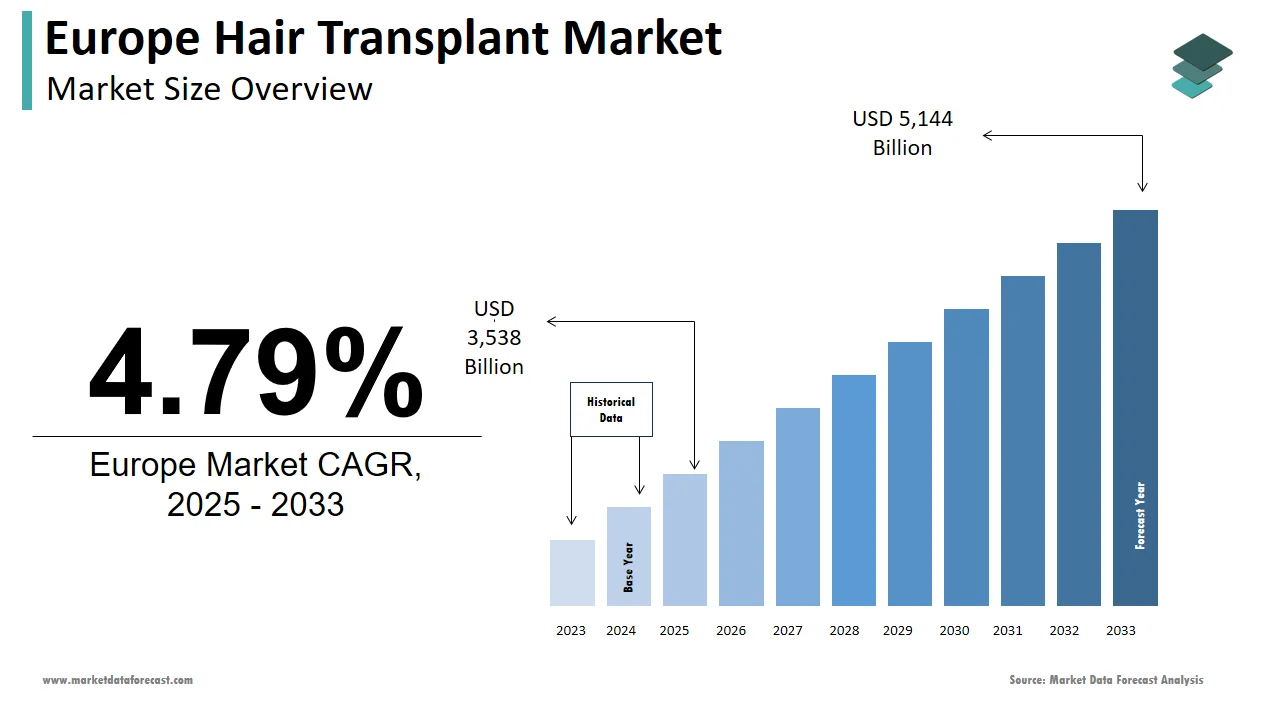
Hair transplant is a surgical and minimally invasive procedure aimed at restoring hair density in individuals experiencing androgenetic alopecia or other forms of permanent hair loss. These interventions primarily include Follicular Unit Extraction and Follicular Unit Transplantation techniques performed in certified medical facilities across both public and private healthcare settings. Unlike cosmetic enhancements that address temporary concerns, hair transplantation offers a long term structural solution increasingly sought by younger demographics. According to sources, a portion of men in Europe experience noticeable hair loss by the age of fifty, while a share of women report some degree of thinning by the age of seventy. As per studies, patient inquiries for hair restoration have risen consistently since 2019, with a marked shift toward early intervention among individuals in their late twenties and thirties. This trend reflects evolving societal perceptions where hair density is increasingly associated with professional credibility and personal confidence. As per research, private out-of-pocket spending on aesthetic medical procedures in the EU grew, which emphasizes rising consumer willingness to invest in appearance-related health services outside traditional insurance coverage.
MARKET DRIVERS
Increasing Prevalence of Androgenetic Alopecia Across Age Groups
Androgenetic alopecia remains a major key driver of the Europe hair transplant market. This acceleration is linked to lifestyle stressors, poor nutrition, and environmental factors, including urban air pollution, which exacerbates oxidative stress on hair follicles. According to the World Health Organization, chronic stress levels among working adults in Western Europe have risen, which contributes to telogen effluvium and premature androgenetic patterns. Furthermore, women’s participation in hair restoration has grown as hormonal imbalances from polycystic ovary syndrome and postpartum conditions lead to irreversible follicular miniaturization. As per the International Society of Hair Restoration Surgery, female hair transplant consultations in Spain and Italy increased in recent years. Awareness is growing, and stigma is diminishing. More individuals are therefore seeking permanent solutions rather than temporary concealers. This strengthens the clinical and psychological rationale for early surgical intervention.
Rising Social and Professional Emphasis on Appearance
Contemporary European society increasingly links physical appearance with professional competence, social desirability, and self-worth by creating strong psychosocial incentives for hair restoration, which bolsters the expansion of the Europe hair transplant market. According to studies, individuals with full hair density were more likely to be perceived as confident and capable in workplace evaluations across sectors such as finance, media, and client-facing services. This perception influences career advancement, with a portion of human resource professionals acknowledging that grooming and appearance play a subtle but real role in hiring decisions. Social media amplifies these burdens as platforms like Instagram and LinkedIn foster curated self-presentation where visible hair loss can trigger self-consciousness, particularly among men under forty. Consequently, individuals are more willing to allocate discretionary income toward corrective procedures. This cultural shift transforms hair transplantation from a vanity-driven choice into a strategic investment in personal and professional capital.
MARKET RESTRAINTS
Stringent Regulatory Oversight on Medical Aesthetic Procedures
The European Union enforces rigorous regulatory standards for surgical and quasi-surgical aesthetic interventions, which constrains the growth of the Europe hair transplant market. According to the European Commission, manufacturers must classify hair transplant tools and graft storage systems as medical devices requiring CE certification, extensive clinical validation, and post-market surveillance. This regulatory burden increases operational costs and delays market entry, particularly for small clinics lacking compliance infrastructure. In countries like Germany and France, national health authorities mandate that only board-certified plastic surgeons or dermatologists may perform follicular unit extraction, limiting the pool of qualified practitioners. These restrictions, while ensuring patient safety, reduce procedural innovation and pricing flexibility, and thereby slow adoption among cost-sensitive consumers and create regional disparities in service availability across the EU.
High Out-of-Pocket Costs and Limited Insurance Coverage
Hair transplantation remains a self-funded procedure across Europe as national health systems classify it as cosmetic rather than medically necessary even in cases of significant psychological distress, which in turn restricts the expansion of the Europe hair transplant market. In most EU member states, patients bear the full cost per session. This financial barrier excludes middle and lower-income groups despite the high prevalence of hair loss. As per Eurostat, a portion of Europeans earning below the median household income consider aesthetic medical procedures financially unattainable. Apart from these, the absence of standardized pricing allows significant clinic-to-clinic variation, fostering consumer uncertainty. Market growth remains concentrated among affluent urban demographics, limiting equitable access and overall procedure volume without broader insurance inclusion or public subsidy mechanisms.
MARKET OPPORTUNITIES
Expansion of Medical Tourism for High-Quality Affordable Care
Both outbound and inbound hair transplant medical tourism provide new opportunities for the growth of the Europe hair transplant market. This is driven by significant cost differentials and recognized clinical excellence. According to the European Travel Commission, a significant number of Europeans traveled to Turkey, Hungary, and Poland specifically for hair restoration procedures, attracted by prices lower than domestic alternatives. Simultaneously, Western European clinics in Spain and Belgium are capitalizing on inbound demand from the Middle East, Asia, and North America by offering multilingual services, premium hospitality, and advanced robotic FUE technology. The cross-border flow not only boosts revenue but also fosters knowledge exchange and protocol standardization. So, medical tourism is transforming the European hair transplant sector into a globally integrated high-value service industry as digital platforms facilitate transparent reviews and virtual consultations.
Integration of Robotic and AI-Assisted Transplant Technologies
The adoption of robotic and artificial intelligence-driven platforms is redefining precision efficiency and patient experience, which is expected to create potential opportunities for the expansion of the Europe hair transplant market. Systems such as ARTAS and NeoGraft enable automated follicular unit harvesting with sub-millimeter accuracy, reducing human error and graft trauma. Artificial intelligence further enhances planning through 3D scalp mapping and predictive density simulation, allowing personalized graft distribution based on future hair loss patterns. Leading clinics in London, Paris, and Milan now bundle robotic procedures with digital aftercare apps that monitor healing and recommend topical regimens. This technological convergence not only elevates clinical outcomes but also justifies premium pricing and attracts tech-savvy patients seeking data-driven aesthetic solutions.
MARKET CHALLENGES
Persistent Risk of Unqualified Practitioners and Clinic Misrepresentation
Misleading advertising and unlicensed providers operating in legal gray zones degrades the growth rate of the Europe hair transplant market. These entities often advertise on social media with edited before and after images and offer prices below 1,500 euros to lure cost-conscious patients. Patient recourse is limited as many operate as limited liability companies with no medical oversight. According to studies, a portion of patients seeking revision surgery had initially undergone procedures at non-accredited centers. This erosion of trust not only endangers individuals but also tarnishes the reputation of legitimate clinics, which forces industry bodies to invest in public awareness campaigns and verification portals.
Long Recovery Periods and Post-Operative Care Burden
The notable recovery trajectory, which deters time-constrained professionals and complicates aftercare adherence, slows down the expansion of the Europe hair transplant market. According to sources, patients must avoid strenuous activity, direct sun exposure, and tight headwear for several days post-procedure, with graft stabilization taking several months. During this period, scalp crusting, itching, and temporary shedding are common, requiring consistent use of prescribed shampoos, antibiotics, and growth serums. This care gap increases complication risks and reduces satisfaction, particularly among international patients who return home shortly after surgery. Until recovery protocols become less disruptive or fully remote monitored, the procedure will remain inaccessible to a significant segment of the working population.
REPORT COVERAGE
| REPORT METRIC | DETAILS |
| Market Size Available | 2025 to 2034 |
| Base Year | 2025 |
| Forecast Period | 2026 to 2034 |
| Segments Covered | By Surgical Method, Surgery Type, End-user, and Region. |
| Various Analyses Covered | Global, Regional and Country-Level Analysis, Segment-Level Analysis, Drivers, Restraints, Opportunities, Challenges; PESTLE Analysis; Porter’s Five Forces Analysis, Competitive Landscape, Analyst Overview of Investment Opportunities |
| Countries Covered | Germany, UK, France, Italy, Rest of Europe |
| Market Leaders Profiled | Allergan Plc, Bernstein Medical, Bosley, GETFUE Hair Clinics Ltd., Hair Restoration Blackrock (HRBR), Hair Club, Venus Concept (NeoGraft), Hairline International Hair and Skin Clinic, Hair Transplant Centre Turkey, Hair Transplants of Florida, and Cole Instruments Inc. |
SEGMENTAL ANALYSIS
By Surgical Method Insights
The Follicular Unit Extraction (FUE) segment was the largest segment in the Europe hair transplant market by accounting for a substantial share in 2025. The prominence of the Follicular Unit Extraction (FUE) is primarily driven by its minimally invasive nature, absence of linear scarring, and faster recovery time compared to traditional strip harvesting. Moreover, strong patient preference for discreet and socially seamless interventions further drives the growth of this segment. Besides, the technique aligns with modern lifestyle demands as patients can often return to office work within three to five days. Technological advancements have further enhanced FUE’s appeal with motorized punches and sapphire blades improving graft survival rates, as per research. Moreover, FUE allows for greater precision in designing natural-looking hairlines and enables harvesting from body donor sites when scalp supply is limited. These clinical and aesthetic advantages have made FUE the default standard in premium clinics across Western and Northern Europe, supporting its market superiority.

The Follicular Unit Extraction segment is predicted to witness the highest CAGR of 9.4% from 2026 to 2034. The rapid growth of the Follicular Unit Extraction (FUE) is propelled by continuous innovation in instrumentation and procedural protocols that expand its applicability and efficiency. In addition, the integration of robotic assistance with systems is also a growth propellant of this segment. Furthermore, the rise of long hair FUE, where grafts are extracted without shaving the donor area, has attracted female patients and professionals unwilling to alter their appearance during recovery. Training programs by the European Hair Research Society have also standardized FUE protocols across member states, increasing practitioner confidence and patient safety. These enhancements lower barriers to adoption and improve outcomes. FUE’s growth trajectory remains robust across both established and emerging European markets.
By Surgery Type Insights
The head hair transplant segment led the Europe hair transplant market and captured a significant share in 2025. The prominence of the head hair transplant segment is attributed to the high prevalence of androgenetic alopecia, which affects millions of men and women across the continent. A further driver of this segment is the irreversible nature of pattern baldness, which renders medical therapies insufficient for advanced cases, prompting surgical intervention. Furthermore, head hair restoration delivers the most visible transformation, impacting self-perception and social interaction. The procedure also benefits from decades of clinical refinement with standardized protocols for density planning, donor management, and aftercare. Head hair transplantation remains the cornerstone of the European hair restoration ecosystem, even as societal acceptance grows and early intervention becomes normalized.
The eyebrow transplant segment is estimated to register the fastest CAGR of 12.7% from 2026 to 2034 due to evolving beauty standards and heightened focus on facial framing in the digital age. Social media platforms, particularly Instagram and TikTok, have amplified the aesthetic importance of well-defined eyebrows. Medical causes such as trichotillomania, thyroid disorders, and overplucking have also increased demand for permanent solutions. Unlike temporary fillers or tattoos, eyebrow transplants offer natural growth, texture, and longevity. Some clinics have pioneered single hair grafting techniques using fine caliber follicles from the nape to mimic natural brow architecture. The growing visibility of facial feminization and gender-affirming procedures is making eyebrow restoration an integral part of holistic aesthetic planning, which is further accelerating its adoption across diverse patient groups.
By End User Insights
The trichology clinics segment dominated the Europe hair transplant market by occupying 54.7% share in 2024. Their specialized focus, integrated diagnostic capabilities, and patient-centric care models that combine medical and surgical hair restoration have significantly contributed to the growth of the trichology clinics segment in the regional market. Unlike general hospitals or dermatology practices, trichology clinics offer end-to-end management, including scalp analysis, blood testing, nutritional counseling, and post-operative care under one roof. The primary driver is the growing recognition of hair loss as a multifactorial condition requiring holistic intervention. Trichology clinics leverage advanced tools such as dermoscopy and phototrichograms to tailor treatment plans, enhancing graft success and retention. Furthermore, their branding as dedicated hair health centers builds trust with patients seeking long-term solutions rather than one-time procedures. This specialization model aligns with consumer preference for expertise and continuity of care, strengthening trichology clinics as the preferred destination for hair restoration.
The dermatologic clinics segment is anticipated to witness the fastest CAGR of 10.2% over the forecast period, owing to the integration of surgical hair restoration into mainstream dermatological practice, as hair loss is increasingly recognized as a dermatological pathology rather than a purely cosmetic concern. Board-certified dermatologists bring medical credibility and diagnostic rigor, particularly in differentiating scarring alopecias from androgenetic patterns where transplantation is contraindicated. These clinics often combine transplants with medical therapies such as minoxidil, platelet-rich plasma, and low-level laser therapy, creating multimodal treatment protocols. Apart from these, dermatologists are more likely to be covered under private health consultations, enhancing accessibility. Hence, this segment is poised for sustained growth, bridging the gap between medical management and aesthetic outcomes as dermatology education increasingly includes surgical training.
COUNTRY LEVEL ANALYSIS
United Kingdom Market Analysis
The United Kingdom was the top performer in the European hair transplant market and captured a 21.3% share in 2024. High public awareness, early adoption of FUE technology, and a dense network of specialized clinics are attributed to the growth of the United Kingdom in the regional market. British patients exhibit a strong willingness to invest in appearance, with notable out-of-pocket expenditure on aesthetic procedures annually, as per studies. The National Health Service does not cover hair transplants, strengthening a robust private market where clinics compete on innovation and service quality. Social factors also play a role. The UK also serves as a hub for medical tourism from Ireland and Scandinavia due to linguistic accessibility and regulatory transparency. These structural and cultural elements sustain the UK’s dominance in both volume and clinical advancement.

Germany Market Analysis
Germany was the second largest in the European hair transplant market by capturing 17.8% share in 2024. The growth of Germany is driven by its rigorous medical standards, high patient expectations, and integration of hair restoration into dermatological care. German consumers prioritize evidence-based treatments, with a portion consulting board-certified dermatologists before considering surgery, as per sources. This has elevated the role of university-affiliated clinics in cities that publish outcomes data and participate in multicenter trials. Germany also leads in robotic FUE adoption. Despite strict advertising laws, clinics thrive through word of mouth and digital education. The combination of clinical excellence, regulatory discipline, and latent demand positions Germany as a high quality high-trust market with steady growth.
Spain Market Analysis
Spain grew steadily in the European hair transplant market due to its emergence as a dual hub for domestic demand and international medical tourism, particularly from the United Kingdom, France, and the Middle East. Spanish clinics in Madrid, Barcelona, and Marbella leverage a favorable climate year-round operation, and multilingual staff to attract global patients. Domestically rising awareness among younger men is driving early intervention with a portion of new patients under thirty-five, as per research. Spain also pioneers long hair FUE and body hair transplantation techniques adapted to Mediterranean hair textures. Spain's appeal as a cost-effective yet high-quality destination grows with the expansion of digital marketing and virtual consultations, bolstering its strategic position in the European landscape.
France Market Analysis
France expanded moderately in the European hair transplant market due to a strong emphasis on natural aesthetics, subtlety, and medical oversight. French patients prioritize undetectable results, with a portion rejecting procedures that produce an artificial or dense look, as per sources. This has driven the adoption of refined techniques such as ultra-refined FUE and hairline feathering practiced in Paris, Lyon, and Nice. Regulatory constraints limit procedures to certified plastic surgeons or dermatologists, ensuring high standards but restricting supply. Despite this demand remains strong. The influence of fashion and media further amplifies appearance consciousness, particularly in urban centers. Transparency is improving trust and conversion rates, and steady market evolution is being sustained as French clinics increasingly publish before-and-after galleries and patient testimonials.
Italy Market Analysis
Italy is likely to grow in the European hair transplant market from 2026 to 2034, owing to its fusion of medical expertise and aesthetic sensibility rooted in Italy’s cultural emphasis on personal grooming. Italian clinics in Mila,n Rome, and Florence specialize in artistic hairline design using single hair grafts to replicate natural growth patterns. Recent years have seen a surge in female patients seeking eyebrow and temple restoration driven by social media trends and celebrity influence. Italy also benefits from medical tourism from Eastern Europe and North Africa due to geographic proximity and historical ties. Italy’s reputation for precision and artistry continues to attract discerning patients seeking both technical excellence and aesthetic harmony as clinics invest in digital platforms and international accreditation.
COMPETITIVE LANDSCAPE
The Europe hair transplant market features a competitive landscape shaped by specialized clinics, dermatology practices, and international medical tourism providers. Competition centers on clinical expertise, technological sophistication, and patient experience rather than price alone. Established players differentiate through board-certified surgeons' advanced FUE protocols and transparent outcome reporting, while newer entrants leverage digital marketing and social proof to gain traction. Regulatory heterogeneity across countries creates uneven playing fields, with stringent markets like Germany and France favoring accredited institutions, whereas Southern Europe sees more fragmented provider ecosystems. The absence of pan-European pricing standards and variable reimbursement policies further intensifies competition for private pay patients. Medical tourism adds another layer as clinics in Spain and Turkey attract European clients through bundled services and lower costs. Despite growth opportunities, concerns about unqualified practitioners and misleading advertising persist, prompting industry bodies to push for harmonized standards. Overall, competition drives innovation in technique delivery and patient care but requires vigilant oversight to ensure safety and ethical practice.
KEY MARKET PLAYERS
Some of the companies that are playing a dominating role in the Europe hair transplant market include
- Allergan Plc
- Bernstein Medical
- Bosley
- GETFUE Hair Clinics Ltd.
- Hair Restoration Blackrock (HRBR)
- Hair Club
- Venus Concept (NeoGraft)
- Hairline International Hair and Skin Clinic
- Hair Transplant Centre Turkey
- Hair Transplants of Florida
- Cole Instruments Inc.
Top Players in the Europe Hair Transplant Market
- Harcourts International operates a network of specialized hair restoration clinics across the United Kingdom, Germany, and Spain under the brand name The Private Clinic. The company is recognized for integrating advanced FUE techniques with comprehensive patient journeys, including pre-operative diagnostics and digital aftercare. It has strengthened its European position by investing in robotic hair transplant systems and training programs accredited by the European Board of Hair Restoration Surgery. Recently, Harcourts expanded its multilingual consultation services to cater to medical tourists from the Middle East and North Africa. Its global contribution lies in standardizing ethical advertising and outcome transparency, which has influenced regulatory discussions in multiple European countries.
- MediTouch Clinics is a leading provider of hair restoration services in France, Italy, and Switzerland, with a strong emphasis on natural hairline design and minimally invasive protocols. The company has pioneered the use of sapphire blade FUE and long hair extraction techniques tailored to Mediterranean hair types. It also collaborates with European dermatological societies to publish clinical outcome data, enhancing scientific credibility. Globally, MediTouch contributes by promoting standardized training modules for FUE practitioners adopted by clinics in emerging markets.
- Vinci Hair Clinic maintains a prominent footprint in the Netherlands, Sweden, and Portugal, offering both surgical and non-surgical hair loss solutions. Known for its Vinci Method, which combines transplantation with medical therapy, the clinic emphasizes long-term hair health over isolated procedures. Recent initiatives include the introduction of AI-powered scalp mapping and partnerships with European trichology associations to develop early intervention protocols. Vinci has also enhanced its digital outreach through educational webinars and multilingual content targeting younger demographics. Its global influence stems from advocating for regulated medical tourism and publishing transparent success metrics that set benchmarks across international markets.
Top Strategies Used by the Key Market Participants
Key players in the Europe hair transplant market focus on technological integration by adopting robotic and AI-assisted systems to enhance precision and graft survival rates. They invest in specialized training and certification programs to ensure practitioner competency and align with European medical standards. Companies prioritize digital transformation through telemedicine platforms, virtual consultations, and AI-driven scalp diagnostics to improve accessibility and patient engagement. Strategic expansion into medical tourism is pursued by offering multilingual services, hospitality packages, and transparent pricing for international patients. Besides, firms emphasize ethical marketing by publishing verified before and after results and adhering to advertising guidelines set by national medical councils to build consumer trust and industry credibility.
MARKET SEGMENTATION
This Europe hair transplant market research report is segmented and sub-segmented into the following categories.
By Surgical Method
- Follicular Unit Transplantation (FUT)
- Follicular Unit Extraction (FUE)
- Others
By Surgery Type
- Head Hair Transplant
- Eyebrow Transplant
- Frontal Hairline Lowering or Reconstruction
- Others
By End-user
- Trichology Clinics
- Hospitals
- Dermatologic Clinics
- Others
By Country
- UK
- France
- Spain
- Germany
- Italy
- Russia
- Sweden
- Denmark
- Switzerland
- Netherlands
- Turkey
- Czech Republic
- Rest of Europe