- Product Description Description
- Table of Contents TOC
- List of Table & Figure LOT
- Get Free Sample PDF Sample PDF
Market Size, 2025
$0.49 BnMarket Estimate, 2026
$0.55 BnMarket Forecast, 2034
$1.45 BnCAGR, 2026–2034
12.86%Executive Summary: Europe Hardware Security Modules Market
- Market Scope: Comprehensive Europe hardware security modules market analysis covering deployment types, application verticals, end-user sectors, country-level leadership frameworks, and regulatory cybersecurity compliance trends.
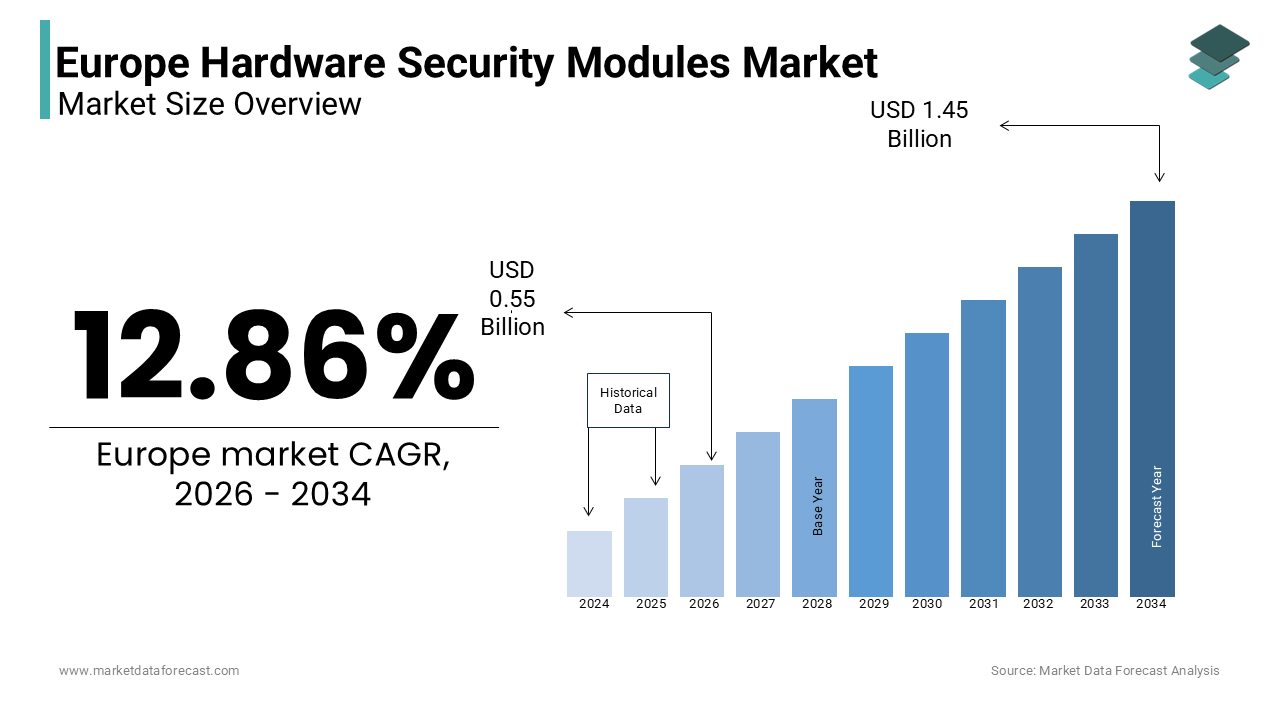
- Market Valuation: Valued at USD 0.49 billion (2025), estimated at USD 0.55 billion (2026), and projected to reach USD 1.45 billion by 2034, registering a strong CAGR of 12.86% (2026–2034).
- Primary Growth Drivers: Accelerating digital transformation, expanding cybersecurity regulations, and increasing demand for certified cryptographic infrastructure across financial services, government, healthcare, and critical infrastructure. Key catalysts include the EU Digital Identity Framework rollout, cloud-based financial services, secure key management, and smart grid digitalization.
Key Market Segment Metrics (2026–2034)
| Category | Leading Segment (2025 Position) | Fastest-Growing Segment |
|---|---|---|
| By Application / Function | Payment Processing Segment (accounted for the largest share of 38.1% in 2025) | Public Key Infrastructure (PKI) Management (projected to register the fastest CAGR of 17.8%) |
| By Type / Deployment | LAN-Based Network-Attached HSMs (held the largest share of 52.7% in 2025) | USB-Based Portable Segment (expected to grow at the highest CAGR of 19.3%) |
| By End User | BFSI Segment (dominated with a 45.1% share in 2025) | Healthcare and Life Sciences Segment (forecast to expand at the highest CAGR of 21.1%) |
| By Country / Region | Germany (led the regional market with a 19.2% share in 2025, followed by the UK at 15.7%) | Expanding cryptographic and compliance-driven markets across Western and Northern Europe |
Major Market Players & Market Structure
Market Structure: Highly competitive European landscape where vendors differentiate through certification capabilities, cloud and legacy system integration, regulatory compliance, quantum-readiness initiatives, and collaboration with national cybersecurity authorities.
Key Companies: Thales Group, Utimaco Management Services GmbH, Atos SE, International Business Machines Corporation (IBM), Infineon Technologies AG, STMicroelectronics, Hewlett Packard Enterprise, Futurex LP, Marvell Technology Group, and Swift SCRL.
Europe Hardware Security Modules Market Size
The europe hardware security modules market size was valued at USD 0.49 billion in 2025 and is anticipated to reach USD 0.55 billion in 2026 from USD 1.45 billion by 2034, growing at a CAGR of 12.86% during the forecast period from 2026 to 2034.
Introduction and Market Definition Hardware security modules are specialized cryptographic processors designed to safeguard and manage digital keys, perform encryption operations, and ensure secure authentication across critical digital infrastructures. In Europe, these devices have become integral to sectors such as banking, government, healthcare, and energy, where data integrity and regulatory compliance are non-negotiable. Member states increasingly focus on defining and implementing robust national cybersecurity strategies, which include a strong emphasis on securing infrastructure and technological components like cryptographic measures to ensure sovereignty and resilience, as per research. Besides, as per multiple sources, European enterprises are widely adopting various ICT security measures as the use of digital services and data exchange expands, increasing the general demand for resilient and reliable security infrastructure across the Union. Unlike general cybersecurity tools, hardware security modules offer certified physical and logical protection compliant with FIPS 140 2 and Common Criteria standards, which makes them indispensable in high assurance environments. The deployment of such modules aligns with the EU’s Digital Identity Framework and NIS2 Directive, both mandating robust identity verification and secure transaction mechanisms. This foundational role in enabling trust within Europe’s digital ecosystem positions hardware security modules as a cornerstone of strategic cyber resilience rather than merely a component of IT procurement.
MARKET DRIVERS
Rising Adoption of Digital Identity Frameworks Across European Institutions
European governments and public sector bodies are accelerating deployment of sovereign digital identity systems that rely on certified cryptographic anchoring, which is one of the major drivers of the Europe hardware security modules market. The European Union's Digital Identity Wallet initiative, formalized by the 2024 EUDI Framework Regulation, is progressing toward the goal of ubiquitous, secure, and interoperable digital identification, with member states obligated to provide compliant wallets by late 2026. Security requirements for the wallets emphasize strong cryptographic measures and tamper-resistant storage mechanisms to protect sensitive data. The European Union Agency for Cybersecurity is establishing harmonized certification requirements for the EUDI wallet, aiming for a high level of security and robustness against sophisticated attacks. National programs such as France’s FranceConnect Plus and Germany’s AusweisApp 2 already integrate hardware security modules to secure citizen authentication flows. Furthermore, as per research, European regulations, such as PSD2, require strong customer authentication for instant payments, and the forthcoming EUDI wallet is expected to provide a secure, harmonized mechanism for seamless identity verification to facilitate these transactions across the EU. This institutional reliance on tamper resistant cryptographic assurance creates a structural demand driver that transcends commercial sector volatility. The alignment between regulatory mandates and technological capability ensures sustained procurement cycles, especially as governments expand digital public services amid increasing cyber threats targeting identity infrastructure.
Expansion of Cloud Based Financial Services Requiring Certified Key Management
Financial institutions across the region are migrating critical operations to cloud environments while facing stringent mandates for cryptographic key custody, which contributes to the expansion of the Europe hardware security modules market. These requirements are directly fueling hardware security module integration in hybrid and public cloud architectures. As per sources, Major EU banks are increasingly adopting cloud services as part of their operations, with regulatory focus placed on managing third-party risks and ensuring operational resilience in these arrangements. European financial entities face increasing regulatory scrutiny regarding cybersecurity and operational resilience, leading to a trend of increased investment in robust security measures and governance frameworks for key management and critical functions. The significant growth in SEPA Instant Credit Transfer volumes is driving payment service providers to enhance their key management practices and overall security infrastructure to manage the increased transaction volume and associated operational risks. The convergence of open banking mandates, real time payment systems, and cloud adoption creates a unique operational environment where cryptographic integrity cannot be virtualized, thereby anchoring persistent demand for certified hardware security solutions across Europe’s financial landscape.
MARKET RESTRAINTS
High Integration Complexity and Specialized Operational Expertise Requirements
Deploying hardware security modules in heterogeneous European enterprise environments often demands extensive customization and deep cryptographic expertise, which poses a barrier to the Europe hardware security modules market growth. Many mid-sized organizations encounter significant difficulties when attempting to integrate hardware security modules, especially when these tools must interact with older systems that are not prepared for public key infrastructure. The requirement for dedicated cryptographic engineers further exacerbates this challenge. The cybersecurity sector is experiencing a notable deficit in specialized personnel, with a particularly small proportion of the workforce demonstrating verified expertise in hardware cryptography. Financial institutions and utilities, bound by NIS2 compliance deadlines, frequently face project delays several months due to configuration mismatches between module firmware and application layer security protocols. Besides, as per research, interoperability testing for hardware security modules in multi-vendor environments consumes a notable share of total deployment budgets. This operational friction discourages organizations from upgrading from software based key storage despite heightened regulatory scrutiny, and thereby constrains market penetration beyond large enterprises with dedicated security teams and mature infrastructure.
Fragmented National Certification Landscapes Within the European Union
Divergent national certification regimes for cryptographic hardware create compliance uncertainty and increase time to market for hardware security module vendors, despite EU level directives, which in turn hinders the expansion of the Europe hardware security modules market. National variation exists in the evaluation of cybersecurity measures across countries. The specific requirements beyond a general baseline framework can differ among these nations, meaning that separate checks are needed even for identical security components. For example, individual national certifications might have different standards concerning physical protection levels and how frequently audits are conducted. This can lead to security vendors having to repeat testing to meet each nation's unique criteria. This lack of uniformity may result in increased financial burdens and longer waits for product approval when contrasted with regions that have a more unified system. Consequently, smaller module manufacturers often restrict their offerings to select markets, reducing competitive diversity. Moreover, Multinational corporations sometimes experience delays when implementing cross-border hardware security modules. These delays often stem from differing national interpretations regarding cryptographic requirements. As a result, achieving a uniform rollout across various European jurisdictions remains a challenge for many organizations. This regulatory balkanization not only inflates operational costs but also impedes the seamless cross border deployment of secure digital services envisioned under the EU’s Digital Single Market strategy.
MARKET OPPORTUNITIES
Integration of Hardware Security Modules in Energy Grid Digitalization Initiatives
The region’s accelerating modernization of power infrastructure is creating a major opening for hardware security modules market. This paves the way for securing distributed energy resources and smart grid communications. Under the European Union's current framework, distribution system operators are increasingly required to adopt secure communication measures for grid control systems. A significant majority of distribution system operators have an obligation to implement comprehensive encrypted communication protocols for grid control systems. Many smart meters being installed across the region necessitate the use of device authentication rooted in hardware to adhere to evolving cybersecurity guidelines. Several member countries have proactively established requirements for utilizing hardware security modules in all grid edge devices that are part of demand response programs. The deployment of certified meters in specific regions has seen considerable growth. Cross-border electricity trading platforms operating within a key EU framework must incorporate specific security level devices for transaction signing to maintain the integrity of real-time pricing data. This convergence of energy policy, cybersecurity regulation, and infrastructure investment positions hardware security modules as critical enablers of Europe’s decarbonized and digitized energy future, which offers vendors a high assurance growth corridor beyond traditional IT sectors.
Adoption of Confidential Computing Architectures in European Healthcare Data Ecosystems
The European healthcare sector is shifting toward confidential computing for cross-institutional medical data processing, which is providing fresh prospects for the hardware security modules market. This change is unlocking new use cases for hardware security modules in securing enclaves and attestation keys. Driven by the EU Health Data Space Regulation, which mandates privacy preserving analytics across member states, healthcare providers are deploying trusted execution environments that rely on hardware rooted integrity verification. Several national health systems initiated confidential computing pilots which require hardware security modules to generate and store remote attestation keys for specific secure environments. A significant number of patient records have been processed through hardware-secured enclaves. Clinical trial data sharing platforms under current regulations must implement hardware-anchored key management to ensure auditability and non-repudiation, and many phase III trials are now using this infrastructure. The stringent GDPR Article 9 requirements for special category data further reinforce this trend, as hardware security modules provide verifiable proof of cryptographic compliance during data subject audits. This emerging convergence of regulatory health data governance and advanced computing architectures establishes a high value and compliance driven opportunity for hardware security module integration in Europe’s sensitive health information ecosystems.
MARKET CHALLENGES
Evolving Quantum Computing Threats Undermining Current Cryptographic Assurances
The accelerating progress in quantum computing capabilities poses a systemic risk to the long-term viability of existing hardware security modules that rely on classical cryptographic algorithms such as RSA and ECC, and thereby challenges the growth of the Europe security modules market. The feasibility of certain types of quantum attacks on widely used RSA keys is approaching, which could eventually make existing module firmware obsolete without appropriate post-quantum cryptography migration paths. A small percentage of the hardware security modules currently used in critical infrastructure support newer post-quantum signature schemes like those based on lattices or hashes This creates a looming obsolescence risk, as organizations must either replace entire module fleets or rely on hybrid firmware updates that may compromise performance or certification status. Moreover, a majority of financial institutions have not yet established a defined plan for transitioning their hardware-anchored keys to post-quantum standards, which increases the risk of potential future data decryption. The absence of standardized post quantum certification criteria under the EU Cybersecurity Act further delays procurement decisions, as buyers await ETSI’s anticipated PQCRYPTO framework. This technological inflection point forces both vendors and end users into costly reassessments of cryptographic lifecycles, which threatens the stability of long-term hardware security module investments across Europe.
Persistent Shortage of Skilled Cryptographic Engineering Talent Across Europe
The effective deployment and lifecycle management of these modules demand a specialized workforce proficient in applied cryptography, secure hardware protocols, and compliance validation, yet the region faces a chronic deficit in such expertise. This constrains the expansion of the Europe hardware security modules market. A very small proportion of cybersecurity professionals across the European Union currently have expertise in cryptographic hardware integration. There appears to be a notable lack of qualified personnel with these specific skills in some member states. This scarcity directly impacts operational reliability. A recent review of cybersecurity incidents indicated that a significant percentage of hardware security module misconfigurations resulted from improper key policy implementation by staff who lacked adequate training. Academic pipelines remain insufficient. Few academic institutions across Europe provide specialized educational programs focused on hardware security. Large financial and energy firms often poach talent from public sector agencies, exacerbating capability gaps in national cybersecurity units responsible for critical infrastructure oversight. Consequently, organizations resort to costly external consultants, inflating total cost of ownership. This human capital bottleneck not only delays project timelines but also increases the risk of security lapses in high assurance environments where hardware security modules are meant to provide fail safe protection.
REPORT COVERAGE
| REPORT METRIC | DETAILS |
| Market Size Available | 2026 to 2034 |
| Base Year | 2025 |
| Forecast Period | 2026 to 2034 |
| CAGR | 12.86% |
| Segments Covered | By Application, Type, Deployment, End-User and Region. |
| Various Analyses Covered | Global, Regional & Country Level Analysis, Segment-Level Analysis, DROC, PESTLE Analysis, Porter’s Five Forces Analysis, Competitive Landscape, Analyst Overview of Investment Opportunities |
| Regions Covered | United Kingdom, France, Spain, Germany, Italy, Russia, Sweden, Denmark, Switzerland, the Netherlands, Turkey, and the Czech Republic. |
| Market Leaders Profiled | Thales Group, Utimaco Management Services GmbH, Atos SE, International Business Machines Corporation (IBM), Infineon Technologies AG, STMicroelectronics, Hewlett Packard Enterprise, Futurex LP, Marvell Technology Group, and Swift SCRL. |
SEGMENTAL ANALYSIS
By Application Insights
The payment processing segment was the largest segment in the Europe hardware security modules market by accounting for a 38.1% share in 2025. Stringent regulatory mandates and the exponential growth of digital financial transactions across the region have contributed to the supremacy of the payment processing segment. The volume of instantaneous interbank transactions within the Single Euro Payments Area (SEPA) has reached significant levels. These specific transactions generally incorporate robust security measures, as required by payment services regulations. A substantial majority of financial institutions that manage payment card transactions across the region now utilize high-level security components to safeguard their systems. The deployment of these security measures is especially prevalent where bank systems connect with external payment service providers The rise of open banking has further intensified demand. As per sources, a notable share of account servicing payment service providers relies on hardware security modules to secure API key exchanges. The irreversible shift toward real time, card not present, and contactless payments has rendered tamper resistant key storage non optional for compliance and fraud prevention, which strengthens payment processing as the cornerstone application for hardware security modules.
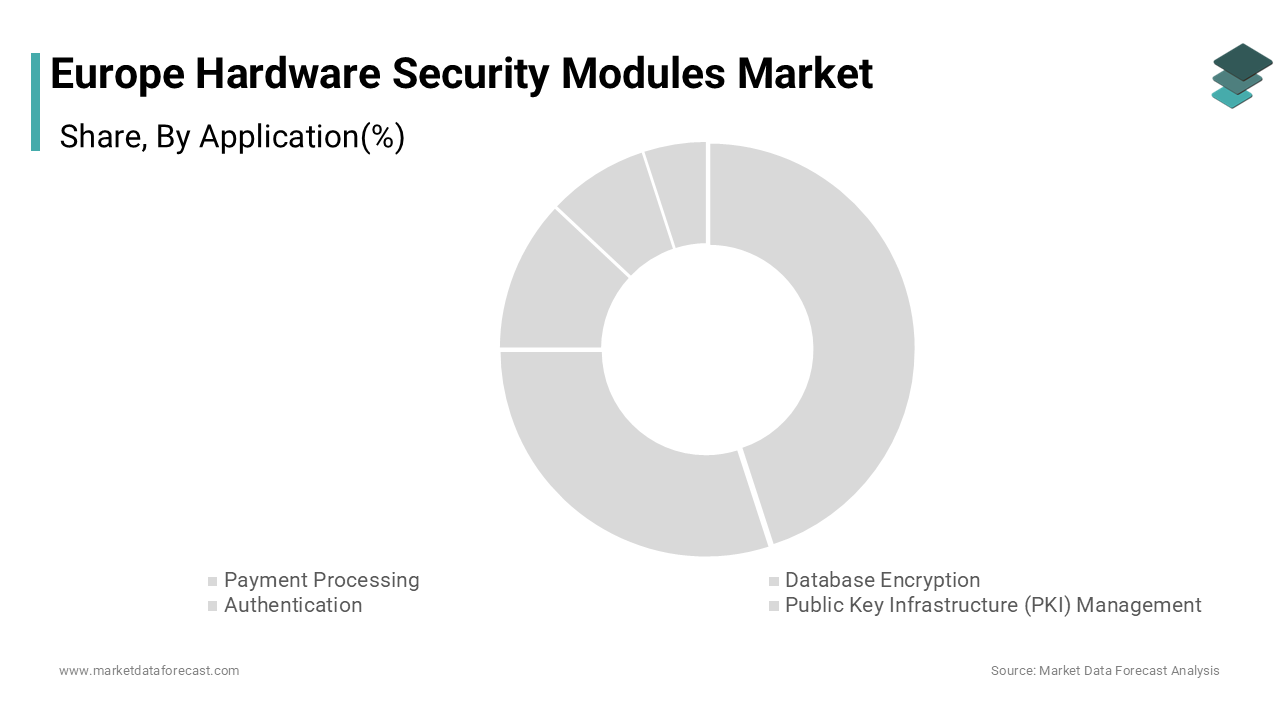
The public key infrastructure management segment is on the rise and is expected to be the fastest growing segment in the market by witnessing a CAGR of 17.8% between 2026 and 2034 due to the EU’s comprehensive digital trust architecture, which mandates hardware rooted certificate authorities for issuing qualified electronic signatures under the eIDAS 2 0 framework. National trust service providers have upgraded their root CA infrastructure to incorporate certified hardware security modules. Furthermore, most public sector digital services now require PKI-based authentication, for which hardware modules are the only compliant method for private key protection. The rollout of the European Digital Identity Wallet further amplifies this trend, as each wallet issuance point must generate X 509 certificates using tamper proof devices. Enterprises are also adopting hardware secured PKI to comply with NIS2 asset inventory requirements,. This convergence of sovereign digital identity, cross border service interoperability, and enterprise cyber hygiene establishes PKI management as the highest momentum application segment.
By Type Insights
The LAN based Network attached segment led the Europe hardware security modules market by holding a 52.7% share in 2025 owing to centralized security architectures adopted by large financial, government, and cloud service organizations that require high availability, remote access, and scalability. Large-scale financial institutions and national payment processors frequently utilize redundant, networked hardware clusters to facilitate high-volume transaction signing. These devices enable seamless integration with cloud key management services and are certified under ETSI EN 303 645 for use in hybrid infrastructures. Furthermore, Frameworks supporting regional cloud sovereignty often require the use of networked modules to manage cryptographic tasks within shared infrastructure. Their support for HA failover, load balancing, and centralized audit logging aligns with NIS2 operational resilience expectations, making them the architecture of choice for entities managing millions of cryptographic operations daily. The shift away from embedded solutions in favor of flexible, centrally managed security infrastructure has cemented the leadership of LAN based modules in Europe’s high assurance ecosystems.
The USB based portable segment is expected to exhibit a noteworthy CAGR of 19.3% during the forecast period. The rapid expansion of the USB based portable segment is fueled by the decentralization of digital workflows and the need for secure cryptographic operations in mobile, edge, and field environments. As per research, a majority of knowledge workers in Europe now engage in hybrid or remote work patterns. This shift in work style contributes to a general demand for versatile, secure data storage solutions designed to be easily carried by the user. National cybersecurity agencies have embraced this form factor for secure remote access. A federal agency has implemented a significant number of portable security modules for its employees as part of an initiative to support mobile work environments. Similarly, an increase in the deployment of these portable security modules has been observed within cross-border healthcare teams. This adoption facilitates secure access to patient data in situations where cloud reliance might not be the primary option, which emphasizes the utility of portable solutions in sensitive sectors. The modules’ plug and play compliance with Common Criteria Protection Profile for cryptographic tokens also accelerates adoption in regulated sectors requiring on the go signing, such as legal notarization and customs documentation. This unique blend of mobility, regulatory alignment, and user centric security positions USB based modules as the highest growth vector in Europe’s evolving cryptographic landscape
By End User Insights
The BFSI segment continued to dominate the Europe hardware security modules market by capturing a share of 45.1% share in 2025. The prominence of the BFSI segment is credited to regulatory imperatives, transaction volume intensity, and the criticality of non-repudiation in financial operations. Large-value and instant payment settlements utilize hardware-verified digital signatures to secure transaction flows. Automated security modules are employed to safeguard high volumes of daily financial exchanges. Major banking institutions utilize dedicated hardware for managing the lifecycle of cryptographic keys. Hardware-based security measures are integrated into core banking functions, including payment processing and trading. Secure modules serve as a foundational component for protecting customer authentication systems within the financial sector. Furthermore, the rise of instant payments, now used a notable share of EU consumers, has intensified pressure to prevent replay and man in the middle attacks, which only hardware anchored cryptography can reliably mitigate. Capital markets are equally dependent. BFSI's inherent need for secure, tamper-proof cryptographic infrastructure, a need reinforced by the expanded NIS2 obligations for payment and e-money institutions, ensures it remains the primary consumer of hardware security modules.
The healthcare and life sciences segment is predicted to witness the highest CAGR of 21.1% from 2025 to 2033. The swift expansion of the healthcare and life sciences segment is attributed to the EU Health Data Space Regulation, which mandates hardware based cryptographic controls for cross institutional data sharing involving sensitive patient information. National health data infrastructures launched secure processing environments that require modules at a specific security level for encrypting various types of medical records. Clinical research is another key driver. Clinical trials now use hardware anchored signing for audit trails to comply with data protection and integrity requirements. Furthermore, a majority of hospitals in certain European regions have implemented electronic prescribing systems where attached modules authenticate physician identities to prevent medication fraud. The convergence of precision medicine, real world evidence generation, and cross border care coordination has transformed cryptographic assurance from an IT function into a clinical necessity, which propels healthcare into the highest growth trajectory among all end user categories.
REGIONAL ANALYSIS
Germany Hardware Security Modules Market Analysis
Germany outperformed other countries in the Europe hardware security modules market by accounting for a 19.2% share in 2025. The demand for these modules in Germany is driven by its advanced digital economy, stringent data sovereignty laws, and leadership in industrial and financial cryptography. Most large corporations in the country utilize certified modules for their public key infrastructure (PKI) and payment operations, showing a high level of adoption in the business sector. The national digital strategy requires secure, hardware-based identity verification for all government digital services provided to the public. The primary platform for these services supports many millions of active secure identities, which are protected by embedded keys. Industrial adoption is equally robust. A significant majority of pilot programs for advanced manufacturing under a major national data infrastructure initiative call for the use of specialized hardware security modules to ensure secure communication between machines. The country’s robust certification ecosystem, through BSI TR 03151, also attracts global vendors seeking EU market entry, reinforcing Germany’s role as both a consumer and standards setter in cryptographic infrastructure.
United Kingdom Hardware Security Modules Market Analysis
The United Kingdom followed closely in the Europe hardware security modules market and captured a share of 15.7% in 2025. The growth of these modules in the UK market is credited to its mature fintech ecosystem, post Brexit regulatory autonomy, and proactive cyber resilience frameworks. Major payment institutions have adopted high-level security modules for transaction signing, which reflects a standardized approach to protecting financial data across the industry. There is also a notable trend of increasing volume in real-time payment processing. The UK’s National Cyber Security Centre has mandated hardware rooted key storage for all critical national infrastructure operators under its Cyber Assessment Framework, covering energy, transport, and health sectors. In addition, the latest guidance in the UK specifies that all authorized identity providers should use devices resistant to tampering for enhanced security measures, which is expected to support broader integration across various public and private services. Despite its departure from the EU, the UK aligns closely with ETSI and Common Criteria standards, ensuring interoperability and sustained demand for high assurance modules across its digitally advanced economy.
France Hardware Security Modules Market Analysis
France is another major player in the Europe hardware security modules market because of strategic state led digital sovereignty initiatives and aggressive cloud localization policies. A notable trend involves a significant number of government ministries and state-owned enterprises moving towards hardware-secured Public Key Infrastructure (PKI) systems as part of a national initiative. Relevant authorities certify specific security module models for national application. The government digital identity platform has facilitated the issuance of many hardware-backed credentials. Protecting root keys within this system requires adherence to established security certification standards. Major banking institutions within the country implemented cloud-hosted security modules to align with regulatory cybersecurity guidelines pertaining to open banking APIs. France’s emphasis on technological independence, exemplified by the Sovereign Cloud label requiring local cryptographic control, further insulates demand from global supply fluctuations. This fusion of regulatory rigor, public sector digitization, and industrial policy cements France’s position as a high intensity hardware security module market.
Netherlands Hardware Security Modules Market Analysis
The Netherlands witnessed a consistent expansion of the Europe hardware security modules market due to its role as a European digital gateway and hub for data intensive industries. Critical infrastructure operators in the Netherlands are integrating network-attached modules into their operational technology networks. A majority of these operators have implemented this measure across their systems, including those at major transportation and energy hubs. This practice appears to be a widespread strategy to address new security guidelines. The country’s leadership in digital health is equally significant. The Dutch Authority for Consumers and Markets requires specific security infrastructure for smart meters and hospital electronic health record systems. This initiative aims to ensure the protection and integrity of consumer and patient data across these critical sectors. Separately, a majority of data centers involved in a data act pilot are using specific modules for customer key management within sovereign cloud offerings. This indicates an emerging trend toward enhanced key management practices in cloud service provision among participating entities. Amsterdam’s status as a top three European data center market, combined with stringent national implementation of GDPR and eIDAS, creates a dense ecosystem of cryptographic demand that far exceeds typical per capita adoption patterns.
Sweden Hardware Security Modules Market Analysis
Sweden is anticipated to expand notably in the Europe hardware security modules market from 2026 to 2034 owing to its advanced e government infrastructure, cashless society, and green tech innovation. National digital services, encompassing sectors like taxation and healthcare, incorporate hardware-anchored authentication within the national eID framework. This system facilitates a large volume of verified logins. Major banks within the nation have implemented module-based key management for their instant payment systems, which constitute a significant portion of all consumer transactions. Furthermore, hardware security modules are integrated into many smart grid and electric vehicle charging networks, working to secure energy trading and user billing processes. Sweden’s early adoption of the EU Cybersecurity Act certification scheme and its strong public private collaboration model have created a high trust, high compliance environment where cryptographic hardware is treated as foundational rather than optional, securing its place among Europe’s top five national markets.
COMPETITITVE LANDSCAPE
The Europe hardware security modules market features intense competition among global technology firms and specialized European vendors, all vying for influence in a highly regulated and compliance driven environment. Companies differentiate through certification depth, integration capabilities with cloud and legacy systems, and responsiveness to EU specific mandates like the Digital Identity Wallet and NIS2 Directive. Established players leverage long standing relationships with central banks and government agencies, while newer entrants focus on quantum readiness and portable form factors. The absence of standardized post quantum certification creates both opportunity and uncertainty, prompting rapid R and D cycles. Collaboration with national cybersecurity authorities and participation in EU cybersecurity labeling schemes further shape competitive dynamics, making regulatory agility as critical as technical performance in securing long term market relevance across diverse European jurisdictions.
KEY MARKET PLAYERS
Some of the companies that are playing a dominating role in the Europe hardware security modules market include
- Thales Group
- Utimaco Management Services GmbH
- Atos SE
- International Business Machines Corporation (IBM)
- Infineon Technologies AG
- STMicroelectronics
- Hewlett Packard Enterprise
- Futurex LP
- Marvell Technology Group
- Swift SCRL
Top Players in the Market
Thales
Thales is a pivotal contributor to the global hardware security modules landscape with deep integration across European financial, defense, and cloud sectors. The company’s Luna series supports FIPS 140 2 Level 3 and Common Criteria certifications, aligning with EU regulatory frameworks such as NIS2 and eIDAS. It also partnered with major European cloud providers to deliver sovereign key management services compliant with Gaia X principles. These initiatives reinforce Thales’s role in shaping secure digital infrastructure across Europe while maintaining its influence in global government and enterprise markets through continuous cryptographic innovation and compliance leadership.
Utimaco
Utimaco has established itself as a trusted European provider of hardware security modules, emphasizing data sovereignty and regulatory alignment. Headquartered in Germany, the company supplies solutions to central banks, national ID programs, and critical infrastructure operators across the continent. It also expanded its secure key management platform to support confidential computing environments in healthcare and finance. By focusing on European certification standards such as BSI TR 03151 and collaborating with EU cybersecurity agencies, Utimaco strengthens its domestic relevance while extending its global footprint in sectors prioritizing localized cryptographic trust.
Entrust
Entrust delivers comprehensive hardware security module solutions globally with significant traction in Europe’s BFSI and public sector domains. The company’s nShield HSMs are widely deployed for payment processing, PKI, and digital identity use cases compliant with PSD2 and eIDAS requirements. It also enhanced its quantum safe readiness by integrating CRYSTALS Dilithium into its cryptographic stack. Additionally, Entrust deepened its collaboration with EU based payment processors to secure open banking APIs under revised RTS guidelines. These strategic moves solidify Entrust’s position as a flexible, compliance focused provider catering to Europe’s evolving cryptographic needs while maintaining robust presence in North American and APAC markets.
Top Strategies Used by the Key Market Participants
Key players in the Europe hardware security modules market primarily employ product innovation through post quantum ready hardware development, strategic partnerships with cloud and financial service providers, expansion of sovereign cloud key management offerings, compliance alignment with evolving EU regulations such as NIS2 and eIDAS 2 0, and localized certification strategies to meet national cybersecurity standards like Germany’s BSI and France’s ANSSI requirements.
MARKET SEGMENTATIION
This research report on the europe hardware security modules market has been segmented and sub–segmented into the following categories.
By Application
- Payment Processing
- Database Encryption
- Authentication
- Public Key Infrastructure (PKI) Management
- Others
By Type
- LAN-based/Network-attached
- PCI-based/Embedded Plugin
- USB-based/Portable
By Deployment
- On-Premise
- Cloud
By End-User
- BFSI
- Technology and Communication
- Retail and Consumer Products
- Industrial and Manufacturing
- Healthcare and Life Sciences
- Others
By Country
- UK
- France
- Spain
- Germany
- Italy
- Russia
- Sweden
- Denmark
- Switzerland
- Netherlands
- Turkey
- Czech Republic
- Rest of Europe