- Product Description Description
- Table of Contents TOC
- List of Table & Figure LOT
- Get Free Sample PDF Sample PDF
Europe Healthcare Asset Management Market Insights
The Europe Healthcare Asset Management Market size was valued at USD 7841.37 million in 2024 and is anticipated to reach USD 9703.13 million in 2025 from USD 53,325.00 million by 2033, growing at a CAGR of 23.74% during the forecast period from 2025 to 2033.
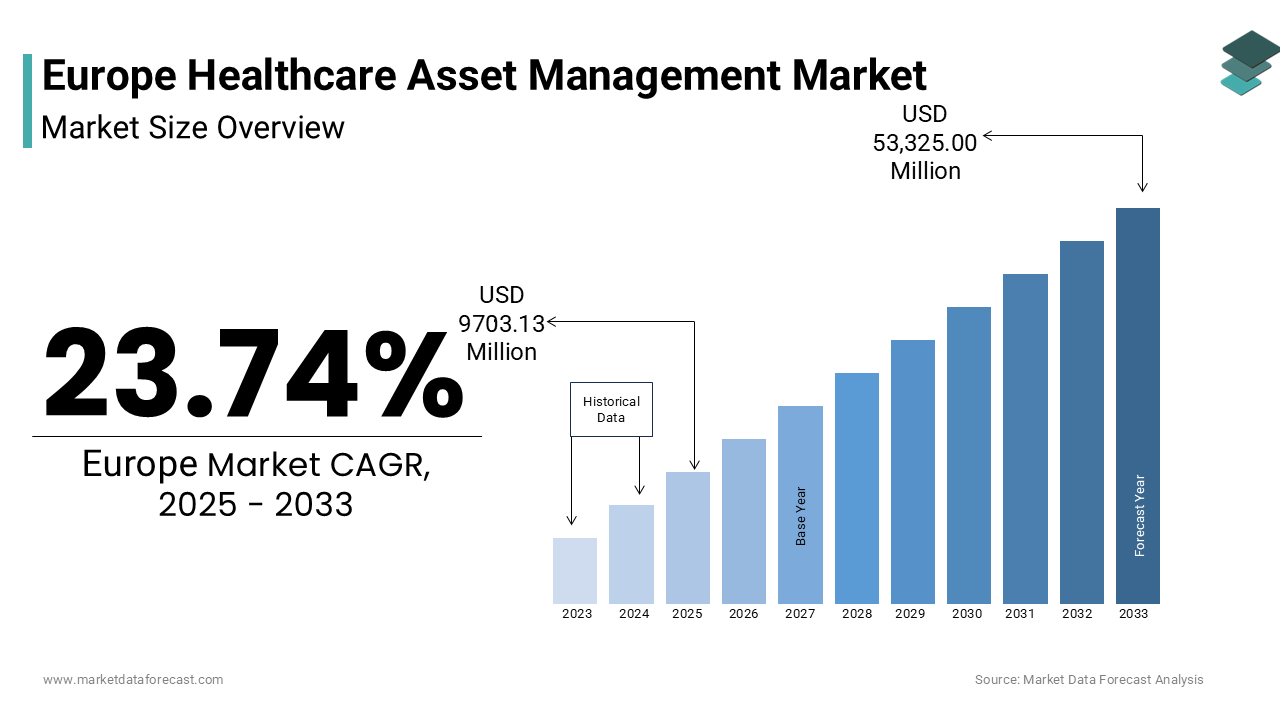
Healthcare asset management includes systematic tracking, maintenance, utilization and optimization of medical devices, equipment and infrastructure across hospitals, clinics and diagnostic centers using digital technologies such as radio frequency identification, real time location systems and cloud-based software platforms. This practice is increasingly vital as European healthcare systems grapple with aging infrastructure, rising operational costs and the need for clinical efficiency. According to Eurostat, hospitals across the European Union face challenges with aging infrastructure with many facilities requiring modernization. A significant share of medical equipment in public hospitals is also used beyond its recommended service life, which raising concerns about efficiency and safety. Healthcare expenditure continues to rise across the EU with countries like Germany and France spending over 11% of GDP on healthcare, which is indicating the financial strain of inefficient asset utilization. Furthermore, according to the OECD data, European hospitals report an average bed occupancy rate of around 73%, which is intensifying pressure to maximize the productivity of every clinical asset. Driven by digital health strategies under the EU’s 2030 Digital Compass and national initiatives like Germany’s Hospital Future Act, healthcare asset management has evolved from a logistical function into a strategic enabler of patient safety, regulatory compliance and fiscal sustainability across the continent.
MARKET DRIVERS
Regulatory Mandates for Medical Device Traceability and Safety
Stricter European regulations on medical device accountability have become a primary catalyst for healthcare asset management adoption, which is one of the major factors propelling the growth of the European healthcare asset management market. The European Union Medical Device Regulation requires all implantable and high-risk devices to be registered in the EUDAMED database and tracked through unique device identification throughout their lifecycle. Hospitals across Europe must now comply with UDI requirements, which is compelling them to implement digital tracking systems capable of real time inventory and recall management. Non-compliance can result in penalties or suspension of clinical operations, which is creating urgent institutional demand for asset visibility platforms. Additionally, the EU’s In Vitro Diagnostic Regulation imposes similar traceability obligations on diagnostic equipment, which is impacting laboratories across the bloc. Hospitals in France and the Netherlands have already integrated UDI compliant asset management modules into their electronic health records to meet national inspectorate mandates. The Medicines and Healthcare products Regulatory Agency in the United Kingdom further requires all NHS trusts to maintain auditable logs of device servicing and sterilization cycles. These overlapping regulatory layers transform asset management from an operational choice into a legal necessity, which is accelerating deployment of RFID and barcode enabled tracking solutions across European care settings.
Aging Medical Infrastructure and Capital Budget Constraints
The aging medical equipment base of Europe and constrained public health budgets are driving hospitals to extend asset lifespans through predictive maintenance and utilization analytics, which is further contributing to the healthcare asset management market expansion in Europe. Many hospitals in Southern and Eastern Europe continue to rely on imaging and monitoring devices that are more than 10 years old, which is increasing failure rates and service costs. Simultaneously, national health expenditures remain under pressure. According to Eurostat data, public health spending growth in the EU averaged around 2% annually in recent years, which is far below inflation. In this context, healthcare asset management systems offer a high return on investment by reducing unplanned downtime and avoiding premature replacements. Facilities using real time asset tracking have reported significant efficiency gains, including reduced equipment search time and extended device service life. Italy’s National Health Service has mandated that all public hospitals implement preventive maintenance protocols by 2025 to qualify for federal capital grants. These fiscal realities compel administrators to treat asset management not as an IT expense but as a capital preservation strategy, particularly for high value items like infusion pumps, ventilators and ultrasound machines that require precise calibration and regulatory documentation.
MARKET RESTRAINTS
Fragmented Health IT Ecosystems and Interoperability Gaps
The Europe healthcare asset management market faces significant resistance from the lack of standardized data exchange between legacy hospital systems and modern tracking platforms. Most European hospitals operate a patchwork of electronic health records, enterprise resource planning tools and biomedical equipment databases that were not designed to communicate with real time location or RFID systems. Fewer than one third of EU hospitals have achieved interoperability levels sufficient to support automated asset lifecycle management. This fragmentation forces costly custom integrations and limits scalability. In Spain, audits have shown that only a small fraction of public hospitals can synchronize device maintenance logs with procurement systems, leading to redundant purchases. The absence of a unified European health data space further delays cross border compatibility. Even when asset management software is deployed, inconsistent coding of device types (e.g., using local vs international nomenclature like EMDN) hampers data analytics. These technical silos increase implementation time, reduce user adoption and undermine the reliability of utilization metrics and ultimately slowing market penetration despite clear operational benefits.
High Initial Investment and Perceived ROI Uncertainty
The substantial upfront costs associated with deploying comprehensive healthcare asset management solutions deter many public and mid-sized private facilities across Europe, which is further restraining the regional market growth. Implementing RFID or Bluetooth Low Energy infrastructure across a medium sized hospital typically requires significant investments for hardware, software integration and staff training. In countries with decentralized healthcare financing like Italy or Belgium, individual hospitals must secure these funds without central support, which is competing against clinical priorities such as staffing or pharmaceuticals. Moreover, the return on investment is often intangible in the short term, encompassing avoided losses rather than direct revenue generation. For instance, European hospital CFOs have revealed that unclear financial justification remains a major barrier to adoption. National reimbursement models rarely account for efficiency gains from asset optimization, which is further weakening the business case. Although Germany’s Hospital Future Fund allocated billions of euros for digitalization, only a small share was directed toward asset tracking by 2023. This funding gap disproportionately affects rural and Eastern European facilities where capital is most constrained, which is creating an uneven adoption landscape that limits market growth despite a strong clinical rationale.
MARKET OPPORTUNITIES
Integration of Artificial Intelligence for Predictive Maintenance
The incorporation of artificial intelligence into asset management platforms presents a significant opportunity for the European healthcare asset management market. AI algorithms can analyze real-time operational data from connected devices to forecast failures before they occur. AI driven maintenance has been shown to significantly reduce unplanned downtime for MRI and CT scanners in German pilot hospitals. This capability is especially valuable for high-cost imaging equipment, which can cost thousands of euros per hour in lost revenue when idle. The European Health Data Space initiative further enables anonymized data pooling across institutions to refine failure prediction models while maintaining GDPR compliance. Companies like Philips and Siemens Healthineers are embedding AI modules directly into their device ecosystems allowing seamless integration with third party asset platforms. Hospitals in the Netherlands have reported notable reductions in service contract costs after deploying machine learning based asset health dashboards. As European hospitals face growing equipment backlogs and technician shortages, AI enhanced asset management offers a scalable path to operational resilience without proportional staffing increases.
Expansion of Mobile and Cloud Based Asset Platforms for Decentralized Care
The shift toward outpatient and home-based care models across Europe is creating demand for lightweight cloud enabled asset management solutions that extend beyond traditional hospital walls, which is another potential opportunity for the European healthcare asset management market. A growing share of surgical procedures in Sweden and Denmark are now performed in ambulatory settings, reflecting a broader European trend toward decentralized care. The EU also projects that home based care will account for a significant portion of chronic disease management in the coming years. These decentralized environments rely on portable devices such as infusion pumps, portable ultrasounds and remote monitoring kits that frequently move between patients’ homes and clinics. Traditional fixed asset tracking fails in this context, but mobile cloud platforms using smartphone scanning and geofencing offer real time visibility. In France, home care agencies have increasingly adopted cloud asset apps to comply with new device sterilization tracking rules. These platforms eliminate on premise servers, reduce IT overhead and support automatic software updates—critical for smaller providers with limited technical staff. Furthermore, cloud systems facilitate centralized oversight for regional health authorities managing shared equipment pools across multiple municipalities. This scalability aligns with Europe’s broader strategy to contain costs through care decentralization while ensuring device safety and accountability across the entire care continuum.
MARKET CHALLENGES
Cybersecurity Vulnerabilities in Connected Medical Devices
The increasing connectivity of medical assets introduces significant cybersecurity risks that complicate asset management implementation across Europe, which is one of the challenges to the European healthcare asset management market. As hospitals deploy Wi Fi and Bluetooth enabled tracking tags on devices ranging from ventilators to wheelchairs each connection point becomes a potential entry vector for ransomware or data exfiltration. According to the European Union Agency for Cybersecurity, a significant share of European healthcare organizations experienced cyber incidents involving medical devices in 2023 with many resulting in clinical disruption. Asset management platforms that aggregate device locations, usage logs and maintenance records create high value targets. A single breach could expose sensitive operational data or enable device tampering. Compliance with the EU’s NIS2 Directive now mandates hospitals to implement asset inventory as part of their cybersecurity risk assessments, yet many legacy tracking systems lack encryption or access controls. In 2024, Ireland’s Health Service Executive suspended its RFID rollout after a third-party vendor failed GDPR security audits. These threats force institutions to conduct extensive vendor due diligence and invest in secure network segmentation, which is adding cost and complexity that delay deployments. Until cybersecurity is seamlessly embedded into asset management design, trust and adoption will remain constrained.
Workforce Resistance and Change Management Barriers
The successful deployment of healthcare asset management systems is frequently undermined by clinical and technical staff resistance rooted in workflow disruption and digital fatigue, which is further challenging the regional market expansion. Nurses and biomedical engineers often perceive tracking requirements as administrative burdens that divert time from patient care. Frontline staff in public hospitals across Spain, Italy and Greece have reported increased documentation tasks after asset system implementation without corresponding staffing adjustments. Legacy cultures where equipment was informally shared or stored in ad hoc locations clash with the discipline required for barcode scanning or RFID check in protocols. Training gaps exacerbate this as fewer than one quarter of EU hospitals provide structured change management programs during digital rollouts. In Finland, a national asset tracking initiative stalled when operating room teams refused to log surgical instrument sets due to perceived delays. Without inclusive design involving end users from the outset and clear demonstration of time savings or error reduction, adoption remains superficial. This human factor poses a persistent challenge to realizing the full operational benefits of asset management investments.
REPORT COVERAGE
| REPORT METRIC | DETAILS |
| Market Size Available | 2024 to 2033 |
| Base Year | 2024 |
| Forecast Period | 2025 to 2033 |
| Segments Covered | By Product, Application, End-User& Region |
| Various Analyses Covered | Global, Regional & Country Level Analysis, Segment-Level Analysis, Drivers, Restraints, Opportunities, Challenges; PESTLE Analysis; Porter's Five Forces Analysis, Competitive Landscape, Analyst Overview of Investment Opportunities |
| Regions Covered | United Kingdom (UK), France, Spain, Germany, Italy, Russia, Sweden, Denmark, Switzerland, the Netherlands, Turkey, the Czech Republic, and the Rest of Europe. |
| Key Market Players | GE Healthcare, IBM Corporation, Zebra Technologies, CenTrak Inc., AiRISTA Flow, Stanley Healthcare, Sonitor Technologies, AeroScout, Versus Technology Inc., and ThingMagic. |
SEGMENTAL ANALYSIS
By Product Insights
The real time location systems segment occupied 46.4% of the European healthcare asset management market share in 2024 due to its superior precision, dynamic tracking capability and integration with clinical workflows beyond static inventory management. Unlike RFID which typically offers room level or zone level visibility, RTLS using ultra-wideband or Bluetooth Low Energy triangulation can locate assets within 30 centimetres, which is critical for time sensitive equipment like defibrillators or infusion pumps in large hospitals. Facilities using RTLS have reported significant reductions in equipment search time per shift, which is directly enhancing staff productivity. National digital health strategies further accelerate adoption as Germany’s Hospital Future Act allocated substantial funding by 2023 specifically for real time tracking infrastructure in acute care settings. RTLS also supports compliance with the EU Medical Device Regulation by enabling automatic logging of device movement, sterilization cycles and usage hours. In Sweden and the Netherlands, national health authorities mandate RTLS for high value mobile assets in all public hospitals as part of their equipment accountability frameworks. This regulatory and operational alignment ensures RTLS remains the preferred architecture for comprehensive asset visibility across Europe.
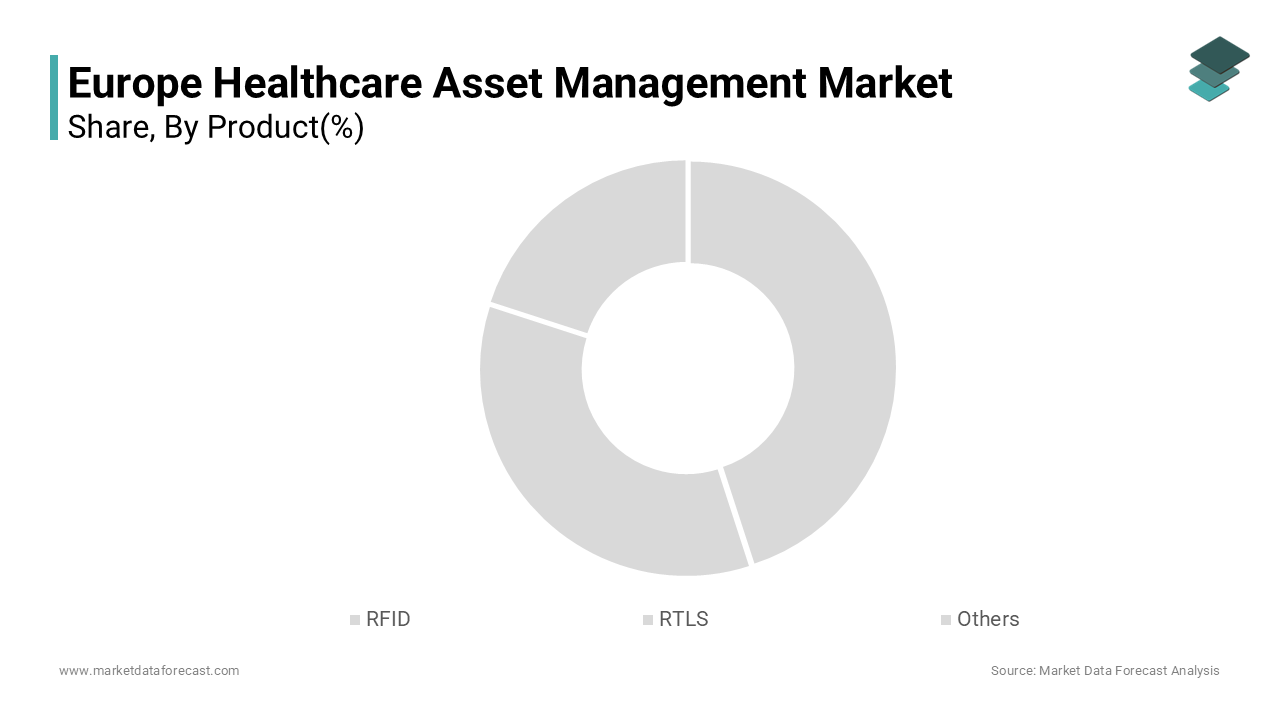
The RFID segment is anticipated to register the fastest CAGR of 11.9% over the forecast period in the European market due to cost reductions in passive UHF RFID tags and the expansion of applications into supply chain and consumables management. While RTLS excels in tracking high value mobile assets, RFID offers a scalable solution for managing high-volume low-cost items such as surgical kits, implant trays and sterilization bins. The European Commission’s Unique Device Identification mandate requires full traceability of implantable devices and RFID enables batch level tracking at a fraction of RTLS cost. Hospitals across Europe are increasingly adopting RFID for sterilization tracking due to its compatibility with autoclave environments and minimal maintenance. Additionally, the integration of RFID with GS1 standards allows seamless data exchange between suppliers, hospitals and regulators, supporting the EU’s vision for a unified health product database. As cloud-based RFID readers and mobile scanning apps eliminate the need for fixed infrastructure, even small clinics and outpatient centers can now deploy asset tagging economically, which is broadening the market base significantly across Southern and Eastern Europe.
By Application Insights
The equipment tracking segment captured 49.7% of the European healthcare asset management market in 2024. The dominance of the equipment tracking segment in the European market is attributed to the acute financial and operational pressure on hospitals to optimize the utilization of high-cost mobile devices such as ultrasound machines infusion pumps and ventilators. Hospitals across Europe report low device utilization rates, which is largely due to poor visibility and hoarding in departments. Equipment tracking systems directly address this by providing real time dashboards that show location, status and maintenance history, enabling central pool management. Facilities implementing digital tracking have reported significant reductions in duplicate equipment purchases in recent years. Furthermore, the EU Medical Device Regulation mandates full lifecycle documentation for Class IIa and higher devices, which is making automated tracking a compliance necessity rather than an efficiency luxury. National inspectorates in the Netherlands and Denmark now include asset visibility in hospital accreditation criteria. With millions of medical devices in active use across EU hospitals, equipment tracking remains the foundational and highest ROI application driving sustained investment across public and private care settings.
The supply chain management segment is estimated to register a promising CAGR of 17.7% over the forecast period in the European healthcare asset management market. The growth of the supply chain management segment is majorly driven by the systemic shift toward lean inventory practices and traceability mandates across hospital logistics. The European Commission’s Falsified Medicines Directive and the UDI requirements under the Medical Device Regulation compel hospitals to track every implantable device and high-risk consumable from delivery to patient use. In 2023, the UK’s National Health Service mandated serialized tracking for all orthopedic and cardiovascular implants across acute trusts using integrated asset platforms. Simultaneously, hospitals face pressure to reduce working capital. According to Eurostat, medical consumables inventory represents a significant share of average hospital current assets, which is far above benchmarks in other industries. RFID enabled smart cabinets and automated dispensing systems now provide real time stock visibility with pilot programs in France demonstrating notable reductions in overstock. The convergence of regulatory compliance, cost containment and digital procurement platforms has transformed supply chain management from back-office logistics into a strategic clinical and financial function, which is accelerating adoption across Europe.
By End User Insights
The hospitals segment accounted for the most significant share of the European healthcare asset management market in 2024. The growth of the hospitals segment is primarily rooted in the scale complexity and regulatory exposure of acute care environments which manage thousands of mobile assets across dozens of departments. A typical European teaching hospital operates thousands of individual medical devices ranging from fixed imaging systems to portable monitors with each requiring maintenance, calibration and regulatory documentation. Hospital equipment downtime costs the EU healthcare system billions of euros annually, which is primarily due to lost procedure time and emergency rentals. National digitalization funds amplify investment as Germany’s Hospital Future Act has disbursed billions of euros since 2020 with asset tracking as a core eligible category. Furthermore, hospitals are the primary enforcement point for the EU Medical Device Regulation, which mandates full device traceability and adverse event reporting. In countries like Sweden and the Netherlands, hospital accreditation now requires digital asset logs as proof of compliance. The high concentration of high value assets, regulatory scrutiny and public funding ensures hospitals remain the central and most mature end user segment for healthcare asset management technologies across Europe.
The laboratories segment is the fastest growing end user segment in the Europe healthcare asset management market and is estimated to register a CAGR of 14.04% over the forecast period owing to the increasing automation of diagnostic workflows and stringent requirements for sample and equipment traceability under the In Vitro Diagnostic Regulation. Modern laboratories operate hundreds of analyzers reagent coolers and sample transport systems that require precise calibration logs and usage records. The IVDR mandates unique device identification for all medium and high risk IVD instruments compelling labs to implement digital tracking for compliance audits. In 2023, newly accredited molecular diagnostics labs in France increasingly deployed RFID based asset systems to manage reagent expiration and instrument service cycles. Additionally, the rise of centralized testing hubs relies on real time visibility of mobile analyzers shared across sites. With tens of thousands of clinical laboratories in the EU and growing consolidation into regional networks, the demand for scalable cloud-based asset platforms that integrate with laboratory information systems is accelerating rapidly across Western and Nordic Europe.
REGIONAL ANALYSIS
Germany Healthcare Asset Management Market Analysis
Germany dominated the healthcare asset management market in Europe by holding 25.5% of the regional market share in 2024. The growth of Germany in the European market is directly tied to the Hospital Future Act which allocated billions of euros for digital infrastructure with asset tracking as a priority use case. By 2023, more than a thousand public and private hospitals had implemented RTLS or RFID systems to comply with strict documentation requirements for medical devices under EU MDR. Germany’s dense network of university hospitals and specialized clinics manages millions of high value mobile devices requiring precise maintenance and location data. Hospitals using digital asset platforms have reported significant reductions in equipment downtime and duplicate purchases. Furthermore, the country’s strong biomedical engineering workforce ensures rapid deployment and integration with existing hospital IT systems. With the majority of German hospitals mandated to achieve digital maturity levels by 2025 under national benchmarks, asset management remains a cornerstone of the nation’s healthcare digital transformation strategy.
France Healthcare Asset Management Market Analysis
France is a promising market for healthcare asset management. The position of France in the European market is majorly attributed to the centralized digital health governance and aggressive UDI compliance enforcement. Since 2022, all public hospitals must integrate equipment tracking data into the national Mon Espace Santé platform enabling cross facility asset sharing and audit readiness. France’s public hospitals manage large volumes of mobile medical devices and face strict penalties for non-compliance with MDR documentation rules. In 2023, the government launched the “Hôpital Numérique” phase two allocating hundreds of millions of euros specifically for real time location systems in emergency and operating departments. For instance, significant improvements in implantable device traceability since 2021 due to asset management adoption. Additionally, France’s emphasis on reducing healthcare disparities has driven RTLS deployment in rural hospitals to optimize scarce equipment pools serving multiple communes. This top-down policy framework ensures consistent nationwide adoption beyond major urban centers.
United Kingdom Healthcare Asset Management Market Analysis
The United Kingdom is predicted to account for a notable share of the Europe healthcare asset management market over the forecast period. Despite Brexit, the UK maintains alignment with EU medical device traceability standards through its own UKCA marking regime which mandates unique device identification and lifecycle tracking. The National Health Service manages a vast number of mobile clinical assets across acute trusts and has made asset visibility a pillar of its Operational Productivity Programme. In 2023, NHS England mandated RTLS for defibrillators, infusion pumps and anaesthetic machines in all trusts to reduce search time and improve emergency response. Equipment delays have been identified as a significant contributor to surgical schedule disruptions, which is making tracking a patient safety priority. Additionally, the NHS Supply Chain introduced RFID based smart cabinets in pilot hospitals to manage high-cost implants with reported reductions in inventory costs. With capital budgets constrained post pandemic, digital asset management offers a high return path to efficiency, making it a strategic focus across the UK healthcare system.
Italy Healthcare Asset Management Market Analysis
Italy is estimated to grow at a healthy CAGR in the Europe healthcare asset management market during the forecast period due to the regional digitalization funds and urgent efficiency measures in its fragmented public hospital network. Italy operates over 1000 public hospitals with significant variation in digital maturity yet recent national policies are accelerating convergence. The National Recovery and Resilience Plan allocated substantial funding to hospital digital infrastructure with asset tracking as an eligible category. Lombardy and Emilia Romagna have led adoption, which is implementing RTLS in dozens of hospitals to manage shared equipment pools across provinces. The Italian Medicines Agency intensified MDR compliance checks in 2023, which is prompting rapid system deployments. Furthermore, Italy’s aging population increases demand for efficient use of imaging and monitoring devices in geriatric care. With hospital occupancy rates exceeding 80% in the north, asset visibility has become critical to maintaining throughput. These regional and demographic pressures are transforming Italy into a high growth market for scalable cloud-based asset management solutions.
Netherlands Healthcare Asset Management Market Analysis
The Netherlands is expected to exhibit a steady CAGR in the regional market during the forecast period. The country’s advanced position stems from its long-standing emphasis on integrated care and data driven healthcare optimization. All Dutch hospitals must comply with the National Quality Framework which includes mandatory equipment utilization metrics and maintenance documentation. The Health Care Inspectorate conducts unannounced audits verifying asset records with digital traceability required for high-risk devices. The Netherlands pioneered the use of RTLS in shared equipment networks; the Amsterdam University Medical Center manages a centralized pool of medical imaging equipment with real time booking and location tracking. In 2023, national programs supported funding to expand asset visibility to outpatient clinics and home care providers. With Dutch hospitals increasingly adopting electronic asset logs and a strong domestic health tech ecosystem including companies like Philips, the Netherlands serves as a model for scalable asset management integration across the continuum of care.
COMPETITVE LANDSCAPE
Competition in the Europe healthcare asset management market is characterized by a mix of global technology leaders and specialized regional vendors competing on regulatory alignment interoperability and clinical workflow integration. The market is highly fragmented by national healthcare systems each with distinct digital maturity levels funding mechanisms and compliance timelines yet unified by overarching EU regulations such as MDR and IVDR. Leading firms differentiate through certified compliance modules seamless EHR integration and predictive analytics rather than hardware alone. Local partnerships with public hospital networks and national digital health agencies are critical for market access especially in countries like France Germany and Italy where procurement is centralized. Emerging players focus on niche applications such as laboratory asset tracking or home care device management to bypass dominance in acute care. Cybersecurity data privacy and workforce adoption remain persistent challenges influencing vendor selection. The competitive landscape is further shaped by the shift toward software as a service models reducing upfront costs and accelerating scalability across multi site health systems.
KEY MARKET PLAYERS
Some of the companies that are playing a dominating role in the Europe Healthcare Asset Management Market include
- GE Healthcare
- IBM Corporation
- Zebra Technologies
- CenTrak, Inc.
- AiRISTA Flow
- Stanley Healthcare
- Sonitor Technologies
- AeroScout
- Versus Technology, Inc.
- ThingMagic
Top Players in the Europe Healthcare Asset Management Market
Stanley Healthcare
Stanley Healthcare is a global leader in real time location systems and RFID based tracking solutions with a strong presence across European hospitals and care facilities. The company specializes in scalable platforms for equipment patient and staff tracking that integrate with existing hospital workflows and electronic health records. Stanley Healthcare has deepened its European footprint through partnerships with national health systems in the UK Germany and the Nordic countries. In 2023 the company launched its AeroScout Mobile View platform enhanced with Bluetooth Low Energy support enabling precise asset visibility on clinician smartphones. It also collaborated with the Dutch Ministry of Health to pilot a shared medical equipment network across five provinces using cloud based RTLS technology to optimize utilization and reduce capital expenditure.
Zebra Technologies Corporation
Zebra Technologies is a prominent provider of asset intelligence solutions including RFID readers mobile computers and cloud based tracking software widely deployed in European healthcare settings. The company’s healthcare portfolio focuses on improving operational efficiency through real time data capture and analytics across the equipment supply chain and patient flow. Zebra has strengthened its position in Europe by aligning its solutions with EU Medical Device Regulation compliance requirements. In 2024 Zebra integrated its SmartLens analytics engine with GS1 standards to enable automatic UDI capture and audit ready device logs for hospitals across France and Italy. The company also expanded its professional services team in EMEA to support rapid deployment in public hospital digitalization programs funded under national recovery plans.
TeleTracking Technologies
TeleTracking Technologies is a key player in healthcare operations management offering asset tracking as part of its broader capacity and flow optimization platform. The company serves major European academic medical centers and integrated delivery networks with solutions that connect asset location data to bed management and staff scheduling. TeleTracking has emphasized interoperability by certifying its platform with major European EHR vendors including Epic and Cerner. In 2023 the company implemented its Resource Management Suite in a large German university hospital enabling centralized tracking of over 2000 mobile devices across 15 departments. TeleTracking also partnered with Sweden’s Karolinska University Hospital to develop predictive analytics that anticipate equipment demand based on surgical schedules and patient admissions enhancing asset availability without increasing inventory.
Top Strategies Used by the Key Market Participants
Key players in the Europe healthcare asset management market prioritize regulatory compliance by embedding EU Medical Device Regulation and In Vitro Diagnostic Regulation requirements directly into their tracking platforms. They invest in cloud native and mobile first architectures to support decentralized care models and reduce on premise IT dependency. Strategic partnerships with national health authorities and public hospital networks secure large scale deployments under digital health funding schemes. Companies enhance interoperability by adopting GS1 standards and integrating with major electronic health record systems across Europe. Innovation focuses on predictive analytics using artificial intelligence to forecast maintenance needs and equipment demand. Workforce centric design ensures minimal disruption to clinical workflows through intuitive mobile interfaces and voice enabled features. These strategies collectively address Europe’s unique blend of regulatory rigor operational efficiency demands and public health system complexity.
MARKET SEGMENTATION
The research report on the europe healthcare asset management market has been segmented and sub-segmented based on categories.
By Product
- RFID
- RTLS
- Others
By Application
- Staff Management
- Equipment Tracking
- Patient Tracking
- Supply Chain Management
By End User
- Hospitals
- Laboratories
- Others
By Country
- UK
- France
- Spain
- Germany
- Italy
- Russia
- Sweden
- Denmark
- Switzerland
- Netherlands
- Turkey
- Czech Republic
- Rest of Europe