Europe Healthcare Business Intelligence Market Size, Share, Trends, & Growth Forecast Report By Component (Software, Services), Mode of Delivery, Application, End Use, Deployment and Country (UK, France, Spain, Germany, Italy, Russia, Sweden, Denmark, Switzerland, Netherlands, Turkey, Czech Republic and Rest of Europe), Industry Analysis From 2025 to 2033
Europe Healthcare Business Intelligence Market Size
The europe healthcare business intelligence market size was valued at USD 3.16 billion in 2024 and is anticipated to reach USD 3.60 billion in 2025 from USD 10.11 billion by 2033, growing at a CAGR of 13.80% during the forecast period from 2025 to 2033.
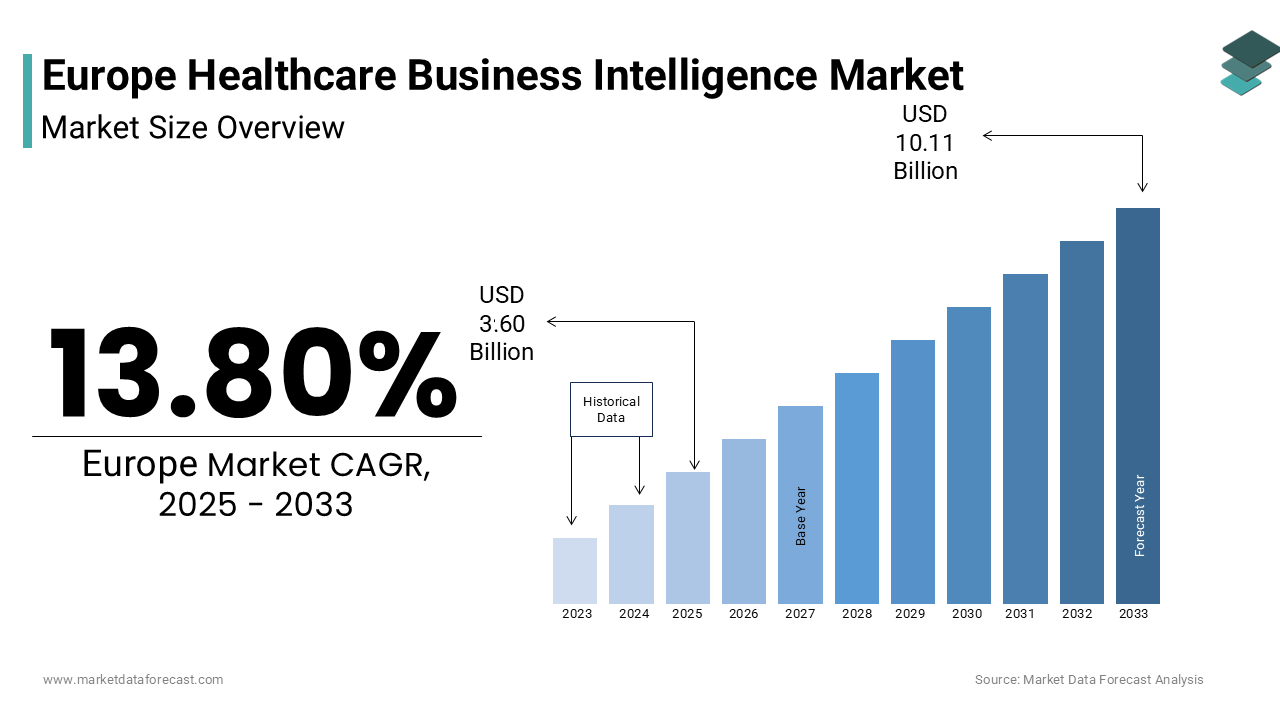
Healthcare Business Intelligence is the integration of data analytics, visualization and decision support systems that transform clinical, operational and financial health data into actionable strategic insights. Unlike generic analytics, these solutions are purpose built for compliance with European health data governance frameworks, interoperability standards like HL7 FHIR and value-based care models. The urgency for such capabilities has intensified as public and private health systems navigate aging populations, workforce shortages and fiscal constraints. According to Eurostat, the median age in the European Union reached 44.7 years in 2024 with over 21.6% of the population aged 65 or older, which is significantly increasing demand for chronic disease management and predictive resource planning. Healthcare expenditure in the EU accounted for about 10% of GDP in 2023, which is reflecting the scale of systemic pressures across member states. These systemic pressures have elevated healthcare business intelligence from a back-office function to a critical enabler of cost containment, clinical quality improvement and regulatory transparency in Europe’s increasingly outcomes driven health ecosystems.
MARKET DRIVERS
Mandatory Value Based Healthcare Reforms Drive Demand for Performance Analytics
Across Europe, national health systems are transitioning from volume-based reimbursement to value-based models that tie provider payments to patient outcomes, efficiency and equity, which is one of the major factors propelling the healthcare BI market growth in Europe. This structural shift necessitates robust business intelligence capabilities to measure, benchmark and optimize performance across care pathways. As per the European Observatory on Health Systems and Policies, several EU member states had implemented formal value-based healthcare pilot programs by early 2024 with Sweden, the Netherlands and Estonia leading in nationwide adoption. In Sweden, the National Board of Health and Welfare requires all county councils to report standardized outcome indicators for high burden conditions using integrated BI dashboards. Similarly, Germany’s Innovation Fund has allocated hundreds of millions of euros since 2020 to integrated care projects that must demonstrate cost and quality improvements through real time analytics. These policy instruments transform business intelligence from optional infrastructure into a contractual obligation, which is compelling hospitals and regional health authorities to invest in data pipelines that link clinical records, billing systems and patient reported outcomes into unified analytical views.
EU Wide Health Data Interoperability Initiatives Enable Cross Institutional Analytics
The European Health Data Space that is formally adopted in 2024 establishes a legal and technical framework for secure secondary use of health data across borders for research, policy and innovation, which is further contributing to the healthcare business intelligence market expansion in Europe. This landmark regulation mandates that member states implement standardized data formats, semantic interoperability and federated query capabilities by 2027. As per the European Commission, many national electronic health record systems in the EU are now either compliant with or in active migration toward the HL7 FHIR standard, which is enabling structured data exchange. This harmonization unlocks unprecedented opportunities for business intelligence applications that analyze population health trends, treatment effectiveness and resource utilization at scale. For instance, France’s Health Data Hub has already connected more than 100 hospitals to a common analytics platform that tracks antibiotic resistance patterns in real time. Likewise, the Nordic Health Data Network allows researchers in Denmark, Finland and Norway to run cross national comparative effectiveness studies using anonymized patient cohorts. These interoperable infrastructures reduce data silos and create fertile ground for advanced analytics that were previously impossible due to technical and legal fragmentation.
MARKET RESTRAINTS
Persistent Fragmentation of Health Data Governance Across Member States Limits Scalable BI Deployment
Despite EU level initiatives, healthcare data governance remains highly decentralized with each member state enforcing distinct interpretations of consent, anonymization and secondary use under the General Data Protection Regulation. According to the European Data Protection Board’s 2024 summary of national practices, several EU countries require explicit patient opt in for any analytics beyond direct care, while others permit broader processing under public interest provisions. This regulatory patchwork complicates the deployment of pan European business intelligence solutions, as vendors must customize data ingestion, which is masking and access controls for each jurisdiction. For example, a pharmaceutical company using real world evidence to assess drug safety must navigate divergent rules in Germany (strict opt in) versus Portugal (broad public health exception). According to a 2024 survey by the European Health Management Association, a majority of hospital networks delayed or scaled back analytics projects due to legal uncertainty around cross regional data pooling. Until harmonized implementation guidelines emerge from the European Health Data Space governance body, this fragmentation will continue to hinder economies of scale and innovation velocity in the healthcare BI market.
Legacy Clinical IT Infrastructure Impedes Real Time Data Integration and Analytics
A significant portion of Europe’s healthcare delivery infrastructure still relies on outdated electronic health record systems that lack modern APIs, structured data outputs, or cloud connectivity, which is further hampering the regional market expansion. According to the European Institute of Innovation and Technology Health, many hospitals in Southern and Eastern Europe operated on EHR platforms developed before 2015, many of which store clinical notes as unstructured PDFs or scanned images. This technical debt creates substantial barriers to automated data extraction and real time dashboarding. Even in digitally advanced nations, integration challenges persist as NHS Digital reported in 2024 that less than half of acute trusts had fully operational HL7 FHIR interfaces across all departments. Without clean, timely and normalized data feeds, business intelligence systems produce incomplete or delayed insights, which is reducing their clinical utility. Consequently, organizations must invest heavily in middleware, data lakes and manual curation that are increasing total cost of ownership and extending implementation timelines. Until legacy system modernization accelerates through EU digital health investment programs, the promise of proactive, data driven healthcare will remain partially unrealized.
MARKET OPPORTUNITIES
Expansion of Predictive Analytics for Chronic Disease Management Unlocks Preventive Value
With chronic conditions accounting for over 80% of healthcare spending in the EU, payers and providers are increasingly deploying predictive business intelligence to shift from reactive treatment to proactive prevention, which is a promising opportunity for the European healthcare BI market. As per the World Health Organization’s European Region office, cardiovascular diseases, diabetes and respiratory illnesses collectively caused around 80% of deaths in 2023 yet a significant share of these cases are preventable through early intervention. Leveraging this insight, countries like Finland and the Netherlands have integrated predictive risk stratification into primary care workflows. Finland’s Kanta Services platform uses machine learning on national registry data to identify patients at high risk of diabetic complications, which is enabling targeted nurse outreach that reduced hospital admissions in a 2024 pilot. Similarly, the Dutch National Institute for Public Health runs real time dashboards that forecast regional influenza surges using pharmacy sales and primary care visit data, which is allowing preemptive resource allocation. These applications demonstrate how healthcare business intelligence can generate measurable clinical and economic value by enabling anticipatory care models aligned with Europe’s sustainability and equity goals.
Integration of Patient Reported Outcome Measures into Routine Care Fuels Personalized Analytics
European health systems are increasingly recognizing patient centred outcomes, which is not just clinical metrics and as essential indicators of care quality. The EU’s Patient Reported Outcome Measures initiative, launched under the European Health Union, mandates that member states incorporate standardized PROMs into treatment pathways for cancer, musculoskeletal disorders and mental health by 2026. As per the Organisation for Economic Co-operation and Development, several EU countries had already embedded PROMs into national reimbursement frameworks by 2024, including the UK, Sweden and Italy. This shift generates rich longitudinal datasets that feed into business intelligence platforms to assess real world treatment effectiveness, symptom trajectories and quality of life impacts. For example, the UK’s National Cancer Registration and Analysis Service integrates PROMs from millions of patients annually, which is enabling oncologists to compare surgical versus non-surgical outcomes across tumor types and demographics. These insights empower shared decision making, reduce unwarranted practice variation and support value-based contracts. As PROM collection becomes routine through mobile apps and wearable integrations, healthcare BI will evolve toward truly person-centred analytics.
MARKET CHALLENGES
Ambiguity in Regulatory Classification of BI Tools as Medical Devices Creates Compliance Risk
The European Commission’s guidance on whether healthcare business intelligence software qualifies as a medical device under the EU Medical Device Regulation remains inconsistently applied, which is creating significant uncertainty for developers and providers and challenging the regional market expansion. According to the European Medicines Agency, if a BI system provides diagnostic suggestions, risk scores, or treatment recommendations based on patient data, it may be classified as a Class IIa or higher medical device, which is requiring clinical validation and notified body certification and post market surveillance. However, the boundary between descriptive analytics and decision support is often blurred. In 2024 the German Federal Institute for Drugs and Medical Devices suspended hospital deployed analytics dashboards for lacking CE certification, which is citing their use of predictive sepsis alerts. Similarly, the French National Authority for Health issued warnings to vendors marketing “clinical decision support” features without MDR compliance. This regulatory gray zone discourages innovation, as developers face unpredictable approval timelines and liability exposure. Until the European Commission issues clear, use case specific criteria distinguishing administrative BI from regulated clinical software, market participants will operate under heightened legal and commercial risk.
Shortage of Health Data Scientists and Clinical Informaticians Constrains Advanced Analytics Adoption
Despite growing demand for data driven healthcare, Europe faces a critical shortage of professionals who can bridge clinical knowledge, data engineering and statistical modeling, which is further challenging the regional market growth. According to the European Federation of Medical Informatics, there is a significant deficit of health data specialists across the EU with particularly acute gaps in Spain, Italy and Poland. This scarcity impedes the design, validation and interpretation of business intelligence outputs. As per a 2024 survey by the European Health Management Association, a majority of hospital chief information officers cited lack of in-house analytics talent as the primary barrier to implementing predictive models or real time dashboards. Even when tools are deployed, clinicians often distrust or ignore insights they cannot contextualize, leading to low utilization. Academic pipelines remain underdeveloped; only a limited number of EU countries offer accredited master’s programs in health data science. Until national strategies scale specialized training and create career pathways for clinical informaticians, the full potential of healthcare business intelligence will remain unrealized across much of the region.
REPORT COVERAGE
| REPORT METRIC | DETAILS |
| Market Size Available | 2024 to 2033 |
| Base Year | 2024 |
| Forecast Period | 2025 to 2033 |
| Segments Covered | By Component, Mode of Delivery, Application, End Use, Deployment & Region |
| Various Analyses Covered | Global, Regional & Country Level Analysis, Segment-Level Analysis, Drivers, Restraints, Opportunities, Challenges; PESTLE Analysis; Porter's Five Forces Analysis, Competitive Landscape, Analyst Overview of Investment Opportunities |
| Regions Covered | United Kingdom (UK), France, Spain, Germany, Italy, Russia, Sweden, Denmark, Switzerland, the Netherlands, Turkey, the Czech Republic, and the Rest of Europe. |
| Key Market Players | Microsoft Corporation, Oracle Corporation, SAP SE, Salesforce Inc., Infor Inc., Domo Inc., Sisense Inc., TIBCO Software Inc., Panorama Software, and IBM Corporation. |
SEGMENTAL ANALYSIS
By Component Insights
The software segment accounted for the largest share of the European healthcare BI market in 2024. The dominance of software segment is driven by the institutional preference for scalable, integrated and auditable analytics platforms. European healthcare organizations prioritize software solutions that offer embedded regulatory compliance, standardized data models and long-term data ownership. According to the European Health Management Association, a large majority of tertiary hospitals in the EU reported using enterprise grade BI software as part of their core digital infrastructure in 2024, which is citing audit readiness and interoperability with electronic health records as key selection criteria. These platforms enable consistent reporting across departments, support compliance with frameworks like the European Health Data Space and reduce reliance on error prone manual spreadsheets. Additionally, the rise of value-based care contracts requires software that can track outcome indicators over time, linking clinical data with cost and quality metrics in a single governed environment. This structural reliance on robust, vendor supported software cements its market leadership.
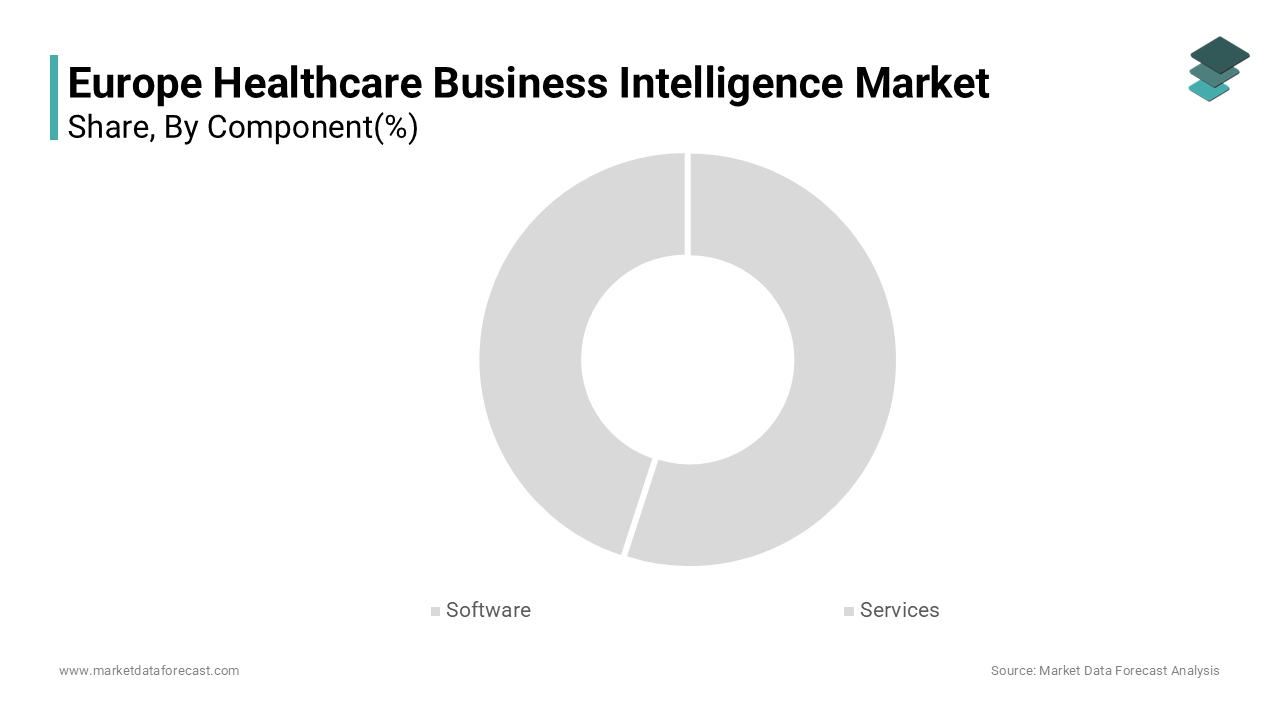
The services segment is anticipated to register a CAGR of 16.6% over the forecast period in the European healthcare BI market. The growth of the services segment in the European market is attributed to the increasing complexity of healthcare data ecosystems that demand specialized implementation, integration and change management support. According to the European Institute of Innovation and Technology Health, many healthcare organizations in 2024 engaged external consultants to design data governance frameworks, map clinical workflows to BI dashboards and train staff on data literacy. Small and mid-sized providers, particularly rely on managed services for cloud migration, real time dashboard maintenance and regulatory reporting. Furthermore, as the European Health Data Space mandates standardized data sharing by 2027, the demand for professional services to retrofit legacy systems with FHIR APIs and anonymization pipelines has surged. The European Commission’s Digital Europe Programme allocated hundreds of millions of euros in 2024 specifically for health data infrastructure modernization, much of which flows into service contracts. This confluence of technical complexity, regulatory urgency and workforce gaps ensures services will outpace software in growth.
By Mode of Delivery Insights
The cloud-based segment occupied 49.4% of the European healthcare BI market in 2024. The dominance of the cloud-based deployment segment in the European market is attributed to the Europe’s strategic shift toward agile, scalable and interoperable health data infrastructure and the rapid adoption of cloud platforms by national health services seeking to unify fragmented data sources. As per the European Commission’s Digital Decade Progress Report 2024, a majority of EU member states had launched national or regional cloud health data platforms, such as France’s Health Data Hub and Sweden’s National eHealth Collaboration. These environments natively support modern BI tools that leverage elastic compute for population health analytics and real time dashboards. Cloud deployment also aligns with the European Health Data Space’s vision of federated, secure data access, which is enabling researchers and providers to query anonymized datasets without centralizing raw records. Additionally, cloud-based BI reduces upfront capital expenditure for cash constrained public hospitals, offering predictable operational costs. This combination of policy alignment, technical flexibility and fiscal pragmatism has made cloud the default choice for new healthcare BI initiatives across Europe.
The hybrid deployment mode segment is the fastest growing segment and is estimated to record a CAGR of 17.7% over the forecast period owing to the pragmatic reality that most European health systems operate in mixed environments where sensitive patient records remain on premise due to legal or legacy constraints, while analytics workloads migrate to the cloud. According to the European Data Protection Board’s 2024 guidance, national authorities in Germany, Austria and Belgium require explicit risk assessments before transferring identifiable health data to non-sovereign cloud regions. Hybrid architectures address this by keeping raw clinical data within hospital firewalls while transmitting de identified aggregates or synthetic datasets to cloud based BI engines. The GAIA-X initiative further accelerates this trend with providers like Siemens Healthineers and Orange offering hybrid stacks that guarantee EU data residency. As per the VDMA Healthcare Division, many German university hospitals adopted hybrid BI models in 2024 to balance innovation with compliance. This dual layer approach satisfies both regulatory caution and analytical ambition.
By Application Insights
The operational analysis segment had the leading share of 33.8% of the European healthcare BI market in 2024. The dominance of the operational analysis segment in the European market is attributed to the acute pressure on European health systems to optimize finite resources amid workforce shortages and rising demand. According to Eurostat, the EU faced a significant deficit of nurses and physicians in 2024, forcing hospitals to maximize efficiency through data driven scheduling, bed management and supply chain forecasting. The UK’s National Health Service reported that operational dashboards reduced emergency department wait times in pilot trusts by predicting patient inflow from ambulance telemetry and primary care referrals. Similarly, Germany’s Hospital Care Reform Act of 2023 mandates public reporting of bed occupancy and staff-to-patient ratios, compelling facilities to implement real time operational BI. These systems integrate data from admission logs, staffing rosters and inventory systems to enable dynamic resource allocation, which is making them essential for fiscal sustainability and regulatory compliance in an era of constrained public health budgets.
The patient care segment is a promising segment and is predicted to grow at a CAGR of 20.9% over the forecast period in this regional market owing to the Europe’s systemic pivot toward person centred, preventive and integrated care models. The European Union’s Chronic Disease Management Framework, adopted in 2023, requires member states to implement risk stratification and care coordination tools for high need populations. As per the WHO European Region, around 70% of healthcare expenditures in 2024 were attributable to chronic conditions yet only about one third of patients received coordinated care plans. In response, countries like the Netherlands and Denmark have deployed patient care BI platforms that synthesize data from wearables, electronic records and patient reported outcomes to generate individualized care pathways. Sweden’s national care program for heart failure uses real time dashboards to alert care teams when remote monitoring metrics deviate from baselines, which is helping reduce readmissions in pilot programs. As value-based contracts and digital therapeutics expand, patient care analytics will become the cornerstone of proactive, holistic health management in Europe.
By End Use Insights
The healthcare providers segment held the major share of the European healthcare business intelligence market in 2024. The dominance of the healthcare providers segment in the European market is driven by their frontline role in delivering care under intensifying efficiency and quality mandates. Hospitals, clinics and integrated delivery networks are the primary adopters of BI tools to manage clinical workflows, reduce adverse events and comply with national reporting requirements. According to the European Observatory on Health Systems and Policies, a large majority of acute care hospitals in Western Europe used operational or clinical BI dashboards in 2024 to monitor metrics such as sepsis onset time, surgical site infection rates and bed turnover. Germany’s hospital reimbursement system now ties a portion of payments to quality indicators tracked through certified BI systems. Similarly, the UK’s Care Quality Commission mandates real time monitoring of staffing levels and incident reports. This regulatory and operational pressure makes providers the most active and consistent investors in healthcare business intelligence, particularly in large, publicly funded systems where accountability is paramount.
The payer segment is projected to grow at a CAGR of 17.1% over the forecast period in the European healthcare business intelligence market due to the Europe’s shift toward value-based reimbursement and real-world evidence assessment. National payers are deploying advanced BI to evaluate treatment cost effectiveness, detect fraud and manage population risk. As per the European Network for Health Technology Assessment, many EU countries now require real world data for coverage decisions on high-cost therapies, driving demand for analytics that link claims, hospital records and patient outcomes. Germany’s Federal Joint Committee launched a BI-driven evaluation platform in 2024 to compare biosimilar adoption rates across regions, which is identifying unwarranted variation. Similarly, Sweden’s National Board of Health and Welfare uses predictive models to allocate capitation funds based on local demographic and morbidity profiles. As payers assume greater stewardship over healthcare value, their reliance on business intelligence for evidence-based purchasing will continue to accelerate.
REGIONAL ANALYSIS
Germany Healthcare Business Intelligence Market Analysis
Germany dominated healthcare business intelligence market in Europe in 2024 by holding 23.3% of the regional market share. The dominating position of Germany in the European market is driven by its robust statutory health insurance system, stringent quality reporting mandates and advanced hospital digitalization. Germany’s Hospital Care Reform Act requires all acute facilities to publicly report numerous performance indicators driving widespread adoption of clinical and operational BI platforms. According to Germany’s Federal Statistical Office, the vast majority of university hospitals had implemented real time dashboards by 2024 to comply with these requirements. The national focus on data sovereignty, reinforced by GAIA-X, also favors on premise and hybrid BI deployments that keep sensitive health data within EU jurisdiction. Furthermore, Germany’s innovation fund continues to finance integrated care projects that rely on BI to coordinate services across primary, specialist and social care domains. This unique blend of regulatory rigor, public investment and technical maturity solidifies Germany’s leadership in the regional market.
United Kingdom Healthcare Business Intelligence Market Analysis
The United Kingdom is a promising market for healthcare business intelligence in Europe. The growth of the UK market is attributed to its centralized National Health Service and pioneering use of national health data for system wide analytics. NHS England’s Digital Transformation Strategy mandates that all acute trusts deploy integrated BI by 2026 to monitor waiting lists, staff safety and clinical outcomes. As per NHS Digital, a majority of trusts used real time operational dashboards in 2024 to manage emergency department flow during winter surges. The UK also leads in linking diverse datasets as the National Cancer Registration and Analysis Service integrates pathology, imaging and patient reported outcomes to benchmark oncology care across regions. Post Brexit, the UK has accelerated sovereign health data initiatives, including the Federated Data Platform that enables secure analytics without centralizing records. This infrastructure, combined with strong academic health partnerships and outcome-based payment pilots, positions the UK as a high impact, policy driven BI market.
France Healthcare Business Intelligence Market Analysis
France is projected to account for a prominent share of the European healthcare BI market in 2024 due to its centralized health data infrastructure and aggressive modernization agenda. The French Health Data Hu now connects over 150 hospitals and research institutions, providing a unified platform for population health analytics and real-world evidence generation. France’s Ministry of Health has promoted the use of BI dashboards to allocate resources based on predictive models of disease burden and hospital capacity. The country’s national strategy for artificial intelligence in health also prioritizes explainable BI tools that support clinical decision making while complying with GDPR. Additionally, France’s hospital financing reform ties reimbursement to quality and efficiency metrics tracked through certified software. With strong state coordination, significant public investment and a culture of health data reuse for policy, France has established a cohesive, high velocity BI ecosystem.
Netherlands Healthcare Business Intelligence Market Analysis
The Netherlands is estimated to hold a notable share of the Europe healthcare business intelligence market over the forecast period due to its world leading integrated care models and patient centred data governance. The Dutch system mandates that all health insurers and providers collaborate within regional care networks, which is requiring shared BI platforms to coordinate chronic disease management. The Netherlands has promoted the use of real time dashboards in integrated care programs to track patient outcomes and care adherence. The country also pioneered the use of patient reported outcome measures in routine care, feeding this data into national quality registries. Furthermore, the Dutch Personal Health Train initiative enables privacy preserving analytics by moving algorithms to data rather than vice versa that is aligning with strict national interpretations of data minimization. This combination of structural integration, patient empowerment and technical innovation defines the Netherlands as a high sophistication BI market.
Sweden Healthcare Business Intelligence Market Analysis
Sweden is expected to record a healthy CAGR in the European healthcare business intelligence market during the forecast period due to its decentralized yet highly digitized county council system and strong focus on outcome transparency. Each of Sweden’s 21 regions operates autonomous health services but adheres to national quality registries that collect standardized data on over 120 conditions. Sweden has promoted the use of BI dashboards to benchmark performance and allocate resources based on real time demand forecasting. Sweden’s national electronic health record system, launched in 2020, enables seamless data flow from primary to specialist care, feeding comprehensive analytics on treatment pathways. The country also leads in value-based care; the National Board of Health and Welfare publishes annual league tables comparing hospital outcomes for procedures like hip replacements and cancer surgery. This culture of measurement, transparency and local accountability creates a fertile environment for advanced, evidence driven healthcare business intelligence.
COMPETITVE LANDSCAPE
The Europe healthcare business intelligence market features intense competition among global enterprise software vendors, specialized health analytics firms and regional system integrators, all navigating a complex landscape of regulatory mandates, interoperability standards and fiscal constraints. Differentiation hinges on the ability to deliver audit ready, explainable analytics that align with national value based care reforms and the European Health Data Space. Large players leverage integrated EHR and cloud ecosystems to offer end to end solutions, while niche vendors focus on predictive modeling, patient reported outcomes, or payer specific risk adjustment. Competitive dynamics are further shaped by the urgent need for legacy system modernization, particularly in Southern and Eastern Europe, creating opportunities for agile, modular BI platforms. Public procurement processes, long sales cycles and stringent data governance requirements raise barriers to entry but reward vendors with deep domain expertise and proven compliance credentials. As health systems prioritize efficiency and outcomes over volume, the race to provide trusted, actionable insights defines the market’s strategic frontier.
KEY MARKET PLAYERS
Some of the companies that are playing a dominating role in the Europe Healthcare Business Intelligence Market include
- Microsoft Corporation
- Oracle Corporation
- SAP SE
- Salesforce, Inc.
- Infor, Inc.
- Domo, Inc.
- Sisense Inc.
- TIBCO Software Inc.
- Panorama Software
- IBM Corporation
Top Players in the Europe Healthcare Business Intelligence Market
Oracle plays a significant role in the Europe healthcare business intelligence market through its integrated Health Sciences and Cerner platforms, which combine electronic health records with advanced analytics for providers and life sciences organizations. The company has strengthened its European footprint by aligning its BI solutions with the European Health Data Space requirements, ensuring data interoperability and sovereignty. In 2024 Oracle enhanced its Cerner Intelligence suite with real time dashboards for value based care metrics and chronic disease registries, tailored to national reporting frameworks in Germany and the UK. It also established a dedicated health data compliance center in Ireland to support GDPR aligned analytics for public health agencies and hospital networks across the region.
Microsoft contributes to the Europe healthcare business intelligence market via its Azure Health Data Services and Power BI ecosystem, enabling secure, scalable analytics on clinical and operational data. The company has prioritized integration with European health standards, including HL7 FHIR and national eHealth infrastructures. In 2024 Microsoft launched sovereign health analytics workspaces in its Swiss and Netherlands cloud regions, allowing public sector clients to process sensitive data within national boundaries. It also partnered with the French Health Data Hub and Sweden’s national eHealth agency to develop pre built BI templates for population health and hospital performance, accelerating deployment while ensuring regulatory adherence across diverse European jurisdictions.
SAS Institute maintains a strong presence in the Europe healthcare business intelligence market through its advanced analytics and AI driven decision support platforms used by payers, providers and public health authorities. The company specializes in predictive modeling for risk stratification, fraud detection and real world evidence generation. In 2024 SAS expanded its European health analytics practice by launching a certified solution for value based care reporting compliant with Germany’s Hospital Care Reform Act. It also collaborated with the UK’s National Health Service to develop dashboards that integrate social determinants of health into care planning. These initiatives reinforce SAS’s reputation for audit ready, explainable analytics that meet Europe’s high standards for transparency and clinical governance.
Top Strategies Used by the Key Market Participants
Key players in the Europe healthcare business intelligence market prioritize compliance with the European Health Data Space and GDPR by embedding data sovereignty, anonymization and audit trails into their platforms. They develop pre configured analytics templates aligned with national quality reporting frameworks in Germany the UK and France to accelerate time to value. Strategic partnerships with national eHealth agencies and hospital federations enable co creation of use case specific dashboards for chronic disease management and operational efficiency. Vendors invest in hybrid and sovereign cloud deployments through GAIA-X aligned infrastructure to address data residency concerns. Continuous integration with HL7 FHIR and national electronic health record systems ensures seamless data ingestion while supporting value based care and real world evidence initiatives across fragmented European health ecosystems.
MARKET SEGMENTATION
The research report on the Europe Healthcare Business Intelligence Market has been segmented and sub-segmented based on categories.
By Component
- Software
- Services
By Mode of Delivery
- On-premise
- Cloud-based
- Hybrid
By Application
- Financial Analysis
- Clinical Analysis
- Operational Analysis
- Patient Care
By End Use
- Payers
- Healthcare Providers
- Healthcare Manufacturers
By Deployment
- Self-service BI
- Corporate BI
By Country
- UK
- France
- Spain
- Germany
- Italy
- Russia
- Sweden
- Denmark
- Switzerland
- Netherlands
- Turkey
- Czech Republic
- Rest of Europe
Frequently Asked Questions
What is the Europe Healthcare Business Intelligence Market?
It refers to BI software and analytics tools used by hospitals, clinics, and healthcare organizations to analyze data, support decision-making, and improve operational and clinical outcomes. These solutions help convert raw healthcare data into actionable insights.
What is driving the growth of healthcare BI in Europe?
The growth is mainly driven by digital transformation, rising healthcare data volumes, and the need for improved performance monitoring. Government support for electronic health records and data transparency also fuels adoption.
Which technologies are commonly used in healthcare BI?
Key technologies include cloud-based BI, AI analytics, data visualization tools, dashboards, and predictive analytics. Machine learning and real-time analysis are becoming increasingly important.
Which countries lead the market in Europe?
Germany, the U.K., and France lead due to strong healthcare IT infrastructure and higher adoption of analytics tools. The Nordic nations also have high digital readiness and strong BI integration.
What challenges does the market face?
Challenges include data privacy regulations, integration difficulties with legacy systems, and shortage of skilled technical staff. High implementation costs can also limit adoption among smaller facilities.
What are the key applications of healthcare BI?
Major applications include clinical analytics, financial analytics, operational analysis, and population health management. BI is also used for quality improvement and patient outcome measurement.
Who are the main end-users of healthcare BI solutions?
Hospitals, health systems, clinics, diagnostic labs, and insurance companies are major users. Pharmaceutical companies also use BI for research and market analysis.
What trends are shaping the market’s future?
Key trends include mobile BI, self-service dashboards, AI-powered insights, and growing demand for interoperability. Integration with EHRs and telehealth systems is becoming essential.
How does BI improve operational efficiency in healthcare facilities?
It identifies inefficiencies, tracks staff performance, and monitors equipment usage. Hospitals use BI to streamline workflows and reduce administrative overhead.
What is the long-term outlook for the Europe Healthcare BI market?
The market is expected to grow steadily as digitalization deepens across Europe. Increasing data-driven decision-making and investments in AI will further accelerate adoption.
Access the study in MULTIPLE FORMATS
Purchase options starting from
$ 2000
Didn’t find what you’re looking for?
TALK TO OUR ANALYST TEAM
Need something within your budget?
NO WORRIES! WE GOT YOU COVERED!
Call us on: +1 888 702 9696 (U.S Toll Free)
Write to us: sales@marketdataforecast.com