- Product Description Description
- Table of Contents TOC
- List of Table & Figure LOT
- Get Free Sample PDF Sample PDF
Market Size, 2025
$9.44 BnMarket Estimate, 2026
$10.28 BnMarket Forecast, 2034
$20.32 BnCAGR, 2026–2034
8.89%Europe Healthcare Consulting Services Market Report Summary
The Europe healthcare consulting services market was valued at USD 9.44 billion in 2025, is estimated to reach USD 10.28 billion in 2026, and is projected to reach USD 20.32 billion by 2034, growing at a CAGR of 8.89% during the forecast period from 2026 to 2034.
The growth of the European healthcare consulting services market is driven by accelerating digital health transformation across public systems, rising regulatory and compliance complexity in life sciences, and increasing pressure on healthcare providers to improve efficiency and sustainability. Large-scale initiatives such as the European Health Data Space, national digitization programs, and value-based care reforms are generating strong demand for advisory support in data governance, interoperability, AI integration, operational restructuring, and regulatory strategy. Growing healthcare expenditure, aging populations, and workforce shortages are further reinforcing the role of consulting services as a strategic enabler of modernization across Europe’s fragmented but highly regulated healthcare landscape.
Key Market Trends
- Growing demand for digital health consulting covering EHR modernization, interoperability, cybersecurity, and AI adoption.
- Rising use of consulting services for regulatory compliance under the EU Medical Device Regulation, Clinical Trials Regulation, and health data governance frameworks.
- Increasing adoption of value-based healthcare models requires outcome measurement design and care pathway redesign.
- Expanding role of consultants in public-sector transformation programs funded by EU recovery and resilience initiatives.
- Growing integration of predictive analytics and artificial intelligence into healthcare planning, operations, and clinical workflows.
Segmental Insights
- Based on services, the strategic management consulting segment held the largest share of the Europe healthcare consulting services market in 2024. Its dominance is driven by the need for long-term system redesign, hospital consolidation strategies, value-based care implementation, and national healthcare reform planning.
- The information technology consulting segment is expected to register the fastest growth at a CAGR of 14.4% during the forecast period. Growth is supported by mandatory digitization programs, electronic health record upgrades, health data platform integration, cybersecurity mandates, and implementation of AI-enabled clinical tools across hospitals and public health systems.
- Based on end-use, the hospitals segment accounted for the largest market share in 2024. Hospitals are the primary consumers of consulting services due to pressures related to operational efficiency, digital maturity targets, sustainability compliance, workforce optimization, and regulatory obligations.
- The government organizations segment is projected to grow at the fastest rate, with a CAGR of 10.6%, supported by increasing reliance on external advisors for national health strategy design, value-based care frameworks, health data regulation implementation, and public-sector transformation programs.
Regional Insights
- Germany led the Europe healthcare consulting services market in 2024, supported by strong demand from hospitals implementing the Hospital Future Act, extensive investment in digital health infrastructure, and high public spending on advisory services related to data governance and AI integration.
- The United Kingdom remains a high-activity market driven by NHS transformation initiatives, integrated care system reforms, performance optimization projects, and digital health innovation programs.
- France continues to witness strong consulting demand due to national healthcare modernization strategies such as Ma Santé 2022, large-scale Health Data Hub integration, and centralized system redesign initiatives.
- Italy is emerging as a high-growth market due to EU-funded reforms under the National Recovery and Resilience Plan, regional system restructuring, and increasing demand for EHR implementation and financial restructuring consulting.
- Sweden represents a sophisticated consulting market, driven by its leadership in value-based healthcare, outcome measurement systems, advanced data governance, and ethical deployment of AI in healthcare services.
Competitive Landscape
The Europe healthcare consulting services market is highly specialized and knowledge-driven, with competition based on regulatory expertise, institutional credibility, and demonstrated impact rather than pricing. Large global consulting firms dominate national-level transformation programs, while boutique firms compete in niche areas such as health data governance, hospital finance, and clinical operations optimization. Firms are increasingly differentiating through proprietary analytics platforms, digital health capabilities, and close partnerships with public health authorities.
Leading companies operating in the Europe healthcare consulting services market include Deloitte, Accenture, McKinsey & Company, PwC, KPMG, EY, Boston Consulting Group, Bain & Company, Cognizant, and Capgemini.
Europe Healthcare Consulting Services Market Size
The europe healthcare consulting services market size was valued at USD 8.67 billion in 2024 and is anticipated to reach USD 9.44 billion in 2025 from USD 18.67 billion by 2033, growing at a CAGR of 8.89% during the forecast period from 2025 to 2033.
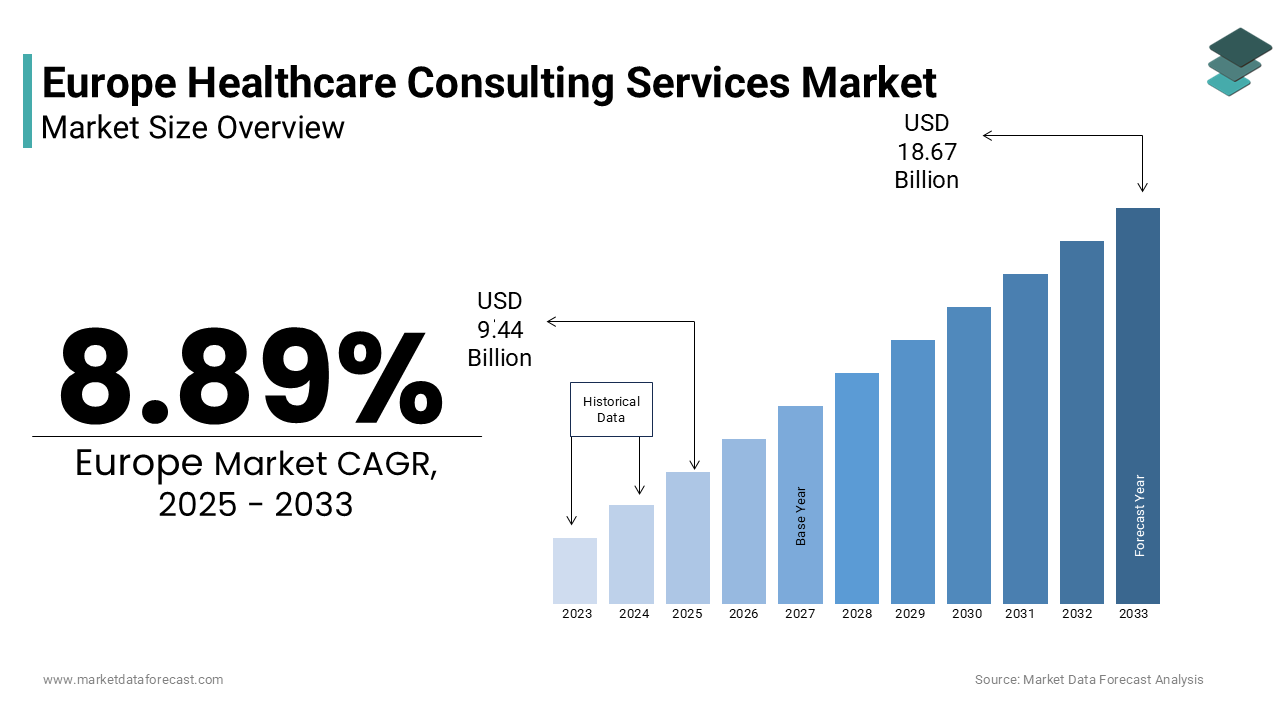
Healthcare consulting services comprises specialized advisory firms that support public health institutions private hospitals insurers digital health companies and life sciences organizations in navigating operational transformation regulatory compliance digital adoption and strategic planning. These services have become indispensable as European health systems confront aging populations workforce shortages and escalating costs amid rapid technological change. According to Eurostat, approximately 21% of the European Union population was aged 65 or older in 2023, which is intensifying pressure on long‑term care and chronic‑disease management infrastructure. According to the estimations of the European Commission, healthcare expenditure across the EU reached about €1.72 trillion in 2023, representing roughly 10% of the region’s GDP, and the rollout of the European Health Data Space alongside national digitization mandates such as Germany’s Hospital Future Act has created urgent demand for expertise in data governance, interoperability, and AI integration. According to OECD, Europe accounts for a substantial share of global public investment in health system modernization, which is indicating the scale of transformation underway, and in this context healthcare consulting serves as a critical enabler of efficiency, resilience, and innovation across a fragmented yet highly regulated multi‑payer landscape.
MARKET DRIVERS
Accelerated Digital Health Transformation Across Public Systems
The rapid digitization of Europe’s public healthcare infrastructure is a primary driver of the European healthcare consulting services market growth. National initiatives such as France’s “Ma Santé 2022” and Germany’s Hospital Future Act have collectively mobilized substantial public and EU funding since 2021 to upgrade electronic health records, telemedicine platforms, and health data exchange capabilities. As per national program reports and EU summaries, these initiatives have mobilized public and EU funding on the order of billions of euros since 2021. According to European Commission, most EU member states have implemented or are implementing national electronic prescribing mandates that require systemic reengineering of pharmacy workflows and clinician training. These complex transitions necessitate external expertise in change management, interoperability standards, and cybersecurity. As per the European Health Management Association, a majority of regional health authorities engaged third‑party consultants in 2023 to design and implement digital transformation roadmaps. Moreover, the European Health Data Space regulation, which mandates cross‑border data accessibility, has triggered demand for advisory support in data governance architecture and patient consent frameworks. As per OECD, some countries allocate a notable share of health IT budgets to consulting and system integration. This wave of state‑led digitalization has made healthcare consulting a strategic partner in Europe’s public health evolution.
Rising Regulatory and Compliance Complexity in Life Sciences
The intensifying regulatory landscape governing pharmaceuticals, medical devices, and digital therapeutics across Europe has significantly amplified demand for specialized consulting services, which is further contributing to the expansion of the European healthcare consulting services market. The European Medicines Agency and national competent authorities have introduced stringent requirements on real‑world evidence, data transparency, and post‑market surveillance, particularly under the EU Medical Devices Regulation and In Vitro Diagnostic Regulation. As per European Commission, thousands of medical device manufacturers were required to recertify products by May 2024, with compliance rates reported to be substantially below full coverage. This regulatory bottleneck has driven life sciences companies to seek expert guidance on quality‑management system redesign, clinical evaluation strategies, and notified‑body engagement. According to EMA, documentation and monitoring obligations increased for sponsors under the EU Clinical Trials Regulation, with a notable rise in protocol amendment requests in 2023. Consulting firms now play a pivotal role in harmonizing multinational trial designs across divergent national ethics committee requirements. As per EFPIA, a large share of mid‑sized biotechs outsource regulatory strategy to specialized consultants. This convergence of tighter oversight, global trials, and digital health convergence ensures sustained demand for high‑caliber regulatory consulting across Europe’s life sciences ecosystem.
MARKET RESTRAINTS
Fragmented Healthcare Systems Limiting Standardized Adoption
A critical restraint in the Europe healthcare consulting services market stems from the deep fragmentation of national and subnational healthcare systems which impedes scalable and standardized advisory solutions. Unlike centralized models, Europe features dozens of distinct health systems each with unique reimbursement mechanisms, procurement rules, and digital maturity levels. As per the European Observatory on Health Systems and Policies, only a minority of EU countries had fully implemented national electronic health record systems as of 2023. This heterogeneity forces consulting firms to customize methodologies for each region, which is increasing delivery costs and time. According to the European Health Management Association, many consulting projects in Southern and Eastern Europe experience scope creep owing to institutional resistance or outdated infrastructure. Moreover, devolved systems delegate health authority to regional governments, resulting in numerous distinct regional health policies across countries such as Spain and Italy. This administrative complexity discourages pan‑European consulting rollouts and limits economies of scale, thereby constraining market expansion despite evident need.
Public Sector Budget Constraints and Procurement Delays
Persistent fiscal pressures on European public health budgets significantly constrain the ability of key clients to engage consulting services in a timely and sustained manner, which is further impeding the growth of the European healthcare consulting services market. As per Eurostat, public healthcare expenditure growth across the EU averaged low single digits between 2021 and 2023, which is forcing institutions to prioritize acute operational spending over strategic transformation initiatives. According to the European Court of Auditors, a substantial share of planned digital health projects experienced delays due to reallocated budgets or frozen procurement processes. Consulting contracts are often among the first discretionary expenditures cut during fiscal reviews. As per a 2023 survey by the European Hospital and Healthcare Employers’ Association, a notable share of planned efficiency improvement engagements were postponed or cancelled. Additionally, rigid public procurement rules requiring multi‑stage tenders often extend procurement timelines. As per OECD reporting, some countries impose caps on external consulting fees (reported examples include caps below 3% of total project budgets). These financial and bureaucratic barriers limit both the volume and impact of consulting services despite their potential to generate long‑term savings.
MARKET OPPORTUNITIES
Expansion of Value Based Healthcare Implementation Frameworks
A significant opportunity for the Europe healthcare consulting services market lies in the continent‑wide shift toward value‑based healthcare which prioritizes patient outcomes over volume of services. According to the European Commission’s 2022 Communication on Value‑Based Health Care, multiple member states are actively developing outcome measurement frameworks with national roadmaps requiring external expertise in metric design, data infrastructure, and incentive alignment. As per Organisation for Economic Co‑operation and Development reporting, Europe represents a large share of global public health systems piloting bundled payment models for chronic conditions such as diabetes and heart failure. Consulting firms are instrumental in helping providers define condition‑specific outcome sets, implement registry‑based tracking, and redesign care pathways accordingly. According to national evaluations, Sweden’s National Board of Health and Welfare partnered with advisory firms to standardize outcome indicators across regional councils, with evaluations reporting measurable reductions in readmissions for hip replacement patients in 2023. Similarly, the Netherlands has introduced mandates and pilots for outcome‑based contracting in oncology that are driving demand for consulting in real‑world data analytics and patient‑reported outcome integration. For instance, over 200 hospitals across Germany, France, and Italy are engaged in value‑based transformation programs supported by specialized consultants. This systemic reorientation offers a durable growth vector for advisory services focused on measurement‑driven care redesign.
Integration of AI and Predictive Analytics in Care Delivery
The strategic deployment of artificial intelligence and predictive analytics in European healthcare systems presents a high‑growth opportunity for the European healthcare consulting services market. National strategies such as Finland’s AuroraAI and France’s Health Data Hub are channeling substantial public and EU funding into AI‑enabled diagnostics, predictive risk stratification, and operational forecasting. According to European Commission, numerous EU countries have launched national health AI sandboxes since 2022 to test algorithms under regulatory supervision. However, most health institutions lack internal capacity to manage data quality, bias mitigation, and clinical validation. Consulting firms bridge this gap by designing governance frameworks ensuring compliance with the EU AI Act’s high‑risk classification for medical AI. As per NHS Digital, external advisors supported deployment of predictive models in 2023 that improved operational forecasting metrics such as bed allocation accuracy. Similarly, Germany’s statutory health insurers now require predictive‑analytics validation as part of digital‑health app reimbursement dossiers. According to innovation‑program reporting, a majority of hospital AI pilots in Europe involve third‑party consultants for data‑pipeline engineering and clinician training. This convergence of policy investment and technical need positions AI advisory as a frontier domain for healthcare consulting in Europe.
MARKET CHALLENGES
Shortage of In‑House Transformation Expertise in Public Institutions
A persistent challenge facing the Europe healthcare consulting services market is the acute shortage of internal change‑management and digital‑transformation capabilities within public health institutions which undermines the sustainability of externally driven initiatives. While consulting firms deliver robust strategies, implementation often falters due to lack of local ownership and technical continuity. According to the European Health Management Association, only a minority of European hospitals have dedicated digital transformation units, with most relying on overburdened IT or clinical staff to manage complex change programs. This capacity gap leads to high project failure rates; as per audit reporting, a substantial share of EU‑funded health IT projects did not achieve intended outcomes due to inadequate post‑go‑live support. Moreover, staff turnover in public health further disrupts knowledge retention. According to Eurofound, a notable share of healthcare professionals in some Southern European countries reported intentions to leave the sector within a short time horizon citing unsustainable workloads. Consulting engagements that do not include embedded capability building often result in regression to legacy practices once advisors depart. As per WHO Europe guidance, building internal transformation capacity remains a primary barrier to realizing the full return on consulting investments.
Ethical and Legal Ambiguity in Health Data Utilization
The evolving but inconsistent regulatory landscape governing health‑data use across Europe poses a significant challenge for consulting firms advising on data‑driven transformation. While the General Data Protection Regulation provides a baseline, national interpretations of lawful processing vary widely, particularly for secondary uses such as research or AI training. According to the European Data Protection Board and national guidance reviews, only a subset of EU countries have issued specific guidelines for health‑data anonymization, leaving consultants to navigate legal gray zones. This uncertainty complicates cross‑border data pooling essential for robust analytics. In 2023, a major oncology data initiative encountered regional ethics‑committee objections that halted planned data sharing across borders. Moreover, the EU AI Act’s requirements for data‑governance transparency and human oversight add another compliance layer for predictive models. For instance, many multi‑country health‑data projects require legal review by multiple national authorities when operating across several EU jurisdictions. These jurisdictional complexities increase project risk, duration, and cost, often deterring institutions from pursuing advanced analytics despite their potential. Until harmonized health‑data governance emerges, consulting firms must invest in legal foresight to mitigate implementation barriers.
REPORT COVERAGE
| REPORT METRIC | DETAILS |
| Market Size Available | 2024 to 2033 |
| Base Year | 2024 |
| Forecast Period | 2025 to 2033 |
| CAGR | 8.89% |
| Segments Covered | By Services, End-Use, And Region |
| Various Analyses Covered | Global, Regional & Country Level Analysis; Segment-Level Analysis; DROC, PESTLE Analysis; Porter’s Five Forces Analysis; Competitive Landscape; Analyst Overview of Investment Opportunities |
| Regions Covered | United Kingdom, France, Spain, Germany, Italy, Russia, Sweden, Denmark, Switzerland, the Netherlands, Turkey, and the Czech Republic |
| Market Leaders Profiled | Deloitte, Accenture, McKinsey & Company, PwC (PricewaterhouseCoopers), KPMG, Ernst & Young (EY), Boston Consulting Group (BCG), Bain & Company, Cognizant, and Capgemini. |
SEGMENTAL ANALYSIS
By Services Insights
The strategic management consulting occupied 36.8% of the European healthcare consulting services market share in 2024. The dominance of strategic management consulting segment in this regional market is attributed to the escalating pressure on healthcare stakeholders to redefine long‑term positioning amid systemic transformation. Providers face existential questions regarding service line consolidation, digital care models, and public‑private partnerships, which is requiring high‑level advisory input. A key driver is the widespread adoption of value‑based healthcare frameworks. According to the Organisation for Economic Co‑operation and Development, 16 European countries have mandated outcome‑based payment pilots since 2021, which require consultants to redesign care pathways and performance metrics. Additionally, hospital networks are consolidating to achieve economies of scale. As per the German Hospital Association, Germany saw 47 hospital mergers in 2023 each demanding strategic due diligence and integration roadmaps. Public health agencies also engage consultants to align national strategies with EU health priorities such as the European Health Data Space. According to the European Commission, 89% of member states commissioned external strategic reviews of their primary care systems between 2022 and 2023. These structural recalibrations across public and private sectors cement strategic management consulting as the foundational service pillar in Europe’s evolving health landscape.
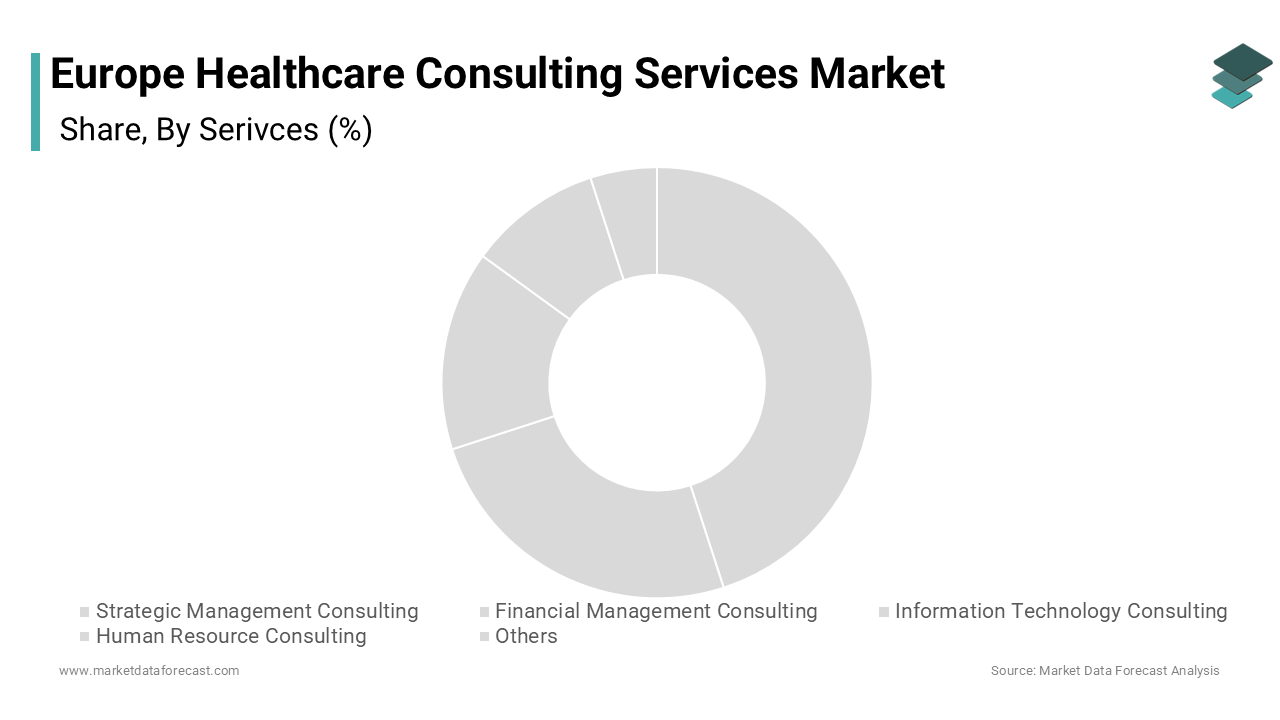
The information technology consulting segment is the fastest growing service segment in the Europe healthcare consulting market and is anticipated to grow at a CAGR of 14.4% over the forecast period owing to the continent‑wide digitization of care delivery and data infrastructure under national and EU mandates. For instance, Germany’s Hospital Future Act allocated €4.3 billion for digital upgrades, generating sustained demand for advisors skilled in electronic health record integration, interoperability standards, and cybersecurity compliance. Similarly, as per France’s Health Data Hub requirements, public hospitals must connect to a national analytics platform by 2025, which is demanding external IT architecture support. According to the European Commission, over 20,000 healthcare facilities across the EU are undergoing electronic prescribing system overhauls, each requiring workflow redesign and staff training. The rollout of the European Health Data Space further intensifies demand, as health institutions seek guidance on anonymization protocols, data governance, and API compliance. As per the European Health Management Association, 74% of IT consulting engagements in 2023 focused on enabling real‑world data collection for regulatory submissions and AI model development. These policy‑driven digital imperatives ensure IT consulting remains the highest growth advisory domain in Europe’s health sector.
By End‑use Insights
Hospitals represent the largest end user segment in the Europe healthcare consulting services market and this segment accounted for 40.6% of the regional market share in 2024. The leading position of the hospitals segment in this regional market is attributed to the acute operational and strategic pressures facing acute care providers across the region. Chronic underfunding, workforce shortages, and aging infrastructure compel hospitals to seek external expertise in efficiency optimization, capacity planning, and digital transformation. The regulatory modernization is further boosting the expansion of the hospitals segment in this regional market. According to the German Hospital Future Act, hospitals must achieve defined digital maturity levels by 2025 or face reimbursement penalties, which is triggering widespread consulting engagements for system implementation and staff upskilling. Similarly, as per the European Commission’s Green Deal for Health, hospitals are required to reduce carbon emissions by 55% by 2030, which is prompting advisory projects on energy‑efficient facility design and sustainable procurement. According to Eurostat, over 1,800 public hospitals across the EU underwent restructuring or merger processes between 2021 and 2023, each involving extensive change management consulting. Furthermore, rising patient expectations for seamless digital experiences push hospitals to redesign service delivery models with external support. These converging clinical, regulatory, and operational demands ensure hospitals remain the anchor client base for healthcare consulting in Europe.
The government organizations segment is the fastest growing end user segment in the Europe healthcare consulting services market and is predicted to register a CAGR of 10.6% over the forecast period owing to the central role of public authorities in steering system‑wide health transformation under EU policy frameworks. National ministries and regional health agencies increasingly commission consultants to design and implement cross‑cutting initiatives such as value‑based care models, health data spaces, and workforce planning strategies. According to the European Commission’s 2023 Progress Report on the European Health Union, 21 member states engaged external advisors to develop national roadmaps for the European Health Data Space, focusing on legal interoperability and patient consent architecture. Additionally, fiscal constraints necessitate rigorous cost‑benefit analyses for major investments; as per UK government reporting, the Department of Health allocated £85 million in 2023 to consulting firms for evaluating integrated care system performance. Public health emergencies also drive demand. According to the European Centre for Disease Prevention and Control, 17 countries commissioned post‑pandemic resilience reviews in 2022–2023 to strengthen surge capacity and supply chain robustness. As per the OECD, public health consulting contracts in Europe grew by 19% in 2023 alone, reflecting institutional reliance on external expertise to navigate complex multi‑stakeholder transformations. These policy‑driven mandates position government entities as the most dynamic and rapidly expanding client segment.
REGIONAL ANALYSIS
Germany Healthcare Consulting Services Market Analysis
Germany dominated the healthcare consulting services market in Europe in 2024 by holding 22.6% of the regional market share. The dominance of Germany in the European market is driven by the dense network of public and private hospitals facing simultaneous pressures of digital modernization, financial sustainability, and workforce shortages. The Hospital Future Act has driven substantial demand for advisory services in IT infrastructure, interoperability, and care‑pathway redesign, with over 1,300 hospitals receiving digital transformation consulting in 2023. Germany’s federal structure creates layered planning needs for system integration and policy alignment, while the statutory health insurance system routinely commissions consultants to evaluate integrated care models and assess digital health apps for reimbursement. Public spending on external advisory services exceeded €220 million in 2023, largely directed at data governance and AI implementation under the national health data strategy. This mix of regulatory ambition, institutional complexity, and financial scale cements Germany’s role as Europe’s foremost market for healthcare consulting.
United Kingdom Healthcare Consulting Services Market Analysis
The United Kingdom is a high‑intensity consulting regional segment in the European healthcare consulting services market. The growth of the UK in the European market is driven by the NHS transformation agenda and strong demand for system redesign and performance management. The NHS Long Term Plan’s push for integrated care systems has generated extensive consulting engagements; in 2023 NHS England commissioned numerous strategic reviews of financially distressed trusts. The UK also leads in real‑world evidence and health technology assessment design, with targeted funding for frameworks that incorporate patient‑reported outcomes. Regulatory pathways for digital therapeutics and the Medicines and Healthcare products Regulatory Agency’s reliance on external expertise further sustain advisory demand across policy, operations, and innovation.
France Healthcare Consulting Services Market Analysis
France is anticipated to account for a promising share of the European healthcare consulting services market over the forecast period. France’s consulting market is shaped by top‑down digital and organizational mandates under the “Ma Santé 2022” strategy, which requires broad upgrades in data sharing, telemedicine, and patient empowerment. Public hospitals must connect to the national Health Data Hub by 2025, driving substantial IT consulting for interoperability and cybersecurity. Regional Health Agencies commissioned numerous system integration projects in 2023 to reduce duplication between primary and hospital care, and the social security system regularly uses external health‑economics consultants for cost‑utility modeling. These centralized reform programs and procurement needs underpin a robust consulting ecosystem.
Italy Healthcare Consulting Services Market Analysis
is expected to register a prominent CAGR in the European healthcare consulting services market during the forecast period. Italy’s consulting demand reflects deep regional disparities and fiscal pressures across 21 semi‑autonomous regional health authorities. Large EU‑funded reform programs, including the National Recovery and Resilience Plan, have allocated significant resources to hospital reorganization and digital infrastructure, with many regions commissioning strategic reviews to address deficits. Slow EHR adoption has created a pronounced need for IT implementation support, while the Italian Medicines Agency engages external advisors for pricing and reimbursement assessments under evolving HTA guidelines. Structural complexity and reform imperatives make Italy a high‑potential consulting market.
Sweden Healthcare Consulting Services Market Analysis
Sweden is predicted to grow at a healthy CAGR in the European healthcare consulting services market during the forecast period. Sweden distinguishes itself through proactive investment in outcome‑based care and data‑driven governance, creating steady demand for consulting in metric design, registry development, and performance benchmarking. Regional councils are required to publish condition‑specific outcomes, and over 90% engaged external advisors in 2023 to refine value‑based frameworks for chronic disease management. Sweden’s active role in the European Health Data Space and growing focus on AI ethics and algorithm validation have expanded consulting opportunities in semantic interoperability, consent management, and equitable digital care pathways. These priorities position Sweden as a sophisticated, forward‑looking consulting market in Northern Europe.
COMPETITIVE LANDSCAPE
Competition in the Europe healthcare consulting services market is characterized by high specialization regulatory acumen and institutional trust rather than price-based rivalry. The market features a tiered structure with global strategy firms dominating large-scale public-sector transformations while boutique consultancies excel in niche domains such as health data governance or hospital finance. Success depends on deep understanding of national health systems language fluency and established relationships with ministries and payers. Unlike other regions Europe’s competition is shaped by multi layered governance with projects often requiring alignment across EU directives national laws and regional implementation bodies. Firms compete on proven impact demonstrated through published case studies and policy co creation. Differentiation arises from proprietary methodologies in outcome measurement change management and digital readiness assessment. The rising complexity of value-based care AI deployment and fiscal sustainability ensure sustained demand for high quality advisory services though public budget scrutiny intensifies pressure to demonstrate measurable return on investment. This environment rewards firms that combine global best practices with hyperlocal execution capabilities.
KEY MARKET PLAYERS
Some of the companies that are playing a dominating role in the europe healthcare consulting services market include
- Deloitte
- Accenture
- McKinsey & Company
- PwC (PricewaterhouseCoopers)
- KPMG
- Ernst & Young (EY)
- Boston Consulting Group (BCG)
- Bain & Company
- Cognizant
- Capgemini
Top Players in the Market
McKinsey and Company
McKinsey and Company maintains a leading presence in the Europe healthcare consulting services market through its deep expertise in health system transformation digital strategy and life sciences innovation. The firm supports national governments hospital networks and pharmaceutical companies across the region in designing value-based care models optimizing operational efficiency and implementing data driven technologies. Recently McKinsey expanded its European Center for Health Innovation in London to accelerate co development of AI enabled decision support tools with NHS partners. It also launched a dedicated European health equity practice in 2023 to advise public agencies on reducing access disparities. These initiatives reinforce McKinsey’s role as a strategic advisor on Europe’s most complex health system challenges while contributing global insights from its cross regional health portfolio.
Deloitte Touche Tohmatsu Limited
Deloitte plays a pivotal role in the Europe healthcare consulting services market by integrating strategy technology and regulatory advisory across public health institutions and private providers. The firm specializes in large scale digital transformation programs including electronic health record implementation cybersecurity readiness and health data governance under the European Health Data Space framework. In 2023 Deloitte established a pan European Health Intelligence Unit to support real world evidence generation for digital therapeutics and advanced therapy medicinal products. It also deepened collaboration with Germany’s Hospital Future Act implementation offices to guide over 200 hospitals through IT modernization. These actions position Deloitte as a trusted enabler of compliant and scalable health system digitization across diverse European jurisdictions.
EY Global
EY Global exerts significant influence in the Europe healthcare consulting services market through its integrated offerings in health economics regulatory strategy and sustainability transformation. The firm advises pharmaceutical companies on EU health technology assessment alignment and supports public hospitals in financial restructuring under tightening budget constraints. Recently EY launched its European Health Equity Analytics Platform which helps regional health authorities identify and address disparities in care access using geospatial and demographic data. It also partnered with the French National Authority for Health in 2023 to refine cost effectiveness evaluation methodologies for innovative therapies. These initiatives demonstrate EY’s commitment to blending policy insight with analytical rigor to advance equitable and fiscally sustainable healthcare systems across Europe.
Top Strategies Used by the Key Market Participants
Key players in the Europe healthcare consulting services market focus on building specialized practices in digital health transformation value-based care design and regulatory compliance to address policy driven client needs. They invest in proprietary analytics platforms that integrate real world data for health economics and operational modeling. Firms establish strategic partnerships with national health agencies and hospital networks to embed advisory services into long term transformation programs. Geographic expansion within Europe emphasizes localized expertise in country specific reimbursement systems and public procurement rules. Additionally, they prioritize thought leadership through policy white papers and participation in EU health initiatives to shape regulatory frameworks and enhance credibility.
MARKET SEGMENTATION
This research report on the Europe Healthcare Consulting Services Market has been segmented and sub–segmented into the following categories.
By Services
- Strategic Management Consulting
- Financial Management Consulting
- Information Technology Consulting
- Human Resource Consulting
- Others
By End-use
- Pharmaceutical Companies
- Hospitals
- Insurance Companies
- Government Organizations
- Other Healthcare Providers
By Country
- UK
- France
- Spain
- Germany
- Italy
- Russia
- Sweden
- Denmark
- Switzerland
- Netherlands
- Turkey
- Czech Republic
- Rest of Europe