Europe Hearth Market Size, Share, Trends & Growth Forecast Report, Segmented By Type (Gas Hearths, Wood Hearths, Electric Hearths, Pellet Hearths) Fuel Source, Application And Country (UK, France, Spain, Germany, Italy, Russia, Sweden, Denmark, Switzerland, Netherlands, Turkey, Czech Republic & Rest Of Europe) - Industry Analysis From (2025 To 2033)
Europe Hearth Market Size
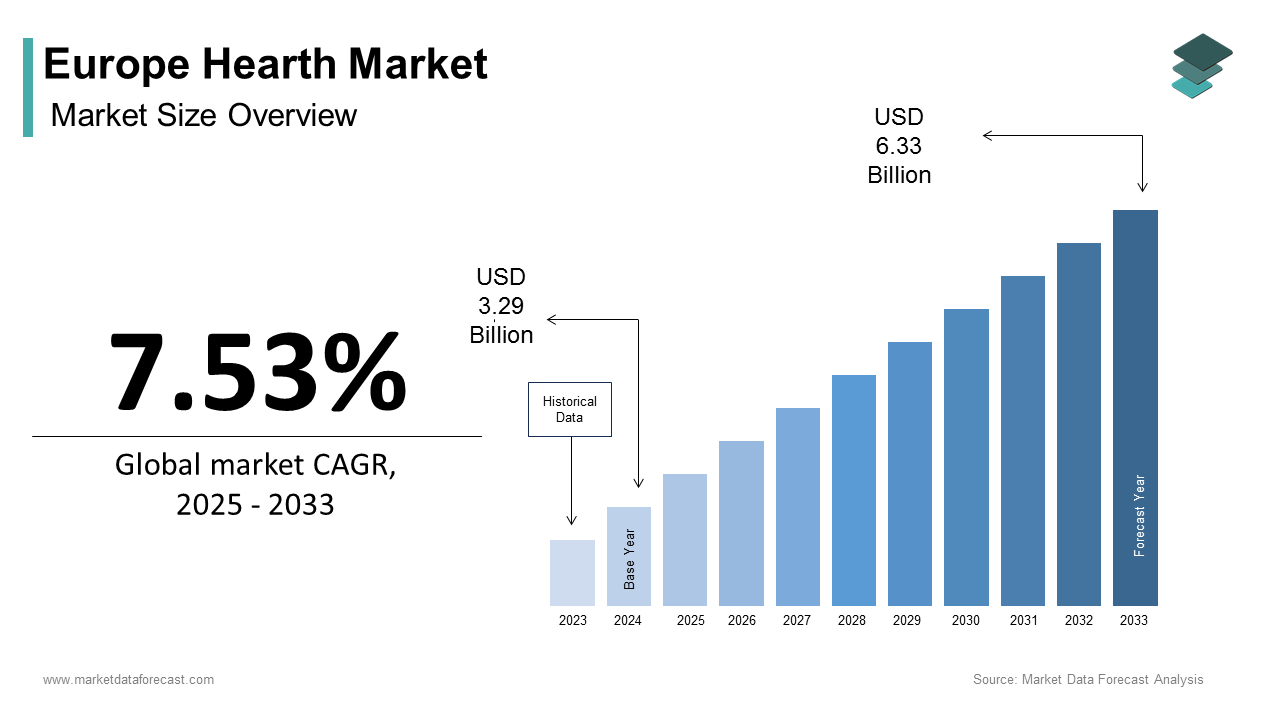
The Europe hearth market size was calculated to be USD 3.29 billion in 2024 and is anticipated to be worth USD 6.33 billion by 2033, from USD 3.54 billion in 2025, growing at a CAGR of 7.53% during the forecast period.
Health is a hearth is a built-in or standalone unit for heating and ambiance, encompassing products like fireplaces, stoves, and fire pits. The market covers design, manufacture, and installation of residential and commercial heating appliances that utilize solid fuels, wood pellets, gas, or electricity to provide space heating and aesthetic focal points in living environments. Unlike generic heating systems, this market is defined by its integration of thermal functionality with architectural and cultural identity, particularly in regions where fireplaces symbolize domestic comfort and historical continuity. According to Eurostat sources, a portion of single-family homes in rural Central and Eastern Europe still rely on solid fuel hearths as a heat source during the winter months. Regulatory frameworks have redefined product standards mandating particulate emission limits below thirty milligrams per cubic meter for new installations. This convergence of heritage thermal need, environmental policy, and evolving interior design expectations shapes a uniquely European hearth landscape where tradition is increasingly filtered through sustainability and efficiency imperatives.
MARKET DRIVERS
Resurgence of Rural and Suburban Homeownership Driving Hearth Adoption
The sustained increase in rural and peri-urban property acquisition has revitalized demand for hearth appliances as homeowners seek both functional heating and symbolic domesticity, which contributes to the growth rate of the Europe hearth market. According to studies, the share of households owning detached or semi-detached homes rose. These property types frequently lack access to centralized district heating or natural gas pipelines, making standalone hearths a practical necessity. Apart from these, the psychological association between fireplaces and home comfort remains potent. This trend is further amplified by remote work patterns, which have increased time spent in primary residences, thereby elevating investment in ambient and thermal quality. Consequently, hearth adoption is not merely a heating choice but a lifestyle affirmation rooted in spatial autonomy and cultural continuity.
Policy Driven Modernization of Solid Fuel Heating Systems
Stringent EU air quality regulations are compelling households to replace outdated wood-burning appliances with certified low-emission hearths, thereby stimulating replacement demand across legacy business regions, and this also bolsters the expansion of the European hearth market. As per research, the combustion of solid fuels for domestic heating remains a significant source of particulate matter emissions, especially in Central and Eastern Europe. This confirms a general trend of older heating systems contributing disproportionately to pollution. In response, national governments have launched subsidy schemes to accelerate modernization. Similarly, France’s MaPrimeRénov program reported that thirty-seven thousand hearth upgrades were funded in 2023, with priority given to rural communes exceeding WHO particulate thresholds. These policy interventions transform regulatory compliance into a market catalyst by lowering consumer cost barriers while aligning thermal comfort with public health objectives. The result is a structural shift from open fireplaces to sealed combustion stoves and pellet inserts that deliver both warmth and environmental accountability.
MARKET RESTRAINTS
Stringent Urban Emission Controls Limiting Hearth Installation
Municipal air quality ordinances in major European cities increasingly restrict or prohibit the installation of solid fuel hearths and thereby constrain the expansion of the Europe hearth market. Many major European cities, including London, Paris, and Milan, have introduced new restrictions on the installation of wood-burning fireplaces in modern residential properties, according to sources. London’s updated emission control policies now classify traditional fireplaces as regulated pollution sources, as per research. These local actions align with international health recommendations emphasizing the environmental and public health risks associated with residential wood combustion, as per research. Consequently, manufacturers face a bifurcated market where rural demand grows while urban opportunities shrink to gas or electric decorative models with minimal thermal output. This regulatory fragmentation complicates product standardization and limits economies of scale for solid fuel appliance producers.
Skilled Labor Shortage in Hearth Installation and Masonry
An important deficit of certified chimney sweeps, stove fitters, and traditional masons is impeding the deployment and expansion of the Europe hearth market. And, this happened despite strong consumer interest and available subsidies. This shortage directly affects project timelines as the average wait for a certified installer exceeds weeks. Moreover, improper installation risks non-compliance with safety standards, potentially voiding insurance coverage and triggering municipal fines. The persistence of the capacity bottleneck, which damages both customer satisfaction and the effectiveness of thehearth modernization agenda, is a direct result of inadequate investment in technical education and a lack of cross-border qualification recognition.
MARKET OPPORTUNITIES
Integration of Hearths into Energy-Efficient Retrofit Programs
The inclusion of certified hearth appliances in national building renovation schemes serves as a key growth prospect for the Europe hearth market. The incorporation positions them as complementary components of holistic home energy upgrades. Several European countries have now included energy-efficient wood pellet stoves that meet Ecodesign standards as approved options within their long-term building renovation programs, as per research. This policy shift reframes hearths not as standalone luxuries but as integrated thermal assets that enhance grid resilience and reduce seasonal energy poverty. Participation in the EU Renovation Wave grants manufacturers access to institutional financing and enhanced credibility in decarbonization.
Rising Demand for Aesthetic Electric Hearths in Urban Apartments
Responding to the dual pressures of urban densification and the desire for emission-free warmth, the rise of compact electric heating solutions in Europe cities is creating significant opportunities for the expansion of the European hearth market. Electric hearths fulfill this niche by offering flame simulation, radiant heat, and a modular design that integrates into minimalist interiors. Technological advances further enhance realism with LED-driven flame effects and infrared heating elements, achieving thermal efficiencies. Unlike gas or wood alternatives, these units require only a standard power outlet, enabling installation in historic buildings where flue modifications are prohibited. This convergence of urban housing trends, technological refinement, and regulatory permissiveness establishes electric hearths as a high-growth segment within Europe’s evolving thermal landscape.
MARKET CHALLENGES
Volatility in Biomass Fuel Supply and Pricing
Unpredictable availability and cost fluctuations of wood pellets and seasoned firewood affect consumer confidence in solid fuel hearths, which slows down the growth of the Europe hearth market. Furthermore, climate-induced disruptions reduced hardwood harvests, as per sources, which limits the supply of properly seasoned logs. These instabilities deter new adopters who fear long-term operational uncertainty, while existing users face budgetary strain. Stable biomass logistics and clear pricing are prerequisites for making the economic case for solid fuel hearths resilient to external shocks.
Complexity of Cross-National Certification and Compliance
The absence of a unified EU-wide certification framework for hearth appliances forces manufacturers to navigate divergent national testing protocols, installation codes, and emission verification processes, and this obstructs the expansion of the Europe hearth market. According to sources, some European countries have adopted the latest harmonized standards for solid fuel heating appliances, while others continue to follow their own long-established national regulations. This fragmentation requires duplicative testing and documentation, with a single stove model often undergoing three to four separate conformity assessments before pan-European distribution. Besides, local chimney sweep guilds in countries retain discretionary authority to reject installations based on non-harmonized flue compatibility rules. These administrative barriers delay market entry, increase costs, and discourage small and medium enterprises from scaling across borders, thereby stifling innovation and consumer choice in a market that remains stubbornly localized despite EU integration efforts.
REPORT COVERAGE
| REPORT METRIC | DETAILS |
| Market Size Available | 2024 to 2033 |
| Base Year | 2024 |
| Forecast Period | 2025 to 2033 |
| CAGR | 7.53% |
| Segments Covered | By Type, Fuel Source, Application, and Region |
| Various Analyses Covered | Global, Regional & Country Level Analysis; Segment-Level Analysis; DROC, PESTLE Analysis; Porter’s Five Forces Analysis; Competitive Landscape; Analyst Overview of Investment Opportunities |
| Regions Covered | UK, France, Spain, Germany, Italy, Russia, Sweden, Denmark, Switzerland, Netherlands, Turkey, and the Czech Republic |
| Market Leaders Profiled | Rais A/S, Nibe Industrier AB, Palazzetti Lelio S.p.A., HNI Corporation / Hearth & Home Technologies, Glen Dimplex Group (Dimplex), Napoleon Fireplaces / Napoleon Products, Regency Fireplace Products, Travis Industries Inc., Empire Comfort Systems Inc., Ravelli Group, MCZ Group, And Jøtu |
SEGMENTAL ANALYSIS
By Type Insights
In 2024, the wood hearths segment retained the largest share of 38.7% of the Europe hearth market. The prominence of the wood hearths segment is driven by deep cultural traditions, widespread rural adoption, and compatibility with existing housing stock across Central and Eastern Europe. According to sources, millions of households across the European Union continue to depend on wood-burning stoves or fireplaces for heating, particularly in regions with limited access to centralized heating networks. As per research, in some European countries, a share of standalone homes still use wood as either the main or supplementary source of heat during colder months. This reliance is reinforced by affordability as firewood costs less per kilowatt hour than electricity in rural regions, according to research. Moreover, heritage preservation policies in countries often mandate the retention of original fireplace structures in historic buildings, further sustaining demand for modern wood-burning inserts that meet Ecodesign emission standards. The convergence of economic necessity, cultural continuity, and regulatory modernization ensures wood hearths remain the most prevalent type despite environmental scrutiny.
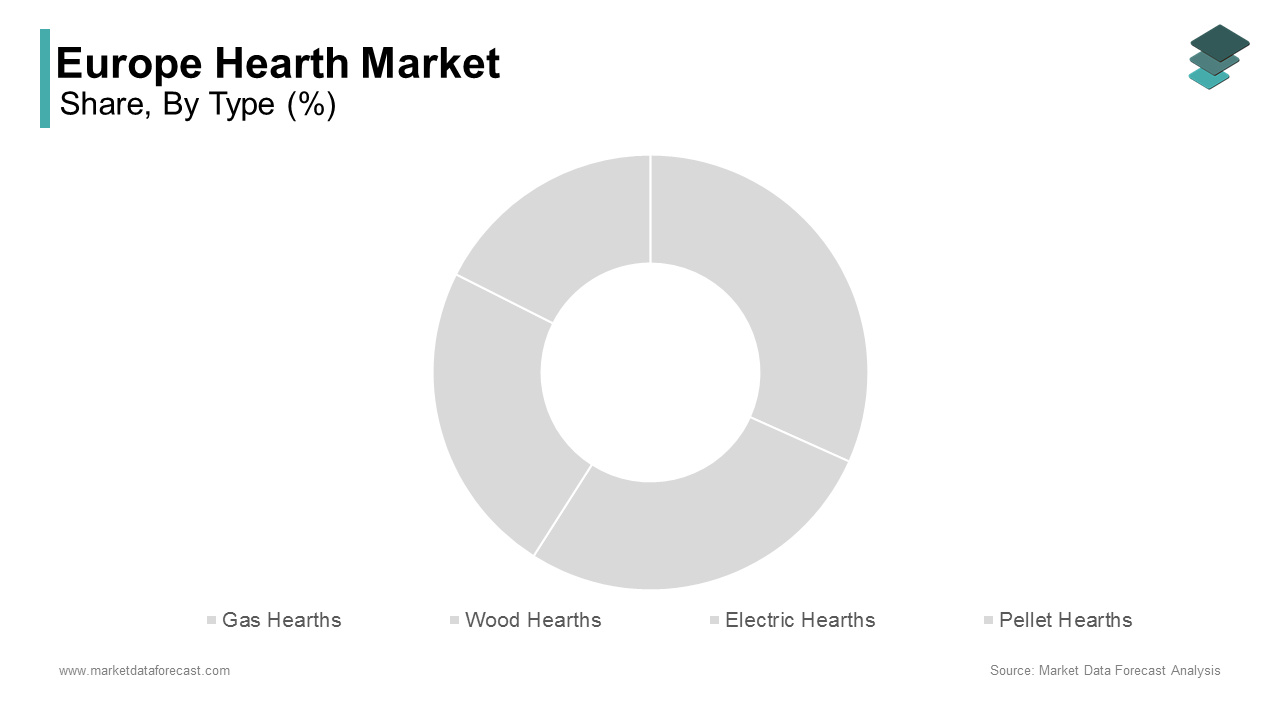
On the other hand, the electric hearths segment is likely to experience the fastest CAGR of 9.1% from 2025 to 2033 due to urban densification, emission restrictions, and advances in flame simulation technology. In addition, electric hearth sales in metropolitan areas grew, according to research. Technological refinement has significantly enhanced realism with infrared heating elements and dynamic LED flame effects, achieving notable thermal efficiencies, as per sources. Furthermore, some cities have enacted bylaws banning new solid fuel installations in buildings constructed, pushing developers toward plug-and-play electric alternatives. The segment’s growth is further amplified by rental market dynamics where tenants seek non-permanent aesthetic upgrades without landlord consent. These interlinked urban regulatory and technological forces position electric hearths as the most dynamic subsegment in Europe’s evolving thermal landscape.
By Fuel Source Insights
The wood segment was the leading segment in the Europe hearth market and accounted for a 41.4% share in 2024. Factors like its historical prevalence, affordability in non-urban regions, and integration into rural energy ecosystems are mainly fuelling the growth of the wood segment in the regional market. According to studies, wood accounted for a portion of residential solid fuel consumption in the EU, with millions of tonnes of firewood and pellets burned annually for space heating. In Eastern Europe, the reliance is especially acute. Even in wealthier nations such as Sweden and Finland, wood fuel remains culturally embedded. The fuel’s low monetary cost makes it economically compelling for low-middle-income households. The continued dominance of wood in European energy markets is a direct result of large-scale existing infrastructure and behavioral inertia, even as emission regulations become stricter.
The electricity segment is on the rise and is expected to be the fastest-growing segment in the global market by witnessing a CAGR of 8.7% over the forecast period, owing to urban housing trends, decarbonization policies, and the elimination of combustion-related permitting hurdles. Furthermore, the EU’s Energy Performance of Buildings Directive now classifies electric resistance heating as acceptable in nearly zero energy buildings when paired with a renewable grid supply, enabling inclusion in green certification schemes. Electricity's role will expand rapidly as grid decarbonization and urban density drive demand for a clean, convenient, and compliant fuel.
By Application Insights
The residential segment dominated the Europe hearth market by occupying a substantial share in 2024. Hearths are primarily installed in private homes for thermal comfort, aesthetic enhancement, and cultural expression, which boosts the expansion of the residential segment. According to sources, the majority of heating appliances sold across Europe are intended for individual residences, apartments, and seasonal homes, highlighting the sector’s strong residential focus. As per research, in Germany, most new detached houses continue to feature space for a fireplace or stove in their design plans, reflecting steady consumer interest in traditional home heating options. This dominance is further reinforced by renovation activity. Unlike commercial or industrial settings, where centralized HVAC systems prevail, European households consistently prioritize localized radiant heat and visual ambiance, particularly in colder regions like Scandinavia and the Alps. The emotional and functional centrality of the hearth in domestic life ensures its near-exclusive association with residential spaces across the continent.
The commercial application segment is expected to exhibit a noteworthy CAGR of 6.4% from 2025 to 2033 and is fueled by experiential retail, hospitality design, and wellness tourism trends that prioritize ambiance and sensory engagement. Many boutique hotels and hospitality venues across Europe are increasingly integrating decorative fireplaces within guest areas such as lounges, restaurants, and wellness spaces to create a more inviting atmosphere, according to sources. Urban co-working spaces in some cities have also adopted wall-mounted electric models to create domesticated zones within professional environments. This shift reflects a broader design philosophy where thermal appliances transcend utility to become narrative and emotional anchors in commercial storytelling.
REGIONAL ANALYSIS
Germany Hearth Market Analysis
Germany dominated the Europe hearth market by capturing 21.7% share in 2024. Factors such as engineering excellence, stringent emissions compliance, and strong demand for both traditional and modernized heating solutions have significantly contributed to the domination of Germany in the regional market. The country’s Solingen and Sauerland regions host certified stove manufacturers producing Ecodesign-ready appliances that meet the nation’s rigorous BImSchV Stage 2 particulate limits. Urban centers like Munich and Hamburg show rising adoption of electric hearths due to local air quality ordinances, while rural Bavaria maintains robust wood hearth usage supported by abundant forestry resources. Germany’s dual focus on technological precision and environmental accountability sets the benchmark for hearth performance and policy alignment across Europe.
France Hearth Market Analysis
France followed closely in the Europe hearth market and accounted for a 17.3% share in 2024. The growth of France is due to its rich architectural heritage, strong rural heating needs, and active policy support for biomass modernization. The government allocated funds for replacing open fireplaces with certified closed combustion stoves, reducing household particulate emissions post-upgrade. Apart from these, historic preservation laws in cities often require the retention of original fireplace structures, prompting demand for discreet gas or electric inserts that comply with both heritage and air quality regulations. This interplay of traditional policy and geography sustains France’s influential role in shaping continental hearth trends.
United Kingdom Hearth Market Analysis
The United Kingdom is also a major region in the Europe hearth market with a complex regulatory environment, rising home renovation activity, and persistent demand for aesthetic heating in older housing stock. The majority of installations occurred in period properties where original fireplaces are preserved but retrofitted with gas or electric inserts to avoid smoke control zone violations. Limited gas grid access in rural Scotland and Wales explains their continued reliance on wood, contrasting with the declining use of solid fuels in urban centers. This duality of regulatory constraint and cultural attachment defines the UK’s distinctive market trajectory.
Italy Hearth Market Analysis
Italy experienced a consistent rise in the European hearth market and was driven by regional climatic variation, artisanal manufacturing, and the integration of hearths into agritourism and luxury residential design. Unlike other EU nations, Italy maintains a vibrant network of small-scale foundries producing handcrafted pellet and wood stoves, often featuring ceramic cladding and custom finishes. Apart from these, high-end real estate developers in Tuscany and Umbria routinely incorporate designer gas hearths into luxury villas targeting international buyers. This blend of artisanal production, climatic necessity, and premium design ensures Italy’s continued relevance in both functional and aesthetic hearth segments.
Sweden Hearth Market Analysis
Sweden is predicted to grow in the European hearth market owing to its advanced biomass infrastructure, cold climate demands, and leadership in sustainable hearth innovation. Also, Sweden’s extensive district heating network covers urban centers but leaves rural and island communities dependent on localized solid fuel solutions. Manufacturers have pioneered hybrid systems that integrate pellet stoves with heat pumps, optimizing efficiency during extreme cold snaps. Besides, the country’s stringent building codes require all new detached homes to include a renewable heating component, making hearths a standard feature in residential planning. Backed by abundant forestry resources and a culture of energy self-reliance, Sweden exemplifies how environmental policy and practical necessity can converge to sustain a technologically advanced hearth market.
COMPETITION OVERVIEW
The Europe hearth market features a highly differentiated competitive landscape where global innovators coexist with regional artisans and niche designers. Competition is not solely price-based but revolves around emission performance, design authenticity, installation support, and alignment with national energy policies. Large players leverage scale to offer integrated heating solutions while small workshops compete through heritage craftsmanship and localized service. Regulatory divergence across member states creates both barriers and opportunities as companies must customize products for varying emission thresholds and building codes. Urban markets favor electric and gas models due to air quality laws, whereas rural areas sustain demand for wood and pellet systems. Digitalization is reshaping engagement with virtual showrooms and augmented reality tools, enabling consumers to visualize hearths in their spaces before purchase. Simultaneously, counterfeit or non-compliant imports from outside the EU pose reputational and safety risks, pressuring legitimate brands to invest in certification transparency and consumer education. This dynamic environment rewards agility, technical compliance, and cultural resonance.
KEY MARKET PLAYERS
A few dominating players in the Europe hearth market include
- Rais A/S
- Nibe Industrier AB
- Palazzetti Lelio S.p.A
- HNI Corporation / Hearth & Home Technologies
- Glen Dimplex Group (Dimplex)
- Napoleon Fireplaces / Napoleon Products
- Regency Fireplace Products
- Travis Industries Inc
- Empire Comfort Systems Inc
- Ravelli Group
- MCZ Group
- Jøtu
Top Strategies Used by the Key Market Participants
Key players in the Europe hearth market deploy multifaceted strategies to navigate regulatory complexity and shifting consumer preferences. Product diversification across fuel types enables adaptation to regional policies and housing conditions. Integration of smart technology, such as app-controlled operation and energy monitoring, enhances user experience and aligns with digital home trends. Strategic partnerships with architects, builders, and energy consultants embed hearths into early-stage construction and renovation planning. Sustainability initiatives, including circular design, recycled materials, and carbon-neutral manufacturing, strengthen brand credibility under EU green frameworks. Finally, targeted expansion into direct-to-consumer channels and experiential showrooms deepens emotional engagement and bypasses traditional distribution limitations. These approaches collectively reinforce market resilience and long-term relevance.
LEADING PLAYERS IN THE EUROPE HEARTH MARKET
Rais A/S
Rais A/S is a Danish manufacturer renowned for its minimalist design and high-efficiency wood and gas hearths that blend Scandinavian aesthetics with advanced combustion technology. The company exports to over forty countries and is recognized globally for its clean-burning certified stoves that meet the strictest European emission standards. Rais has strengthened its position as a premium European hearth brand, gaining influence in North American and Asian markets through its emphasis on design integrity, environmental performance, and cross-disciplinary collaboration.
Nibe Industrier AB
Nibe Industrier AB is a Swedish multinational that combines pellet hearths with integrated heat pump systems to deliver hybrid residential heating solutions across Europe and beyond. While globally known for climate solutions, Nibe’s hearth division has gained traction for its automated pellet stoves that connect to smart home energy management platforms. It also expanded its service network in Germany and France to support the installation and maintenance of complex hybrid systems. Through vertical integration, digital innovation, and alignment with EU decarbonization goals, Nibe has redefined the hearth as a dynamic component of the modern energy ecosystem.
Palazzetti Lelio S.p.A.
Palazzetti Lelio S.p.A. is an Italian leader in pellet and wood hearths celebrated for combining artisanal craftsmanship with industrial scalability. The company operates manufacturing facilities in Italy and Poland and exports to more than sixty countries, with a strong presence in North America and Australia. It also launched a circular economy initiative, recovering and refurbishing end-of-life stoves to reduce material waste. Palazzetti's global reputation as an agile and attuned hearth innovator has been strengthened by its strategic diversification of fuel types, adoption of digital retail, and commitment to sustainable product development.
MARKET SEGMENTATION
This research report on the Europe hearth market has been segmented and sub-segmented based on type, fuel source, application, and region.
By Type
- Gas Hearths
- Wood Hearths
- Electric Hearths
- Pellet Hearths
By Fuel Source
- Natural Gas
- Propane
- Wood
- Electricity
By Application
- Residential
- Commercial
- Industrial
By Region
- UK
- France
- Spain
- Germany
- Italy
- Russia
- Sweden
- Denmark
- Switzerland
- Netherlands
- Turkey
- Czech Republic
- Rest of Europe
Frequently Asked Questions
1. What factors are driving the growth of the Europe Hearth Market?
Increasing home renovation activities, growing preference for eco-friendly heating systems, and cold climatic conditions across Northern and Central Europe are key growth drivers.
2. What types of hearth products are popular in Europe?
Popular types include gas fireplaces, electric fireplaces, wood-burning stoves, pellet stoves, and inserts for modern home designs.
3. Which countries dominate the Europe Hearth Market?
Major markets include Germany, the United Kingdom, France, Italy, and the Nordic countries, owing to high adoption of advanced heating technologies and strong construction sectors.
4. Who are the key players in the Europe Hearth Market?
Leading players include HNI Corporation, Napoleon Fireplaces, Travis Industries Inc., Glen Dimplex Group, Hearth & Home Technologies, MCZ Group S.p.A., and Stove Industry Supplies Ltd.
5. What technological trends are influencing the Europe Hearth Market?
Smart and connected fireplaces, electric hearths with app control, bioethanol-based systems, and low-emission combustion technologies are major trends.
6. How is sustainability impacting the hearth market in Europe?
The push for carbon neutrality and stricter EU emission standards is encouraging manufacturers to develop cleaner, energy-efficient, and renewable-fuel-based hearth systems.
7. What are the major challenges faced by the Europe Hearth Market?
High installation costs, strict emission regulations, and competition from central heating systems are significant challenges.
8. What is the growth outlook for the Europe Hearth Market?
The market is expected to maintain stable growth, supported by the rising trend of luxury home décor and the adoption of green heating technologies.
9. Which segment holds the largest share in the market?
Electric hearths and gas fireplaces hold the largest shares due to ease of installation, low maintenance, and high energy efficiency.
10. What are the recent developments in the Europe Hearth Market?
Recent developments include the introduction of smart app-controlled hearths, hybrid electric-gas systems, and collaborations for eco-friendly material sourcing.
Related Reports
Access the study in MULTIPLE FORMATS
Purchase options starting from
$ 2000
Didn’t find what you’re looking for?
TALK TO OUR ANALYST TEAM
Need something within your budget?
NO WORRIES! WE GOT YOU COVERED!
Call us on: +1 888 702 9696 (U.S Toll Free)
Write to us: sales@marketdataforecast.com