- Product Description Description
- Table of Contents TOC
- List of Table & Figure LOT
- Get Free Sample PDF Sample PDF
Market Size, 2025
$61.89 BnMarket Estimate, 2026
$65.40 BnMarket Forecast, 2034
$98.27 BnCAGR, 2026–2034
5.64%Europe Heavy Equipment Market Size, Growth, Trends & Forecast (2026–2034)
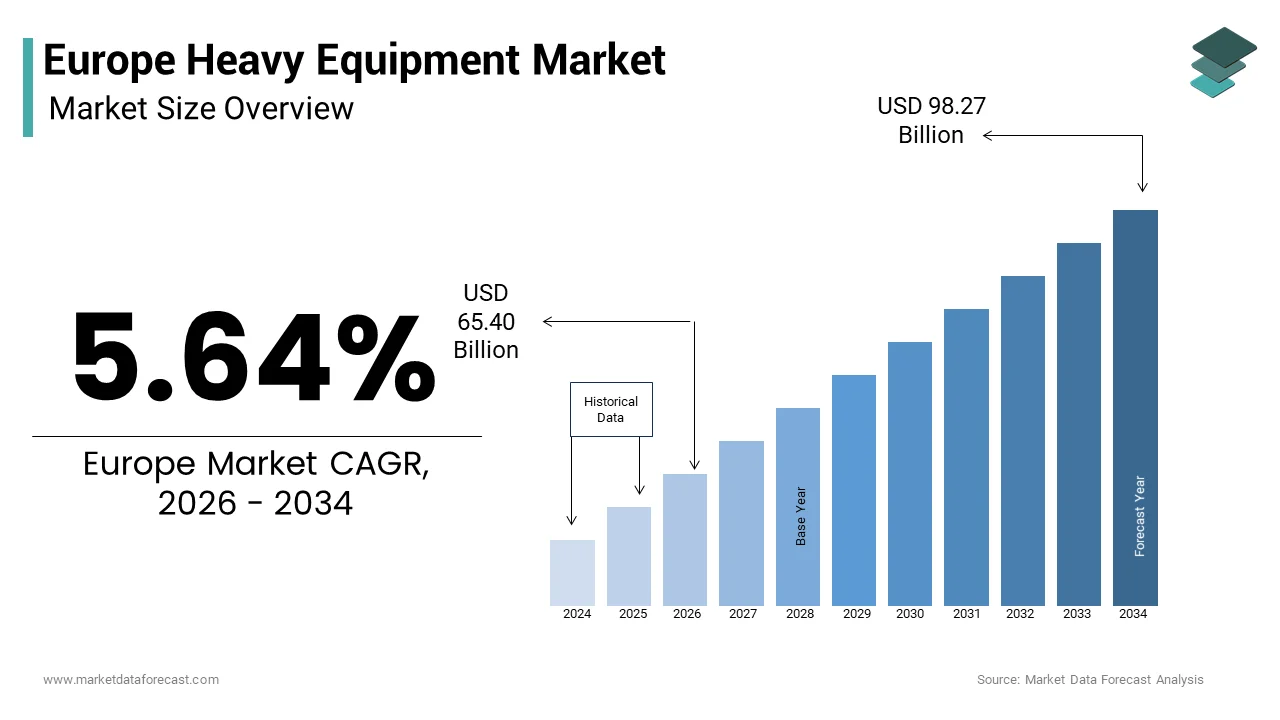
The Europe heavy equipment market size was valued at USD 61.89 billion in 2025, is anticipated to reach USD 65.40 billion in 2026, and is expected to expand up to USD 98.27 billion by 2034, registering a compound annual growth rate (CAGR) of 5.64% during the forecast period from 2026 to 2034. Driven by large-scale public infrastructure investments, urban renewal and brownfield redevelopment initiatives, and the transition toward low-emission electric machinery, the regional market demonstrates steady long-term growth.
Key Executive Metrics (At-a-Glance)
- 2025 Base Valuation: USD 61.89 Billion
- 2026 Current Valuation: USD 65.40 Billion
- 2034 Forecast Valuation: USD 98.27 Billion
- Compound Annual Growth Rate (CAGR): 5.64% (2026–2034)
- Dominant Country Market: Germany (holding a 22.4% share in 2025 due to its massive construction economy and advanced manufacturing hub)
- Leading Machine Segment: Excavators (holding a 28.4% market share in 2025 for unmatched versatility across earthmoving and utilities)
Core Market Drivers
- Large-Scale Public Infrastructure Investment: Sustained multi-billion euro public funding for cross-border transport corridors, renewable energy networks, and urban transit expansions.
- Urban Renewal & Brownfield Redevelopment: Shifting urban policies prioritizing infill development, rehabilitation of industrial sites, and low-emission machinery usage in confined spaces.
Primary Market Restraints & Challenges
- Stringent Emission & Noise Regulations: EU Stage V standards and urban noise control directives increasing production costs and total cost of ownership.
- Operator Shortages & Supply Volatility: Persistent deficits of certified machine operators alongside raw material and semiconductor supply chain vulnerabilities.
Europe Heavy Equipment Market Segmentation Breakdown
| Category Dimension | Largest Segment / Leader | Fastest-Growing Segment |
|---|---|---|
| By Machine | Excavators (28.4% Share in 2025) | Electric Wheel Loaders (Projected 11.3% CAGR driven by urban emission rules) |
| By Application / End User | Construction Companies (42.7%–44.1% Share) | Infrastructure Developers & Rental Providers (Projected up to 9.2% CAGR) |
| By Mobility | Mobile Equipment (Majority Share) | Semi-Mobile Equipment (Projected 7.6% CAGR fueled by renewable energy projects) |
| By Country | Germany (22.4% Share in 2025) | France & United Kingdom (expanding via national investment plans and housing targets) |
Major Industry Players Profiled
Key multinational corporations leading the European market include Caterpillar Inc., Doosan Infracore (Develon), Hitachi Construction Machinery, HD Hyundai Construction Equipment, JCB, John Deere, Komatsu Ltd., Liebherr Group, Manitowoc Company, Sany Heavy Industry, Tadano Ltd, Terex Corporation, Volvo Construction Equipment, XCMG Group, and Zoomlion Heavy Industry.
Europe Heavy Equipment Market Size
The Europe heavy equipment market size was valued at USD 61.89 billion in 2025 and is anticipated to reach USD 65.40 billion in 2026 to from USD 98.27 billion by 2034, growing at a CAGR of 5.64% during the forecast period from 2026 to 2034.
Current Introduction of the Europe Heavy Equipment Market
Heavy equipment (also known as heavy machinery or earthmovers) refers to heavy-duty vehicles and machines specifically designed for executing construction tasks, earthwork operations, and large-scale industrial projects. These machines are engineered for high load capacity, durability under extreme conditions, and increasingly, integration with digital control systems. Unlike generic industrial tools, modern European heavy equipment is defined by stringent compliance with environmental, safety, and noise regulations, particularly under the EU’s Non Road Mobile Machinery Directive. According to studies, significant and sustained public investment across the European Union in transport and energy networks continues to drive a consistent requirement for heavy construction and material handling equipment. Furthermore, as per sources, the widespread adoption of restricted emission zones in major European urban centers is serving as a catalyst for the transition toward battery-powered and hybrid propulsion systems in the heavy machinery sector. The market is also shaped by the EU’s Green Deal, which mandates reduced carbon intensity in construction activities. Consequently, heavy equipment in Europe is evolving from purely mechanical assets into intelligent, connected, and low emission platforms that support sustainable development and operational efficiency across the continent.
MARKET DRIVERS
Large Scale Public Infrastructure Investment Programs
The region’s sustained commitment to public infrastructure modernization serves as a primary driver of the Europe heavy equipment market. Major European financial institutions are providing multi-billion euro long-term financing to support critical cross-border transport corridors and the expansion of renewable energy networks across the continent. Public sector investment in fixed assets remains a cornerstone of economic growth in the European Union, with the largest economies contributing a significant portion of the total expenditure on civil engineering and development. These initiatives require extensive use of excavators, pavers, and mobile cranes for site preparation, foundation work, and component installation. Massive urban transit expansions in major European capitals require the simultaneous operation of numerous specialized tunneling systems and a large fleet of support machinery to meet ambitious construction timelines. Dedicated European funding programs are supporting the integration of national energy markets by financing the construction of cross-border electricity and gas interconnectors. Municipalities are also investing in climate resilient infrastructure. Climate adaptation strategies in coastal European cities involve extensive urban restructuring and specialized excavation to manage extreme rainfall and prevent flooding in high-density areas. This wave of state funded development ensures consistent utilization of heavy machinery fleets, directly stimulating procurement and rental activity across the European market.
Urban Renewal and Brownfield Redevelopment Initiatives
The transformation of aging urban centers through brownfield redevelopment and densification policies is taking place across the region, which fuels the growth of the Europe heavy equipment market. This shift is significantly boosting demand for compact and versatile heavy equipment. European urban policies are increasingly prioritizing the rehabilitation of abandoned or contaminated industrial sites to promote sustainable growth and reduce the consumption of greenfield land. Cities like Berlin, Milan, and Warsaw are prioritizing infill development to curb urban sprawl, leading to complex demolition and site preparation tasks in confined spaces. A significant majority of new housing approvals in Germany are concentrated in multi-family residential projects within urban environments, driving a need for compact and low-emission construction machinery suitable for confined city spaces. Additionally, strategic European initiatives to enhance building energy performance are accelerating the pace of renovations, creating sustained demand for specialized machinery used in the selective deconstruction and processing of building materials. In Amsterdam, municipal contracts mandate the use of low noise equipment during daytime hours, favoring manufacturers with acoustic enclosures and electric powertrains. This shift toward dense, sustainable urbanism redefines equipment requirements, emphasizing agility, precision, and environmental compatibility over raw power.
MARKET RESTRAINTS
Stringent Emission and Noise Regulations for Off Highway Machinery
The EU’s Stage V emission standards and urban noise control directives significantly increase design complexity and production costs, which hampers the growth of the Europe heavy equipment market. The Non Road Mobile Machinery Regulation mandates near elimination of particulate matter and nitrogen oxide emissions for all new diesel engines above 19 kilowatts, requiring advanced exhaust after treatment systems such as diesel particulate filters and selective catalytic reduction units. The implementation of stringent emission standards has resulted in higher production costs for construction machinery due to the necessity of incorporating sophisticated exhaust treatment components. Simultaneously, urban noise regulations are pushing manufacturers to develop quieter machinery through improved insulation and electrification to reduce the acoustic impact of construction activities on city residents. Economic factors and the higher acquisition costs of modern, low-emission machinery have led some smaller firms to extend the service life of their existing fleets rather than investing in new equipment. Moreover, retrofitting older fleets is often economically unviable, forcing early retirement of functional assets. These regulations advance public health and environmental goals. However, they simultaneously restrict market accessibility for cost-sensitive operators and inflate total cost of ownership, acting as a structural restraint on equipment deployment.
Persistent Shortage of Skilled Equipment Operators
The acute shortage of certified machine operators, particularly for digitally enabled and multi function machinery, hinders the expansion of the Europe heavy equipment market. European vocational training analyses indicate a substantial and growing shortage of qualified personnel capable of operating modern construction machinery, particularly in major industrial and developing economies across the Union. Modern excavators and cranes now feature integrated telematics, grade control systems, and remote diagnostics that require specialized training beyond traditional operation. Studies emphasizes that the difficulty in finding skilled machine operators is increasingly impacting the operational efficiency and completion timelines of large-scale construction projects. Vocational education pipelines have failed to keep pace. Educational policy reviews suggest that the integration of digital and automated technology into vocational training programs is not yet widespread, lagging behind the rapid technological advancements seen in the construction equipment industry. This skills mismatch inflates labor costs, with operator wages rising year on year in Western Europe. Unplanned downtime from improper handling can also lead to costly repairs, with notable hydraulic system failures. The lack of aligned, digital-focused training will persist in eroding productivity and ROI throughout the heavy equipment value chain.
MARKET OPPORTUNITIES
Electrification of Compact and Urban Construction Equipment
The rapid electrification of compact heavy equipment opens up major possibilities for manufacturers to align with the region’s urban sustainability mandates, which is predicted to significantly contribute to the growth of the Europe heavy equipment market. This shift also enables them to capture new customer segments. The expansion of restricted emission zones in major European cities is increasingly influencing the transition toward electric power for equipment used in urban environments. Field data from electric machinery pilots in Northern European cities indicates that battery-powered units can offer lower energy and maintenance expenses compared to traditional diesel models. Continuous advancements in battery chemistry and cell packaging are extending the operational range and efficiency of electric power systems used in heavy duty applications. Municipalities are further incentivizing this shift. Local government initiatives in major European capitals are providing financial incentives to help businesses offset the higher acquisition costs of zero-emission construction equipment. Caterpillar and Liebherr have responded by launching electric mini excavators with 8 hour runtimes suitable for basement excavation and street utility work. Broad European climate policies and robust regional charging infrastructure are accelerating the adoption of electric compact machinery, particularly in markets with strong environmental mandates.
Integration of Heavy Equipment into Digital Construction Workflows
The convergence of heavy machinery with Building Information Modeling and real time site analytics is opening new performance and efficiency prospects across the regional construction projects, which is expected to propel the expansion of the Europe heavy equipment market. Modern excavators and graders now feature factory installed GNSS receivers and 3D grade control systems that auto adjust bucket position based on digital terrain models, reducing rework and material waste. Field evaluations of automated machine control systems demonstrate that digital guidance significantly enhances the speed of earthmoving operations while reducing the total fuel consumption required for site preparation. Companies like Topcon and Trimble have partnered with OEMs to embed their guidance systems directly into cabs, eliminating third party retrofits. Furthermore, telematics platforms provide fleet managers with real time data on location utilization and maintenance needs, enabling predictive servicing and optimized asset allocation. European digital transformation initiatives are providing financial and technical support to help small and medium-sized enterprises integrate advanced data-driven technologies and connected systems into their operational workflows. This integration transforms heavy machinery from passive tools into active data nodes within intelligent construction ecosystems, enhancing precision productivity and sustainability while opening new revenue streams through software and analytics services.
MARKET CHALLENGES
Fragmented Certification and Type Approval Processes Across Member States
Disparities in national type approval and operator certification requirements exist, despite EU harmonization efforts, which impede the growth of the Europe heavy equipment market. These differences create significant operational friction for heavy equipment deployment across borders. While the CE marking provides baseline conformity, individual countries maintain supplementary rules affecting noise testing vibration limits and cab safety standards. For example, Sweden mandates additional ROPS FOPS certification for forestry equipment beyond EU norms, while France requires specific hydraulic leak detection protocols for urban machinery. European technical committees work to maintain harmonized safety standards for construction equipment to ensure that a single technical certification allows for the free movement of machinery across all Member States. Industrial associations indicate that the increasing complexity of administrative and environmental documentation represents a significant financial investment for machinery manufacturers operating in international markets. This fragmentation delays time to market and inflates costs particularly for SMEs lacking legal resources, ultimately stifling cross border innovation. The European heavy equipment sector’s scalability and competitiveness will remain hampered by this regulatory patchwork until deeper alignment is achieved through initiatives such as the Single Market Enforcement Action Plan.
Volatility in Raw Material and Semiconductor Supply Chains
Mounting exposure to supply chain disruptions stemming from geopolitical tensions and critical input shortages, particularly in steel and semiconductors, obstructs the expansion of the Europe heavy equipment market. Due to persistent weak demand in automotive and construction sectors, along with high import competition, European hot-rolled coil prices have remained under pressure during the first half of 2025. Despite a global expansion in manufacturing, the European semiconductor sector has experienced continued, albeit moderate, demand challenges in specific automotive applications, with industry initiatives focused on securing long-term supply resilience. These components are essential for Stage V compliance and digital functionality, making shortages directly impact production schedules. Liebherr continued to navigate a complex, uncertain economic environment in early 2025, with production strategies focused on managing variable demand and strengthening its market position in specialized sectors. Moreover, ongoing geopolitical instability and efforts to diversify critical raw materials, including rare earth elements for electric motors, have continued to influence price volatility and supply security for European manufacturers. Although the EU’s Critical Raw Materials Act aims to bolster domestic refining capacity by 2030, current dependency leaves manufacturers vulnerable to sudden input shocks. This external fragility not only inflates production costs but also undermines just in time assembly models, compelling firms to hold larger inventories and absorb carrying costs, thereby threatening the resilience and cost structure of Europe’s heavy equipment industry.
REPORT COVERAGE
| REPORT METRIC | DETAILS |
| Market Size Available | 2025 to 2034 |
| Base Year | 2025 |
| Forecast Period | 2026 to 2034 |
| CAGR | 5.77% |
| Segments Covered | By Machine, Application, Mobility, Power Source, End-user, Distribution Chanel, and By Country |
| Various Analyses Covered | Global, Regional & Country Level Analysis, Segment-Level Analysis, DROC, PESTLE Analysis, Porter’s Five Forces Analysis, Competitive Landscape, Analyst Overview on Investment Opportunities |
| Regions Covered | UK, France, Spain, Germany, Italy, Russia, Sweden, Denmark, Switzerland, Netherlands, Turkey, the Czech Republic, and the Rest of Europe |
| Market Leaders Profiled | Caterpillar Inc., Doosan Infracore (now Develon), Hitachi Construction Machinery, Hyundai Construction Equipment (now HD Hyundai Construction Equipment), JCB, John Deere, Komatsu Ltd., Liebherr Group, Manitowoc Company, Sany Heavy Industry, Tadano Ltd, Terex Corporation, Volvo Construction Equipment, XCMG Group, Zoomlion Heavy Industry |
SEGMENTAL ANALYSIS
By Machine Insights
The excavators segment dominated the Europe heavy equipment market and accounted for a 28.4% share in 2025. The dominance of the segment is driven by its unparalleled versatility across construction, demolition, utility installation, and landscaping applications. In urban environments, compact zero tail swing excavators are essential for working in confined spaces such as alleyways and basement excavations. Driven by urban construction and, particularly, utility/residential landscaping, compact excavation equipment remains the dominant machine type for foundation and service work in Western Europe. Additionally, large hydraulic excavators are critical in infrastructure megaprojects. The Grand Paris Express project has utilized a significant number of specialized tunnel boring machines alongside conventional earthmoving equipment to construct new metro lines and stations throughout the Île-de-France region. The integration of digital grade control systems has further expanded their utility, enabling precision digging within 2 centimeters of design specifications without manual surveying. Amid a challenging,, and declining, overall market, German construction machinery manufacturers are seeing increased adoption of electric-powered compact models for urban municipal contracts across Europe. Their adaptability through quick coupler systems, allowing attachment swaps from buckets to breakers to augers, cements excavators as the indispensable backbone of modern European earthmoving operations.
The electric wheel loaders segment is expected to exhibit a noteworthy CAGR of 11.3% from 2026 to 2034 due to urban emission restrictions and operational cost advantages. European municipalities are increasingly implementing Low Emission Zones that restrict older vehicles, with a growing trend toward transitioning public works and construction sites to zero-emission machinery, particularly in city centers aiming to become zero-emission zones by the end of the decade. Volvo Construction Equipment indicates that electric compact wheel loaders provide substantial operational cost savings compared to diesel counterparts in urban environments, driven by reduced energy consumption and maintenance needs. Declining costs in lithium battery technology are improving the total cost of ownership for electric industrial machinery, making them increasingly competitive with conventional equipment. Furthermore, waste management companies are adopting electric loaders for material handling in recycling centers to comply with indoor air quality standards. Under stricter EU emission standards and urban decarbonization goals, electric wheel loaders are increasingly favored for short-cycle, high-frequency urban tasks, accelerating their adoption from niche use cases into mainstream construction and logistics.
By Application Insights
The construction companies segment led the Europe heavy equipment market and captured a 42.7% share in 2025. The leading position of the segment is attributed to the sector’s role as the primary driver of demand for earthmoving, lifting, and material handling machinery across residential, commercial, and civil projects. According to Eurostat, Germany remains a primary driver of construction investment in the EU. Major contractors like Vinci and Skanska operate fleets exceeding 10000 machines collectively, deploying excavators cranes and telehandlers on multi year developments. The rise of modular and prefabricated construction has further increased reliance on mobile cranes and forklifts for precise component placement. Additionally, post pandemic housing shortages have intensified residential construction. Data from the German Federal Statistical Office shows that housing construction permits in Germany rose in 2025 for the first time after three years of declines, with new-build apartments driving the increase. This sustained project pipeline ensures consistent equipment deployment, making construction firms the cornerstone of heavy equipment demand across the region.
The rental service providers segment is predicted to witness the highest CAGR of 8.9% over the forecast period owing to contractor preference for operational flexibility and capital preservation. European construction firms, largely comprised of small and medium-sized enterprises, are increasingly favoring equipment rental over purchasing to avoid high capital expenditures. Major rental companies in the region are experiencing revenue growth, driven by strong demand for specialized machinery. The shift toward project based work and volatile material costs makes rental economically rational. Research suggests that renting equipment allows contractors to reduce overhead costs and improve financial flexibility. Moreover, rental companies invest heavily in fleet modernization offering clients access to Stage V compliant and electric machines without upfront investment. This model aligns with circular economy principles by maximizing asset utilization and minimizing idle time, positioning rental providers as agile enablers of Europe’s evolving construction landscape.
By Mobility Insights
The mobile equipment segment held the majority share of the Europe heavy equipment market in 2025 because of the dynamic nature of construction and infrastructure projects which require machinery that can be rapidly redeployed across sites. Wheeled and tracked excavators wheel loaders and mobile cranes form the core of this category enabling contractors to respond to changing terrain demands and project phases. The construction industry across Europe increasingly favors compact and mobile machinery to improve site logistics and efficiency. Urban renewal initiatives further amplify demand for compact mobile units that navigate narrow streets and limited access zones. Due to dense urban environments and space restrictions, construction projects in Berlin often require the use of compact, maneuverable equipment, increasing the adoption of mini excavators and skid steer loaders. The integration of GPS telematics and remote diagnostics has enhanced fleet management allowing real time tracking and predictive maintenance across dispersed job sites. This operational agility combined with regulatory alignment ensures mobile equipment remains the default choice for European contractors prioritizing responsiveness and versatility.
The semi mobile equipment segment is estimated to register the fastest CAGR of 7.6% between 2026 and 2034. The rapid growth is fuelled by the rise of decentralized infrastructure projects particularly in renewable energy where wind and solar farms require temporary yet stable processing setups. This category includes machinery mounted on trailers or skids that can be relocated periodically but operate as fixed assets during project phases such as concrete batching plants crushing units and modular crane bases. According to WindEurope, European wind power capacity grew in 2025, but total installations fell short of initial projections due to persistent permitting and grid connection challenges. Onshore projects remained the primary driver of this development, with Germany leading in capacity expansion. Similarly mining rehabilitation projects in Sweden and Finland deploy portable crushers that process overburden into backfill material reducing haulage emissions. The EU’s Circular Economy Action Plan encourages localized material processing further boosting demand for relocatable yet high capacity systems. These units offer the optimal balance between the flexibility of mobile equipment and the productivity of stationary installations making them ideal for medium duration projects across energy waste and mining sectors.
By End Use Insights
The construction companies segment was the largest segment in the Europe heavy equipment market and occupied a share of 44.1% in 2025 because of its central role in executing the continent’s vast portfolio of building and civil engineering projects. From high rise developments in Frankfurt to highway expansions in southern Italy construction firms deploy diverse fleets including excavators cranes and compactors on a daily basis. According to industry reports, the European construction sector experienced a contraction in 2024, driven by a sharp drop in residential housing, though civil engineering projects continued to support the sector. Large contractors increasingly adopt integrated fleet management systems to optimize utilization across multiple sites. According to FIEC, the European construction sector faces a negative outlook in 2025 with no clear recovery, following a decline in 2024, as high costs and interest rates continue to affect the industry. Additionally the push for energy efficient buildings under the EU Renovation Wave Strategy requires specialized machinery for insulation installation and facade retrofitting. This combination of volume scale regulatory compliance and project complexity ensures construction companies remain the primary engine of heavy equipment utilization in Europe.
The infrastructure developers segment is anticipated to witness the fastest CAGR of 9.2% over the forecast period. The swift expansion of the segment is propelled by unprecedented public investment in transport energy and digital backbone projects across the EU. The European Investment Bank Group has achieved record financing levels, with a significant portion of its 2025 investment directed towards enhancing European energy security, power grid infrastructure, and major cross-border transport projects. These megaprojects demand specialized heavy equipment such as tunnel boring machines piling rigs and heavy duty dump trucks capable of operating in extreme conditions. The Brenner Base Tunnel project is employing a large-scale, complex mix of specialized mechanized TBMs and traditional drilling methods to construct the major rail link through the Alps. Additionally, climate adaptation initiatives like Copenhagen’s cloudburst management plan require extensive use of compact track loaders and vacuum excavators for underground water channel construction. Increased funding under the Connecting Europe Facility for energy projects is accelerating the construction of cross-border electricity interconnectors and hydrogen networks, significantly boosting demand for specialized, heavy-lift infrastructure machinery and marine construction vessels. This wave of strategic infrastructure development positions developers as the highest growth end user segment in the European heavy equipment ecosystem.
COUNTRY WISE ANALYSIS
Germany Heavy Equipment Market Analysis
Germany led the European Heavy Equipment Market and occupied a 22.4% share in 2025. The demand for heavy equipment in Germany is driven by its status as the largest construction economy on the continent and a global hub for advanced machinery manufacturing. The country’s market reveals a robust demand for high efficiency excavators, wheel loaders, and cranes fueled by massive infrastructure renewal projects and the ongoing energy transition. According to the German Federal Statistical Office (Destatis), the construction sector contributes approximately 5.9% to the national GDP. For 2025, the federal government allocated €33.5 billion for transport infrastructure and €4 billion for digitalization, as part of a larger €166 billion five-year investment cycle intended to modernize the rail network and motorway bridges. A primary driving factor is the aggressive push toward renewable energy, which necessitates heavy lifting equipment for the installation of wind turbines and solar farms across the country. As per research, the renovation wave aimed at improving energy efficiency in existing buildings has created sustained demand for compact and versatile machinery suitable for urban environments. Furthermore, the strong presence of original equipment manufacturers like Liebherr fosters a culture of innovation, accelerating the adoption of hydrogen powered and electric heavy machines. The labor shortage in the construction workforce has also compelled contractors to invest in automated and telematics enabled equipment to maximize productivity. This convergence of public investment, green energy mandates, and technological leadership solidifies Germany's dominant position in the regional landscape.
France Heavy Equipment Market Analysis
France followed closely behind in the Europe heavy equipment market and captured a 18.5% share in 2025. The expansion of the French market is attributed to ambitious national reconstruction plans and a strategic focus on preparing infrastructure for major international sporting events. The market status reflects a dynamic environment where public sector initiatives drive the procurement of earthmoving and material handling equipment for large scale urban development and transport networks. According to the French Ministry of Economic Affairs, the France 2030 investment plan mobilizes a total of €54 billion to transform strategic sectors. As of mid-2025, nearly €30 billion has been deployed across 3,500 projects, focusing on industrial decarbonization and the production of 2 million electric vehicles, which directly stimulates demand for modernized industrial machinery. A key driving factor is the extensive program to renovate nuclear power plants and expand renewable energy capacity, which requires specialized cranes and heavy transport vehicles for component logistics. As per research, the preparation for the Olympic Games in Paris accelerated the completion of transport links and housing projects, creating a temporary but significant surge in equipment utilization rates. The government's commitment to decarbonizing the construction sector has also led to incentives for purchasing low emission excavators and loaders, shifting fleet compositions toward cleaner technologies. Furthermore, the resilience of the residential construction market, despite economic headwinds, ensures a steady baseline demand for mini excavators and telehandlers. This synergy between state led investment, event driven activity, and environmental regulation sustains France's critical role in the market.
United Kingdom Heavy Equipment Market Analysis
The United Kingdom holds a significant position in the European market due to a relentless focus on housing delivery, rail network modernization, and offshore wind farm development despite broader economic volatility. The country’s market sees a shift toward rental and leasing models as contractors seek to manage capital expenditure while accessing the latest technology to meet strict safety and emission standards. According to data from the Ministry of Housing, Communities & Local Government, the government has set a mandatory annual target of 370,000 new homes for England. This ambitious "1.5 million homes in five years" pledge is the primary driver for sustained demand for heavy earthmoving equipment across residential and "grey belt" development sites. A major driving factor is the HS2 high speed rail project, which represents one of the largest infrastructure undertakings in European history, requiring a vast fleet of heavy earthmoving equipment for tunneling and track laying operations. As per a study, the offshore wind sector is expanding rapidly, with billions invested in port infrastructure and turbine installation, fueling demand for high capacity mobile cranes and specialized marine equipment. The chronic shortage of skilled operators has accelerated the adoption of semi autonomous and remote controlled machinery to maintain project timelines. Furthermore, the implementation of stricter non road mobile machinery emission regulations forces fleet owners to upgrade to Euro Stage V compliant engines. This blend of mega projects, housing targets, and regulatory pressure characterizes the UK market trajectory.
Italy Heavy Equipment Market Analysis
Italy is moving ahead steadfastly in the European market due to a unique dual engine of post disaster reconstruction efforts and the modernization of its historic but aging transport infrastructure. The market status is influenced by substantial funds from the National Recovery and Resilience Plan, which directs billions of euros toward repairing flood damaged regions and upgrading railway and road networks to improve connectivity. According to data from the Italian National Institute of Statistics, the construction sector has seen a resurgence driven by public works contracts, with a specific emphasis on hydraulic safety and bridge reinforcement projects that require specialized piling rigs and heavy cranes. A key driving factor is the Superbonus tax incentive scheme, which, although modified, initially spurred a massive wave of residential renovations and seismic retrofitting, driving demand for compact and agile heavy equipment suitable for dense urban centers. As per research, the manufacturing sector's investment in new industrial facilities to support electric vehicle production is also contributing to the need for site preparation machinery. The tourism industry's recovery has prompted upgrades to airport and port facilities, further boosting equipment sales. Furthermore, the strong tradition of local contracting firms favors versatile machines that can handle diverse tasks from agriculture to construction. This combination of recovery funding, infrastructure renewal, and industrial transformation positions Italy as a vital growth market.
Spain Heavy Equipment Market Analysis
Spain is likely to expand in the European market over the forecast period owing to its role as a logistical gateway to Latin America, a booming renewable energy sector, and a recovering residential construction market. The market shows a surge in large scale engineering projects focused on water management, high speed rail expansion, and the installation of solar and wind power capacities. According to data from the Spanish Ministry of Transport, the state-owned railway manager has launched a multi billion euro plan to extend high speed lines, creating sustained demand for tunnel boring machines and heavy earthmovers over the next decade. A primary driving factor is the leadership of Spain in solar energy production within Europe, which necessitates extensive land clearing and grading activities using bulldozers and motor graders for vast photovoltaic parks. As per sources, the expansion of logistics hubs near Madrid and Barcelona to serve as distribution centers for Southern Europe drives the need for warehouse construction and port expansion equipment. The coastal tourism sector continues to invest in hotel and resort developments, fueling demand for compact construction machinery. Furthermore, the government's push to modernize irrigation systems in the agricultural heartland creates niche opportunities for trenchers and pipe laying equipment. This alignment of energy leadership, infrastructure investment, and logistical growth drives steady expansion in the Spanish market.
COMPETITIVE LANDSCAPE
The competition in the Europe heavy equipment market is characterized by a blend of global industrial titans, European engineering specialists, and agile niche innovators vying for dominance across diverse applications. Established players leverage scale, brand trust, and integrated digital platforms to offer comprehensive fleets and lifecycle services, while regional manufacturers compete through customization, rapid response, and deep local regulatory knowledge. Intense rivalry centers on sustainability, with companies racing to electrify compact equipment, reduce emissions, and demonstrate circularity through remanufacturing and recyclable design. Regulatory compliance—particularly under Stage V emission standards and the EU Green Deal—acts as both a barrier and a differentiator, favoring firms with robust R&D and compliance infrastructure. Simultaneously, the rise of rental models and digital fleet management is reshaping customer expectations toward flexibility and data driven insights. This multifaceted environment rewards technological agility, service excellence, and authentic alignment with Europe’s decarbonization and digitalization agenda, making the market both highly competitive and rich with opportunity for differentiated value creation.
KEY MARKET PLAYERS
A few of the dominating market players that are in the Europe heavy equipment market
- Caterpillar Inc.
- Doosan Infracore (now Develon)
- Hitachi Construction Machinery
- Hyundai Construction Equipment (now HD Hyundai Construction Equipment)
- JCB
- John Deere
- Komatsu Ltd.
- Liebherr Group
- Manitowoc Company
- Sany Heavy Industry
- Tadano Ltd.
- Terex Corporation
- Volvo Construction Equipment
- XCMG Group
- Zoomlion Heavy Industry
Top Players In The Market
- Volvo Construction Equipment is a global leader in sustainable construction machinery with deep integration across European markets. The company emphasizes electrification, connectivity, and operator safety in its product portfolio, aligning closely with EU environmental directives. It also enhanced its CareTrack telematics platform to provide real time carbon footprint analytics per machine, supporting contractors in meeting sustainability reporting requirements. Through partnerships with cities like Stockholm and Lyon, Volvo supplies zero emission fleets for public infrastructure projects. These initiatives reinforce its global reputation as a pioneer in green construction technology while strengthening its foothold in Europe’s transition toward climate neutral building practices.
- Caterpillar Inc maintains a formidable presence in the Europe heavy equipment market through its broad portfolio of high performance machinery and digital solutions. The company serves diverse sectors including mining, infrastructure, and energy, with a strong focus on durability and lifecycle value. It also expanded its Cat Certified Rebuild program across Germany and Poland, offering refurbished machines with full warranties to support circular economy goals. By investing in localized service centers and digital training academies for operators, Caterpillar enhances customer uptime and loyalty. These actions solidify its role as a trusted partner in Europe’s large scale industrial and civil engineering projects while reinforcing its global leadership in intelligent, resilient heavy equipment systems.
- Liebherr Group is a European engineering powerhouse renowned for its precision cranes, earthmoving machinery, and mining equipment. Headquartered in Germany, the company combines vertical integration with cutting edge R&D to deliver highly specialized solutions for complex infrastructure challenges. It also deployed autonomous telehandlers at renewable energy sites in Spain and Finland, enabling remote operation in hazardous environments. Liebherr’s investment in modular manufacturing allows rapid customization for regional requirements, from alpine tunneling to Baltic port logistics. By prioritizing innovation, localization, and sustainability, Liebherr strengthens its influence across Europe while contributing advanced engineering standards to global heavy equipment development.
Top Strategies Used By The Key Market Participants
Key players in the Europe heavy equipment market pursue several strategic imperatives to maintain competitiveness and regulatory alignment. First they accelerate electrification of compact and urban machinery to comply with low emission zone mandates and reduce total cost of ownership. Second they embed digital intelligence through telematics predictive maintenance and machine control systems to enhance productivity and sustainability reporting. Third they expand localized service ecosystems including certified rebuild programs operator training academies and spare parts depots to maximize uptime and customer retention. Fourth they adopt circular economy principles by designing for disassembly remanufacturing and end of life recyclability in line with EU Ecodesign regulations. Fifth they form strategic partnerships with public infrastructure authorities and renewable energy developers to co create purpose built solutions for megaprojects. These strategies collectively enable companies to differentiate beyond hardware and respond effectively to Europe’s unique regulatory technological and operational landscape.
MARKET SEGMENTATION
This research report on the Europe heavy equipment market is segmented and sub-segmented into the following categories.
By Machine Type
- Excavators
- Cranes
- Backhoe loaders
- Bulldozers/dozers
- Wheel loaders
- Motor graders
- Dump trucks
- Compactors/rollers
- Others
By Application
- Construction companies
- Rental service providers
- Mining companies
- Infrastructure developers
- Manufacturing plants
- Others
By Mobility
- Mobile equipment
- Stationary equipment
- Semi-mobile equipment
By Power Source
- Diesel-powered
- Electric power
- Hybrid-powered
By End Use
- Construction companies
- Rental service providers
- Mining companies
- Infrastructure developers
- Manufacturing plants
- Others (utilities, government, etc.)
By Distribution Channel
- Direct sales
- Indirect sales
By Country
- UK
- France
- Spain
- Germany
- Italy
- Russia
- Sweden
- Denmark
- Switzerland
- Netherlands
- Turkey
- Czech Republic