Europe Helicopter Market Size, Share, Trends, & Growth Forecast Report, Segmented By Point of Sale (OEM and Aftermarket), Type, Application, Component & System, Number of Engines, Component & System, Country (UK, France, Spain, Germany, Italy, Russia, Sweden, Denmark, Switzerland, Netherlands, Turkey, Czech Republic & Rest of Europe), Industry Analysis From 2026 to 2034
Market Size, 2025
$10.66 BnMarket Estimate, 2026
$11.28 BnMarket Forecast, 2034
$17.72 BnCAGR, 2026–2034
5.81%Europe Helicopter Market Size
The European Helicopter market was valued at USD 10.66 billion in 2025 and is anticipated to reach USD 11.28 billion in 2026 and USD 17.72 billion by 2034, growing at a CAGR of 5.81% from 2026 to 2034.

As of 2023, Europe remains one of the largest consumers of helicopters globally due to the robust demand for advanced rotorcraft technologies tailored to meet specific operational needs. According to Eurocontrol, which is the air traffic management organization of Europe, helicopter operations in Europe have witnessed steady growth over the past decade, with approximately 15% of all rotary-wing flights dedicated to emergency medical services (EMS), underscoring their critical role in public safety infrastructure.
The rising investments in modernizing aging fleets, particularly among NATO member states seeking to enhance defense capabilities amidst evolving geopolitical tensions, are fuelling the demand for helicopters in the European region. France, Germany, and the United Kingdom are leading contributors to this trend and collectively account for nearly 60% of total regional expenditure on military-grade helicopters, as noted by the Stockholm International Peace Research Institute. On the civilian front, urban air mobility initiatives and offshore energy support operations continue to drive demand for light and medium-weight helicopters. Meanwhile, stringent regulatory frameworks imposed by the European Union Aviation Safety Agency ensure high standards of safety and environmental compliance, further shaping the competitive landscape of this thriving market.
MARKET DRIVERS
Increasing Demand for Emergency Medical Services (EMS) and Search-and-Rescue (SAR) Operations
The rising demand for helicopters in emergency medical services (EMS) and search-and-rescue (SAR) operations is driving the growth of the Europehelicopters market. These sectors are critical to public safety, particularly in remote and urban areas where rapid response is essential. According to Eurocontrol, over 80,000 helicopter missions were conducted annually in Europe for medical emergencies as of 2022, with Germany and France being the largest contributors. As per the European Commission, approximately 25% of all SAR operations in the region involve helicopters, which emphasizes their indispensability. Additionally, according to the reports of the European Maritime Safety Agency, maritime SAR activities account for nearly 15% of total helicopter usage, which is further amplifying demand. With aging fleets requiring replacement and advancements in technology enhancing operational efficiency, governments are prioritizing fleet modernization, thereby propelling market growth.
Rising Adoption of Helicopters in Offshore Energy Operations
The growing adoption of helicopters in offshore energy operations, particularly in regions like the North Sea, is further propelling the European helicopters market expansion. The commitment of the European Union to renewable energy has spurred offshore wind farm installations, which are creating a parallel need for reliable transportation and maintenance support via helicopters. A report by the International Energy Agency states that Europe accounts for over 40% of global offshore wind capacity, with projections indicating a compound annual growth rate of 8% through 2030. Helicopters are indispensable for transporting personnel and equipment to these remote locations, with the UK Civil Aviation Authority estimating that over 100,000 flights annually are dedicated to offshore energy logistics. Furthermore, NATO’s increased defense spending has indirectly supported this sector by encouraging dual-use technologies. These factors collectively underscore the pivotal role of offshore energy operations in driving the European helicopter market forward.
MARKET RESTRAINTS
Stringent Regulatory Frameworks and Environmental Compliance
One of the major restraints impacting the European helicopter market is the stringent regulatory frameworks imposed by governing bodies such as the European Union Aviation Safety Agency (EASA). These regulations, while ensuring safety and environmental sustainability, often lead to increased operational costs and delays in fleet modernization. For instance, EASA mandates rigorous noise emission standards, which require operators to invest in costly upgrades or replacements of older models. According to a report by the European Environment Agency, helicopters contribute approximately 0.5% of total aviation emissions in Europe, prompting stricter emission norms that further strain manufacturers and operators. Additionally, the certification process for new helicopter models can take up to five years, as highlighted by the European Commission. These prolonged timelines and compliance costs hinder market growth, particularly for small and medium-sized enterprises operating in the sector.
Economic Uncertainty and Budget Constraints
Economic uncertainty and budget constraints across Europe also pose significant challenges to the helicopter market. Fluctuating economic conditions, coupled with inflationary pressures, have led to reduced defense and civil aviation budgets in several countries. The European Central Bank reports that defense spending growth in the region has slowed to 2.3% in 2023, compared to 4.5% in 2021, affecting procurement plans for military-grade helicopters. Similarly, the European Investment Bank highlights that private operators face liquidity challenges due to rising fuel prices, which account for nearly 30% of operational costs. This financial strain is further exacerbated by geopolitical tensions, which divert funds away from civilian helicopter projects. As a result, many operators are delaying fleet expansions or opting for cost-effective alternatives, thereby restraining overall market growth in the region.
MARKET OPPORTUNITIES
Advancements in Urban Air Mobility (UAM) Initiatives
The European helicopter market is poised to benefit significantly from advancements in urban air mobility (UAM) initiatives, which are gaining traction as cities seek innovative solutions for congestion and pollution. The European Commission has identified UAM as a key pillar of its sustainable urban transport strategy, with projections indicating that the global UAM market could reach USD 9 billion by 2030. According to Eurocontrol, over 300 UAM-related projects are currently underway in Europe, with countries like Germany and France leading pilot programs for electric vertical takeoff and landing (eVTOL) aircraft. These initiatives create opportunities for traditional helicopter manufacturers to diversify into hybrid and electric rotorcraft technologies. Additionally,
Expansion of Helicopter Services in Emerging Markets within Europe
The expansion of helicopter services in emerging markets within Eastern and Southern Europe, where infrastructure development is accelerating, is another significant opportunity in the European helicopters market. As per the reports of the European Bank for Reconstruction and Development, investments in regional connectivity have grown by 15% annually over the past five years, which is creating demand for helicopters in construction, tourism, and emergency services. For instance, Romania and Poland have seen a 20% increase in helicopter usage for medical evacuations and disaster response, according to the European Emergency Number Association. Furthermore, according to the European Maritime Safety Agency, coastal nations like Greece and Croatia are leveraging helicopters for tourism and maritime logistics, with over 50,000 annual flights supporting these sectors. As these regions continue to develop, the need for versatile and reliable helicopter solutions presents a lucrative growth avenue for manufacturers and operators alike.
MARKET CHALLENGES
High Operational and Maintenance Costs
One of the major challenges facing the European helicopter market is the high operational and maintenance costs associated with rotorcraft, which limit their accessibility for smaller operators. As per the European Aviation Safety Agency, maintenance expenses account for nearly 40% of the total lifecycle cost of a helicopter, which is making it a significant financial burden. Additionally, fuel costs, which constitute approximately 30% of operational expenses, have risen sharply due to geopolitical tensions and supply chain disruptions, as reported by the European Central Bank. These escalating costs are particularly challenging for regional operators in Eastern Europe, where profit margins are already thin. According to the European Investment Bank, small-scale operators often delay fleet upgrades or reduce flight operations to manage expenses, which is stifling the European market growth.
Limited Infrastructure for Helicopter Operations
The limited infrastructure available for helicopter operations across many parts of Europe, particularly in rural and underdeveloped regions, is further challenging the growth of the European helicopter market. As per the reports of the European Commission, only 20% of heliports in Europe are equipped to handle modern, medium-weight helicopters, creating bottlenecks for expanding services. Furthermore, according to Eurocontrol, airspace congestion in urban areas restricts helicopter usage, with over 60% of European cities lacking dedicated air corridors for rotorcraft. This lack of infrastructure is especially problematic for emergency medical services and search-and-rescue operations, where timely access is critical. The European Union Agency for the Space Programme also notes that inadequate navigation and communication systems in remote areas hinder the efficiency of helicopter operations. Addressing these infrastructure gaps requires substantial investment, which many governments and private entities are reluctant to undertake amidst competing priorities, thereby constraining market potential.
REPORT COVERAGE
| REPORT METRIC | DETAILS |
| Market Size Available | 2025 to 2034 |
| Base Year | 2025 |
| Forecast Period | 2026 to 2034 |
| CAGR | 5.81% |
| Segments Covered | By Point of Sale, Type, Application, Component & System, Number of Engines, Country |
| Various Analyses Covered | Regional & Country Level Analysis, Segment-Level Analysis, DROC, PESTLE Analysis, Porter’s Five Forces Analysis, Competitive Landscape, Analyst Overview on Investment Opportunities |
| Countries Covered | UK, France, Spain, Germany, Italy, Russia, Sweden, Denmark, Switzerland, Netherlands, Turkey, Czech Republic, and the rest of Europe |
| Market Leaders Profiled | Airbus Helicopters SAS (France), Bell Helicopters (US), The Boeing Company (US), Leonardo S.p.A. (Italy), Sikorsky-Lockheed Martin (US), Russian Helicopters (Russia), and Kawasaki Heavy Industries (Japan). |
SEGMENTAL ANALYSIS
By Point of Sale Insights
The OEM segment led the market by accounting for 60.6% of the European market share in 2025. The high demand for new helicopters equipped with advanced technologies, particularly in defense and urban air mobility sectors, is contributing to the domination of the OEM segment in the European market. According to NATO, defense-related OEM sales grew by 5% annually due to the fleet modernization programs. The segment's importance lies in its ability to introduce innovative rotorcraft, such as hybrid and electric models, which align with sustainability goals. With Eurocontrol estimating over 80,000 annual missions relying on new-generation helicopters, the OEM segment remains critical for meeting evolving operational needs.
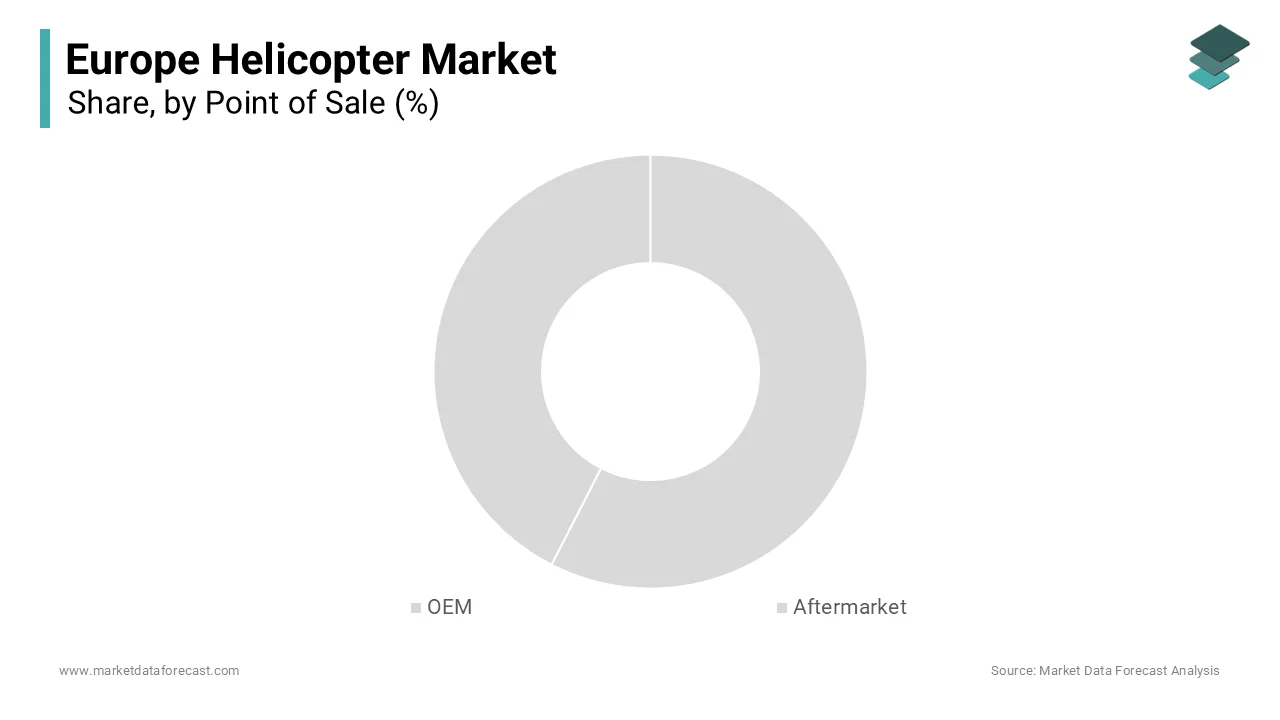
The aftermarket segment is likely to be the fastest-growing segment in the European market and is predicted to witness a CAGR of 4.5% over the forecast period. Factors such as aging fleets requiring frequent maintenance and repairs, and stringent safety regulations imposed by the European Union Aviation Safety Agency are propelling the growth of the aftermarket segment in the European market. Annual spending on MRO services exceeds EUR 3 billion, as highlighted by the European Emergency Number Association, with emergency services driving demand. The segment's rapid expansion underscores its importance in ensuring operational safety and efficiency, making it indispensable for sustaining Europe’s helicopter operations amidst rising operational complexities.
By Type Insights
The medium military helicopter segment (4.5–8.5 tons) dominated the market by accounting for 40.8% of the European market share in 2025 due to its versatility in missions like troop transport, combat support, and disaster response. As per the reports of NATO, defense spending on medium helicopters grew by 6% annually, with over 1,200 units operational across Europe. These helicopters strike a balance between payload capacity, range, and cost-efficiency, making them indispensable for modern militaries. According to the European Commission, the role of medium military helicopters is critical in addressing geopolitical challenges, particularly in Eastern Europe. With aging fleets requiring replacement, medium helicopters remain critical for ensuring operational readiness and enhancing defense capabilities.
The light civil and commercial helicopter segment (<3.1 tons) is predicted to showcase a notable CAGR of 5.2% over the forecast period. The rising demand for emergency medical services (EMS), urban air mobility (UAM), and tourism is fuelling the expansion of the light civil and commercial helicopter segment in the European market. According to the European Investment Bank, more than 70% of EMS helicopters in Europe are light models, conducting approximately 20,000 annual missions. Advancements in hybrid and electric technologies have also reduced operational costs, boosting adoption. The European Emergency Number Association emphasizes the importance of remote-area accessibility and rapid response. Their affordability and adaptability make them pivotal for emerging applications, positioning them as a key growth driver in the civil helicopter market.
By Application Insights
The military transport helicopters dominated the European helicopter market by occupying a share of 35.7% of the European market in 2025. These helicopters are essential for troop deployment, logistics support, and humanitarian missions, with NATO reporting a 7% annual increase in procurement due to modernization programs. The European Commission notes that over 800 transport helicopters are operational across Europe, with France and Germany leading investments. Their ability to operate in diverse terrains and carry heavy payloads makes them indispensable for defense operations. Additionally, their role in disaster relief, such as during floods or wildfires, underscores their strategic importance. With geopolitical tensions driving fleet upgrades, military transport helicopters remain a cornerstone of Europe's defense infrastructure.
The emergency rescue and medical support helicopter segment is anticipated to witness a CAGR of 6.1% over the forecast period due to the increasing demand for rapid medical response, particularly in remote areas. According to the reports of the European Emergency Number Association, these helicopters conducted over 80,000 life-saving missions annually in Europe as of 2022. Advances in navigation and communication technologies have enhanced their efficiency, while urbanization has amplified the need for quick access to healthcare. As per the European Investment Bank, governments are investing heavily in EMS infrastructure, with countries like Germany and France expanding fleets. Their critical role in saving lives ensures sustained growth and innovation in this vital sector.
By Component & System Insights
The airframe segment captured the leading share of the European market in 2024. The critical role of airframes in defining a helicopter's structural integrity, performance, and payload capacity is driving the segmental expansion in the European market. Aerostructures and main rotor systems, key subcomponents of the airframe, are particularly significant due to their direct impact on flight efficiency and safety. EASA highlights that over 60% of maintenance-related expenditures are linked to airframe components, reflecting their importance in operational reliability. The European Commission notes that advancements in lightweight composite materials have further boosted demand for modern airframes, especially in military and civil applications. With stringent safety regulations and aging fleets requiring upgrades, the airframe segment remains pivotal for the helicopter industry.
The avionics segment is predicted to grow at the fastest CAGR of 7.2% over the forecast period due to factors such as the increasing demand for advanced navigation, communication, and stability augmentation systems that enhance operational safety and efficiency. According to the European Defence Agency, investments in avionics for military helicopters have surged by 8% annually due to the integration of AI-based flight control systems and real-time data analytics. In the civil sector, Eurocontrol notes that emergency systems and environmental control systems are becoming standard in new models, particularly for urban air mobility (UAM) and emergency medical services (EMS). According to the European Investment Bank, avionics innovations are critical for meeting regulatory compliance and reducing pilot workload. As helicopters evolve into smarter, more autonomous platforms, avionics will remain a key driver of technological advancement and market growth.
By Number of Engines Insights
The twin-engine segment held the largest share of the European helicopters market in 2024. The domination of the twin-engines segment is driven by their superior safety, reliability, and ability to perform long-range missions, which makes them ideal for critical applications such as offshore energy operations, emergency medical services (EMS), and military transport. As per the European Maritime Safety Agency, more than 70% of offshore helicopters in Europe are twin-engine models, given their ability to operate in challenging maritime environments. Additionally, EASA emphasizes that twin-engine configurations are preferred for EMS and search-and-rescue (SAR) missions due to their redundancy and enhanced safety features. With increasing demand for versatile and high-performance rotorcraft, twin-engine helicopters remain a cornerstone of the European market.
The single-engine helicopter segment is anticipated to expand at a CAGR of 4.8% over the forecast period due to its cost-effectiveness, lower maintenance requirements, and suitability for light-duty applications such as training, tourism, and urban air mobility (UAM). According to the European Investment Bank, single-engine helicopters are increasingly being adopted for UAM initiatives, particularly in urban areas where smaller, agile rotorcraft are needed for short-distance travel. Furthermore, advancements in engine efficiency and safety technologies have expanded their operational scope, making them more competitive. As per the European Emergency Number Association, single-engine models are also gaining traction in emergency response roles in less densely populated regions. Their affordability and adaptability position them as a key growth driver in emerging applications across Europe.
By Component & System Insights
The aerostructures segment dominated the market by occupying a share of 25% in the European market in 2024. Aerostructures form the backbone of a design of helicopter design and include components like fuselages, rotor blades, and tail assemblies, which directly impact performance and safety. According to the European Commission, advancements in lightweight composite materials, such as carbon fiber and advanced alloys, have significantly increased demand for modern aerostructures, particularly in military and civil applications. As per the reports of the EASA, more than 40% of maintenance-related costs are linked to aerostructure upkeep, which indicates their critical role in operational reliability. With aging fleets requiring upgrades and increasing emphasis on fuel efficiency, aerostructures remain a pivotal focus for manufacturers and operators alike.
The avionics segment is another key segment in the European market and is likely to showcase the fastest CAGR of 7.5% over the forecast period due to factors such as rising adoption of advanced navigation, communication, and flight control systems that enhance safety, efficiency, and operational capabilities. As per the European Defence Agency, investments in avionics for military helicopters have surged by 9% annually due to the integration of AI-based stability augmentation systems and real-time data analytics. In the civil sector, according to Eurocontrol, emergency systems and environmental control systems are becoming standard in new models, particularly for urban air mobility (UAM) and emergency medical services (EMS). The European Investment Bank emphasizes that avionics innovations are critical for meeting stringent regulatory standards and reducing pilot workload. As helicopters evolve into smarter and more autonomous platforms, avionics will continue to drive technological advancements and market expansion.
REGIONAL ANALYSIS
France Helicopter Market Analysis
France was the largest market for helicopters in Europe and held 25.3% of the regional market share in 2024. The domination of France in the European market is majorly driven by the robust aerospace industry of France that is spearheaded by global leaders like Airbus Helicopters, which commands over 50% of the global civil and parapublic helicopter market. As per the European Defence Agency, France's military modernization programs, including investments in heavy and medium helicopters, have bolstered demand. Additionally, France's focus on innovation, particularly in hybrid-electric rotorcraft, aligns with sustainability goals. According to Eurocontrol, France's strategic position in offshore energy operations in the North Sea further amplifies its helicopter usage. With strong government support and cutting-edge R&D, France remains at the forefront of the European helicopter market.
Germany Helicopter Market Analysis
Germany is another significant player in the European helicopter market and is expected to expand at a CAGR of 5.1% during the forecast period. The advanced manufacturing capabilities of Germany and significant investments in defense and emergency medical services (EMS) are propelling the helicopter market in Germany. According to the reports of NATO, Germany's defense spending on helicopters has grown by 6% annually due to the fleet upgrades for search-and-rescue and troop transport missions. Furthermore, as per the European Emergency Number Association, Germany operates one of Europe's largest EMS fleets, conducting over 50,000 annual missions. The country's emphasis on urban air mobility (UAM) initiatives also positions it as a leader in adopting next-generation rotorcraft technologies, ensuring sustained growth and innovation.
United Kingdom Helicopter Market Analysis
The United Kingdom holds a prominent position in the European helicopter market. The extensive offshore energy sector of the UK, particularly in the North Sea, where helicopters are indispensable for transporting personnel and equipment, is driving the UK helicopters market. As per the reports of the European Maritime Safety Agency, more than 30% of Europe's offshore helicopter operations are based in the UK. Additionally, the UK's commitment to defense modernization includes the procurement of advanced attack and reconnaissance helicopters. The country is also a hub for avionics innovation, with companies pioneering autonomous flight systems.
COMPETITIVE LANDSCAPE
KEY MARKET PLAYERS
A few of the market players in the European helicopter market
- Airbus Helicopters SAS (France)
- Bell Helicopters (US)
- The Boeing Company (US)
- Leonardo S.p.A. (Italy)
- Sirkorsky-Lockheed Martin (US)
- Russian Helicopters (Russia)
- Kawasaki Heavy Industries (Japan).
MARKET SEGMENTATION
This research report on the European helicopter market is segmented and sub-segmented into the following categories.
By Point of Sale
- OEM
- Aftermarket
By Type
- Military
- Heavy Helicopters ( >8.5 Tons)
- Medium Helicopters (4.5 -8.5 Tons)
- Light Helicopters ( <4.5 Tons)
- Civil & Commercial
- Heavy Helicopters ( >9.0 Tons)
- Medium Helicopters (3.1 –9.0 Tons)
- Light Helicopters ( <3.1 Tons)
By Application
- Military
- Attack & Reconnaissance Helicopters
- Transport Helicopters
- Maritime Helicopters
- Training Helicopters
- Search & Rescue Helicopters
- Civil & Commercial
- Transport Helicopters
- Civil Utility Helicopters
- Emergency Rescue & Medical Support Helicopters
- Offshore Helicopters
By Component & System
- Airframe
- Aerostructures
- Main Rotor Systems
- Cabin Interiors
- Anti-torque Systems
- Transmission Systems
- Electrical Systems
- Hydraulic Systems
- Avionics
- Stability Augmentation Systems
- Flight Control Systems
- Undercarriages
- Environment Control Systems
- Emergency Systems
- Special-purpose Systems
- Engines
By Number of Engines
- Twin Engines
- Single Engines
By Component & System
- Aerostructures
- Main Rotor Systems
- Avionics
- Landing Gear Systems
- Emergency Systems
- Cabin Interiors
- Actuators
- Filters
By Country
- UK
- France
- Spain
- Germany
- Italy
- Russia
- Sweden
- Denmark
- Switzerland
- Netherlands
- Turkey
- Czech Republic
- Rest of Europe
Frequently Asked Questions
What is the Europe helicopter market?
It refers to the regional industry for manufacturing, sales, lease, and operation of helicopters across civil, commercial, and defense sectors.
What drives growth in the Europe helicopter market?
Increasing demand for emergency medical services, law enforcement, offshore operations, tourism, and defense modernization fuels market expansion.
Which helicopter types are commonly used in Europe?
Light single-engine, medium twin-engine, heavy utility, and multi-role helicopters serve a range of missions from transport to search and rescue.
How does defense spending influence the helicopter market?
Defense budgets support procurement of military helicopters for surveillance, transport, combat, and border security missions.
What role do civil applications play in the helicopter market?
Civil uses include emergency medical services (EMS), air ambulance, VIP transport, firefighting, law enforcement, and corporate travel.
How does offshore energy production affect market demand?
Helicopters are crucial for crew transport to offshore oil & gas platforms and wind farms, boosting demand in the North Sea and other regions.
Are helicopter leasing and charter services popular?
Yes, leasing and charter services offer flexibility and lower upfront costs for operators and corporate users.
What technologies are shaping the helicopter market?
Advanced avionics, digital flight controls, improved safety systems, fuel-efficient engines, and hybrid/electric propulsion trends influence innovation.
How do regulations impact the European helicopter market?
EASA safety standards, noise emissions regulations, pilot licensing requirements, and airspace rules shape operations and certification.
How does helicopter training influence the market?
Flight schools and training simulators support pilot certification, safety standards, and operational readiness across civil and defense sectors.
Related Reports
Access the study in MULTIPLE FORMATS
Purchase options starting from
$ 2000
Didn’t find what you’re looking for?
TALK TO OUR ANALYST TEAM
Need something within your budget?
NO WORRIES! WE GOT YOU COVERED!
Call us on: +1 888 702 9696 (U.S Toll Free)
Write to us: sales@marketdataforecast.com