- Product Description Description
- Table of Contents TOC
- List of Table & Figure LOT
- Get Free Sample PDF Sample PDF
Market Size, 2025
$83.81 BnMarket Estimate, 2026
$89.50 BnMarket Forecast, 2034
$151.38 BnCAGR, 2026–2034
6.79%Executive Summary: Europe Home Insurance Market
- Market Scope: Comprehensive Europe home insurance market analysis covering policy types, property classifications, coverage tiers, country-level leadership frameworks, climate risk analytics, and smart home technology trends.
- Market Valuation: Valued at USD 83.81 billion (2025), estimated at USD 89.50 billion (2026), and projected to reach USD 151.38 billion by 2034, registering a robust CAGR of 6.79% (2026–2034).
- Primary Growth Drivers: Increasing climate-related property damage, mandatory insurance requirements linked to mortgages and tenancy agreements, and growing awareness of residential risk management. Key catalysts include geospatial analytics, climate-risk modeling, IoT-enabled premium personalization, and dynamic risk management solutions.
Key Market Segment Metrics (2026–2034)
| Category | Leading Segment (2025 Position) | Fastest-Growing Segment |
|---|---|---|
| By Policy Type | Standard Policies (dominated with a 55.2% share in 2025 due to mortgage requirements and automatic renewals) | Bundled Policies (projected to register the fastest CAGR of 7.5% through multi-product offerings) |
| By Property Type | Single-Family Homes (accounted for the largest share of 52.5%) | Apartment Segment (expected to record the fastest CAGR of 6.8%) |
| By Coverage Level | Basic Coverage (held the leading 48.7% share) | Catastrophic Coverage (anticipated to witness the fastest CAGR of 9.2% due to climate risks) |
| By Country / Region | United Kingdom (led with a 20.4% share in 2025, followed by Germany at 18.9%) | France, Italy, and Spain (expanding through regulatory reforms and resilience initiatives) |
Major Market Players & Market Structure
Market Structure: Highly competitive European landscape featuring multinational insurers, mutual insurers, and digital insurtech providers focusing on climate resilience, digital claims processing, smart home integration, and parametric insurance models.
Key Companies: Allianz SE, AXA Group, Zurich Insurance Group, Generali Group, Aviva plc, MAPFRE S.A., AIG Europe, Munich Re, Swiss Re, and Legal & General Group.
Europe Home Insurance Market Size
The Europe Home Insurance Market size was valued at USD 83.81 billion in 2025 and is anticipated to reach USD 89.50 billion in 2026 from USD 151.38 billion by 2034, growing at a CAGR of 6.79% during the forecast period from 2026 to 2034.
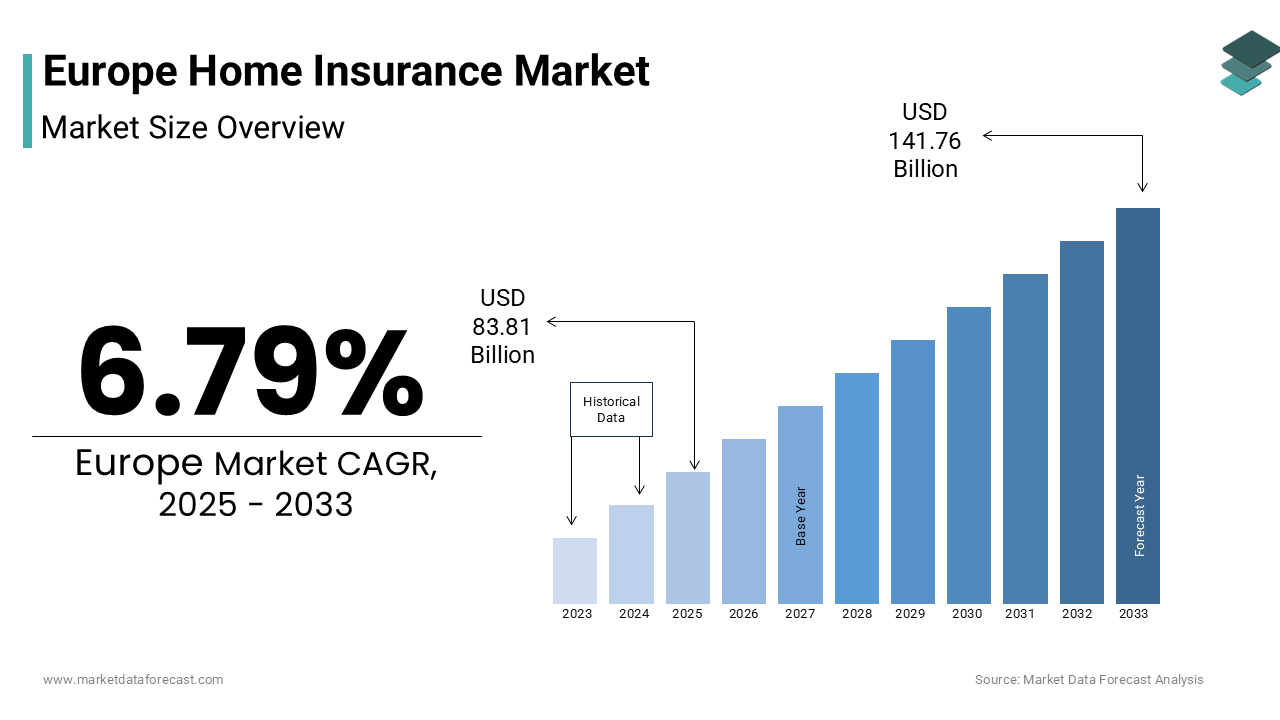
Home insurance refers to the financial protection for residential properties against perils such as fire, theft, natural catastrophes, and third party liability, tailored to diverse national legal frameworks and housing typologies. Unlike commoditized markets, European home insurance is deeply influenced by regional climate exposure, mandatory coverage laws, and public disaster compensation schemes that coexist with private underwriting. According to research, the market penetration of insurance against elemental risks is generally higher in Western European owner-occupied homes compared to Southern and Eastern member states, a difference often attributed to varying alternative risk coping mechanisms and historical market development. Furthermore, as per multiple sources, a substantial proportion of the housing stock within the EU was constructed before 1990, a factor which can contribute to increased vulnerability to weather-related damage and add complexity to risk modeling efforts. The Corporate Sustainability Reporting Directive now requires insurers to disclose climate risk exposure in residential portfolios, linking underwriting practices to EU green finance taxonomy. Home insurance is evolving into a dynamic risk management partnership from a static indemnity product, driven by recurrent floods in Germany, wildfires in Greece, and drought-induced subsidence in the UK. This context, shaped by physical exposure, regulatory evolution, and societal expectations, defines the Europe home insurance market not merely as a financial transaction but as a critical component of household and community resilience.
MARKET DRIVERS
Escalating Frequency and Severity of Climate Related Property Damage
The region’s residential property stock faces intensifying physical threats from climate change, which acts as a key accelerator for the Europe home insurance market growth. This directly amplifies demand for comprehensive home insurance. Insured losses resulting from weather events have reached substantial levels, driven largely by significant flooding and wildfire activity. The proportion of residential properties facing a high risk of flooding has increased over the last decade. Major regional flooding incidents have led to a high volume of insurance claims for residential properties. Frequent extreme weather occurrences have influenced consumer habits, with a notable shift toward purchasing or increasing insurance coverage. Homeowners residing in areas identified as high-risk are increasingly proactive in securing protection following weather-related warnings. Insurers, in turn, are integrating real time geospatial hazard data from Copernicus into underwriting engines to refine pricing and risk selection. This feedback loop, where climate volatility drives both policy uptake and analytical sophistication, cements environmental exposure as the foremost structural driver of home insurance demand across Europe.
Legislative Mandates Linking Home Insurance to Mortgage and Tenancy Requirements
Legal frameworks across numerous European countries enforce home insurance as a prerequisite for property transactions or occupancy, which propels the expansion of the Europe home insurance market. This creates structural demand independent of voluntary risk awareness. A significant majority of nations within the euro area make property insurance against certain perils a mandatory condition for securing a mortgage loan. In France, legal frameworks introduced in 1989 require tenants to hold liability coverage, with recent adjustments expanding mandatory coverage for homeowners in specific areas to include damage from natural elements. Spanish mortgage lenders consistently require comprehensive home insurance policies, a practice that has contributed to a general increase in the adoption of such policies. The Netherlands enforces tenant liability insurance, considering rental agreements invalid without documented proof of coverage, which results in widespread coverage among the renter population. These statutory requirements transform insurance from a discretionary choice into a functional necessity for housing access, generating consistent demand even in low awareness regions. The institutional embedding of coverage within property law thus serves as a foundational and non-cyclical driver across the European home insurance landscape.
MARKET RESTRAINTS
Existence of State Backed Disaster Compensation Schemes Reducing Private Uptake
In several European countries, public compensation mechanisms for natural disasters diminish consumer incentive to purchase private home insurance, particularly for elemental risks, which impedes the growth of the Europe home insurance market. Certain national frameworks utilize policy levies to provide broad coverage for natural disasters, which can foster a public perception of a guaranteed safety net. The existence of state-supported payout systems appears to correspond with lower rates of private insurance adoption among homeowners in regions vulnerable to environmental hazards. In areas where disaster assistance is discretionary and formal insurance is not required, a significant portion of losses from major events may remain unprotected. Public expectations of government relief can diminish the perceived urgency for individuals to secure private coverage, even following substantial local disasters. This moral hazard, reinforced by historical precedent, suppresses market expansion in regions where state schemes, however underfunded, anchor public risk perception. Private insurers will struggle to achieve sustainable market penetration in vulnerable regions until systems adopt risk-based premiums or introduce co-payment requirements.
Fragmented National Regulatory and Tax Treatment of Home Insurance Products
Divergent regulatory and fiscal policies across European member states create barriers to standardized product development and cross border distribution, which inhibits the expansion of the Europe home insurance market. This fragments the market and increases operational complexity. Variations in insurance premium tax rates across different nations create disparities in price competitiveness and impact consumer affordability. Diverse definitions for environmental damage coverage necessitate the localized adaptation of insurance products to meet specific national requirements. The absence of a harmonized EU policy on parametric triggers or smart home discounts further inhibits pan European innovation. Insurance providers must manage a wide array of legal interpretations regarding contractual obligations, claims processing schedules, and termination rights. This regulatory patchwork inflates compliance costs, particularly for digital insurers seeking scale, and discourages entry into smaller markets. The European home insurance market will continue to lack full integration, acting as a set of distinct national markets, until greater alignment is reached through Solvency III reforms or EIOPA guidance.
MARKET OPPORTUNITIES
Integration of Smart Home Technologies for Dynamic Risk Assessment and Premium Personalization
The proliferation of Internet of Things devices in European households is enabling insurers to shift from static annual policies to dynamic and behavior-based coverage models, which generates potential growth possibilities for the Europe home insecure market. The number of households within the European Union utilizing smart home devices has increased significantly in recent times. A growing proportion of these homes are now equipped with technology like leak detectors, smoke sensors, and security cameras. In response to this increased adoption, some insurance providers have begun to offer incentives. Certain companies in the German and UK markets, for example, now provide premium reductions for policyholders who install specific home protection systems, such as water shutoff mechanisms. This trend is further supported by new regulatory frameworks governing digital markets. Evolving data governance rules are designed to enable consumers to securely and conveniently share their sensor data with service providers like insurers through standardized interfaces. This facilitates real time risk monitoring: a policy could automatically adjust if a leak detector signals prolonged inactivity during winter, indicating heating failure risk. Hence, this convergence of consumer technology, data rights, and actuarial innovation unlocks a high engagement and prevention-oriented insurance model that aligns profitability with loss mitigation.
Expansion of Parametric Insurance for Climate Vulnerable and Underinsured Segments
Parametric home insurance, triggered by objective indices like rainfall levels or wind speed rather than loss assessment, offers a scalable solution for regions with low insurance penetration and high climate exposure, which is anticipated to accelerate the expansion of the Europe home insurance market. A notable portion of residential properties in certain regions of Europe may lack insurance coverage for common natural hazards like floods and wildfires, potentially linked to general issues regarding insurance accessibility or confidence in claim systems. Parametric insurance structures are increasingly seen as a mechanism that could help bridge this gap by offering a streamlined claims process. These models are designed to facilitate rapid, automated payouts following a predefined trigger event, which can help eliminate traditional disputes associated with claims. In one national example, an insurer implemented a wildfire-specific parametric policy leveraging satellite data, which experienced significant initial adoption. In another regional pilot, a different program utilized local water level data to insure homes against river flooding, reportedly resulting in high customer satisfaction regarding the speed of payment distribution. The European Commission’s Natural Disaster Resilience Fund now co finances parametric product development, recognizing its role in closing protection gaps. Parametric insurance provides a clear, reachable, and swift reaction system designed specifically for the European communities most vulnerable to climate change, by separating coverage from the subjective process of verifying individual losses.
MARKET CHALLENGES
Rising Reinsurance Costs and Capacity Constraints for Natural Catastrophe Exposure
European home insurers face mounting pressure from escalating reinsurance pricing and reduced capacity for climate related risks, which threatens product affordability and availability, and thereby negatively impacts the growth of the Europe home insurance market. Average European property catastrophe reinsurance rates showed an upward trend during mid-year renewals. Specific risks like flood and wildfire in Southern Europe experienced a more significant rate adjustment. A segment of insurers made adjustments to their new home policy offerings in certain coastal and forested zones. These changes in policy issuance were related to various underwriting requirements or capital considerations. The withdrawal of global reinsurers from certain perils, such as earthquake coverage in Italy, has further fragmented capacity. These dynamics force primary carriers to either raise premiums beyond consumer tolerance or absorb greater net risk, undermining solvency buffers. The absence of collaborative risk-sharing (public-private) and EU catastrophe bonds will create 'insurance deserts' in vulnerable areas already weakened by depopulation and failing infrastructure.
Consumer Mistrust and Low Financial Literacy Regarding Policy Scope and Claims Processes
Persistent gaps in insurance understanding and historical claims dissatisfaction continue to suppress voluntary home insurance uptake, especially in markets without legal mandates. Consequently, this obstructs the expansion of the Europe home insurance market. Many individuals do not accurately identify specific types of damage, such as subsidence or cyber incidents, covered by their policies. A significant number of consumers hold a misperception that standard home insurance includes coverage for certain natural disasters like floods, which can lead to complications following an event. There is a noticeable level of dissatisfaction regarding home insurance claims, often linked to the pace of the claims process and the application of coverage limitations. Digital insurers have attempted to address this through interactive policy simulators and plain language summaries, but trust remains low. This credibility deficit is exacerbated by complex policy wordings and inconsistent advice from distribution channels. The insurance market will struggle to secure sustained coverage among younger and lower-income households unless insurers pivot their focus from pricing to transparency, education, and compassionate claims handling.
REPORT COVERAGE
| REPORT METRIC | DETAILS |
| Market Size Available | 2025 to 2034 |
| Base Year | 2025 |
| Forecast Period | 2026 to 2034 |
| CAGR | 6.79% |
| Segments Covered | By Policy Type, Property Type, Coverage Level and Region. |
| Various Analyses Covered | Global, Regional & Country Level Analysis, Segment-Level Analysis, DROC, PESTLE Analysis, Porter’s Five Forces Analysis, Competitive Landscape, Analyst Overview of Investment Opportunities |
| Regions Covered | United Kingdom, France, Spain, Germany, Italy, Russia, Sweden, Denmark, Switzerland, the Netherlands, Turkey, and the Czech Republic. |
| Market Leaders Profiled | Allianz SE, AXA Group, Zurich Insurance Group, Generali Group, Aviva plc, MAPFRE S.A., AIG Europe, Munich Re, Swiss Re, and Legal & General Group |
SEGMENTAL ANALYSIS
By Policy Type Insights
The standard policies segment led the Europe home insurance market and held a 55.2% share in 2025 by serving as the default offering for owner occupiers and landlords across the region. These policies combine building and contents coverage under a single contract with predefined terms, aligning with national regulatory templates and mortgage lender expectations. Insurers often utilize standardized policy wordings, which can potentially reduce consumer confusion and streamline processing. In certain nations, established standard home insurance policies are commonly renewed automatically, suggesting they are deeply ingrained in housing practices. Many European households approach home insurance as a routine expense, indicating a general preference for simplicity in coverage over personalized choices. Bancassurance channels further entrench standard policies by bundling them with mortgages as a turnkey compliance solution. Standard policies succeed because their economies of scale, established regulations, and customer habit outweigh the appeal of more flexible, modular choices.
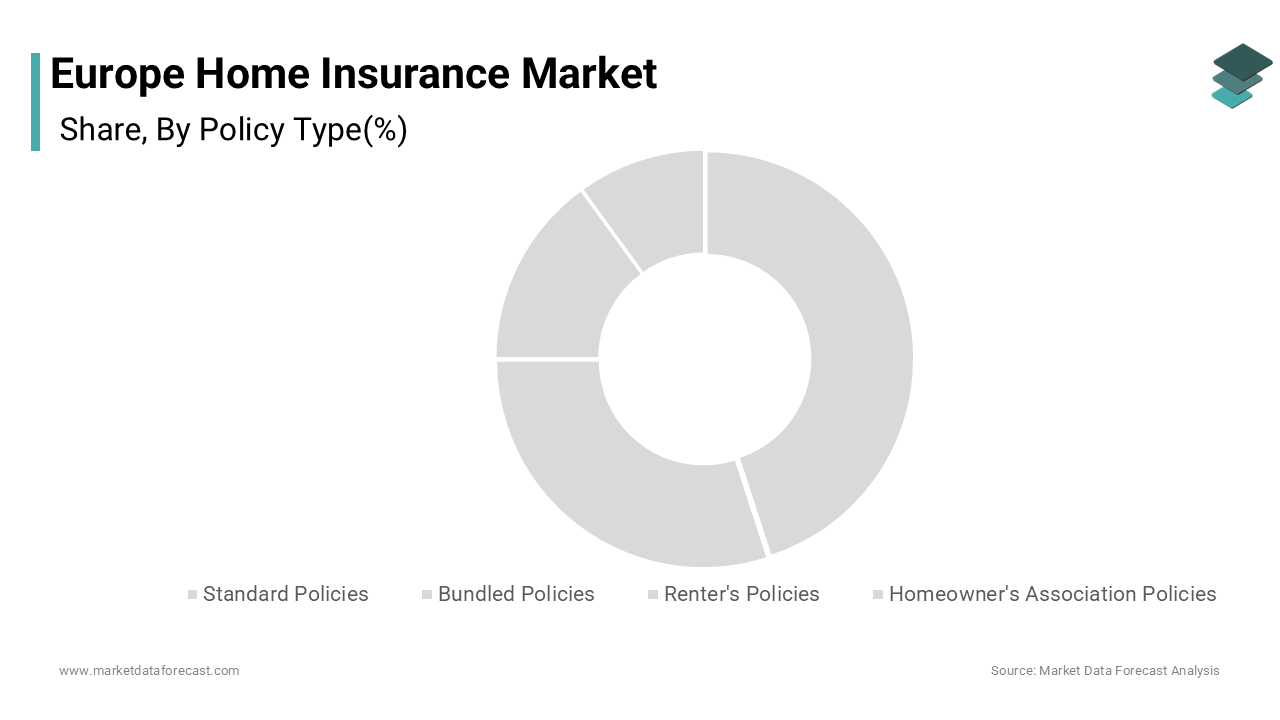
The bundled policies segment is likely to experience the fastest CAGR of 7.5% share in 2025. The rapid expansion of the bundled policies segment is fueled by insurer strategies to enhance customer retention, reduce acquisition costs, and leverage cross product data for risk pricing. Many European insurers have adopted multi-line discounts to incentivize customers to hold multiple policies. Policyholders who bundle different types of insurance demonstrate higher retention levels compared to those who hold only a single product. Increased competition among comparison platforms has prompted firms to expand their bundled offerings. The integration of data from various technological sources across different insurance lines has supported the growth of multi-product sales. A significant portion of new residential insurance contracts is now being issued in conjunction with vehicle policies. Consumers show an increasing inclination toward insurance arrangements that offer simplified billing and unified service experiences. The rise of digital ecosystems, where insurers partner with utility and telecom providers, further accelerates bundling, offering home and connectivity packages in markets like Spain and Sweden. This convergence of economic incentive, behavioral loyalty, and digital integration positions bundled policies as the highest momentum segment in an increasingly consolidated retail insurance landscape.
By Property Type Insights
In 2024, the single-family homes segment continued to be the prominent segment in the Europe home insurance market and accounted for a 52.5% share. Its prevalence as the primary form of owner occupied housing across the continent propels the growth of the single-family homes segment. Households in Europe generally favor detached or semi-detached residences. This housing preference is prominent in countries like Germany, the Netherlands, and the Nordic region. This segment’s dominance stems from higher reconstruction values, greater exposure to standalone perils like fire and storm damage, and stronger financial incentives for coverage, especially among mortgage holders. For many homes with mortgages in the euro area, building insurance is a common loan condition. This condition helps create a consistent demand for insurance products. Additionally, national disaster compensation schemes often exclude or limit coverage for owner occupied detached properties, compelling reliance on private insurers. In the UK, where most homes are single family dwellings, these property types account for a substantial portion of total home insurance premiums. This trend is linked to higher average coverage values. The combination of legal, financial, and physical risk factors ensures single family homes remain the bedrock of the European home insurance market.
The apartment segment is estimated to register the fastest CAGR of 6.8% from 2025 to 2033 due to rapid urbanization, rising rental markets, and evolving liability structures in multi-unit buildings. According to sources, the share of EU citizens living in apartments rose, with particularly sharp increases in Spain, Italy, and Eastern Europe. Growing urban density leads to increased complexity in insurance responsibilities. Homeowner associations usually manage the building's policy, but owners and tenants are more frequently purchasing their own contents and liability protection. Digital insurers like Lemonade and Getsafe have capitalized on this trend by offering tailored apartment policies with smart home integrations for leak detection. Besides, new EU energy renovation mandates require apartment buildings to upgrade heating and electrical systems, temporarily increasing fire and water risks and prompting insurers to offer renovation specific coverage. This confluence of demographic, regulatory, and risk factors positions apartments as the highest growth property segment.
By Coverage Level Insights
The basic coverage segment dominated the Europe home insurance market and captured a 48.7% share in 2024. The supremacy of the basic coverage segment is credited to legal mandates, affordability constraints, and standardized mortgage requirements. This tier typically includes fire, lightning, explosion, and third party liability, which are sufficient to meet minimum lender and tenancy obligations across most member states. According to research, a significant majority of mortgage agreements across the region specify coverage only for fundamental risks, which may present a disincentive for individuals sensitive to costs to secure more comprehensive protection. In countries like France and Spain, public disaster compensation schemes further reduce perceived need for expanded elemental coverage, reinforcing reliance on basic policies. Households in the southern and eastern parts of Europe, where annual spending on insurance is typically lower, frequently select basic coverage to satisfy mandatory requirements without accumulating further expenses. Besides, legacy policy structures from state dominated insurance eras continue to influence consumer expectations, particularly among older demographics. Millions in Europe opt for standard, bare-minimum insurance plans primarily for regulatory compliance, not robust climate protection; this preference sustains the market's current offerings even as climate risks escalate.
The catastrophic coverage segment is anticipated to witness the fastest CAGR of 9.2% during the forecast period owing to escalating natural disaster frequency and regulatory shifts toward risk transparency. This tier specifically addresses high severity, low frequency events such as floods, earthquakes, wildfires, and drought induced subsidence, perils increasingly excluded from standard policies. Weather-related home insurance claims have increased notably in recent times. A significant majority of overall losses are now attributed to events classified as catastrophic. In response, insurers in high-risk zones are unbundling catastrophic coverage to enable precise pricing and risk pooling. In southern European and Alpine areas, a growing number of new home insurance policies have started to incorporate specific coverage for severe events. This trend indicates a shift in how risk is underwritten in these regions. New disclosure requirements for the insurance industry are influencing how carriers manage and report on their exposure to climate-related physical risks. This is leading to the development of specialized insurance products designed to address severe and clearly defined events. Besides, public private partnerships, such as Italy’s proposed national flood pool, are encouraging private uptake through premium subsidies. This trend reflects a maturing market where granular risk segmentation replaces one size fits all protection, especially as climate volatility erodes the viability of traditional bundled policies.
REGIONAL ANALYSIS
United Kingdom Home Insurance Market Analysis
The United Kingdom was the top performer in the Europe home insurance market and captured a 20.4% share in 2025 because of high penetration, mature competition, and significant exposure to flood and storm risks. A significant majority of households hold home insurance coverage, a rate which is high relative to other European nations. The high adoption rate is influenced by common mortgage stipulations and recurring weather events, and following a particular named storm event, a large number of home insurance claims were recorded with associated payouts amounting to a considerable financial sum. The UK’s regulatory framework mandates clear policy wording and rapid claims handling, fostering consumer trust but also increasing operational costs. Digital insurers like Urban Jungle have gained traction by offering dynamic pricing based on post code flood scores from the Environment Agency. Despite Brexit, the UK maintains alignment with core EU data and consumer protection norms, enabling continued innovation. This combination of risk exposure, regulatory clarity, and market sophistication ensures the UK’s leadership in Europe’s home insurance landscape.
Germany Home Insurance Market Analysis
Germany was the next prominent country in the European home insurance market and accounted for a 18.9% share in 2025, with its dual system of private insurance and strong public building codes that collectively shape risk culture. Most individuals who own their residences maintain insurance policies that cover the structure of their homes. A significant portion of households choose voluntary insurance against elemental damages, a trend potentially linked to the cyclical natural disasters common in specific locales. Recent, significant damage from water-related events highlights the relevance and importance of comprehensive coverage, which may contribute to general consumer awareness of risks. Germany’s mortgage market universally requires building insurance, and banks like Deutsche and Commerzbank integrate policy verification into loan origination. Besides, A notable majority of new home insurance policies incorporate discounts related to technological systems that detect issues such as water leaks and fire, indicating an increasing interest in the adoption of smart home technology. The country’s strict liability laws also compel renters to carry contents and third-party coverage, ensuring broad market participation. A combination of strict rules, rich citizens, and climate threats ensures Germany's home insurance sector remains robust and in high demand.
France Home Insurance Market Analysis
France is moving ahead steadfastly in the Europe home insurance market due to legal mandates, a centralized public reinsurance pool, and high urban density. Home insurance is a mandatory requirement for all tenants and landlords based on housing regulations. This requirement has led to widespread coverage for a vast majority of residential properties. The Caisse Centrale de Réassurance provides state backed compensation for natural disasters, but only if private insurance is held, which creates a unique public private linkage that drives uptake. The insurance system recently processed a significant number of claims stemming from damage caused by severe weather events. Furthermore, recent energy legislation requires insurers to incorporate a building's energy efficiency into their risk evaluations. This approach encourages property upgrades that can help lessen the likelihood of certain common risks. Digital brokers like Luko have modernized distribution by offering instant policies with automated damage assessment via smartphone photos. France’s blend of legal obligation, state support, and regulatory innovation creates a distinct yet highly stable home insurance environment.
Italy Home Insurance Market Analysis
Italy is rapidly expanding in the Europe home insurance market owing to recent seismic and hydrogeological events that have reshaped consumer and policyholder behavior. The prevalence of home insurance has increased significantly among households. Recent major natural disasters and associated uninsured losses have heightened the public’s awareness of property risks. Governmental fiscal policies, such as income tax deductions for premium payments, have encouraged the adoption of catastrophe coverage. A growing number of residential mortgage agreements now include mandatory requirements for property damage insurance. These shifts indicate that the domestic insurance market is increasingly aligning with broader regional standards. Insurers are investing in geospatial risk platforms using data from the National Institute of Geophysics to refine pricing in high-risk zones. Public awareness campaigns co funded by the European Investment Bank have further accelerated uptake, particularly in the historically underinsured south. This convergence of disaster experience, fiscal policy, and institutional support is transforming Italy into a high growth home insurance market.
Spain Home Insurance Market Analysis
Spain is likely to grow notably in the Europe home insurance market over the forecast period due to escalating wildfire and drought risks, coastal property concentration, and EU funded climate resilience initiatives. Home insurance coverage has shown an upward trend over a recent period. This shift suggests that more homeowners are choosing to protect their property, possibly reflecting a response to significant weather-related events. Regarding catastrophic events, a state-backed insurance entity has provided substantial compensation in a recent year, indicating significant financial exposure across the country. New regulations require insurers to disclose climate risk scores in policy documents, driving demand for granular hazard modeling. Furthermore, a large majority of new coastal developments now require comprehensive coverage as a prerequisite for urban planning permits, integrating insurance requirements into development processes. Digital insurers like Rastreator have expanded comparison tools that emphasize elemental risk transparency, shifting consumer behavior. Home insurance is increasingly fundamental to personal finance, no longer a discretionary choice, because a significant portion of the population lives in high-climate-risk areas. This dynamic supports ongoing expansion in the insurance market.
COMPETITIVE LANDSCAPE
The Europe home insurance market features intense competition among multinational insurers, mutual societies, and agile digital entrants, all operating within a highly fragmented yet increasingly regulated landscape. Incumbents like Allianz and AXA leverage scale, brand trust, and bancassurance networks to maintain dominance, while digital insurers such as Lemonade and Getsafe gain ground through frictionless onboarding and usage based pricing. Competition is no longer solely price driven but centers on value added services—such as risk prevention, energy efficiency advice, and rapid parametric payouts—that address evolving consumer expectations and climate realities. Regulatory harmonization remains limited, forcing companies to localize products across jurisdictions while seeking efficiency through shared data platforms and EU level catastrophe risk pools. The entry of insurtechs has accelerated innovation in claims automation and smart home integration, pressuring traditional carriers to modernize legacy systems. Ultimately, success hinges on balancing affordability, transparency, and resilience in a market where trust and responsiveness increasingly outweigh brand legacy alone.
KEY MARKET PLAYERS
Some of the companies that are playing a dominating role in the Europe Home Insurance Market include
- Allianz SE
- AXA Group
- Zurich Insurance Group
- Generali Group
- Aviva plc
- MAPFRE S.A.
- AIG Europe
- Munich Re
- Swiss Re
- Legal & General Group
Top Players in the Market
Allianz SE
Allianz SE is a leading insurer in the Europe home insurance market with deep integration across residential property protection in Germany, France, Italy, and Central Europe. The company offers comprehensive home policies that combine traditional perils coverage with digital innovations such as smart home integration and parametric triggers for natural disasters. It also enhanced its claims platform with AI powered damage assessment using smartphone photos, reducing settlement time. These initiatives reinforce Allianz’s commitment to proactive risk management while maintaining its global influence through standardized underwriting frameworks applied across numerous countries, which ensures consistent risk transfer solutions for multinational clients with European property exposure.
AXA Group
AXA Group maintains a dominant presence in the Europe home insurance market through its localized brands in France, the UK, Spain, and Belgium, offering tailored coverage that aligns with national legal and climatic contexts. The company has pioneered the use of geospatial analytics to refine pricing in high risk zones, particularly for flood and drought subsidence. It also partnered with smart home providers to offer discounted premiums for verified leak detection systems. AXA leverages compliance, climate adaptation, and digital platforms to strengthen its European presence and share its risk modelling solutions internationally, including in Asia and North America.
Generali Group
Generali Group is a key player in the Europe home insurance market, particularly in Italy, Germany, Austria, and Eastern Europe, where it emphasizes customer centricity and sustainability driven insurance design. The company integrates environmental, social, and governance principles into its home policies, offering green home upgrades and discounts for energy efficient retrofits. It also deployed a digital claims assistant powered by natural language processing to guide policyholders through post disaster recovery. These strategies position Generali as a holistic risk partner rather than a mere indemnity provider, extending its influence globally through sustainability focused insurance frameworks adopted in Latin America and Southeast Asia
Top Strategies Used by the Key Market Participants
Key players in the Europe home insurance market focus on integrating smart home data for dynamic pricing, developing parametric products for climate related perils, bundling insurance with prevention and renovation services, enhancing digital claims through AI and image recognition, and aligning policy design with EU sustainability and consumer protection regulations
RECENT MARKET SEGMENTATION
- In March 2024, Allianz SE launched a climate resilience toolkit offering personalized flood and wildfire risk scores linked to premium incentives. This initiative strengthens customer engagement and aligns with EU sustainability disclosure requirements for insurers.
- In May 2024, AXA Group introduced a parametric wildfire insurance product for Southern Europe using satellite fire perimeter data from the European Forest Fire Information System. This enables automatic payouts within 72 hours of trigger events enhancing consumer trust.
- In February 2024, Generali Group rolled out its Resilient Home program in Italy bundling insurance with anti seismic and water damage prevention services co funded by EU recovery funds. This positions Generali as a holistic risk mitigation partner.
- In April 2024, Allianz SE enhanced its mobile claims platform with AI powered damage assessment using smartphone photos reducing settlement time by 40 percent. This improves customer experience and operational efficiency across European markets.
- In January 2024, AXA Group partnered with European smart home providers to offer premium discounts for verified leak detection system installations. This drives loss prevention and deepens integration into homeowners daily risk management routines.
MARKET SEGMENTATION
This research report on the europe home insurance market has been segmented and sub–segmented into the following categories.
By Policy Type
- Standard Policies
- Bundled Policies
- Renter's Policies
- Homeowner's Association Policies
By Property Type
- Single-Family Homes
- Multi-Family Homes
- Condominiums
- Apartments
- Mobile Homes
By Coverage Level
- Basic Coverage
- Expanded Coverage
- Premium Coverage
- Catastrophic Coverage
By Country
- UK
- France
- Spain
- Germany
- Italy
- Russia
- Sweden
- Denmark
- Switzerland
- Netherlands
- Turkey
- Czech Republic
- Rest of Europe