- Product Description Description
- Table of Contents TOC
- List of Table & Figure LOT
- Get Free Sample PDF Sample PDF
Market Size, 2025
$4.43 BnMarket Estimate, 2026
$4.76 BnMarket Forecast, 2034
$8.11 BnCAGR, 2026–2034
7.55%Europe Home Theater Market Size, Growth, Trends & Forecast (2026–2034)
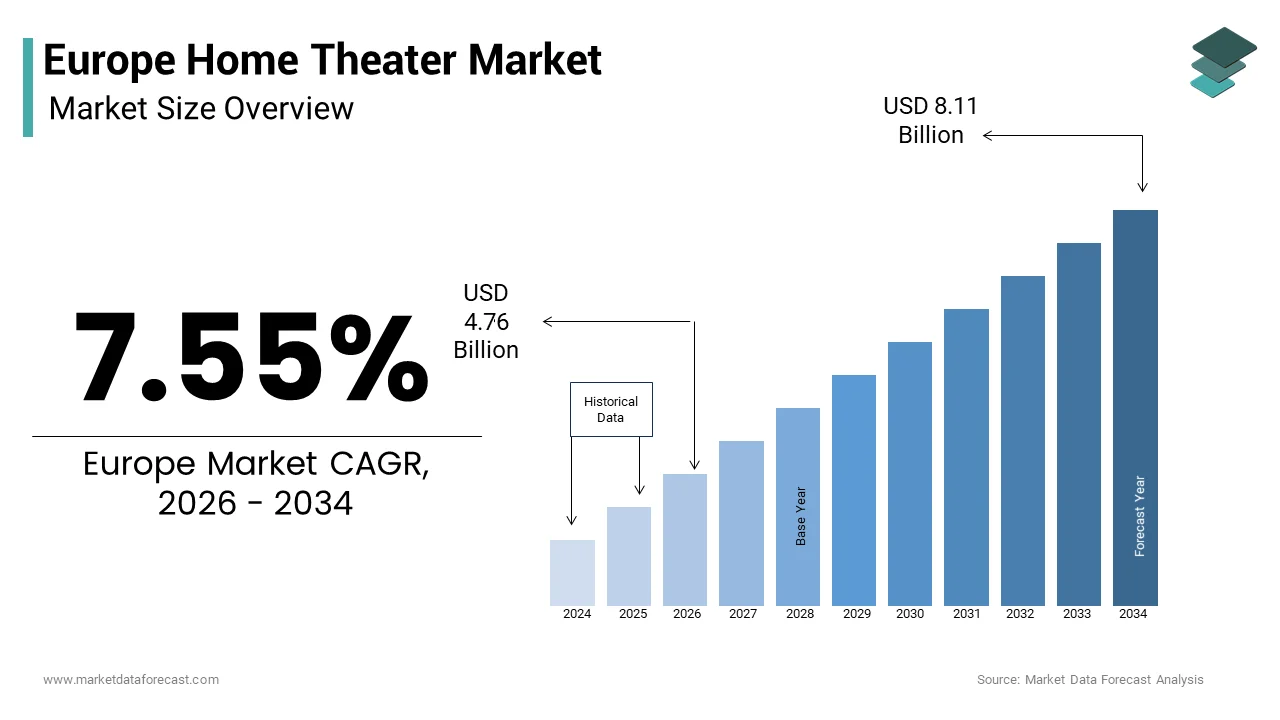
The Europe home theater market size was valued at USD 4.43 billion in 2025, is anticipated to reach USD 4.76 billion in 2026, and is projected to scale up to USD 8.11 billion by 2034, registering a compound annual growth rate (CAGR) of 7.55% during the forecast period from 2026 to 2034. Driven by the proliferation of high-bandwidth streaming platforms, integration with smart home ecosystems, rising adoption of immersive audio formats like Dolby Atmos, and gaming-centric home entertainment solutions, the European market continues to record consistent expansion.
Key Executive Metrics (At-a-Glance)
- 2025 Base Valuation: USD 4.43 Billion
- 2026 Current Valuation: USD 4.76 Billion
- 2034 Forecast Valuation: USD 8.11 Billion
- Compound Annual Growth Rate (CAGR): 7.55% (2026–2034)
- Dominant Product Segment: Sound Bar Segment (54.3% share in 2025)
- Fastest-Growing Product Segment: Component System Segment (projected at 8.4% CAGR)
- Dominant Distribution Channel: Offline and Online Channels
- Dominant Country Market: Germany (24.8% share in 2025) followed by the United Kingdom, France, and Italy
Core Market Drivers
- Streaming Growth: Proliferation of high-bandwidth streaming services and 4K/HDR content availability driving hardware upgrades.
- Smart Connectivity: Deep integration of audio-visual systems into connected smart home ecosystems using voice control and Matter protocol.
- Immersive Audio: Widespread consumer preference for object-based sound formats like Dolby Atmos and DTS:X.
Primary Market Restraints & Challenges
- Energy Regulations: High energy costs and strict EU Ecodesign directives limiting standby power and overall efficiency.
- Space Constraints: Compact urban living spaces and small average apartment sizes restricting large multi-component speaker layouts.
- Technical Complexity: Consumer difficulties regarding installation, configuration, and calibration of sophisticated systems.
Europe Home Theater Market Segmentation Highlights
| Segment Category | Largest Market Segment | Fastest-Growing Market Segment |
|---|---|---|
| By Product Type | Sound Bar Segment (54.3% share in 2025) | Component System Segment (8.4% CAGR) |
| By Distribution Channel | Offline Retail Channels | Online E-Commerce Platforms |
| By Country | Germany (24.8% share in 2025) | United Kingdom, France, and Spain |
Major Industry Players Profiled
Key enterprises dominating the European home theater market include Samsung Electronics Co., Ltd. (KR), Sony Corporation (JP), LG Corporation (KR), Sonos, Inc. (US), Bose Corporation (US), Panasonic Holdings Corporation (JP), Koninklijke Philips N.V. (NL), and Yamaha Corporation (JP).
Europe Home Theater Market Size
The Europe home theatre market size was valued at USD 4.43 billion in 2025 and is anticipated to reach USD 4.76 billion in 2026 to reach USD 8.11 billion by 2034, growing at a CAGR of 7.55% during the forecast period from 2026 to 2034.
Current Introduction of the Europe Home Theater Market
The home theater is an ecosystem of audio-visual technologies designed to replicate the cinematic experience within residential environments, encompassing large-format displays, immersive surround sound systems, and media playback devices. The definition now extends beyond hardware to include the software ecosystems and streaming services that drive content consumption. According to Eurostat, over 92% of households in the European Union had internet access in 2024, providing the essential infrastructure for high-bandwidth 4K and 8K streaming services that fuel demand for advanced display and audio equipment. Furthermore, the European Audiovisual Observatory reports that subscription video on demand services have reached over 130 million subscribers across the region, creating a constant stream of premium content that necessitates superior playback hardware. The market is also shaped by stringent energy efficiency regulations under the Ecodesign Directive, pushing manufacturers to develop power-efficient panels and amplifiers.
MARKET DRIVERS
Proliferation of High-Bandwidth Streaming Services and Premium Content Availability
The explosive growth of high-bandwidth streaming services coupled with the increasing availability of premium 4K and High Dynamic Range content is majorly propelling the growth of Europe home theatre market. European consumers are shifting away from traditional broadcast television towards on-demand platforms that offer cinema-quality productions, necessitating hardware capable of rendering these formats accurately. This surge in data consumption is directly linked to the adoption of Ultra High-Definition televisions and Dolby Atmos sound systems, as users seek to maximize their viewing experience. The launch of dedicated high-fidelity tiers by major providers like Netflix, Disney Plus, and Amazon Prime Video has created a virtuous cycle where better content drives hardware upgrades. Statistics reveal that 68% of European households with gigabit fiber connections have upgraded their display or audio equipment in the last two years to match the quality of streamed content, as per consumer behavior studies conducted by national telecom regulators. Furthermore, the rise of live sports streaming in 4K resolution has become a significant catalyst, with major sporting events driving temporary spikes in sales of large-screen displays and soundbars. The inability of standard definition equipment to reproduce the depth and clarity of modern codecs ensures that content availability remains the most potent driver for market expansion.
Integration of Smart Home Ecosystems and Voice Control Technologies
The deep integration of audio-visual components into broader smart home ecosystems, facilitated by advanced voice control and automation protocols is another attribute accelerating the growth of Europe home theatre market. Modern consumers demand seamless interoperability where their television, soundbar, and lighting systems communicate effortlessly via central hubs or voice assistants like Amazon Alexa, Google Assistant, and Apple Siri. This connectivity allows for automated scenes, such as dimming lights and lowering blinds when a movie starts, enhancing the immersive experience without manual intervention. The adoption of the Matter protocol, supported by major European retailers and manufacturers, has further reduced fragmentation, encouraging consumers to invest in compatible home theater gear. This trend is particularly strong among younger demographics who view the home theater not as an isolated setup but as an integral node in their connected living environment. The convenience of controlling complex systems through simple voice commands or smartphone apps lowers the barrier to entry for sophisticated setups, driving adoption rates across diverse consumer segments.
MARKET RESTRAINTS
High Energy Costs and Stringent Power Consumption Regulations
The persistent issue of high energy costs, exacerbated by geopolitical tensions and supply constraints by increasing the total cost of ownership for power-intensive equipment is limiting the growth of Europe home theatre market. Large OLED panels, high-lumen projectors, and multi-channel amplifier systems consume substantial electricity, leading to hesitation among cost-conscious consumers. According to Eurostat, household energy prices in the European Union increased by an average of 18% in 2024 compared to the previous year, prompting many families to reconsider the operation of high-wattage entertainment systems. Furthermore, the European Union's Ecodesign for Sustainable Products Regulation imposes increasingly strict limits on standby power consumption and overall energy efficiency classes for electronic displays and audio equipment. Compliance with these regulations often requires manufacturers to use more expensive components or limit peak performance capabilities, which can inflate retail prices. The regulatory push for lower power usage sometimes conflicts with the consumer desire for brighter, louder, and more powerful systems, creating a technological bottleneck. Additionally, the requirement for detailed energy labeling can deter purchases of lower-rated but higher-performance models.
Space Constraints in Urban Residential Dwellings
The physical limitation of living space in densely populated European urban centers on the adoption of traditional, component-heavy home theater systems is another attribute hindering the growth of Europe home theatre market. A significant portion of the European population resides in apartments or smaller housing units where dedicating a specific room for a home theater is impractical or impossible. According to the European Union Statistics on Income and Living Conditions, the average usable floor area per person in major cities like Paris, London, and Berlin is often below 40 square meters, leaving little room for large projection screens, multiple speaker stands, and extensive cabling. This spatial scarcity discourages the installation of bulky 5.1 or 7.1 channel speaker systems that require careful placement for optimal acoustic performance. Consequently, consumers are forced to compromise on immersion or opt for simplified alternatives, limiting the market potential for high-end discrete components. Real estate trends indicate that new residential developments in Europe are prioritizing open-plan living areas over separate media rooms, further reducing the feasibility of elaborate setups. Statistics from interior design surveys show that 60% of urban European residents cite lack of space as the primary reason for not upgrading to a full surround sound system. While this drives demand for compact soundbars, it simultaneously restrains the growth of the premium, multi-component segment that traditionally drives higher revenue per unit. The architectural reality of European housing thus imposes a hard ceiling on the complexity and scale of home theater installations.
MARKET OPPORTUNITIES
Adoption of Immersive Audio Formats and Object-Based Sound Technologies
The widespread adoption of immersive audio formats such as Dolby Atmos and DTS:X, which utilize object-based sound to create a three-dimensional auditory experience is certainly a major factor elevating the growth of the Europe home theatre market. Unlike traditional channel-based systems, these technologies allow sound engineers to place audio objects precisely in a 3D space, including overhead effects, offering a level of realism previously only available in commercial cinemas. The European market, with its strong tradition of high-fidelity audio appreciation, is particularly receptive to these advancements. Manufacturers have the opportunity to drive upgrades by marketing soundbars and receiver systems equipped with upward-firing drivers that simulate height channels without requiring ceiling installation, addressing space constraints. Furthermore, the integration of these formats into gaming consoles and PC gaming setups opens a new demographic of users seeking competitive advantages and deeper immersion.
Expansion of Gaming-Centric Home Entertainment Solutions
The expansion of gaming-centric home entertainment solutions with the emergence of console gaming and cinematic experiences is also to promote new opportunities for the growth of Europe home theatre market. The latest generation of gaming consoles from Sony and Microsoft supports features like 4K resolution at 120 frames per second, variable refresh rate, and auto low latency mode, which require advanced display and processing capabilities found in high-end home theater equipment. According to the Interactive Software Federation of Europe, there are over 220 million gamers in Europe, a massive demographic that views their television and audio system as critical gaming infrastructure. This segment is willing to invest in premium hardware to reduce input lag and enhance visual fluidity, blurring the lines between a gaming setup and a home theater. Retail data shows that televisions marketed specifically with "Gaming Mode" features have seen a sales increase of 30% in the past year, indicating a shift in consumer priorities. Additionally, the rise of cloud gaming services reduces the need for local hardware, placing greater emphasis on the quality of the display and network connectivity. Manufacturers can capitalize on this by developing hybrid systems that seamlessly switch between movie and gaming profiles, optimizing settings for each activity.
MARKET CHALLENGES
Complexity of Installation and Lack of Technical Expertise Among Consumers
The inherent complexity of installing and calibrating advanced home theater systems, particularly as equipment becomes more sophisticated with features like room correction and multi-zone audio is one of the major challenges for the growth of Europe home theatre market. Many European consumers lack the technical expertise required to optimally set up surround sound speakers, configure audio receivers, and calibrate display settings, leading to subpar experiences that discourage further investment. According to a survey by the European Consumer Centre, nearly 40% of users who purchased multi-component home theater systems reported dissatisfaction due to difficulties in installation and configuration, often resulting in returns or unused equipment. The decline of specialized independent audio-visual retailers, who traditionally provided expert installation services, has exacerbated this issue, leaving big-box stores and online channels as the primary points of sale where personalized guidance is limited. Professional installation services are often perceived as prohibitively expensive, with labor costs in Western Europe averaging 60 to 80 EUR per hour, deterring homeowners from seeking help. Furthermore, the proliferation of wireless technologies has created a false sense of simplicity, leading consumers to underestimate the acoustic planning required for true immersive sound. This gap between product capability and user competence creates a barrier to entry, limiting the adoption of high-end systems to only the most tech-savvy enthusiasts.
Rapid Technological Obsolescence and Fragmentation of Standards
The rapid pace of technological obsolescence coupled with the fragmentation of connectivity and format standards by creating consumer anxiety about the longevity of their investments is another attributed to inhibit the growth of Europe home theatre market in coming years. The frequent introduction of new HDMI specifications, HDR formats like HDR10 Plus and Dolby Vision, and evolving audio codecs means that equipment purchased today may become incompatible with future content sources within a few years. According to industry analysis by the Consumer Technology Association, the average lifecycle of a home theater receiver has shortened to just 4 years due to changing standards, forcing consumers to question the value of high-priced purchases. This uncertainty is compounded by the lack of universal adoption of certain standards across different manufacturers and regions, leading to a fragmented ecosystem where interoperability is not guaranteed. Additionally, the proprietary nature of some smart home platforms creates walled gardens that limit flexibility.
REPORT COVERAGE
| REPORT METRIC | DETAILS |
| Market Size Available | 2025 to 2034 |
| Base Year | 2025 |
| Forecast Period | 2026 to 2034 |
| CAGR | 7.55% |
| Segments Covered | By Product, Distributional Channel, Country |
| Various Analyses Covered | Global, Regional & Country Level Analysis, Segment-Level Analysis, DROC, PESTLE Analysis, Porter’s Five Forces Analysis, Competitive Landscape, Analyst Overview on Investment Opportunities |
| Regions Covered | UK, France, Spain, Germany, Italy, Russia, Sweden, Denmark, Switzerland, Netherlands, Turkey, the Czech Republic, and the Rest of Europe |
| Market Leaders Profiled | Bose Corporation, Sonos, Inc., Masimo Corporation, LG Corporation, Panasonic Holdings Corporation, Samsung Electronics Co., Ltd. (Samsung Group), Sony Corporation, Koninklijke Philips N.V., Toshiba Corporation, Yamaha Corporation |
SEGMENTAL ANALYSIS
By Product Insights
The sound bar segment was the largest by holding 54.3% of the Europe home theater market share in 2025 with the unique architectural constraints of European housing and the demand for simplified, high-quality audio solutions that integrate seamlessly with modern living spaces. According to Eurostat, the average usable floor area per person in major European cities like Paris and London is often below 40 square meters by making the installation of bulky component systems with multiple speakers and extensive wiring physically impractical for the majority of residents. Sound bars offer a sleek, low-profile design that fits easily beneath televisions or mounts on walls without cluttering limited living areas. Statistics from interior design surveys indicate that 68% of urban European homeowners cite lack of space as the primary reason for avoiding traditional surround sound setups, directly fueling the adoption of all-in-one audio bars. The second factor is the rapid advancement in virtualization technology that allows single-unit devices to simulate immersive 3D audio experiences previously reserved for multi-speaker arrays. Manufacturers have integrated upward-firing drivers and sophisticated digital signal processing algorithms that reflect sound off walls and ceilings to create height channels, effectively mimicking Dolby Atmos performance.
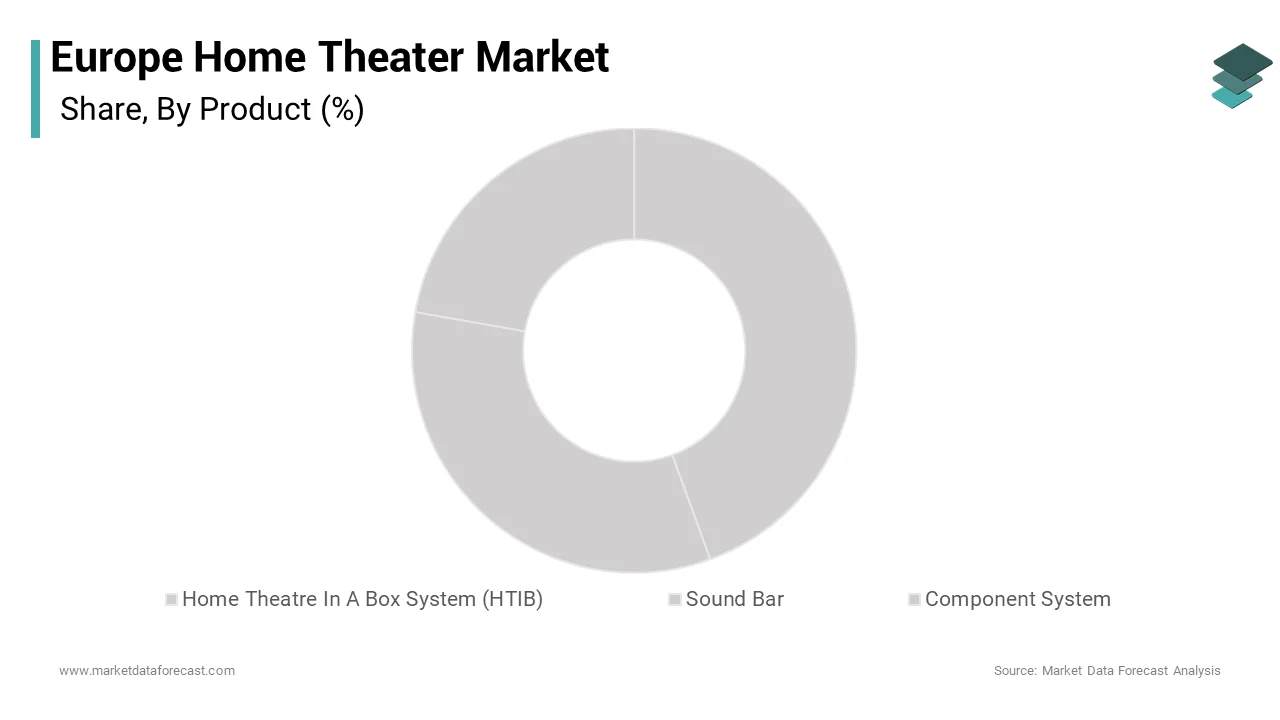
The component system segment is projected to register a fastest CAGR of 8.4% during the forecast period due to a resurgent interest among affluent enthusiasts and the rising integration of home theaters with luxury real estate developments. This accelerated growth is fueled by the inability of compact solutions to match the raw power, dynamic range, and customization potential required by high-end aficionados and dedicated media room installations. Real estate data from Knight Frank indicates that 35% of new luxury home listings in Germany and the United Kingdom, now feature a dedicated media room, creating a robust demand for discrete amplifiers, high-fidelity speakers, and 4K laser projectors that define the component category. These consumers prioritize acoustic perfection and are willing to invest in complex calibration and large-scale setups that sound bars cannot provide. The second driving factor is the professionalization of home installation services and the availability of wireless high-resolution audio protocols that reduce the historical barrier of cable management. The adoption of technologies like WiSA (Wireless Speaker and Audio) allows for lossless transmission of multi-channel audio, enabling clean installations even in retrofitted rooms. Furthermore, the gaming community's push for ultra-low latency and maximum immersion is driving hardcore gamers toward component receivers that offer superior processing power and connectivity options.
COUNTRY-LEVEL ANALYSIS
Germany Home Theatre Market Analysis
Germany was the largest contributor in the Europe home theatre market by capturing 24.8% of the share in 2025. The robust presence of specialized electronics retailers and a consumer base that values technical specifications and build quality above aggressive pricing is additionally fuelling the growth of market. This hardware foundation creates a fertile ground for premium audio upgrades, as consumers seek to match their visual experience with equally impressive sound. The second factor is the strong tradition of Hi-Fi culture, where audiophile communities drive demand for high-end component systems and advanced soundbars with detailed acoustic profiles. German consumers are also early adopters of smart home integration, frequently purchasing home theater systems that seamlessly connect with broader automation ecosystems. Furthermore, the country's strict energy efficiency regulations push manufacturers to introduce innovative, power-efficient models that appeal to the environmentally conscious demographic. The synergy between technical literacy, economic strength, and a commitment to quality ensures Germany's continued dominance as the primary engine of the European home theater economy.
United Kingdom Home Theatre Market Analysis
The United Kingdom home theater market growth is likely to grow with a vibrant content consumption culture and the widespread adoption of subscription streaming services. The massive uptake of streaming platforms like Netflix, Disney Plus, and Sky Glass, which has created an insatiable demand for hardware capable of rendering High Dynamic Range and immersive audio formats. This content abundance necessitates regular hardware upgrades to fully experience premium productions. The thriving gaming sector, where the UK serves as a global hub for console gaming, driving sales of low-latency televisions and high-performance sound systems optimized for interactive entertainment. Additionally, the "staycation" trend has encouraged homeowners to invest in domestic entertainment improvements, viewing home cinemas as a viable alternative to public venues.
France Home Theatre Market Analysis
France home theater market growth is likely to grow with its reputation as a global capital of cinema and artistic expression to drive demand for premium viewing experiences. The sophisticated consumer base that values aesthetic design and cinematic authenticity, often seeking equipment that blends seamlessly with interior decor while delivering theater-grade performance. A significant driving factor is the strong cultural attachment to film, supported by government initiatives and a dense network of film festivals that keep cinema at the forefront of national consciousness. The second factor is the growing trend of luxury home renovation, where integrating hidden speakers and projection systems into elegant living spaces is becoming a standard requirement for high-end properties. French consumers are particularly receptive to designer soundbars and invisible speaker technologies that maintain the visual integrity of their homes. Furthermore, the expansion of fiber optic broadband coverage across the country has enabled reliable streaming of 4K content, removing bandwidth bottlenecks that previously hindered adoption.
Italy Home Theatre Market Analysis
Italy home theater market growth is likely to with the strong passion for social gathering, design excellence, and a thriving luxury goods sector that influences consumer electronics choices. The market status is characterized by a preference for products that combine cutting-edge technology with Italian stylistic flair, where the visual appeal of the device is as important as its performance. A primary driving factor is the cultural importance of hosting family and friends for movie nights and sports events, making the living room a central hub of social activity that demands impressive audio-visual setups. The robust manufacturing base for high-end audio components, with several renowned Italian brands producing premium speakers and amplifiers that cater to both domestic and international markets. This local expertise fosters a knowledgeable consumer base that appreciates nuanced sound reproduction and craftsmanship. Additionally, the resurgence of home projection systems is notable in Italy, where larger living spaces in suburban areas allow for the installation of big-screen setups that mimic commercial cinemas.
Spain Home Theatre Market Analysis
Spain home theatre market is likely to grow with rapidly evolving player in the Europe home theater landscape driven by a booming tourism sector, a warm climate that encourages indoor evening entertainment, and a youthful demographic eager for digital experiences. The intense popularity of football and other live sports, which drives seasonal spikes in sales of large-screen televisions and powerful sound systems as fans seek to enhance their viewing experience of major tournaments. The second factor is the rapid modernization of housing stock and the increasing adoption of smart home technologies among younger generations, who view integrated entertainment systems as essential. The Spanish market is also seeing a surge in the popularity of portable and wireless home theater solutions that can be easily moved between indoor and outdoor spaces, catering to the Mediterranean lifestyle of al fresco dining and evening gatherings.
COMPETITIVE LANDSCAPE
The competition in the Europe home theater market is intensely fierce characterized by a constant battle for technological supremacy between established electronics giants and emerging niche audio specialists. Global conglomerates leverage their vast research and development budgets to dominate through innovations in display panels and proprietary processing chips that enhance visual clarity. However, specialized audio brands are gaining traction by offering high-fidelity component systems that appeal to purist audiophiles seeking superior sound staging. The market sees rapid product cycles where manufacturers must continuously introduce new features like higher refresh rates and advanced upscaling to retain consumer interest. Price competition exists but brand equity and ecosystem integration often drive purchasing decisions more than cost alone. The rise of soundbars has intensified rivalry as companies vie for the limited space beneath televisions with increasingly powerful yet compact units. Success depends on balancing cutting-edge performance with intuitive usability and aesthetic appeal while adapting quickly to shifting consumer preferences for streaming and gaming. Companies must also navigate complex regulatory landscapes regarding energy efficiency to maintain market access.
KEY MARKET PLAYERS
A Few of the market players that are dominating the Europe home theatre market are
- Bose Corporation
- Sonos, Inc.
- Masimo Corporation
- LG Corporation
- Panasonic Holdings Corporation
- Samsung Electronics Co., Ltd. (Samsung Group)
- Sony Corporation
- Koninklijke Philips N.V.
- Toshiba Corporation
- Yamaha Corporation
Top Players In The Market
- Samsung Electronics Co Ltd stands as a global titan in the Europe home theater market, driving innovation through its QLED and Neo QLED display technologies alongside sophisticated soundbar ecosystems. The company contributes significantly to the global sector by pioneering quantum dot technology and seamless smart home integration via its SmartThings platform. Recently, Samsung has strengthened its European position by launching ultra-slim soundbars with wireless Dolby Atmos capabilities designed specifically for compact urban living spaces. The brand actively collaborates with major streaming services to optimize content delivery for its devices, ensuring users experience cinema-grade quality at home. Samsung also invests heavily in sustainability initiatives, utilizing recycled materials in packaging and reducing energy consumption across its product lines.
- Sony Corporation maintains a dominant presence in the Europe home theater market by leveraging its dual heritage in professional cinema and consumer electronics to deliver unmatched audio-visual fidelity. The company drives global standards through its Bravia XR processors and 360 Reality Audio technology, creating immersive experiences that rival commercial theaters. Recent strategic moves include the introduction of OLED panels with perfect black levels and acoustic surface audio that turns the screen itself into a speaker. Sony has expanded its direct-to-consumer engagement in key European markets by hosting immersive demonstration events that showcase the synergy between its PlayStation gaming consoles and home theater systems. The brand also prioritizes high-resolution audio formats, partnering with music studios to bring studio-quality sound to living rooms.
- LG Electronics Inc operates as a pivotal force in the Europe home theater market, renowned for its OLED display technology that offers infinite contrast and perfect viewing angles. The company contributes globally by setting benchmarks in panel manufacturing and integrating webOS smart platforms that aggregate diverse content sources into user-friendly interfaces. LG recently strengthened its foothold by launching gallery-design OLED TVs that blend seamlessly into home decor, appealing to design-conscious European consumers. The firm actively promotes its AI Picture Pro and AI Sound Pro features which automatically optimize settings based on ambient conditions and content type. LG also collaborates with gaming organizations to certify its displays for next-generation console performance, attracting a younger demographic.
Top Strategies Used By Key Market Participants
Key players in the Europe home theater market primarily focus on integrating advanced artificial intelligence to automate picture and sound calibration for optimal user experiences without manual intervention. Companies heavily invest in developing immersive audio technologies like object-based sound formats to simulate three-dimensional environments within compact living spaces. Major participants leverage strategic partnerships with streaming platforms and gaming console manufacturers to ensure seamless content compatibility and exclusive feature access. Firms also prioritize sleek industrial design and eco-friendly materials to align with European aesthetic preferences and stringent environmental regulations. Additionally, brands expand their smart home ecosystems by ensuring interoperability with voice assistants and automation hubs for unified control. These strategies collectively help companies maintain competitiveness and foster long-term loyalty in a technologically advanced marketplace.
MARKET SEGMENTATION
This research report on the Europe market is segmented and sub-segmented into the following categories.
By Distribution Channel
- Offline
- Online
By Product Type
- Home Theatre In A Box System (HTIB)
- Sound Bar
- Component System
By Country
- UK
- France
- Spain
- Germany
- Italy
- Russia
- Sweden
- Denmark
- Switzerland
- Netherlands
- Turkey