- Product Description Description
- Table of Contents TOC
- List of Table & Figure LOT
- Get Free Sample PDF Sample PDF
Market Size, 2025
$174.64 BnMarket Estimate, 2026
$183.09 BnMarket Forecast, 2034
$267.23 BnCAGR, 2026–2034
4.84%Executive Summary: Europe Homeland Security Market
- Market Scope: Comprehensive European homeland security market analysis covering critical infrastructure protection, cybersecurity obligations, cross-border intelligence clouds, procurement frameworks, and sovereign technology mandates.
- Market Valuation: Valued at USD 174.64 billion (2025), estimated at USD 183.09 billion (2026), and projected to reach USD 267.23 billion by 2034, registering a robust CAGR of 4.84% (2026–2034).
- Primary Growth Drivers: Escalating hybrid threats, mandatory EU Critical Entities Resilience Directive implementation, rising cybersecurity obligations under NIS2, and increased adoption of artificial intelligence for predictive threat anticipation alongside sovereign cloud infrastructures.
Key Market Segment Metrics (2026–2034)
| Category | Leading Segment (2025 Position) | Fastest-Growing Segment |
|---|---|---|
| By Security Type | Critical Infrastructure Security (dominated with a 29.1% share in 2025) | Cybersecurity (witnessing a CAGR of 12.6% from 2026 to 2034) |
| By Region / Country | Germany (leads regionally with a 23.5% market share in 2025, followed by France at 19.6%) | Cross-border and multi-nation security cloud deployments driven by sovereign tech mandates |
Major Market Players & Market Structure
Market Structure: Highly competitive defense and security landscape featuring major industry leaders collaborating on sovereign earth observation capabilities, real-time AI threat analytics, and cross-border intelligence platforms while navigating fragmented national procurement frameworks and strict privacy safeguards.
Key Companies: Elbit Systems Ltd., IBM Corporation, Lockheed Martin Corporation, Leidos, Thales Group, Teledyne FLIR LLC, Northrop Grumman Corporation, Raytheon Technologies Corporation, Textron Systems, General Dynamics Information Technology, BAE Systems plc, Saab AB, Indra Sistemas S.A., and Leonardo S.p.A.
Europe Homeland Security Market Size
The europe homeland security market size was valued at USD 174.64 billion in 2025 and is anticipated to reach USD 183.09 billion in 2025 from US 267.23 billion by 2034, growing at a CAGR of 4.84% during the forecast period from 2026 to 2034.
Homeland security refers to the integrated systems technologies and services deployed by national and supranational authorities to safeguard critical infrastructure prevent terrorism manage border integrity and respond to hybrid threats including cyber physical attacks and disinformation campaigns. Unlike conventional defense this domain focuses on domestic resilience through intelligence fusion surveillance interoperable communication and rapid emergency response. The European Union has institutionalized homeland security as a shared competence following a series of coordinated terrorist incidents and escalating geopolitical instability along its eastern and southern perimeters. Critical infrastructure sectors, including energy, transport, health, and digital networks, are now required to undergo mandatory risk assessments to enhance resilience. Large populations living in urban areas face exposure to multiple hazards, ranging from chemical and biological risks to radiological and cyber threats. The detection of undocumented border crossings along external frontiers indicates persistent security and management challenges related to migration. This complex threat landscape coupled with binding regulatory mandates defines a market where security is increasingly systemic collaborative and preemptive rather than reactive or siloed.
MARKET DRIVERS
Escalating Hybrid and Asymmetric Threats Across European Borders
The intensification of hybrid threats combining cyber intrusions disinformation campaigns illegal migration and drone based surveillance has boosted the growth of the Europe homeland security market. A number of documented incidents involving coordinated messaging campaigns targeted critical infrastructure and public service facilities. A key driver is the weaponization of migration flows where state and non state actors exploit humanitarian vulnerabilities to destabilize border states. An increase in organized smuggling efforts occurred along key routes, which involved the use of advanced communications and surveillance methods to avoid authorities. Additionally uncrewed aerial systems have emerged as persistent threats. Multiple instances of unauthorized drone activity were confirmed near sensitive sites such as energy facilities and transportation hubs. Funding has been directed toward enhancing surveillance capabilities, including advanced detection and monitoring systems, along vulnerable transit areas. These evolving tactics necessitate layered sensor networks fused command centers and cross agency data sharing thereby accelerating investment in integrated homeland security platforms.
Mandatory Implementation of the EU Critical Entities Resilience Directive
The enforcement of the European Union’s Critical Entities Resilience Directive from October 2024 serves as a key accelerator for the expansion of the Europe homeland security market. This legislation compels operators of entities in eleven critical sectors to conduct comprehensive risk assessments implement mitigation measures and report significant incidents to national authorities. Entities across various critical sectors, such as energy, transportation networks, healthcare systems, and digital infrastructure providers, are now subject to legal requirements concerning baseline security measures. A significant number of organizations in Europe are working towards meeting these cybersecurity obligations within the next couple of years. Within specific nations, public authorities have pinpointed numerous essential organizations that need to improve their security measures immediately. Emphasis is often placed on safeguarding crucial infrastructure components, like the systems that manage energy and water distribution. Besides, national security agencies are implementing stringent technical mandates for their most important sites. These directives often include the installation of advanced security technologies, such as biometric access controls, systems for detecting perimeter intrusions, and backup communication mechanisms. This regulatory shift transforms homeland security from discretionary expenditure into a compliance imperative driving sustained demand for physical access control cybersecurity integration and crisis simulation platforms across public and private sectors throughout Europe.
MARKET RESTRAINTS
Fragmented National Procurement Frameworks and Interoperability Gaps
The absence of a unified European procurement and technical standardization framework significantly hinders the scalability and effectiveness of homeland security systems, and thereby impedes the growth of the Europe homeland security market. Despite EU level directives national agencies retain full autonomy over equipment selection vendor qualification and operational protocols resulting in incompatible communication systems sensor networks and data formats. A review of cross-border counter-terrorism exercises indicates that a significant majority of participating agencies face difficulties exchanging real-time situational data, primarily due to the use of differing radio frequencies and command software. In Eastern Europe, the acquisition of integrated surveillance systems appears to be limited by budgetary considerations in some nations. A majority of recently acquired border surveillance drones operate on platforms that are not interoperable, which prevents coordinated joint aerial coverage. These fragmentation issues not only reduce operational efficiency but also create exploitable seams that adversaries can target during coordinated attacks thereby undermining the very resilience the EU seeks to achieve through centralized policy.
Public Resistance to Mass Surveillance and Privacy Safeguards
Growing societal and judicial pushback against expansive surveillance technologies poses a persistent constraint on the Europe homeland security market. A significant legal determination regarding the retention of biometric and communication metadata indicates a violation of individual rights within the European legal framework. Following this, a national court invalidated a national facial recognition database, pointing to insufficient safeguards for individual privacy. Public sentiment in Europe generally favors specific security measures over broad public surveillance. This skepticism is reflected in new legislative measures that restrict the use of real-time facial recognition in public transportation hubs without prior legal authorization. Consequently, agencies must invest in privacy enhancing technologies like anonymized analytics and purpose limited AI models increasing system complexity and cost. The implementation of sophisticated surveillance technology will continue to face legal challenges and vary geographically throughout European homeland security until a broader social agreement on the balance between security and civil liberties is reached.
MARKET OPPORTUNITIES
Integration of Artificial Intelligence for Threat Anticipation and Response
The deployment of artificial intelligence to predict detect and neutralize emerging threats gives a major opportunity for the Europe homeland security market. Unlike rule based legacy systems AI enables pattern recognition across disparate data streams including social media satellite imagery border crossing records and dark web chatter to identify precursors of violence or infrastructure sabotage. The European Union’s Counter Terrorism Coordinator initiated a pilot program for an artificial intelligence early warning system across several high-risk urban areas, which led to a decrease in false alarm rates and facilitated better coordination during response efforts. An artificial intelligence engine designed to correlate flooding and cyber threats identified a synchronized ransomware attack targeting water treatment infrastructure during severe weather events. The European Commission is funding an initiative through the Horizon Europe program to develop explainable threat forecasting algorithms that align with regional artificial intelligence regulations' high-risk classification standards. These capabilities shift homeland security from reactive containment to anticipatory resilience creating a new paradigm where predictive analytics becomes central to national protection strategies.
Expansion of Cross Border Security Clouds for Real Time Intelligence Fusion
The emergence of secure interoperable cloud platforms enabling real time intelligence sharing among EU member states provides a significant growth prospect for the Europe homeland security market. Traditional data silos between police customs border agencies and cyber units have long impeded coordinated responses to transnational threats. The European Security Cloud pilot connects national fusion centers in several member states including Germany, France, Italy, Poland, and Spain, using a zero trust architecture that includes end-to-end encryption and role-based access. This platform has reportedly helped decrease cross-border investigation lead times during a recent operation focused on illicit drone trafficking. Additionally, the cloud integrates feeds from civilian critical infrastructure operators allowing authorities to correlate physical anomalies like power grid fluctuations with cyber intrusion alerts. As more member states onboard and the system scales to include private sector partners this federated model promises to overcome historical fragmentation and establish a genuinely collective European homeland security posture.
MARKET CHALLENGES
Proliferation of Open Source and Commercially Available Attack Tools
The democratization of offensive security tools through commercial and open source channels has dramatically lowered the barrier to entry for malicious actors targeting European infrastructure. This is among the serious challenges facing the growth of the European homeland security market. A wide array of tools capable of compromising control systems has been observed on various online platforms. These tools enable non state actors to conduct sophisticated attacks such as GPS spoofing against maritime navigation or ransomware deployment on hospital networks without advanced technical expertise. Disruptions to cargo tracking systems have occurred, leveraging widely available technology and malicious software. Unmanned aerial vehicles equipped with advanced visual and signal interception capabilities are increasingly utilized for reconnaissance purposes in proximity to sensitive locations. This accessibility of attack vectors forces homeland security agencies to defend against a far broader and more agile threat base than previously anticipated requiring continuous red teaming and adaptive defense postures that strain existing resource allocations.
Shortage of Multidisciplinary Security Professionals with Hybrid Skill Sets
A deficit in personnel capable of integrating physical cyber and intelligence domains severely limits the operational effectiveness of the region’s homeland security apparatus, which ultimately obstructs the expansion of the Europe homeland security market. There is a notable shortage of professionals across European nations who possess expertise in both cyber threat analysis and the protection of physical infrastructure. This gap is most acute in Central and Eastern Europe where specialized training programs are scarce. The annual number of homeland security specialists graduating from specialized public service programs remains low relative to the quantity of critical sites requiring oversight. The mismatch stems from traditional education models that silo law enforcement cyber defense and emergency management into separate disciplines. Consequently, agencies struggle to staff security operation centers capable of correlating a phishing campaign with a simultaneous physical breach attempt. Significant coordinated investment in shared curricula, joint exercises, and unified certification is crucial to overcome human capital bottlenecks and build truly converged security in Europe.
REPORT COVERAGE
| REPORT METRIC | DETAILS |
| Market Size Available | 2025 to 2034 |
| Base Year | 2025 |
| Forecast Period | 2026 to 2034 |
| CAGR | 4.84% |
| Segments Covered | By Type, and Region. |
| Various Analyses Covered | Global, Regional, and Country Level Analysis, Segment-Level Analysis, DROC, PESTLE Analysis, Porter’s Five Forces Analysis, Competitive Landscape, Analyst Overview of Investment Opportunities |
| Regions Covered | United Kingdom, France, Spain, Germany, Italy, Russia, Sweden, Denmark, Switzerland, the Netherlands, Turkey, and the Czech Republic. |
| Market Leaders Profiled | Elbit Systems Ltd., IBM Corporation, Lockheed Martin Corporation, Leidos, Thales Group, Teledyne FLIR LLC, Northrop Grumman Corporation, Raytheon Technologies Corporation, Textron Systems, General Dynamics Information Technology, BAE Systems plc, Saab AB, Indra Sistemas, S.A., and Leonardo S.p.A. |
SEGMENTAL ANALYSIS
By Type Insights
The critical infrastructure security segment dominated the Europe homeland security market by capturing a share of 29.1% in 2025. The dominance of the critical infrastructure security segment is primarily driven by the transversal vulnerability of energy transport health and digital networks to both physical and cyber threats and the binding regulatory mandates introduced under the Critical Entities Resilience Directive. An additional driver of this segment is the escalating frequency of hybrid attacks targeting energy grids. In addition, national authorities have mandated layered protection including perimeter intrusion detection biometric access control and real time operational technology monitoring. The interconnectedness of sectors acts as a different reinforcing factor. It is a security breach in one area inevitably leads to cascading consequences across others. This systemic risk compels continuous investment in resilience making critical infrastructure security the cornerstone of Europe’s homeland security strategy.
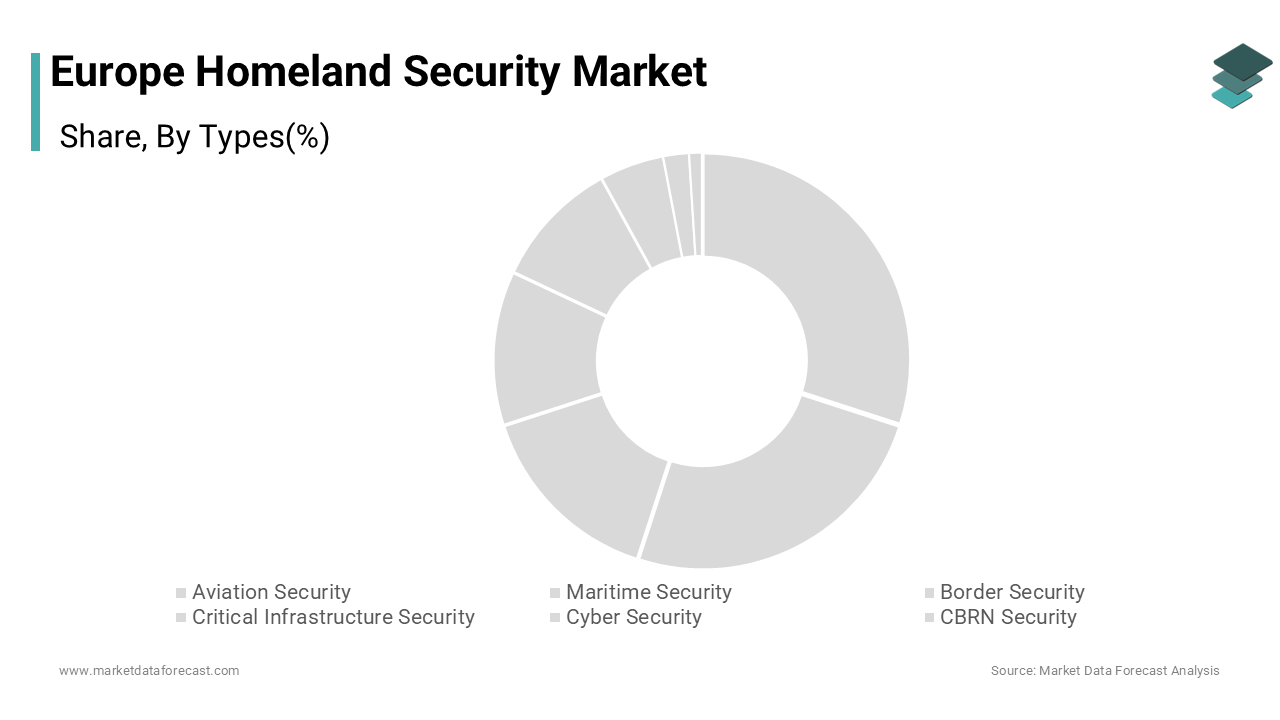
The cybersecurity segment is on the rise and is expected to be the fastest growing segment in the market by witnessing a CAGR of 12.6% from 2026 to 2034. The rapid acceleration of the cybersecurity segment is propelled by the convergence of digital transformation in public services and the sophistication of state sponsored threat actors targeting national digital assets. The implementation of the NIS2 Directive expands cybersecurity obligations across various critical sectors, including energy, health, transport, and digital infrastructure. These mandates require organizations to maintain real-time threat detection capabilities and adhere to secure software development practices. Affected entities are also tasked with establishing formal procedures for incident reporting within specific timeframes. There has been a notable upward trend in ransomware attacks against hospital networks, which has influenced cybersecurity priorities. In response to evolving threats, there is an increased focus on the deployment of sovereign intrusion prevention systems to protect national infrastructure. A further driver is the weaponization of artificial intelligence by adversaries. These dynamics position cybersecurity not as a standalone function but as an embedded layer across all homeland security domains driving sustained and cross cutting investment.
REGIONAL ANALYSIS
Germany Homeland Security Market Analysis
Germany was the top performer in the Europe homeland security market and accounted for a 23.5% share in 2025. The dominance of the German market is driven by its central role in EU security architecture and dense concentration of critical infrastructure. The country is home to a significant portion of Europe’s high voltage electricity interconnectors and strategic gas storage facilities. This concentration of infrastructure highlights its central role in regional energy networks. A key consideration is the national security strategy, which has identified hybrid threats as a primary concern. Consequently, a substantial financial commitment has been made to strengthen homeland resilience initiatives over a five-year period. This includes mandatory security upgrades for all tier one critical entities under the Federal Office for Civil Protection and Disaster Assistance. Additionally, the country leads in industrial security innovation with many homeland tech startups funded under the Federal Ministry for Economic Affairs’ Tech Security Accelerator. These structural regulatory and investment advantages ensure Germany remains the operational and financial epicenter of Europe’s homeland security landscape.
France Homeland Security Market Analysis
France was the next prominent country in the Europe homeland security market and held a 19.6% share in 2025, with its proactive counter terrorism posture and leadership in integrated civil military security operations. The country maintains a permanent state of emergency readiness following repeated terrorist incidents. A substantial number of security personnel are consistently deployed as part of a ongoing domestic operation. A defining strength is France’s centralized fusion model where the National Intelligence and Customs Directorate shares real time data with local prefectures and infrastructure operators through the Secure Information Exchange Platform. This operational framework has facilitated the early intervention and prevention of several potential attacks on public transportation systems. The nation maintains stringent regulations concerning critical infrastructure protection, mandating frequent, simulated breach exercises for key facilities such as nuclear power plants and major railway junctions. A significant increase in security resource allocation was observed in preparation for a major international sporting event, incorporating advanced technologies for crowd monitoring and airspace protection. These coordinated measures solidify France’s role as a model of operational readiness and strategic foresight.
United Kingdom Homeland Security Market Analysis
The United Kingdom is another key player in the Europe homeland security market due to world class intelligence capabilities and a post Brexit emphasis on sovereign security resilience. Despite its geographic separation the UK remains deeply integrated into European threat monitoring through bilateral agreements with France Germany and the Netherlands on counter terrorism and cyber defense. A significant number of critical infrastructure sites underwent mandatory security reviews following updates to national security and investment legislation. Moreover, a key differentiator is the UK’s National Cyber Strategy which established the National Cyber Force to conduct offensive and defensive operations against hostile state actors. Coordinated ransomware campaigns targeting regional water treatment facilities were successfully neutralized. Additionally, the UK leads in CBRN preparedness with the Defence Science and Technology Laboratory operating Europe’s only mobile field deployable detection lab capable of identifying novel chemical agents within minutes. These capabilities ensure the UK exerts disproportionate influence on continental security despite its formal departure from EU institutions.
Italy Homeland Security Market Analysis
Italy is growing steadily in the European homeland security market because of its extensive Mediterranean coastline and role as a frontline state for irregular migration and transnational crime. Authorities recorded a significant influx of maritime arrivals, which has strained national border monitoring and reception capabilities. The government implemented a unified maritime surveillance network that integrates radar, drones, and satellite data to monitor extensive stretches of the coastline. A different driver is the country’s vulnerability to organized crime infiltration of public infrastructure. Legal oversight has led to the suspension of various public infrastructure projects following investigations into potential illicit interference. This has spurred investment in biometric vetting and supply chain integrity platforms for critical construction. Furthermore, Italy is participating in a collaborative international initiative to integrate artificial intelligence into port security protocols for screening shipping containers. These geostrategic and governance imperatives position Italy as a critical node in Europe’s southern security arc.
Netherlands Homeland Security Market Analysis
The Netherlands is anticipated to expand in the Europe homeland security market from 2025 to 2033 owing to its command in digital infrastructure protection and integrated urban security ecosystems. As home to AMS IX the world’s largest internet exchange point and the Port of Rotterdam Europe’s busiest maritime gateway the country faces disproportionate cyber and physical threats. National security directives now require critical digital infrastructure providers to adopt sovereign encryption and zero-trust architectures to mitigate risks from supply chain vulnerabilities. The collaborative ecosystem of public-private innovation clusters facilitates the co-development of advanced security technologies, including automated container scanning and aerial threat detection systems. Urban resilience initiatives have introduced integrated sensor networks in major cities that synthesize traffic, environmental, and social data to anticipate potential public safety incidents or coordinated disruptions. This blend of digital sophistication urban planning and public private collaboration makes the Netherlands a testbed for next generation integrated security models across Europe.
COMPETITIVE LANDSCAPE
The Europe homeland security market is characterized by a concentrated yet dynamic competitive landscape dominated by large defense and technology conglomerates with deep government relationships and sovereign technology mandates. Thales Rheinmetall and Leonardo lead through end to end system integration combining surveillance communications cyber defense and crisis management under national and EU regulatory frameworks. Competition is less price driven and more influenced by technological sovereignty interoperability with existing national architectures and proven operational reliability in high stakes scenarios. Mid tier firms and specialized cybersecurity startups gain traction through niche capabilities in AI powered analytics drone defense or biometric verification but face barriers in scaling due to stringent certification and long procurement cycles. The market is also shaped by geopolitical considerations with governments favoring domestic or EU based vendors over non European suppliers to ensure control over critical security infrastructure. Collaboration rather than confrontation defines the ecosystem as players co develop standards participate in EU funded security initiatives and share anonymized threat intelligence to collectively enhance continental resilience against evolving hybrid threats.
KEY MARKET PLAYERS
Some of the companies that are playing a dominating role in the Europe Homeland Security Market include
- Elbit Systems Ltd.
- IBM Corporation
- Lockheed Martin Corporation
- Leidos
- Thales Group
- Teledyne FLIR LLC
- Northrop Grumman Corporation
- Raytheon Technologies Corporation
- Textron Systems
- General Dynamics Information Technology
- BAE Systems plc
- Saab AB
- Indra Sistemas, S.A.
- Leonardo S.p.A.
Top Players in the Europe Homeland Security Market
Thales Group
Thales Group is a cornerstone of the Europe homeland security market delivering integrated solutions in critical infrastructure protection border surveillance cyber defense and secure communications. Headquartered in France the company supplies sovereign security systems to over twenty European governments including biometric border control radar networks and encrypted command platforms. Globally Thales contributes to NATO and EU security frameworks through its secure satellite communications and air defense command systems. It also partnered with the European Space Agency to develop sovereign earth observation capabilities for real time border monitoring. These initiatives reinforce Thales’s role as a trusted enabler of European strategic autonomy and integrated security resilience.
Rheinmetall AG
Rheinmetall AG has expanded beyond defense into homeland security by providing critical infrastructure protection CBRN detection systems and integrated command and control solutions across Germany and Central Europe. The company’s Homeland Security division develops vehicle mounted surveillance units perimeter intrusion detection and AI powered video analytics deployed at airports power plants and mass transit hubs. Internationally Rheinmetall supports NATO resilience programs and supplies hybrid threat response systems to allied nations. These actions position Rheinmetall as a key architect of layered defense strategies that bridge military-grade protection with civilian infrastructure needs in an era of hybrid threats.
Leonardo S.p.A.
Leonardo S.p.A. plays a pivotal role in the Europe homeland security market through its advanced surveillance radar electro optical systems and secure communications infrastructure. The Italian multinational equips national agencies with maritime domain awareness platforms airspace monitoring systems and biometric identification tools used at major European borders and airports. Globally Leonardo contributes to EU and UN missions by providing intelligence fusion and crisis response technologies. It also launched the VEGA AI analytics suite for real time threat correlation across mass transit and energy grids in collaboration with the Italian Ministry of the Interior. These efforts underscore Leonardo’s commitment to sovereign resilient and interoperable security ecosystems across Europe.
Top Strategies Used by the Key Market Participants
Key players in the Europe homeland security market prioritize the development of integrated multi domain platforms that fuse physical cyber and intelligence capabilities into unified command systems. They actively align solutions with binding EU regulations such as the Critical Entities Resilience Directive and NIS2 to ensure compliance driven procurement. Companies invest in sovereign and AI enhanced technologies to counter hybrid threats while maintaining data autonomy. Strategic partnerships with national agencies research institutes and critical infrastructure operators facilitate co development and real world validation. Additionally firms are expanding into predictive security services leveraging artificial intelligence and big data analytics to shift from reactive response to anticipatory threat neutralization across urban and border environments.
MARKET SEGMENTATION
This research report on the europe homeland security market has been segmented and sub–segmented into the following categories.
By Types
- Aviation Security
- Maritime Security
- Border Security
- Critical Infrastructure Security
- Cyber Security
- CBRN Security
- Mass Transit Security
- Others
By Country
- UK
- France
- Spain
- Germany
- Italy
- Russia
- Sweden
- Denmark
- Switzerland
- Netherlands
- Turkey
- Czech Republic
- Rest of Europe