- Product Description Description
- Table of Contents TOC
- List of Table & Figure LOT
- Get Free Sample PDF Sample PDF
Market Size, 2025
$77.77 BnMarket Estimate, 2026
$82.71 BnMarket Forecast, 2034
$130.22 BnCAGR, 2026–2034
6.33%Europe Hoodies Market Report Summary
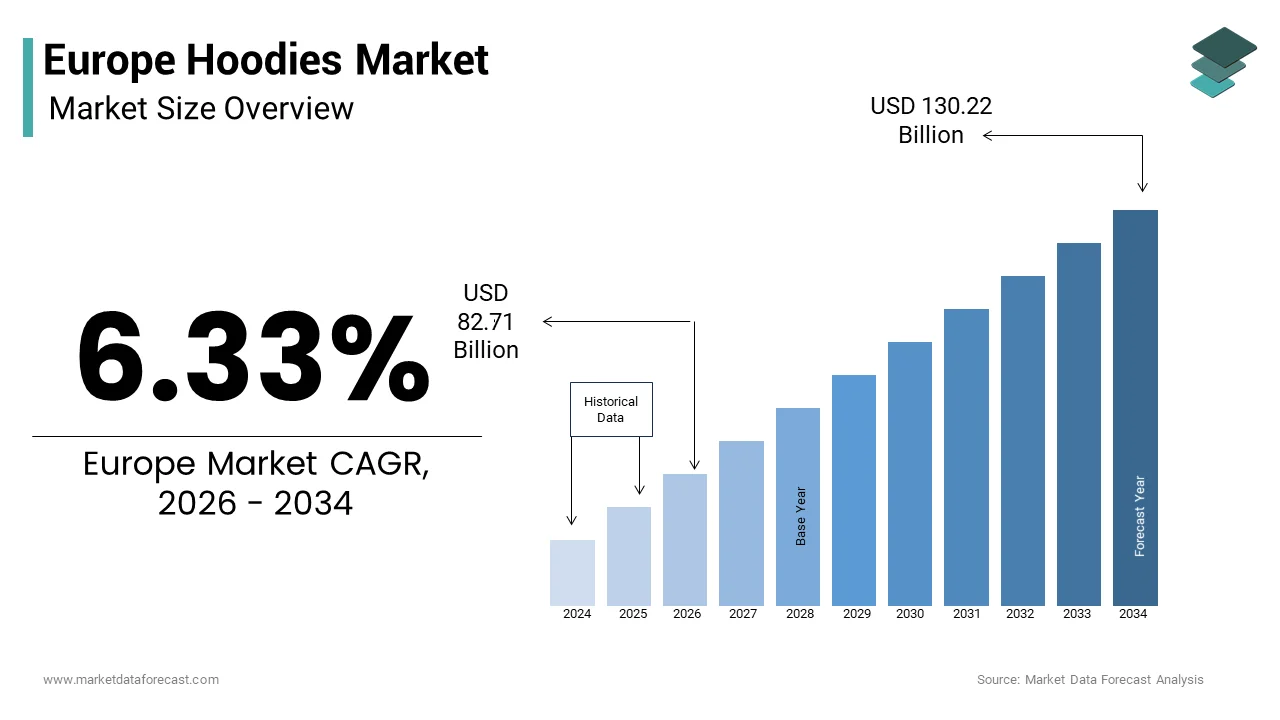
The European hoodies market was valued at USD 77.77 billion in 2025, is estimated to reach USD 82.71 billion in 2026, and is projected to grow to USD 130.22 billion by 2034, expanding at a CAGR of 6.33% during the forecast period from 2026 to 2034.
The growth of the European hoodies market is driven by the rapid expansion of athleisure and casual wear trends, increasing youth influence on fashion, and the growing preference for comfort-led apparel. Rising adoption of hoodies across sportswear, streetwear, and premium fashion segments, along with the influence of social media and celebrity endorsements, is further fueling market growth. Moreover, the surge in online shopping, fast fashion cycles, and sustainable fabric innovations is reshaping hoodie consumption patterns across Europe.
Key Market Trends
- Strong shift toward athleisure and everyday casual wear, blending comfort with style.
- Rising demand for sustainable and ethically sourced hoodie materials, especially organic cotton.
- Growth of premium and designer hoodies driven by luxury fashion collaborations.
- Increasing influence of e-commerce platforms and direct-to-consumer brand strategies.
- Expansion of oversized, minimalist, and gender-neutral hoodie designs.
Segmental Insights
- Based on material, the cotton segment dominated theEuropeane hoodies market in 2025, accounting for 65.6% of the total market share. The segment’s leadership is attributed to cotton’s comfort, breathability, durability, and widespread consumer preference for natural fabrics.
- Based on end user, the men’s segment held the majority share of 48.4% of the European hoodies market in 2025. This dominance is driven by strong adoption of hoodies in men’s casual wear, sportswear, and streetwear fashion.
- Based on distribution channel, the e-commerce (online) segment led the European hoodies market by capturing 54.2% share in 2025. The segment’s growth is supported by convenience, wider product variety, competitive pricing, and increasing penetration of fashion-focused online platforms.
Regional Insights
The European hoodies market is witnessing robust growth across key fashion-driven economies.
- Germany emerged as the largest market, accounting for 18.4% share in 2025, supported by strong sportswear demand and established apparel brands.
- The United Kingdom followed closely with 16.9%, driven by youth fashion trends and high online apparel consumption.
- France holds a distinctive position, with hoodies increasingly integrated into high fashion and Parisian chic styles.
- Italy continues to grow steadily, supported by its strong textile heritage and design excellence,
- The Netherlands is expected to expand further due to rising casualwear adoption and e-commerce penetration.
Competitive Landscape
The European hoodies market is highly competitive, characterized by the presence of global sportswear giants, fast-fashion brands, and premium fashion houses. Leading companies are focusing on sustainable materials, limited-edition drops, digital-first sales strategies, and brand collaborations to strengthen consumer engagement and market positioning.
Prominent players in the European hoodies market include:
Nike, Inc., Adidas AG, Inditex (Zara), H&M Group, PUMA SE, Under Armour, Inc., LVMH, ASICS Corporation, Columbia Sportswear Company, New Balance, Ralph Lauren Media LLC, and PVH Corp.
Europe Hoodies Market Size
The European hoodies market size was valued at USD 77.77 billion in 2025 and is anticipated to reach USD 82.71 billion in 2026 and USD 130.22 billion by 2034, growing at a CAGR of 6.33% during the forecast period from 2026 to 2034.
Current Introduction of theEuropeane Hoodies Market
A hoodie, defined as a sweatshirt with an integrated hood, has evolved from its utilitarian origins in American sportswear to become a ubiquitous symbol of contemporary European youth culture, urban fashion, and relaxed lifestyle. Its enduring appeal lies in its unique blend of comfort, versatility, and expressive potential. The market is not merely driven by seasonal demand but is deeply embedded in social identity and subcultural movements. According to Eurostat, the European Union's median age is increasing, with a large, active population segment driving significant, sustained growth in the apparel market for versatile clothing that combines comfort with fitness-oriented fashion. This youthful demographic, combined with a widespread cultural acceptance of smart-casual dress codes in both social and professional settings across Northern and Western Europe, has cemented the hoodie’s status as a year-round wardrobe staple rather than a simple seasonal garment.
MARKET DRIVERS
Mainstreaming of Athleisure and Casual Dress Codes
The irreversible mainstreaming of athleisure and the relaxation of formal dress codes across social and professional spheres is one of the key factors boosting the growth of the European hoodies market. The hoodie has become the quintessential piece of this sartorial shift, seamlessly transitioning from gym wear to office attire to evening social events. This trend is particularly pronounced in the tech and creative industries, which are major economic sectors in countries like Germany, the Netherlands, and Sweden, where a “work from anywhere” culture has normalized comfortable yet stylish clothing. As per a study, knowledge-based workplaces across Europe are increasingly adopting hybrid, smart-casual dress policies as part of a broader shift in corporate culture toward employee comfort and flexibility. This institutional acceptance has liberated the hoodie from its countercultural past, transforming it into a socially sanctioned and versatile garment that meets the modern consumer’s demand for comfort without sacrificing style.
Powerful Influence of Streetwear and Celebrity Endorsement
The profound and sustained influence of global streetwear culture and celebrity endorsement on European fashion consumption further propels the expansion of the Europe hoodies market. The hoodie serves as the primary canvas for this cultural expression, with its large surface area ideal for logos, graphic prints, and brand storytelling. European consumers, particularly those aged eighteen to thirty-five, are highly attuned to trends set by international music artists, athletes, and social media influencers who consistently feature premium and limited-edition hoodies in their public appearances. This creates a powerful “see now, buy now” dynamic that fuels demand for both high-end designer collaborations and accessible fast-fashion interpretations. According to research, social media influencers and celebrity style have become the primary drivers of fashion inspiration for young European consumers, dominating purchasing behavior over traditional media. This constant stream of aspirational content positions the hoodie not just as clothing but as a key marker of personal identity and cultural belonging, driving continuous purchase cycles.
MARKET RESTRAINTS
Growing Consumer Skepticism Toward Fast Fashion Practices
The rising tide of consumer skepticism and activism against the environmental and social practices of the fast fashion industry is a primary obstacle in the European hoodies market. The hoodie, as a staple of mass-market retailers, is often at the center of this criticism due to its association with overproduction, synthetic materials like polyester, and short product lifecycles. An increasingly informed European consumer base is demanding greater transparency and accountability. EU citizens are increasingly prioritizing environmental sustainability, actively considering the ecological impact of products before making purchases. This shift has led to a decline in the mindless consumption of cheap, disposable hoodies and has forced brands to justify their production methods. The resulting pressure to adopt more sustainable practices adds cost and complexity, creating a significant headwind for the traditional, volume-driven business model that has long dominated the market.
Volatile Raw Material Costs and Supply Chain Disruptions
The volatility in the cost of key raw materials, particularly cotton and polyester, which are the foundational fabrics for most hoodies, inhibits the expansion of the Europe hoodies market. Global supply chains for these commodities are subject to disruption from climate events, geopolitical tensions, and fluctuating energy prices, which directly impact manufacturing costs. For instance, a severe drought in a major cotton-producing region can lead to a sharp price increase that ripples through the entire textile industry. According to sources, significant volatility in textile prices is creating substantial pressure on profit margins within the European non-food consumer goods sector. This instability makes it difficult for brands to maintain consistent pricing and forces them to either absorb costs, risking profitability, or pass them on to consumers, potentially dampening demand in a competitive market.
MARKET OPPORTUNITIES
Expansion of Premium Sustainable and Circular Fashion Models
The rapid expansion of premium sustainable and circular fashion models creates substantial growth prospects for the Europe hoodies market. Consumers are increasingly willing to pay a significant premium for hoodies made from certified organic cotton, recycled polyester, or innovative bio-based materials, provided the brand can demonstrate genuine environmental stewardship. This opens the door for brands to move beyond basic sustainability claims and develop closed-loop systems. For example, a company could offer a take-back program where old hoodies are collected, broken down into fibers, and remanufactured into new garments. The European apparel market is experiencing rapid expansion in resale and rental services as circular business models gain popularity and become a focal point for industry growth. Trading disposability for durability allows brands to turn a premium, recyclable hoodie into a loyalty-building tool and a steady, longevity-based income stream.
Leveraging Digital Platforms for Hyper-Personalization and Direct Engagement
Digital platforms offer hyper-personalized products and foster direct, meaningful engagement with consumers, which opens the door for the expansion of the European hoodies market. Advanced e-commerce technologies now allow brands to offer customization options for hoodies, from selecting fabric blends and colors to adding bespoke embroidery or prints. This transforms the hoodie from a mass-produced item into a unique personal statement. Furthermore, social media and brand-owned apps can be used to build communities around shared values, such as sustainability or local art, turning customers into brand advocates. As per research, tailoring online product recommendations to individual consumers significantly improves e-commerce performance by increasing user engagement and sales conversion rates across Europe. Ethical data usage allows brands to provide personalized experiences that stand out in a competitive landscape, enabling them to secure premium pricing and build deeply loyal customer connections.
MARKET CHALLENGES
Intensifying Competition from a Fragmented Brand Landscape
An intensely fragmented and competitive brand landscape that spans from global luxury houses and major sportswear giants to countless independent designers and online-only micro-brands challenges the growth of the European hoodies market. This saturation makes it exceptionally difficult for any single player to achieve lasting differentiation. Consumers are presented with an overwhelming array of choices at every price point, leading to decision fatigue and a focus on price over brand loyalty. As per a study, the ease of launching online businesses has resulted in a substantial influx of new fashion brands in the EU, significantly increasing market competition and market fragmentation. This hyper-competition compresses marketing budgets, drives down margins, and forces a constant cycle of new product launches, making it hard for brands to build a stable, long-term identity and achieve sustainable profitability in a market where attention spans are short and trends change rapidly.
Navigating Complex and Evolving Textile Sustainability Regulations
The need to navigate an increasingly complex and evolving web of European regulations concerning textile sustainability and circularity also hinders the expansion of the European hoodies market. The European Union’s Strategy for Sustainable and Circular Textiles, part of the European Green Deal, is introducing stringent new requirements for product design, labeling, and end-of-life management. These include mandates for digital product passports that track a garment’s environmental footprint and rules that will eventually ban the destruction of unsold inventory. Upcoming environmental regulations in Europe are demanding that brands invest in tracking technology and supply chain transparency to meet stringent new reporting obligations and sustainability standards. For many brands, especially smaller ones, this regulatory burden represents a major operational and financial hurdle. Failure to adapt quickly and effectively could result in market access restrictions, reputational damage, and a loss of consumer trust in an environment where greenwashing is being actively policed.
REPORT COVERAGE
| REPORT METRIC | DETAILS |
| Market Size Available | 2025 to 2034 |
| Base Year | 2025 |
| Forecast Period | 2026 to 2034 |
| CAGR | 6.33% |
| Segments Covered | By Material, End-User, Distribution Channel, And Region |
| Various Analyses Covered | Global, Regional & Country Level Analysis, Segment-Level Analysis, DROC, PESTLE Analysis, Porter’s Five Forces Analysis, Competitive Landscape, Analyst Overview on Investment Opportunities |
| Regions Covered | UK, France, Spain, Germany, Italy, Russia, Sweden, Denmark, Switzerland, Netherlands, Turkey, Czech Republic, & Rest of Europe |
| Market Leaders Profiled | Nike, Inc. (U.S.), Adidas AG (Germany), Inditex (Zara), H&M Group, PUMA SE (Germany), Under Armour, Inc. (U.S.), LVMH (France), ASICS Corporation (Japan), Columbia Sportswear Company (U.S.), New Balance (U.S.), Ralph Lauren Media LLC (U.S.), PVH Corp. (U.S.) |
SEGMENTAL ANALYSIS
By Material Insights
The cotton segment maintained dominance in the European hoodies market by accounting for a 65.6% share in 2025. Its long-standing reputation for softness, breathability, and natural comfort against the skin, qualities highly valued by European consumers who prioritize everyday wearability, drives the dominance of the cotton segment. The material’s versatility allows it to be used in a wide range of hoodie styles, from lightweight summer layers to heavy winter fleece. Furthermore, the rise of sustainability concerns has reinforced cotton’s appeal, particularly when sourced as organic or Better Cotton Initiative certified. European consumers increasingly prioritize sustainable textiles, with a growing market shift toward plant-based, biodegradable materials over synthetic alternatives. Cotton continues to hold its ground as a vital, eco-friendly material in fashion, even as economic considerations shift buying habits.
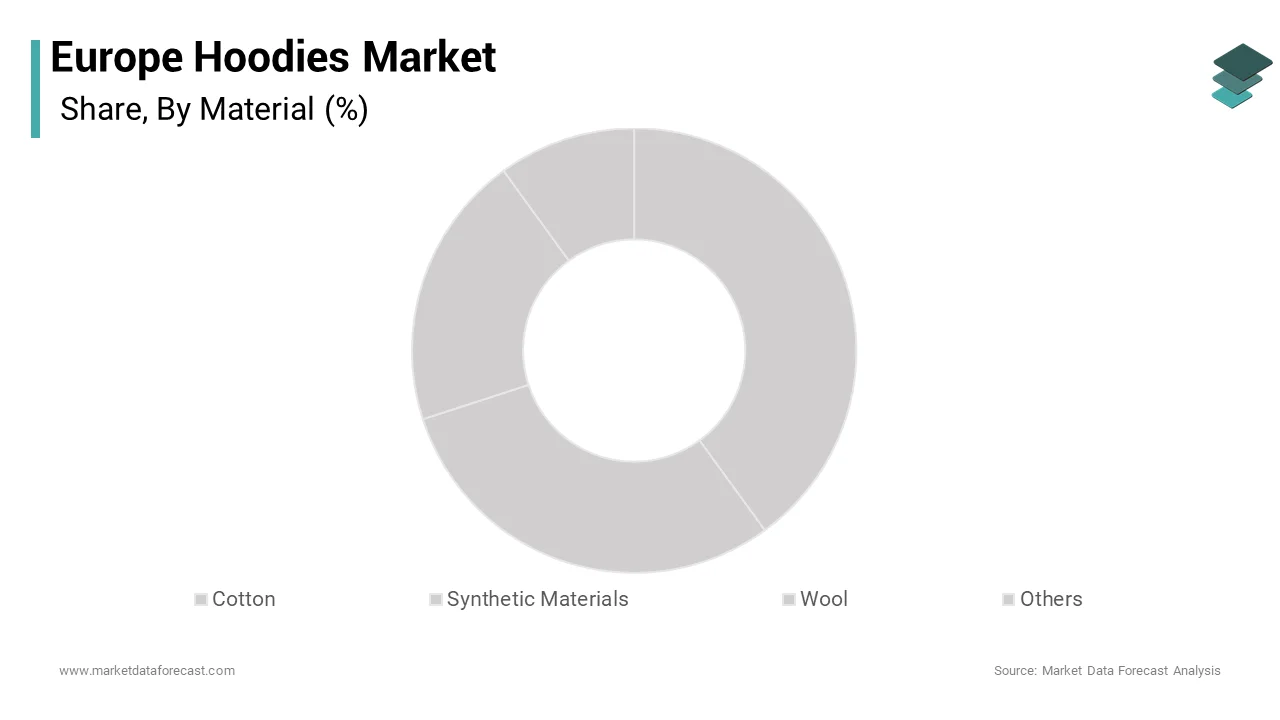
The synthetic materials segment is predicted to witness the highest CAGR of 7.8% from 2026 to 2034 due to the booming athleisure and technical streetwear segments, where performance attributes are paramount. Synthetic fibers offer superior durability, moisture-wicking capabilities, and quick-drying properties that are essential for hoodies designed for active lifestyles or unpredictable weather. A key sub-trend within this segment is the use of recycled polyester, often derived from post-consumer plastic bottles. According to the European Environment Agency and related EU strategies, apparel brands are rapidly increasing the use of recycled materials in new products to comply with stringent European Union sustainability legislation and upcoming circularity requirements, despite the overall low percentage of fiber-to-fiber recycling in the market. This dual benefit of functionality and environmental responsibility is making high-tech synthetic blends increasingly attractive to a broad and discerning European consumer base.
By End User Insights
The men’s segment held the majority share of 48.4% of the European hoodies market in 2025. The supremacy of the men’s segment is attributed to the hoodie’s historical and cultural roots in male-dominated subcultures like skateboarding, hip-hop, and sportswear, which have cemented its status as a core item in the modern male wardrobe. The design of men’s hoodies often emphasizes a relaxed, unstructured silhouette that aligns perfectly with the prevailing preference for casual and comfortable clothing across professional and social settings in Europe. According to sources, younger and middle-aged men are prominent online buyers of apparel, with the versatile hoodie serving as a favored, multifunctional choice for this influential demographic within the growing casual and comfortable clothing market. Its role as a foundational layering piece and a standalone statement garment ensures its consistent and high-volume demand in the men’s category.
The women’s segment is estimated to register the fastest CAGR of 8.5% over the forecast period, owing to a powerful convergence of fashion trends and shifting gender norms in apparel. Contemporary women’s hoodies have moved far beyond simple unisex designs to feature tailored fits, feminine cuts, diverse color palettes, and sophisticated details like cropped lengths, oversized silhouettes, and luxury fabrications. This evolution has elevated the hoodie from a basic casual item to a key fashion piece that can be styled for a wide array of occasions. Modern European women’s fashion is increasingly defined by a shift toward versatile, comfortable, and stylish loungewear that blends the boundary between home and public spaces. Within this elevated casual aesthetic, hoodies have become a central item, blending functional streetwear with refined comfort.
By Distribution Channel Insights
The e-commerce or online channel segment led theEuropeane hoodies segment by capturing a 54.2% share in 2025. The leading position of this segment is credited to a fundamental shift in European shopping behavior, accelerated by the pandemic but sustained by its inherent convenience and breadth of choice. Online platforms allow consumers to access an unparalleled variety of brands, styles, and price points from the comfort of their homes, with features like detailed product imagery, customer reviews, and personalized recommendations enhancing the decision-making process. According to sources, apparel and related fashion items have become the most common category for online purchases among internet users across the European Union. E-commerce is highly popular, but clothing retail is the clear leader, surpassing cosmetics, food, and household items. The ability of online retailers to manage vast inventories and offer rapid delivery has made them the primary destination for the fast-paced, trend-driven hoodie market.
The brand outlets segment is anticipated to witness the fastest CAGR of 9.2% from 2026 to 2034. The rapid growth of the brand outlets segment is propelled by a consumer desire for authentic brand experiences and a tactile shopping journey that online cannot replicate. Flagship stores and brand-owned boutiques are being transformed into immersive lifestyle spaces where customers can not only purchase a hoodie but also engage with the brand’s story, values, and community. These outlets often feature exclusive product lines, customization services, and events that foster deep loyalty. According to a study, European consumer research indicates a growing willingness among younger to mid-aged shoppers to pay a higher price for products in return for a curated, premium brand experience in a controlled environment. This strategic focus on experiential retail is allowing brands to build stronger emotional connections and command higher margins, driving the rapid expansion of their physical footprints.
COUNTRY-LEVEL ANALYSIS
United Kingdom Hoodies Market Analysis
The United Kingdom followed closely in the European hoodies market by accounting for 16.9% share in 2025. The expansion of the UK market is driven by a highly developed and competitive retail landscape, blending global giants with a vibrant ecosystem of independent designers and online-native brands. It is acting as a major trendsetter for streetwear and casual fashion. London, in particular, serves as a global fashion capital where hoodie culture is deeply intertwined with music, art, and youth identity. According to various sources, a significant portion of non-essential household expenditure is directed towards apparel. Consumers generally exhibit a strong preference for versatile clothing that balances comfort with brand recognition, favoring styles that blend casual wear with everyday functionality. This mature and style-conscious market is highly receptive to new trends and limited-edition collaborations, making it a critical launchpad for brands seeking pan-European success.
Germany Hoodies Market Analysis
Germany was the top performer in the European hoodies market by occupying a 18.4% share in 2025. The supremacy of the German market is attributed to a massive domestic population, a strong economy, and a consumer base that values quality, functionality, and understated style. The German market is a key driver for both premium sustainable brands and value-oriented mass retailers. There is a pronounced demand for hoodies made from certified organic cotton and recycled materials, reflecting the nation’s strong environmental consciousness. According to research, the market for sustainably labeled textiles in Germany has experienced a consistent upward trend in demand and consumer recognition in recent years, driven by increasing engagement in the sector. This focus on ethical production and durable quality, combined with a widespread acceptance of casual dress codes in both urban and professional settings, creates a stable and substantial foundation for the hoodie market.
France Hoodies Market Analysis
France holds a noteworthy position in the European hoodies market, where the garment is being reinterpreted through the lens of Parisian chic and high fashion. French brands and consumers have elevated the humble hoodie from a casual staple to a sophisticated fashion item by incorporating luxurious materials like cashmere, minimalist designs, and precise tailoring. This transformation emphasizes a shift toward refined, high-end comfort. This fusion of streetwear sensibility with haute couture aesthetics has made the French market a key destination for premium and designer hoodies. According to research, the nation's premier luxury apparel sector maintains strong, sustained growth, driven in part by the increasing market influence of high-end casual wear and athleisure. The French consumer’s emphasis on timeless style over fleeting trends ensures a steady demand for high-quality, well-designed hoodies that transcend seasonal fads.
Italy Hoodies Market Analysis
Italy grew steadily in the European hoodies market due to its unparalleled heritage in textile manufacturing and fashion design. The Italian market is a powerhouse for premium and luxury hoodies, where the focus is on exceptional craftsmanship, innovative fabric development, and bold aesthetic statements. Italian consumers and international buyers alike look to Milan and other fashion hubs for hoodies that blend comfort with sartorial elegance, often featuring unique prints, rich textures, and meticulous detailing. According to research, the Italian textile and apparel sector is navigating a period of stabilization following a sharp contraction, with export performance diverging based on product tier. Italian fashion is fighting back against sales slumps by doubling down on premium craftsmanship and tech integration, ensuring its elite brands stay ahead of budget-focused competitors. This deep-rooted expertise in materials and design ensures that Italy remains a crucial source of innovation and aspiration within the European hoodie landscape.
Netherlands Hoodies Market Analysis
The Netherlands is anticipated to expand in the European hoodies market during the forecast period, owing to a young, affluent, and highly digitally connected population that is at the forefront of adopting new fashion trends and sustainable practices. Amsterdam, as a major European cultural hub, fosters a creative and inclusive streetwear scene where the hoodie is a ubiquitous canvas for self-expression. There is a strong national emphasis on circularity and ethical consumption, with Dutch consumers actively seeking out brands that offer transparency and take-back schemes. The Netherlands ranks as a leading European market for online fashion consumption, where consumers demonstrate a strong preference for innovative direct-to-consumer brands that champion sustainability. Consequently, the country functions as a critical testing ground for the future of casual and comfortable clothing.
COMPETITIVE LANDSCAPE
The competitive landscape of the European hoodies market is a complex and dynamic arena characterized by intense rivalry between global fast-fashion giants, premium sportswear brands, luxury houses, and a multitude of agile independent labels. The primary battleground is not just price but brand identity, sustainability credentials, and the ability to capture the zeitgeist of youth culture. Fast-fashion leaders compete on speed and trend replication, while sportswear brands leverage their performance heritage and celebrity partnerships. Luxury players focus on craftsmanship and exclusivity. This fragmentation creates a highly saturated market where differentiation is challenging. Success hinges on a brand’s ability to authentically communicate its values, offer a compelling product at a fair price, and build a loyal community through both digital and physical touchpoints in an environment where consumer attention is fleeting and expectations for ethical production are constantly rising.
KEY MARKET PLAYERS
A few of the market players that are dominating the European hoodies market
- Nike, Inc. (U.S.)
- Adidas AG (Germany)
- Inditex (Zara)
- H&M Group
- PUMA SE (Germany)
- Under Armour, Inc. (U.S.)
- LVMH (France)
- ASICS Corporation (Japan)
- Columbia Sportswear Company (U.S.)
- New Balance (U.S.)
- Ralph Lauren Media LLC (U.S.)
- PVH Corp. (U.S.)
Top Players In The Market
- Inditex, through its flagship brand Zara, is a dominant force in the European hoodies market, renowned for its agile supply chain and rapid response to global fashion trends. Its contribution to the global market lies in its ability to democratize high-street fashion by quickly translating runway and streetwear inspirations into affordable, on-trend hoodie designs available in its vast network of stores. To strengthen its position, Inditex has recently intensified its focus on sustainability by expanding its Join Life collection, which features hoodies made from certified organic cotton and recycled materials. The company has also invested heavily in its integrated online and offline shopping experience, enabling seamless click-and-collect services and real-time inventory visibility across its European markets.
- H&M Group is a key player in the European hoodies market, offering a wide spectrum of products from its core H&M brand to its premium & Other Stories and sustainable COS lines. Its global impact stems from its massive scale and its early and vocal commitment to circular fashion principles. The company has strengthened its market stance by significantly scaling up its garment collecting initiative and launching new hoodie lines under its Conscious label that use innovative materials like recycled cotton and Tencel. Furthermore, H&M has leveraged its extensive data analytics capabilities to refine its product assortment and personalize its online marketing, ensuring its hoodie offerings remain highly relevant to diverse European consumer segments.
- Adidas AG holds a powerful position in the European hoodies market, where its sportswear heritage seamlessly blends with contemporary streetwear culture. The company’s global contribution is defined by its iconic three-stripe branding and its successful collaborations with designers and celebrities, which have elevated the athletic hoodie to a coveted fashion item. To fortify its presence, Adidas has doubled down on its sustainability agenda by increasing the use of its proprietary Primeblue and Primegreen fabrics, which are made from recycled ocean plastic and other sustainable sources, across its entire hoodie range. The company has also enhanced its direct-to-consumer strategy by expanding its digital marketplace and opening flagship stores in major European cities that showcase its full lifestyle and performance hoodie collections.
Top Strategies Used By The Key Market Participants
Key players in the European hoodies market are executing a multi-faceted strategic playbook to secure their competitive advantage. They are aggressively investing in sustainable material innovation, replacing conventional cotton and polyester with certified organic, recycled, and bio-based alternatives. Simultaneously, they are leveraging their digital infrastructure to create seamless omnichannel experiences that blend physical retail with advanced e-commerce functionalities. Another core strategy involves building powerful brand narratives through high-profile collaborations with artists, designers, and athletes to generate cultural relevance and desirability. Finally, they are optimizing their supply chains for speed and flexibility to respond instantly to fast-changing streetwear trends, ensuring their hoodie collections remain fresh and in-demand.
MARKET SEGMENTATION
This research report on the European hoodies market is segmented and sub-segmented into the following categories.
By Material
- Cotton
- Synthetic Materials
- Wool
- Others
By End User
- Men
- Women
- Kids
By Distribution Channel
- Hypermarket/Supermarket
- Brand Outlets
- E-commerce/Online
- Others
By Country
- UK
- France
- Spain
- Germany
- Italy
- Russia
- Sweden
- Denmark
- Switzerland
- Netherlands
- Turkey
- Czech Republic
- Rest of Europe