- Product Description Description
- Table of Contents TOC
- List of Table & Figure LOT
- Get Free Sample PDF Sample PDF
Market Size, 2025
$2,785.15 MnMarket Estimate, 2026
$3,115.96 MnMarket Forecast, 2034
$7,733.71 MnCAGR, 2026–2034
12.30%Europe Human Capital Management Market Report Summary
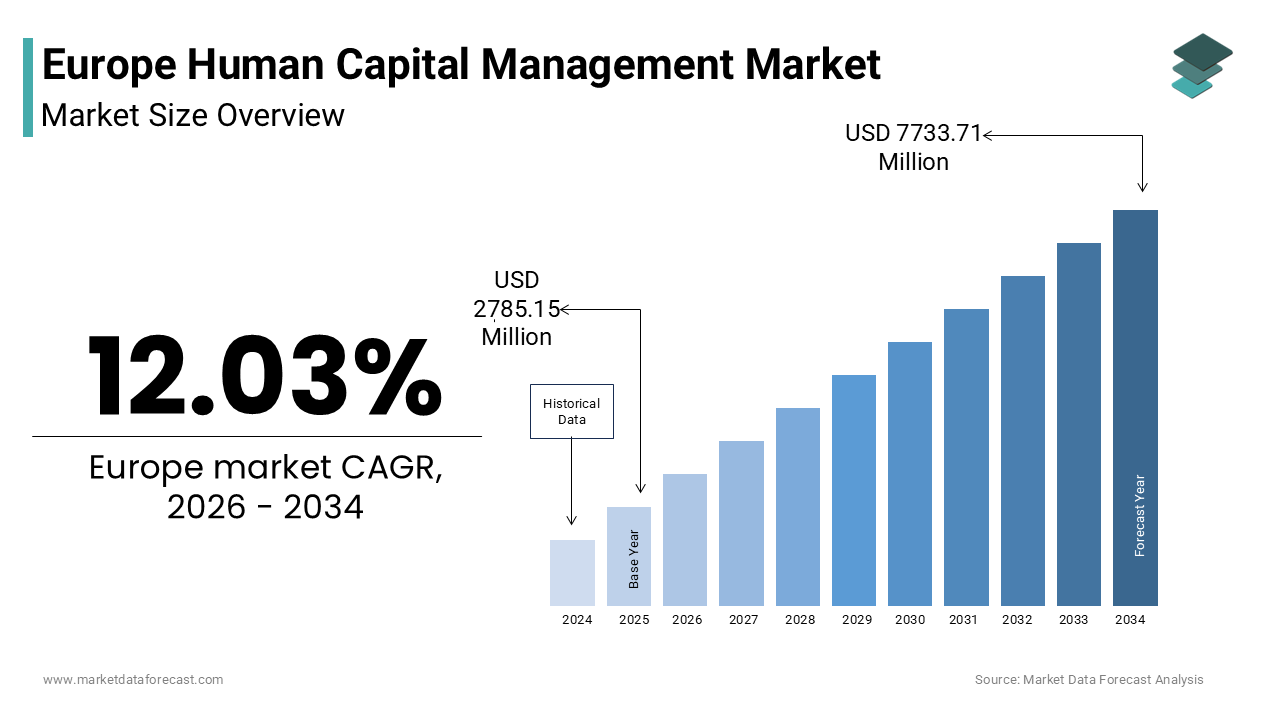
The Europe human capital management market was valued at USD 2,785.15 million in 2025, is estimated to reach USD 3,115.96 million in 2026, and is projected to reach USD 7,733.71 million by 2034, growing at a CAGR of 12.03% during the forecast period from 2026 to 2034. The growth of the Europe human capital management market is driven by the rapid adoption of hybrid work models, increasing demand for digital HR platforms, and the growing need for workforce analytics and talent management solutions. Organizations across Europe are increasingly adopting cloud-based human capital management platforms to streamline recruitment, payroll, performance evaluation, and employee engagement processes. Moreover, the increasing focus on workforce upskilling, remote collaboration, and compliance with complex labor regulations such as the General Data Protection Regulation is further accelerating the adoption of advanced human capital management technologies across the region.
Key Market Trends
-
Growing adoption of cloud-based human capital management platforms to manage distributed and hybrid workforces.
-
Increasing use of artificial intelligence and predictive analytics for workforce planning, employee engagement, and retention management.
-
Rising demand for continuous learning and upskilling platforms to address skill gaps in the digital and green technology sectors.
-
Expansion of employee self-service portals and mobile HR applications to improve employee experience and operational efficiency.
-
Increasing focus on data privacy and compliance management due to strict European labor and data protection regulations.
Segmental Insights
- Based on component, the software segment held the largest share of the Europe human capital management market in 2025. The dominance of this segment is attributed to the increasing transition from legacy HR systems to cloud-based human capital management software that offers scalability, real-time analytics, and automated compliance updates aligned with evolving labor regulations.
- Based on vertical, the banking, financial services, and insurance (BFSI) segment accounted for the largest share of the Europe human capital management market in 2025. The segment’s leadership is driven by stringent regulatory requirements, large workforce sizes, and the need for advanced HR systems capable of managing employee certifications, compliance documentation, and performance monitoring.
- Based on functionality, the core HR segment held the largest share of the Europe human capital management market in 2025 due to its role as the central system for employee data management, payroll processing, benefits administration, and regulatory reporting across organizations.
Regional Insights
The Europe human capital management market is witnessing strong growth across major economies due to digital transformation initiatives, evolving workforce structures, and increasing investment in HR technology solutions.
-
Germany held the largest share of the Europe human capital management market in 2025, driven by its strong industrial base, strict labor regulations, and high enterprise spending on digital transformation and workforce management technologies.
-
The United Kingdom followed closely due to its highly digitalized service economy, strong adoption of cloud-based HR platforms, and the presence of a dynamic startup ecosystem demanding scalable workforce management solutions.
-
France continues to experience steady growth supported by government initiatives promoting digital transformation and the increasing adoption of advanced HR systems across large corporations in sectors such as aerospace, luxury goods, and energy.
-
The Netherlands is witnessing growing adoption of human capital management solutions due to its progressive labor policies, strong multinational presence, and increasing demand for flexible workforce management tools.
-
Sweden is expected to experience significant growth driven by its advanced digital infrastructure, strong innovation ecosystem, and increasing focus on employee engagement, diversity monitoring, and data-driven HR practices.
Competitive Landscape
The Europe human capital management market is highly competitive and characterized by the presence of global enterprise software providers and specialized HR technology vendors. Companies are increasingly focusing on integrating artificial intelligence, predictive workforce analytics, and cloud-native architectures into their platforms to improve HR efficiency and support strategic decision-making. Strategic partnerships, acquisitions of niche HR technology startups, and expansion of localized cloud infrastructure are key strategies adopted by market players to strengthen their presence across European markets. Prominent players in the Europe human capital management market include SAP SE, Oracle Corporation, Workday Inc., Automatic Data Processing Inc., International Business Machines Corporation, Cornerstone OnDemand Inc., Infor, UKG Inc., Ceridian HCM Holding Inc., and Cegid.
Europe Human Capital Management Market Size
The europe human capital management market size was valued at USD 2785.15 million in 2025 and is anticipated to reach USD 3115.96 million in 2026 from USD 7733.71 million by 2034, growing at a CAGR of 12.03% during the forecast period from 2026 to 2034.
Human capital management encompasses the integrated suite of software solutions and strategic practices designed to acquire, manage, develop and optimize the workforce within organizations across the continent. This ecosystem extends beyond traditional administrative functions to include talent acquisition, performance management, learning and development, and workforce analytics, all aimed at maximizing employee potential and organizational agility. The operational context is defined by a highly regulated labor environment and a rapidly evolving demographic landscape. According to Eurostat, the European Union population is experiencing an increase in median age, which signals an aging workforce that necessitates sophisticated retention and succession planning strategies. As per the European Commission, many employees in the EU engaged in some form of telework or hybrid arrangement during the same period, which is creating an urgent need for digital tools that facilitate remote collaboration and performance tracking. The General Data Protection Regulation imposes strict constraints on how employee data is collected and processed, requiring vendors to embed privacy by design into their architectures. As per OECD statistics, employee tenure in European firms has shown a decline over the last decade, which is reflecting a shift toward more dynamic career paths that demand continuous upskilling platforms. These factors collectively shape a market where technology serves as the critical enabler for navigating complex labor laws, demographic shifts, and changing work paradigms.
MARKET DRIVERS
Accelerated Adoption of Hybrid Work Models Across European Enterprises
The widespread transition to hybrid work arrangements is one of the major factors propelling the expansion of the European human capital management market. As per Eurofound research, European companies have institutionalized hybrid work policies, requiring robust digital infrastructure to manage distributed teams effectively. Traditional manual processes and legacy systems fail to provide the visibility needed to track attendance, productivity, and engagement across multiple locations and time zones. Organizations are increasingly deploying cloud-based human capital management platforms that offer mobile accessibility, real-time collaboration features, and automated workflow capabilities to bridge the physical distance between employees and managers. The necessity to maintain company culture and ensure equitable treatment for both remote and on-site staff drives investment in modules dedicated to pulse surveys, virtual recognition, and digital onboarding. Furthermore, the complexity of managing compliance with varying local labor laws regarding remote work hours and right-to-disconnect regulations necessitates automated tracking and reporting tools. This structural shift in work organization ensures that human capital management systems are no longer optional but essential utilities for maintaining operational continuity. The demand for seamless integration between communication tools and HR platforms further accelerates market growth, as businesses seek unified ecosystems to support their flexible workforce strategies.
Intensifying Focus on Continuous Upskilling and Reskilling Initiatives
The rapid pace of technological change and the widening skills gap across European industries are further boosting the expansion of the European human capital management market. According to the European Centre for the Development of Vocational Training, European employers report difficulties in finding workers with the right skills, particularly in digital and green technology sectors. This scarcity forces organizations to pivot from external hiring to internal talent development strategies, which is relying heavily on integrated learning management systems to identify skill gaps and deliver targeted training. Modern human capital management platforms utilize artificial intelligence to recommend personalized learning paths, track certification progress, and measure the return on investment of training programs. The European Union emphasis on lifelong learning through initiatives like the European Skills Agenda encourages companies to invest in systematic upskilling frameworks that are easily managed through centralized software. Additionally, the rise of the gig economy and project-based work requires agile systems that can quickly onboard contingent workers and provide them with necessary compliance and role-specific training. The ability to rapidly reskill the workforce in response to market disruptions such as automation or economic shifts makes these systems critical for organizational resilience. Consequently, the imperative to build a future-ready workforce sustains strong demand for comprehensive talent development solutions.
MARKET RESTRAINTS
Complex Regulatory Fragmentation Across European Member States
The diverse and often conflicting labor regulations across European nations create significant implementation barriers for standardized human capital management solutions, which is a major impediment to the growth of the European human capital management market. As per analysis by the European Parliament, labor laws regarding working hours, termination procedures, data privacy, and employee representation vary substantially between member states, which is complicating the deployment of unified systems. Multinational corporations operating in multiple European countries struggle to configure a single platform that complies with the specific legal requirements of each jurisdiction without extensive customization. The General Data Protection Regulation adds another layer of complexity by imposing strict rules on the processing of sensitive employee data such as health records, biometric information, and performance evaluations. Non-compliance can result in severe financial penalties and reputational damage, causing organizations to delay or limit their adoption of advanced features like predictive analytics or AI-driven recruitment tools. The constant evolution of labor legislation in response to economic shifts and social movements requires vendors to continuously update their software, which increases maintenance costs and implementation timelines. Small and medium enterprises often lack the legal expertise and resources to navigate this regulatory maze, leading to hesitation in adopting sophisticated human capital management technologies. This fragmentation hinders the scalability of solutions and slows down the overall market penetration of innovative HR technologies.
Persistent Resistance to Cultural Change and Digital Adoption
A significant portion of the European workforce and management teams exhibit resistance to transitioning from traditional HR practices to digital-first human capital management systems, which is further hampering the growth of the European human capital management market. According to a survey by the Chartered Institute of Personnel and Development, HR professionals in Europe cite employee resistance as a major obstacle to successful digital transformation initiatives. This reluctance often stems from fears of job displacement due to automation, concerns over increased surveillance, and a general preference for face-to-face interactions over digital interfaces. Older demographics within the workforce may lack the digital literacy required to effectively utilize self-service portals and mobile applications, leading to low adoption rates and data inaccuracies. Management layers accustomed to intuitive decision-making may distrust algorithmic recommendations provided by AI-enhanced systems, viewing them as opaque or biased. The lack of change management strategies and inadequate training programs exacerbates these issues, resulting in underutilization of expensive software licenses. Furthermore, the perception that digital tools depersonalize the employee experience can damage organizational culture and reduce engagement levels. Overcoming this cultural inertia requires substantial investment in communication, training, and user experience design, which many organizations are unwilling or unable to commit. This human factor remains a formidable brake on the speed and depth of market expansion.
MARKET OPPORTUNITIES
Integration of Artificial Intelligence for Predictive Workforce Analytics
The emergence of sophisticated artificial intelligence capabilities offers a promising opportunity in the European human capital management market. As per research from Gartner, organizations leveraging AI-driven people analytics can improve hiring quality and reduce turnover by identifying flight risks before they resign. European companies are increasingly seeking solutions that can analyse vast amounts of employee data to forecast future skill needs, optimize workforce planning, and personalize employee experiences. AI algorithms can detect patterns in performance reviews, engagement surveys, and productivity metrics to recommend targeted interventions such as mentorship programs or role adjustments. This shift from reactive reporting to proactive prediction allows HR leaders to align talent strategies more closely with business objectives and market dynamics. The ability to simulate various scenarios such as the impact of a merger or a change in compensation structures provides executives with valuable foresight. Furthermore, AI-powered chatbots and virtual assistants can handle routine inquiries, freeing up HR professionals to focus on strategic initiatives. The growing acceptance of data-driven management in Europe, combined with advancements in natural language processing, creates a fertile ground for the adoption of intelligent human capital management tools. Vendors who successfully embed these capabilities will gain a significant competitive advantage.
Expansion of Gig Economy and Contingent Workforce Management Solutions
The rapid growth of the gig economy and the increasing reliance on contingent workers offer a lucrative avenue for the expansion of human capital management functionalities. According to Eurostat, the number of people employed in non-standard forms of work, including freelancers and platform workers, has risen steadily, accounting for a significant portion of the European labor force. Traditional HR systems are ill-equipped to manage the lifecycle of these flexible workers, from onboarding and compliance checks to payment and performance evaluation. There is a burgeoning demand for specialized modules that can seamlessly integrate contingent workers into the broader workforce ecosystem while ensuring adherence to evolving labor laws regarding worker classification. Solutions that offer vendor management systems, statement of work tracking, and automated tax compliance for cross-border contractors are becoming essential for large enterprises. The ability to access a global talent pool and scale the workforce up or down rapidly based on project needs drives the adoption of these agile management tools. Furthermore, the desire to provide a consistent employee experience for all workers, regardless of their employment status, encourages the development of inclusive platforms. As the boundary between permanent and temporary work continues to blur, vendors who provide comprehensive contingent workforce management capabilities will capture a growing segment of the market.
MARKET CHALLENGES
Escalating Cybersecurity Threats Targeting Sensitive Employee Data
The concentration of highly sensitive personal and financial information within human capital management systems makes them a prime target for cybercriminals, which is posing a severe challenge to market stability. As per the European Union Agency for Cybersecurity, ransomware attacks and data breaches targeting HR systems have increased, with attackers exploiting vulnerabilities in cloud-based platforms and third-party integrations. A single breach can expose millions of employee records, including social security numbers, bank details, and health information, leading to catastrophic legal liabilities and loss of trust. The complexity of modern IT environments, with multiple touchpoints and remote access points, expands the attack surface, making it difficult to secure every entry point. Organizations face the dual challenge of implementing robust security measures without compromising the user experience or hindering the accessibility that defines modern human capital management. The shortage of cybersecurity experts in Europe further complicates the ability of firms to detect and respond to threats in real time. Compliance with stringent data protection regulations requires continuous monitoring and auditing, which strains IT resources. The fear of high-profile breaches may cause some organizations to delay migration to cloud-based solutions or limit the use of advanced features. Maintaining the delicate balance between security, compliance, and usability remains a persistent and costly challenge for vendors and customers alike.
High Implementation Costs and Complexity for Small and Medium Enterprises
The substantial financial investment and technical complexity associated with deploying enterprise-grade human capital management systems is further challenging the expansion of the European human capital management market. According to data from the European Commission, small businesses often operate with limited IT budgets and lack the internal expertise required to manage complex software implementations. The total cost of ownership includes not only licensing fees but also expenses for customization, data migration, integration with existing systems, and ongoing maintenance. For many smaller organizations, these costs are prohibitive, forcing them to rely on fragmented spreadsheets or basic tools that hinder their ability to compete for talent. The lengthy implementation timelines and the risk of disruption to daily operations further deter adoption. While vendors offer scaled-down versions, the functionality gaps often fail to meet the specific needs of growing businesses. The lack of standardized processes in smaller firms also complicates the configuration of off-the-shelf solutions, requiring extensive consulting services that add to the cost. This affordability gap limits the total addressable market and slows the overall digitization of HR practices across the European SME sector. Bridging this divide requires innovative pricing models and simplified deployment options that remain elusive for many providers.
REPORT COVERAGE
| REPORT METRIC | DETAILS |
| Market Size Available | 2025 to 2034 |
| Base Year | 2025 |
| Forecast Period | 2026 to 2034 |
| CAGR | 12.03% |
| Segments Covered | By Component, Deployment Model, Organization Size, Vertical, Functionality and Region. |
| Various Analyses Covered | Global, Regional & Country Level Analysis, Segment-Level Analysis, DROC, PESTLE Analysis, Porter’s Five Forces Analysis, Competitive Landscape, Analyst Overview of Investment Opportunities |
| Country Covered | UK, France, Spain, Germany, Italy, Russia, Sweden, Denmark, Switzerland, the Netherlands, Turkey, the Czech Republic, and the Rest of Europe. |
| Market Leaders Profiled | AP SE, Oracle Corporation, Workday Inc., Automatic Data Processing, Inc., International Business Machines Corporation, Cornerstone OnDemand, Inc., Infor, UKG Inc., Ceridian HCM Holding Inc., and Cegid. |
SEGMENTAL ANALYSIS
By Component Insights
The software segment dominated the market by holding the dominant share of the European human capital management market in 2025. The dominance of software segment in the European market can be credited to the fundamental shift from on-premises legacy systems to cloud-based platforms that offer scalability and continuous updates. The aggressive migration of European enterprises toward software-as-a-service models that eliminate the need for costly physical infrastructure and dedicated IT maintenance teams is further boosting the dominance of software segment in the European market. According to Eurostat, enterprises in the European Union with ten or more employees utilized cloud computing services, with human resources applications being among the top adopted categories. This transition allows organizations to access sophisticated features such as mobile self-service portals, automated payroll calculations, and real-time analytics without significant upfront capital expenditure. The flexibility of cloud software enables companies to scale their user licenses up or down based on workforce fluctuations, which is particularly valuable in economies with seasonal employment patterns. Furthermore, the automatic inclusion of regulatory updates within cloud subscriptions ensures continuous compliance with evolving European labor laws and data protection standards without manual intervention. The ability to integrate seamlessly with other enterprise resource planning and customer relationship management systems via application programming interfaces further cements the position of software as the core component. This architectural shift supports remote work initiatives by providing secure access from any location, ensuring business continuity.
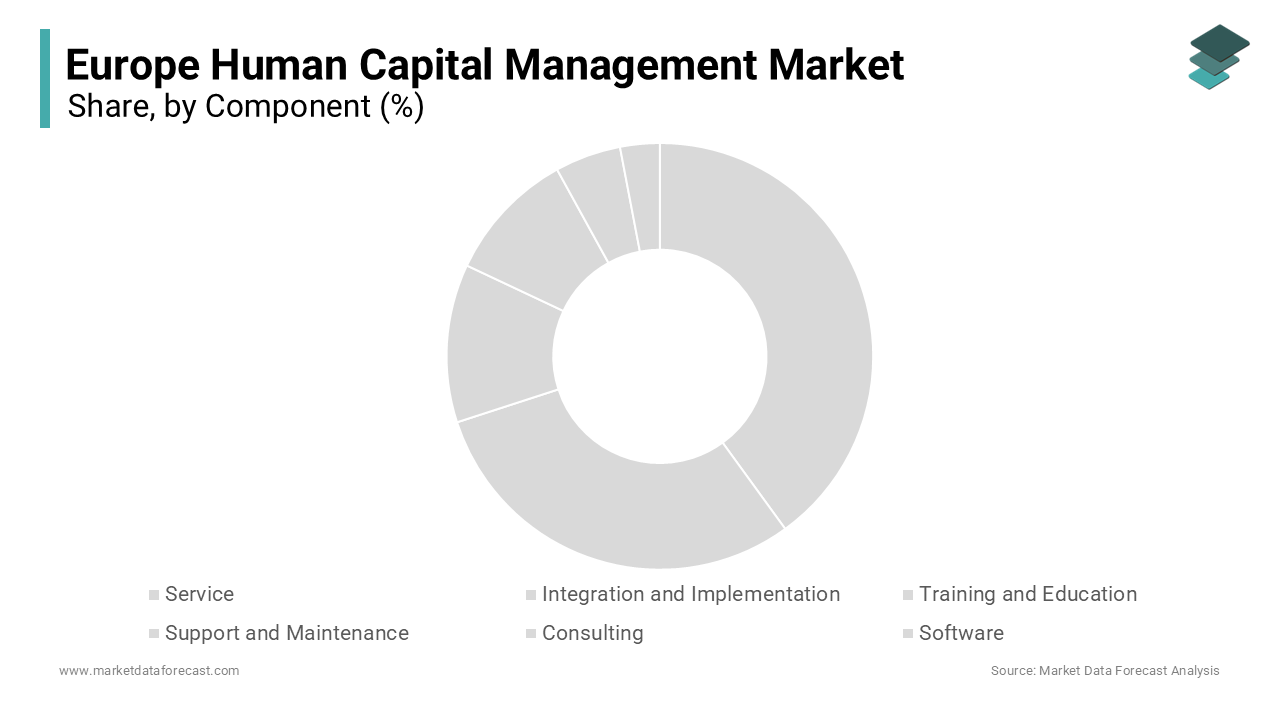
The service segment is a promising segment and is anticipated to grow at a CAGR of 15.5% over the forecast period in the European market owing to the increasing complexity of human capital management implementations and the strategic need for expert guidance during digital transformation journeys. The surge in demand for professional services is primarily driven by the intricate nature of deploying advanced human capital management systems, which often requires extensive customization and process reengineering to align with specific organizational goals. As per Gartner, digital transformation initiatives often fail due to inadequate change management and lack of user adoption, highlighting the indispensable role of consulting services. European companies frequently engage external experts to map existing workflows, configure software parameters, and manage the cultural shift associated with new technologies. These services include detailed gap analysis, data migration strategies, and the development of tailored training programs that ensure employees can effectively utilize new tools. The complexity of integrating legacy data from older systems into modern cloud platforms necessitates specialized technical expertise that internal IT teams often lack. Furthermore, the diverse regulatory landscape across Europe requires consultants to provide localized advice on compliance configuration, ensuring that the system adheres to national labor laws. The high stakes of these implementations, where errors can lead to payroll disruptions or legal penalties, drive organizations to invest heavily in premium implementation partners. This reliance on external expertise ensures robust growth for the service segment.
By Vertical Insights
The banking, financial services, and insurance segment accounted for the major share of the European human capital management market in 2025 due to its massive workforce size, stringent regulatory requirements, and early adoption of advanced technologies to manage complex talent ecosystems. The rigorous regulatory environment that mandates precise tracking of employee certifications, conduct records and compensation structures to prevent financial misconduct is also contributing to the dominance of BFSI segment in the European market. According to the European Banking Authority, financial institutions must adhere to strict guidelines regarding remuneration policies and fit-and-proper assessments for senior management, which require sophisticated human capital management systems for documentation and reporting. These regulations necessitate automated workflows that ensure no unauthorized payments are made and that all staff members possess valid licenses for their roles. The high cost of non-compliance, including massive fines and reputational damage, drives banks and insurers to invest heavily in robust software capable of real-time monitoring and audit trail generation. The complexity of managing global workforces across different jurisdictions with varying financial regulations further amplifies the need for centralized yet flexible platforms. Additionally, the sector faces intense scrutiny regarding data privacy, requiring systems with advanced encryption and access controls to protect sensitive employee and client information. The imperative to maintain operational resilience and business continuity in a volatile economic climate also pushes these institutions toward scalable cloud solutions. This regulatory pressure creates a non-negotiable demand for high-end human capital management tools.
The healthcare and life sciences segment is estimated to witness the highest CAGR of 16.1% over the forecast period owing to the post-pandemic workforce restructuring, severe staffing shortages, and the critical need for efficient workforce scheduling and compliance management. The chronic shortage of healthcare professionals across Europe that requires highly efficient workforce management strategies to maximize the utility of available staff is also contributing to the expansion of the healthcare and life sciences segment in the European market. According to the World Health Organization, Europe faces a deficit of health workers, requiring hospitals and clinics to optimize shift scheduling, reduce burnout, and improve retention rates through advanced human capital management tools. These systems provide intelligent rostering capabilities that match staff skills with patient needs while adhering to strict labor laws regarding working hours and rest periods. The ability to manage a mix of permanent, temporary, and agency staff from a single platform is essential for handling fluctuating patient volumes and emergency situations. Furthermore, the high turnover rates in the sector drive investment in engagement modules that monitor staff well-being and facilitate recognition programs to boost morale. The integration of credentialing and license tracking ensures that only qualified personnel are assigned to critical roles, mitigating clinical risks. The urgency to address staffing gaps while maintaining high-quality patient care creates a compelling business case for adopting sophisticated human capital management solutions. This operational necessity drives rapid adoption rates across the healthcare landscape.
By Functionality Insights
The core HR functionality segment had the highest share of the European human capital management market in 2025 as it serves as the foundational layer for all other human resources activities, encompassing employee data management, payroll, benefits administration, and regulatory reporting. The dominance of Core HR segment is also driven by its role as the single source of truth for all employee information, which is critical for operational stability and legal compliance across diverse European jurisdictions. According to Eurostat, the complexity of managing workforce data across multiple member states with varying tax codes, social security rules, and labor contracts necessitates a robust centralized database. Organizations cannot function effectively without accurate records of employee identities, contract terms, salary structures, and attendance history. Core HR systems automate the calculation of gross-to-net pay to ensure compliance with intricate local tax laws and minimizing the risk of costly errors. The requirement to generate statutory reports for government agencies on a regular basis further entrenches the need for reliable core modules. Additionally, the General Data Protection Regulation mandates strict control over personal data access and processing, which Core HR systems facilitate through granular permission settings and audit logs. The foundational nature of this functionality means that every organization, regardless of size or industry, must invest in a competent Core HR solution before layering on advanced talent modules. This universal requirement ensures that Core HR remains the largest revenue generator in the market.
The advanced analytics functionality segment is anticipated to record a CAGR of 17.7% over the forecast period in the European market due to the increasing strategic reliance on data-driven decision making and the maturation of artificial intelligence technologies within human resources. The transition of HR from an administrative function to a strategic partner that leverages data to forecast future workforce needs and mitigate risks is further contributing to the expansion of the advanced analytics functionality segment in the European market. As per Gartner, organizations that utilize predictive analytics for workforce planning are better at anticipating skill gaps and reducing unplanned turnover compared to those relying on historical reporting. European companies are increasingly deploying algorithms that analyze patterns in employee behavior, performance metrics, and market trends to predict flight risks and recommend retention interventions. This capability allows leaders to make proactive decisions regarding hiring, succession, and restructuring rather than reacting to crises after they occur. The ability to model various scenarios, such as the impact of economic downturns or mergers on workforce productivity, provides executives with valuable foresight. Furthermore, the integration of external data sources, such as labor market statistics and competitor analysis, enriches the insights derived from internal data. The demand for real-time dashboards that visualize key human capital indicators empowers managers to take immediate action. This strategic elevation of HR through data intelligence drives rapid adoption of advanced analytics modules.
REGIONAL ANALYSIS
Germany held the major share of the European human capital management market in 2025. The growth of Germany in the European market can be credited to its robust industrial base, strong manufacturing sector, and rigorous adherence to labor regulations. According to Statista, Germany records the highest expenditure on enterprise software in Europe, which is reflecting the willingness of its corporate sector to invest in digital transformation. The complex co-determination laws, which require worker representation on supervisory boards, necessitate advanced systems for managing employee data, voting processes, and communication. German companies place a premium on data privacy and security, driving the adoption of locally hosted or sovereign cloud solutions that comply with strict interpretations of the General Data Protection Regulation. The ongoing Industry 4.0 initiative has accelerated the need for upskilling and reskilling programs, fostering demand for integrated learning and talent management modules. Furthermore, the aging demographic profile of the German workforce creates urgent requirements for succession planning and knowledge transfer tools. The combination of economic strength, regulatory complexity, and a culture of precision ensures that Germany remains the dominant force in the regional human capital management landscape.
The United Kingdom occupied the second largest position in the European market due to its mature service economy, vibrant fintech sector, and London’s status as a global hub for professional services. The nation benefits from a high level of digital maturity and a flexible labor market that encourages the adoption of agile human capital management practices. As per the Department for Business and Trade, the UK creative and technology industries are major drivers of software adoption, utilizing advanced analytics and talent acquisition tools to compete for global talent. The post-Brexit landscape has introduced new complexities regarding immigration and right-to-work checks, spurring demand for automated compliance and verification modules within human capital systems. British firms are particularly adept at leveraging cloud technologies to support hybrid work models, which became entrenched during the pandemic. The strong presence of venture capital and a dynamic startup ecosystem fuels the demand for scalable and user-friendly human capital management solutions that can grow with the business. Additionally, the UK’s leadership in artificial intelligence research fosters innovation in HR tech, with many local vendors developing predictive analytics and chatbot capabilities. The convergence of regulatory changes, digital ambition, and a competitive talent market secures the UK’s position as a critical powerhouse in the European human capital management sector.
France is anticipated to account for a prominent share of the European market over the forecast period owing to its strong public sector, extensive labor code, and government-led initiatives to promote digital sovereignty and technological independence. According to the French Ministry of Economy, the France 2030 investment plan includes significant funding for the digitalization of businesses, including the modernization of human resources functions. French labor laws are among the most complex in Europe regarding working hours, leave entitlements, and termination procedures, necessitating highly localized and robust human capital management software. Large French corporations in the luxury, aerospace, and energy sectors drive demand for comprehensive suites that can manage global workforces while adhering to domestic regulations. The emphasis on social dialogue and employee representation requires systems that facilitate communication and consultation processes effectively. Furthermore, the growing startup scene in Paris and other tech hubs is increasing the adoption of modern, cloud-native human capital management platforms. The blend of regulatory strictness, state support for digital infrastructure, and industrial diversity cements France’s role as a top-tier market for human capital management solutions.
The Netherlands is expected to exhibit a healthy CAGR in the European human capital management market during the forecast period owing to its high English proficiency, advanced digital infrastructure, and role as a gateway for multinational corporations establishing their European headquarters. The Dutch market status is defined by a progressive approach to work-life balance, flexible employment arrangements, and early adoption of innovative HR technologies. According to Statistics Netherlands, the country has one of the highest rates of part-time work and remote employment in Europe, creating strong demand for human capital management systems that can handle complex scheduling and distributed workforce management. The Netherlands is a hub for shared service centers where companies consolidate their HR operations for the region, driving demand for scalable and multi-lingual platforms. Dutch organizations prioritize employee experience and well-being, leading to the rapid uptake of engagement, recognition, and wellness modules. The favorable business climate and transparent regulatory environment encourage experimentation with new technologies such as blockchain for credential verification and AI for unbiased recruitment. The strong presence of international tech firms and a highly educated workforce further accelerate the diffusion of best practices in human capital management. This combination of openness, innovation, and strategic location secures the Netherlands a leading position in the regional market hierarchy.
Sweden is estimated to witness a notable CAGR in the European human capital management market over the forecast period due to its advanced digital society, high internet penetration, and commitment to sustainability, which influences the features and values embedded in human capital management solutions. The country is home to several global technology giants and has a culture that embraces flat organizational structures and employee empowerment. As per Statistics Sweden, a large majority of the population uses the internet regularly, and the workforce expects seamless digital experiences from their employers, including mobile-first HR tools. Swedish enterprises in the telecommunications, gaming, and clean tech sectors are heavy users of advanced analytics and talent management systems to foster innovation and retain top creative talent. The strong emphasis on gender equality and diversity drives the adoption of tools that monitor pay equity, track diversity metrics, and ensure unbiased hiring practices. The government’s proactive digitalization policies encourage the use of e-identification and digital signatures, streamlining onboarding and administrative processes. Stockholm has become a hotspot for HR tech startups developing niche solutions for engagement and learning that gain traction across Europe. The alignment of cultural values with technological capabilities positions Sweden as a key player in the northern European human capital management landscape and a model for future-oriented workforce management.
COMPETITIVE LANDSCAPE
The competition within the Europe human capital management market is intense and characterized by a rivalry between established enterprise resource planning giants and specialized cloud native vendors. Large conglomerates leverage their extensive existing customer bases and broad functional suites to offer integrated solutions that span finance and HR while niche players compete on agility, user experience and deep specialization in specific HR domains. The market sees frequent mergers and acquisitions as larger entities seek to absorb innovative technologies such as skills ontologies or advanced analytics to stay relevant. Differentiation increasingly depends on the sophistication of artificial intelligence features, the ability to guarantee data sovereignty within European borders, and the quality of local language support. Price competition remains fierce particularly in the mid-market segment where organizations seek cost effective yet powerful tools. Talent acquisition wars are also prevalent as vendors compete for skilled developers and data scientists to build next generation capabilities. The rise of composable HR architectures allows customers to mix and match best of breed solutions challenging the traditional all in one model. This dynamic environment forces continuous innovation and strategic positioning to capture and retain market share.
KEY MARKET PLAYERS
Some of the companies that are playing a dominating role in the Europe Human Capital Management Market include
- SAP SE
- Oracle Corporation
- Workday Inc.
- Automatic Data Processing, Inc.
- International Business Machines Corporation
- Cornerstone OnDemand, Inc.
- Infor
- UKG Inc.
- Ceridian HCM Holding Inc.
- Cegid
Top Players in the Europe Human Capital Management Market
SAP SE
SAP SE stands as a dominant force in the Europe human capital management market through its comprehensive SuccessFactors suite which serves millions of users globally. The company contributes significantly to the global landscape by integrating advanced artificial intelligence and machine learning capabilities into its core HR and talent modules. SAP recently strengthened its market position by launching enhanced skills ontology features that enable organizations to map employee competencies dynamically and facilitate internal mobility. The firm continues to invest heavily in cloud infrastructure to ensure data sovereignty compliance with European regulations while offering seamless scalability. Strategic partnerships with major consulting firms have accelerated the deployment of these solutions across large enterprises in Germany and France. SAP focuses on creating a unified employee experience that connects hiring, onboarding, performance and learning into a single cohesive journey. Their commitment to sustainability reporting within HR analytics further appeals to European corporations prioritizing environmental social and governance goals. These initiatives solidify SAP reputation as a leader in enterprise grade human capital innovation.
Oracle Corporation
Oracle Corporation maintains a formidable presence in the region with its Fusion Cloud Human Capital Management platform known for robust functionality and deep analytical capabilities. Globally the company empowers organizations to automate complex HR processes and gain strategic insights through its integrated data model. Oracle has recently intensified its focus on generative artificial intelligence by embedding smart assistants across its application suite to streamline recruiting and employee service interactions. The corporation expanded its European data center footprint to meet strict local data residency requirements ensuring trust among public sector and financial clients. Recent updates include advanced workforce planning tools that help businesses model various scenarios and optimize labor costs effectively. Oracle actively collaborates with technology partners to extend its ecosystem with specialized add ons for niche industries. The emphasis on user interface modernization has improved adoption rates among diverse workforces. By delivering continuous innovation and secure cloud environments Oracle reinforces its status as a critical partner for digital transformation in human resources.
Workday Inc
Workday Inc operates as a leading provider of cloud based human capital management and financial software with a strong foothold in the European enterprise sector. The company drives global change by championing a unified system architecture that eliminates data silos between finance and HR functions. Workday recently enhanced its platform with sophisticated skills cloud capabilities allowing companies to identify skill gaps and recommend personalized learning paths at scale. The firm has expanded its network of implementation partners across Europe to support rapid deployment for mid-sized and large organizations. Workday continues to innovate in the area of people analytics offering predictive insights that help leaders make data driven decisions about talent retention and succession. Their commitment to ethical AI principles resonates strongly with European values regarding fairness and transparency in algorithmic decision making. Regular updates to their mobile application ensure employees can access services anytime and anywhere. These strategic moves enable Workday to attract forward thinking organizations seeking agile and intelligent workforce management solutions.
Top Strategies Used by Key Market Participants
Key players in the Europe human capital management market primarily focus on embedding artificial intelligence and machine learning into their platforms to automate routine tasks and provide predictive insights. Companies are aggressively expanding their local data center infrastructure to ensure strict compliance with European data sovereignty laws and General Data Protection Regulation requirements. Another major strategy involves acquiring niche technology startups specializing in skills intelligence or employee engagement to enhance their product portfolios rapidly. Vendors are forming strategic alliances with global consulting firms to accelerate implementation timelines and offer tailored industry solutions. There is a significant push toward developing unified suites that integrate finance and human resources data for holistic business planning. Providers are also investing heavily in user experience improvements to drive higher adoption rates among diverse and remote workforces. Finally companies are prioritizing sustainability features within their software to help clients track and report on environmental social and governance metrics effectively.
MARKET SEGMENTATION
This research report on the Europe Human Capital Management Market has been segmented and sub-segmented based on the following categories.
By Component
- Service
- Integration and Implementation
- Training and Education
- Support and Maintenance
- Consulting
- Software
By Deployment Model
- Cloud
- On-Premises
By Organization Size
- Small and Medium-Sized Enterprises
- Large Enterprises
By Vertical
- Banking, Financial Services, and Insurance
- Government
- Manufacturing
- Telecom and IT
- Consumer Goods and Retail
- Healthcare and Life Sciences
- Energy and Utilities
- Transportation and Logistics
- Others
By Functionality
- Core HR
- Talent Acquisition
- Performance Management
- Succession Planning
- Reward and Recognition
- Advance Analytics
- Compliance
- Others
By Country
- UK
- France
- Spain
- Germany
- Italy
- Russia
- Sweden
- Denmark
- Switzerland
- Netherlands
- Turkey
- Czech Republic
- Rest of Europe