- Product Description Description
- Table of Contents TOC
- List of Table & Figure LOT
- Get Free Sample PDF Sample PDF
Market Size, 2025
$61.85 BnMarket Estimate, 2026
$65.78 BnMarket Forecast, 2034
$107.64 BnCAGR, 2026–2034
6.35%Executive Summary: Europe HVAC Systems Market
- Market Scope: Comprehensive European HVAC systems market analysis covering equipment categories, application verticals, distribution channels, regional leadership frameworks, and energy-efficiency adoption metrics.
- Market Valuation: Valued at USD 61.85 billion (2025), estimated at USD 65.78 billion (2026), and projected to reach USD 107.64 billion by 2034, registering a robust CAGR of 6.53% (2026–2034).
- Primary Growth Drivers: Building decarbonization, energy-efficiency mandates, smart HVAC adoption, and large-scale renovation programs. Key macro highlights include buildings accounting for ~40% of EU final energy consumption, heating and cooling representing ~50% of total energy demand, and the EU Renovation Wave targeting ~35 million building renovations by 2030 to drive substantial HVAC replacement opportunities.
Key Market Segment Metrics (2026–2034)
| Category | Leading Segment (2025 Position) | Fastest-Growing Segment |
|---|---|---|
| By Equipment | Heating Systems (dominated the European market with a 52.3% share in 2025) | Cooling Systems (projected to register the fastest CAGR of 9.9%) |
| By Application | Residential Systems (held a 47.7% share in 2025) | Commercial Applications (forecast to grow at a 9.12% CAGR) |
| By Distribution Channel | Wholesale Stores (commanded 61.7% of the distribution market in 2025) | Online Channels (expected to record the fastest CAGR of 16.1%) |
| By Region / Country | Germany (led Europe with a 23.4% market share in 2025) | Advanced European energy-efficient building renovation markets |
Major Market Players & Market Structure
Market Structure: Highly competitive European climate-control and building automation landscape featuring global HVAC manufacturing leaders competing intensely on heat-pump innovation, low-GWP refrigerants, smart-grid integration, building automation, energy performance, installer networks, and lifecycle carbon reduction.
Key Companies: Trane Technologies, Lennox International, Haier, Carrier Global, Daikin Industries, LG Electronics, Samsung Electronics, Mitsubishi Electric, Johnson Controls, Hitachi, and Fujitsu.
Europe HVAC Systems Market Size
The European HVAC systems market size was valued at USD 61.85 billion in 2025 and is projected to reach USD 107.64 billion by 2034 from USD 65.78 billion in 2026, growing at a CAGR of 6.53%.
HVAC systems are deployed across residential, commercial, and industrial buildings to regulate indoor thermal comfort, air quality, and energy efficiency. Unlike generic climate control systems, modern European HVAC systems integrate smart sensors, variable refrigerant flow systems, and renewable energy interfaces to comply with stringent environmental mandates. The policy framework shaped by the European Green Deal, the Energy Performance of Buildings Directive, and F-gas regulations that phase down high global warming potential refrigerants is guiding the operations of HVAC systems in Europe. According to the European Environment Agency (EEA), buildings account for around 40 % of the European Union’s total final energy consumption, which is making HVAC a critical lever for decarbonisation. The European Commission’s Renovation Wave Strategy sets a target of renovating 35 million buildings by 2030 to boost energy-efficiency upgrades. These structural, regulatory, and behavioural dynamics define the evolution of the European HVAC systems market toward sustainability, digitalisation, and performance-based outcomes.
MARKET DRIVERS
Stringent EU Energy Efficiency and Decarbonization Mandates
European Union legislation imposes binding requirements on building energy performance, which is directly accelerating the adoption of high-efficiency HVAC systems and propelling the European market growth. The revised Energy Performance of Buildings Directive was transposed into national law by 2025 and mandates that all new public buildings achieve nearly zero energy building status, while existing structures must undergo deep energy retrofits. According to the European Commission, heating and cooling represent around 50 % of the EU’s total energy demand, with HVAC systems offering the largest near-term reduction potential. The Fgas Regulation requires a major phase-down of hydrofluorocarbon quotas from 2015 to 2030, which is compelling manufacturers to shift toward low-global-warming-potential refrigerants like R32 and natural alternatives such as CO2 and propane. According to the European Environment Agency/related industry data, heat-pump installations across the EU number in the multi-million range, driven by these policies. Countries like Germany and France now require energy performance certificates for all property transactions, which incentivise homeowners to upgrade outdated boilers and split units. This regulatory ecosystem transforms compliance into a primary demand driver and ensures continuous market renewal and technology advancement across the region.
Rising Urbanisation and Expansion of Commercial Real Estate
The ongoing urban concentration of Europe fuels demand for centralised and zoned HVAC solutions in multi-occupancy buildings, offices, and mixed-use developments, which is another significant factor boosting the regional market expansion. According to the World Bank, the urban population in the European Union was approximately 75.95% of the total in 2025. The rise in urban density and heat island effects necessitates active cooling. The European Construction Observatory analyses and monitors market conditions across the EU construction ecosystem. Commercial construction output across the EU has shown modest growth, though specific figures vary by segment and year. The energy demands of data-intensive facilities such as data centres, hospitals and logistics hubs are increasing. According to the International Energy Agency, global data centres consumed around 1.5% of global electricity in 2025. Additionally, post-pandemic workplace redesigns emphasise indoor air quality, which is driving demand for demand-controlled ventilation and HEPA filtration integrated into HVAC systems. As per a 2025 study by the Technical University of Munich, 68% of new office projects in Western Europe specified VRF or chilled beam systems to meet WELL Building Standard criteria. This convergence of urban growth, building complexity, and health awareness is fuelling robust demand for advanced HVAC infrastructure across European cities.
MARKET RESTRAINTS
High Upfront Investment and Fragmented Incentive Schemes
Despite long-term savings, the initial cost of high-efficiency HVAC systems, particularly heat pumps and geothermal solutions, remains a significant barrier for many European consumers and small businesses, which is a major restraint for the European HVAC systems market. According to the European Heat Pump Association’s 2025 Market Report, the stock of heat pumps across the EU reached approximately 24 million units. While national subsidy schemes exist across member states, they vary widely in their structure and accessibility. According to a 2025 analysis by the European Commission’s Joint Research Centre, households in the lowest income quintile face upfront installation costs for heat-pump systems that can represent about one-quarter of annual household income, which is creating a barrier to adoption. This fragmentation undermines the EU’s harmonised climate goals and disproportionately affects lower-income households is slowing market penetration despite strong policy intent and environmental urgency.
Shortage of Skilled Technicians for Installation and Maintenance
The rapid shift toward advanced HVAC technologies has outpaced the availability of qualified professionals capable of designing, installing, and servicing modern systems, which is further impeding the regional market growth. According to the European Labour Authority, there was a severe shortage of “air-conditioning and refrigeration mechanics” in 11 EU countries in 2023. This shortage is driven by retirements and insufficient vocational training. For instance, Heat pumps require precise refrigerant handling, electrical integration, and hydronic balancing skills not covered in traditional boiler training. According to Cedefop, the European Centre for the Development of Vocational Training, around one-third of HVAC training programs in Southern Europe included heat pump certification modules in 2025. This gap leads to suboptimal installations that underperform and damage consumer trust. According to the German Federal Environment Agency, many field audits have shown that a notable share of heat pumps operated below expected efficiency levels due to improper sizing or commissioning. Until workforce development aligns with technological evolution, system performance, customer satisfaction, and market growth will remain constrained.
MARKET OPPORTUNITIES
Integration of HVAC with Building Energy Management and Smart Grids
Modern HVAC systems are evolving from standalone units into intelligent nodes within broader building and grid ecosystems, which is creating new value streams through demand response and predictive optimisation.
According to the European Network of Transmission System Operators for Electricity, over 40 million smart meters were deployed across the EU in 2025, enabling real-time energy pricing and load shifting. HVAC systems equipped with IoT sensors and cloud connectivity can automatically adjust operation during peak tariff periods or grid stress events, reducing costs and supporting renewable integration. As per the European Innovation Partnership on Smart Cities, pilot projects in Amsterdam and Copenhagen demonstrated that smart HVAC reduced building electricity demand by 18 per cent during summer peaks. Companies like Siemens and Schneider Electric now offer HVAC-centric building management platforms that aggregate data from lighting, occupancy, and weather to optimise thermal comfort and energy use. This convergence transforms HVAC from a cost centre into a strategic asset for energy resilience, unlocking revenue opportunities through grid services and corporate sustainability reporting.
Growth of Retrofit and Renovation Markets Under the EU Renovation Wave
According to the European Commission, the Renovation Wave aims to at least double the annual energy renovation rate of residential and non-residential buildings by 2030, with HVAC replacement positioned as a core component of deep energy retrofits. The initiative also targets the renovation of around 35 million buildings by 2030. Public and private investment in building renovation reached significant levels in recent years, with HVAC upgrades forming a large share of project budgets. Social housing authorities in France and Italy have launched mass boiler replacement programs by installing air-source heat pumps in over 120,000 units since 2022. Additionally, the Energy Efficiency First principle mandates that HVAC upgrades be prioritised in all publicly funded renovations. According to the European Investment Bank, its “Green Buildings” financing program approved €4.3 billion in 2025 for upgrades, including modernisation in schools, hospitals, and municipal buildings. This policy-driven renovation surge creates a predictable, large-scale demand channel that favours integrated and high-efficiency solutions over piecemeal replacements, which is positioning HVAC as a cornerstone of Europe’s built environment transformation.
MARKET CHALLENGES
Supply Chain Volatility for Critical Components and Raw Materials
The volatility in the supply of compressors, electronic controls, copper, and rare earth magnets used in high-efficiency motors is one of the major challenges to the growth of the European HVAC systems market. According to the European Raw Materials Alliance (ERMA), the EU is almost entirely dependent on imports of rare-earth elements and other critical raw materials for key industrial value-chains. The 2025 copper price surged up 22% year on year as per the London Metal Exchange, which directly increased manufacturing costs for heat-exchangers and wiring. Additionally, semiconductor shortages continue to delay production of inverter-driven compressors and smart thermostats. Lead times for variable-refrigerant-flow systems extended dramatically in early 2026, which is up from just over three months in 2022. These bottlenecks inflate project costs, delay building completions, and force contractors to substitute lower-efficiency models. Until Europe diversifies its supply chains or scales domestic component production through initiatives like the Net Zero Industry Act, the European HVAC systems market will remain exposed to global trade and geopolitical risks that undermine deployment timelines and cost stability.
REPORT COVERAGE
| REPORT METRIC | DETAILS |
| Market Size Available | 2025 to 2034 |
| Base Year | 2025 |
| Forecast Period | 2026 to 2034 |
| CAGR | 6.53% |
| Segments Covered | By Equipment, Application, Distribution Channel, and Region |
| Various Analyses Covered | Global, Regional, & Country Level Analysis; Segment-Level Analysis; DROC, PESTLE Analysis; Porter’s Five Forces Analysis; Competitive Landscape; Analyst Overview of Investment Opportunities |
| Regions Covered | UK, France, Spain, Germany, Italy, Russia, Sweden, Denmark, Switzerland, Netherlands, Turkey, and the Czech Republic |
| Market Leaders Profiled | Trane Technologies PLC Class A, Lennox International Inc, Haier, Carrier Global Corp Ordinary Shares, Daikin Industries Ltd, LG Electronics Inc ADR, Samsung Electronics Co Ltd, Mitsubishi Electric Corp, Johnson Controls International PLC, Hitachi Ltd, and Fujitsu Ltd |
SEGMENTAL ANALYSIS
By Equipment Insights
In 2025, the heating segment dominated the European HVAC systems market with a 52.3% share. The growth of the heating segment in the European market is majorly driven by Europe’s climatic conditions, legacy infrastructure, and policy focus on decarbonising thermal energy. Cold climate and high heating degree days across northern and central Europe are also boosting the expansion of the heating segment in the European market. The geographic and climatic profile of Europe requires robust heating solutions for the majority of the year. According to the European Environment Agency, average heating-degree-day values in EU member states such as Sweden and Finland exceed 4900 annually, indicative of long heating seasons. This prolonged demand sustains a vast installed base of boilers, heat pumps, and district-heating interfaces. According to Eurostat, 62.5% of final energy consumption in the residential sector in 2023 was for home-heating, underscoring the dominant share of space-heating in household energy use. Even in milder regions like Spain and Italy, ageing building stocks with poor insulation increase heating loads during the winter months. According to the European Commission’s Energy Poverty Observatory, around 11% of EU households struggle to keep homes adequately warm, driving public investment in efficient-heating retrofits. This structural thermal need, compounded by population density and building ag, is mainly driving the domination of the heating segment in the European market.
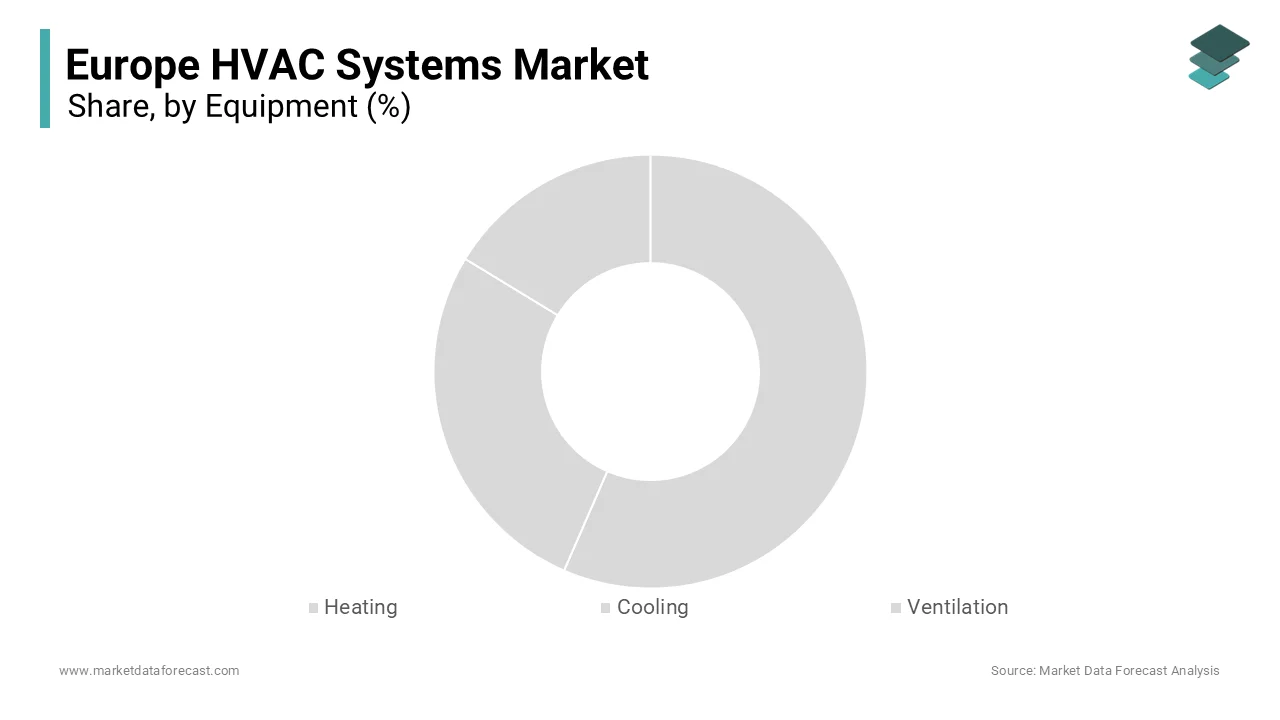
The cooling segment is predicted to witness the fastest CAGR of 9.9% over the forecast period in the European HVAC systems market. Rising summer temperatures and urban heat island intensification are one of the major factors driving the expansion of the cooling segment in the European market. Climate change is dramatically increasing cooling demand across Europe, even in historically temperate regions. According to the Copernicus Climate Change Service, the summer of 2025 was the hottest on record, with average temperatures about 2.3°C above the 1991–2020 baseline. Southern Europe experienced more than 30 days above 35°C while cities such as Paris and Berlin recorded unprecedented heat stress events. According to the World Meteorological Organisation, the number of cooling degree days in Western Europe has increased by around 45 % since 2000. The German Institute for Building Technology now requires active cooling in all new public buildings south of the 50th parallel. Additionally, the European Centre for Disease Prevention and Control links extreme heat to rising mortality, prompting hospitals and care homes to prioritise HVAC upgrades and contributing to the growth of the cooling segment in the European market.
By Application Insights
The residential segment had the major share of 47.7% of the European HVAC systems market in 2025. The growth of the residential segment in the European market is primarily attributed to the sheer scale of housing stock and policy-driven retrofit programs, and massive housing stock EU-mandated energy renovation programs. According to the European Commission, the building stock in the EU comprises over 220 million units. According to the Buildings Performance Institute Europe, about 75% of these units were constructed before 1990 and lack modern insulation or efficient HVAC systems. According to the European Commission, the Renovation Wave targets upgrading 35 million buildings by 2030, with residential retrofits forming the core. National schemes such as Germany’s BEG EM and Italy’s Superbonus 110% have subsidised HVAC replacements for millions of households. As per Eurostat, 12.4 million residential HVAC units were installed in 2025, with heat pumps accounting for 41% of new heating systems. Social housing authorities are particularly active, and France’s Action Logement funded HVAC upgrades in 180,000 low-income homes in 2025 alone. This combination of ageing infrastructure, policy urgency, and financial incentives is propelling the domination of the residential segment in the European market.
The commercial segment is predicted to witness the highest CAGR of 9.12% over the forecast period in the European market. Expansion of datacentress and cold chain logistics infrastructure is one of the key factors propelling the growth of the commercial segment in the European HVAC systems market. The digital economy and e-commerce boom of Europe are driving the construction of energy-intensive facilities requiring precision cooling. As per the publicly available data, the electricity consumption of data centres in Europe is in the order of tens of terawatt-hours annually. Additionally, the EU’s Farm to Fork Strategy has expanded cold-chain requirements for food safety, which is leading to growth in refrigerated warehouses. These mission-critical applications require high reliability and efficiency, that are creating premium demand for integrated and monitored HVAC solutions and driving the segmental expansion.
By Distribution Channel Insights
The wholesale stores segment commanded 61.7% of the European market share in 2025. The dominance of professional installation and contractor procurement models is primarily driving the domination of the wholesale stores segment in the European market. HVAC systems require certified technicians for design, installation, and commissioning, which is making direct consumer purchasing rare for full systems. For instance, OEM-installer networks commanded about 62.4% share of the European HVAC market’s distribution channel in 2025. These distributors offer technical support, bulk pricing, credit terms, and logistics coordination services critical for complex projects. The professional ecosystem ensures quality and safety while reinforcing wholesale as the primary conduit for HVAC equipment across Europe. In Germany, most heat-pump installations were handled by certified contractors purchasing through wholesale channels. Manufacturers like Daikin and Viessmann maintain exclusive partnerships with wholesale networks to ensure proper training and warranty compliance.
The online segment is predicted to be the fastest-growing segment and is expected to grow at a CAGR of 16.1% over the forecast period, owing to the rise of DIY components and smart thermostat adoption. While full HVAC systems remain professionally installed, European consumers increasingly purchase complementary components online, such as smart thermostats, air purifiers, and zoning dampers. According to Eurostat, 28% of internet users in the EU used internet-connected devices or systems for energy management in the home in 2025. Retailers like Amazon and specialised HVAC e-retailers offer detailed compatibility guides, installation videos, and chat support, which is reducing perceived complexity. Online sales of HVAC accessories are seeing marked growth driven by rising energy-cost awareness and remote-control convenience. This partial digitisation of the purchase journey creates a scalable entry point for online channels, which is also supporting the expansion of the online segment in the European market.
REGIONAL ANALYSIS
Germany Market Analysis
Germany led the HVAC systems market in Europe in 2025 with 23.4% of the regional market share. The growth of Germany in the European market is primarily driven by its industrial base, stringent energy policies, and extensive building renovation programs. The Energiewende strategy of Germany mandates a near-complete phase-out of fossil fuel heating by 2045, which is accelerating heat pump adoption. According to the German Federal Environment Agency, around 356,000 heat pumps were newly installed in Germany in 2023, and the total operational stock reached about 1.8 million units. Germany also hosts leading HVAC manufacturers like Viessmann and Bosch, which drive innovation in hybrid and hydrogen-ready systems. The dense network of certified installers ensures high-quality deployment. Additionally, the Social Housing Decarbonization Fund of the German government allocated funding for HVAC retrofits in public housing in Germany, and this demonstrates policy support for decarbonisation. This combination of policy ambition, industrial capacity, and skilled labour is boosting the domination of Germany in the European market.
France Market Analysis
France accounted for a substantial share of the European market in 2025. The aggressive public investment in residential energy renovation and strong consumer incentives are propelling the HVAC systems market in France. According to theMaPrimeRénov scheme that was expanded in 2025, more than 1.5 million grants were provided for HVAC upgrades, with low-income households receiving elevated levels of cost coverage. France also leads in district heating integration with networks in Paris and Lyon, incorporating geothermal and waste-heat sources. Additionally, France’s RE2020 building regulation mandates that all new homes achieve net-positive energy, requiring advanced HVAC design. This policy-driven and equity-focused approach is driving the HVAC systems market in France.
United Kingdom Market Analysis
The United Kingdom is another promising market for HVAC systems in Europe. The rapid heat pump adoption, post-Brexit regulatory autonomy, and strong commercial construction activity are driving the UK HVAC systems market growth. According to the Department for Energy Security and Net Zero, the Boiler Upgrade Scheme issued grants for heat pumps in 2025, and installations grew substantially year-on-year. The UK’s Future Homes Standard bans gas boilers in new homes, which is creating a structural shift toward electric heating. Additionally, London’s commercial real estate boom, which is driven by data centres and life sciences labs, fuels demand for precision cooling systems. This dual momentum in residential decarbonisation and commercial expansion is majorly boosting the UK market expansion.
Italy Market Analysis
Italy is projected to showcase a prominent CAGR over the forecast period in the European HVAC systems market due to its Superbonus 110% tax credit that catalysed mass HVAC retrofits across its ageing housing stock. Although scaled back in 2025, the incentive drove over 600,000 heat-pump installations between 2021 and 2023. Southern Italy’s rising summer temperatures have also increased demand for reversible heat pumps that provide both heating and cooling. According to industry data, the Italian heat-pump market represented about 30% of all heating appliance sales in 2023. Italy’s dense network of small HVAC contractors facilitates localised service delivery. According to the Italian National Agency for New Technologies, Energy and Sustainable Economic Development (ENEA) study, electric heat pumps delivered about 11.1% of thermal-energy savings between 2020 and 2022 under renovation programmes in Italy. Additionally, Italy leads in solar-thermal integration, with over 1.2 million systems installed to date. This blend of fiscal stimulus, climatic need, and artisanal distribution is supporting the HVAC systems market growth in Italy.
Sweden Market Analysis
Sweden is anticipated to account for a notable share of the European HVAC systems market over the forecast period, owing to its district heating dominance, renewable integration, and leadership in sustainable HVAC innovation. According to the International Energy Agency, district heating supplies more than 50% of the heat demand in Sweden’s building stock. Southern Sweden’s rising summer temperatures have also increased demand for reversible heat-pump systems that provide both heating and cooling. According to the European Heat Pump Association, heat pumps represented about 93% of the market for space-heating technologies in Sweden in 2023. Sweden also pioneers geothermal and seawater cooling in urban developments such as Stockholm Royal Seaport. Spain’s dense network of small-scale HVAC contractors facilitates localised service delivery across diverse climates. According to the Swedish Environmental Protection Agency, new public buildings in Sweden are required to significantly reduce life-cycle emissions compared to 2010 benchmarks. This systemic, circular approach to thermal management is fuelling the HVAC systems market in Spain.
COMPETITIVE LANDSCAPE
KEY MARKET PLAYERS
Some of the notable key players in the European HVAC systems market are
- Trane Technologies PLC Class A
- Lennox International Inc
- Haier
- Carrier Global Corp Ordinary Shares
- Daikin Industries Ltd
- LG Electronics Inc ADR
- Samsung Electronics Co Ltd
- Mitsubishi Electric Corp
- Johnson Controls International PLC
- Hitachi Ltd
- Fujitsu Ltd
TOP STRATEGIES USED BY THE KEY MARKET PLAYERS
Key players in the European HVAC systems market prioritise regulatory compliance by designing products that meet F-gas phase-down requirements, Ecodesign efficiency standards, and national heating bans. They invest heavily in heat pump innovation, focusing on cold climate performance, noise reduction, and hybrid configurations. Strategic partnerships with utilities, housing authorities, and installer networks ensure seamless deployment and subsidy access. Companies also integrate HVAC with building automation and smart grid systems to enable demand response and energy optimisation. Additionally, they expand training academies to address technician shortages and guarantee proper installation. Sustainability is embedded through circular design, refrigerant tracking, and lifecycle carbon reporting. These strategies collectively align product development with Europe’s decarbonization trajectory while strengthening customer trust and market penetration.
COMPETITION OVERVIEW
Competition in the European HVAC systems market is highly dynamic, featuring a mix of global technology leaders, regional European champions, and specialised niche players. Global firms like Daikin and Johnson Controls leverage scale and R&D to dominate premium segments, particularly in commercial and high-efficiency residential applications. European manufacturers such as Viessmann, Bosch, and Ariston maintain strong brand loyalty through localised product engineering, extensive installer networks, and deep policy engagement. The market is not primarily price-driven; instead, differentiation hinges on energy performance, refrigerant sustainability, digital connectivity, and compliance with national renovation schemes. Intense rivalry exists in heat pump innovation, with players racing to improve low-temperature efficiency and reduce noise. Meanwhile, the industrial segment sees competition around precision cooling for data centres and life sciences. As the EU tightens emissions rules and building standards, competition is increasingly centred on total lifecycle value rather than upfront cost, fostering a high innovation, high service intensity environment across the region.
TOP PLAYERS IN THE MARKET
- Daikin Europe is a leading force in the European HVAC systems market, renowned for its advanced heat pump and variable refrigerant flow technologies tailored to the region’s climate and regulatory landscape. The company supplies residential, commercial, and industrial solutions across all major EU countries, with manufacturing facilities in Belgium, the Czech Republic, and Isral, ensuring local responsiveness. In 2025, Daikin launched its Altherma 6 series, a next-generation air-to-water heat pump compliant with the EU F-gas Regulation and optimised for low-temperature district heating integration. It also expanded its training academies in Germany and Spain to certify over 10,000 installers annually. These initiatives reinforce Daikin’s global leadership in sustainable thermal comfort while deepening its integration into Europe’s decarbonization infrastructure.
- Viessmann Group plays a pivotal role in the European HVAC systems market through its comprehensive portfolio of gas, hybrid, and hydrogen-ready heating systems, with a strategic pivot toward full electrification. Headquartered in Germany, the company serves millions of households and public institutions across the continent. In early 2026, Viessmann completed the integration of its HVAC division into the Carrier Global Corporation while retaining brand autonomy and R&D leadership in Europe. It also introduced the Vitocal 300 G Pro heat pump with integrated smart grid communication, enabling demand response participation. Furthermore, Viessmann partnered with municipal housing authorities in France and the Netherlands to deliver turnkey renovation packages. These actions strengthen its position as a trusted enabler of the European energy transition.
- Johnson Controls exerts significant influence in the European HVAC systems market through its smart building solutions that integrate HVAC with energy management, security, and occupancy analytics. The company’s YORK and Metasys brands are widely deployed in data centres, hospitals, and commercial complexes across Western and Northern Europe. In 2025, Johnson Controls enhanced its OpenBlue platform with AI-driven HVAC optimisation algorithms that reduce energy use by up to 25 per cent in real-world applications. It also established a sustainability compliance hub in Dublin to support clients with EU Taxonomy and CSRD reporting. By positioning HVAC as a core component of intelligent, net-zero-ready buildings, Johnson Controls extends its global leadership in building efficiency into the European regulatory and operational context.
Europe HVAC Systems Market News
- In March 2025, Daikin Europe launched the Altherma 6 series heat pump with R32 refrigerant and a smart grid interface to comply with EU F-gas rules and strengthen the European HVAC systems market presence.
- In October 2025, Viessmann Group partnered with the Amsterdam Housing Authority to deliver 5,000 integrated heat pump and ventilation retrofits in social housing and strengthen the European HVAC systems market presence.
- In January 2026, Johnson Controls upgraded its OpenBlue platform with AI-driven HVAC optimisation for European commercial buildings and strengthened its European HVAC systems market presence.
- In July 2025, Bosch Thermotechnology expanded its training academy network in Southern Europe to certify 8,000 technicians in heat pump installation and strengthen the European HVAC systems market presence.
- In November 2025, Ariston Group introduced a hydrogen-ready hybrid boiler compliant with German and Italian decarbonization roadmaps and strengthened its European HVAC systems market presence.
MARKET SEGMENTATION
This research report on the European HVAC systems market has been segmented and sub-segmented based on categories.
By Equipment
- Heating
- Cooling
- Ventilation
By Application
- Residential
- Commercial
- Industrial
By Distribution Channel
- Online
- Retail Stores
- Wholesale Stores
By Country
- UK
- France
- Spain
- Germany
- Italy
- Russia
- Sweden
- Denmark
- Switzerland
- Netherlands
- Turkey
- Czech Republic
- Rest of Europe