- Product Description Description
- Table of Contents TOC
- List of Table & Figure LOT
- Get Free Sample PDF Sample PDF
Market Size, 2025
$2,818 MnMarket Estimate, 2026
$3,060 MnMarket Forecast, 2034
$5,907 MnCAGR, 2026–2034
8.57%Europe Hyaluronic Acid Products Market Size, Growth, Trends & Forecast (2026–2034)
The size of the Europe hyaluronic acid products market was valued at USD 2,818 million in 2025, is anticipated to reach USD 3,060 million in 2026, and is projected to scale up to USD 5,907 million by 2034, registering a compound annual growth rate (CAGR) of 8.57% during the forecast period from 2026 to 2034. Driven by the rising prevalence of osteoarthritis, an expanding aesthetic consumer base, and exceptional biocompatibility for medical and cosmetic applications, the industry continues to expand steadily across Europe.
Key Executive Metrics (At-a-Glance)
- 2025 Base Valuation: USD 2,818 Million
- 2026 Current Valuation: USD 3,060 Million
- 2034 Forecast Valuation: USD 5,907 Million
- Compound Annual Growth Rate (CAGR): 8.57% (2026–2034)
- Dominant Product Type & Application: Single Cycle Injection Products / Dermal Fillers (backed by convenience in osteoarthritis care and high demand for minimally invasive aesthetics)
- Fastest-Growing Product Type & Application: Five-Cycle Injection Products / Ophthalmic Application (propelled by multi-dose clinical support and rising volumes of cataract surgeries)
- Dominant Country: Germany (holding the major market share supported by robust healthcare infrastructure and biotechnology innovation)
- Fastest-Growing Countries: United Kingdom & Italy (driven by high private aesthetic expenditure and aging demographics)
Core Market Drivers
- Rising Osteoarthritis Prevalence: Degenerative joint disorders affecting millions of older adults across Europe, with viscosupplementation endorsed by national guidelines.
- Cultural Shifts in Aesthetics: Growing normalization of aesthetic enhancements, urban medical spa proliferation, and digital self-presentation pressures.
Primary Market Restraints & Challenges
- Regulatory Hurdles: Strict compliance demands and extended CE certification timelines for Class III medical devices under the European Commission.
- Cost Sensitivity & Reimbursement Limits: Inconsistent public coverage for viscosupplementation across European nations and supply chain substrate vulnerabilities.
Europe Hyaluronic Acid Products Market Segmentation Breakdown
| Segment Category | Leading Sub-Segment (2025 Base) | Fastest-Growing Sub-Segment (2026–2034) |
|---|---|---|
| By Product Type | Single Cycle Injection Products (dominant share driven by patient convenience and compliance) | Five-Cycle Injection Products (fastest growth due to multi-dose clinical support for early-stage osteoarthritis) |
| By Application | Dermal Fillers (largest share led by non-surgical aesthetic procedure volumes) | Ophthalmic (fastest growth driven by surging cataract and refractive surgeries among aging demographics) |
| By Country | Germany (top market performer backed by advanced healthcare and local biotech production) | United Kingdom & Italy (prominent growth opportunities driven by private expenditure and aging societies) |
Major Industry Players Profiled
Key enterprises shaping the competitive Europe hyaluronic acid products market include Allergan, Galderma S.A., Sanofi, Ferring B.V., Zimmer Biomet, Fidia Farmaceutici, Salix Pharmaceuticals, Anika Therapeutics, Seikagaku Corporation, Hoffmann-La Roche Ltd, Alcon, Inc., Smith & Nephew plc, and Merz Aesthetics, Inc..
Europe Hyaluronic Acid Products Market Size
The size of the Europe hyaluronic acid products market was valued at USD 2,818 million in 2025. This market is expected to grow at a CAGR of 8.57% from 2026 to 2034 and be worth USD 5,907 million by 2034 from USD 3,060 million in 2026.

The hyaluronic acid products are dermatology, aesthetics, orthopedics, and ophthalmology driven by the molecule’s exceptional viscoelasticity and moisture retention capacity. Hyaluronic acid, a naturally occurring glycosaminoglycan, is prized for its biocompatibility and biodegradability, making it suitable for both medical and cosmetic use.
MARKET DRIVERS
Rising Prevalence of Osteoarthritis Fuels Medical Demand
The osteoarthritis for hyaluronic acid viscosupplementation is majorly fuelling the growth of the Europe hyaluronic acid products market. This degenerative joint disorder impairs mobility and diminishes quality of life, particularly among older adults. According to the World Health Organization, more than forty million individuals in the European region suffer from osteoarthritis, with prevalence exceeding 33% in those aged seventy and above. National treatment guidelines in Germany France,, and Italy endorse its use as part of conservative management strategies.
Expanding Aesthetic Consumer Base Driven by Cultural Shifts
The cultural shift toward the normalization of aesthetic enhancements has significantly fueled the consumer base is propelling the growth of the Europe hyaluronic acid products market. Urban proliferation of medical spas, social media influence, and the emphasis on digital self-presentation have accelerated adoption.
MARKET RESTRAINTS
Stringent Regulatory Hurdles Impede Product Commercialization
The regulatory environment for hyaluronic acid product developers, particularly for those classified as medical devices or combination products, is likely to degrade the growth of the Europe hyaluronic acid products market. According to the European Commission, the average CE certification timeline for Class III devices, such as across-linkeded dermal filler,s now exceeds eighteen months, up from twelve months under the prior directive.
Price Sensitivity and Reimbursement Limitations Constrain Adoption
The cost for the advanced treatment procedures is high, which is solely to degrade the growth of the Europe hyaluronic acid products market. Reimbursement policies for viscosupplementation are inconsistent with the Organisation for Economic Co-operation and Development, reporting that only nine out of twenty-eight European nations offer full or partial public coverage for osteoarthritis injections. Countries like the United Kingdom and Denmark restrict access to specific subgroups or research protocols. This financial caution curbs discretionary expenditure on premium hyaluronic acid treatments, particularly among middle-income consumers, thereby limiting market expansion in economically vulnerable regions.
MARKET OPPORTUNITIES
Innovation in Cross-Linking and Delivery Technologies
The cutting-edge advancements in biomaterial engineering for hyaluronic acid through enhanced molecular stability and precision delivery are greatly influencing the growth of the Europe hyaluronic acid products market. Next-generation cross-linking platforms such as Vycross and XpresHAn enable tunable gel rheology, improving longevity and tissue integration. These innovations extend dermal filler duration from six to eighteen months and improve intra-articular residence time, reducing treatment frequency.
Growing Integration into Preventive Skincare Regimens
The hyaluronic acid is increasingly embedded in daily preventive skincare rather than reserved for corrective interventions, aligning with Europe’s shift toward proactive beauty and wellness is another attribute to elevate the growth of Europe's hyaluronic acid products market. Leading European dermocosmetic brands, including La Roche Posay, Vichy, and Eucerin, have reformulated core lines to feature hyaluronic acid as a key active.
MARKET CHALLENGES
Supply Chain Vulnerabilities for Biofermentation-Derived Hyaluronic Acid
The supply chain disruptions with structural fragility, as biofermentation processes are vulnerable to contamination, and input volatility is likely to challenge the growth of the Europe hyaluronic acid products market. Key fermentation substrates like glucose and peptones are agricultural derivatives whose prices surged by up to 22% in 2022, per the Food and Agriculture Organization of the United Nations, due to climate disruptions and trade restrictions.
Intensifying Competition from Alternative Biomaterials
The competitive pressure from next-generation biomaterials offering extended duration or regenerative capabilities is to slightly degrade the growth of the Europe hyaluronic acid products market. In aesthetics, polylactic acid, calcium hydroxylapatite and poly caprolactone fillers are gaining ground due to their collagen-stimulating effects and semi-permanent results. In orthopedics, platelet-rich plasma and mesenchymal stem cell therapies are emerging as regenerative alternatives, with the European Orthopaedic Research Society citing clinical trials showing comparable pain relief over twelve months. Topical skincare also sees competition from niacinamide peptides and ceramides, which offer multi-functional benefits beyond hydration.
REPORT COVERAGE
| REPORT METRIC | DETAILS |
| Market Size Available | 2025 to 2034 |
| Base Year | 2025 |
| Forecast Period | 2026 to 2034 |
| Segments Covered | By Product Type, Application, and Region. |
| Various Analyses Covered | Global, Regional and Country-Level Analysis, Segment-Level Analysis, Drivers, Restraints, Opportunities, Challenges; PESTLE Analysis; Porter’s Five Forces Analysis, Competitive Landscape, Analyst Overview of Investment Opportunities |
| Countries Covered | UK, France, Spain, Germany, Italy, Russia, Sweden, Denmark, Switzerland, Netherlands, Turkey, Czech Republic, and the Rest of Europe. |
| Market Leaders Profiled | Allergan, Sanofi, Ferring B.V., Zimmer Biomet, Fidia Farmceutici, Salix Pharmaceutical, Anika Therapeutics, Seikagaku Corporation, Hoffmann-LA Roche Ltd, Alcon, Inc., Smith & Nephew plc and F.Merz Asthetics, Inc. |
SEGMENTAL ANALYSIS
By Product Type Insights
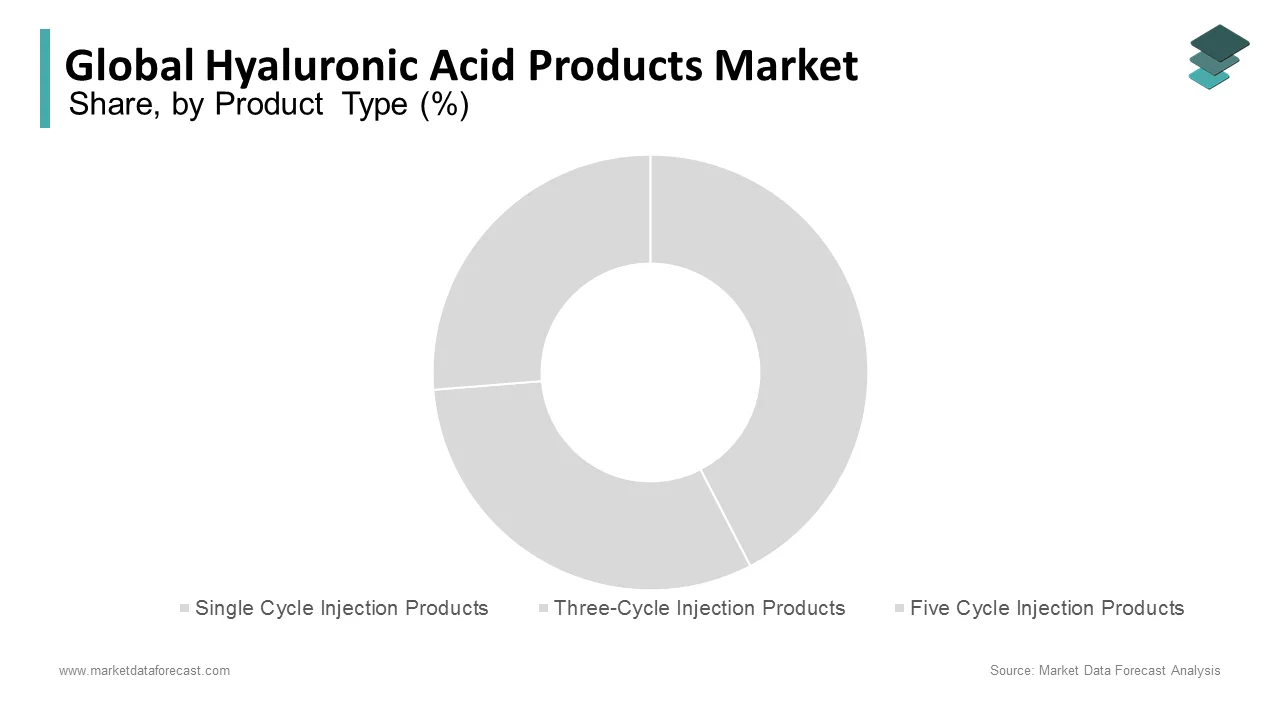
The single Cycle Injection Products segment accounted in holding 48.2% of the Europe hyaluronic acid products market share in 2024, with the strong adoption in osteoarthritis treatment, where a single intra-articular injection offers convenience and compliance advantages over multi cycle regimens. Additionally, the European Medicines Agency has streamlined approvals for single-dose products, reducing time to market. Patient preference for fewer clinic visits, especially post-pandemic further accelerates uptake.
The Five Cycle Injection Products segment is projected to grow at a CAGR of 9.3% from 2025 to 2033, with the rising adoption of multi-dose regimens in early-stage osteoarthriti,s where repeated low-dose injections are believed to stimulate endogenous hyaluronic acid production and delay joint deterioration. Clinical guidelines from the Osteoarthritis Research Society International increasingly support multi cycle protocols for patients under 60 with mild to moderate disease. Furthermore, national health systems in countries like Germany and France reimburse multi-cycle treatments more readily due to long-term cost-effectiveness data.
By Application Insights
The dermal fillers segment was the largest by occupying 52.3% of the Europe hyaluronic acid products market share in 2024. The growth of the segment is attributed to grow with the demand for minimally invasive aesthetic procedures across Western and Northern Europe. As per the International Society of Aesthetic Plastic Surgery, Europe accounted for 28% of global non-surgical cosmetic procedures in 2022 ,with over 2.1 million hyaluronic acid filler treatments performed. Cultural shifts toward preventive aging and increased social media influence have normalized aesthetic enhancements, particularly among adults aged 30 to 55. Regulatory support also plays a role as the European Commission’s Medical Device Regulation ensures high safety standards, boosting consumer confidence. Leading brands like Juvederm and Restylane dominate pharmacy and clinic distribution channels.
The Ophthalmic application segment is likely to register a CAGR of 10.1% in coming years with the rising volume of cataract and refractive surgeries across aging European populations. Hyaluronic acid is indispensable in ophthalmic surgery as a viscoelastic agent protecting the corneal endothelium during lens implantation. Technological advancements, such as cohesive dispersive formulations, improve surgical precision and reduce postoperative complications. National health systems in Germany, France, and Italy fully reimburse cataract surgeries, creating stable demand.
COUNTRY LEVEL ANALYSIS
Germany Market Analysis
Germany was the top performer in the European hyaluronic acid products market with 22.3% of share in 2024. The country’s robust healthcare infrastructure and universal health coverage ensure broad access to both therapeutic and aesthetic applications. Stringent quality regulations under the Federal Institute for Drugs and Medical Devices foster trust in hyaluronic acid products. Moreover, Germany’s strong biotechnology sector supports local production and innovation with companies like Merz Pharma investing heavily in next-generation formulations.

France Market Analysis
France was positioned second in the European hyaluronic acid market with a 17.3% of share in 2024. The country exhibits high utilization across both medical and cosmetic domains, driven by a culturally ingrained emphasis on aesthetic wellness and comprehensive public healthcare. In 2022, more than 400000 hyaluronic acid-based cosmetic procedures were performed, placing France among the top three globally. The National Institute of Health and Medical Research supports clinical studies validating multi-cycle injection protocols.
United Kingdom Market Analysis
The United Kingdom hyaluronic acid market growth is likely to grow with new opportunities in next coming years. The UK’s market is characterized by high private expenditure on aesthetic treatments alongside growing adoption of viscosupplementation within the National Health Service framework. Regulatory reforms post-Brexit have accelerated product approvals through the Medicines and Healthcare products Regulatory Agency.
Italy Market Analysis
Italy's hyaluronic acid products market growth is likely to grow with prominent growth opportunities in next coming years. The country demonstrates strong demand in both aesthetic and orthopedic applications, influenced by cultural preferences for non-surgical beauty enhancements and an aging population. Italy’s demographic profile is particularly relevant, with 24% of its population aged 65 or older as per ISTAT, making it one of Europe’s oldest societies. This drives consistent demand for joint and ophthalmic applications. Regional healthcare autonomy allows northern regions like Lombardy and Emilia Romagna to adopt innovative treatments faster.
Spain Market Analysis
Spain hyaluronic acid market growth is anticipated to have steady growth with the rising aesthetic procedure volumes and expanding access to osteoarthritis treatments in both public and private healthcare settings. The National Health System includes viscosupplementation in regional clinical guidelines for knee osteoarthritis, particularly in autonomous communities like Catalonia and Madrid, benefiting nearly 100000 patients. Government initiatives to modernize primary care and integrate regenerative therapies further support market expansion. Strong dermatology and rheumatology networks ensure consistent product adoption across urban and semi urban areas.
COMPETITIVE LANDSCAPE
The Europe Hyaluronic Acid Products Market features intense competition among multinational corporations and specialized biotech firms. Established players leverage extensive distribution channels, strong brand recognition, and robust clinical data to dominate both aesthetic and therapeutic segments. New entrants focus on cost effective formulations and regional regulatory pathways to gain a foothold, particularly in Southern and Eastern Europe. Competition is further intensified by rapid product innovation with companies introducing next-generation hyaluronic acid variants featuring improved viscosity, elasticity, and biodegradability. Pricing pressure from national healthcare systems influences market dynamics especially in publicly funded osteoarthritis treatments.
KEY MARKET PLAYERS
Some of the companies that are playing a dominating role in the Europe hyaluronic acid products market include
- Allergan
- Sanofi
- Ferring B.V.
- Zimmer Biomet
- Fidia Farmaceutici
- Salix Pharmaceuticals
- Anika Therapeutics
- Seikagaku Corporation
- Hoffmann-La Roche Ltd
- Alcon, Inc.
- Smith & Nephew plc
- Merz Aesthetics, Inc.
Top Players in the Market
- Allergan plc is a prominent participant in the Europe Hyaluronic Acid Products Market through its globally recognized Juvederm dermal filler portfolio. The company focuses on aesthetic and therapeutic applications, leveraging its strong research and development capabilities. In recent years, Allergan has expanded its European footprint by launching next-generation hyaluronic acid formulations with enhanced longevity and integration of lidocaine for improved patient comfort. The company has also strengthened its distribution partnerships across key markets, including Germany, France, and the United Kingdom. Regulatory compliance and continuous medical education initiatives for practitioners further boost its presence.
- Galderma S.A. plays a significant role in the Europe Hyaluronic Acid Products Market with its Restylane product line, which is widely used for facial aesthetics and skin rejuvenation. Headquartered in Switzerland the company emphasizes science-based dermatological solutions and maintains a strong clinical evidence portfolio. Galderma has recently intensified its focus on digital engagement tools for healthcare professionals and launched new hyaluronic acid-based products tailored for specific facial zones. The company has also expanded its manufacturing capacity in Europe to meet rising demand.
- Ferring Pharmaceuticals is a key contributor to the Europe Hyaluronic Acid Products Market, particularly in the orthopedic and urological therapeutic areas. The company markets hyaluronic acid products for osteoarthritis and vesicoureteral reflux, demonstrating a strong commitment to unmet medical needs. Ferring has recently invested in clinical trials to validate the long-term efficacy of its single-injection viscosupplementation therapies. The company also enhanced its supply chain resilience by upgrading its production facilities in Germany and Switzerland. Strategic partnerships with European healthcare providers and inclusion of its products in national treatment guidelines have broadened access.
Top strategies used by the key market participants
Key players in the Europe Hyaluronic Acid Products Market employ several strategic approaches to maintain a competitive advantage. Product innovation remains central, with companies investing heavily in research to develop longer-lasting and safer formulations. Strategic partnerships with dermatologists, rheumatologists, and ophthalmologists enhance clinical adoption and credibility. Geographic expansion through localized marketing and distribution networks strengthens presence in high growth countries. Regulatory compliance and early engagement with agencies like the European Medicines Agency accelerate product approvals. Companies also prioritize physician training programs and digital health platforms to improve patient outcomes and brand loyalty.
MARKET SEGMENTATION
This Europe hyaluronic acid products market research report is segmented and sub-segmented into the following categories.
By Product Type
- Single Cycle Injection Products
- Three-Cycle Injection Projects
- Five Cycle Injection Products
By Application
- Osteoarthritis
- Ophthalmic
- Dermal Fillers
- Vesicoureteral Reflux
By Country
- UK
- France
- Spain
- Germany
- Italy
- Russia
- Sweden
- Denmark
- Switzerland
- Netherlands
- Turkey
- Czech Republic
- Rest of Europe