- Product Description Description
- Table of Contents TOC
- List of Table & Figure LOT
- Get Free Sample PDF Sample PDF
Market Size, 2025
$0.33 BnMarket Estimate, 2026
$0.35 BnMarket Forecast, 2034
$0.56 BnCAGR, 2026–2034
16.13%Europe Hydrogen Compressor Market Report Summary
The Europe Hydrogen Compressor Market was valued at USD 0.33 billion in 2025, is estimated to reach USD 0.35 billion in 2026, and is projected to reach USD 0.56 billion by 2034, growing at a CAGR of 6.13% during the forecast period from 2026 to 2034. The market growth is primarily driven by the rapid expansion of green hydrogen production, increasing deployment of hydrogen refueling stations, and ongoing investments in hydrogen infrastructure across Europe. The rising adoption of fuel-cell vehicles, focus on industrial decarbonization, and technological advancements in oil-free and energy-efficient compression systems further support market expansion. Additionally, favorable government policies such as the European Green Deal and Hydrogen Strategy for a Climate-Neutral Europe are promoting large-scale hydrogen projects, fueling compressor demand across production, storage, and transportation applications.
Key Market Trends
- Rising focus on green hydrogen production and electrolyzer integration is driving compressor installations at renewable energy hubs.
- Growing demand for oil-free hydrogen compressors to ensure purity in chemical and mobility applications.
- Technological advancements in multi-stage and diaphragm compressors are enhancing energy efficiency and system reliability.
- Increasing adoption of AI-based predictive maintenance systems to optimize compressor performance and reduce operational downtime.
- Expansion of hydrogen refueling infrastructure supporting fuel-cell vehicle adoption across Europe.
Segmental Insights
- Based on Technology Insights, the multistage compressors segment accounted for a substantial share of the Europe hydrogen compressor market in 2024, owing to their ability to achieve higher pressures suitable for hydrogen transport and refueling applications.
- Based on Type Insights, the oil-free hydrogen compressors segment dominated the market in 2024 due to their ability to maintain hydrogen purity and minimize contamination risks, making them ideal for chemical and mobility sectors.
- Based on End-User Insights, the chemical segment led the Europe hydrogen compressor market, occupying a 45.3% share in 2025, driven by the increasing use of hydrogen in refining, fertilizers, and ammonia production industries.
Regional Insights
- Germany dominated the Europe hydrogen compressor market with a 30.8% share in 2025, supported by strong hydrogen infrastructure investments and a robust manufacturing base.
- France continues to expand its hydrogen ecosystem, emphasizing renewable hydrogen integration with energy storage and mobility sectors.
- The Netherlands is witnessing the rapid development of hydrogen refueling networks and green hydrogen production hubs.
- The United Kingdom is accelerating hydrogen compressor deployment to meet its net-zero transport targets and refueling infrastructure goals.
- Norway is emerging as a key market due to its investments in hydrogen-powered transport systems and offshore energy integration.
Competitive Landscape
The Europe Hydrogen Compressor Market is moderately consolidated, featuring a mix of established global and regional manufacturers. Companies are focusing on technological innovation, strategic partnerships, and localization of manufacturing to enhance competitiveness.
Prominent players operating in the market include Burckhardt Compression AG, Howden Group Ltd., Atlas Copco AB, Siemens Energy AG, Nel ASA, PDC Machines Inc., Haug Kompressoren AG, Ariel Corporation, Bauer Kompressoren GmbH, Gardner Denver Holdings, Inc., Hydrogenics Corporation (a Cummins Inc. company), Kobelco Compressors Europe B.V., Sauer Compressors, Mitsui E&S Machinery Co., Ltd., Anest Iwata Corporation, Greenfield Compression, Hitachi Industrial Equipment Systems Co., Ltd., Hydro-Pac Inc., Coltri Compressors, and J.P. Sauer & Sohn Maschinenbau GmbH.
Europe Hydrogen Compressor Market Size
The Europe hydrogen compressor market size was valued at USD 0.33 billion in 2025 and is anticipated to reach USD 0.35 billion in 2026 from USD 0.56 billion by 2034, growing at a CAGR of 6.13% during the forecast period from 2026 to 2034.
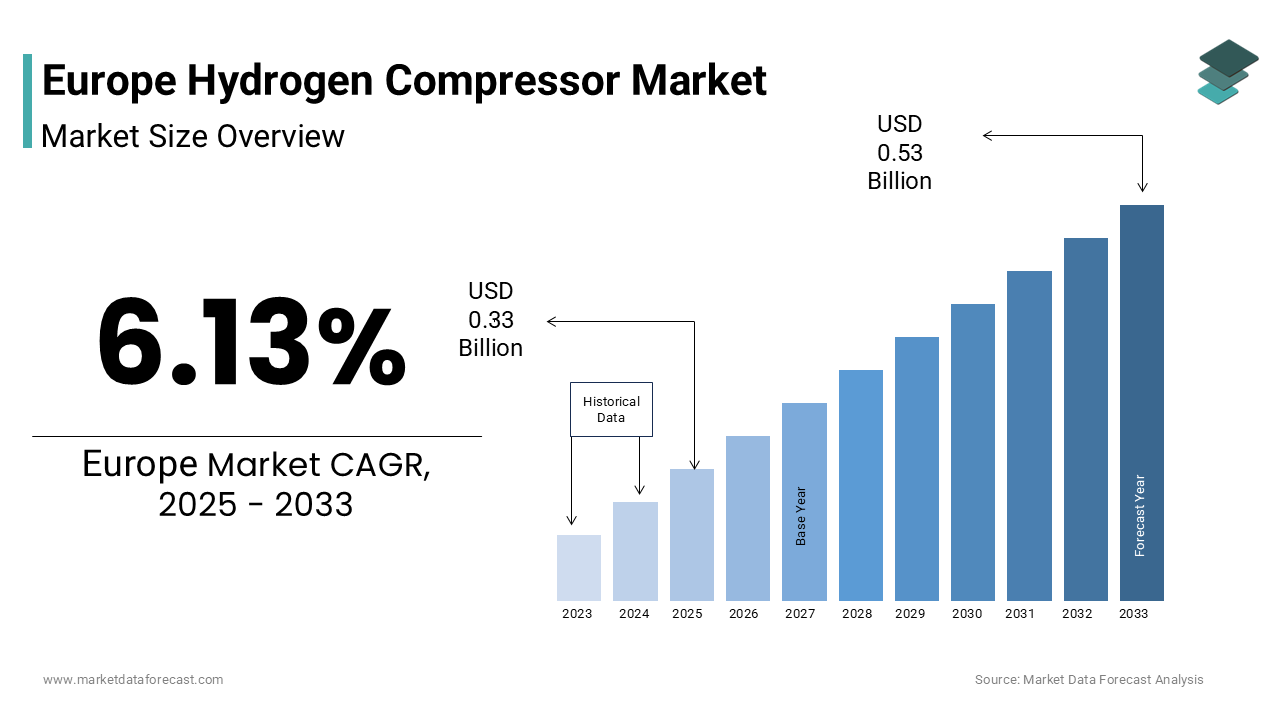
A hydrogen compressor is a specialized mechanical system designed to increase the pressure of gaseous hydrogen for storage, transport, or end use in applications ranging from refueling stations to industrial synthesis and power generation. This technology provides the essential link across the European hydrogen value chain, from production to final use. Unlike generic industrial gas compressors, hydrogen units must address unique challenges including hydrogen embrittlement, high leakage potential, and stringent safety requirements under the EU’s ATEX and Pressure Equipment Directives. Europe’s strategic decarbonization agenda, articulated through the European Green Deal and the REPowerEU plan, has elevated hydrogen from a niche industrial feedstock to a cornerstone of energy transition. The European Union is actively increasing its support for and approval of a large number of renewable hydrogen projects. Furthermore, the European Union is committed to significantly expanding its domestic renewable hydrogen production capacity within the next decade. This ambition necessitates extensive compression infrastructure, particularly at electrolysis sites where hydrogen is generated at near atmospheric pressure and must be pressurized to 30 bar or higher for pipeline injection or liquefaction. The technical specificity, regulatory rigor, and integration demand of Europe’s hydrogen ecosystem define the operational and developmental contours of its compressor market far beyond simple equipment supply.
MARKET DRIVERS
Mandated Expansion of Hydrogen Refueling Infrastructure
The systematic rollout of hydrogen refueling stations in the region constitutes a key demand driver for the growth of the Europe hydrogen compressor market. This demand is particularly high-pressure units capable of delivering 700 bar for light duty fuel cell vehicles. Under the Alternative Fuels Infrastructure Regulation, all EU member states are required to establish hydrogen refueling corridors along the Trans European Transport Network by 2030, with a minimum station every 200 kilometers on core routes. As of early 2024, Europe operated approximately 294 public hydrogen refueling stations according to the European Hydrogen Refueling Station Database maintained by Ludwig Bölkow Systemtechnik (LBST). Germany alone accounted for 113 of these stations and, as part of the National Innovation Program for Hydrogen and Fuel Cell Technology (NIP), has in the past planned to reach 1,000 by 2030, though current projections lean heavily toward battery-electric solutions for road transport. Each station typically requires at least one multi-stage diaphragm compressor with capacities ranging from 300 to 1,500 kilograms per day (though typical operational capacities for current stations are often 100-500 kg/day) to meet peak demand cycles. The United Kingdom and France have each committed public funding in excess of EUR 200 million (or equivalent) to accelerate station deployment, directly stimulating compressor procurement. Unlike industrial applications that may use lower pressure systems, mobility infrastructure demands reliability, fast response times, and compliance with ISO 19880 safety standards, which makes compressor selection both technically and commercially critical to the viability of Europe’s clean transport vision.
Integration of Electrolytic Hydrogen into Gas Grids and Industrial Clusters
The large-scale coupling of green hydrogen from electrolyzers into existing natural gas networks and industrial zones is generating sustained demand for medium pressure hydrogen compressors in the region, which also boosts the expansion of the Europe hydrogen compressor market. Regulatory frameworks within the European Union are evolving to permit and encourage significant hydrogen blending into existing natural gas infrastructure, establishing clear targets and directives for future integration. In addition, The industry is seeing the emergence of large-scale commercial projects aimed at the substantial injection of renewable hydrogen into national gas grids, indicating a push toward practical implementation of hydrogen infrastructure across Europe, according to research. Similarly, industrial hydrogen valleys require centralized compression hubs to distribute hydrogen to steel, chemical, and refining facilities. These systemic integration efforts transform compressors from ancillary components into pivotal nodes in Europe’s emerging hydrogen backbone.
MARKET RESTRAINTS
Technological Immaturity of High Efficiency Low Maintenance Compressors
Limited commercial availability of units simultaneously delivers high energy efficiency, long service intervals, and compliance with stringent safety norms, which hampers the growth of the Europe hydrogen compressor market. Most hydrogen compressors currently deployed, particularly diaphragm and ionic liquid types, operate at efficiencies significantly lower than natural gas compressors, according to sources. This inefficiency translates into higher operational costs and increased electricity consumption, undermining the economic case for green hydrogen. Furthermore, mechanical wear from hydrogen embrittlement necessitates fewer maintenance operating hours, compared to that for conventional gas compressors, as per studies. While manufacturers such as Burckhardt Compression and NEUMAN & ESSER are investing in advanced metallurgy and sealing technologies, field validated high reliability units above 1 000 kW remain scarce. Major European ports are proactively developing strategic plans and infrastructure to accommodate large volumes of imported hydrogen, anticipating its crucial role in the future energy mix. Europe's hydrogen economy will struggle with scalability and cost effectiveness until material science innovation and standardized testing protocols help resolve existing engineering limitations in compressor performance.
Lack of Standardized Certification and Interoperability Frameworks
The absence of harmonized technical standards for hydrogen compressor performance, safety, and interoperability across European jurisdictions inhibits the expansion of the Europe hydrogen compressor market. This impedes procurement, integration, and cross border project development. The EU's Pressure Equipment Directive establishes a baseline, but it lacks specific hydrogen testing protocols for critical areas like cyclic fatigue, leakage rates, or compatibility with green hydrogen impurities (e.g., residual oxygen or moisture from electrolysis). Consequently, manufacturers must navigate divergent national certification requirements. This fragmentation increases lead times by several months and adds in compliance costs for compressor suppliers. Moreover, the lack of standardized interface protocols between compressors and electrolyzers or refueling dispensers complicates system integration, often requiring custom engineering solutions. Until a unified regulatory and technical framework emerges, the market will remain fragmented, slowing deployment and inflating total system costs across the hydrogen value chain
MARKET OPPORTUNITIES
Deployment of Offshore Green Hydrogen Production and Export Hubs
The region’s strategic pivot toward offshore wind powered hydrogen production creates an opportunity for the growth of the Europe hydrogen compressor market. This presents a major opportunity for specialized marine grade hydrogen compressors designed for harsh environments and high reliability. The North Sea is projected to host approximately 193 gigawatts (GW) of offshore wind capacity by 2040 according to the North Seas Energy Cooperation (NSEC), with the potential for much of this power to be used for both direct grid injection and to power electrolyzers on coastal terminals and potentially future offshore floating platforms. These facilities will require compressors capable of operating in corrosive saline atmospheres with minimal maintenance, often integrated directly with subsea pipeline export systems. Unlike onshore industrial applications, offshore systems demand compactness, corrosion resistance, and remote monitoring capabilities, which spurs innovation in oil free screw and electrochemical compressors. This emerging offshore segment creates a premium niche for European engineering firms with maritime expertise, positioning compressors as mission critical enablers of Europe’s hydrogen export ambitions.
Retrofitting of Existing Natural Gas Compression Infrastructure
The conversion of legacy natural gas compressor stations to handle hydrogen blends or pure hydrogen offers a scalable and capital efficient opportunity for the expansion of the Europe hydrogen compressor market. Europe’s existing gas grid spans over thousands of kilometers, with number of compressor stations. Projects are already piloting the retrofit of centrifugal compressors with hydrogen compatible seals and coatings. Retrofitting reduces capital expenditure compared to greenfield construction. This pathway not only accelerates hydrogen grid deployment but also creates demand for upgrade kits, monitoring systems, and recertification services, which transforms compressor manufacturers into lifecycle solution providers rather than equipment vendors alone.
MARKET CHALLENGES
Material Limitations in Hydrogen Embrittlement Resistance
The susceptibility of conventional high strength alloys to hydrogen embrittlement remains an impediment to the Europe hydrogen compressor market. It is a phenomenon where atomic hydrogen diffuses into metal lattices and causes premature cracking under stress. This issue is especially acute in high pressure components such as pistons, valves, and cylinder heads, which operate under cyclic loading conditions. Despite advances, widely used materials still exhibit reduced fatigue life when exposed to pressurized hydrogen compared to air environments. Furthermore, there is no universally accepted test standard for hydrogen embrittlement in dynamic compression applications, which leads to inconsistent material validation across manufacturers. Compressor downtime and safety risks will continue to hinder system availability and investor confidence in hydrogen infrastructure until cost-effective, embrittlement-resistant materials or surface engineering methods (like nanostructured coatings or additive manufacturing with tailored microstructures) are industrialized and widely adopted.
Skilled Workforce Shortage for Installation and Maintenance
A shortage of technicians and engineers trained in hydrogen-specific handling, safety protocols, and maintenance procedures obstructs the expansion of the Europe hydrogen compressor market. Unlike natural gas, hydrogen requires specialized knowledge due to its wide flammability range, low ignition energy, and unique leak detection challenges. Vocational programs in Germany, France, and the Netherlands have only recently introduced hydrogen modules, and certification is not yet harmonized across borders. This deficit leads to extended commissioning times. Moreover, unplanned maintenance events often face delays of several weeks due to limited on call expertise, reducing system uptime at refueling stations and industrial sites. Europe's hydrogen compression infrastructure faces a growing threat to its performance and expandability unless immediate investments are made in standardized training programs, mobile simulation facilities, and mutual credential recognition across nations.
REPORT COVERAGE
| REPORT METRIC | DETAILS |
| Market Size Available | 2025 to 2034 |
| Base Year | 2025 |
| Forecast Period | 2026 to 2034 |
| Segments Covered | By Technology, Type, End-User Industry and Region. |
| Various Analyses Covered | Global, Regional & Country Level Analysis, Segment-Level Analysis; DROC, PESTLE Analysis, Porter's Five Forces Analysis, Competitive Landscape, Analyst Overview of Investment Opportunities |
| Regions Covered | United Kingdom, France, Spain, Germany, Italy, Russia, Sweden, Denmark, Switzerland, the Netherlands, Turkey, and the Czech Republic, |
| Market Leader Profiled | Burckhardt Compression AG, Howden Group Ltd., Atlas Copco AB, Siemens Energy AG, Nel ASA, PDC Machines Inc., Haug Kompressoren AG, Ariel Corporation, Bauer Kompressoren GmbH, Gardner Denver Holdings, Inc., Hydrogenics Corporation (a Cummins Inc. company), Kobelco Compressors Europe B.V., Sauer Compressors, Mitsui E&S Machinery Co., Ltd., Anest Iwata Corporation, Greenfield Compression, Hitachi Industrial Equipment Systems Co., Ltd., Hydro-Pac Inc., Coltri Compressors, and J.P. Sauer & Sohn Maschinenbau GmbH. |
SEGMENTAL ANALYSIS
By Technology Insights
The multistage compressors segment account for a substantial share of the Europe hydrogen compressor market in 2024. The dominance of the multistage compressors segment is attributed to their ability to achieve the high discharge pressures, typically 350 to 1 000 bar, required for hydrogen refueling stations, pipeline injection, and industrial storage. Unlike single stage units limited to pressure ratios below 10, multistage systems use sequential compression with intercooling to manage thermal load and improve efficiency, a necessity for continuous hydrogen operations. The European Alternative Fuels Infrastructure Regulation (AFIR) mandates that new public hydrogen refueling stations along the TEN-T core network and within urban nodes by the end of 2030 must have at least one 700 bar dispenser capability and a minimum daily capacity of one tonne, primarily to support heavy-duty vehicles. In 2023, over 90% of newly inaugurated hydrogen refueling stations in Europe were adapted to refuel both light-duty cars and heavy-duty vehicles like buses and trucks, according to a report from TÜV SÜD. Apart from these, Large scale hydrogen transport projects, such as the planned European Hydrogen Backbone, utilize compression to move hydrogen through pipelines typically at pressures in the range of 30 to 100 bar. The European Clean Hydrogen Partnership emphasizes the need for efficient and reliable hydrogen compression technologies to achieve high pressures required for various applications, including refuelling which exceeds 200 bar and typically uses multistage systems.
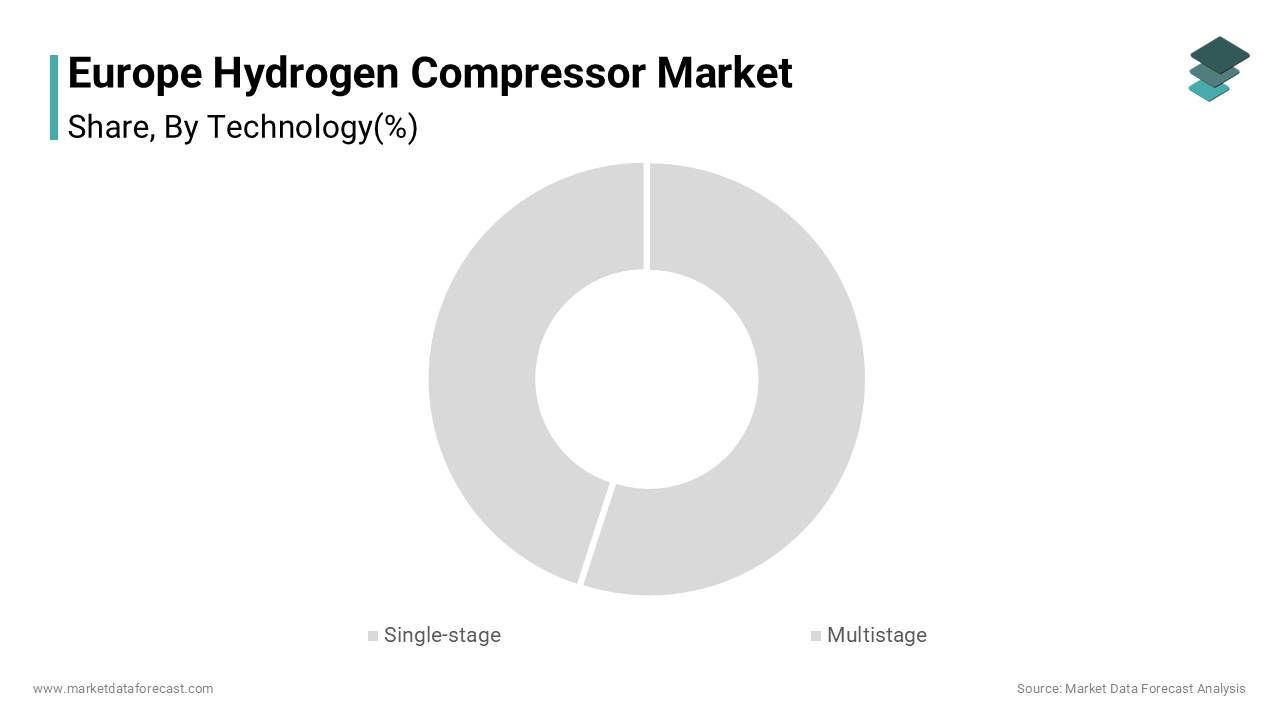
The single stage hydrogen compressors segment is likely to experience the fastest CAGR of 18.2% from 2025 to 2033. The rapid expansion of the single stage hydrogen compressors segment is driven by emerging applications that prioritize simplicity, low capital cost, and moderate pressure requirements—typically below 50 bar. Electrolyzer manufacturers such as ITM Power and ThyssenKrupp Nucera increasingly integrate single stage compressors directly into their stack systems to boost hydrogen output from ambient pressure to 30 bar for immediate grid injection or on site storage. Besides, small scale industrial users in the food and electronics sectors, where hydrogen is used for inerting or annealing, favor compact single stage units due to lower maintenance needs and smaller footprint. Their modular nature also supports decentralized hydrogen production in rural areas where grid connectivity is limited. The rollout of distributed green hydrogen in Europe is driven by single-stage compressors, which provide the key technology for simple, cost-effective system integration.
By Type Insights
The oil free hydrogen compressors segment was the largest segment in the Europe hydrogen compressor market and captured a significant share in 2024. Stringent purity requirements in fuel cell mobility and sensitive industrial processes where even trace hydrocarbon contamination can poison catalysts or compromise product quality are fuelling the growth of the oil free hydrogen compressors segment. Regulatory bodies are establishing stringent hydrogen purity standards for automotive applications by favoring technologies that ensure oil-free compression to meet these requirements. Public hydrogen refueling infrastructure in several European countries is exclusively adopting oil-free compression systems to adhere to international purity standards. Key green hydrogen export facilities and industrial projects are mandating oil-free compression technology to satisfy certification requirements for downstream applications. Certification programs have introduced policies that deny financial incentives to hydrogen produced using oil-lubricated compression systems. This regulatory and technical alignment ensures oil free compressors remain the default choice across high value hydrogen applications in Europe.
The oil-based hydrogen compressors segment is on the rise and is expected to be the fastest growing segment in the regional market by witnessing a CAGR of 15.4% during the forecast period due to factors like cost sensitive industrial retrofits and non-mobility applications where ultra-high purity is not critical. These systems, typically modified reciprocating compressors with oil lubrication, offer lower upfront costs than oil free alternatives and benefit from established maintenance ecosystems in legacy chemical and refining facilities. Moreover, the European steel sector’s early pilot projects, initially employed oil based units for inerting and purge gas compression before transitioning to oil free systems. While excluded from mobility and export chains, oil based compressors serve as a pragmatic bridge technology for industries seeking affordable hydrogen integration during the early transition phase.
By End User Insights
The chemical segment led the Europe hydrogen compressor market and occupied a 45.3% share in 2024. Hydrogen’s foundational role as a feedstock in ammonia, methanol, and refining processes, activities deeply embedded in Europe’s industrial base, has primarily contributed to the expansion of the chemical segment. Millios of tonnes of hydrogen are consumed annually by EU chemical plants, with most requiring compression for reaction feed or storage, as per sources. Ammonia facilities alone operate numerous large scale compressors, many recently upgraded to handle green hydrogen under the EU’s Carbon Border Adjustment Mechanism compliance strategies. Furthermore, the European Green Deal’s Industrial Emissions Directive mandates emission reductions that are accelerating hydrogen substitution in hydrogenation and desulfurization units. Major players are investing billions in green hydrogen integration, directly driving compressor procurement. The chemical industry’s capital intensity, regulatory exposure, and process integration needs make it the most stable and substantial end user segment in the European market.
The Other End Users segment is expected to exhibit a noteworthy CAGR of 21.6% from 2025 to 2033. The swift expansion of the other end users segment is fueled by the rapid deployment of new hydrogen applications beyond traditional industry. The EU’s Alternative Fuels Infrastructure Regulation requires 1 000 public hydrogen refueling stations by 2030, each requiring at least one high pressure compressor, a mandate already driving installations in France, Italy, and Denmark. Simultaneously, power to X projects such as NortH2 in the Netherlands and FlagshipONE in Sweden are building synthetic fuel plants that compress green hydrogen for reaction with captured CO2 by creating demand for mid pressure units. In the steel sector, some fossil free pilot plant uses hydrogen compressors to supply direct reduced iron reactors. Unlike the mature chemical sector, these applications are scaling from near zero, creating exponential growth in compressor demand across a diversified set of high impact industries.
REGIONAL ANALYSIS
Germany Hydrogen Compressor Market Analysis
Germany dominated the Europe hydrogen compressor market by accounting for a 30.8% share in 2024. The dominance of Germany is primarily driven by a coordinated national hydrogen strategy that integrates industrial decarbonization, mobility, and import infrastructure. The country operates public hydrogen refueling stations and hosts Europe’s first hydrogen backbone pipeline network, H2ercules, which requires compression at 15 interconnect points. Industrial giants are retrofitting facilities with green hydrogen systems, directly stimulating compressor orders. The presence of leading compressor manufacturers like Burckhardt Compression and MAN Energy Solutions further strengthens the domestic supply chain. So, the nation’s integrated policy industry and infrastructure ecosystem ensures its continued dominance in compressor deployment.
Netherlands Hydrogen Compressor Market Analysis
The Netherlands is the next biggest player in the Europe hydrogen compressor market and held a 14.1% share in 2024. The prominence of these compressors in the Netherlands is fuelled by the country's role as Europe’s envisioned hydrogen import and distribution hub by leveraging the Port of Rotterdam and existing gas infrastructure. Projects such as NortH2 and Porthos are commissioning multi megawatt compressor stations to link offshore wind electrolysis with onshore industry. Apart from these, the country’s dense natural gas grid is being repurposed for hydrogen,. The Netherlands’ geographic position, regulatory clarity, and port logistics make it a critical node in Europe’s hydrogen value chain and a major driver of compressor demand.
France Hydrogen Compressor Market Analysis
France is an attractive country in the Europe hydrogen compressor market, with a state led industrial decarbonization agenda centered on green hydrogen for refineries, steel, and heavy transport. France is setting ambitious targets for the expansion of its hydrogen electrolysis capacity as part of its national strategy. Extensive hydrogen compression infrastructure is becoming a critical requirement at various production and distribution points across the country. Major industrial players, such as the Grandpuits biorefinery and the Dunkirk steel plant, are leading the adoption of industrial-scale, multistage compression systems for their on-site hydrogen applications. There is a clear government mandate and a growing network of operational refuelling stations supporting the expansion of hydrogen mobility. France is establishing itself as a southern European hydrogen corridor, utilizing its robust nuclear-powered electrolysis capabilities and cross-border pipeline initiatives to ensure the ongoing deployment of necessary compressor infrastructure.
Sweden Hydrogen Compressor Market Analysis
Sweden witnessed a steady growth in the Europe hydrogen compressor market due to pioneering fossil-free steel production and renewable-powered electrolysis in a highly electrified economy. Furthermore, Sweden participates in the Nordic Hydrogen Corridor, linking with Norway and Finland via compressed hydrogen transport. Its focus on heavy industry decarbonization and renewable integration makes Sweden a high growth, high impact market for specialized compressors.
United Kingdom Hydrogen Compressor Market Analysis
The United Kingdom is predicted to grow in the European hydrogen compressor market during the forecast period owing to ambitious offshore wind to hydrogen projects and industrial cluster decarbonization. Projects are commissioning compressor stations to link electrolyzers with industrial users and refueling networks. Despite its non-EU status, the UK aligns with European purity and safety standards, ensuring compatibility with continental supply chains. Hence, the UK remains a strategically significant and technically advanced market for hydrogen compression technologies
COMPETITVE LANDSCAPE
The Europe hydrogen compressor market features a dynamic competitive landscape comprising specialized industrial engineering firms, legacy gas compression players, and emerging technology startups. Competition is driven less by price and more by technical differentiation in efficiency, reliability, oil free operation, and compliance with stringent EU regulations such as the Pressure Equipment Directive and ATEX. Established players like Burckhardt Compression and NEUMAN & ESSER leverage decades of compression expertise and localized manufacturing to secure large infrastructure contracts, while global firms such as Howden and Atlas Copco adapt their industrial platforms for hydrogen applications. New entrants are introducing disruptive technologies like electrochemical and ionic liquid compressors but face hurdles in scalability and field validation. The market is also witnessing consolidation through joint ventures and technology alliances to bundle compression with electrolysis or dispensing. With project timelines tightening under REPowerEU and national hydrogen strategies, the ability to deliver certified, high availability systems on schedule has become the decisive competitive factor, favoring firms with integrated engineering and service capabilities across the hydrogen value chain.
KEY MARKET PLAYERS
Some of the companies that are playing a dominating role in the Europe Hydrogen Compressor Market include
- Burckhardt Compression AG
- Howden Group Ltd.
- Atlas Copco AB
- Siemens Energy AG
- Nel ASA
- PDC Machines Inc.
- Haug Kompressoren AG
- Ariel Corporation
- Bauer Kompressoren GmbH
- Gardner Denver Holdings, Inc.
- Hydrogenics Corporation (a Cummins Inc. company)
- Kobelco Compressors Europe B.V.
- Sauer Compressors
- Mitsui E&S Machinery Co., Ltd.
- Anest Iwata Corporation
- Greenfield Compression
- Hitachi Industrial Equipment Systems Co., Ltd.
- Hydro-Pac Inc.
- Coltri Compressors
- J.P. Sauer & Sohn Maschinenbau GmbH
Top Players in the Europe Hydrogen Compressor Market
Burckhardt Compression AG
Burckhardt Compression AG, headquartered in Basel Switzerland, is a global leader in high pressure compression technologies with deep expertise in hydrogen applications. The company supplies diaphragm and reciprocating compressors for refueling stations, industrial hydrogen networks, and green hydrogen export terminals across Europe. It plays a critical role in enabling 700 bar fuel cell mobility infrastructure and pipeline injection systems. Its focus on reliability, efficiency, and compliance with EU safety directives supports its strategic position in both European and global hydrogen ecosystems.
NEUMAN & ESSER GROUP
NEUMAN & ESSER GROUP, based in Übach Palenberg Germany, is a prominent manufacturer of hydrogen compressors serving industrial, mobility, and energy sectors. The company offers both oil free diaphragm and advanced ionic liquid compressors capable of pressures up to 1 000 bar. It actively supports Europe’s hydrogen valleys and refueling corridor initiatives with customized compression solutions. The firm also collaborated with Siemens Energy on integrated electrolyzer compression skids for green hydrogen plants. Its engineering heritage, local manufacturing footprint, and commitment to ATEX and PED compliance make it a trusted partner for European infrastructure developers and a key contributor to global hydrogen standardization efforts.
Howden Group Ltd
Howden Group Ltd, a UK based industrial compression specialist, has emerged as a significant player in the European hydrogen compressor market through its Howden Hydrogen division. The company provides oil free screw and reciprocating compressors for applications ranging from ammonia production to hydrogen refueling and power to X facilities. Howden leverages its global service network to support projects in over 30 countries while maintaining strong R&D ties with European research institutions. The company also joined the European Clean Hydrogen Alliance to shape technical guidelines. Its ability to offer lifecycle support and modular designs aligns with Europe’s need for scalable and maintainable hydrogen infrastructure.
Top Strategies Used by the Key Market Participants
Key players in the Europe hydrogen compressor market are pursuing vertical integration by co developing compression systems with electrolyzer and refueling equipment manufacturers to ensure compatibility and performance optimization. They are investing in digital twin and remote monitoring technologies to enhance predictive maintenance and system uptime. Strategic partnerships with energy majors and industrial conglomerates secure early access to large scale hydrogen projects. Companies are establishing dedicated hydrogen testing and validation centers to demonstrate compliance with evolving EU safety and purity standards. Geographic expansion through localized assembly and service hubs in key hydrogen valleys improves delivery speed and regulatory alignment. Innovation in material science to combat hydrogen embrittlement is a core R&D focus. Lastly, active participation in European standardization bodies allows them to influence technical regulations and certification protocols shaping market entry barriers.
MARKET SEGMENTATION
The research report on the europe hydrogen compressor market has been segmented and sub-segmented based on categories.
By Technology
- Single-stage
- Multistage
By Type
- Oil-based
- Oil-free
By End-user Industry
- Chemical
- Oil and Gas
- Other End-user Industries
By Country
- UK
- France
- Spain
- Germany
- Italy
- Russia
- Sweden
- Denmark
- Switzerland
- Netherlands
- Turkey
- Czech Republic
- Rest of Europe