- Product Description Description
- Table of Contents TOC
- List of Table & Figure LOT
- Get Free Sample PDF Sample PDF
Market Size, 2025
$367.50 MnMarket Estimate, 2026
$575.66 MnMarket Forecast, 2034
$20,859.41 MnCAGR, 2026–2034
56.64%Europe Hydrogen Electrolyzer Market Report Summary
The Europe hydrogen electrolyzer market was valued at USD 367.50 million in 2025, is expected to reach USD 575.66 million in 2026, and is projected to grow significantly to USD 20,859.41 million by 2034, registering an exceptional CAGR of 56.64% during the forecast period from 2026 to 2034. The growth of the Europe hydrogen electrolyzer market is primarily driven by increasing investments in green hydrogen production, industrial decarbonization initiatives, and renewable energy integration aligned with the European Green Deal and REPowerEU strategy. Hydrogen electrolyzers are becoming critical infrastructure for producing low-carbon hydrogen used in steel, chemicals, energy storage, and transport sectors. Strong policy support, cross-border hydrogen pipeline development, and rising renewable electricity generation are accelerating electrolyzer deployment across Europe despite challenges related to capital costs, grid integration, and critical material supply.
Key Market Trends
-
Rapid expansion of green hydrogen projects and hydrogen valleys across Europe is supported by EU funding programs.
-
Increasing adoption of PEM electrolyzers for flexible operation alongside wind and solar energy.
-
Growing integration of electrolyzers into offshore wind, solar farms, and industrial clusters.
-
Development of the European Hydrogen Backbone enabling cross-border hydrogen trade.
-
Rising investments in gigawatt-scale manufacturing facilities to reduce system costs and improve supply chain resilience.
Segmental Insights
- Based on type, the alkaline electrolyzer segment held the largest share of the Europe hydrogen electrolyzer market in 2025 due to its technological maturity, lower capital costs, and suitability for continuous industrial hydrogen production. These systems remain the preferred choice for large-scale steel, ammonia, and refining projects requiring stable baseload operation.
- The polymer electrolyte membrane (PEM) electrolyzer segment is expected to register the fastest growth during the forecast period owing to its ability to operate dynamically with intermittent renewable power sources. PEM technology is increasingly used in mobility applications, grid balancing projects, and renewable energy curtailment zones.
- Based on end-user industry, the energy segment dominated the market by accounting for a major share in 2025, supported by rising demand for long-duration energy storage, seasonal power balancing, and hydrogen-based electricity generation in high renewable penetration grids. The automobile segment is projected to witness rapid growth driven by expanding deployment of fuel cell electric trucks, buses, and hydrogen refueling infrastructure across Europe.
Regional Insights
- Germany led the Europe hydrogen electrolyzer market in 2025 supported by strong industrial decarbonization policies, large funding programs, and domestic manufacturing capabilities from companies such as Siemens Energy and Thyssenkrupp Nucera.
- France captured a significant share of the regional market due to state-led hydrogen investments and the integration of electrolysis with nuclear and renewable power generation.
- The Netherlands plays a strategic role as a hydrogen logistics hub supported by the Port of Rotterdam and major offshore wind-powered electrolysis projects.
- Spain is expected to register strong growth during the forecast period owing to its abundant solar resources, low-cost renewable electricity, and export-oriented green hydrogen projects.
- Denmark continues to emerge as a key innovation hub driven by offshore wind integration, island-based electrolysis pilots, and cross-border hydrogen corridor development.
Competitive Landscape
The Europe hydrogen electrolyzer market is highly competitive and innovation-driven, with companies focusing on scaling manufacturing capacity, improving catalyst efficiency, and developing modular electrolyzer systems to support Europe’s rapid hydrogen expansion. Market players are strengthening partnerships with utilities, industrial off-takers, and renewable energy developers to secure large-scale projects and long-term hydrogen supply agreements. Major companies operating in the Europe hydrogen electrolyzer market include Thyssenkrupp Nucera AG & Co. KGaA, Siemens Energy AG, Nel ASA, ITM Power plc, McPhy Energy S.A., Sunfire GmbH, John Cockerill Hydrogen, Enapter AG, Cummins Inc. (Hydrogenics), Plug Power Inc., Elogen S.A., and H-TEC Systems GmbH.
Europe Hydrogen Electrolyzer Market Size
The Europe hydrogen electrolyzer market size was valued at USD 367.50 million in 2025 and is anticipated to reach USD 575.66 million in 2026 from USD 20859.41 million by 2034, growing at a CAGR of 56.64% during the forecast period from 2026 to 2034
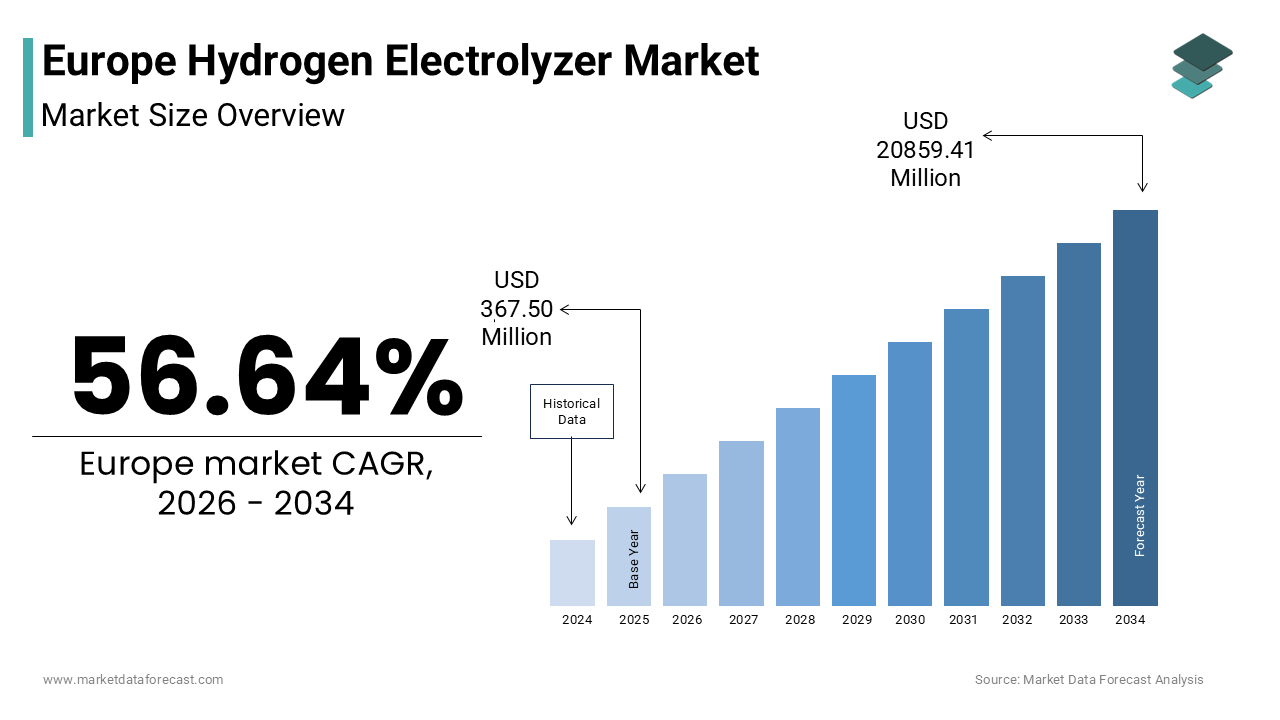
Hydrogen electrolyzers are electrochemical devices that split water into hydrogen and oxygen using renewable or low carbon electricity, producing green or clean hydrogen without greenhouse gas emissions. These systems are primarily based on alkaline, proton exchange membrane (PEM), and emerging solid oxide technologies and are central to the European Union’s strategy for decarbonizing hard to abate sectors such as heavy industry, long haul transport, and seasonal energy storage. Unlike gray or blue hydrogen derived from fossil fuels, electrolytic hydrogen aligns with the EU’s climate neutrality goals under the European Green Deal and the REPowerEU plan, which targets 10 million tonnes of domestic renewable hydrogen production by 2030. According to the European Commission, more than 40 gigawatts of electrolyzer capacity are planned for deployment across EU member states by 2030, supported by national hydrogen strategies and cross border projects such as the European Hydrogen Backbone. As per Eurostat, the EU generated about 44% of its electricity from renewable sources in 2023, providing a growing surplus of wind and solar power suitable for cost effective electrolysis during off peak hours. Furthermore, the European Environment Agency notes that industrial processes account for roughly 19% of the EU’s total CO2 emissions, creating urgent demand for clean hydrogen as a feedstock and fuel. This positions electrolyzers not merely as energy equipment but as strategic infrastructure enabling systemic decarbonization across Europe’s economy.
MARKET DRIVERS
EU Green Deal and Binding Renewable Hydrogen Targets Accelerate Deployment
The European Union’s legally binding framework for renewable hydrogen production serves as the primary catalyst for electrolyzer adoption across member states, which is majorly propelling the growth of the European hydrogen electrolyzer market. The revised Renewable Energy Directive (RED III), enacted in 2023, mandates that a significant share of hydrogen used in industry must be renewable by 2030, rising further by 2035, with strict additionality and temporal correlation requirements ensuring new renewable capacity powers electrolyzers. According to the European Commission, this translates to a minimum of 10 million tonnes of domestically produced renewable hydrogen annually by 2030, requiring approximately 90 to 100 gigawatts of electrolyzer capacity when accounting for load factors. National strategies reinforce this ambition. Germany’s H2Global initiative has committed billions of euros to scale electrolysis, while France’s France 2030 plan allocates substantial funding specifically for green hydrogen production. The EU Innovation Fund has already awarded over 1.5 billion euros to large scale electrolyzer projects such as NortH2 in the Netherlands and Hybrit in Sweden. These policy instruments create predictable demand signals, de‑risk private investment, and establish clear certification pathways through the Guarantees of Origin system. As a result, industrial off‑takers in steel, chemicals, and refining are signing long term hydrogen purchase agreements, directly driving electrolyzer procurement and project financing across the continent.
Industrial Decarbonization Imperatives in Hard to Abate Sectors
Europe’s heavy industries face existential pressure to eliminate fossil fuel dependency, which is making electrolyzers indispensable for producing green hydrogen as a clean feedstock and high temperature process fuel and contributing to the European hydrogen electrolyzer market expansion. According to the European Environment Agency, the steel sector alone emits hundreds of millions of tonnes of CO2 annually, representing around 6% of total EU emissions, while ammonia and methanol production rely almost entirely on natural gas derived hydrogen. The Carbon Border Adjustment Mechanism (CBAM), which entered its transitional phase in 2023, imposes carbon costs on imported goods, incentivizing domestic producers to adopt clean alternatives. HYBRIT, a joint venture between SSAB, LKAB, and Vattenfall in Sweden, has already demonstrated fossil free steel using hydrogen from a PEM electrolyzer, with plans to scale further by 2025. Similarly, BASF and Yara are piloting green ammonia plants in Germany and Norway powered by multi‑megawatt electrolyzers. According to the data from the European Steel Association, dozens of industrial hydrogen valleys are under development across the EU, each integrating local renewable generation, electrolysis, and end use. With EU Emissions Trading System allowance prices exceeding 80 euros per tonne in 2023, the economic case for electrolytic hydrogen strengthens daily. These industrial clusters transform electrolyzers from standalone units into core nodes of regional zero carbon ecosystems.
MARKET RESTRAINTS
High Capital Expenditure and Limited Economies of Scale
Despite policy support, the high upfront cost of electrolyzer systems remains a significant barrier to the European hydrogen electrolyzer market. According to the International Renewable Energy Agency, the capital expenditure for PEM electrolyzers averaged between 1,200 and 1,600 euros per kilowatt in 2023, while alkaline systems ranged from 800 to 1,100 euros per kilowatt, figures that remain prohibitive without substantial subsidies. Although costs are projected to fall significantly by 2030 due to scaling and automation, current project economics rely heavily on public funding. The European Court of Auditors reported in 2024 that only a small share of announced electrolyzer projects had secured full private financing, with the rest dependent on EU or national grants. Manufacturing capacity also lags demand. As per the European Clean Hydrogen Partnership, European electrolyzer production stood at just 1.5 gigawatts annually in 2023, far below the 10-gigawatt target set for 2025 under the Net Zero Industry Act. Supply chain bottlenecks exacerbate costs as platinum, iridium, and titanium components face limited global availability, with the EU importing most of its iridium from South Africa according to the European Raw Materials Alliance. Until localized manufacturing and material recycling mature, capital intensity will constrain deployment velocity, particularly for small and medium industrial users lacking access to green finance instruments.
Grid Connection Delays and Renewable Energy Integration Complexity
The deployment of large-scale electrolyzers is frequently hampered by protracted grid connection timelines and insufficient renewable energy curtailment mechanisms across Europe, which is another significant impediment to the growth of the European hydrogen electrolyzer market. According to the European Network of Transmission System Operators for Electricity, average grid connection waiting times for industrial consumers exceeded three years in 2023, with Germany and Spain reporting large backlogs in pending renewable and electrolysis projects. Electrolyzers require stable high-capacity connections, yet many suitable sites lack upgraded substations or transmission corridors. Moreover, regulatory frameworks often fail to incentivize optimal operation. While the EU promotes “additionality” (new renewables powering electrolysis), few member states have implemented dynamic pricing or direct power purchase agreement models that allow electrolyzers to respond to real time surplus generation. As per the data from WindEurope, the EU curtailed significant volumes of wind power in 2023, enough to produce millions of tonnes of hydrogen, yet only a small fraction was captured by electrolyzers due to inflexible grid access rules. Without streamlined permitting, dedicated hydrogen grid injection points, and market designs that reward flexibility, electrolyzers cannot fulfill their role as demand side assets balancing variable renewables, which is undermining both economic viability and system integration potential.
MARKET OPPORTUNITIES
Integration into Cross Border Hydrogen Transport Infrastructure
Europe’s coordinated development of a transnational hydrogen pipeline network presents a transformative opportunity for the European hydrogen electrolyzer market. The European Hydrogen Backbone initiative plans to repurpose and construct over 28,000 kilometers of hydrogen pipelines by 2030, connecting production hubs in Iberia, the North Sea, and Southern Europe with demand centers in Germany, Italy, and Central Europe. According to Gas Infrastructure Europe, this network will reduce hydrogen transport costs significantly compared to trucking, making large scale electrolysis economically viable even in regions with moderate renewable resources. Projects such as HyDeal Ambition aim to deliver green hydrogen at competitive prices by 2030 through integrated solar farms and gigawatt scale electrolysis in Spain feeding into the backbone. The European Commission’s Hydrogen Bank auction mechanism further de‑risks investment by offering long term contracts for difference to bridge the cost gap between green and fossil hydrogen. As pipeline interconnectors become operational, electrolyzer manufacturers can design standardized modular units for rapid deployment in hydrogen valleys, knowing that produced hydrogen will reach diversified industrial customers across borders. This infrastructure certainty transforms electrolyzers from isolated assets into interconnected nodes of a pan‑European clean energy market.
Electrolyzer Deployment in Renewable Energy Curtailment Zones
Strategic placement of electrolyzers in regions with high renewable energy curtailment offers an immediate economic and grid balancing opportunity by converting otherwise wasted electricity into storable hydrogen, which is another potential opportunity in the European hydrogen electrolyzer market. According to the European Environment Agency, Germany curtailed several terawatt hours of wind power in 2023, primarily in northern coastal states where grid congestion prevents southward transmission. Installing electrolyzers near these constrained wind and solar farms allows direct consumption of surplus power without additional grid upgrades. The Danish island of Bornholm, for instance, operates a PEM electrolyzer coupled with offshore wind that runs during curtailment events, producing hydrogen for local buses and ferries. Similarly, Portugal’s Sines industrial zone leverages abundant solar irradiance to power multi‑megawatt electrolysis with minimal land competition. The EU’s upcoming Guidelines on Renewable Energy Communities encourage such co‑location by simplifying permitting for hybrid projects. By acting as flexible loads that absorb excess generation, electrolyzers enhance grid stability, reduce renewable developer losses, and lower levelized hydrogen costs, which is creating a triple win for system operators, producers, and clean fuel consumers across Europe’s most renewable‑rich but grid‑constrained territories.
MARKET CHALLENGES
Shortage of Skilled Workforce for Manufacturing and Maintenance
The rapid scaling of electrolyzer deployment in Europe is outpacing the availability of specialized technicians, engineers, and supply chain professionals needed for assembly, installation, and servicing, which is a primary challenge to the European hydrogen electrolyzer market growth. According to the European Commission’s Skills Agenda, the clean hydrogen sector will require a very large workforce by 2030, yet current vocational training programs lack standardized curricula for electrolyzer technology. A 2024 survey by the European Federation of Chemical Engineers found that most electrolyzer manufacturers reported delays in project commissioning due to shortages of certified personnel capable of handling high pressure hydrogen systems and power electronics integration. Germany’s Federal Institute for Vocational Education notes that only a limited number of technicians nationwide hold certifications for PEM stack maintenance, which is a critical bottleneck as systems age. Moreover, the interdisciplinary nature of electrolysis demands cross‑domain expertise rarely found in traditional energy or chemical sectors. Without urgent investment in apprenticeships, university specializations, and cross‑border recognition of qualifications, Europe risks undermining its hydrogen ambitions through human capital gaps that delay construction, inflate operational costs, and compromise safety standards across the emerging value chain.
Material Criticality and Geopolitical Supply Chain Risks
Europe’s electrolyzer industry faces acute vulnerability due to dependence on geographically concentrated critical raw materials essential for cell performance and durability, which is further challenging the growth of the European hydrogen electrolyzer market. Proton exchange membrane (PEM) electrolyzers require iridium as a catalyst, which is an element with annual global production of only a few tonnes, of which most originates from South Africa according to the United States Geological Survey. Similarly, platinum group metals and high purity titanium for bipolar plates are largely sourced from Russia, China, and Japan. The European Commission’s 2023 Critical Raw Materials Act identifies iridium and platinum as strategic materials but acknowledges that domestic recycling rates for electrolyzer components remain very low due to immature collection and refining infrastructure. A supply disruption could severely constrain scaling; producing 100 gigawatts of PEM capacity would consume nearly the entire current global iridium output for several years. While research into low‑iridium or iridium‑free catalysts is advancing, commercial deployment remains distant. Until Europe establishes secure circular supply chains, the electrolyzer rollout will remain exposed to geopolitical volatility and price spikes that threaten cost reduction trajectories and energy sovereignty objectives.
REPORT COVERAGE
| REPORT METRIC | DETAILS |
| Market Size Available | 2025 to 2034 |
| Base Year | 2025 |
| Forecast Period | 2026 to 2034 |
| CAGR | 56.64% |
| Segments Covered | By Type, End-user and Region |
| Various Analyses Covered | Regional & Country Level Analysis, Segment-Level Analysis, DROC, PESTLE Analysis, Porter’s Five Forces Analysis, Competitive Landscape, Analyst Overview on Investment Opportunities |
| Countries Covered | UK, France, Spain, Germany, Italy, Russia, Sweden, Denmark, Switzerland, the Netherlands, Turkey, the Czech Republic, and the Rest of Europe. |
| Market Leaders Profiled | Thyssenkrupp Nucera AG & Co. KGaA, Siemens Energy AG, Nel ASA, ITM Power plc, McPhy Energy S.A., Sunfire GmbH, John Cockerill Hydrogen, Enapter AG, Cummins Inc. (Hydrogenics), Plug Power Inc., Elogen S.A., and H-TEC Systems GmbH |
SEGMENTAL ANALYSIS
By Type Insights
The alkaline electrolyzer segment dominated the Europe hydrogen electrolyzer market by holding 55.6% of the regional market share in 2025. The dominance of alkaline electrolyzer segment in the regional market is driven by its technological maturity, cost efficiency at scale, and suitability for large industrial applications requiring steady-state operation. One key driver is its proven track record in industrial hydrogen production over several decades. Alkaline systems use nickel-based electrodes and potassium hydroxide electrolyte, materials that are abundant, non-critical, and significantly cheaper than the platinum group metals required in PEM systems. According to the European Clean Hydrogen Partnership, alkaline electrolyzers currently achieve capital costs in the range of 800 to 1,100 euros per kilowatt, approximately 30% lower than PEM counterparts, making them the preferred choice for gigawatt-scale projects like Hybrit in Sweden and NortH2 in the Netherlands. Furthermore, their durability under continuous operation aligns with the baseload demand profiles of ammonia and steel plants, which account for a majority of current clean hydrogen off-take agreements as per the European Hydrogen Backbone initiative. The technology also benefits from established manufacturing know-how, with companies like thyssenkrupp Nucera having deployed significant alkaline capacity globally and major production facilities in Germany ensuring EU supply chain resilience. As Europe prioritizes rapid decarbonization of heavy industry through multi-hundred-megawatt electrolysis hubs, alkaline technology remains the workhorse due to its balance of reliability, scalability, and affordability.

The polymer electrolyte membrane (PEM) electrolyzer segment is the fastest growing and is predicted to witness a CAGR of 30.6% over the forecast period. The growth of PEM segment in the European market its superior responsiveness, dynamic operation, and compact footprint, attributes essential for integration with variable renewable energy sources. A major factor is its compatibility with intermittent wind and solar power. PEM systems can ramp from 10 to 100% load in under 30 seconds and operate efficiently at partial load, critical for capturing curtailed electricity during low demand periods. According to WindEurope, the EU curtailed around 15 terawatt hours of wind power in 2023, and PEM electrolyzers are uniquely positioned to monetize this surplus. Projects like the Refhyne II refinery installation in Germany and the HyBalance facility in Denmark rely on PEM technology for grid balancing services. Additionally, PEM’s high purity hydrogen output meets stringent requirements for fuel cell vehicles and semiconductor manufacturing. The European Commission’s Innovation Fund has allocated over 600 million euros to PEM-based projects since 2022, recognizing their role in flexible clean hydrogen production. Advances in iridium catalyst loading, reduced significantly by companies like ITM Power, are lowering material dependency and costs. As Europe’s energy system becomes increasingly renewable-driven, PEM electrolyzers transition from niche assets to indispensable flexibility providers, enabling real-time sector coupling between power, industry, and transport.
By End User Insights
The energy segment led the market by accounting for 40.9% of the regional market share in 2025. The growth of energy segment in the European market is attributed to the hydrogen’s dual role as a long-duration energy storage medium and a clean fuel for power generation in grids with high renewable penetration. A primary driver is the need to manage seasonal imbalances in renewable supply. According to the European Network of Transmission System Operators for Electricity, wind and solar generation exceeded 44% of the EU electricity mix in 2023, yet winter lulls create multi-week deficits that batteries cannot address. Electrolyzers convert summer surplus into hydrogen stored in salt caverns or depleted gas fields for reconversion via fuel cells or hydrogen turbines during winter peaks. The HyStock project in the Netherlands plans to store large volumes of hydrogen in underground reservoirs by 2027 specifically for grid balancing. Utilities like Iberdrola and Ørsted are integrating multi-megawatt electrolyzers into hybrid renewable plants to provide ancillary services. Data from the International Renewable Energy Agency indicates that hydrogen-based storage can reduce renewable curtailment while enhancing grid stability. National strategies reinforce this trend, with Germany’s H2Grid program mandating that new offshore wind farms include electrolysis capacity by 2026. With the EU targeting 10 million tonnes of renewable hydrogen production annually by 2030, the energy sector remains the foundational demand pillar for electrolyzer deployment across the continent.
The automobile segment is the fastest growing and is estimated to record a CAGR of 35.8% over the forecast period owing to the commercialization of heavy-duty fuel cell electric vehicles (FCEVs), where battery weight and refueling time make hydrogen the only viable zero-emission solution. According to the European Automobile Manufacturers Association, thousands of fuel cell trucks and buses are expected to be deployed across EU logistics corridors by 2027 under the Joint Initiative for Hydrogen Vehicles Across Europe program. Companies like Daimler Truck, Volvo, and Scania are launching Class 8 FCEVs with ranges exceeding 800 kilometers, requiring high purity hydrogen achievable through PEM electrolysis. The EU Alternative Fuels Infrastructure Regulation mandates that hydrogen refueling stations be installed every 200 kilometers on the Trans-European Transport Network by 2030, creating direct demand for localized electrolyzers at refueling hubs. Pilot projects in Austria and Switzerland already operate on-site electrolysis to ensure green hydrogen supply. Data from the Fuel Cells and Hydrogen Joint Undertaking indicates that each heavy-duty refueling station requires multiple megawatts of electrolyzer capacity, translating to significant near-term demand. As urban delivery fleets and port operations adopt FCEVs to meet zero-emission zones, the automobile segment will drive decentralized electrolyzer deployment at unprecedented velocity.
REGIONAL ANALYSIS
Germany Hydrogen Electrolyzer Market Analysis
Germany led the hydrogen electrolyzer market in Europe in 2025 by occupying a share of 25.9% of the regional market. The dominance of Germany in the European hydrogen electrolyzer market is primarily driven by its industrial decarbonization urgency, robust policy framework, and advanced manufacturing base. The country’s National Hydrogen Strategy targets 10 gigawatts of domestic electrolysis capacity by 2030, although recent reports suggest progress may be slower than expected. According to the Federal Ministry for Economic Affairs and Climate Action, over 8 billion euros have been committed through the H2Global and IPCEI programs to de-risk private investmentbundeswirtschaftsministerium.de. Germany hosts global leaders like thyssenkrupp Nucera and Siemens Energy, whose gigafactories in Duisburg and Berlin aim to produce 3 gigawatts of electrolyzer capacity annually by 2025. The Carbon Contracts for Difference scheme guarantees price stability for green hydrogen producers, further accelerating deployment. Heavy industry accounts for a significant share of national emissions, and with strong grid interconnections to North Sea wind, Germany’s integrated approach combining policy, finance, and industrial demand solidifies its position as Europe’s hydrogen powerhouse.
France Hydrogen Electrolyzer Market Analysis
France captured the second largest share of the European hydrogen electrolyzer market in 2025 owing to the state-led industrial strategy, nuclear-powered electrolysis, and cross-border collaboration. The France 2030 investment plan allocates nearly 2 billion euros specifically for green hydrogen production, with a focus on gigawatt-scale electrolysis co-located with offshore wind and nuclear facilities. EDF and Engie are pioneering “pink hydrogen” projects using low-carbon nuclear power for high-capacity factor electrolysis, a model suited to France’s electricity mix where nuclear remains dominant. The Normandy Hydrogen Valley integrates refineries, steel plants, and port logistics with large electrolysis clusters targeting decarbonization by 2035. According to the French Environment and Energy Management Agency, dozens of hydrogen valleys are operational or planned nationwide, creating dense regional ecosystems. France also co-leads the IPCEI Hy2Use consortium with Germany, securing EU approval for multiple large-scale projects. This blend of public investment, technological diversification, and industrial clustering ensures sustained leadership in both green and low-carbon hydrogen pathways.
Netherlands Hydrogen Electrolyzer Market Analysis
Netherlands secured a promising share of the European hydrogen electrolyzer market in 2025. The strategic location of Netherlands, North Sea wind resources, and pioneering hydrogen infrastructure are promoting the market growth in Netherlands. The country is the cornerstone of the European Hydrogen Backbone, with the Port of Rotterdam designated as Europe’s primary hydrogen import and distribution hub. Government reports indicate the Netherlands may fall short of its electrolyzer capacity targets for 2030, with projections closer to 1.5 gigawatts. Projects like NortH2 aim to produce several gigawatts of green hydrogen by 2030 using dedicated wind power. The Dutch government’s SDE++ subsidy scheme offers financial support per kilogram of hydrogen produced, ensuring project bankability. Moreover, the Netherlands serves as a testbed for regulatory innovation, with the Hydrogen Act of 2023 establishing clear permitting and safety standards for large-scale electrolysis. With world-class ports, existing gas pipelines suitable for repurposing, and strong industrial off-takers like Shell and Yara, the Netherlands functions as Europe’s hydrogen gateway linking production, consumption, and international trade.
Spain Hydrogen Electrolyzer Market Analysis
Spain is predicted to register a prominent CAGR in the European hydrogen electrolyzer market during the forecast period. The exceptional solar irradiance, low land costs, and ambitious national targets are driving the Spanish market growth. The country receives abundant sunshine annually, making it ideal for low-cost solar-powered electrolysis. The National Integrated Energy and Climate Plan targets 11 gigawatts of electrolyzer capacity by 2030, with flagship projects like HyDeal Ambition planning multi-gigawatt solar-coupled electrolysis in Extremadura and Andalusia. According to Red Eléctrica de España, solar power accounted for around 21% of national electricity generation in 2024Wikipedia, providing abundant low-cost input for hydrogen production. The government’s Hydrogen Roadmap includes streamlined permitting for hybrid renewable hydrogen projects and tax incentives for green hydrogen derivatives like ammonia and e-methanol. Industrial clusters in Puertollano are attracting global investors including Iberdrola and Enagás, who are building large electrolysis hubs for export to Northern Europe. Spain’s combination of natural advantage, policy clarity, and export orientation positions it as Europe’s solar hydrogen leader.
Denmark Hydrogen Electrolyzer Market Analysis
Denmark is expected to account for a notable share of the European hydrogen electrolyzer market during the forecast period due to the offshore wind integration, small-scale innovation, and cross-sectoral hydrogen use. The country generates nearly 60% of its electricity from wind as per Ember data and is pioneering island-based electrolysis to capture curtailed power. The Bornholm Island project operates a PEM electrolyzer directly coupled to offshore wind, producing hydrogen for buses, ferries, and industrial use. Denmark’s Energy Agreement 2022 mandates that all new offshore wind tenders include electrolysis options, ensuring future capacity. Companies like Green Hydrogen Lab and Everfuel are developing modular electrolyzer units for decentralized refueling and industrial applications. According to the Danish Energy Agency, over 30 hydrogen refueling stations are planned by 2027Hydrogen Standard, supporting heavy transport decarbonization. Moreover, Denmark co-leads the Baltic Sea Hydrogen Corridor connecting Sweden, Poland, and Germany through pipeline and shipping routes. With strong public-private partnerships, agile regulation, and a culture of green engineering, Denmark serves as a testbed for scalable hydrogen solutions across Europe.
COMPETITIVE LANDSCAPE
Competition in the Europe hydrogen electrolyzer market is characterized by intense technological differentiation strategic scaling and deep policy integration. Incumbent industrial giants leverage decades of electrochemical engineering expertise to deliver proven large-scale systems primarily alkaline based for heavy industry. Meanwhile agile innovators focus on PEM technology optimized for dynamic renewable integration and mobility applications. The market is not price driven alone but defined by reliability scalability and alignment with EU regulatory requirements such as additionality temporal correlation and carbon intensity thresholds. New entrants face high barriers including capital intensity material criticality and complex certification processes yet benefit from unprecedented public funding through the Innovation Fund and national schemes. Consolidation is accelerating as companies acquire stack developers or balance of plant specialists to secure supply chains. Competition extends beyond hardware into service ecosystems including digital twins training and maintenance networks. Ultimately leadership is determined by the ability to deliver bankable gigawatt scale projects on time while navigating Europe’s intricate mosaic of industrial demand policy mandates and grid constraints.
KEY MARKET PLAYERS
Some of the companies that are playing a dominating role in the Europe Hydrogen Electrolyzer Market include
- Thyssenkrupp Nucera AG & Co. KGaA
- Siemens Energy AG
- Nel ASA
- ITM Power plc
- McPhy Energy S.A.
- Sunfire GmbH
- John Cockerill Hydrogen
- Enapter AG
- Cummins Inc. (Hydrogenics)
- Plug Power Inc.
- Elogen S.A.
- H-TEC Systems GmbH
Top Players in the Europe Hydrogen Electrolyzer Market
ThyssenKrupp Nucera AG & Co KGaA
ThyssenKrupp Nucera is a German industrial technology leader specializing in large scale alkaline electrolysis with a strong global footprint and deep integration into European decarbonization initiatives. The company’s advanced alkaline systems are deployed in multi hundred-megawatt projects across steel chemicals and refining sectors including the landmark Hybrit initiative in Sweden. ThyssenKrupp Nucera leverages decades of chlor alkali expertise to deliver highly efficient durable and cost-effective electrolyzers tailored for industrial baseload operation. Recently the company inaugurated a gigafactory in Duisburg Germany targeting 5 gigawatts of annual production capacity by 2026 to meet surging EU demand. It also partnered with E.ON and RWE to develop integrated renewable hydrogen hubs linking offshore wind to electrolysis and storage infrastructure. These actions reinforce its position as a cornerstone supplier for Europe’s heavy industry transition.
Siemens Energy AG
Siemens Energy is a German multinational providing cutting edge proton exchange membrane PEM electrolysis technology through its subsidiary Siemens Hydrogen Solutions. The company’s Silyzer platform powers flagship projects such as the 30-megawatt Refhyne II installation at Shell’s Rhineland refinery, which is the world’s largest PEM electrolyzer upon completion. Siemens Energy emphasizes dynamic operation grid balancing capabilities and digital twin integration enabling real time performance optimization. In recent years the company expanded its Berlin facility to increase PEM stack production and launched a modular product line scalable from 1 to 100 megawatts. It also collaborated with Iberdrola on solar powered electrolysis in Spain aligning with EU additionality rules. By combining power electronics heritage with hydrogen innovation Siemens Energy bridges renewable energy and industrial decarbonization across Europe.
Nel ASA
Nel is a Norwegian pioneer in both alkaline and PEM electrolysis with a vertically integrated manufacturing model spanning from R and D to system delivery. The company supplies standardized and custom electrolyzers to mobility industry and energy storage applications across more than 20 European countries. Nel’s focus on automation and lean production has driven significant cost reductions while maintaining high reliability in harsh climates. Recently Nel commissioned a 500-megawatt automated PEM stack factory in Herøya Norway and secured framework agreements with major European utilities for gigawatt scale deployments. It also partnered with Linde Engineering to develop containerized hydrogen solutions for refueling stations and industrial sites. Through continuous innovation and strategic scaling Nel strengthens Europe’s supply chain resilience and accelerates access to green hydrogen technologies.
Top Strategies Used by the Key Market Participants
Key players in the Europe hydrogen electrolyzer market pursue strategies centered on gigascale manufacturing policy alignment and industrial integration. Companies are rapidly expanding production capacity through gigafactories to achieve economies of scale and reduce capital costs. Strategic partnerships with utilities energy majors and industrial off takers de risk project financing and ensure offtake certainty. Vertical integration from stack production to balance of plant enhances quality control and delivery timelines. Active engagement with EU regulatory frameworks such as IPCEI and the Net Zero Industry Act secures funding and streamlines permitting. Technology diversification across alkaline and PEM platforms allows firms to address both steady state and flexible applications. Digitalization through remote monitoring predictive maintenance and performance analytics improves operational efficiency. These approaches collectively position electrolyzer manufacturers as enablers of Europe’s systemic energy transition rather than mere equipment suppliers.
MARKET SEGMENTATION
This research report on the Europe Hydrogen Electrolyzer Market has been segmented and sub-segmented based on the following categories.
By Type
- PEM
- Alkaline
- Solid Oxide Electrolyzers
By End-user
- Metal Fabrication
- Energy
- Electronics
- Automobile
- Food & Beverage
- Pharmaceuticals
- Others (Glass)
By Country
- UK
- France
- Spain
- Germany
- Italy
- Russia
- Sweden
- Denmark
- Switzerland
- Netherlands
- Turkey
- Czech Republic
- Rest of Europe