- Product Description Description
- Table of Contents TOC
- List of Table & Figure LOT
- Get Free Sample PDF Sample PDF
Market Size, 2025
$301.30 MnMarket Estimate, 2026
$373.97 MnMarket Forecast, 2034
$2106.55 MnCAGR, 2026–2034
24.12%Europe Hydrogen Fueling Station Market Report Summary
The Europe hydrogen fueling station market was valued at USD 301.30 million in 2025, is projected to reach USD 373.97 million in 2026, and is expected to reach USD 2106.55 million by 2034, growing at a CAGR of 24.12% during the forecast period (2026–2034). The market growth is driven by Europe’s accelerating transition toward zero-emission mobility, strong government initiatives promoting hydrogen infrastructure, and rising adoption of fuel cell electric vehicles (FCEVs). Additionally, collaborations between energy companies and automakers, coupled with funding for large-scale hydrogen refueling networks, are fueling the expansion of hydrogen fueling stations across the region.
Key Market Trends
- Increasing deployment of hydrogen refueling stations to support the adoption of fuel cell passenger and commercial vehicles.
- Growing public–private partnerships and EU funding programs such as the “Fit for 55” package and Hydrogen Europe initiatives.
- Technological advancements in hydrogen storage and dispensing systems to improve refueling efficiency and safety.
- Rising integration of renewable energy sources (solar and wind) for green hydrogen production to ensure sustainability.
- Expansion of cross-border hydrogen corridors connecting major European transportation routes and logistics hubs.
Segmental Insights
Based on Type, the medium station segment accounted for 52.3% of the Europe hydrogen fueling station market share in 2024, driven by its balanced capacity and cost-efficiency suited for both passenger and light commercial vehicles.
Small stations are expanding in urban pilot projects, while large-capacity stations are being deployed for heavy-duty transport and industrial applications.
Regional Insights
- Germany led the European hydrogen fueling station market with 38.3% share in 2024, supported by government incentives, robust automotive manufacturing, and well-established hydrogen infrastructure networks such as H2 MOBILITY.
- France continues to expand its hydrogen corridor networks and fleet-based refueling infrastructure under the national hydrogen strategy.
- The Netherlands and Denmark are emerging as regional hubs for hydrogen logistics and green hydrogen integration into refueling systems.
- The United Kingdom focuses on expanding hydrogen stations along key highways to support public transport and logistics fleets.
Competitive Landscape
The Europe hydrogen fueling station market is characterized by active participation from global energy leaders, hydrogen technology firms, and government-backed infrastructure developers. Companies are focusing on expanding refueling networks, integrating renewable hydrogen production, and developing scalable and modular station designs to meet rising demand. Strategic partnerships, investments in green hydrogen, and cross-border infrastructure projects remain key competitive priorities. Major players in the Europe Hydrogen Fueling Station Market include: Air Liquide, Linde PLC, MAXIMATOR Hydrogen GmbH, Hydrogen Refueling Solutions (HRS), H2 MOBILITY Germany GmbH, Plug Power Inc., Shell PLC, Nel ASA, Air Products and Chemicals Inc., ITM Power PLC, Ballard Power Systems, Hydrogenious LOHC Technologies, McPhy Energy SA, Hexagon Purus ASA, Powertech Labs Inc., Iwatani Corporation of America (Europe operations), NPROXX GmbH, Chart Industries Inc., Siemens Energy AG, and ENGIE SA.
Europe Hydrogen Fueling Station Market Size
The europe hydrogen fueling station market size was valued at USD 301.30 million in 2025 and is anticipated to reach USD 373.97 million in 2026 from USD 2106.55 million by 2034, growing at a CAGR of 24.12% during the forecast period from 2026 to 2034.
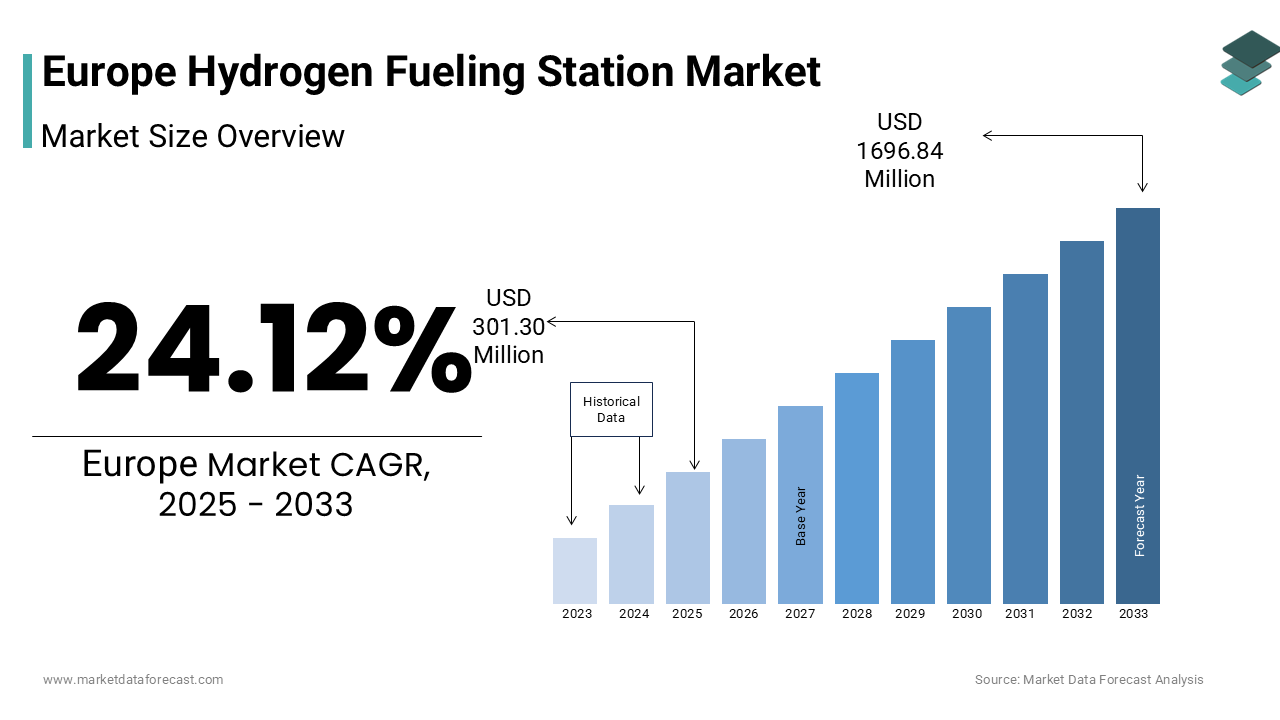
The hydrogen fueling station is the physical and operational infrastructure dedicated to the storage dispensing and distribution of hydrogen for fuel cell electric vehicles across the continent. Hydrogen refueling stations in Europe predominantly offer gaseous hydrogen at 700 bar for passenger cars and 350 bar for buses and heavy duty vehicles. The International Energy Agency confirms that Europe maintains the world’s most extensive publicly accessible hydrogen refueling network.
MARKET DRIVERS
Stringent EU Emission Regulations Accelerate Adoption of Zero Emission Mobility Solutions
The European Union’s legally binding climate and transport regulations have created a structural impetus for hydrogen refueling infrastructure, which is driving the growth of Europe hydrogen fuelling station market. Regulation (EU) 2019/631 mandates a 55% reduction in average CO₂ emissions from new passenger cars by 2030 relative to 2021 levels and a complete phase out of internal combustion engine sales by 2035. These targets render battery only solutions insufficient for long haul freight and heavy duty applications due to payload penalties and charging downtime. In response the Alternative Fuels Infrastructure Regulation requires member states to install hydrogen refueling points every 200 kilometers along core Trans European Transport Network routes by 2030.
Growing Commercial Deployment of Fuel Cell Electric Vehicles in Logistics and Public Transit
The operational advantages of hydrogen in commercial fleets are driving concrete demand for refueling infrastructure, which is additionally to escalate the growth of Europe hydrogen fuelling station market. Unlike passenger vehicles heavy duty transport requires rapid refueling high energy density and minimal downtime that attributes where hydrogen outperforms battery alternatives. Major logistics players including DHL and IKEA have launched pilot deployments with DHL planning 120 hydrogen vans in Germany by 2026. Public transport agencies in Oslo Paris and Amsterdam are replacing diesel fleets with hydrogen buses citing zero tailpipe emissions and silent operation as key benefits for urban air quality. The European Clean Hydrogen Partnership notes that more than 30 hydrogen mobility projects involving commercial fleets were initiated in 2024 under Horizon Europe funding. Fleet operators are increasingly co investing in station development to guarantee refueling access creating a self reinforcing cycle where vehicle adoption stimulates infrastructure and vice versa.
MARKET RESTRAINTS
High Capital Expenditure and Fragmented Permitting Processes Impede Station Rollout
The deployment of hydrogen refueling stations faces significant financial and administrative barriers, which is one of the restraining factors for the growth of Europe hydrogen fuelling station market. This capital intensity deters private investors without substantial public co funding. Further complicating deployment is the absence of harmonized permitting across the EU. In countries such as Italy and Spain the approval process for hydrogen infrastructure can exceed 24 months due to overlapping environmental safety and zoning reviews. Local opposition fueled by outdated safety perceptions also contributes to project stalls despite hydrogen’s compliance with rigorous EU safety directives including ATEX and the Pressure Equipment Directive.
Limited Green Hydrogen Availability Constrains Environmental and Economic Viability
The long term sustainability hinges on access to genuinely low carbon hydrogen yet supply remains overwhelmingly fossil based, which is additionally to limit the growth of Europe hydrogen fuelling station market. Although the Renewable Energy Directive II defines green hydrogen as electrolysis powered by additional renewable electricity certified supply in 2024 accounted for less than 0.2 % of total demand as per the European Commission. Consequently, many stations dispense grey hydrogen or diluted blends reducing eligibility for carbon incentives and discouraging environmentally focused fleet operators.
MARKET OPPORTUNITIES
Cross Border Hydrogen Corridor Integration Offers Strategic Expansion Pathways
The emergence of pan hydrogen transport corridors for scalable and interoperable infrastructure is solely creating huge growth opportunities for Europe hydrogen fueling station market. The European Hydrogen Backbone initiative backed by 23 countries plans over 28000 kilometers of hydrogen pipelines by 2030 linking North Sea offshore wind powered production to industrial and mobility demand centers. The Alternative Fuels Infrastructure Regulation mandates hydrogen refueling stations every 200 kilometers on core road corridors by 2030 creating a predictable deployment grid. Projects in Germany France and the Netherlands now adopt standardized connectors digital billing and safety protocols compliant with EU Intelligent Transport Systems directives. This shift from isolated stations to integrated networks unlocks long distance zero emission freight and intercity passenger mobility.
Public Private Partnerships Unlock Capital and De Risk Early Stage Deployment
The collaborative financing models between public institutions and private enterprises are proving essential to overcome new entry barriers is additionally to gear up the growth of Europe hydrogen fuelling station market. Germany’s National Innovation Program for Hydrogen and Fuel Cell Technology has co-funded over 60 stations with industry partners like Linde using a 50–50 cost sharing mechanism totaling 1.4 billion euros since inception. These arrangements often include offtake guarantees from municipal fleets or logistics firms ensuring baseline demand and revenue stability. The Copenhagen model, where the city committed to 50 hydrogen buses to anchor an Everfuel refueling hub that exemplifies this approach.
MARKET CHALLENGES
Intermittent Renewable Energy Integration Complicates On Site Green Hydrogen Production
On site electrolysis at refueling stations is a key pathway to green hydrogen that faces significant technical hurdles due to Europe’s variable renewable energy supply, which is a challenge for the growth of Europe hydrogen fuelling station market. Proton exchange membrane electrolyzers require stable power input yet solar and wind generation exhibit high intermittency. This inconsistency forces stations to either invest in costly battery buffers or rely on grid electricity with increasing hydrogen production costs by 25 to 40 %. Compounding the issue over 600 gigawatts of renewable projects remain stuck in EU grid interconnection queues with average approval times exceeding 42 months in Southern Europe as reported by the European Commission. Consequently, many planned stations have deferred or downsized electrolysis capacity opting instead for delivered liquid hydrogen which negates the benefits of localized green production and increases transport emissions.
Lack of Uniform Safety Codes and Public Perception Hurdles Slow Urban Deployment
The inconsistent local implementation and public awareness continue to hinder urban station development, which is also to degrade the growth of Europe hydrogen fuelling station market. While the Pressure Equipment Directive and ATEX Directive establish harmonized technical standards municipal authorities often impose divergent setback requirements fire codes and ventilation rules. Public perception remains another critical barrier. This perception gap fuels community opposition with more than 20 urban station proposals encountering local resistance between 2022 and 2024.
REPORT COVERAGE
| REPORT METRIC | DETAILS |
| Market Size Available | 2024 to 2033 |
| Base Year | 2024 |
| Forecast Period | 2025 to 2033 |
| Segments Covered | By Type, and Region. |
| Various Analyses Covered | Global, Regional & Country Level Analysis, Segment-Level Analysis; DROC, PESTLE Analysis, Porter's Five Forces Analysis, Competitive Landscape, Analyst Overview of Investment Opportunities |
| Regions Covered | United Kingdom, France, Spain, Germany, Italy, Russia, Sweden, Denmark, Switzerland, the Netherlands, Turkey, and the Czech Republic, |
| Market Leader Profiled | Hydrogen Fueling Station Market include Air Liquide, Linde PLC, MAXIMATOR Hydrogen GmbH, Hydrogen Refueling Solutions (HRS), H2 MOBILITY Germany GmbH, Plug Power Inc., Shell PLC, Nel ASA, Air Products and Chemicals Inc., ITM Power PLC, Ballard Power Systems, Hydrogenious LOHC Technologies, McPhy Energy SA, Hexagon Purus ASA, Powertech Labs Inc., Iwatani Corporation of America (Europe operations), NPROXX GmbH, Chart Industries Inc., Siemens Energy AG, and ENGIE SA. |
SEGMENTAL ANALYSIS
By Type Insights
The medium station segment was accounted in holding 52.3% of the Europe hydrogen fueling station market share in 2024 with its optimal balance between scalability and cost efficiency particularly for commercial fleets and public transit operators. Medium capacity stations align precisely with the daily refueling needs of municipal bus depots regional logistics hubs and intercity coach operators. A typical hydrogen bus consumes around 8 to 10 kilograms of hydrogen per 100 kilometers and operates 300 to 400 kilometers per day requiring 24 to 40 kilograms daily. A depot with 30 buses thus demands roughly 1 tonne of hydrogen per day placing it squarely within the medium station range. These fleets require reliable frequent refueling without the capital intensity of large scale infrastructure. Medium stations also benefit from modular design allowing phased capacity expansion as fleet sizes grow.
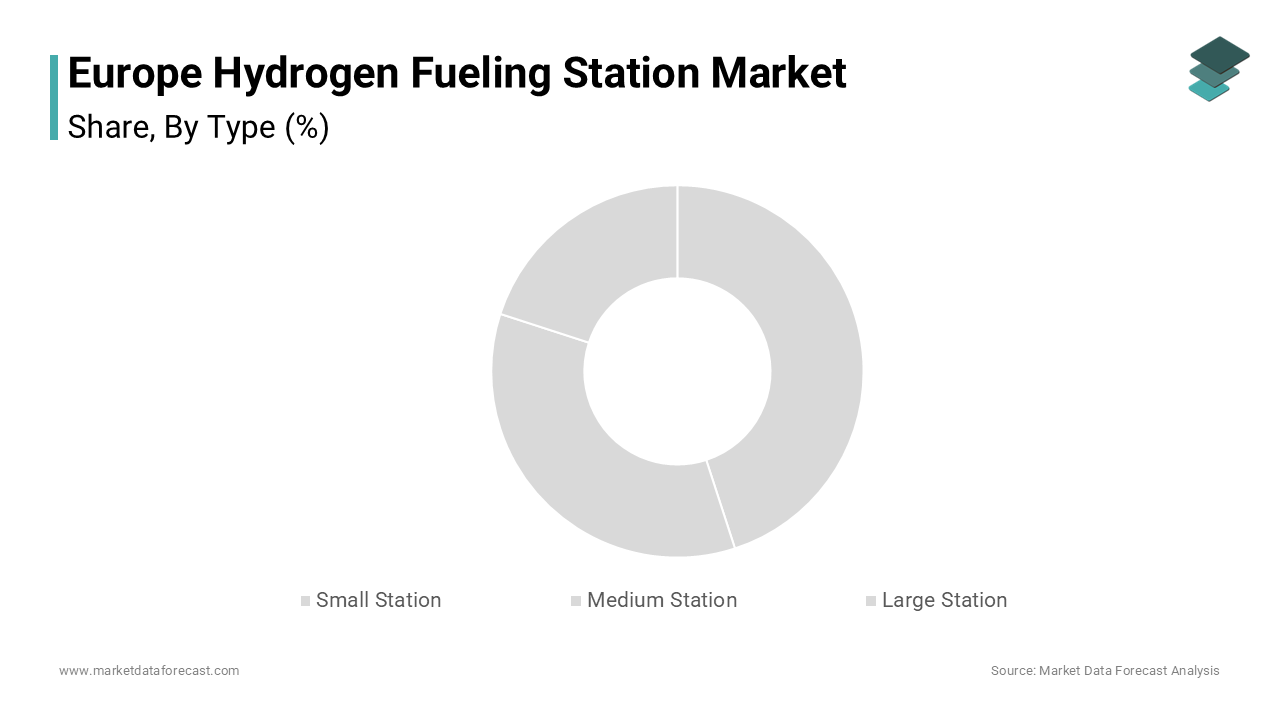
The small hydrogen fueling station segment is likely to witness a fastest CAGR of 28.4% during the forecast period. Small stations are increasingly deployed to support early adopters of passenger fuel cell vehicles and demonstration projects in urban centers. Although private hydrogen car ownership remains modest Europe hosted over 21000 fuel cell passenger vehicles by the end of 2024. A small station dispensing 300 to 500 kilograms daily can serve 60 to 100 such users making it viable in high income urban clusters. Countries like Denmark and Switzerland have launched community based refueling initiatives where small stations are co located with car dealerships or municipal garages. Their compact footprint and lower safety buffer requirements enable installation in space constrained cities accelerating accessibility.
REGIONAL ANALYSIS
Germany Hydrogen Fueling Station Market Analysis
Germany was the largest contributor in the Europe hydrogen fueling station market with 38.3% of share in 2024 with the comprehensive national strategy coordinated public private investment and early mover advantage in heavy duty hydrogen mobility. Germany’s National Hydrogen Strategy launched in 2020 allocated 9 billion euros to hydrogen infrastructure including direct subsidies covering up to 80 % of station capital costs for projects serving zero emission fleets. The government also mandated that all new autobahn service areas include hydrogen refueling capability by 2026 accelerating corridor development. Industrial clusters in North Rhine Westphalia and Lower Saxony are integrating hydrogen refueling with green steel and chemical production creating co located demand.
France Hydrogen Fueling Station Market Analysis
France was positioned second by holding 16.3% of Europe hydrogen fuelling station market share in 2024 with its aggressive push to decarbonize urban transport and regional freight through state led hydrogen ecosystems. The country operates nearly 40 public hydrogen stations with a strong concentration in Île de France Auvergne Rhône Alpes and Normandy. France’s 2020 National Low Carbon Strategy committed 7 billion euros to hydrogen including 1.5 billion specifically for refueling infrastructure by 2030. This integration of clean power production and mobility refueling enhances environmental credibility and attracts EU Innovation Fund grants accelerating deployment velocity.
United Kingdom Hydrogen Fueling Station Market Analysis
The United Kingdom hydrogen fuelling station market growth is likely to have significant growth opportunities throughout the forecast period. As of early 2025 the UK operates 22 public hydrogen stations concentrated in London the West Midlands and Scotland according to the UK Department for Transport. The UK’s Industrial Decarbonisation Strategy provides 240 million pounds in grants for low carbon transport infrastructure with priority given to stations co located with renewable generation or waste to hydrogen facilities.
COMPETITIVE LANDSCAPE
The Europe hydrogen fueling station market features intense yet collaborative competition among industrial gas majors energy companies and specialized technology providers. While Linde Air Liquide and Shell lead in deployment scale the landscape includes strong regional players like Everfuel Hystar and Hy2gen that focus on niche applications or localized ecosystems. Competition centers less on price and more on integration capabilities speed of deployment access to green hydrogen and alignment with national decarbonization roadmaps. Companies differentiate through proprietary compression storage or dispensing technologies and strategic siting along transport corridors. The market remains capital intensive and policy dependent fostering frequent joint ventures and public private partnerships. Regulatory harmonization under the EU’s Alternative Fuels Infrastructure Regulation is gradually reducing fragmentation yet national subsidies and permitting variances continue to shape competitive dynamics.
KEY MARKET PLAYERS
Some of the companies that are playing a dominating role in the europe hydrogen fueling station market include
- Air Liquide
- Linde PLC
- MAXIMATOR Hydrogen GmbH
- Hydrogen Refueling Solutions (HRS)
- H2 MOBILITY Germany GmbH
- Plug Power Inc.
- Shell PLC
- Nel ASA
- Air Products and Chemicals Inc.
- ITM Power PLC
- Ballard Power Systems
- Hydrogenious LOHC Technologies
- McPhy Energy SA
- Hexagon Purus ASA
- Powertech Labs Inc.
- Iwatani Corporation of America (Europe operations)
- NPROXX GmbH
- Chart Industries Inc.
- Siemens Energy AG
- ENGIE SA
Top Players in the Market
Linde plc
Linde is a global industrial gases leader with deep involvement in Europe’s hydrogen refueling infrastructure. The company designs builds and operates hydrogen fueling stations across multiple European countries including Germany France and the Netherlands. Linde’s proprietary ionic compression technology enables efficient high pressure hydrogen dispensing with reduced energy consumption. The company also co launched the H2Accelerate collaboration to standardize refueling protocols and accelerate heavy duty vehicle adoption. Linde’s end to end capabilities from production to dispensing position it as a critical enabler of Europe’s hydrogen mobility ecosystem.
Air Liquide
Air Liquide plays a pivotal role in advancing hydrogen mobility across Europe through integrated infrastructure and clean production. The company operates over 60 hydrogen stations in the region supporting both public and private fleets. Air Liquide leverages its expertise in cryogenic and gaseous hydrogen to offer scalable refueling solutions tailored to urban and intercity needs. Air Liquide also collaborates with automotive manufacturers to validate fuel cell performance and safety standards. Its strategy emphasizes coupling station deployment with renewable powered electrolysis ensuring environmental integrity and long-term fuel security for transport customers.
Shell plc
Shell has emerged as a key participant in Europe’s hydrogen refueling landscape by integrating mobility infrastructure with its broader energy transition strategy. The company operates hydrogen stations in Germany the UK and the Netherlands often co located with existing retail fuel sites to maximize land use and customer access. Shell’s focus spans both passenger and heavy duty segments with recent investments targeting truck refueling hubs at major logistics centers. The company also participates in EU funded projects like HyTrucks to demonstrate cross border hydrogen freight viability. Shell’s brand recognition and distribution network accelerate public acceptance and commercial scalability of hydrogen mobility.
Top Strategies Used by the Key Market Participants
Key players in the Europe hydrogen fueling station market employ several core strategies to strengthen their position. They prioritize strategic partnerships with governments automotive manufacturers and logistics companies to secure offtake agreements and co funding. Investments in green hydrogen production via electrolysis powered by renewables ensure fuel sustainability and compliance with EU regulations. Companies are standardizing refueling technology to enhance interoperability across borders and vehicle types. They also adopt modular scalable station designs to match demand growth and reduce upfront capital risk. Additionally, players actively participate in EU funded demonstration projects to validate technical and economic models while influencing policy development and safety standards across member states.
MARKET SEGMENTATION
The research report on the europe hydrogen fueling station market has been segmented and sub-segmented based on categories.
By Type
- Small Station
- Medium Station
- Large Station
By Country
- UK
- France
- Spain
- Germany
- Italy
- Russia
- Sweden
- Denmark
- Switzerland
- Netherlands
- Turkey
- Czech Republic
- Rest of Europe