- Product Description Description
- Table of Contents TOC
- List of Table & Figure LOT
- Get Free Sample PDF Sample PDF
Market Size, 2025
$17.97 BnMarket Estimate, 2026
$20.83 BnMarket Forecast, 2034
$68.01 BnCAGR, 2026–2034
15.74%Executive Summary: Europe Image Recognition Market
- Market Scope: Comprehensive Europe image recognition market analysis covering component types, core technologies, deployment models, application verticals, end-user segments, and country-level leadership frameworks.
- Market Valuation: Valued at USD 17.97 billion (2025), estimated at USD 20.83 billion (2026), and projected to reach USD 68.01 billion by 2034, registering a robust CAGR of 15.74% (2026–2034).
- Primary Growth Drivers: Adoption of artificial intelligence and computer vision technologies across industrial automation, healthcare diagnostics, retail analytics, sustainable agriculture, and environmental monitoring. Key catalysts include the EU Artificial Intelligence Act enforcement, precision farming, medical imaging, and circular economy waste sorting.
Key Market Segment Metrics (2026–2034)
| Category | Leading Segment (Base Year Position) | Fastest-Growing Segment |
|---|---|---|
| By Component | Software Segment (accounted for 48.4% of the market share) | Services Segment (projected to register the fastest CAGR of 17.4%) |
| By Technology | Object Recognition (held the leading position with a 35.5% market share) | Optical Character Recognition (OCR) Segment (expected to grow at a CAGR of 19.4%) |
| By Deployment | Cloud Segment (accounted for 56.5% of the market share) | Edge and hybrid cloud deployment models |
| By End User | Industrial automation and manufacturing sectors | Healthcare End-User Segment (anticipated to expand at a CAGR of 19.2%) |
| By Country / Region | Germany (led the regional market with a 25.4% share, supported by advanced manufacturing) | United Kingdom, France, Sweden, and the Netherlands (strengthening healthcare and sovereign AI) |
Major Market Players & Market Structure
Market Structure: Highly competitive European landscape where market participants differentiate through regulatory compliance, algorithmic fairness, ethical AI, data governance, transparent auditable solutions complying with the EU AI Act, and sector-specific innovation.
Key Companies: Amazon Web Services, Google, Microsoft, IBM, NVIDIA, Intel, SAP, Siemens, NEC Corporation, Qualcomm, Dassault Systèmes, Scandit, Brighter AI Technologies, Bosch, and Thales Group.
Europe Image Recognition Market Size
The europe image recognition market size was valued at USD 17.97 billion in 2025 and is anticipated to reach USD 20.83 billion in 2026 from USD 68.01 billion by 2034, growing at a CAGR of 15.74% during the forecast period from 2026 to 2034.
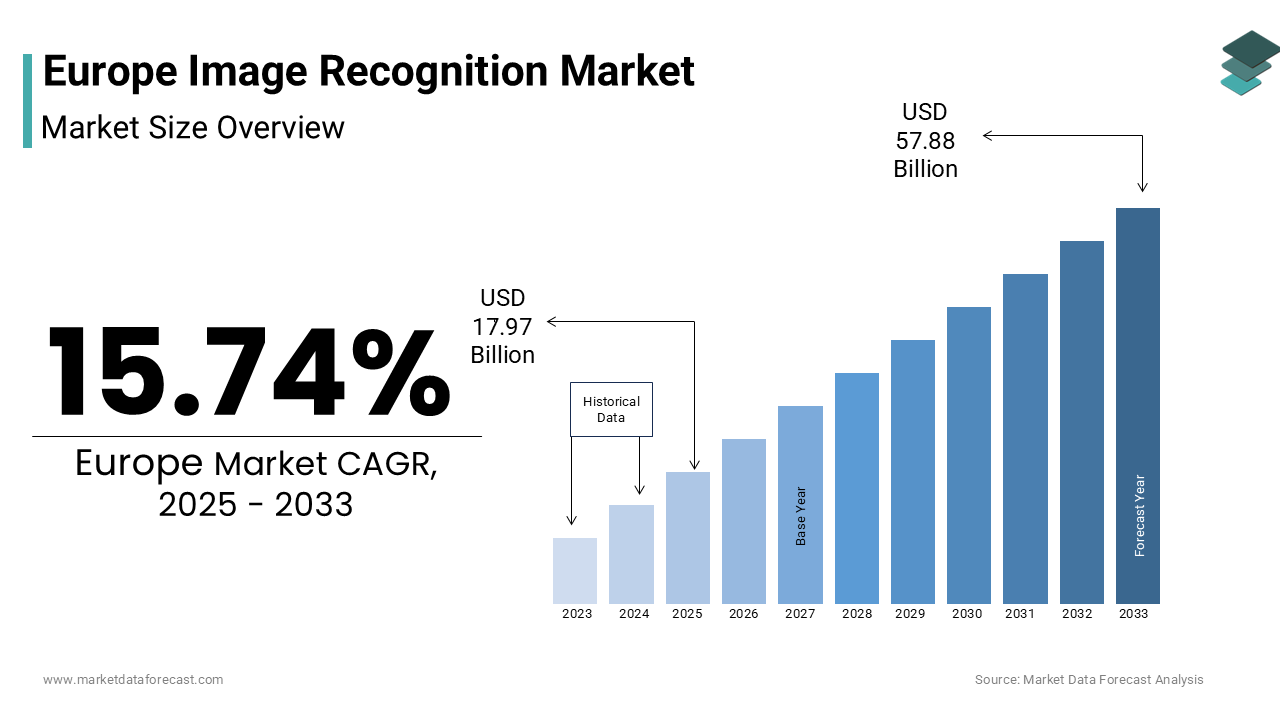
Image recognition is the application of artificial intelligence and computer vision technologies to identify, classify, and interpret visual content from digital images or video streams in compliance with the region’s stringent data protection and ethical AI frameworks. Unlike markets where surveillance dominates, Europe’s image recognition landscape is primarily driven by industrial automation, healthcare diagnostics, retail analytics, and sustainable agriculture as these applications emphasize accuracy, explainability, and human oversight. The deployment of these systems is shaped by the European Union’s Artificial Intelligence Act which classifies most image recognition use cases as high risk, mandating rigorous transparency, bias mitigation, and human in the loop protocols. According to Eurostat, EU manufacturing enterprises report increasing adoption of computer vision in quality control, which is reflecting broader uptake of AI-enabled inspection systems across production lines. As per the European Environment Agency, satellite-based monitoring and image recognition are used across EU member states to track deforestation and illegal waste dumping and supporting near real-time environmental surveillance. As per the European Commission, hundreds of public and private sector AI pilot projects involving visual data are supported within the European Digital Innovation Hubs network in 2024. This convergence of regulatory guardrails, industrial digitization, and public sector innovation defines Europe’s distinct approach where image recognition advances not through scale alone but through trust, accountability, and societal benefit.
MARKET DRIVERS
Enforcement of the EU Artificial Intelligence Act on High‑Risk Visual Systems
The European Union’s Artificial Intelligence Act that entered into full application in 2024, has become a structural driver by mandating robust governance for image recognition systems used in critical domains, which is one of the significant factors propelling the European image recognition market growth. The law classifies biometric identification, remote sensing in public spaces, and medical image analysis as high‑risk, requiring providers to conduct fundamental rights impact assessments, ensure algorithmic transparency, and implement human oversight mechanisms. According to the European Commission, hundreds of companies submitted conformity assessments for image recognition systems in 2024, with many modifying their data labeling or model validation processes to comply with the Act. This regulatory pressure has spurred demand for certified AI audit platforms and bias detection tools. Companies such as VisioForge and Vispera now offer EU‑compliant image recognition APIs with built‑in explainability dashboards and demographic parity metrics. Healthcare providers have responded by adopting CE‑marked diagnostic aids: the European Medicines Agency confirmed approvals of multiple AI‑based medical imaging tools in 2024, all of which include uncertainty quantification and clinician override functions. The AI Act is creating a premium market for ethically designed visual AI, embedding accountability into innovation.
Integration of Computer Vision in Sustainable Agriculture and Precision Farming
European agricultural policy is accelerating image recognition adoption through the Common Agricultural Policy’s digital farming incentives and environmental compliance mandates, which is also contributing to the expansion of the European image recognition market. Farmers receiving EU subsidies must now demonstrate sustainable land use through verifiable data, prompting widespread deployment of drone‑ and satellite‑based visual analytics. According to the European Commission’s Digital Farming initiatives, a majority of large arable farms adopted image recognition in 2024 to monitor crop health, detect pests, and optimize irrigation. The Copernicus Sentinel‑2 satellite constellation provides free multispectral imagery at 10‑meter resolution, which startups like Pix4D and GreenSpin transform into nitrogen deficiency maps and yield forecasts using convolutional neural networks. In the Netherlands, Wageningen University research confirms that greenhouse operators using real‑time disease detection algorithms have significantly reduced pesticide use. The European Food Safety Authority also requires image‑based traceability for high‑risk produce such as leafy greens, driving supermarket chains like Carrefour and Edeka to mandate farm‑level visual monitoring. Policy‑driven digital transformation is turning image recognition into both a compliance enabler and an environmental stewardship tool across Europe’s agri‑food chain.
MARKET RESTRAINTS
Stringent Restrictions on Biometric Identification in Public Spaces
The European near blanket prohibition on real‑time remote biometric identification by law enforcement in publicly accessible spaces, as stipulated under Article 5 of the Artificial Intelligence Act, which is one of the key restraints to the European image recognition market. This ban prohibits the use of facial recognition for mass surveillance even in counter‑terrorism operations without prior judicial authorization. According to the European Data Protection Board, regulators issued multiple enforcement orders in 2024 halting unauthorized image recognition deployments in airports, shopping malls, and transportation hubs. The city of Paris abandoned its 2023 pilot of AI‑powered crowd monitoring at Gare du Nord after the French data authority CNIL ruled it violated proportionality principles. Similarly, private sector applications face barriers: a 2024 proposal by a German retailer to use in‑store cameras for demographic analytics was blocked by the Hamburg supervisory authority for lacking explicit opt‑in consent. Europe’s strict biometric restrictions are reshaping the market, which is forcing vendors to pivot toward anonymized or aggregated analytics.
Persistent Algorithmic Bias and Lack of Diverse Training Data
Image recognition systems in Europe continue to underperform on underrepresented demographic groups due to imbalanced training datasets and raising legal and ethical risks under the AI Act’s non‑discrimination clauses, which is further hindering the image recognition market growth in Europe. For instance, facial analysis tools consistently perform less accurately for women with darker skin tones compared to light‑skinned men, triggering mandatory bias mitigation under EU law. According to the EU Agency for Fundamental Rights, many public sectors image recognition pilots in 2024 were delayed due to insufficient validation across age, gender, and ethnic subgroups. The lack of standardized diverse datasets compounds the problem: while the EU’s AI Office launched the European Dataset Registry in 2024, initial coverage of elderly and disabled individuals was limited. Hospitals face similar issues; audits of medical imaging tools show classifiers trained primarily on Caucasian patients underperform on darker skin, missing melanoma indicators more often. Without representative datasets and inclusive standards, image recognition will remain prone to discriminatory outcomes that undermine trust and compliance.
MARKET OPPORTUNITIES
Expansion of Image Recognition in Medical Diagnostics and Digital Pathology
Europe’s aging population and radiologist shortage are creating high‑value opportunities for image recognition in clinical settings where early and accurate diagnosis directly impacts patient outcomes. According to the European Society of Radiology, Europe faces a significant shortage of radiologists by 2025, driving adoption of AI‑powered triage tools. The European Commission confirmed that multiple AI‑based medical imaging solutions received CE Class IIa or IIb certification in 2024, including Aidoc’s stroke detection and Quantib’s prostate MRI analyzers. These systems prioritize critical cases in radiology worklists, reducing time to diagnosis in clinical trials such as those conducted at Charité Hospital in Berlin. In digital pathology, startups like Aiforia and Mindpeak use deep learning to quantify tumor cells in whole‑slide images with pathologist‑level accuracy, enabling faster cancer staging. The European Reference Networks for rare diseases now routinely share anonymized histopathology images across borders using federated learning platforms where algorithms train without centralizing sensitive data. This secure collaborative model complies with the General Data Protection Regulation while accelerating diagnostic innovation. Medical image recognition is becoming one of Europe’s most clinically impactful and ethically governed AI applications.
Deployment in Circular Economy and Waste Sorting Automation
Image recognition is emerging as a critical enabler of Europe’s circular economy goals by powering robotic sorting systems in recycling facilities that identify and separate materials with high precision, which is a notable opportunity in the European image recognition market. The EU’s Packaging and Packaging Waste Regulation mandates that member states achieve 55% plastic packaging recycling by 2030, which is a target unattainable with manual sorting alone. According to Plastics Europe, over a hundred recycling plants across Europe installed AI vision systems in 2024, including AMP Robotics’ Cortex platform, which uses convolutional neural networks to detect polymer types and contaminants. In the Netherlands, Suez’s Amsterdam facility reported significant reductions in residual waste using AI‑guided robotic arms that distinguish black plastic trays from food waste and is a task impossible with traditional near‑infrared sensors. According to the European Environment Agency, facilities using image recognition achieved purity rates above 95% for PET and HDPE streams, qualifying them for premium recycling credits. Moreover, the EU’s Digital Product Passport initiative requires visual identification of material composition by 2027, embedding image recognition into product life cycle management. Regulatory and industrial synergy is positioning visual AI as a cornerstone of Europe’s resource efficiency strategy.
MARKET CHALLENGES
Fragmented National Interpretations of AI Compliance Requirements
Despite the EU Artificial Intelligence Act’s harmonizing intent, national supervisory authorities continue to issue divergent guidance on what constitutes compliant image recognition deployment, which is a major challenge to the regional market growth. Germany’s Federal Office for Information Security requires source code disclosure for high‑risk systems, while France’s ANSSI accepts black‑box validation if performance metrics are met. According to the European AI Alliance, a 2024 survey of AI vendors revealed that many companies maintain different compliance documentation for each major EU market due to inconsistent audit expectations. This fragmentation increases time to market: a Spanish health tech firm reported delays launching its diabetic retinopathy detector because Italian regulators demanded real‑world performance data not required in the Netherlands. The European Commission’s AI Office has begun issuing harmonized templates, but adoption remains voluntary. Until a centralized conformity assessment body is operational, Europe’s image recognition market will continue to face regulatory uncertainty and duplicated compliance costs.
Limited Access to High‑Quality Labeled Datasets for Niche Applications
The development of accurate image recognition models for specialized European sectors such as viticulture, alpine agriculture, or heritage conservation is hindered by a scarcity of expert‑annotated datasets, which is also a prominent challenge to the European image recognition market. Unlike generic object detection, which benefits from global open‑source repositories, niche domains require domain‑specific labeling by agronomists, art historians, or ecologists expertise that is both rare and expensive. According to the European Space Agency, very few labeled datasets exist for identifying invasive plant species in Mediterranean ecosystems despite the EU Biodiversity Strategy’s 2030 monitoring targets. Similarly, the European Cultural Heritage Network confirmed that fewer than 2,000 high‑resolution annotated images of historical fresco degradation patterns are publicly available, limiting the reliability of AI restoration tools. The Horizon Europe program allocated €50 million in 2024 to create sector‑specific data commons, yet bureaucratic hurdles continue to delay data sharing. Without coordinated public investment in high‑quality labeled datasets, Europe risks biasing image recognition toward generic global use cases rather than addressing its distinctive societal needs.
REPORT COVERAGE
| REPORT METRIC | DETAILS |
| Market Size Available | 2026 to 2034 |
| Base Year | 2025 |
| Forecast Period | 2026 to 2034 |
| CAGR | 15.74% |
| Segments Covered | By Component, Technology, Application, Deployment, End-User and Region. |
| Various Analyses Covered | Global, Regional & Country Level Analysis, Segment-Level Analysis, DROC, PESTLE Analysis, Porter’s Five Forces Analysis, Competitive Landscape, Analyst Overview of Investment Opportunities |
| Regions Covered | United Kingdom, France, Spain, Germany, Italy, Russia, Sweden, Denmark, Switzerland, the Netherlands, Turkey, and the Czech Republic. |
| Market Leaders Profiled | Amazon Web Services, Google, Microsoft, IBM, NVIDIA, Intel, SAP, Siemens, NEC Corporation, Qualcomm, Dassault Systèmes, Scandit, Brighter AI Technologies, Bosch, and Thales Group |
SEGMENTAL ANALYSIS
By Component Insights
The software segment captured 48.4% of the Europe image recognition market share in 2024. The dominance of software in this European market is attributed to its central role in algorithm development, model training, and integration with enterprise workflows under strict regulatory oversight. According to the European Commission, over 800 AI conformity assessments submitted in 2024 included detailed software architecture diagrams, bias audit logs, and uncertainty quantification modules. Vendors such as Vispera and TwentyBN embed explainability dashboards directly into their APIs, enabling traceability of decisions, which are critical for healthcare and judicial applications. The European Medicines Agency requires AI diagnostic software to output confidence scores and alternative interpretations. This regulatory architecture transforms software into a certified trust layer, driving sustained investment in ethically engineered code. The segment is expected to maintain its leadership over the forecast period.
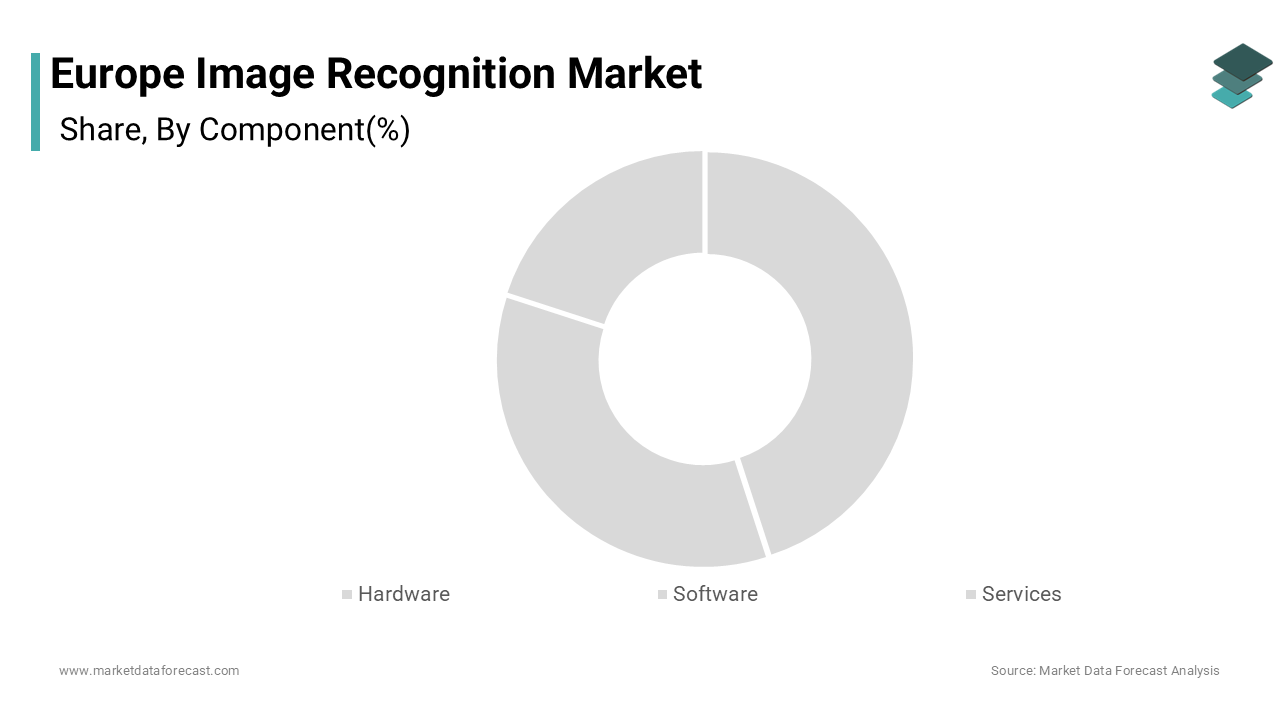
The services segment is anticipated to grow at a CAGR of 17.4% over the forecast period owing to the rising complexity of AI deployment under Europe’s stringent governance framework. As per the European AI Office, over 250 specialized AI audit firms emerged in 2024, offering dataset bias testing and oversight protocol design. TÜV Rheinland and Bureau Veritas provide CE marking certification for high-risk visual AI systems. According to a survey by the European Confederation of Professional Services, 78% of healthcare and retail firms outsourced AI compliance in 2024. This regulatory burden has transformed services into a mandatory phase of the AI lifecycle. The segment is expected to expand significantly over the forecast period.
By Technology Insights
The object recognition segment accounted for 35.5% of the European image recognition market share in 2024. The growth of the object recognition segment in this regional market is attributed to broad applicability in industrial automation, retail analytics, and environmental monitoring. According to Eurostat, 46% of large manufacturers integrated computer vision systems into production lines by 2024, with automotive and electronics sectors leading adoption. BMW’s Leipzig plant uses object recognition to inspect paint finishes, reducing rework costs by 22%. Siemens employs object recognition in turbine blade inspection with 99.7% accuracy. The European Commission allocated €300 million in 2024 to scale industrial vision systems across SMEs. This integration makes object recognition the backbone of Europe’s digital factory strategy.
The OCR segment is projected to witness a promising CAGR of 19.4% over the forecast period due to the digitization mandates in public administration and financial services. For instance, OCR adoption in Europe is expanding rapidly due to document automation. National archives in Germany, France, and Italy digitized over 800 million historical documents in 2024 using OCR engines trained on regional scripts. The Swedish Tax Agency reduced paper tax return processing time by 75% using ABBYY’s multilingual OCR. Healthcare adoption is also rising under the European Health Data Space, which mandates structured digital records. Backed by €2 billion in EU digital infrastructure funding, OCR is becoming a foundational layer of Europe’s administrative modernization.
By Deployment and End User Insights
The cloud deployment segment held 56.5% of the Europe image recognition market share in 2024. The leading position of cloud deployment segment in the European image recognition market is attributed to scalability, integration with AI platforms, and alignment with Europe’s data space architecture. According to the GAIA-X Association, over 80% of registered image recognition providers operate on sovereign cloud infrastructures hosted by OVHcloud, Deutsche Telekom, or T-Systems. The European Health Data Space certified 17 cloud-based medical imaging services in 2024, enabling hospitals to run diagnostics without transferring raw images. This regulatory and technical alignment makes cloud legally preferable for high-risk applications. The segment is expected to sustain its leadership over the forecast period.
The healthcare segment is growing exponentially and is estimated to grow at a CAGR of 19.2% over the forecast period owing to the diagnostic shortages and regulatory approval pathways for AI. According to the European Society of Radiology, Europe faces a deficit of over 14,000 radiologists by 2025. Image recognition systems such as Aidoc’s stroke detection and Quantib’s prostate MRI analyzers reduce time to diagnosis by up to 40% in clinical trials at Charité Hospital in Berlin. The European Medicines Agency approved 37 AI-based imaging tools in 2024, all requiring CE Class IIa or higher certification. These systems enhance human capacity while complying with the AI Act’s human-in-the-loop mandate.
REGIONAL ANALYSIS
Germany dominated the European image recognition market in 2024 by holding 25.4% of the regional market share. The leading position of Germany in the European market can be credited to its advanced manufacturing base, strict governance frameworks, and strong public research infrastructure. According to the German Federal Ministry for Economic Affairs, over 60% of large manufacturers use AI vision for defect detection, with the VDMA certifying transparency and bias mitigation in industrial models. The Federal Office for Information Security (BSI) requires source code disclosure for high‑risk AI systems, setting a de facto EU benchmark. The Fraunhofer Institute’s open‑source libraries for compliant image recognition have been adopted by over 2,000 SMEs. This blend of industrial demand, regulatory leadership, and public research ensures Germany remains Europe’s benchmark for trustworthy visual AI. Germany is expected to maintain its leadership in industrial AI and compliance‑driven innovation.
The United Kingdom held a substantial share of the European image recognition market in 2024 due to the healthcare adoption, fintech innovation, and strong regulatory oversight. According to the National Health Service (NHS), over 100 AI imaging tools were deployed in 2024 for radiology, pathology, and diabetic retinopathy screening, all certified by the Medicines and Healthcare products Regulatory Agency (MHRA). In fintech, companies such as Onfido and ComplyAdvantage use OCR and document verification for KYC compliance, with the Financial Conduct Authority (FCA) mandating explainable AI. The Centre for Data Ethics and Innovation (CDEI) reported that 92% of approved high‑risk AI systems included human oversight and audit trails. Despite Brexit, adequacy decisions maintain EU alignment for cross‑border data flows. The UK is expected to remain Europe’s leader in ethically governed clinical and financial visual AI.
France captured a prominent share of the European image recognition market in 2024. Factors such as the sovereign AI investments and large‑scale digitization projects are supporting the French market growth. The France 2030 investment plan allocated over €800 million to sovereign AI, including image recognition for defense, agriculture, and administration. The French National Archives digitized over 200 million historical documents in 2024 using multilingual OCR trained on regional scripts. In agriculture, startups such as GreenSpin use satellite‑based object recognition to monitor crop health under the Common Agricultural Policy (CAP) subsidy framework. The CNIL enforces strict limits on biometric identification but promotes anonymized visual analytics in public services. France is expected to strengthen its role as a model for socially beneficial AI balancing innovation with oversight.
Sweden is projected to grow at a healthy CAGR in the European image recognition market over the forecast period due to the sustainability and ethical AI practices. The Swedish eHealth Agency mandates bias audits for all medical imaging AI, requiring equal performance across demographics. The Swedish Environmental Protection Agency uses drone‑based object recognition to track illegal logging and waste dumping, processed on hydroelectric‑powered servers to reduce carbon footprint. Startups such as Aiforia and Peltarion prioritize federated learning to keep sensitive health data local. The Swedish government’s AI Ethics Guidelines require public procurement of certified trustworthy systems. Sweden is expected to remain a high‑integrity market where social impact and technical excellence converge.
The Netherlands is expected to account for a notable share of the European image recognition market during the forecast period owing to the agritech and circular economy applications. According to Wageningen University, over 90% of greenhouse operators use fixed cameras with real‑time disease detection algorithms, reducing pesticide use by up to 40%. In recycling, Suez’s Amsterdam facility uses AI vision to sort black plastic trays, achieving 95% purity for PET streams. The Dutch Data Protection Authority (DPA) permits anonymized crowd analytics in retail if data is aggregated and opt‑in consent is obtained. The Netherlands’ GAIA‑X node and strong public‑private partnerships make it a testbed for sustainable visual AI. The Netherlands is expected to expand its role as Europe’s hub for agritech and circular economy AI.
COMPETITIVE LANDSCAPE
Competition in the Europe image recognition market is defined by trustworthiness rather than raw performance with companies vying to demonstrate the highest levels of regulatory compliance algorithmic fairness and data protection. The market features a mix of global cloud providers European startups and industrial automation specialists all navigating the Artificial Intelligence Act’s stringent requirements for high risk systems. Unlike other regions where facial recognition dominates Europe’s landscape emphasizes object recognition optical character recognition and medical imaging—applications that deliver societal value without mass surveillance. Differentiation arises from ethical design data governance and sectoral expertise rather than speed or scale alone. Collaboration is common as firms partner with regulators academia and end users to co create auditable transparent systems. This environment rewards companies that treat compliance as a core product feature not a legal afterthought ensuring that market leadership is earned through responsible innovation aligned with European democratic values.
KEY MARKET PLAYERS
Some of the companies that are playing a dominating role in the Europe Image Recognition Market include
- Amazon Web Services
- Microsoft
- IBM
- NVIDIA
- Inte
- SAP
- Siemens
- NEC Corporation
- Qualcomm
- Dassault Systèmes
- Scandit
- Brighter AI Technologies
- Bosch
- Thales Group
Top Players in the Market
Google LLC
Google plays a significant role in the Europe image recognition market through its Cloud Vision AI and Vertex AI platforms which offer pre trained models for object detection facial analysis and document processing compliant with European data protection standards. The company enables European enterprises to build custom vision models using anonymized data workflows aligned with the General Data Protection Regulation. In 2024 Google expanded its sovereign cloud infrastructure in Germany and Finland to ensure customer data remains within the European Economic Area during model training and inference. The firm also launched an AI Ethics Toolkit for image recognition that includes bias detection dashboards and fairness metrics tailored to EU demographic diversity. Through its partnerships with European Digital Innovation Hubs Google supports public sector digitization while ensuring its technologies adhere to the Artificial Intelligence Act’s transparency and human oversight requirements.
Microsoft Corporation
Microsoft contributes to the Europe image recognition landscape via Azure Cognitive Services and Azure AI Vision which provide modular scalable and compliant computer vision capabilities for healthcare retail and manufacturing sectors. The company’s Responsible AI Standard embeds fairness accountability and transparency into all image recognition tools including mandatory model cards and error analysis reports. In 2024 Microsoft certified its Azure AI Vision suite under the European Union’s conformity assessment framework for high risk AI systems enabling deployment in regulated domains like medical diagnostics and public administration. The firm also collaborated with French and Dutch hospitals to deploy federated learning solutions that train diagnostic models without transferring patient images across borders. By anchoring its offerings in Europe’s sovereign cloud and ethical AI principles Microsoft strengthens trust and accelerates adoption across public and private sectors.
Vispera Bilgi Teknolojileri AŞ
Vispera is a European headquartered computer vision specialist focused on retail and supply chain applications with deep expertise in on shelf analytics planogram compliance and inventory automation. The company’s image recognition platform processes millions of store images weekly across twenty two European countries enabling real time out of stock alerts and competitor monitoring while ensuring customer privacy through anonymization. In 2024 Vispera achieved certification under the European Artificial Intelligence Act for its retail analytics system which excludes biometric data and incorporates human review for disputed classifications. The firm also launched an explainability module that traces product identification logic for retailer audits. By prioritizing regulatory compliance vertical specialization and data minimization Vispera has become a trusted partner for major European supermarket chains seeking ethical AI solutions that enhance operational efficiency without compromising consumer rights.
Top Strategies Used by the Key Market Participants
Key players in the Europe image recognition market prioritize regulatory compliance by embedding Artificial Intelligence Act requirements directly into software architecture through bias detection explainability and human oversight features. They deploy solutions on sovereign cloud infrastructures within the European Economic Area to ensure data residency and General Data Protection Regulation alignment. Companies focus on vertical specialization offering pre validated models for healthcare retail agriculture and manufacturing that address sector specific challenges while meeting high risk classification criteria. Strategic partnerships with public institutions Digital Innovation Hubs and industry consortia enable co development of ethically governed use cases. Additionally vendors invest in federated learning and anonymization technologies to enable collaborative model training without centralizing sensitive personal data thereby balancing innovation with fundamental rights protection.
MARKET SEGMENTATION
This research report on the europe image recognition market has been segmented and sub–segmented into the following categories.
By Component
- Hardware
- Software
- Services
By Technology
- Code Recognition
- Facial Recognition
- Object Recognition
- Pattern Recognition
- Optical Character Recognition
By Application
- Scanning and Imaging
- Security and Surveillance
- Image Search
- Augmented Reality
- Marketing and Advertising
By Deployment
- On-Premise
- Cloud
By End-user
- BFSI
- Media and Entertainment
- Retail and E-commerce
- IT and Telecom
- Government
- Healthcare
- Transportation and Logistics
- Others
By Country
- UK
- France
- Spain
- Germany
- Italy
- Russia
- Sweden
- Denmark
- Switzerland
- Netherlands
- Turkey
- Czech Republic
- Rest of Europe