- Product Description Description
- Table of Contents TOC
- List of Table & Figure LOT
- Get Free Sample PDF Sample PDF
Market Size, 2025
$133.96 MnMarket Estimate, 2026
$164.88 MnMarket Forecast, 2034
$868.29 MnCAGR, 2026–2034
23.08%Executive Summary: Europe Immersion Cooling Market
- Market Scope: Comprehensive European immersion cooling market analysis covering product categories (single-phase vs. two-phase), cooling liquid types (fluorocarbon, hydrocarbon/mineral oil), application sectors (AI, edge computing), and country-level developments across Ireland, Sweden, Germany, Finland, the Netherlands, and the wider region.
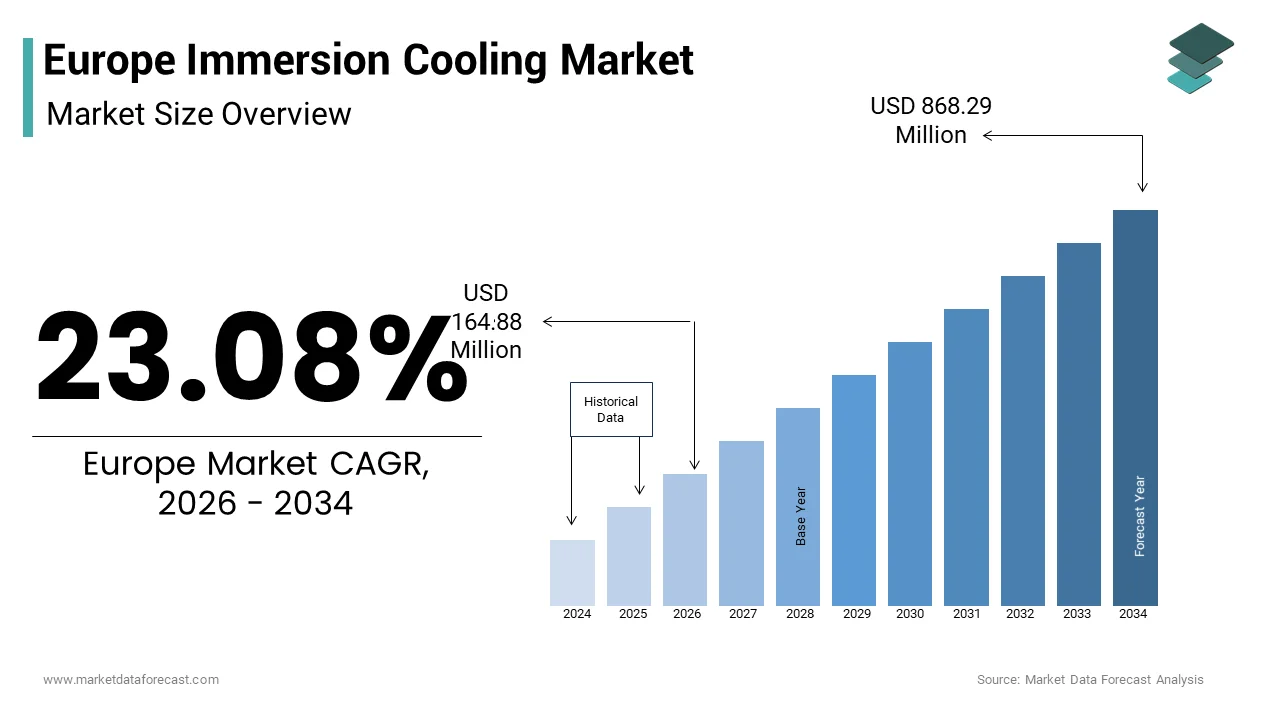
- Market Valuation: Valued at USD 133.96 million (2025), estimated at USD 164.88 million in 2026, and projected to reach USD 868.29 million by 2034, registering a robust CAGR of 23.08% (2026–2034).
- Primary Growth Drivers: Stringent EU energy efficiency mandates and carbon reduction targets, water-use restrictions in data-intensive regions, explosive growth in AI and high-performance computing (HPC) workloads, and rising integration with municipal district heating networks.
Key Market Segment Metrics (2026–2034)
| Category | Leading Segment (2025 Position) | Fastest-Growing Segment |
|---|---|---|
| By Product | Single-Phase Immersion Cooling (holding 66.5% share in 2024 for reliability, operational simplicity, and edge deployment) | Two-Phase Immersion Cooling (accelerating due to extreme thermal density demands of high-performance AI supercomputers) |
| By Cooling Liquid | Fluorocarbon-Based Fluids (capturing 50.3% share in 2024 for superior dielectric stability, inertness, and mission-critical safety) | Hydrocarbon / Mineral Oil / Biodegradable Fluids (growing at a 22.8% CAGR driven by cost efficiency and biodegradability) |
| By Application | Artificial Intelligence (occupying 38.4% share in 2024 to mitigate thermal throttling in high-density GPU training clusters) | Edge Computing (projected at a 37.7% CAGR fueled by silent, compact nodes required in 5G, smart cities, and transport hubs) |
| By Country | Ireland (dominating with 23.5% share in 2024 as a major hyperscale data center hub enforcing non-evaporative cooling policies) | Sweden, Finland & Germany (expanding rapidly through circular waste-heat reuse, industrial AI, and HPC infrastructure) |
Major Market Players & Market Structure
Market Structure: Specialized and fast-evolving ecosystem featuring dedicated European pioneers competing alongside global technology players, focusing on open-architecture immersion pods, fluid circularity, district heating integration, and compliance with strict EU chemical (REACH) and energy efficiency directives.
Key Companies: Submer, Asperitas, Green Data Center, Fujitsu, DUG Technology, Green Revolution Cooling, LiquidStack Holding B.V., Midas Immersion Cooling, DCX Polska Sp. z o.o., LiquidCool Solutions, STULZ GmbH, and UNICOM Engineering Inc.
Europe Immersion Cooling Market Size
The Europe immersion cooling market size was valued at USD 133.96 million in 2025 and is anticipated to reach a valuation of USD 164.88 million in 2026 and USD 868.29 million by 2034, growing at a CAGR of 23.08% from 2026 to 2034.
Immersion cooling is an advanced thermal management technique where electronic components are submerged directly in a dielectric, non-conductive fluid that absorbs and dissipates heat far more efficiently than air or traditional liquid cooling. This approach eliminates fans, reduces energy consumption by up to 90% for cooling, and enables unprecedented computing density in data centers. According to the European Commission’s Joint Research Centre, data centres in the European Union consumed an estimated 45–65 terawatt‑hours of electricity in 2022, which indicates the sector’s substantial and growing energy footprint. As per the GSMA’s analysis of European network usage trends, data consumption in Europe is projected to grow at an annual rate of around 25% through 2030, intensifying the urgency to decarbonize digital infrastructure. Immersion cooling aligns with the EU Code of Conduct for Data Centre Energy Efficiency and supports the Energy Efficiency Directive’s 2030 target of a 32.5% reduction in final energy consumption. Countries such as Finland, Sweden, and Ireland are actively piloting immersion‑cooling deployments to comply with national carbon budgets and water‑use constraints. This convergence of regulatory pressure, energy scarcity, and escalating computational demand positions immersion cooling not as a niche alternative but as a strategic enabler of Europe’s sustainable digital sovereignty.
MARKET DRIVERS
Stringent EU Energy Efficiency and Carbon Reduction Mandates
The European Union’s binding climate and energy regulations are accelerating the adoption of immersion cooling as a means to reduce data‑center power usage and water consumption, which is one of the major factors propelling the European immersion cooling market growth. The Energy Efficiency Directive requires member states to implement measures that collectively achieve at least 32.5% energy‑efficiency improvement by 2030, while the EU Climate Law mandates net‑zero emissions by 2050. According to the European Environment Agency, data centers account for approximately 2.7% of Europe’s total electricity demand, placing them under increasing regulatory scrutiny. Immersion cooling offers substantial efficiency gains. According to the 2024 study by the Fraunhofer Institute for Environmental, Safety, and Energy Technology, found that immersion systems can reduce cooling‑related energy consumption by up to 90% compared with air‑cooled facilities. Water savings are equally significant. As per the European Water Partnership, mid‑sized data centers using evaporative cooling can consume millions of liters of water annually, which is a challenge in drought‑prone regions such as Spain and Italy. Ireland’s Climate Action Plan 2024 restricts new data centers from using water‑intensive cooling, prompting hyperscalers to adopt single‑phase immersion systems to meet compliance requirements.
Explosive Growth in AI and High‑Performance Computing Workloads
The rapid expansion of artificial‑intelligence workloads and high‑performance computing clusters across Europe is generating heat densities that conventional cooling cannot manage, further expanding the regional market growth. According to the European High‑Performance Computing Joint Undertaking, next‑generation AI racks can exceed 100 kilowatts of heat output, far beyond the 10–20-kilowatt capacity typical of air‑cooled data halls. Europe’s LUMI supercomputer in Finland, one of the world’s most powerful systems, uses immersion‑based liquid cooling to maintain stable operation of GPU‑intensive climate‑modeling and drug‑discovery workloads. Automotive manufacturers such as BMW and Volkswagen also operate immersion‑cooled compute clusters for autonomous‑driving simulation, where thermal stability directly affects model accuracy. As per the European Commission’s AI Office, AI‑related data‑center capacity expanded significantly in 2024, with immersion cooling adoption rising in parallel as organizations seek reliable thermal management for dense GPU deployments.
MARKET RESTRAINTS
High Initial Capital Expenditure and Retrofitting Complexity
The European immersion‑cooling market faces adoption barriers due to high upfront investment costs and the difficulty of retrofitting existing data centers. Full immersion deployments require specialized tanks, fluid‑handling systems, dielectric‑fluid inventory, and modified electrical distribution, resulting in capital expenditures significantly higher than traditional air‑cooling systems. According to the European Data Centre Association, immersion installations can cost 30–50% more than air‑cooled builds. Retrofitting legacy facilities is often impractical; most European data centers were not designed for fluid weight loads, containment requirements, or spill‑recovery infrastructure. A TÜV Rheinland assessment found that only a small share of existing Tier II and Tier III facilities in Germany and France could be retrofitted economically without major structural reinforcement. Operators also face ongoing fluid‑management costs, as dielectric liquids can be expensive and require periodic replacement. These financial and engineering challenges disproportionately affect small and medium colocation providers, limiting immersion adoption primarily to hyperscalers and new greenfield developments.
Lack of Standardization and Fluid Environmental Uncertainty
The absence of unified technical standards and unresolved environmental questions surrounding dielectric fluids constrain widespread immersion‑cooling deployment in Europe, which is further hindering the immersion cooling market expansion in Europe. Unlike air cooling, which follows established ASHRAE guidelines, immersion cooling lacks harmonized protocols for fluid compatibility, maintenance cycles, fire safety, and end‑of‑life handling. The European Committee for Standardization has only recently initiated work on liquid‑immersion standards, with formal guidance not expected before 2026. Environmental concerns add further uncertainty. The European Chemicals Agency has placed several fluorinated dielectric fluids on its REACH candidate list due to persistence and environmental‑impact concerns, raising the possibility of future restrictions. Some synthetic fluids also carry global‑warming‑potential considerations, while certain hydrocarbon alternatives pose flammability risks. This regulatory ambiguity discourages long‑term fluid commitments and increases perceived operational risk for data‑center operators. Without clear standards and environmental guidance, many organizations delay immersion‑cooling adoption despite its efficiency advantages.
MARKET OPPORTUNITIES
Integration with Waste Heat Reuse and District Heating Networks
Immersion cooling enables data centers to function not only as digital infrastructure but also as thermal‑energy contributors by capturing high‑grade waste heat suitable for district‑heating networks, which is a promising opportunity in the European market. Unlike air cooling, which releases low‑temperature exhaust, immersion systems typically output fluid temperatures of 50–60°C, making them compatible with municipal heating grids. According to the Swedish Energy Agency, Stockholm’s heat‑recovery partnerships with data centers already supply thousands of households with recovered heat, reducing reliance on fossil‑based heating. Helsinki has implemented similar requirements through its Data Heat initiative, mandating heat‑reuse integration for new data‑center developments. As per the European Heat Pump Association, data‑center waste heat could supply up to 10% of Europe’s urban‑heating demand by 2030, highlighting its strategic potential. With the EU Renewable Energy Directive requiring 47% renewable heating by 2030, immersion‑cooled facilities become valuable contributors to clean‑heat systems.
Expansion in Edge Data Centers for 5G and Autonomous Infrastructure
The rollout of 5G networks and autonomous‑mobility systems across Europe is accelerating demand for compact, high‑density edge data centers where immersion cooling offers critical advantages and is another notable opportunity in the regional market. Edge facilities are often located in constrained environments such as basements, roadside cabinets, or telecom towers and face strict limits on noise, space, and maintenance access. Immersion cooling eliminates fans and compressors, enabling silent, high‑density computing suitable for hospitals, residential districts, and transportation hubs. According to the European 5G Observatory, more than 180 edge‑data‑center deployments are planned across the EU by 2026, many requiring operation in unstaffed or thermally challenging environments. Immersion’s passive reliability and minimal maintenance requirements make it well-suited for these distributed nodes, supporting real‑time processing for autonomous‑vehicle testing zones in cities such as Barcelona and Munich.
MARKET CHALLENGES
Shortage of Skilled Workforce and Maintenance Expertise
The European immersion‑cooling market is constrained by a shortage of technicians and engineers trained in fluid handling, dielectric‑safety protocols, and immersion‑specific maintenance. Unlike air cooling, which benefits from decades of standardized training, immersion systems require expertise in fluid chemistry, leak detection, material compatibility, and fluid reclamation. According to the European Data Centre Academy, the EU has fewer than 600 technicians with immersion‑cooling training, insufficient for current and planned deployments. Major operators report onboarding delays of several months to train internal teams, slowing project timelines. Only a few countries offer specialized immersion‑cooling modules in technical curricula. This skills gap increases operational risk, as improper fluid management can lead to corrosion, pump failures, or safety hazards when hydrocarbon‑based fluids are used.
Supply Chain Vulnerability for Dielectric Fluids and Components
Europe’s immersion‑cooling ecosystem faces supply‑chain vulnerabilities due to reliance on a small number of global suppliers for dielectric fluids and specialized components, which further challenges the immersion cooling market growth in Europe. According to the European Chemical Industry Council, a significant share of synthetic dielectric fluids used in Europe is produced by a limited number of manufacturers outside the EU, creating strategic dependency. The 2023 phase‑out of certain fluorinated fluids by 3M disrupted multiple European projects and forced reformulation efforts. Component manufacturers such as Submer and Green Data Center continue to scale production but remain dependent on imported pumps, seals, and sensors that meet strict dielectric‑compatibility standards. As per the European Raw Materials Information System, critical materials such as perfluoropolyethers are not produced within the EU, increasing exposure to geopolitical or export‑control risks. This fragility threatens cost stability and long‑term reliability for immersion‑cooling deployments.
REPORT COVERAGE
| REPORT METRIC | DETAILS |
| Market Size Available | 2025 to 2034 |
| Base Year | 2025 |
| Forecast Period | 2026 to 2034 |
| CAGR | 23.08% |
| Segments Covered | By Product, Cooling Liquid, Application By Region |
| Various Analyses Covered | Global, Regional & Country Level Analysis, Segment-Level Analysis, DROC, PESTLE Analysis, Porter’s Five Forces Analysis, Competitive Landscape, Analyst Overview of Investment Opportunities |
| Regions Covered | UK, France, Spain, Germany, Italy, Russia, Sweden, Denmark, Switzerland, Netherlands, Turkey, Czech Republic, & Rest of Europe |
| Market Leaders Profiled | Fujitsu (Japan), DUG Technology (Australia), Green Revolution Cooling (U.S.), Submer (Spain), LiquidStack Holding B.V. (Netherlands), Midas Immersion Cooling (U.S.), DCX POLSKA SP. Z O.O. (Poland), LiquidCool Solutions (U.S.), STULZ GMBH (Germany), UNICOM Engineering Inc. (U.S.) |
SEGMENTAL ANALYSIS
By Product Insights
The single-phase segment led the market by holding 66.5% of the European market share in 2024. The dominance of the single-phase segment in the European market is driven by operational simplicity, fluid stability, and compatibility with existing hardware. Single-phase systems use non‑evaporative dielectric fluids that remain liquid throughout the cooling cycle, eliminating the need for condensers, vapor‑recovery systems, or phase‑change management. This simplicity reduces operational risk and minimizes maintenance, which are critical for operators managing distributed or remote facilities. According to TÜV Rheinland’s published reliability findings, single-phase immersion systems demonstrate fewer maintenance incidents than more complex cooling architectures, largely due to the absence of moving parts in passive designs. Companies across Germany and the Netherlands deploy single-phase tanks in edge data centers where on‑site technician access is limited. Fluid loss is also minimal compared to two‑phase systems that require periodic replenishment. This reliability, combined with easier fluid handling and compatibility with standard server components, makes single-phase the default choice for enterprises prioritizing uptime. Single-phase immersion cooling is expected to maintain its lead over the forecast period as edge deployments and distributed compute environments expand across Europe.
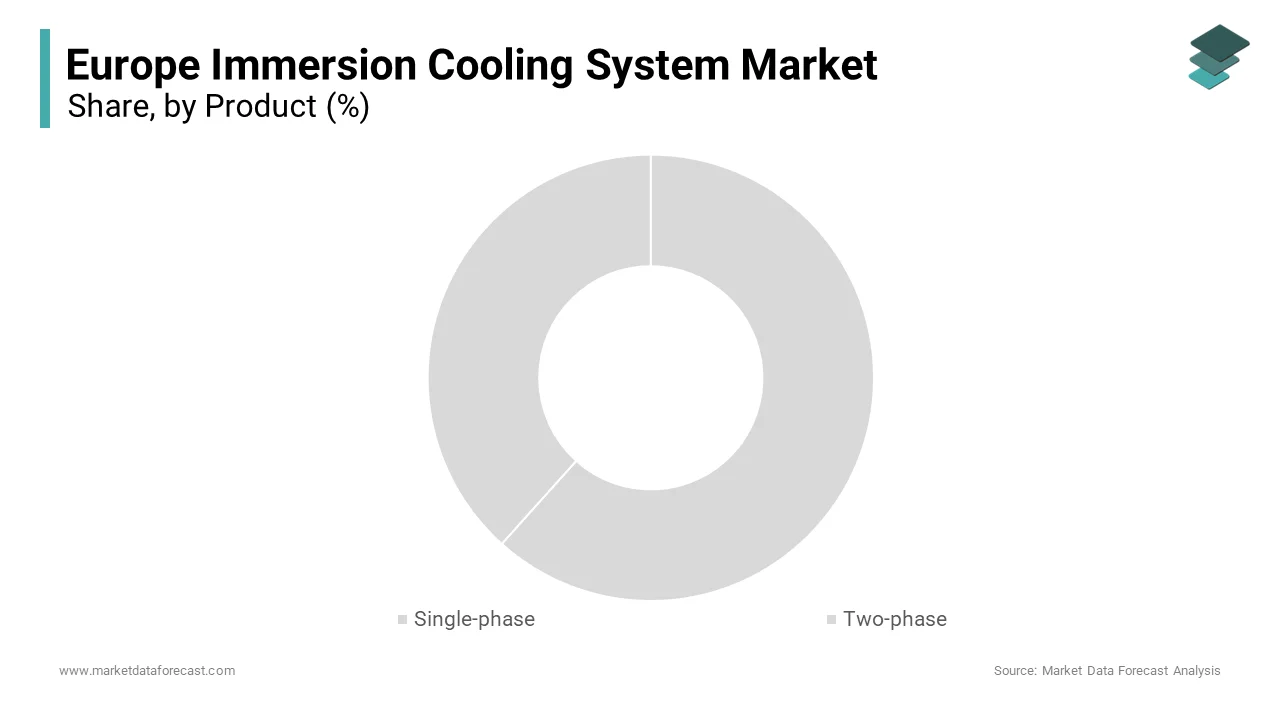
The two-phase segment is the fastest-growing product segment and is expected to grow at a significant CAGR in the European market over the forecast period. Two-phase systems leverage the latent heat of vaporization to absorb extremely high thermal loads, enabling cooling capacities far beyond conventional limits. According to the EuroHPC Joint Undertaking, Europe’s LUMI supercomputer uses advanced immersion cooling to achieve exceptionally low power‑usage‑effectiveness values, demonstrating the efficiency of phase‑change‑based systems. CERN also employs two-phase cooling for high‑density particle‑tracking servers that exceed the thermal envelope of single-phase systems. The European Commission’s AI Office notes that a growing share of next‑generation AI clusters require immersion cooling to support rising GPU densities and heat flux levels. As AI models scale and compute intensity increases, two-phase immersion becomes essential for stable, high‑performance operation. Two-phase systems are expected to grow rapidly over the forecast period as AI and exascale computing workloads accelerate across Europe.
By Cooling Liquid Insights
The fluorocarbon-based fluids segment accounted for 50.3% of the European market share in 2024 due to their superior dielectric properties, material compatibility, and thermal stability. Fluorocarbon fluids exhibit exceptional inertness, causing no swelling, cracking, or degradation of common data‑center materials such as elastomers, plastics, and conformal coatings. According to a joint IMEC and CERN materials‑compatibility study, fluorocarbon fluids showed no material failure after extended immersion, whereas some hydrocarbon alternatives caused minor seal degradation. These fluids also possess high dielectric strength, ensuring electrical safety during live maintenance. Regulatory bodies recognize this safety profile. The European Committee for Electrotechnical Standardization includes fluorocarbon fluids in draft immersion‑cooling standards, which reflects their acceptance in mission‑critical environments. Hyperscalers rely on these fluids for high‑availability deployments where hardware failure is unacceptable. Fluorocarbon fluids are expected to retain their dominance over the forecast period as mission‑critical data‑center requirements intensify.
The hydrocarbon-based fluids segment is the fastest-growing cooling‑liquid segment and is predicted to grow at a CAGR of 22.8% over the forecast period. Hydrocarbon fluids offer significant cost advantages, often priced far below fluorocarbon alternatives. According to the European Raw Materials Information System, many hydrocarbon fluids fall within lower cost brackets, which makes them attractive for small and medium data centers. Many hydrocarbons are also readily biodegradable. As per the European Chemicals Agency, several synthetic hydrocarbons are readily biodegradable under OECD testing, aligning with EU environmental priorities. This sustainability profile supports adoption in municipal, educational, and public‑sector cloud infrastructure. Hydrocarbon immersion is increasingly offered as a standard option for budget‑constrained deployments seeking environmentally aligned solutions. Hydrocarbon fluids are expected to grow rapidly over the forecast period as cost‑sensitive and sustainability‑focused operators adopt immersion cooling.
By Application Insights
The artificial intelligence segment led the market by application and occupied 38.4% of the European immersion cooling market share in 2024. The leading position of the AI segment in this regional market is driven by the extreme thermal demands of GPU‑accelerated AI training and inference. Modern AI clusters featuring high‑performance GPUs generate heat densities far beyond the limits of air cooling. According to GENCI’s published performance data, immersion cooling enables the stable operation of thousands of accelerators in the Jean Zay supercomputer, preventing thermal throttling during large‑scale model training. DeepMind’s London research facilities also use immersion cooling to maintain consistent clock speeds during long‑duration reinforcement‑learning workloads. The European Commission’s AI Strategy mandates energy‑efficient infrastructure for publicly funded AI research, with immersion cooling explicitly recommended in implementation guidelines. With over 120 national AI institutes established across the EU, immersion cooling has become essential for Europe’s AI competitiveness. AI applications are expected to remain the largest segment over the forecast period as compute intensity and GPU deployment scale across the region.
The edge computing segment is promising and is estimated to witness a CAGR of 37.7% over the forecast period. Edge data centers deployed in cell towers, hospitals, retail stores, and transport hubs face strict noise, space, and reliability constraints. Immersion cooling eliminates fans and compressors, enabling silent operation, which is critical in residential or sensitive environments. According to the European Urban Agenda, smart‑city projects increasingly require low‑noise compute infrastructure, making immersion cooling a natural fit. A Deutsche Telekom pilot in Berlin demonstrated that immersion tanks can achieve high compute density in a significantly smaller footprint with no noise complaints. Autonomous‑vehicle test fleets and roadside compute nodes also rely on immersion to prevent thermal throttling during real‑time processing. Edge computing is expected to grow rapidly over the forecast period as Europe expands distributed digital infrastructure and smart‑city deployments.
COUNTRY ANALYSIS
Ireland Immersion Cooling Market Analysis
Ireland dominated the immersion cooling market in Europe in 2024 by holding 23.5% of the regional market share. The dominance of Ireland in the European market is attributed to its position as a major hyperscale data‑center hub and its strong regulatory push toward non‑evaporative cooling. The country hosts a large concentration of cloud and colocation facilities operated by global technology companies, which is reinforcing demand for high‑efficiency thermal‑management systems. National electricity‑consumption data highlights the scale of Ireland’s data‑center footprint, prompting government policies that restrict water‑intensive cooling methods and accelerate immersion‑cooling adoption. Several hyperscale operators have already deployed immersion solutions for AI and high‑density compute environments, while local technology firms collaborate with universities to develop region‑specific cooling innovations. With significant new data‑center capacity planned and all future builds required to meet non‑evaporative cooling standards, Ireland is positioned to remain Europe’s most influential immersion‑cooling market.
Sweden Immersion Cooling Market Analysis
Sweden is a promising regional segment in the Europe immersion cooling market. The position of Sweden in the European market can be credited to its leadership in waste‑heat reuse and sustainable data‑center design. The country’s cold climate and abundant renewable‑energy resources make it an ideal location for high‑density computing, but its defining advantage lies in integrating data‑center heat into municipal heating networks. Several large facilities already supply recovered heat to residential districts and greenhouses, demonstrating the efficiency of immersion‑based thermal capture. National policy requires new data centers above a defined capacity threshold to incorporate heat‑reuse systems, with immersion cooling favoured for its high‑temperature output. Sweden’s operators continue to expand carbon‑negative and energy‑positive data‑center models, supported by the ongoing construction of additional immersion‑cooled capacity. With its circular‑energy approach and strong renewable‑power base, Sweden is expected to remain a benchmark for sustainable computing in Europe.
Germany Immersion Cooling Market Analysis
Germany is expected to account for a prominent share of the Europe immersion cooling market over the forecast period, owing to the rapid industrial AI adoption and expansion of edge‑computing infrastructure. The country’s Industry 4.0 initiatives have driven the deployment of immersion‑cooled AI clusters across automotive, manufacturing, and logistics sectors. Several major industrial firms operate immersion‑cooled compute environments to support autonomous‑system training and real‑time quality‑control workloads. Germany is also advancing immersion‑cooled edge deployments for 5G, with telecom operators installing compact, silent cabinets in urban locations. Regulatory requirements for improved energy efficiency in new data centers further accelerate the shift toward immersion cooling. With continued investment in industrial AI and planned expansion of edge‑data‑center networks, Germany is positioned to strengthen its role in Europe’s immersion‑cooling landscape.
Finland Immersion Cooling Market Analysis
Finland is predicted to showcase a notable CAGR in the Europe immersion cooling market over the forecast period due to its world‑class high‑performance‑computing infrastructure and natural climate advantages. The country hosts one of Europe’s most powerful supercomputing systems, which uses immersion cooling to achieve extremely low energy‑efficiency ratios while supplying recovered heat to local district‑heating networks. Finland’s stable, low‑carbon electricity mix supports cost‑efficient operation of immersion‑cooled HPC and AI facilities. National strategy documents promote immersion cooling for future HPC deployments, with financial incentives available for qualifying projects. Finnish technology providers continue to expand immersion‑based cloud and compute services across the Nordic and Baltic regions. With substantial new capacity planned, Finland is expected to remain a leading center for exascale and climate‑efficient computing.
Netherlands Immersion Cooling Market Analysis
The Netherlands is anticipated to exhibit a healthy CAGR in the Europe immersion cooling market over the forecast period, owing to its semiconductor ecosystem, logistics‑infrastructure demands, and strong data‑center regulatory framework. Major logistics hubs deploy immersion‑cooled edge data centers to support autonomous‑operations management and real‑time analytics. The country’s proximity to leading semiconductor‑equipment manufacturers accelerates the development of immersion‑compatible hardware and cooling technologies. National investment programs continue to fund sustainable data‑infrastructure projects, with immersion cooling identified as a priority. Dutch data‑center operators and technology firms also export immersion‑cooling solutions globally, reinforcing the country’s role as an innovation hub. With strict energy‑efficiency requirements for new data‑center builds and ongoing expansion of high‑density compute environments, the Netherlands is expected to maintain its strong position in the European immersion‑cooling market.
COMPETITIVE LANDSCAPE
Competition in the Europe immersion cooling market is defined by technological differentiation, sustainability alignment, and regulatory preparedness rather than price alone. The landscape features European innovators like Submer and Asperitas competing with global entrants through localized engineering, fluid flexibility, and heat reuse integration. Unlike commoditized cooling segments, immersion remains highly specialized, with success dependent on reliability, fluid lifecycle management, and compliance with EU chemical and energy regulations. Players differentiate through single-phase versus two-phase focus, fluid environmental profiles, and edge versus hyperscale deployment optimization. Public sector mandates—particularly in Ireland, Sweden, and the Netherlands—favor vendors with proven heat recovery and low GWP credentials. The absence of universal standards creates both opportunity and risk; early movers establish de facto protocols while others await formalization. Ultimately, competition centers on building trusted, certified, and circular solutions that transform data centers from energy sinks into thermal resources, reflecting Europe’s unique blend of digital ambition and environmental stewardship.
KEY MARKET PLAYERS
A few of the market players in the Europe immersion cooling system market
- Fujitsu (Japan)
- Asperitas
- Green Data Center
- DUG Technology (Australia)
- Green Revolution Cooling (U.S.)
- Submer (Spain)
- LiquidStack Holding B.V. (Netherlands)
- Midas Immersion Cooling (U.S.)
- DCX POLSKA SP. Z O.O. (Poland)
- LiquidCool Solutions (U.S.)
- STULZ GMBH (Germany)
- UNICOM Engineering Inc. (U.S.)
Top Players In The Market
- Submer is a Barcelona-based pioneer in single-phase immersion cooling technology, offering scalable SmartPodXL solutions deployed across data centers, edge sites, and high-performance computing facilities throughout Europe. The company contributes globally by providing open architecture immersion platforms that support heterogeneous hardware from major OEMs. Submer’s systems are certified for integration with leading cloud and AI infrastructures, enabling sustainable computing in over 30 countries. In 2024, Submer launched a new fluid management suite with real-time monitoring and automated replenishment, enhancing operational reliability for unstaffed edge deployments. It also partnered with Fortum Värme in Stockholm to optimize waste heat recovery from its immersion tanks. These initiatives reinforce Submer’s leadership in scalable, circular, and user-centric immersion cooling solutions aligned with European sustainability mandates.
- Asperitas, headquartered in the Netherlands, specializes in direct contact liquid cooling with its proprietary AIC25 platform that combines immersion efficiency with a modular, rack-integrated design. The company serves hyperscalers, research institutions, and enterprises across Europe, emphasizing silent operation and ultra-low power usage effectiveness. Asperitas contributes to the global market by collaborating with semiconductor manufacturers to validate next-generation processors in immersion environments. In 2024, Asperitas introduced a new two-phase capable upgrade path for its existing single-phase units, allowing customers to scale thermal capacity without full system replacement. It also achieved full compliance with the EU Code of Conduct for Data Centre Energy Efficiency, enabling inclusion in public procurement frameworks. These actions demonstrate its commitment to flexibility, compliance, and long-term customer value in a rapidly evolving thermal landscape.
- Green Data Center, a Dutch innovator, focuses on sustainable immersion cooling using biodegradable hydrocarbon fluids and circular design principles. The company operates its own immersion-cooled data centers in Amsterdam and offers turnkey solutions to public sector and enterprise clients seeking compliant, low environmental impact infrastructure. Green Data Center contributes globally by advocating for eco-friendly fluid standards and hosting open testbeds for European startups. In 2024, it launched a certified biodegradable fluid program using Shell Durasyn 180X, achieving full alignment with EU Green Public Procurement criteria. It also integrated its cooling system with Amsterdam’s district heating pilot, demonstrating dual energy benefits. These efforts position Green Data Center as a benchmark for environmentally responsible immersion deployment in regulated European markets.
Top Strategies Used by the Key Market Participants
Key players in the Europe immersion cooling market prioritize integration with waste heat reuse systems to align with district heating mandates and circular economy goals. They develop fluid agnostic platforms to accommodate regulatory shifts and customer preferences across fluorocarbon and hydrocarbon options. Companies invest in remote monitoring and automated fluid management to reduce maintenance burden in edge and unstaffed deployments. Strategic partnerships with hyperscalers and public utilities enable large-scale validation and policy alignment. Additionally, they pursue compliance with EU energy efficiency codes and Green Public Procurement criteria to secure inclusion in public and enterprise tenders.
RECENT MARKET NEWS
- In March 2024, Submer launched a real-time fluid monitoring and automated replenishment suite for its SmartPodXL immersion cooling systems across European edge deployments. This digital enhancement is anticipated to reduce maintenance visits and strengthen Submer’s position in the Europe immersion cooling market.
- In May 2024, Asperitas introduced a two-phase upgrade path for its existing AIC25 single-phase immersion platforms, enabling higher thermal density without full system replacement. This scalability feature is expected to extend customer lifecycle value and strengthen Asperitas’s position in the Europe immersion cooling market.
- In February 2024, Green Data Center launched a certified biodegradable hydrocarbon fluid program using Shell Durasyn 180X fully compliant with EU Green Public Procurement criteria. This sustainability initiative is anticipated to secure public sector contracts and strengthen Green Data Center’s position in the Europe immersion cooling market.
- In June 2024, Submer partnered with Fortum Värme in Stockholm to optimize waste heat recovery from its immersion-cooled data centers for district heating integration. This energy circularity project is expected to demonstrate dual environmental benefits and strengthen Submer’s position in the Europe immersion cooling market.
- In April 2024, Asperitas achieved full compliance certification with the EU Code of Conduct for Data Centre Energy Efficiency enabling inclusion in public and enterprise procurement frameworks. This regulatory alignment is anticipated to accelerate adoption in regulated sectors and strengthen Asperitas’s position in the Europe immersion cooling market.
MARKET SEGMENTATION
This research report on the Europe immersion cooling market is segmented and sub-segmented into the following categories.
By Product
- Single-phase
- Two-phase
By Cooling Liquid
- Mineral Oil
- Fluorocarbon-based Fluids
- Deionized Water
- Others
By Application
- High-performance Computing
- Edge Computing
- Cryptocurrency Mining
- Artificial Intelligence
- Others
By Country
- UK
- France
- Spain
- Germany
- Italy
- Russia
- Sweden
- Denmark
- Switzerland
- Netherlands
- Turkey
- Czech Republic
- Rest of Europe