Europe Inductor Market Size, Share, Trends, & Growth Forecast Report By Type (Power Inductors, RF/High-Frequency Inductors, Coupled Inductors, Multilayer Inductors, Thin-Film Inductors, Molded/Wire-Wound Inductors), Core Material, End-User Vertical and Country (UK, France, Spain, Germany, Italy, Russia, Sweden, Denmark, Switzerland, Netherlands, Turkey, Czech Republic and Rest of Europe), Industry Analysis From 2026 to 2034
Market Size, 2025
$3.46 BnMarket Estimate, 2026
$3.60 BnMarket Forecast, 2034
$4.90 BnCAGR, 2026–2034
3.95%Europe Inductor Market Report Summary
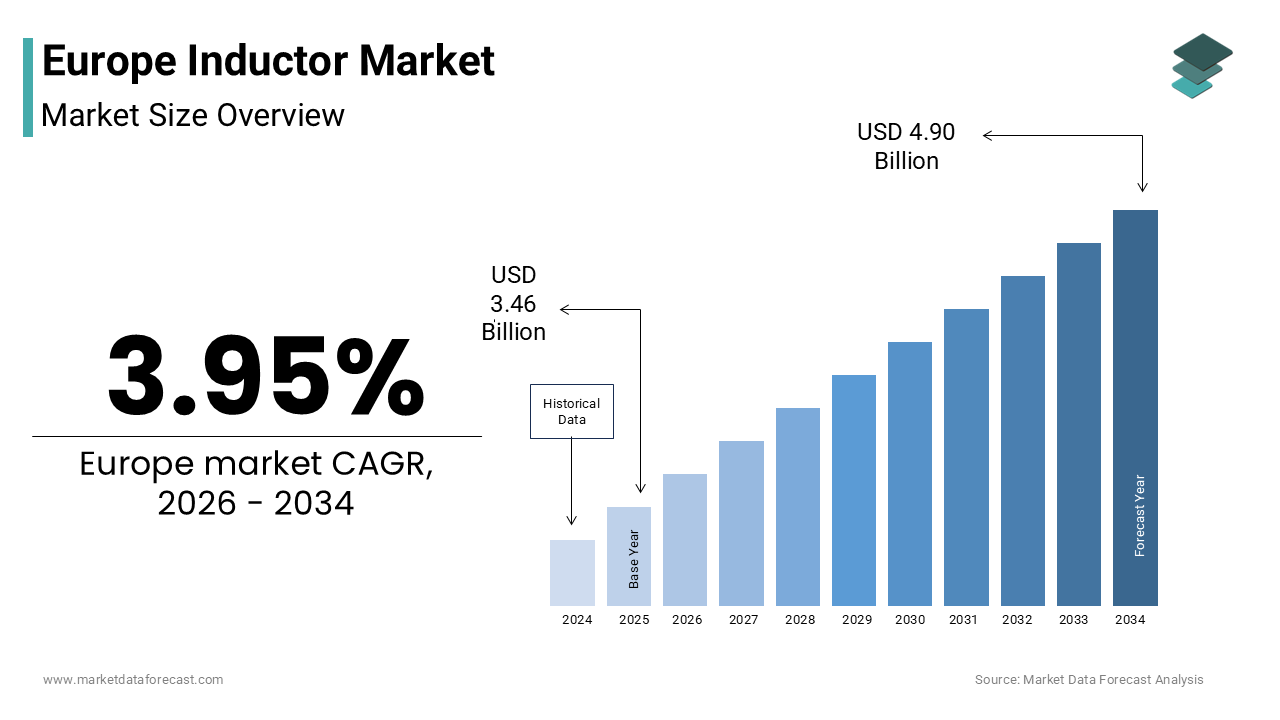
The Europe inductor market was valued at USD 3.46 billion in 2025, is projected to reach USD 3.60 billion in 2026, and is expected to grow to USD 4.90 billion by 2034, expanding at a CAGR of 3.95% during the forecast period from 2026 to 2034. The growth of the Europe inductor market is primarily driven by rising adoption of electric vehicles, expanding renewable energy installations, and increasing deployment of 5G infrastructure across the region. Inductors play a critical role in power electronics, energy conversion, and electromagnetic interference suppression, making them essential components in Europe’s transition toward electrification and digitalization. Additionally, strict electromagnetic compatibility regulations and growing industrial automation investments are accelerating the demand for high-performance inductive components across automotive, communications, and industrial sectors.
Key Market Trends
-
Increasing use of high-power inductors in electric vehicle traction systems and fast-charging infrastructure.
-
Growing deployment of renewable energy inverters and wind turbine converters requiring advanced magnetic components.
-
Rising demand for miniature RF inductors is driven by 5G network expansion and future 6G research initiatives.
-
Strong focus on high-efficiency ferrite and nanocrystalline core materials to improve thermal and saturation performance.
-
Expansion of industrial automation and robotics systems is creating steady demand for precision power inductors.
Segmental Insights
-
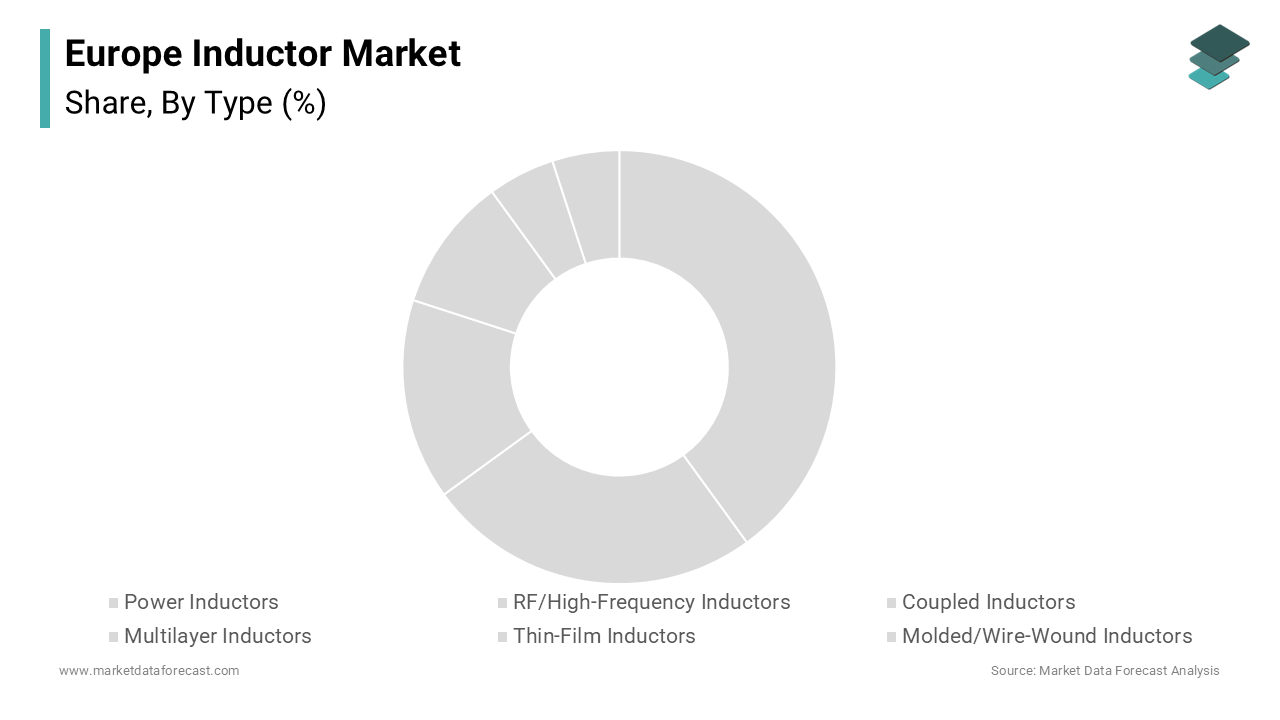
Based on type, the power inductors segment dominated the Europe inductor market with a 60.8% share in 2025, supported by strong demand from EVs, renewable energy systems, and industrial motor drives.
-
Based on core material, the ferrite core inductors segment held 71.4% of the Europe inductor market share in 2025, owing to their cost-effective performance, high magnetic permeability, and compatibility with EU regulatory standards.
-
Based on end-user vertical, the automotive segment accounted for 40.5% of the Europe inductor market in 2025, driven by aggressive electrification strategies and rising adoption of high-voltage EV architectures.
Regional Insights
The Europe inductor market demonstrates strong regional performance supported by automotive manufacturing, renewable energy deployment, and telecommunications advancements.
-
Germany led the Europe inductor market by accounting for 27.7% of the regional share in 2025, backed by its automotive leadership and strong industrial automation ecosystem.
-
France maintains a significant position through aerospace, defense electronics, and solar energy expansion driving demand for high-reliability inductors.
-
The United Kingdom is witnessing steady growth supported by 5G infrastructure, advanced electronics design, and specialized RF component development.
-
Italy and Sweden are emerging as key markets due to increasing industrial robotics adoption, renewable energy projects, and smart grid infrastructure development.
Competitive Landscape
The Europe inductor market features a competitive landscape shaped by advanced engineering expertise, material innovation, and strict regulatory compliance requirements. Leading companies focus on developing high-efficiency core materials, expanding localized production capacity, and strengthening partnerships with automotive, industrial, and telecommunications OEMs. Prominent players operating in the Europe inductor market include Vishay Intertechnology, TDK Corporation, Murata Manufacturing, Taiyo Yuden, Delta Electronics, Panasonic Corporation, Coilcraft, Pulse Electronics, AVX Corporation, Sumida Corporation, and Würth Elektronik. These companies emphasize innovation in miniaturized high-frequency inductors, high-current power chokes, and customized solutions tailored to Europe’s electrification and connectivity demands.
Europe Inductor Market Size
The Europe inductor market size was valued at USD 3.46 billion in 2025 and is anticipated to reach USD 3.60 billion in 2026 from USD 4.90 billion by 2034, growing at a CAGR of 3.95% during the forecast period from 2026 to 2034.
Inductors are passive electronic components that store energy in a magnetic field when electric current flows through a coiled conductor, primarily used for filtering, energy storage, impedance matching, and noise suppression in power electronics and signal circuits. These components are critical enablers in applications such as renewable energy inverters, electric vehicle powertrains, industrial motor drives, and telecommunications infrastructure. Europe’s inductor market operates within a high precision engineering ecosystem shaped by stringent electromagnetic compatibility standards and a strong industrial base in automation and green technology. As per the International Federation of Robotics over 400000 industrial robots were operational in EU factories in 2024, each requiring multiple inductors for servo drive and power management systems. Additionally, according to Eurostat renewable energy sources accounted for about 47% of EU electricity generation in 2024, which is driving demand for high frequency inductors in solar inverters and wind turbine converters. The European Union’s Radio Equipment Directive and EMC Directive mandate strict electromagnetic interference limits, which is requiring necessitating advanced inductor designs with high saturation currents and low core losses. These regulatory and technological landscape positions inductors not as commoditized parts but as precision-engineered components essential to Europe’s digital and energy transition.
MARKET DRIVERS
Accelerated Deployment of Renewable Energy Systems Requiring Power Conversion Electronics
The rapid expansion of solar photovoltaic and wind power installations across Europe is a primary driver for high power inductor demand, due to their indispensable role in inverters and DC-DC converters. According to Eurostat, renewable sources generated about 47% of the EU’s electricity in 2024, and solar energy generation increased significantly, with annual solar generation rising by 54 TWh (+22%) compared to 2023. Each utility scale solar inverter requires 6 to 12 high current common mode and differential mode inductors to suppress electromagnetic interference and ensure grid compliance under the EU’s EN 61000 6 2 EMC standard. Similarly, offshore wind farms like Denmark’s Kriegers Flak project use multi megawatt converters containing custom wound inductors rated for 2000 amperes or more. The European Commission’s REPowerEU plan targets 750 GW of solar by 2030, necessitating millions of new inverters, each consuming specialized magnetic component. Companies like ABB and Siemens Energy source high saturation ferrite and powdered iron inductors from European suppliers to meet stringent thermal and reliability requirements.
Rising Adoption of Electric Vehicles and Onboard Power Electronics
Europe’s aggressive transition to electric mobility is fuelling demand for advanced inductors in traction inverters, onboard chargers, and DC-DC converters within EV powertrains, which is further propelling the inductors market growth in Europe. According to the European Automobile Manufacturers Association, battery electric car sales in the EU reached 1.88 million units in 2024, up 29.9% year-on-year. Each battery electric vehicle contains 15 to 25 high frequency inductors for functions such as current smoothing in the traction inverter and voltage regulation in the 400-to-800-volt architecture. The EU’s stringent electromagnetic compatibility regulations, particularly ECE R10, mandate that all EVs pass radiated and conducted emission tests, necessitating shielded and low loss inductors with tight tolerance. Volkswagen’s ID series and Stellantis’s Peugeot e 208 use custom planar inductors that minimize size while handling 600 ampere peak currents, as confirmed by supplier disclosures. Furthermore, the European Commission’s Alternative Fuels Infrastructure Regulation requires ultra-fast charging stations every 60 kilometers on major highways by 2025, each station containing high power inductors in its 350 kilowatt chargers.
MARKET RESTRAINTS
Supply Chain Vulnerability for Specialty Magnetic Core Materials
The Europe inductor market faces significant constraints due to dependence on imported and geopolitically sensitive raw materials for magnetic cores, particularly high purity ferrites and rare earth doped alloys. In 2024, the EU was heavily dependent on China for imports of rare earth elements, with 95% of EU imports coming from China, Malaysia, and Russia combined. China accounts for more than 90% of global gallium production, and its 2023 export controls triggered price spikes across Europe. The European Commission’s 2023 Critical Raw Materials Act classified several magnetic materials as high supply risk, with single country dependency exceeding 60%. While companies like TDK and VACUUMSCHMELZE maintain European production, they source base oxides from Asia, creating latent vulnerability.
Stringent Electromagnetic Compatibility Standards Increasing Design Complexity and Certification Costs
Europe’s rigorous electromagnetic compatibility framework imposes substantial technical and financial burdens on inductor manufacturers and end users alike, which is further hindering the inductors market expansion in Europe. The EU’s EMC Directive 2014 30 EU and harmonized standards like EN 55032 require all electronic devices to limit both emitted and susceptibility to electromagnetic interference, necessitating inductors with precise inductance stability, low core loss, and effective shielding. Certification testing at notified bodies such as TÜV Rheinland or SGS costs between 15000 and 40000 euros per product family and can take 8 to 12 weeks, as per the European Electrical Equipment Association. A 2024 survey by the European Passive Components Institute found that 64% of manufacturers delayed product launches due to EMC compliance issues.
MARKET OPPORTUNITIES
Integration into Industrial Automation and Robotics Power Systems
Europe’s leadership in industrial automation presents a high value opportunity for the European inductors market. According to the International Federation of Robotics, about 400000 industrial robots were in operation across EU factories in 2024, with Germany accounting for the largest share of installations. Each collaborative or articulated robot requires 4 to 8 servo axes, each powered by a drive containing multiple high frequency chokes and DC link inductors to stabilize current and suppress switching noise. The EU’s Machinery Regulation 2023 now mandates functional safety and electromagnetic resilience for all robotic systems, driving demand for inductors with high saturation flux density and thermal stability up to 150 degrees Celsius. Companies like KUKA and ABB specify custom planar inductors from European suppliers that integrate directly onto power modules, reducing footprint and parasitic inductance. With the European Investment Bank allocating 4.2 billion euros to smart manufacturing under the Digital Europe Programme, and robotics density projected to grow steadily, the industrial automation segment offers a stable and technically demanding outlet for high performance inductors aligned with Europe’s Industry 4.0 strategy.
Expansion in 5G Infrastructure and Telecommunications Power Management
The rollout of 5G networks across Europe is creating new demand for miniature high frequency inductors in base station power supplies and RF front end modules, which is another promising opportunity in the European inductors market. Each 5G macro cell site requires 3 to 5 power amplifiers and multiple DC DC converters to manage the 3.5 to 26 gigahertz spectrum bands, all dependent on multilayer chip inductors with low insertion loss and high self-resonant frequency. According to the European Telecom Market Observatory, over 270000 5G base stations were operational in the EU by the end of 2024, with coverage in all major urban centers. The European Electronic Communications Code mandates energy efficiency and electromagnetic compatibility for all network equipment, necessitating inductors that maintain performance under high ripple current and temperature cycling. Companies like Ericsson and Nokia source shielded multilayer inductors from European manufacturers that meet the stringent ETSI EN 301 489 1 emissions standard. Additionally, small cell deployments in dense urban areas are projected to reach over 1 million units by 2027, relying on ultra compact inductors for compact power designs. With the EU allocating 1.8 billion euros to 5G corridors and smart connectivity initiatives, this segment offers scalable growth for miniaturized and high reliability inductive components.
MARKET CHALLENGES
Miniaturization Demands Versus Thermal and Saturation Performance Trade Offs
The relentless drive toward smaller electronic systems, particularly in automotive and consumer applications, is creating a fundamental engineering conflict between size reduction and inductor performance in European designs and is challenging the growth of the European inductors market. As power densities increase in EV onboard chargers and 5G base stations, inductors must handle higher currents in shrinking footprints, yet core saturation and thermal rise remain physical constraints. A high frequency inductor for an 11-kilowatt EV charger must now fit within 30 cubic centimetres while managing 40 amperes continuous current, representing a significant reduction in volume compared to earlier designs. This forces designers to use expensive core materials like amorphous metal or nanocrystalline alloys, which offer higher saturation flux but are brittle and difficult to wind. Additionally, thermal management becomes critical, as inductors operating above 125 degrees Celsius suffer 15 to 20% inductance drop, degrading system stability. European OEMs often reject cost effective ferrite solutions due to these trade-offs, leading to supply bottlenecks for advanced materials. Until new core compositions or 3D integrated magnetics overcome these physical limits, miniaturization will continue to strain performance, reliability, and cost structures across the inductor value chain.
Fragmented Manufacturing Base and Lack of High-Volume Domestic Production
Europe’s inductor market suffers from a fragmented and low scale manufacturing landscape that struggles to meet the volume and cost demands of mass markets like consumer electronics and EVs. While the region hosts high precision specialists like VACUUMSCHMELZE and Würth Elektronik, these firms focus on low volume, high margin components for industrial and automotive sectors. Mass production of standard chip inductors, required in millions of units for smartphones and IoT devices, is dominated by Asian suppliers with automated high throughput lines. According to the European Passive Components Institute, over 85% of multilayer ceramic and chip inductors used in EU assembled electronics are imported from Japan, South Korea, and China. This dependency undermines supply security and innovation speed, with lead times for standard parts often exceeding 20 weeks during shortages, as seen in 2023. The EU’s Chips Act largely excludes passive components from funding despite their criticality, creating a strategic gap. Without coordinated investment in automated European inductor production, the continent will remain reliant on external sources for foundational electronic building blocks, weakening its sovereignty in key technological domains.
REPORT COVERAGE
| REPORT METRIC | DETAILS |
| Market Size Available | 2025 to 2034 |
| Base Year | 2025 |
| Forecast Period | 2026 to 2034 |
| CAGR | 3.95% |
| Segments Covered | By Type, Core Material, End-User Vertical and Region |
| Various Analyses Covered | Regional & Country Level Analysis, Segment-Level Analysis, DROC, PESTLE Analysis, Porter’s Five Forces Analysis, Competitive Landscape, Analyst Overview on Investment Opportunities |
| Countries Covered | UK, France, Spain, Germany, Italy, Russia, Sweden, Denmark, Switzerland, the Netherlands, Turkey, the Czech Republic, and the Rest of Europe. |
| Market Leaders Profiled | Vishay Intertechnology, Inc., TDK Corporation, Murata Manufacturing Co., Ltd., Taiyo Yuden Co., Ltd., Delta Electronics, Inc., Panasonic Corporation, Coilcraft, Inc., Pulse Electronics Corporation, AVX Corporation, Sumida Corporation, and Würth Elektronik. |
SEGMENTAL ANALYSIS
By Type Insights
The power inductors segment dominated the market by accounting for 60.8% of the European market share in 2025. The dominance of power inductors segment in the European market is driven by their critical role in energy conversion and management across high growth sectors such as electric vehicles, renewable energy, and industrial automation. According to the European Automobile Manufacturers Association, 1.88 million battery electric cars were sold in the EU in 2024, up nearly 30% year‑on‑year, each requiring 15 to 25 power inductors in its traction inverter, onboard charger, and DC DC converter systems. Each solar inverter deployed under the EU’s solar expansion contained 8 to 12 high current power inductors to meet EN 61000 6 2 electromagnetic compatibility standards. Industrial motor drives used in hundreds of thousands of operational robots across EU factories also rely on shielded power inductors for current smoothing and noise suppression. The European Commission’s REPowerEU and Fit for 55 initiatives further institutionalize demand by mandating electrification and grid stability. Unlike RF inductors, which serve niche signal applications, power inductors are embedded in the physical infrastructure of Europe’s energy and mobility transition, making them the foundational and highest volume segment in the market.
The RF and high frequency inductors segment the fastest growing type in the Europe inductor market and is predicted to expand at a CAGR of 12.5% over the forecast period owing to the continent‑wide deployment of 5G networks and advanced telecommunications infrastructure requiring precision passive components for signal integrity and power efficiency. Each 5G macro cell site operating in the 3.5 to 26 gigahertz bands uses 20 to 30 multilayer chip inductors in RF front ends, power amplifiers, and antenna tuning circuits. According to the European Commission, over 270000 5G base stations were active across the EU by December 2024, with coverage in all urban centers and major transport corridors. Additionally, the rollout of 5G private networks in smart factories demands ultra compact high Q inductors that maintain performance under thermal stress. The European Electronic Communications Code mandates strict spectral efficiency, driving adoption of advanced ceramic and air core RF inductors with low insertion loss. With the EU allocating 1.8 billion euros to 6G research and smart connectivity, this segment is poised for sustained growth as Europe leads in next generation wireless innovation.
By Core Material Insights
The ferrite core inductors segment led the market by holding 71.4% of the European market share in 2025. The dominating position of ferrite core inductors segment in the European market can be credited to ferrite’s optimal balance of high magnetic permeability, low electrical conductivity, and cost effectiveness for frequencies up to 2 megahertz that cover the majority of power electronics applications. Ferrite cores are essential in EV traction inverters, solar microinverters, and industrial motor drives where high saturation flux density and low core loss are critical. As per the European Power Electronics Association, ferrites are used in the majority of power inductors employed in EU manufactured EVs and renewable energy systems. The material’s brittleness is offset by mature manufacturing processes that enable precise geometries for shielded drum and E cores. Furthermore, ferrite aligns with EU RoHS and REACH regulations, as it contains no restricted heavy metals. Despite supply chain vulnerabilities, its performance, reliability, and scalability ensure continued dominance across automotive, industrial, and consumer power applications in Europe.
The air and ceramic core inductors segment is estimated to register a CAGR of 10.5% over the forecast period owing to the rising demand for ultra stable high frequency components in 5G/6G telecommunications, radar systems, and aerospace avionics where minimal core loss and temperature stability are paramount. Unlike ferrite, which suffers from permeability drift above 100-megahertz, air and ceramic cores maintain consistent inductance with Q factors exceeding 100 at gigahertz frequencies. Each 5G base station in the EU uses multiple ceramic core inductors in its power amplifier matching networks. Additionally, the European Defence Agency’s radar modernization program specifies air core inductors for pulse fidelity in X band transceivers. The EU’s 6G Vision published by Hexa X explicitly identifies low loss passive components as critical enablers for terahertz communication. With European telecom and defense sectors prioritizing signal integrity over size, air and ceramic cores are gaining strategic relevance in high frequency frontiers.
By End‑User Vertical Insights
The automotive segment commanded for the highest share of 40.5% of the European market in 2025. The dominance of automotive segment in the European market is driven by Europe’s aggressive electrification trajectory and the intensive use of inductors in electric and hybrid vehicle powertrains. According to ACEA, 1.88 million battery electric vehicles were sold in the EU in 2024, each requiring 15 to 25 high current power inductors for traction inverters, onboard chargers, and DC link stabilization. The EU’s CO2 emission targets have forced manufacturers like Volkswagen, Stellantis, and BMW to accelerate EV production, creating structural demand for automotive grade magnetics. Additionally, 48-volt mild hybrid systems use additional inductors for DC-DC conversion. The European Commission’s Alternative Fuels Infrastructure Regulation mandates 350-kilowatt ultra-fast chargers every 60 kilometers on major highways by 2025, each containing high power inductors. With most European EVs assembled locally and stringent ECE R10 electromagnetic compatibility certification required, automotive remains the deepest and most consistent inductor application vertical in Europe.
The communications segment is the fastest growing end user vertical in the Europe inductor market and is estimated to grow at a CAGR of 13.3% over the forecast period owing to the continent‑wide rollout of 5G infrastructure, private networks, and future 6G research requiring high frequency precision inductors for signal conditioning and power management. Over 270000 5G base stations were operational in the EU by end of 2024, with each macro site consuming 25 to 30 RF and power inductors. The European Commission’s 5G Corridors initiative funded cross border highway coverage connecting Rotterdam, Hamburg, and Marseille, accelerating deployment in transport logistics. Additionally, thousands of private 5G networks were installed in EU factories and ports in 2024, enabling autonomous logistics and requiring compact multilayer inductors with high self-resonant frequency. The EU’s Digital Decade target of gigabit connectivity for all households and enterprises by 2030 ensures continued investment. With the European 6G Office allocating 900 million euros to pre standardization research, communications is transforming from a cyclical to a strategic growth pillar for advanced inductor technologies.
REGIONAL ANALYSIS
Germany Inductor Market Analysis
Germany led the inductor market in Europe in 2025 by holding 27.7% of the regional market share. The leading position of Germany in the European market is driven by its position as Europe’s top automotive producer and industrial automation leader. Volkswagen, BMW, and Mercedes‑Benz manufactured millions of vehicles in 2024, many electrified, requiring advanced power inductors for 800-volt architectures. Simultaneously, Germany hosts over 200000 industrial robots, representing close to 30% of the EU total, each using servo drive inductors from domestic suppliers like Würth Elektronik and VACUUMSCHMELZE. The German government’s “Power Electronics 2030” initiative allocated 320 million euros to secure domestic magnetics production for EVs and renewables. With world class engineering clusters in Bavaria, Baden‑Württemberg, and Saxony, Germany integrates inductor design into high value manufacturing ecosystems, ensuring its continued leadership in precision electromagnetic components.
France Inductor Market Analysis
France captured second largest share of the European inductor market in 2025. The growth of France in the European market is attributed to its dual strength in defense, aerospace, and solar energy deployment. Thales, Safran, and Dassault Aviation specify high reliability air core and ferrite inductors for radar avionics and satellite power systems used in the Future Combat Air System and Syracuse IV programs. The French Armed Forces modernized radar sites in 2024, requiring custom inductors with extreme temperature stability. Concurrently, France added 8.2 GW of solar capacity in 2024, one of the highest in Europe, driving demand for power inductors in string inverters from companies like Schneider Electric. The French National Research Agency’s “Magnetics for Sovereignty” program funds R&D in domestic ferrite production to reduce Chinese dependency. With strategic focus on technological autonomy and green energy, France maintains a high value diversified inductor market anchored in national security and sustainability.
United Kingdom Inductor Market Analysis
The United Kingdom is estimated to witness a promising CAGR in the European inductors market during the forecast period. Despite Brexit, the UK remains a leader in telecommunications and advanced electronics design. BT and Vodafone activated tens of thousands of 5G sites in 2024, requiring high frequency ceramic core inductors from UK‑based suppliers like TT Electronics. The National Quantum Computing Centre and Rolls‑Royce’s aerospace division also drive demand for ultra stable inductors in cryogenic and avionics systems. Post Brexit, the UK Electronics Cluster Partnership launched the “Secure Magnetics” initiative to onshore critical inductor production with 85 million pounds in government co‑funding. Companies like IQE and Compound Semiconductor Applications Catapult develop advanced substrates for RF inductors used in defense and 6G. With strong design houses and strategic focus on supply chain resilience, the UK sustains a specialized high tech inductor niche despite manufacturing scale limitations.
Italy Inductor Market Analysis
Italy is anticipated to account for a notable share of the European inductors market over the forecast period. The country’s strength lies in its dense network of automotive tier suppliers and industrial machinery manufacturers. Companies like Marelli, Hitachi Astemo, and Brembo integrate power inductors into EV motor control units for Stellantis and Ferrari. Simultaneously, Italy hosts around 150000 operational industrial robots, concentrated in Emilia‑Romagna and Lombardy, driving demand for servo drive inductors from local converters. The Italian National Recovery Plan allocated 1.4 billion euros to electronics sovereignty, including inductor component development under the “Made in Italy Tech” pillar. The National Research Council’s Materials Institute in Turin pioneered nanocrystalline core prototypes for high frequency applications, now being piloted with Fincantieri naval systems. With deep integration into European automotive value chains and growing focus on advanced manufacturing, Italy maintains a resilient and technically sophisticated inductor ecosystem.
Sweden Inductor Market Analysis
Sweden is expected to exhibit a healthy CAGR in the European inductors market over the forecast period. The country’s demand is driven by its leadership in renewable energy integration and smart grid infrastructure. Vattenfall and Fortum deployed several gigawatts of solar and wind capacity in 2024, requiring high reliability power inductors in grid‑tied inverters and battery storage converters. Sweden also leads in 5G private networks, with over 300 industrial sites—including Volvo and Sandvik—using RF inductors for autonomous logistics. The Swedish Energy Agency mandates grid stability for renewable injection, driving adoption of active filtering inductors with real time current monitoring. Companies like ABB and Hitachi Energy Sweden specify custom wound inductors with low acoustic noise for urban substations. With 65% of electricity from renewables and strong public‑private R&D collaboration, Sweden’s inductor market is defined by sustainability, innovation, and grid resilience priorities.
COMPETITIVE LANDSCAPE
The Europe inductor market features a tiered competitive structure with a few high precision domestic manufacturers serving strategic sectors and numerous Asian suppliers dominating standard components. Competition is driven by technical performance core material innovation and compliance with EU electromagnetic and environmental regulations rather than price alone. Incumbents like VACUUMSCHMELZE and Würth Elektronik leverage deep engineering integration and material science expertise to secure contracts in automotive defense and industrial automation where reliability is non-negotiable. However, the market faces vulnerability in high volume chip inductors which remain heavily imported due to limited European mass production capacity. Barriers to entry are high owing to certification costs thermal design complexity and long qualification cycles with OEMs. The European Chips Act’s exclusion of passive components further constrains investment despite their criticality. Overall, the landscape rewards companies that combine advanced magnetics localized production and regulatory agility while exposing structural gaps in volume electronics sovereignty.
KEY MARKET PLAYERS
Some of the companies that are playing a dominating role in the Europe Inductor Market include
- Vishay Intertechnology, Inc.
- TDK Corporation
- Murata Manufacturing Co., Ltd.
- Taiyo Yuden Co., Ltd.
- Delta Electronics, Inc.
- Panasonic Corporation
- Coilcraft, Inc.
- Pulse Electronics Corporation
- AVX Corporation
- Sumida Corporation
- Würth Elektronik
Top Players in the Market
VACUUMSCHMELZE GmbH & Co KG
VACUUMSCHMELZE is a Germany based global leader in advanced magnetic materials and inductive components with deep integration across European automotive aerospace and energy sectors. The company specializes in high performance inductors using proprietary nanocrystalline and amorphous core alloys that offer superior saturation flux density and thermal stability for electric vehicle inverters and renewable energy converters. In 2024 VACUUMSCHMELZE launched its VITROPERM 500 HF series tailored for 800-volt EV architectures enabling 20 percent higher power density than conventional ferrites. The firm also expanded its Hanau production facility to support just in time delivery to German and French OEMs. Through material science innovation and vertical integration from alloy production to finished inductors VACUUMSCHMELZE reinforces Europe’s technological sovereignty in critical power electronics.
Würth Elektronik eiSos GmbH & Co KG
Würth Elektronik is a German manufacturer renowned for its extensive portfolio of standard and custom inductors serving industrial automation automotive and telecommunications markets across Europe. The company offers over 15000 inductor variants including shielded power chokes multilayer chip inductors and high frequency RF components compliant with EU electromagnetic compatibility directives. In 2023 Würth Elektronik introduced it’s WE-HCF series of high current flat wire inductors optimized for onboard EV chargers achieving 40 percent lower DC resistance than comparable parts. In 2024 the company enhanced its Niedersachsen manufacturing site with automated winding and testing lines to meet surging demand from robotics and 5G infrastructure clients. By combining design flexibility rapid prototyping and regulatory expertise Würth Elektronik strengthens its role as a trusted partner for European engineering teams.
TDK Electronics AG
TDK Electronics is a Germany headquartered subsidiary of Japan’s TDK Corporation and a major supplier of ferrite-based inductors for automotive industrial and consumer applications in Europe. The company leverages global scale with local engineering to deliver components that meet stringent EU safety and environmental standards. In 2024 TDK Electronics released its B82791H* series of common mode chokes for 5G base station power supplies featuring ultra-low insertion loss and extended operating temperature range. The firm also deepened integration with European EV manufacturers by co developing compact power inductors for 800-volt traction inverters that comply with ECE R10 electromagnetic compatibility requirements. Through continuous investment in ferrite R and D and localized technical support TDK Electronics ensures reliable supply of high-volume precision inductors aligned with Europe’s electrification and digitalization agendas.
Top Strategies Used by the Key Market Participants
Key players in the Europe inductor market are investing in advanced core materials such as nanocrystalline and high frequency ferrites to meet the power density and thermal demands of electric vehicles and renewable energy systems. Companies are expanding automated manufacturing capacity within Europe to ensure supply chain resilience and comply with just in time delivery requirements from automotive and industrial clients. Strategic co development partnerships with OEMs enable early integration of custom inductors into next generation power electronics architectures. Firms are also aligning product portfolios with EU electromagnetic compatibility and RoHS regulations through rigorous testing and certification. Additionally, manufacturers are enhancing design support with simulation tools and application engineering teams to accelerate customer time to market. These strategies collectively address performance reliability and regulatory compliance in a market defined by technological precision and strategic autonomy.
MARKET SEGMENTATION
This research report on the Europe inductor market has been segmented and sub-segmented based on the following categories.
By Type
- Power Inductors
- RF/High-Frequency Inductors
- Coupled Inductors
- Multilayer Inductors
- Thin-Film Inductors
- Molded/Wire-Wound Inductors
By Core Material
- Air/Ceramic Core
- Ferrite Core
- Iron and Metal-Alloy Core
- Nanocrystalline and Amorphous Core
By End-User Vertical
- Automotive
- Aerospace and Defense
- Communications and 5G Infrastructure
- Consumer Electronics and Computing
- Industrial and Power
- Healthcare and Medical Devices
- Renewable Energy Systems
By Country
- UK
- France
- Spain
- Germany
- Italy
- Russia
- Sweden
- Denmark
- Switzerland
- Netherlands
- Turkey
- Czech Republic
- Rest of Europe
Frequently Asked Questions
What is the Europe inductor market?
It refers to the market for passive electronic components used to store energy in magnetic fields within electronic circuits across Europe.
What factors are driving market growth?
Rising demand for electric vehicles, 5G infrastructure, renewable energy systems, and consumer electronics.
Which industries use inductors the most?
Automotive, telecommunications, industrial equipment, aerospace, and consumer electronics.
What are the main types of inductors available?
Power inductors, RF/high-frequency inductors, multilayer inductors, and wire-wound inductors.
Why are power inductors important?
They help regulate voltage and improve energy efficiency in power management systems.
Which materials are commonly used in inductor cores?
Ferrite, air/ceramic, metal alloy, and nanocrystalline materials.
What challenges does the Europe inductor market face?
Supply chain disruptions, raw material costs, and miniaturization challenges.
Which countries are leading the market in Europe?
Germany, the UK, France, Italy, and the Netherlands are key contributors.
What trends are shaping the future of the market?
High-frequency components, EV electrification, and IoT expansion.
What is the future outlook for the Europe inductor market?
The market is expected to grow steadily with increasing adoption of advanced electronics and smart technologies.
Access the study in MULTIPLE FORMATS
Purchase options starting from
$ 2000
Didn’t find what you’re looking for?
TALK TO OUR ANALYST TEAM
Need something within your budget?
NO WORRIES! WE GOT YOU COVERED!
Call us on: +1 888 702 9696 (U.S Toll Free)
Write to us: sales@marketdataforecast.com