Europe Industrial Automation Market Size, Share, Trends, & Growth Forecast Report By Component ( Hardware, Software), Industry, and Country (UK, France, Spain, Germany, Italy, Russia, Sweden, Denmark, Switzerland, Netherlands, Turkey, Czech Republic and Rest of Europe), Industry Analysis From 2025 to 2033
Europe Industrial Automation Market Size
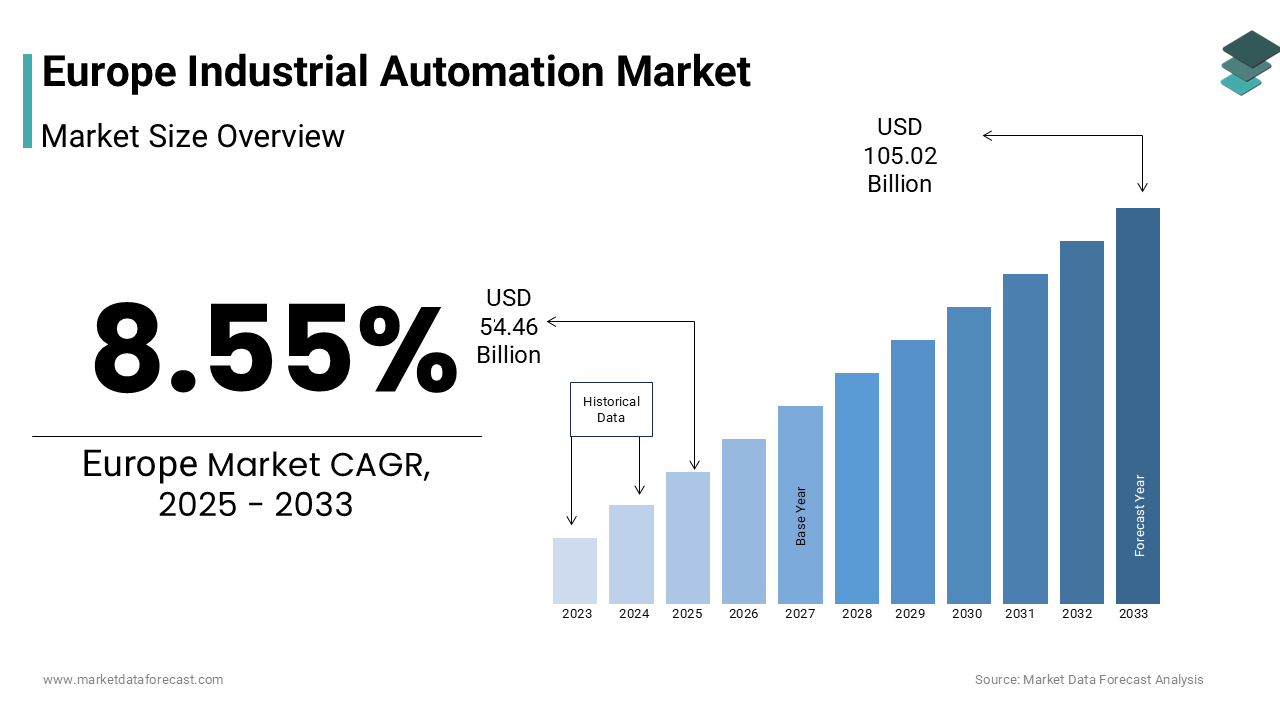
The europe industrial automation market size was valued at USD 50.17 billion in 2024 and is anticipated to reach USD 54.46 billion in 2025 from USD 105.02 billion by 2033, growing at a CAGR of 8.55% during the forecast period from 2025 to 2033.
Industrial automation refers to the integrated technologies and control systems, including programmable logic controllers, robotics, machine vision, and industrial software, that enable manufacturing and production processes to operate with minimal human intervention. This ecosystem is foundational to modern industrial efficiency precision and scalability across sectors such as automotive chemicals food and beverage and pharmaceuticals. Unlike generic digitization efforts industrial automation in Europe is deeply interwoven with regulatory imperatives for energy efficiency worker safety and environmental sustainability. "According to Eurostat data from 2023, the adoption of advanced automation systems and artificial intelligence in the European Union is a developing trend, with large enterprises using advanced technologies (such as AI) significantly more than SMEs. The convergence of legacy industrial infrastructure with emerging digital twins and edge computing capabilities defines the current trajectory of automation in Europe where technological sophistication is increasingly aligned with circular economy and decarbonization goals.
MARKET DRIVERS
Accelerated Adoption of Industry 4.0 Frameworks Driven by Policy and Competitiveness Mandates
The region’s strategic push toward Industry 4.0 accelerates the growth of the Europe industrial automation market. The European Commission allocated funds to support smart manufacturing initiatives including robotics integration and real time process monitoring. This policy driven momentum is reinforced by national strategies such as Germany’s Plattform Industrie 4.0 and France’s AI for Industry plan which mandate digital transformation as a condition for accessing public innovation grants. Apart from these, the EU’s Carbon Border Adjustment Mechanism incentivizes exporters to adopt automated systems that provide granular energy consumption data for compliance reporting. These regulatory and competitive pressures have transformed automation from a cost saving tool into a strategic necessity for maintaining global export relevance and meeting sustainability benchmarks.
Persistent Shortage of Skilled Industrial Workforce Across Advanced Economies
A structural deficit in technical labor is compelling European manufacturers to automate core production functions at an unprecedented pace, and this further bolsters the expansion of the Europe industrial automation market. The aging industrial workforce exacerbates this gap. In addition, companies are deploying collaborative robots and self-optimizing production lines that reduce dependency on manual oversight. For instance, automotive suppliers have implemented vision guided robotic cells that operate with minimal human calibration. This labor driven automation shift is not merely reactive but strategic, which enables firms to maintain output stability while reallocating human capital to higher value tasks such as system supervision and data analysis.
MARKET RESTRAINTS
Fragmented Legacy Infrastructure Hindering Seamless Integration of Advanced Systems
Many European industrial facilities operate on outdated machinery and control architectures that resist interoperability with modern automation solutions and restrict the growth of the Europe industrial automation market. The technological fragmentation forces companies to invest heavily in middleware gateways and custom integration layers which can increase deployment costs. Moreover, legacy systems often lack cybersecurity safeguards making them vulnerable to operational technology breaches. These infrastructural constraints disproportionately affect small and medium enterprises that lack capital for full line replacements thereby slowing region wide automation penetration and creating uneven competitiveness across the industrial landscape.
Stringent and Evolving Regulatory Compliance Burdens
Industrial automation in the region must navigate a complex web of safety, environmental, and data governance regulations, which hinders the expansion of the Europe industrial automation market. Compliance requires extensive re-engineering of control logic and safety interlocks particularly for legacy robotic cells. Apart from these, the General Data Protection Regulation imposes strict limitations on the collection and storage of operational data from connected machines even when used solely for predictive maintenance. These regulatory ambiguities increase time to deployment and deter investment especially among export oriented firms that must also align with non EU standards such as ANSI or ISO creating a dual compliance burden that stifles innovation velocity.
MARKET OPPORTUNITIES
Expansion of Circular Manufacturing Enabled by Intelligent Automation
Circular economy principles in European manufacturing through real time material tracking and adaptive reuse systems offer new opportunities for the expansion of the Europe industrial automation market. Automated sorting robots equipped with hyperspectral imaging can now identify and separate polymer types in post industrial waste streams. This capability allows companies to reintegrate recycled feedstock into high specification production lines without compromising quality. Furthermore, digital twin platforms synchronized with physical automation systems enable dynamic rerouting of energy and material flows to minimize waste. Supported by the EU’s Circular Economy Action Plan these intelligent systems transform sustainability from a compliance cost into a source of operational efficiency and brand differentiation.
Rise of Sovereign Industrial Tech Ecosystems Through Public Private Alliances
The region is actively cultivating domestic automation capabilities to reduce reliance on non EU technology providers and secure strategic autonomy, which creates fresh opportunities for the Europe industrial automation market. Initiatives have unified companies and research institutes to co develop open architecture automation platforms compliant with EU safety and data norms. These sovereign tech ecosystems are further reinforced by procurement preferences in defense and critical infrastructure sectors where automated systems must meet stringent origin and security criteria. This strategic reorientation not only strengthens supply chain resilience but also positions European automation vendors to export standards compliant solutions to global markets seeking alternatives to dominant non EU platforms.
MARKET CHALLENGES
Cybersecurity Vulnerabilities in Converged Operational Technology Environments
The integration of information technology and operational technology in smart factories has expanded the attack surface for industrial cyber threats with potentially catastrophic consequences, which hinders the growth of the Europe industrial automation market. Many legacy automation devices lack secure boot mechanisms or encrypted communication channels making them susceptible to firmware tampering. Even new installations often inherit vulnerabilities through third party software components. These risks are amplified by the shortage of OT cybersecurity specialists. The automation market will continue to be vulnerable to cascading supply chain disruptions unless security-by-design protocols are standardized and mandatory vulnerability disclosure frameworks are established.
Geopolitical Disruptions Impacting Critical Component Supply Chains
There is a mounting burden from geopolitical instability affecting the availability of semiconductor sensors and power electronics, which impedes the expansion of the Europe industrial automation market. A portion of advanced microcontrollers used in European programmable logic controllers is sourced from Taiwan and South Korea. Rare earth elements are essential for high performance servo motors such as neodymium and dysprosium. The EU's Critical Raw Materials Act aims to expand its sourcing of raw materials, but the move away from current dependencies will be a gradual process. In the interim manufacturers are forced to redesign systems or maintain costly buffer inventories. These supply chain fragilities not only inflate capital expenditure but also delay automation rollouts in strategic sectors like renewable energy equipment and medical device manufacturing undermining Europe’s industrial sovereignty ambitions
REPORT COVERAGE
| REPORT METRIC | DETAILS |
| Market Size Available | 2024 to 2033 |
| Base Year | 2024 |
| Forecast Period | 2025 to 2033 |
| Segments Covered | By Component, Industry and Region |
| Various Analyses Covered | Global, Regional & Country Level Analysis, Segment-Level Analysis, DROC, PESTLE Analysis, Porter’s Five Forces Analysis, Competitive Landscape, Analyst Overview of Investment Opportunities |
| Regions Covered | UK, France, Spain, Germany, Italy, Russia, Sweden, Denmark, Switzerland, the Netherlands, Turkey, the Czech Republic, and the Rest of Europe |
| Market Leaders Profiled | Siemens AG, ABB Ltd., Schneider Electric SE, Rockwell Automation Inc., Mitsubishi Electric Corporation, Emerson Electric Co., Honeywell International Inc., Yokogawa Electric Corporation, Omron Corporation, FANUC Corporation, Yaskawa Electric Corporation, KUKA AG, Bosch Rexroth AG (Robert Bosch GmbH), Beckhoff Automation GmbH & Co. KG, Phoenix Contact GmbH & Co. KG, Endress+Hauser Group, Krohne Group, and Festo SE & Co. KG. |
SEGMENTAL ANALYSIS
By Component Insights
The hardware segment led the Europe industrial automation market by accounting for 64.2% share in 2024. The dominance of the hardware segment is propelled by the foundational role of physical systems, such as sensors actuators industrial robots and programmable logic controllers, in enabling automated production. A key driver is the extensive retrofitting of legacy manufacturing lines across Southern and Eastern Europe where companies prioritize hardware upgrades to meet EU energy efficiency mandates. Apart from these, the automotive and machinery sectors, which together a portion of EU industrial output, require high precision hardware for assembly and quality inspection. The physical nature of automation deployment means that even software centric initiatives like predictive maintenance depend on hardware infrastructure such as vibration sensors and thermal cameras. This interdependence ensures hardware remains the largest and most capital intensive segment in the automation value chain.
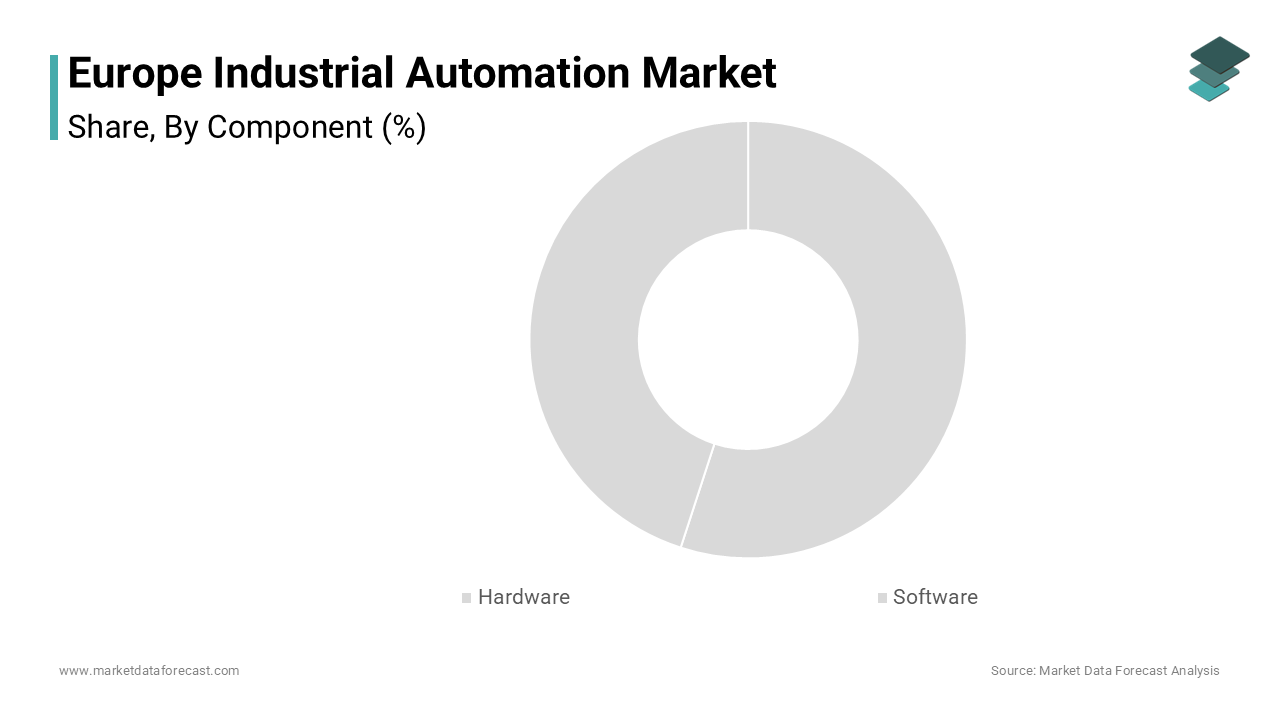
The industrial software segment is likely to experience the fastest CAGR of 13.8% from 2025 to 2033. The growth of the industrial software segment is fueled by the shift from isolated automation to integrated cyber physical production systems. Cloud based manufacturing execution systems and digital twin platforms now enable real time optimization of throughput quality and energy use across multi site operations. Companies have responded by launching subscription based software suites that include automatic compliance updates. This convergence of operational intelligence regulatory compliance and scalable deployment models positions industrial software as the highest growth vector in Europe’s automation transformation.
By Industry Insights
The discrete automation segment held the leading share of 58.7% share of the Europe industrial automation market in 2024. The prominence of the discrete automation segment is fueled by the region’s strong automotive electronics and machinery manufacturing base. Beyond automotive the rise of electric vehicle production has intensified demand for precision battery assembly and motor winding systems which rely heavily on discrete automation. Apart from these, the EU’s Chips Act has spurred construction of semiconductor fabs in Germany France and Italy all of which deploy high speed pick and place robots and vision guided inspection cells. These capital intensive industries collectively sustain discrete automation’s market primacy through continuous reinvestment in flexible high speed production lines.
The process automation segment is on the rise and is expected to be the fastest growing segment in the regional market by witnessing a CAGR of 12.4% from 2025 to 2033 due to stringent environmental regulations and the need for continuous operational control in sectors like chemicals pharmaceuticals and food processing. The EU’s Industrial Emissions Directive requires real time monitoring of emissions and effluents prompting chemical plants to upgrade to advanced distributed control systems. Moreover, the pharmaceutical industry’s shift toward continuous manufacturing demands tightly integrated automation for blending granulation and drying. These regulatory and efficiency imperatives are transforming process automation from a compliance necessity into a strategic enabler of sustainable and agile production.
REGIONAL ANALYSIS
Germany Industrial Automation Market Analysis
Germany outperformed other region in the Europe industrial automation market by capturing 24.6% share in 2024. The domination of Germany is driven by its world class machinery and automotive sectors which together account for over 30 percent of national industrial output. A portion of Germany’s top 500 manufacturers have implemented Industry 4.0 solutions including smart sensors and autonomous material handling systems. Apart from these, Germany hosts global automation giants like Siemens and Bosch whose R and D centers continuously pilot next generation technologies such as edge AI controllers and self configuring production cells. This ecosystem of industrial demand technological innovation and policy support solidifies Germany’s position as Europe’s automation powerhouse.
Italy Industrial Automation Market Analysis
Italy was the second largest region in the Europe industrial automation market by accounting for 12.3% share in 2024. The market is primarily driven by the need to modernize small and medium sized enterprises which constitute 98 percent of Italy’s manufacturing base. A portion of Italian machinery producers invested in collaborative robots and vision systems to enhance flexibility for low volume high variety production. The food and beverage sector has been a key adopter with automated packaging and sorting lines now standard in dairy and pasta facilities. This targeted support combined with strong domestic robotics integrators like Comau ensures Italy remains a dynamic and resilient automation market despite its fragmented industrial structure.
France Industrial Automation Market Analysis
France is a lucrative region in the Europe industrial automation market due to strategic autonomy in critical sectors including aerospace defense and nuclear energy. The French government committed funds to advanced manufacturing with a focus on automated composite layup systems for aircraft and robotic welding cells for naval construction. The semiconductor push is also accelerating automation demand. These state backed initiatives combined with strong engineering education pipelines ensure France maintains a technologically advanced and sovereign industrial automation footprint.
United Kingdom Industrial Automation Market Analysis
The United Kingdom expanded steadily in the Europe industrial automation market. Despite Brexit related supply chain adjustments the UK remains a leader in high value discrete manufacturing particularly in aerospace and specialty pharmaceuticals. Major manufacturing sites in the United Kingdom are increasingly integrating collaborative robotics and automated quality control systems to enhance precision and reduce manual intervention in production processes. Many UK manufacturers are expanding automation investments to address persistent labor shortages and improve operational resilience in the post-Brexit industrial environment. UK-based automation firms are increasingly successful in exporting compliant solutions globally, using their established experience in meeting both EU (CE) and domestic (UKCA) regulatory requirements, even as these standards diverge.
Sweden Industrial Automation Market Analysis
Sweden is predicted to grow in the Europe industrial automation market due to sustainable and human centric automation. Sweden also pioneers worker robot collaboration with ABB’s YuMi cobots now standard in electronics assembly lines across Gothenburg. This fusion of environmental responsibility technological sophistication and ergonomic design ensures Sweden’s outsized influence in shaping Europe’s next generation automation standards.
COMPETITIVE LANDSCAPE
The Europe industrial automation market features intense competition among global technology leaders regional specialists and agile software startups. Multinationals like Siemens ABB and Schneider Electric dominate through vertically integrated portfolios spanning hardware control systems and cloud based analytics. They leverage strong brand equity deep domain expertise and extensive service networks to retain large industrial clients. Meanwhile specialized firms such as Beckhoff and Festo compete on innovation in niche areas like PC based control and pneumatic automation. The competitive landscape is further shaped by rising demand for open architecture solutions prompting vendors to adopt OPC UA and other interoperability standards. Regulatory pressures around cybersecurity energy efficiency and data sovereignty have raised entry barriers favoring established players with compliance capabilities. However digital native entrants are gaining traction by offering modular scalable software solutions that appeal to small and medium enterprises seeking cost effective automation pathways.
KEY MARKET PLAYERS
A few of the major companies in the europe industrial automation market include
- Siemens AG
- ABB Ltd.
- Schneider Electric SE
- Rockwell Automation Inc.
- Mitsubishi Electric Corporation
- Emerson Electric Co.
- Honeywell International Inc.
- Yokogawa Electric Corporation
- Omron Corporation
- FANUC Corporation
- Yaskawa Electric Corporation
- KUKA AG
- Bosch Rexroth AG (Robert Bosch GmbH)
- Beckhoff Automation GmbH & Co. KG
- Phoenix Contact GmbH & Co. KG
- Endress+Hauser Group
- Krohne Group
- Festo SE & Co. KG
Top Players in the Market
Siemens AG
Siemens AG is a German multinational deeply embedded in the Europe industrial automation market through its Digital Industries division which delivers integrated hardware software and services for smart manufacturing. The company plays a pivotal role globally by advancing open automation architectures and industrial edge computing. Recently Siemens expanded its Industrial Edge ecosystem with new AI enabled analytics applications for predictive maintenance and energy optimization. It also launched a cybersecurity certification program for industrial devices in alignment with the EU’s NIS2 Directive. These initiatives reinforce Siemens’ leadership in secure interoperable and sustainable automation solutions across both European and international markets.
ABB Ltd
ABB Ltd headquartered in Switzerland is a global technology leader in robotics and industrial automation with a strong footprint across Europe’s automotive and process industries. The company contributes significantly to global standards in collaborative robotics and machine control. In recent developments ABB introduced its OmniCore robot controller featuring built in energy recovery and OPC UA over TSN compliance enhancing real time communication in smart factories. It also partnered with several European universities to develop AI driven robotic vision systems for complex assembly tasks. These innovations strengthen ABB’s position as a provider of future ready flexible and efficient automation technologies worldwide.
Schneider Electric SE
Schneider Electric SE a French multinational specializes in energy management and industrial automation solutions with a focus on sustainability and digital transformation. The company’s EcoStruxure platform integrates connected products edge control and analytics to optimize industrial operations across Europe and beyond. Recently Schneider Electric enhanced its industrial software suite with AI powered energy forecasting tools and launched a circularity assessment module for production lines. It also established a new automation innovation hub in Barcelona to accelerate co development with local manufacturers. These actions underscore Schneider Electric’s commitment to delivering resilient intelligent and eco efficient automation systems globally.
Top Strategies Used by the Key Market Participants
Key players in the Europe industrial automation market prioritize strategic initiatives to sustain leadership and drive innovation. They invest heavily in research and development to advance AI enabled control systems and interoperable software platforms compliant with European standards. Strategic acquisitions of niche software and cybersecurity firms enhance their integrated offering capabilities. Companies actively collaborate with academic institutions and industry consortia to co develop next generation automation technologies. Expansion of local innovation hubs and customer experience centers across major European countries strengthens client engagement and solution customization. Additionally they align product roadmaps with EU regulatory frameworks such as the Cyber Resilience Act and Energy Efficiency Directive to ensure compliance and market relevance.
MARKET SEGMENTATION
This research report on the europe industrial automation market has been segmented based on the following categories.
By Component
- Hardware
- Software
By Industry
- Discrete
- Process Automation
By Country
- UK
- France
- Spain
- Germany
- Italy
- Russia
- Sweden
- Denmark
- Switzerland
- Netherlands
- Turkey
- Czech Republic
- Rest of Europe
Frequently Asked Questions
What is the Europe Industrial Automation Market?
It refers to technologies, control systems, software, and equipment used to automate industrial operations and manufacturing processes across various industries in Europe.
What factors are driving the Europe industrial automation market?
Key growth drivers include Industry 4.0 adoption, need for improved productivity, labor shortage, focus on energy efficiency, digital transformation, and rapid adoption of robotics and AI-based solutions.
Which countries lead the automation market in Europe?
Germany, France, the United Kingdom, Italy, and the Netherlands are major contributors due to strong industrial manufacturing bases and technological advancement.
What challenges does the market face?
Key challenges include high installation costs, cybersecurity risks, shortage of skilled workforce, integration with legacy systems, and supply chain disruptions.
What is the future outlook for the Europe industrial automation market?
The market is expected to grow steadily due to investments in smart factories, robotics expansion, cloud & edge automation, and government support for digital industrial transformation.
Access the study in MULTIPLE FORMATS
Purchase options starting from
$ 2000
Didn’t find what you’re looking for?
TALK TO OUR ANALYST TEAM
Need something within your budget?
NO WORRIES! WE GOT YOU COVERED!
Call us on: +1 888 702 9696 (U.S Toll Free)
Write to us: sales@marketdataforecast.com