Europe Industrial Edge Market Size, Share, Trends, & Growth Forecast Report By Organization Size (Large Enterprises, Small & Medium Enterprises), Component, Deployment Mode, End-User, Application and Country (UK, France, Spain, Germany, Italy, Russia, Sweden, Denmark, Switzerland, Netherlands, Turkey, Czech Republic and Rest of Europe), Industry Analysis From 2026 to 2034
Market Size, 2025
$6.60 BnMarket Estimate, 2026
$7.42 BnMarket Forecast, 2034
$19.11 BnCAGR, 2026–2034
12.54%Europe Industrial Edge Market Report Summary
The Europe industrial edge market was valued at USD 6.60 billion in 2025, is estimated to reach USD 7.42 billion in 2026, and is projected to reach USD 19.11 billion by 2034, growing at a CAGR of 12.54% during the forecast period from 2026 to 2034. The growth of the Europe industrial edge market is driven by rising Industry 4.0 adoption, increasing demand for ultra-low latency processing in mission-critical manufacturing environments, and stringent European data sovereignty regulations. Growing deployment of connected industrial assets, need for real-time analytics on production floors, and cybersecurity considerations surrounding centralized cloud architectures are further accelerating market growth. Moreover, integration of industrial edge platforms with renewable energy optimization initiatives and semiconductor sovereignty programs is expanding adoption across multiple industrial sectors in Europe.
Key Market Trends
-
Increasing deployment of localized data processing infrastructure to enable deterministic control and ultra-low latency operations in industrial environments.
-
Growing emphasis on data sovereignty and regulatory compliance is driving on-premise and sovereign edge deployments across European manufacturing facilities.
-
Rising adoption of edge-enabled energy optimization solutions supporting renewable integration and industrial decarbonization strategies.
-
Expansion of edge-as-a-service and modular edge platforms is improving accessibility for small and medium enterprises.
-
Strong innovation momentum in AI-enabled edge analytics supporting predictive maintenance, digital twins, and autonomous industrial operations.
Segmental Insights
-
Based on organization size, the large enterprises segment led the Europe industrial edge market by accounting for 66.5% of the regional market share in 2025, driven by strong capital capacity, multi-site production networks, and advanced IT–OT convergence strategies.
-
Based on component, the hardware segment dominated the Europe industrial edge market with 51.9% share in 2025 due to the foundational requirement for ruggedized edge servers, gateways, and networking infrastructure supporting industrial workloads.
-
Based on deployment mode, the on-premise segment held 70.2% of the Europe industrial edge market share in 2025, attributed to strict data residency requirements, cybersecurity considerations, and latency-sensitive industrial control applications.
Regional Insights
The Europe industrial edge market is experiencing significant growth across major economies, supported by advanced manufacturing ecosystems, national digitalization initiatives, and regulatory requirements for sovereign data processing.
-
Germany was the largest contributor, accounting for 25.5% of the Europe industrial edge market share in 2025, driven by its strong automotive and machinery sectors, extensive industrial automation adoption, and supportive digital transformation programs.
-
France maintains a strong position supported by aerospace manufacturing demand, sovereign technology investments, and national industrial AI initiatives.
-
The United Kingdom is witnessing promising growth driven by pharmaceutical manufacturing innovation, industrial energy optimization programs, and supportive regulatory frameworks for advanced production analytics.
-
Italy is emerging steadily due to SME-focused digitalization incentives, adoption across specialized manufacturing clusters, and government-backed Industry 4.0 transition programs.
-
The Netherlands is gaining traction through smart logistics, semiconductor manufacturing leadership, and advanced horticulture automation requiring real-time edge intelligence.
Competitive Landscape
The Europe industrial edge market is characterized by intense competition among global technology providers, industrial automation leaders, and emerging software-driven edge platform vendors. Leading companies are focusing on integrating edge capabilities within existing automation ecosystems, enhancing AI-driven analytics functionality, and developing sovereign, cybersecurity-compliant infrastructure aligned with European regulations. Strategic collaborations with cloud providers, investments in ruggedized industrial hardware, and expansion of subscription-based edge service models are shaping the competitive landscape. Prominent players in the Europe industrial edge market include Siemens AG, Atos SE, SAP SE, ADLINK Technology Inc., EdgeConnex Inc., Rockwell Automation, Inc., Honeywell International Inc., Cisco Systems, Inc., Hewlett Packard Enterprise Development LP, Dell Technologies, IBM Corporation, Intel Corporation, Amazon Web Services, Inc., Microsoft Corporation, and General Electric Company.
Europe Industrial Edge Market Size
The Europe industrial edge market size was valued at USD 6.60 billion in 2025 and is anticipated to reach USD 7.42 billion in 2026 from USD 19.11 billion by 2034, growing at a CAGR of 12.54% during the forecast period from 2026 to 2034.
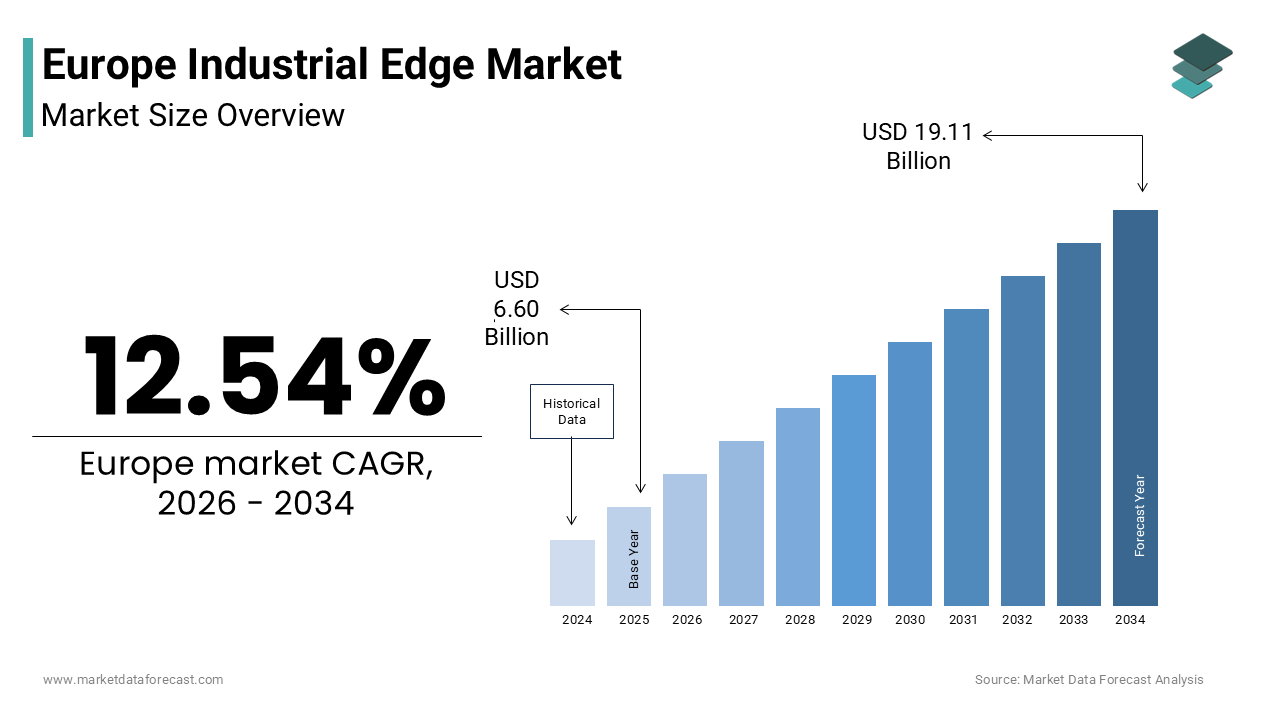
Industrial edge computing represents a paradigm shift in European manufacturing operations by decentralizing data processing capabilities directly onto factory floors and industrial environments. This architecture processes information at or near the source of generation rather than routing vast data streams to distant cloud repositories. The European industrial landscape increasingly adopts this approach to address stringent operational requirements for real time decision making in production environments where latency tolerance often falls below twenty milliseconds. According to Eurostat, Europe’s industrial sector consumed a significant amount of final energy in 2023, with electricity and natural gas collectively accounting for a large share of this consumption. This energy intensive operational environment necessitates localized computing infrastructure capable of optimizing resource utilization without introducing network bottlenecks. As per Eurostat, only a portion of European citizens possessed basic digital skills in 2023, creating an imperative for edge solutions that simplify operator interfaces while maintaining sophisticated analytics capabilities. The convergence of Industry 4.0 adoption pressures, energy efficiency mandates under the European Green Deal, and escalating cybersecurity concerns surrounding centralized data repositories has positioned industrial edge computing as a critical enabler for sustainable manufacturing transformation across the continent.
MARKET DRIVERS
Imperative for Ultra Low Latency in Mission Critical Manufacturing Processes
Industrial edge computing eliminates network induced delays that compromise production integrity in European manufacturing facilities, which is one of the major factors propelling the growth of the European industrial edge market. European automotive assembly lines require sub millisecond response times for robotic welding coordination. Semiconductor fabrication environments across Germany and the Netherlands demand deterministic control loops operating within strict thresholds to maintain nanometer scale precision during photolithography processes. As per Eurostat, electricity represented a notable portion of total industrial energy use in 2023, which is creating operational vulnerability during network disruptions that could trigger uncontrolled equipment shutdowns. Edge architectures mitigate this risk by maintaining localized control during connectivity interruptions, preventing catastrophic production halts. Furthermore, European aerospace manufacturers implementing digital twin technologies for real time structural health monitoring require edge processing to analyze massive vibration sensor data streams without cloud transmission bottlenecks. This localized intelligence capability becomes indispensable as European industrial facilities increasingly deploy collaborative robots sharing workspaces with human operators, where safety protocols mandate instantaneous collision avoidance responses impossible to achieve through centralized cloud architectures.
European Data Sovereignty and Regulatory Compliance Imperatives
The European Union's stringent data governance framework fundamentally reshapes industrial data architecture requirements toward edge centric models, which is further boosting the expansion of the European industrial edge market. The General Data Protection Regulation mandates that personal data pertaining to European workers remain subject to EU legal jurisdiction regardless of physical storage location, compelling manufacturers to process sensitive operational data within continental boundaries. European industrial facilities generate vast volumes of operational data daily according to industry estimates, with cross border transmission to non EU cloud providers creating substantial compliance liabilities under the Data Governance Act. As per Germany’s Federal Office for Information Security, industrial espionage attempts targeting manufacturing intellectual property increased in 2023, intensifying corporate reluctance to transmit proprietary production formulas and machine calibration parameters to external servers. The European Commission’s Cyber Resilience Act further mandates that critical infrastructure operators maintain uninterrupted access to industrial control systems during cyber incidents, a requirement practically unattainable with cloud dependent architectures vulnerable to distributed denial of service attacks. Consequently, European manufacturers increasingly deploy sovereign edge infrastructure that processes data within national borders while satisfying the EU’s Digital Decade target of achieving technological autonomy in critical industrial sectors by 2030.
MARKET RESTRAINTS
Acute Shortage of Specialized Edge Computing Talent Across European Industrial Workforce
European manufacturers face profound human capital constraints impeding industrial edge deployment at scale, which is impeding the European industrial edge market growth. As per Eurostat, only a portion of EU citizens possessed basic digital skills in 2023, while edge implementation demands advanced competencies spanning distributed systems architecture, time sensitive networking protocols, and operational technology cybersecurity. The European Commission estimates a significant deficit of ICT specialists across member states, with industrial edge roles requiring hybrid expertise in both information technology and operational technology proving particularly scarce. German industrial equipment manufacturers report challenges in recruitment for edge solution architects with requisite knowledge of Time Sensitive Networking standards alongside PROFINET industrial protocol experience. This skills gap manifests operationally through extended deployment timelines, with European automotive plants experiencing longer commissioning periods compared to regions with mature edge talent pools. The situation deteriorates when considering maintenance requirements, as many European maintenance technicians lack certification in edge gateway troubleshooting according to VDMA industry surveys. Consequently, manufacturers incur substantial premium costs for external consultancy services, rendering edge adoption economically unviable for small and medium enterprises employing the majority of Europe’s manufacturing workforce. Without accelerated vocational training programs integrating edge computing curricula, this human capital bottleneck will persistently constrain market penetration despite technological readiness.
Fragmented European Industrial Infrastructure Creating Integration Complexity
Europe's heterogeneous industrial asset base presents formidable integration barriers for edge computing standardization, which is also hampering the industrial edge market growth in Europe. The continent's manufacturing facilities operate equipment spanning multiple decades of technological evolution, with German chemical plants maintaining older distributed control systems alongside newly installed Industry 4.0 compliant machinery. This temporal fragmentation necessitates edge gateways supporting numerous distinct industrial communication protocols including legacy Fieldbus variants alongside modern OPC UA implementations. As per VDMA data, European industrial facilities operate with a wide range of equipment vendors per production site, each employing proprietary data formats that require custom edge middleware development consuming a large share of deployment budgets. The situation intensifies when considering regional regulatory divergence, as French nuclear facilities mandate longer edge data retention periods compared to German automotive plants under differing national interpretations of EU data minimization principles. Furthermore, Europe’s industrial energy consumption profile, where electricity accounts for a notable portion of total industrial energy use, creates operational constraints as legacy facilities lack sufficient power distribution capacity to support edge server deployments without costly electrical infrastructure upgrades. These integration complexities extend deployment timelines and increase total cost of ownership according to European Automation Association benchmarks. Until harmonized edge interoperability standards emerge through initiatives like the European Edge Computing Consortium, this infrastructure fragmentation will continue impeding scalable adoption across the continent’s diverse industrial landscape.
MARKET OPPORTUNITIES
Synergistic Integration with European Renewable Energy Transition Initiatives
Industrial edge computing positions European manufacturers to capitalize on the continent's accelerating renewable energy integration while optimizing operational expenditure, which is a promising opportunity in the European industrial edge market. As per Eurostat, renewable energy penetration in gross final consumption reached a notable level in 2023, with industrial facilities increasingly installing onsite solar photovoltaic arrays and wind turbines to hedge against volatile fossil fuel markets. Edge intelligence platforms enable dynamic load management that aligns energy intensive production processes with renewable generation peaks, which is reducing grid dependency during high tariff periods. German steel manufacturers deploying edge-controlled electrolysis systems have demonstrated reductions in electricity costs by synchronizing hydrogen production with midday solar generation peaks. Furthermore, the European Commission’s RePowerEU plan targets a significant increase in annual heat pump installations by 2030 and is creating demand for edge managed thermal energy storage systems that buffer industrial process heat requirements against intermittent renewable supply. Edge analytics additionally facilitate predictive maintenance for renewable generation assets, with Spanish ceramic manufacturers reporting fewer generation outages after implementing edge-based panel degradation monitoring. This symbiotic relationship between edge intelligence and renewable integration becomes increasingly valuable as the EU’s Carbon Border Adjustment Mechanism imposes escalating costs on carbon intensive production methods, compelling manufacturers to maximize renewable utilization through sophisticated edge orchestrated energy management systems.
Strategic Alignment with European Semiconductor Sovereignty Initiatives
Europe’s concerted effort to rebuild semiconductor manufacturing capacity creates fertile ground for specialized industrial edge hardware development, which is another notable opportunity in the European industrial edge market. As per the European Commission, the European Chips Act targets increasing the continent’s global semiconductor production share by 2030. This strategic pivot necessitates edge computing infrastructure specifically engineered for European fabrication environments, where trailing edge semiconductor production dominates current capacity. European semiconductor fabs require edge systems capable of processing vast volumes of metrology data while maintaining sub millisecond control loop responses for precision processes. Domestic edge hardware manufacturers can leverage this demand to develop radiation hardened edge processors meeting SEMI standards for cleanroom environments, creating export opportunities to global semiconductor producers seeking supply chain diversification. The European Processor Initiative has already allocated significant funding toward developing RISC V based edge processors with integrated AI acceleration cores optimized for industrial workloads. Furthermore, European automotive manufacturers require edge systems certified under ISO 26262 functional safety standards for autonomous vehicle sensor fusion applications, representing a substantial addressable market by 2027 according to ACEA projections. By aligning edge hardware development with Europe’s semiconductor sovereignty objectives, domestic technology firms can establish defensible market positions insulated from geopolitical supply chain disruptions while supporting the continent’s strategic autonomy in critical manufacturing technologies.
MARKET CHALLENGES
Escalating Cybersecurity Threat Landscape Targeting Operational Technology Environments
Industrial edge deployments expand Europe’s attack surface at a pace exceeding defensive capability development, which is challenging the expansion of the European industrial edge market. As per the European Union Agency for Cybersecurity, thousands of new vulnerabilities were documented between 2023 and 2024, with a portion rated critical severity, creating an overwhelming patch management burden for distributed edge infrastructure. Unlike centralized data centers with dedicated security operations teams, edge nodes deployed across European factory floors often operate with minimal physical security controls and infrequent firmware updates due to production continuity requirements. German industrial control system operators reported a sharp increase in ransomware incidents targeting edge gateways during 2024, with attackers exploiting unpatched vulnerabilities in popular edge operating systems. The consequences proved severe, with incidents causing prolonged production downtime and significant financial losses. Compounding this challenge, European manufacturers face conflicting security mandates, as the NIS2 Directive requires rapid vulnerability disclosure while production environments cannot tolerate the downtime required for patch validation cycles. Additionally, edge nodes processing sensitive production data become attractive targets for industrial espionage, with ENISA reporting that a notable portion of cyber incidents targeting European critical infrastructure in 2024 specifically aimed at exfiltrating intellectual property from distributed edge storage. Without breakthroughs in zero trust edge architectures and automated security orchestration, this escalating threat landscape will continue constraining industrial edge adoption despite its operational benefits.
Persistent Semiconductor Supply Constraints Limiting Edge Hardware Availability
Europe’s minimal position in global semiconductor manufacturing creates structural vulnerability for industrial edge hardware procurement, which is another major challenge to the growth of the European industrial edge market. For instance, the continent accounts for just under 10% of worldwide semiconductor production capacity, with advanced node fabrication virtually non-existent within European borders. This dependency on Asian foundries creates supply chain fragility, as demonstrated during the global chip shortage when European automotive production was significantly reduced. Edge computing infrastructure requires specialized semiconductor components including time sensitive networking controllers, industrial grade field programmable gate arrays, and AI acceleration chips, all subject to allocation constraints during supply disruptions. European industrial equipment manufacturers reported extended lead times for edge gateway processors during 2024, forcing production line modernization projects into indefinite suspension. The situation deteriorates when considering edge hardware’s semiconductor intensity, as industrial edge servers contain more integrated circuits than equivalent cloud data center equipment due to redundant communication interfaces and environmental hardening requirements. As per Germany’s VDMA association, many member companies delayed edge deployment initiatives during 2023 specifically due to component unavailability rather than budget constraints. While the European Chips Act targets doubling semiconductor capacity by 2030, this timeline fails to address near term constraints as new fabrication facilities require several years from groundbreaking to volume production. Consequently, European manufacturers face an unavoidable trade-off between accepting extended deployment timelines with current supply chains or investing in costly inventory stockpiling strategies, creating a fundamental bottleneck that transcends software innovation or architectural optimization efforts.
REPORT COVERAGE
| REPORT METRIC | DETAILS |
| Market Size Available | 2025 to 2034 |
| Base Year | 2025 |
| Forecast Period | 2026 to 2034 |
| CAGR | 12.54% |
| Segments Covered | By Organisation Size, Component, Deployment Mode, End-User, Application and Region |
| Various Analyses Covered | Regional & Country Level Analysis, Segment-Level Analysis, DROC, PESTLE Analysis, Porter’s Five Forces Analysis, Competitive Landscape, Analyst Overview on Investment Opportunities |
| Countries Covered | UK, France, Spain, Germany, Italy, Russia, Sweden, Denmark, Switzerland, the Netherlands, Turkey, the Czech Republic, and the Rest of Europe. |
| Market Leaders Profiled | Siemens AG, Atos SE, SAP SE, ADLINK Technology Inc., EdgeConnex Inc., Rockwell Automation, Inc., Honeywell International Inc., Cisco Systems, Inc., Hewlett Packard Enterprise Development LP, Dell Technologies, IBM Corporation, Intel Corporation, Amazon Web Services, Inc., Microsoft Corporation, and General Electric Company. |
SEGMENTAL ANALYSIS
By Organization Size Insights
The large enterprises segment led the market by commanding for 66.5% of the regional market share in 2025. The growth of the large enterprises segment in the European market is majorly driven by their capacity to absorb high upfront capital expenditures associated with edge infrastructure deployment and integration. Large manufacturing conglomerates in Germany and France operate multi-site production networks that generate petabyte scale operational data daily, necessitating localized processing to maintain real time control integrity. These organizations benefit from mature IT OT convergence strategies. As per Siemens, thousands of edge nodes were deployed across its European factories by 2024 to support predictive maintenance and digital twin applications. Additionally, large enterprises are primary beneficiaries of EU funding mechanisms such as Horizon Europe grants, which allocated significant resources in 2023 for advanced manufacturing digitization projects involving edge computing. Their scale enables them to negotiate favorable terms with hyperscalers and hardware vendors while maintaining in house cybersecurity teams capable of managing distributed edge environments compliant with NIS2 Directive requirements. The ability to vertically integrate edge solutions into existing enterprise resource planning and manufacturing execution systems further solidifies their market leadership.
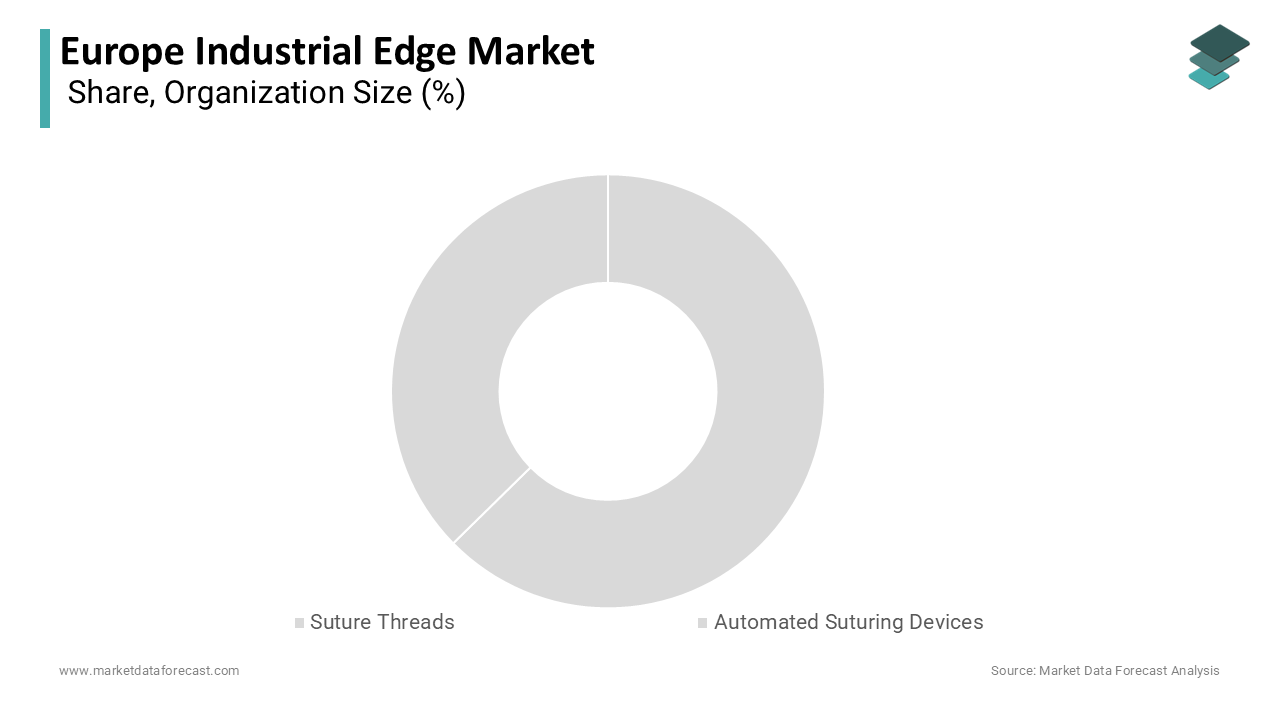
The small and medium enterprises segment is a promising segment and is estimated to register a CAGR of 25.9% over the forecast period owing to the modular edge as a service offering that eliminate prohibitive capital outlays. Cloud providers such as OVHcloud now offer subscription-based edge platforms tailored for SMEs in food processing and textile manufacturing. National digitalization initiatives significantly lower adoption barriers. As per Italy’s Industry 4.0 Transition Plan, billions of euros in tax credits were provided in 2024 specifically for SMEs implementing edge enabled automation, resulting in a notable increase in edge pilot deployments among Italian mid-sized manufacturers. Furthermore, sector specific edge solutions are emerging, with Dutch agri-tech startups developing plug and play edge kits for greenhouse climate control that reduced energy consumption in trials conducted across SME operated nurseries. The proliferation of open-source edge frameworks like Eclipse ioFog also empowers SMEs with limited IT staff to customize lightweight analytics without vendor lock in. As supply chain resilience becomes paramount post pandemic, SMEs increasingly adopt edge monitoring to gain real time visibility into subcontractor performance, a capability previously exclusive to large corporations.
By Component Insights
The hardware segment dominated the market by capturing 51.9% of the regional market share in 2025. The dominance of hardware segment in the European market can be credited to its foundational requirement for ruggedized edge servers, gateways, and networking equipment capable of operating in harsh industrial environments. European manufacturers prioritize hardware certified for extreme conditions. As per deployment data, a majority of new edge installations in Scandinavian mining operations utilize IP67 rated enclosures that withstand wide temperature ranges. The semiconductor content intensity of edge hardware further drives value. As per VDMA component audits, industrial edge nodes contain numerous integrated circuits including specialized time sensitive networking controllers and AI acceleration chips. Regulatory mandates amplify demand. The EU’s Radio Equipment Directive requires all new industrial wireless devices sold after January 2025 to incorporate hardware level security modules, prompting manufacturers like Bosch to redesign their edge gateway portfolio. Additionally, the push for circular economy compliance under the Ecodesign for Sustainable Products Regulation compels hardware vendors to develop modular architectures enabling component level upgrades rather than full system replacements, extending device lifespans beyond seven years in many cases.
The services segment is estimated to record a CAGR of 33.5% over the forecast period owing to the growing complexity of edge ecosystem management across heterogeneous industrial environments. Managed service providers now offer end to end edge lifecycle support including remote firmware updates, cybersecurity patching, and performance optimization. As per Bitkom Research, a majority of European manufacturers lack dedicated edge operations teams, making managed services critical. The rise of outcome based contracting models further accelerates service adoption. Schneider Electric’s “Edge Performance as a Service” guarantees high uptime for predictive maintenance workloads with pricing tied to actual machine availability improvements. Cybersecurity services represent a particularly high growth sub segment. As per ENISA, most industrial ransomware incidents in 2024 originated from unpatched edge firmware vulnerabilities, driving demand for continuous vulnerability assessment services. Additionally, EU Green Deal compliance mandates compel manufacturers to engage sustainability auditing services that leverage edge telemetry to quantify carbon footprint reductions from energy optimization initiatives, creating new revenue streams for service integrators aligned with CSRD reporting requirements.
By Deployment Mode Insights
The on-premise deployment segment led the market by holding 70.2% of the European market share in 2025. The growth of the on-premises segment in the European market is attributed to the stringent regulatory requirements mandating data residency within national borders. The General Data Protection Regulation prohibits transferring personally identifiable information to third country cloud providers without complex legal safeguards. Industrial control systems in critical sectors like energy and water treatment require deterministic latency below ten milliseconds, a threshold unattainable with public cloud round trip times as measured by the Fraunhofer Institute. Furthermore, on premise architectures provide air gapped security essential for defense and aerospace manufacturers. As per the European Union Agency for Cybersecurity, on premise deployments reduce attack surface significantly compared to hybrid cloud models. National sovereignty concerns further reinforce this trend. Germany’s IT Security Act mandates that all critical infrastructure operators maintain physical control over data processing hardware, effectively banning cloud only edge implementations in regulated industries.
The cloud-storage segment is estimated to register a CAGR of 28.8% over the forecast period. The emergence of sovereign cloud platforms that reconcile data localization requirements with scalable infrastructure benefits is primarily driving the expansion of the cloud storage segment in the European market. OVHcloud’s “Edge as a Service” offering provides physically located edge nodes within EU member states with data never leaving continental jurisdiction, satisfying both GDPR and NIS2 compliance mandates. The model particularly appeals to multinational manufacturers operating across fragmented regulatory landscapes. As per IDC Europe benchmarks, cloud deployments reduce total cost of ownership significantly compared to on premise alternatives, primarily through elimination of hardware refresh cycles and dedicated IT staffing. Additionally, cloud platforms enable rapid scaling during demand spikes. Nestlé, for example, activated temporary edge analytics clusters across its European confectionery plants during the 2024 holiday season to optimize real time production scheduling without capital expenditure. The integration of generative AI services such as Microsoft Azure’s confidential computing enabled anomaly detection further accelerates adoption by providing advanced analytics capabilities previously inaccessible to mid-market manufacturers.
REGIONAL ANALYSIS
Germany Industrial Edge Market Analysis
Germany dominated the industrial edge market in Europe in 2025 by holding 25.5% of the regional market share. The dominance of Germany in the European market can be attributed to its world leading machinery and automotive manufacturing base that demands ultra reliable edge infrastructure for precision production. German factories installed a significant number of industrial robots in 2024 as reported by the International Federation of Robotics, each requiring sub millisecond edge processing for coordinated motion control. The government’s “Digital Now” initiative allocated billions of euros in 2023 specifically for SME digitization including edge computing subsidies. Germany’s engineering culture emphasizes vertical integration, with Siemens’ Amberg electronics plant operating thousands of edge nodes managing millions of daily production transactions. Strict data sovereignty laws under the Bundesdatenschutzgesetz further cement on premise edge adoption, with most German manufacturers refusing to transmit operational data outside national borders according to Bitkom surveys. The country’s dual education system produces tens of thousands of certified industrial IT specialists annually who possess the hybrid skills necessary for edge deployment, creating a sustainable talent pipeline unmatched elsewhere in Europe.
France Industrial Edge Market Analysis
France commanded for the second leading share of the European industrial edge market in 2025. The growth of France in the European market is attributed to its diversified industrial portfolio spanning aerospace, luxury goods, and nuclear energy as all sectors requiring mission critical edge reliability. Airbus’ Toulouse facility deploys edge analytics across extensive assembly lines to synchronize robotic drilling operations with micron level precision. The French government’s “France 2030” investment plan committed substantial funding for industrial AI and edge computing in 2023, with particular focus on sovereign technology development. Nuclear operator EDF utilizes radiation hardened edge servers at its reactors to process sensor data locally during electromagnetic pulse events. Cultural factors also influence adoption, with French manufacturers exhibiting strong preference for domestic technology providers. The country’s robust vocational training system graduates thousands of industrial digital technicians yearly who specialize in integrating edge systems with legacy automation infrastructure, ensuring smooth technology transitions across generations of manufacturing equipment.
United Kingdom Industrial Edge Market Analysis
The United Kingdom is expected to witness a promising CAGR in the European industrial edge market during the forecast period. Despite Brexit related uncertainties, the UK maintains strong industrial computing adoption driven by its pharmaceutical and specialty chemicals sectors. AstraZeneca’s Cambridge facility implements edge controlled continuous manufacturing processes that significantly reduced batch validation times while maintaining MHRA compliance. The UK’s regulatory environment uniquely supports innovation, with the Medicines and Healthcare products Regulatory Agency pioneering real time release testing protocols that mandate edge-based quality analytics for pharmaceutical production. London’s financial technology expertise spills over into industrial applications, with startups providing edge optimized machine learning models for predictive maintenance. The government’s Industrial Energy Transformation Fund allocated hundreds of millions of pounds in 2024 for energy efficiency projects including edge managed load shifting systems. UK manufacturers benefit from English language dominance in global technology ecosystems, enabling faster adoption of international edge standards while maintaining data residency through sovereign cloud partnerships.
Italy Industrial Edge Market Analysis
Italy is projected to capture a notable share of the European industrial edge market over the forecast period due to its dense network of small and medium enterprises in fashion, furniture, and food processing that increasingly adopt affordable edge solutions. Italian ceramic tile manufacturers reduced energy consumption through edge-controlled kiln temperature optimization across numerous factories in the Sassuolo district. The government’s “Transizione 4.0” tax credit program reimbursed billions of euros in 2024 for digital investments including edge computing hardware, with simplified application procedures specifically designed for SMEs. Italy’s geographic position makes it vulnerable to Mediterranean climate extremes, where edge enabled predictive maintenance prevented production halts in southern textile mills by anticipating HVAC system failures during heat waves. Cultural emphasis on craftsmanship translates into unique edge applications, with luxury leather goods manufacturers using computer vision edge nodes to grade material quality at high frame rates. The country’s strong mechanical engineering tradition ensures seamless integration of edge systems with legacy Italian machinery brands that dominate global woodworking markets.
Netherlands Industrial Edge Market Analysis
The Netherlands is expected to exhibit a steady CAGR in the European industrial edge market over the forecast period. The country’s strategic advantage lies in its port centric logistics and advanced horticulture sectors that demand real time edge intelligence. Rotterdam’s smart port deploys thousands of edge sensors across container terminals to optimize crane movements and truck routing, reducing vessel turnaround time. Dutch greenhouse operators lead global agricultural technology adoption, with extensive hectares of glasshouse cultivation utilizing edge-controlled climate systems. The Netherlands’ progressive data governance framework enables secure data sharing, with the Dutch Data Exchange Platform allowing cooperatives to pool edge analytics while preserving individual grower privacy through federated learning. ASML’s Veldhoven facility represents the pinnacle of edge computing application, where extreme ultraviolet lithography machines generate massive volumes of metrology data processed by custom edge clusters to maintain nanometer scale alignment accuracy. The country’s multilingual workforce and central European location make it an ideal testbed for multinational edge deployments, with many European manufacturers conducting pilot programs in Dutch facilities before continental rollout.
COMPETITIVE LANDSCAPE
The Europe industrial edge market features intense competition among global technology leaders and specialized regional vendors vying for dominance in a rapidly evolving landscape. Established players leverage their deep industrial automation heritage to embed edge capabilities into existing control architectures while newer entrants focus on agile software defined solutions. Differentiation arises through compliance with stringent EU data sovereignty and cybersecurity mandates which act as significant entry barriers. Competition also centers on vertical specific use cases with companies tailoring edge offerings for automotive aerospace food processing and energy sectors. Strategic alliances with sovereign cloud providers and national digitalization initiatives further shape competitive dynamics. The absence of universal interoperability standards fuels proprietary ecosystem development intensifying vendor lock in concerns among end users. Continuous innovation in AI at the edge and energy efficient computing remains critical to maintaining competitive advantage.
KEY MARKET PLAYERS
Some of the companies that are playing a dominating role in the Europe Industrial Edge Market include
- Siemens AG
- Atos SE
- SAP SE
- ADLINK Technology Inc.
- EdgeConnex Inc.
- Rockwell Automation, Inc.
- Honeywell International Inc.
- Cisco Systems, Inc.
- Hewlett Packard Enterprise Development LP
- Dell Technologies
- IBM Corporation
- Intel Corporation
- Amazon Web Services, Inc.
- Microsoft Corporation
- General Electric Company
Top Players in the Europe Industrial Edge Market
Siemens AG
Siemens AG is a pivotal force in the Europe industrial edge market through its comprehensive portfolio of edge hardware and software solutions tailored for manufacturing and process industries. The company’s Industrial Edge platform enables real time data processing directly on factory floors, supporting applications from predictive maintenance to digital twins. In recent developments, Siemens expanded its collaboration with Microsoft to integrate Azure IoT Edge capabilities into its automation systems, enhancing hybrid cloud edge interoperability for European clients. It also launched new ruggedized edge devices compliant with EU cybersecurity regulations, reinforcing its commitment to data sovereignty and operational resilience across critical infrastructure sectors throughout the region.
Schneider Electric SE
Schneider Electric SE plays a central role in advancing industrial edge adoption across Europe by integrating edge intelligence into its EcoStruxure architecture. The company focuses on energy efficiency and sustainability, offering edge enabled solutions that optimize power usage in industrial settings. Recently, Schneider Electric introduced its “Edge Control as a Service” model, allowing manufacturers to deploy and manage edge infrastructure through subscription-based contracts. This initiative lowers entry barriers for small and medium enterprises while aligning with EU Green Deal objectives. The firm also strengthened its cybersecurity posture by embedding secure boot and hardware root of trust features in all new edge controllers deployed across European facilities.
Bosch Rexroth AG
Bosch Rexroth AG significantly contributes to the Europe industrial edge market by embedding intelligent edge computing directly into hydraulic and electric drive systems. Its ctrlX AUTOMATION platform eliminates traditional hardware dependencies by running industrial applications on open Linux based edge devices. Bosch Rexroth recently enhanced this ecosystem by launching an app store for industrial edge software, enabling third party developers to create and distribute solutions tailored to specific European manufacturing needs. The company also partnered with German research institutes to develop time sensitive networking protocols that ensure deterministic communication in mixed legacy and modern production environments, reinforcing its leadership in smart factory innovation.
Top Strategies Used by the Key Market Participants
Key players in the Europe industrial edge market primarily employ strategic partnerships to enhance technological interoperability and expand solution offerings. They invest heavily in research and development to create ruggedized and regulation compliant edge hardware tailored for European industrial standards. Companies increasingly adopt subscription based and edge as a service models to lower adoption barriers for small and medium enterprises. Vertical integration of edge platforms with existing automation and enterprise systems remains a core focus to ensure seamless deployment. Additionally, firms prioritize cybersecurity by embedding hardware level security features and achieving certifications aligned with EU directives such as NIS2 and Cyber Resilience Act to build customer trust and regulatory compliance.
MARKET SEGMENTATION
This research report on the Europe Industrial Edge Market has been segmented and sub-segmented based on the following categories.
By Organization Size
- Large Enterprises
- Small & Medium Enterprises
By Component
- Hardware
- Software
- Services
By Deployment Mode
- On-Premise
- Cloud
By End-use
- Manufacturing
- Energy & Utilities
- Transportation & Logistics
- Automotive
- Oil & Gas
- Healthcare
- Other End-use
By Application
- Predictive Maintenance
- Real-Time Monitoring & Control
- Automation & Robotics
- Asset Tracking & Management
- Remote Monitoring & Management
- Quality Control & Inspection
- Process Optimization
- Other Application
By Country
- UK
- France
- Spain
- Germany
- Italy
- Russia
- Sweden
- Denmark
- Switzerland
- Netherlands
- Turkey
- Czech Republic
- Rest of Europe
Access the study in MULTIPLE FORMATS
Purchase options starting from
$ 2000
Didn’t find what you’re looking for?
TALK TO OUR ANALYST TEAM
Need something within your budget?
NO WORRIES! WE GOT YOU COVERED!
Call us on: +1 888 702 9696 (U.S Toll Free)
Write to us: sales@marketdataforecast.com