- Product Description Description
- Table of Contents TOC
- List of Table & Figure LOT
- Get Free Sample PDF Sample PDF
Europe Industrial Fasteners Market Report Summary
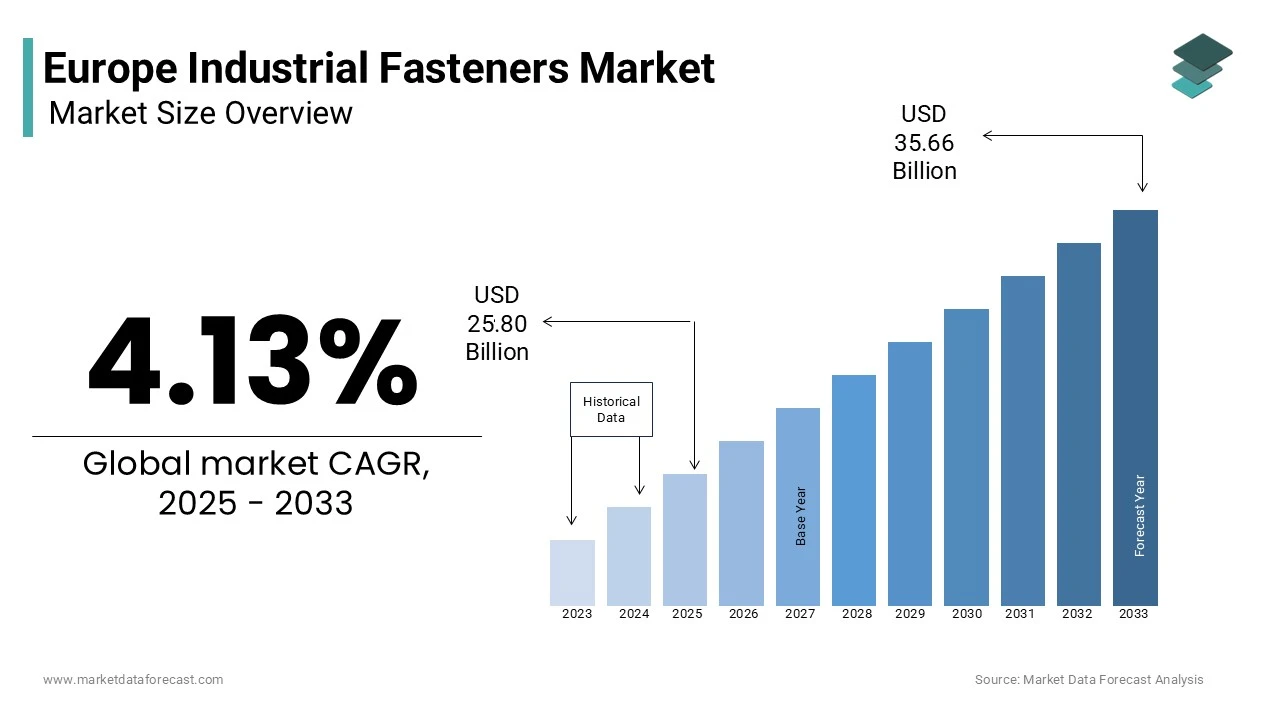
The Europe industrial fasteners market was valued at USD 24.78 billion in 2024, is estimated to reach USD 25.80 billion in 2025, and is projected to reach USD 35.66 billion by 2033, growing at a CAGR of 4.13% during the forecast period from 2025 to 2033. The growth of the Europe industrial fasteners market is driven by expanding manufacturing activity, rising demand for high-precision components, and the region’s emphasis on durable and safety-compliant engineering systems. Increasing investment in automotive, aerospace, construction, and renewable energy infrastructure further fuels market growth. Moreover, the shift toward modular construction, digitalized manufacturing, and circular-economy design principles is strengthening the need for advanced fastening systems across Europe.
Key Market Trends
- Increasing industrial automation and adoption of digital twin technologies, accelerating demand for traceable and smart fasteners.
- Rising deployment of wind and solar infrastructure, boosting the consumption of corrosion-resistant and high-strength fasteners for harsh-environment applications.
- Growing preference for modular and prefabricated construction systems, requires standardized, high-volume fasteners for rapid assembly.
- Strong regional focus on sustainability and recyclability, encouraging the use of low-carbon materials and demountable fastening solutions.
- Expansion of electric vehicle production across Europe, increasing demand for lightweight, high-performance fastening systems used in battery packs and power electronics.
Segmental Insights
- Based on material, the metal fasteners segment was the largest and held a significant share of the Europe industrial fasteners market in 2024. Their dominance is attributed to high tensile strength, durability, and mandatory use in safety-critical applications across automotive, aerospace, and construction industries.
- Based on product type, the externally threaded fasteners segment accounted for the largest share of the Europe industrial fasteners market in 2024. Bolts, screws, and studs remain essential components in machinery and structural assemblies due to their torque control precision and compatibility with automated production lines.
- Based on application, the automotive segment was the largest and occupied a prominent share of the Europe industrial fasteners market in 2024. The segment’s dominance stems from Europe’s strong automotive production base, including electric vehicle manufacturing, which requires thousands of precision fasteners per vehicle.
Regional Insights
The Europe industrial fasteners market is witnessing robust growth across major economies supported by manufacturing expansion, infrastructure modernization, and rising investments in renewable energy and advanced engineering.
- Germany was the largest contributor, accounting for 21.4% of the Europe industrial fasteners market share in 2024, driven by its leadership in automotive, machinery production, and offshore wind infrastructure.
- Italy followed as a major market with 14.2% share in 2024, supported by strong machinery, automotive component, and appliance manufacturing sectors.
- France continues to perform well, fueled by aerospace manufacturing, defense modernization, and large-scale public construction projects.
- The United Kingdom maintains a notable share due to high-value aerospace engineering and growing offshore wind deployment.
- Spain is emerging as a key growth hub, driven by rapid solar energy expansion and increasing residential and commercial construction activity.
Competitive Landscape
The Europe industrial fasteners market is characterized by the dominance of established engineering manufacturers with strong technical expertise, quality certifications, and robust supply networks. Leading companies focus on integrating smart inventory management systems, offering value-added engineering services, and developing high-performance fasteners tailored for automotive, aerospace, and renewable energy industries. Sustainability initiatives, including low-carbon steel production and recyclable fastening systems, are also shaping competitive strategies. Prominent players in the Europe industrial fasteners market include Würth Group, SFS Group, EJOT, Altenloh Brinck & Co. (SPAX), Bossard Group, Bulten AB, Arconic Corporation, LISI Group, Illinois Tool Works (ITW), and Stanley Black & Decker.
Europe Industrial Fasteners Market Size
The europe industrial fasteners market size was valued at USD 24.78 billion in 2024 and is anticipated to reach USD 25.80 billion in 2025 from USD 35.66 billion by 2033, growing at a CAGR of 4.13% during the forecast period from 2025 to 2033.
Industrial fasteners are foundational elements in the structural integrity and assembly of machinery, infrastructure, and advanced manufacturing systems across Europe. These components, though small in scale, play a disproportionately critical role in ensuring mechanical reliability, safety compliance, and operational longevity in sectors ranging from automotive and aerospace to renewable energy and heavy engineering. The manufacturing sector in the European Union consistently generates significant economic value, supporting ongoing demand for high-precision fastening solutions. The vast majority of industrial enterprises operating in the EU are small and medium-sized businesses, which rely heavily on standardized and robust fastening systems to achieve production goals. The EU's transition toward circular economy principles is increasing the requirements for product designs that allow for easy demounting and repair, which elevates the functional importance of engineered fasteners for reasons beyond initial assembly. This evolving industrial landscape positions fasteners not as commodity items but as mission critical enablers of Europe’s manufacturing resilience, digital transformation, and sustainability transition.
MARKET DRIVERS
Revitalization of European Manufacturing Infrastructure Drives Component Demand
The strategic reindustrialization of the region’s manufacturing base has emerged as a pivotal drive for the Europe industrial fasteners market. This is because nations are prioritizing resilient domestic supply chains and advanced production capabilities. European Union member states are prioritizing modernization initiatives for manufacturing, focusing on automation and upgrading machinery. Investment in industrial machinery is increasing in some key member states. This modernization and expansion creates a demand for high tensile fasteners used in precision engineering applications. Investment plans in other regions are supporting mechanical engineering clusters. This support is stimulating a need for specific fasteners, such as those that are corrosion-resistant and vibration proof. Capital goods production is showing growth, driven by an expansion of domestic capacity and exports. This resurgence in hard asset investment ensures sustained pull for industrial fasteners, especially those engineered for durability under high stress cyclic loading, a non-negotiable requirement in modern European manufacturing environments.
Expansion of Onshore Renewable Energy Infrastructure Elevates Specialized Fastener Requirements
The accelerated deployment of wind and solar energy projects across the region has accelerated the expansion of the Europe industrial fasteners market. It has created a surge in demand for high performance industrial fasteners engineered for extreme environmental exposure and structural longevity. Europe experienced significant new wind capacity additions, with contributions from both onshore and offshore projects. Offshore turbine construction involves using substantial amounts of structural steel. Fasteners used in offshore applications are required to have high corrosion resistance and fatigue endurance. Manufacturers are increasingly using fasteners that align with established material standards and feature enhanced protective coatings. Ground-mounted solar projects have expanded, particularly in certain European regions, using tracker systems. Solar tracker systems require stainless steel fasteners designed to endure environmental factors like temperature fluctuations and UV exposure. There has been an increase in permitted renewable infrastructure projects, all of which require specialized fastening solutions. These developments position industrial fasteners as silent yet essential enablers of Europe’s energy sovereignty, with performance specifications directly tied to project bankability and operational safety, factors that elevate fasteners from standard components to certified engineering elements.
MARKET RESTRAINTS
Persistent Volatility in Raw Material Costs Suppresses Margins and Pricing Stability
Fluctuations in the prices of key raw materials, particularly steel, stainless steel, and specialty alloys, pose a significant restraint on the Europe industrial fasteners market. These price changes erode manufacturer margins and disrupt supply chain predictability. Since fasteners are predominantly manufactured from carbon steel, such volatility directly impacts production economics. The instability discourages long term procurement contracts and forces smaller fastener manufacturers, particularly in Southern Europe, to ration raw material purchases, leading to production delays. Suppliers are highly vulnerable to geopolitical shifts and volatile alloy pricing because they lack effective hedging mechanisms and strategic material stockpiles, severely limiting their investment capacity.
Stringent Regulatory Compliance Burdens Increase Operational Complexity
The cumulative weight of evolving EU regulatory frameworks imposes significant compliance costs and technical barriers on the Europe industrial fasteners market. This burden is particularly challenging for small and medium enterprises that lack dedicated certification teams. A notable number of harmonized standards apply to mechanical fasteners used across various sectors, necessitating compliance with regulations like the Machinery and Construction Products Regulations. The required testing and documentation for a standard fastener grade involves a significant time commitment and associated costs. New regulations introduce mandatory supply chain due diligence, including requirements for the traceability of certain raw materials used in specialty alloy coatings. Producers are experiencing delays in bringing products to market, which may be linked to certification processing times at compliance bodies. These administrative and financial hurdles disproportionately affect regional manufacturers, limiting their agility in responding to emerging sectoral demands such as hydrogen infrastructure or electric vehicle assembly, where fastener specifications evolve rapidly.
MARKET OPPORTUNITIES
Integration of Digital Twin Technology in Manufacturing Opens Precision Fastening Opportunities
The adoption of digital twin systems across European industrial facilities is creating new demand for traceable and high precision fasteners embedded with digital identifiers, which is expected to drive the growth of the Europe industrial fasteners market. This is to support real time asset monitoring and predictive maintenance. Fasteners equipped with QR codes or RFID tags, linked to material batch, torque specifications, and installation parameters, are increasingly specified in aerospace and rail applications to enable lifecycle tracking. Specifications for railway components now include a focus on using digital fastener logs for assemblies like bogies to help address fatigue-related issues. The automotive industry, in specific manufacturing areas, utilizes digitally tracked fasteners in critical assemblies such as battery housings. The use of tracked fasteners in automotive production helps ensure consistency in assembly and facilitates traceability for recall management. This shift transforms fasteners from passive components into active data points within industrial IoT ecosystems. Companies have launched Smart Bin systems that auto replenish digitally cataloged fasteners, reducing assembly errors. This convergence of physical reliability and digital accountability defines a high value niche beyond traditional commodity fastening.
Growth of Modular and Prefabricated Construction Fuels Demand for Standardized Joining Systems
The rapid adoption of offsite construction methodologies is providing fresh prospects for the Europe industrial fasteners market. This is generating consistent demand for high volume standardized industrial fasteners designed for rapid assembly and structural certification in modular buildings. The use of modular construction is experiencing notable growth for new non-residential projects within the region. This increase is influenced by a combination of factors, including the availability of labor and evolving building requirements. Structural components, such as modular steel frames, rely on specific types and quantities of fasteners, including pre-drilled bolts and self-drilling screws that adhere to relevant quality and load-bearing standards. A significant portion of new social housing is being built using advanced modular building methods in certain areas. The volume of fasteners consumed per square meter has shown an increase when comparing modular construction methods to traditional building techniques Crucially, the EU’s Level(s) framework for sustainable buildings emphasizes demountability, requiring fasteners that enable non destructive disassembly, spurring innovation in reusable clamping and wedge lock systems. This structural shift positions industrial fasteners as enablers of Europe’s housing affordability and decarbonization goals, with performance tied not just to strength but to circularity.
MARKET CHALLENGES
Fragmented Regional Standards Hinder Cross Border Product Compatibility
Lingering disparities in national fastener standards and certification interpretations continue to impede seamless cross border trade and complicate pan European procurement strategies, which challenges the growth of the Europe industrial fasteners market. Core dimensions for fasteners are internationally standardized, but protocols for material testing and application-specific approvals are not fully harmonized across all regions. Facilities and projects within specific countries often require compliance with unique national testing standards that are not universally recognized by other nations. This lack of mutual recognition can affect operational efficiency In Central and Eastern Europe, legacy use of GOST and ČSN standards persists in infrastructure projects, requiring dual certification even for fasteners marked with CE labels. This fragmentation is particularly acute in aerospace and defense, where national airworthiness authorities impose additional fastener traceability rules beyond EASA guidelines. Consequently, smaller suppliers often restrict their market reach to one or two countries, limiting economies of scale and innovation diffusion. The European industrial fasteners market cannot achieve the full efficiency benefits of a single market until mutual recognition of conformity assessments is fully implemented.
Intensifying Competition from Low Cost Asian Imports Undermines Local Innovation Capacity
The influx of competitively priced industrial fasteners from China, India, and Vietnam, often backed by state subsidized production, poses a structural challenge to the region’s value added fastener manufacturers, which in turn hampers the growth of the Europe industrial fasteners market. This challenge is realized by compressing price expectations and diverting investment from R&D. Fastener imports from outside the region have increased in volume. The prices for these imported products are significantly lower than those for locally produced items. While many of these imports meet basic ISO dimensions, they frequently lack full material certification or fatigue testing required for critical applications, a risk increasingly overlooked by cost pressured procurement departments in construction and general machinery. A portion of manufacturers have decreased the number of engineering employees on staff. Despite the existing anti-dumping duties, enforcement continues to be a challenge. Even with anti-dumping measures enacted, gaps in their enforcement endure. This price driven competition shifts market emphasis from performance and traceability to upfront cost, discouraging the premium innovation ecosystem Europe needs to maintain its engineering leadership in high reliability industrial applications.
REPORT COVERAGE
| REPORT METRIC | DETAILS |
| Market Size Available | 2024 to 2033 |
| Base Year | 2024 |
| Forecast Period | 2025 to 2033 |
| Segments Covered | By Material, Product and Region |
| Various Analyses Covered | Global, Regional & Country Level Analysis, Segment-Level Analysis, Drivers, Restraints, Opportunities, Challenges, PESTLE Analysis, Porter’s Five Forces Analysis, Competitive Landscape, Analyst Overview on Investment Opportunities |
| Regions Covered | United Kingdom, France, Spain, Germany, Italy, Russia, Sweden, Denmark, Switzerland, the Netherlands, Turkey, and the Czech Republic. |
| Key Market Players | Würth Group, SFS Group, EJOT, Altenloh, Brinck & Co. (SPAX), Bossard Group, Bulten AB, Arconic Corporation, LISI Group, Illinois Tool Works (ITW), Stanley Black & Decker |
SEGMENTAL ANALYSIS
By Material Insights
The metal fasteners segment led the Europe industrial fasteners market and accounted for a substantial share in 2024. The supremacy of the metal fasteners segment is credited to the non-negotiable strength, thermal resilience, and load bearing capacity required across core industrial sectors. In automotive and aerospace applications, where safety critical joints must endure extreme vibration and temperature fluctuations, carbon steel and stainless steel fasteners remain irreplaceable. Passenger vehicles generally incorporate thousands of metal fasteners. Electric vehicle designs may require additional fasteners, often due to the integration needs of battery housing and power electronics. Offshore wind turbines utilize a significant number of high tensile steel bolts for critical structural connections in the tower and nacelle. These fasteners are typically specified to meet rigorous strength class standards to ensure structural integrity The building and construction sector further reinforces demand. Even in cost sensitive applications, the lifecycle reliability of metal, particularly in outdoor or high stress environments, renders plastic alternatives unsuitable for mission critical roles.
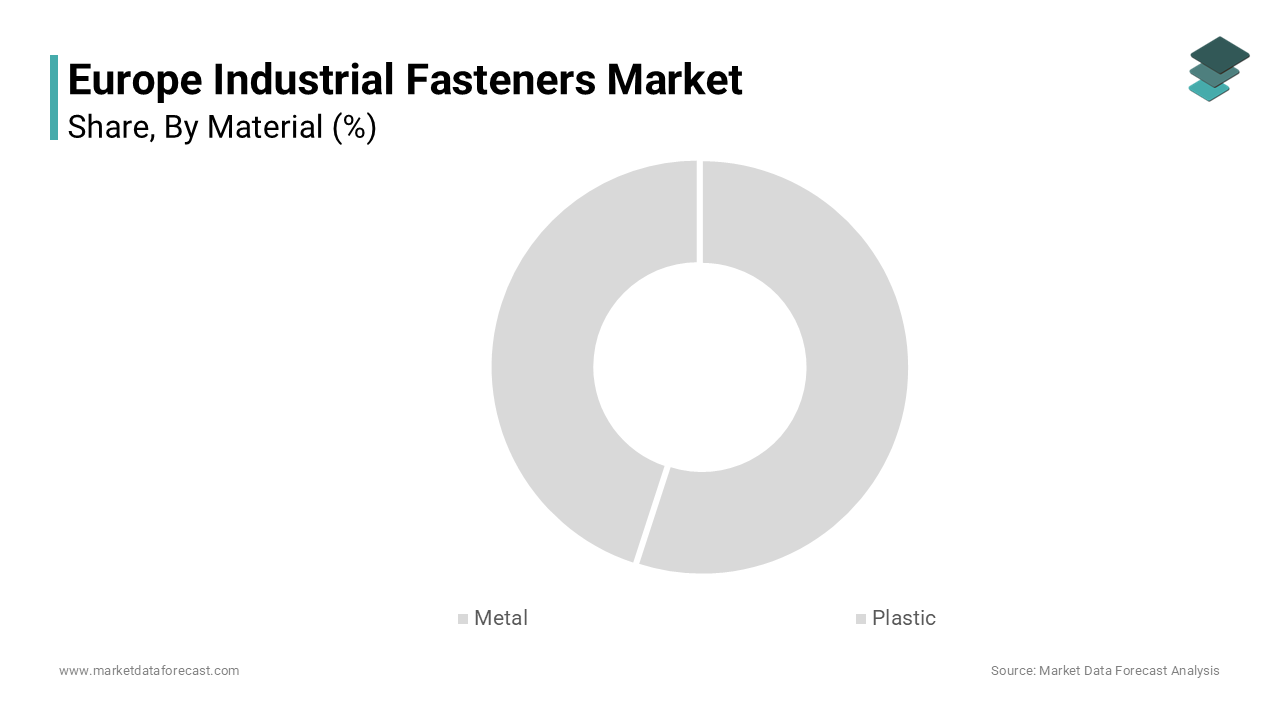
The plastic fasteners segment is predicted to witness the highest CAGR of 7.4% between 2025 and 2033 due to rising demand in non-structural yet functionally critical applications where electrical insulation, corrosion resistance, and weight reduction outweigh mechanical load requirements. The industrial electronics sector is a primary growth engine. Control cabinets assembled in Europe are increasingly utilizing nylon or PEEK fasteners to prevent galvanic corrosion and ensure dielectric isolation between components. New washing machines and dishwashers are incorporating plastic fasteners in drum mounts and interior panels to help dampen vibration and reduce noise emissions. The medical device industry also contributes significantly. Crucially, advancements in high performance polymers like PVDF and PPS have expanded operating temperatures beyond 150 degrees Celsius, enabling use in HVAC and pump housings. This functional diversification positions plastic fasteners as enablers of lightweighting and electromagnetic compatibility in Europe’s evolving industrial landscape.
By Product Type Insights
The externally threaded fasteners segment dominated the Europe industrial fasteners market by capturing a share of 52.7% in 2024. The leading position of the externally threaded fasteners segment is attribute to universal applicability across mechanical assembly where clamping force, disassembly capability, and torque control are essential. Externally threaded components are fundamental to the assembly processes across the automotive sector. These fasteners are crucial for key structural elements like engine blocks, chassis joints, and transmission systems, where achieving specific operational tension is important. The use of externally threaded fasteners extends widely to industrial machinery, including standard CNC machine tools, for tasks such as modular fixturing and guard assembly. A substantial number of these threaded fasteners are necessary for the production of typical commercial vehicles. There is a strong preference for using robust alloy steel materials in the manufacturing of many of these automotive fasteners. The standardization of ISO metric threads across EU manufacturing has streamlined procurement and reduced inventory complexity, reinforcing adoption. Moreover, the rise of automated assembly lines favors externally threaded designs due to consistent feedability and torque feedback compatibility. This operational synergy ensures externally threaded fasteners remain the backbone of industrial joining in Europe.
The aerospace grade fasteners segment is estimated to register the fastest CAGR of 9.1% from 2025 to 2033 owing to the continent’s aggressive aircraft production ramp up and next generation program investments. Commercial aircraft production has shown a growth trend. Individual aircraft in the narrow-body category require a significant quantity of fasteners. The majority of these fasteners are made from high-specification aerospace materials, such as titanium or corrosion-resistant steel variants. Defence sector aviation modernization initiatives are ongoing. These modernization efforts are a factor in driving demand for high fatigue-resistant fasteners used in various military aircraft airframes. Crucially, the shift toward sustainable aviation is driving innovation. Besides, the European Aviation Safety Agency’s updated maintenance protocols mandate full traceability for every airframe fastener, creating a high value ecosystem where certification and material integrity outweigh cost considerations. This confluence of volume growth, regulatory rigor, and material science advancement positions aerospace grade fasteners as Europe’s premium growth frontier.
By Application Inisights
The automotive segment was the largest segment in the Europe industrial fasteners market and held a 28.6% share in 2024. The prominence of the automotive segment is because of the continent’s status as a global hub for premium and electric vehicle manufacturing, where complex assemblies demand vast quantities of high precision fasteners. Motor vehicle production in Europe remains a significant industry. Conventional vehicle assembly typically requires a substantial number of fasteners. Electric vehicles generally utilize more fasteners, primarily due to the integration of battery packs, motors, and power electronics. A notable volume of automotive manufacturing occurs in Germany. Specific high-strength bolts are commonly specified by leading German luxury vehicle manufacturers for critical chassis applications to help ensure robust safety performance. The transition to e mobility has intensified demand for specialized fasteners. Furthermore, the rise of modular vehicle platforms standardizes fastener specifications across multiple models, which enables bulk procurement and just in time delivery. This deep integration into automotive value chains ensures the sector remains the primary consumption engine for industrial fasteners in Europe.
The building and construction application segment is anticipated to witness the fastest CAGR of 8.3% between 2023 and 2025. The rapid expansion of the building and construction application segment is propelled by the EU’s dual mandate of infrastructure renewal and sustainable urban development. European construction projects are focusing heavily on retrofitting public buildings and expanding renewable energy infrastructure. Prefabricated steel structures are a significant part of new non-residential building trends. Structural bolts are required for these steel structures, adhering to specific standards. Government programs are driving numerous school renovation projects, which require substantial quantities of various fasteners for HVAC and facade systems. The increasing popularity of modular construction in some regions is boosting the use of fasteners compared to traditional building methods. Future regulations will require demountable design principles in buildings, which may lead to a preference for mechanical fastening over alternative joining methods to help with material reuse. This regulatory shift transforms fasteners from assembly tools into enablers of circularity, driving demand for high quality reusable and traceable joining solutions across the European construction ecosystem.
REGIONAL ANALYSIS
Germany Industrial Fasteners Market Analysis
Germany outperformed other countries in the Europe industrial fasteners market and accounted for a 21.4% from 2025 to 2033. The leading position of the German market is driven by the nation’s unparalleled depth in automotive machinery and renewable energy manufacturing where precision fastening is non-negotiable. The country's motor vehicle production requires a substantial number of standardized fasteners for assembly. Increased output in industrial machinery suggests a reinforcing demand for high tensile bolts in applications like automation and robotics. Germany also leads Europe in offshore wind deployment. The presence of globally recognized fastener manufacturers like Würth and EJOT further strengthens the ecosystem through R&D in smart fastening and digital inventory systems. Strict adherence to DIN and VDA standards ensures German fasteners meet the highest reliability thresholds, making the country both a massive consumer and a technology exporter in the industrial fastening domain.
Italy Industrial Fasteners Market Analysis
Italy was the second-largest country in the Europe industrial fasteners market and captured a share of 14.2% share in 2024. The growth of the Italian market is propelled by its dual role as a major consumer and exporter of engineered joining solutions. The industrial base, which includes a large number of manufacturing enterprises, depends significantly on fasteners. These fasteners are used across machinery, automotive components, and home appliances. The country is a key producer of machine tools within Europe. Each of these units typically integrates many fasteners. The furniture sector also contributes significantly. Italian fastener manufacturers like Bulten and Marcegaglia Fasteners have gained global recognition for innovation in stainless steel and self-tapping technologies. This blend of traditional craftsmanship and digital modernization sustains Italy’s influential position in the European fastening landscape.
France Industrial Fasteners Market Analysis
France is growing steadily in the Europe industrial fasteners market due to ambitious public investment and defense industrial programs. Government initiatives in industrial rearmament and green infrastructure are shaping demand for components like fasteners. Fasteners play a role in the maintenance and expansion of key infrastructure, including nuclear reactor upgrades, high-speed rail, and military vehicle production. Aircraft manufacturing activity contributes to the need for aerospace-grade fasteners. General construction activity in building projects influences the demand for structural bolts and anchors. The high-speed rail network requires specialized vibration-resistant fasteners for track and signaling systems. The presence of global fastener suppliers like Infastech and locally rooted SMEs ensures a resilient supply chain aligned with national strategic autonomy goals. This policy driven industrial momentum solidifies France’s status as a top tier fastener market.
The United Kingdom Industrial Fasteners Market Analysis
The United Kingdom is moderately expanding in the Europe industrial fasteners market owing to its concentration in high value aerospace and precision engineering. The UK has major sites for all three companies; Broughton is the global center for Airbus wing assembly. Aerospace production involves a high demand for advanced, specialized fasteners, including those made from nickel-based superalloys for critical engine components like the Trent XWB. The expansion of the UK's offshore wind sector continues to drive demand for large-scale, high-strength fastening systems for turbine foundations. Following Brexit-related supply chain adaptations, UK fastener standards have largely maintained alignment with European norms, which aids continued international trade. This focus on technological sophistication ensures the UK remains a premium fastener market despite its smaller industrial footprint.
Spain Industrial Fasteners Market Analysis
Spain is predicted to grow in the Europe industrial fasteners market from 2025 to 2033 due to explosive growth in solar energy and residential construction. The nation has seen significant growth in photovoltaic capacity, which is a leading trend in regional energy development. Ground-mounted solar systems generally utilize specific types of fasteners for their infrastructure components like tracker frames and mounting rails. A government initiative supporting affordable housing has expanded, indicating a growing need for materials in the construction sector. This expansion in housing activity suggests an increased demand for structural and drywall fasteners across the construction industry. Industrial parks in Catalonia and Valencia also expanded. The automotive sector remains relevant. Crucially, Spain’s focus on cost efficient yet durable joining solutions has made it a key market for mid-range carbon steel and galvanized fasteners. This dual engine of green infrastructure and urban development positions Spain as a dynamic and rapidly scaling fastener market within Southern Europe.
COMPETITIVE LANDSCAPE
The Europe industrial fasteners market features a dual tier competitive structure comprising globally integrated engineering specialists and regional volume suppliers. Competition is less about price and increasingly centered on technical support traceability compliance and digital integration capabilities. Large players leverage proprietary platforms for inventory management and joint design while smaller manufacturers compete on niche certifications or geographic proximity. The market is highly fragmented with over 4 000 producers yet dominated in high value segments by firms with metallurgical expertise and global logistics networks. Regulatory pressures including the EU Green Deal and Conflict Minerals Regulation raise entry barriers favoring established players with robust compliance systems. Innovation is focused on material science such as low carbon steel alloys and surface treatments that enhance fatigue life in extreme environments. Customer loyalty is built through embedded engineering partnerships where fastener suppliers co develop solutions during product design phases. This technical intensity ensures competition remains rooted in reliability performance and sustainability rather than cost alone defining a sophisticated industrial ecosystem.
KEY MARKET PLAYERS
Some of the companies that are playing a dominating role in the Europe Industrial Fasteners Market include
- Würth Group
- SFS Group
- EJOT
- Altenloh, Brinck & Co. (SPAX)
- Bossard Group
- Bulten AB
- Arconic Corporation
- LISI Group
- Illinois Tool Works (ITW)
- Stanley Black & Decker
Top Players in the Market
Würth Group
Würth Group maintains a commanding presence in the Europe industrial fasteners market through its extensive distribution network and deep integration into industrial supply chains. It also launched a digital material passport platform aligned with EU circular economy directives to provide full traceability of steel composition and carbon footprint for each fastener batch. These innovations reinforce Würth’s role as a solutions provider rather than a mere distributor and enhance its global influence through standardized fastening ecosystems deployed in North America and Asia.
Bulten AB
Bulten AB is a key European player specializing in high performance fasteners for the automotive and heavy vehicle industries with strong engineering capabilities in metallurgy and surface treatment. The company supplies critical fastening systems to major OEMs including Volvo Scania and Daimler. It also enhanced its sustainability reporting in compliance with the EU Corporate Sustainability Reporting Directive and achieved ISO 14064 certification for carbon neutral manufacturing at three facilities. These actions position Bulten as a technology driven supplier aligned with Europe’s green transition and strengthen its global partnerships in electric and alternative fuel vehicle platforms.
Bossard Group
Bossard Group distinguishes itself in the Europe industrial fasteners market through its focus on smart factory integration and engineering services for complex assembly challenges. The company works closely with aerospace and medical device manufacturers requiring fully documented and digitally managed fastening processes. It also partnered with Siemens to embed its fastener data into the Xcelerator digital engineering platform enabling virtual validation of joint integrity during product design. This shift toward value added engineering rather than transactional sales reinforces Bossard’s global reputation as a knowledge based fastening partner particularly in high reliability industrial segments.
Top Strategies Used by the Key Market Participants
Leading participants in the Europe industrial fasteners market prioritize vertical integration to secure raw material supply and control quality. They invest in digital inventory systems such as SmartBins and automated vending to enhance customer retention and reduce supply chain friction. Strategic alignment with EU sustainability regulations including material passports and carbon footprint labeling strengthens brand credibility. Companies focus on application engineering services offering torque analysis joint simulation and failure prevention rather than commodity sales. Expansion into high growth sectors such as hydrogen infrastructure electric vehicles and offshore wind drives product innovation in corrosion resistant and high strength alloys. Collaborations with OEMs on early stage design ensure fastener specifications are embedded in product architecture. Adoption of Industry 4.0 technologies including AI driven demand forecasting and robotic kitting improves operational efficiency. Certification to aerospace and automotive quality standards such as AS9100 and VDA 6.3 remains a critical competitive differentiator.
MARKET SEGMENTATION
This research report on the Europe Industrial Fasteners Market has been segmented and sub–segmented into the following categories.
By Material
- Metal
- Plastic
By Product
- Internally Threaded
- Externally Threaded
- Non-Threaded
- Aerospace Grade
By Country
- UK
- France
- Spain
- Germany
- Italy
- Russia
- Sweden
- Denmark
- Switzerland
- Netherlands
- Turkey