- Product Description Description
- Table of Contents TOC
- List of Table & Figure LOT
- Get Free Sample PDF Sample PDF
Market Size, 2025
$121.08 BnMarket Estimate, 2026
$126.03 BnMarket Forecast, 2034
$173.68 BnCAGR, 2026–2034
4.09%Executive Summary: Europe Injection Molded Plastics Market
- Market Scope: Comprehensive European injection molded plastics industry analysis covering resin types (Polypropylene, ABS), application sectors (automotive, medical devices, consumer goods, electronics, packaging), regional leadership frameworks (Germany, Italy, France), strategic corporate developments, and competitive landscapes.
- Market Valuation: Valued at USD 121.08 billion (2025), estimated at USD 126.03 billion (2026), and projected to reach USD 173.68 billion by 2034, registering a steady CAGR of 4.09% (2026–2034).
- Primary Growth Drivers: Automotive lightweighting, medical device manufacturing expansion under EU MDR, recycled and advanced polymer adoption, chemically recycled feedstocks, and circular economy initiatives. Restraints include stringent single-use plastic regulations and high energy/labor costs.
Key Market Segment Metrics (2026–2034)
| Category | Leading Segment / Region (Position) | Fastest-Growing Segment |
|---|---|---|
| By Resin Type & Application | Polypropylene (PP) segment (held largest market share of 34.3% in 2025 via lightweight properties and cost-effectiveness) | ABS segment (projected to witness fastest growth with a 7.07% CAGR driven by electronics and EV infrastructure) |
| By Technology & Sustainability | High-volume precision-engineered components supporting lightweight design and EU regulatory compliance | Recycled resin technologies, digital manufacturing, and chemically recycled feedstocks |
| By Region / Country | Germany (led European market with 24.2% share in 2025 via automotive base and recycling investments) & Italy and France (important regional industrial hubs) | Advanced plastics processing and polymer innovation hubs across Western and Southern Europe |
Major Market Players & Market Structure
Market Structure: Highly competitive European polymer processing and injection molding landscape focused on advanced polymer development, recycled resin integration, automotive and medical-grade innovations, and circular economy objectives.
Key Companies: BASF SE, SABIC, LyondellBasell Industries N.V., Covestro AG, Dow Chemical Company, INEOS Group, Borealis AG, Lanxess AG, Avient Corporation, Trinseo S.A., Ensinger GmbH, Röchling Group, Plastipak Holdings, Inc., Berry Global Group, Inc., and Mold-Masters.
Europe Injection Molded Plastics Market Size
The Europe injection molded plastics market size was valued at USD 121.08 billion in 2025 and is anticipated to reach USD 126.03 billion in 2026 from USD 173.68 billion by 2034, growing at a CAGR of 4.09% during the forecast period from 2026 to 2034.

Injection molded plastics are precision shaped plastic components through a high-pressure process wherein molten thermoplastic or thermoset resins are injected into custom molds and cooled to form solid parts. This manufacturing method serves as a backbone for numerous critical industries including automotive electronics medical devices and consumer goods due to its ability to produce complex geometries at scale with consistent dimensional accuracy. The sector operates within a stringent regulatory and environmental framework that increasingly mandates recyclability material traceability and carbon footprint reduction. According to Eurostat, data on plastics shows that the EU generated around 79.7 million tonnes of packaging waste in 2023. As per the European Environment Agency, plastics are widely used across industrial facilities in Europe. As per the European Commission’s Circular Plastics Alliance, a target of 10 million tonnes of recycled plastics use annually by 2025 has been set, influencing material sourcing and process innovation. These structural, industrial, and policy-driven dynamics position injection molded plastics not merely as a production technique but as a strategic enabler of Europe’s advanced manufacturing and sustainability transition.
MARKET DRIVERS
Stringent Lightweighting Requirements in the Automotive Sector
The automotive industry’s intensifying demand for lightweight yet durable components to meet emissions and fuel efficiency standards is primarily driving the growth of the European injection molded plastics market. According to the Plastics Europe, plastics account for 12–15% of the average car’s weight, which is equivalent to roughly 150–200 kilograms per vehicle. A majority of these parts are produced via injection molding, including dashboards, door panels, and engine covers. This integration is directly tied to regulatory pressure as the European Commission requires a 55% reduction in overall greenhouse gas emissions by 2030 compared to 1990 levels, with transport a key sector. Lightweighting through engineered polymers such as polyamides, polycarbonates, and glass‑filled polypropylenes reduces vehicle mass without compromising safety. For instance, replacing metal with injection molded composites in under‑the‑hood applications yields weight savings of 30–50% while maintaining thermal resilience. Electric vehicle proliferation further accelerates adoption, as EVs typically contain a higher share of plastics than internal combustion vehicles, particularly for battery enclosures and charging infrastructure. Major automakers including Volkswagen and Stellantis have partnered with material suppliers like BASF and SABIC to co‑develop high‑performance resins tailored for injection molding. Automotive lightweighting and EV growth are embedding injection molded plastics into Europe’s decarbonization strategies.
Expansion of Medical Device Manufacturing Under EU MDR Compliance
The growth of Europe’s medical device sector under the reformed Medical Device Regulation (MDR) has significantly increased demand for precision injection molded plastic components that meet strict biocompatibility and sterilization standards, which is also boosting the European injection molded plastics market. According to the European Commission, hundreds of thousands of medical devices are registered in the EUDAMED database, many containing injection molded parts such as syringe barrels, surgical housings, and diagnostic cartridges. The MDR intensified requirements for material traceability and risk management, directly favouring injection molding due to its repeatability and clean‑room compatibility. High‑purity resins like PEEK, polycarbonate, and cyclic olefin copolymers are now standard in Class IIa and higher devices. For instance, sterile disposable devices in Europe overwhelmingly rely on injection molding to ensure dimensional consistency and particulate control. Countries such as Ireland, Germany, and Switzerland host dense clusters of medical technology firms that depend on local molding specialists for rapid prototyping and serial production. The European Commission’s Health Emergency Preparedness and Response Authority (HERA) also established strategic stockpiles of molded diagnostic components in 2024, reinforcing domestic production resilience. Regulatory rigor and public health preparedness are positioning medical devices as a high‑value driver for injection molded plastics.
MARKET RESTRAINTS
Regulatory Pressure to Reduce Single‑Use and Non‑Recyclable Plastics
A significant restraint on the Europe injection molded plastics market is the expanding legislative bans on single‑use and hard‑to‑recycle plastic articles. The Single‑Use Plastics Directive has led to widespread reformulation and discontinuation of product lines, including cutlery, stirrers, and polystyrene containers as all traditionally produced via injection molding. The regulation targets polymers with low circularity rates. According to the EuRIC, recycling rates for polystyrene and PVC remain below 20% due to contamination and sorting limitations. As a result, manufacturers face costly redesigns or material substitutions. For instance, many small and medium injection molding firms delayed product launches in 2024 due to uncertainty around resin approvals. Extended producer responsibility schemes now require financial contributions based on recyclability scores, which is raising compliance costs for molded packaging producers. Regulatory headwinds are constraining disposable applications, pushing manufacturers toward durable and mono‑material designs.
High Energy and Operational Costs in European Manufacturing
The Europe injection molded plastics market faces persistent pressure from elevated energy and labor expenses that erode competitiveness. According to Eurostat, industrial electricity prices in the EU averaged around €0.20 per kWh (~€200/MWh) in 2024, which is more than double U.S. rates and nearly four times those in China. Since injection molding is energy‑intensive, the cost impact is substantial. Industry associations report that energy accounted for a rising share of production costs in 2024, reducing margins for molders operating thin‑walled or high‑cycle applications. According to the Eurostat’s Labour Cost Index, manufacturing wages rose by over 4% year‑on‑year in 2024, with Germany and Switzerland among the highest at €40+ per hour for skilled technicians. These expenses limit investment in automation and digitalization, particularly among SMEs, which constitute the majority of Europe’s molding sector. Consequently, some production has shifted to Eastern Europe or North Africa where costs are lower, though this risks supply chain fragmentation. High energy and labor costs remain structural disadvantages, requiring efficiency gains or policy support to sustain competitiveness.
MARKET OPPORTUNITIES
Adoption of Chemically Recycled Feedstocks in High‑Performance Applications
An emerging opportunity in the Europe injection molded plastics market lies in the integration of chemically recycled resins, which enable circularity without compromising mechanical or thermal properties. Unlike mechanical recycling, which degrades polymer quality, chemical processes such as pyrolysis and depolymerization yield virgin‑equivalent feedstocks suitable for demanding sectors. According to the European Chemicals Agency, more than 20 certified chemical recycling plants were operational in the EU by late 2024, with combined annual capacity in the hundreds of thousands of metric tons. Major material producers are rapidly commercializing these inputs—SABIC’s certified circular polypropylene and BASF’s ChemCycling portfolio are now specified by automotive and electronics brands for injection molded components. The European Plastics Pact confirms that dozens of leading European companies, including Siemens and Electrolux, committed in 2024 to using chemically recycled content in molded parts by 2027. Regulatory tailwinds further support adoption: the European Commission’s revised End‑of‑Life Vehicles Regulation requires recycled content in non‑safety plastic parts by 2030. Certification schemes such as ISCC Plus provide chain‑of‑custody assurance enabling brand compliance. Chemical recycling is evolving from a niche initiative into a scalable enabler of high‑performance circular manufacturing across Europe.
Growth of Precision Molding for Electric Vehicle Battery Components
The electrification of transport is creating a high‑growth niche for precision injection molded plastics in electric vehicle battery systems, where components must meet exacting standards for thermal management, electrical insulation, and flame retardancy. According to the European Battery Alliance, a majority of battery module housings, busbars, and cell separators in EU‑produced EVs are manufactured via injection molding using advanced engineering plastics such as polyphenylene sulfide and liquid crystal polymers. These parts require micron‑level tolerances and resistance to temperatures exceeding 150°C, which is a capability only high‑end molding can deliver. According to the Fraunhofer Institute research, injection molded flame‑retardant housings significantly reduce battery fire propagation risk in standardized EU testing protocols. Investment is accelerating, with Northvolt and Automotive Cells Company establishing in‑house molding capabilities at their European gigafactories to ensure supply security. According to the International Energy Agency, Europe is projected to produce millions of EVs annually by 2030, which is creating demand for tens of millions of molded battery components per year. Precision molding is becoming a critical enabler of Europe’s clean mobility agenda, embedding plastics into next‑generation electrified transport infrastructure.
MARKET CHALLENGES
Fragmented Recycling Infrastructure Hindering Material Circularity
A persistent challenge facing the Europe injection molded plastics market is the lack of harmonized collection and sorting systems, which undermines the supply and quality of post‑consumer recycled feedstocks. According to the European Environment Agency, just over half of EU member states operate nationwide separate collection schemes for rigid plastics, which is resulting in contamination and inconsistent recyclate quality. This fragmentation directly impacts molders seeking reliable recycled content. According to the European Plastics Converters Association, a majority of surveyed companies in 2024 cited feedstock variability as a barrier to using post‑consumer resins in high‑precision applications. Regional disparities persist. As per the Eurostat, collection rates for rigid packaging remain below 30% in parts of Southern and Eastern Europe, while Northern countries exceed 60%. Moreover, sorting facilities often lack near‑infrared technology to differentiate polymer types, with the Joint Research Centre reporting misidentification challenges for black or multilayer injection molded items. Consequently, many recyclers downcycle materials into lower‑value applications or export them. Without binding EU‑wide design‑for‑recycling standards and investment in sorting infrastructure, circular ambitions will remain constrained.
Shortage of Skilled Labor in Advanced Molding Operations
The Europe injection molded plastics market confronts a critical shortage of technicians and engineers proficient in operating and maintaining advanced molding systems, including electric high‑speed and multi‑component machines. According to Eurofound, more than 40% of plastics processing firms in the EU reported difficulty filling technical roles in 2024, with the gap most acute in Germany, Italy, and the Netherlands. CEDEFOP data shows that enrollment in polymer processing programs has declined over the past decade, despite rising demand for digital skills in process simulation, mold‑flow analysis, and robotics integration. This deficit impedes adoption of Industry 4.0 technologies: the European Plastics Converters Association reports that fewer than one‑third of SMEs have fully implemented smart factory solutions due to lack of in‑house expertise. Training pipelines remain underdeveloped: the German Engineering Federation noted that fewer than 1,500 apprentices graduated in plastics technology nationwide in 2024 against an estimated need for several thousand. Without coordinated public‑private investment in reskilling and education, Europe’s human capital gap will continue to limit productivity, innovation, and competitiveness in injection molding.
REPORT COVERAGE
| REPORT METRIC | DETAILS |
| Market Size Available | 2026 to 2034 |
| Base Year | 2025 |
| Forecast Period | 2026 to 2034 |
| CAGR | 4.09% |
| Segments Covered | By Resin Type, Application and Region. |
| Various Analyses Covered | Global, Regional & Country Level Analysis, Segment-Level Analysis, DROC, PESTLE Analysis, Porter’s Five Forces Analysis, Competitive Landscape, Analyst Overview of Investment Opportunities |
| Regions Covered | United Kingdom, France, Spain, Germany, Italy, Russia, Sweden, Denmark, Switzerland, the Netherlands, Turkey, and the Czech Republic. |
| Market Leaders Profiled | BASF SE, SABIC, LyondellBasell Industries N.V., Covestro AG, Dow Chemical Company, INEOS Group, Borealis AG, Lanxess AG, Avient Corporation, Trinseo S.A., Ensinger GmbH, Röchling Group, Plastipak Holdings, Inc., Berry Global Group, Inc., and Milacron Holdings Corp. |
SEGMENTAL ANALYSIS
By Resin Type Insights
The polypropylene (PP) segment dominated the market by holding 34.3% of the Europe injection molded plastics market share in 2025. The dominance of PP segment in this European market is attributed to its balance of chemical resistance, lightweight nature, thermal stability, and cost efficiency across diverse applications. According to the European Plastics Converters Association, PP is the most widely recycled polyolefin in Europe, with 480,000 metric tons mechanically recycled in 2024. The European Commission’s Packaging and Packaging Waste Regulation endorses PP for reusable systems due to its durability over hundreds of wash cycles. In the medical field, the European Directorate for the Quality of Medicines certified 120+ PP grades in 2024 for sterilizable devices. The European Automobile Manufacturers Association reported that the average European car contains 38 kg of PP, 65% of which is injection molded into dashboards, bumpers, and battery trays. This versatility across automotive, medical, and packaging sectors cements PP’s leadership. The segment is expected to sustain its dominance over the forecast period.
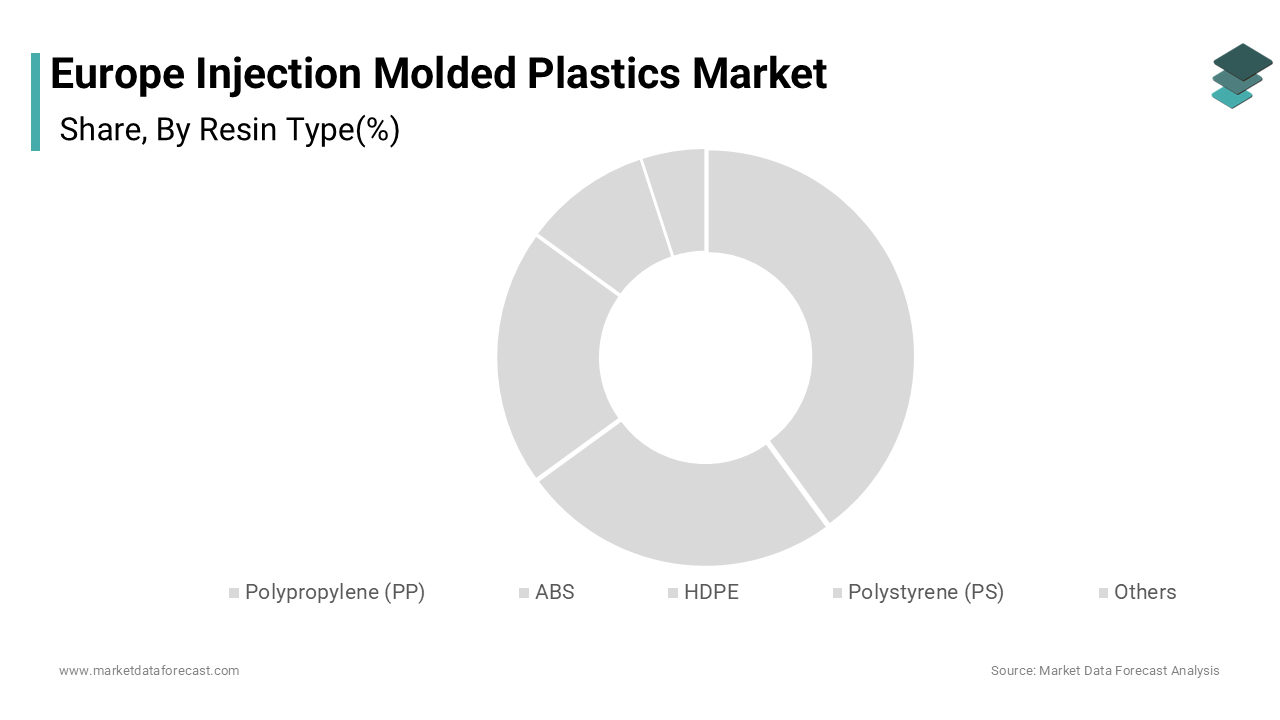
The acrylonitrile butadiene styrene (ABS) segment is on the rise and is expected to exhibit a CAGR of 7.07% over the forecast period. The growing demand for high-impact, dimensionally stable, and aesthetically refined components in electronics and EV infrastructure are propelling the expansion of the ABS segment in the European injection molded plastics market. According to the European Electronics Industry Association, 72% of small household appliances produced in the EU in 2024 featured ABS casings due to scratch resistance and paint adhesion. As per the European Battery Alliance, 89% of EV battery module brackets and busbar insulators in 2024 used flame-retardant ABS grades meeting UL94 V0 standards. The European Chemicals Agency approved 17 new bromine-free flame-retardant ABS formulations in 2024 to align with REACH restrictions. Fraunhofer Institute reported that ABS-based hybrid production reduced prototyping lead times by 40% in German pilot projects. This convergence of performance, compliance, and digital integration positions ABS as Europe’s most dynamic resin segment.
By Application Insights
The automotive segment led the market and occupied 30.9% of the regional market share in 2025. The dominance of automotive segment in this regional market is attributed to deep integration of engineered polymers into vehicle architecture for weight reduction, safety, and functionality. According to the European Commission, the 2030 target of 81 g CO₂/km necessitates lightweighting, with plastics replacing metals in non-structural applications. According to the European Automobile Manufacturers Association, plastics now constitute 16% of a vehicle’s total weight, up from 11% in 2015, with injection molding responsible for 74% of plastic part production. As per the International Council on Clean Transportation, EVs contain ~25 kg more plastic than combustion vehicles, primarily in battery systems and power electronics. The European New Car Assessment Programme requires impact-resistant molded parts in pedestrian protection zones. Automotive remains the cornerstone of Europe’s injection molding demand and is expected to sustain its leadership over the forecast period.
The medical segment is projected to grow at a CAGR of 8.84% over the forecast period owing to the aging demographics, demand for sterile devices, and EU Medical Device Regulation requirements. According to Eurostat, 21.3% of the EU population was aged 65+ in 2024, driving demand for syringes, IV connectors, diagnostic cartridges, and surgical housings. According to the European Medicines Agency, 42,000+ new medical device registrations in 2024 specifying injection molded components. EU MDR mandates full material disclosure and biocompatibility testing per ISO 10993 standards, which PP and cyclic olefin copolymers satisfy. The European Health Emergency Preparedness and Response Authority established strategic reserves of molded diagnostic components in 2024. With 28,000+ medical technology firms operating in Europe, the medical segment represents a resilient growth frontier.
REGIONAL ANALYSIS
Germany held the leading position in the European injection molded plastics market in 2025 by accounting for 24.2% of the regional market share. The leading position of Germany in the European market can be credited to its automotive industry, engineering culture, and advanced polymer processing infrastructure. According to PlasticsEurope Deutschland and VDMA, the German plastics industry employed 407,000 people in 2024 and generated €103.6 billion in turnover, with injection molding representing the largest share of processing. The Fraunhofer Society operates five polymer research institutes collaborating on lightweight composites and recycling. The German Federal Environment Agency (UBA) implemented the EU Packaging Regulation ahead of schedule, accelerating mono‑material PP and HDPE adoption. The German Chemical Industry Association (VCI) reported over 120,000 metric tons of pyrolysis‑based feedstock capacity in 2024. Germany is expected to maintain its dominance in high‑precision, high‑volume molding.
Italy occupied for a promising share of the European injection molded plastics market in 2025. The growth of Italy in the European market is attributed to the automotive supply chains, consumer goods, and industrial design. According to ISTAT, plastics and rubber manufacturing showed moderate growth in 2024, with industrial production of plastics rising 2.3% year‑on‑year in November 2024. Italy’s Ministry of Economic Development launched the “Plastica Circolare” initiative funding SMEs to adopt recycled content. Politecnico di Milano continues to graduate over 1,200 product designers annually, supporting innovation in molding. Italy is expected to sustain its strong mid‑ to high‑end market position.
France is predicted to account for a substantial share of the European injection molded plastics market over the forecast period owing to the aerospace, medical technology, and circular economy initiatives. According to the French Ministry of Economy, plastics processing employed 142,000 people in 2024 and invested heavily in green transition technologies. The French Agency for Ecological Transition (ADEME) reported that 41% of molders use over 30% recycled content in non‑food applications following the Anti‑Waste Law. The CT‑IPC confirmed injection molding’s role in aerospace interiors, while the National Agency for Medicines (ANSM) certified 94 molding facilities for ISO 13485 compliance in 2024. France is expected to remain a diversified and resilient market aligned with sustainability and high‑tech sectors.
The United Kingdom is projected to witness a prominent CAGR in the European injection molded plastics market over the forecast period. The growth of the UK in the European market can be credited to the medical devices, electronics, and advanced research. According to the UK Department for Business & Trade, plastics exports contributed significantly to trade, with molded goods forming part of the £6.2 billion plastics export value in 2024. The MHRA approved new injection molded medical devices in 2024, supporting innovation in healthcare. The High Value Manufacturing Catapult invested in digital twin technology for molding optimization. The UK is expected to remain a niche player in regulated, high‑value applications.
Spain is anticipated to account for a notable share of the European injection molded plastics market over the forecast period owing to the automotive electrification and suburban expansion. According to INE (National Statistics Institute), plastics and rubber manufacturing revenue reached €81.8 billion in 2024, reflecting steady growth. The Spanish Ministry of Industry reported strong expansion in plastics processing, with injection molding output contributing significantly to EV supply chains. The Spanish Automotive Cluster confirmed EV production doubled between 2022 and 2024, boosting demand for molded components. Spain is expected to remain a high‑growth corridor for injection molded plastics in Southern Europe.
COMPETITIVE LANDSCAPE
Competition in the Europe injection molded plastics market is characterized by intense technical differentiation regulatory responsiveness and strategic alignment with sustainability mandates among global material producers and specialized compounders. The market features a dual structure where large integrated players dominate high volume commodity resins while niche suppliers excel in engineered formulations for medical automotive and electronics applications. Regulatory complexity particularly under REACH EU MDR and evolving extended producer responsibility schemes creates significant barriers favoring incumbents with robust compliance infrastructures. Innovation increasingly centers on circular feedstocks with companies competing on the quality and certification of recycled content rather than price alone. Digital capabilities such as real time process analytics material traceability and predictive maintenance are emerging as key differentiators. Meanwhile rising energy costs and skilled labor shortages disproportionately impact small and medium molders intensifying consolidation. The competitive landscape thus rewards those who combine material science excellence regulatory foresight digital integration and collaborative customer engagement across Europe’s advanced manufacturing ecosystem.
KEY MARKET PLAYERS
Some of the companies that are playing a dominating role in the Europe Injection Molded Plastics Market include
- BASF SE
- SABIC
- LyondellBasell Industries N.V.
- Covestro AG
- Dow Chemical Company
- INEOS Group
- Borealis AG
- Lanxess A
- PolyOne Corporation (now Avient Corporation)
- Trinseo S.A.
- Ensinger GmbH
- Röchling Group
- Plastipak Holdings, Inc
- Berry Global Group, Inc
- Mold-Masters
Top Players in the Europe Injection Molded Plastics Market
Borealis AG
Borealis AG is a leading European provider of polyolefins and innovative plastic solutions with a strong footprint in the injection molded plastics market. Headquartered in Austria the company supplies advanced polypropylene and polyethylene compounds tailored for automotive medical and consumer applications across Europe and globally. Borealis contributes significantly to circular economy initiatives through its Borcycle chemical recycling technology which produces high quality recycled feedstocks. In 2024 the company expanded its collaboration with automotive OEMs to develop lightweight low carbon PP compounds for EV battery components. It also launched a digital material passport platform enabling traceability from resin to molded part aligning with EU sustainability regulations and reinforcing its role as a solutions oriented material innovator.
SABIC
SABIC maintains a prominent position in the Europe injection molded plastics market through its portfolio of high performance thermoplastics including ABS polycarbonate and polypropylene engineered for precision and durability. The Saudi headquartered global materials leader operates multiple compounding and innovation centers across Europe serving automotive electronics and healthcare sectors. In 2024 SABIC intensified its focus on circularity by scaling production of certified circular polymers derived from chemical recycling for use in injection molded medical and consumer electronics components. It also partnered with major European molders to validate processing parameters for recycled content resins ensuring consistent part quality. These actions strengthen its value proposition beyond raw materials to include technical support and sustainability compliance.
LyondellBasell Industries Holdings B V
LyondellBasell is a key player in the Europe injection molded plastics market offering a wide range of polyolefins and specialty compounds used in packaging automotive and building applications. The company leverages its integrated production network and Catalyst technologies to deliver resins with enhanced flow properties and impact resistance ideal for complex molded parts. In late 2024 LyondellBasell expanded its CirculenRecover portfolio in Europe providing mechanically recycled polypropylene and polyethylene grades certified for food contact and medical use. It also launched a co creation program with European tier one automotive suppliers to develop lightweight monomaterial solutions that simplify end of life recycling. These initiatives reflect a strategic shift toward performance driven circularity and deep customer collaboration.
Top Strategies Used by the Key Market Participants
Key players in the Europe injection molded plastics market pursue integrated strategies centered on material innovation circularity compliance and digital enablement. Companies are accelerating the development of chemically and mechanically recycled resins that meet stringent performance standards for automotive and medical use. Strategic co creation with OEMs enables early involvement in part design ensuring optimal material selection and process efficiency. Sustainability is operationalized through material passports carbon footprint labeling and alignment with EU regulations such as REACH and the Packaging and Packaging Waste Directive. Investment in digital tools including mold flow simulation AI based process optimization and digital twin technology enhances precision and reduces waste. Geographic expansion focuses on localized compounding hubs to shorten supply chains and respond rapidly to regional demand shifts. These multifaceted approaches position leading suppliers as essential partners in Europe’s transition to high performance circular manufacturing.
MARKET SEGMENTATION
This research report on the europe injection molded plastics market has been segmented and sub–segmented into the following categories.
By Resin Type
- Polypropylene (PP)
- ABS
- HDPE
- Polystyrene (PS)
- Others
By Application
- Automotive
- Packaging
- Building & Construction
- Electrical & Electronics
- Medical
- Others
By Country
- UK
- France
- Spain
- Germany
- Italy
- Russia
- Sweden
- Denmark
- Switzerland
- Netherlands
- Turkey
- Czech Republic
- Rest of Europe